The mortgage broker website framework should be understood as two systems operating at once. On the surface, the architecture of the website tells the story of the business through a compliant public-facing infrastructure that forms the basis of a coherent framework. The page and content architecture gives your website depth, credibility, search value, education value, and commercial clarity. It makes the broker look serious, established, useful, and authoritative. But the visible page structure is only the first layer. The real power is not simply that the website contains more pages, more tools, more data, and more resources than a conventional or pedestrian broker website. The power is that those assets are connected to a broader cognitive and conditional funnel-centric conversion system.
The framework becomes materially different because the website is directly integrated with funnel-focused tools and functionality. This means the website does not merely present information - it responds to interaction. A user who enters through a refinance page, completes a comparison form, watches a video, downloads a guide, clicks a rate, books a meeting, or returns to a property page should not be treated as anonymous traffic. Their behaviour should shape what happens next.
Detailing how and why our website framework is the only industry funnel tool of its kind is difficult to express in a conventional website article because the scope of the functionality is so significant: the website is conditional. It is not one fixed experience served equally to every visitor. It is an adaptive marketing environment that can change content, suppress irrelevant forms, escalate calls to action, redirect users based on behaviour, trigger email and SMS pathways, assign lists, present the right calendar opportunity, and move users through education based on their demonstrated intent or resolved borrowing objective. The architecture tells one story, but the conditional framework decides which part of that story matters most to the person in front of it. That is the distinction between a broker website and the Belief framework. A normal website waits to be read. This framework listens, interprets, educates, redirects, escalates, and converts. It is not simply a website with marketing features attached; it is a website built as the operating system for the broker’s entire digital funnel.
Website Requirements and Delivery Time: Part of our method is designed around ownership, so you own the assets we create for you. Part of this process includes the creation of a Microsoft Azure application in your company name. Should you choose to not use Yabber in the future, the application exists to support your continued integration. To this end, each of our clients requires a Microsoft 365 Business email account. The application supports a range of features including Nexus - our full-featured email marketing system. An SMS Application is created with Telstra for SMS services, and Yabber provides the gatway. Charges for SMS messages are billed directly to you - this enables us to keep costs very low. The website is delivered around 3-10 days after the MS365 account is created. Two sessions are required to set up the required features before the website is made live.
Website SEO: SEO is the oxygen of the mortgage broker website framework because even the most sophisticated conversion architecture is commercially useless if nobody visits. A website needs traffic before it can educate, segment, trigger, convert, or escalate, but search visibility is not created by design alone; it is created by technical structure, content depth, page relevance, internal linking, schema, speed, crawlability, engagement, and authority. Yabber provides the SEO architecture required to support this outcome, ensuring pages are properly represented, connected, indexed, structured, and positioned within a broader website ecosystem rather than existing as isolated service pages. The website is designed to attract and retain users through deep content libraries, borrowing pages, FAQs, insights, lender data, calculators, property resources, location assets, and conditional conversion pathways, but those assets must also generate engagement because Google’s understanding of authority is increasingly tied to usefulness, relevance, and behavioural value. In simple terms, traffic feeds the website, engagement feeds authority, and architecture feeds visibility. Without SEO, the website has no audience; without engagement, it has no authority; without architecture, its pages are not properly understood; and without users, even the most powerful broker website framework cannot perform its intended function. Paying somebody for 'SEO Services' is now a ridiculous proposition - SEO is determined (by Google and others) based on four attributes they readily publish: Expertise, Experience, Authoritativeness, and Trust - something a service rarely provides. We include a full session in our Broker Growth Workshop on SEO.
The website is designed specifically for conversions, not merely presentation. Landing pages may be created directly in just a few minutes by the user when a campaign, audience, offer, or partner pathway requires something new, but the framework already includes dozens of professionally structured pages ready to go, each created around proven advertising, conversion, and funnel principles. These pages are not generic templates; they include relevant forms, page assets, conditional pathways, supporting content, trust signals, and conversion architecture designed to produce stronger results from paid, organic, social, partner, and database-driven campaigns. This matters because advertising should not be surrendered entirely to agencies, platforms, or third-party tools that rarely understand the full broker journey. Businesses should take control of their advertising, understand the psychology and mechanics of offer creation, and know how to match campaign intent with the correct landing page, form, follow-up, and escalation pathway. Our Broker Growth Workshop exists for this reason: it gives brokers the practical knowledge required to promote their own business with far more confidence, discipline, and commercial intelligence, and to use the website framework in a way that returns industry-leading results.
The vast majority of websites don't perform the task that they're meant to perform, and those brokers that advertise are often led into the technical-debt world of High Level or Calendly. The entire broker digital environment is usually provided in a way that supports failure. Our framework changes this.
Your website experience will perform better than your competition and you'll have the tools necessary for a compelling funnel-centric experience. Your marketing will be more agile, your advertising will be more compelling and effective, and your options for growth will be more significant.
The Definitive Guide to Finance Marketing: There's a link to our Finance Marketing Guide at the bottom of this page. Written over just a couple of days, the 650-page guide wasn't to a standard that we wanted, and we've just had the time to update it to a newer and more up-to-date version. Nothing will send until the 13th July (when it's published), so until that time, it becomes a wait-list. It introduces a large number of concepts that support your efforts. For those looking to advertise it'll show you how to create your first ad.
Funnel Focused Integration: Don't use third-party services in your funnel. High Level, Calendly, Lead Pages, and other services are not a solution for a scalable business, and they'll never perform as well as an integrated solution. The services negate scale, performance, and conditional features. This is not opinion - it is objective fact. Professional services that utilise these services are normally doing so for their ongoing affiliate payments - not because it best suits your business commercial outcomes.
At its core, the website is merely a website. More powerful than other options in the market by a significant margin, what you do with it is determined by what you want to achieve from your operation.
For those that advertise, our framework - paired with our advertising architecture - will explode your conversions.
Foundational Principles
In reading this article, we're not able to properly articulate the full scope of advantages offered by way of our services, but the following (limited) Foundational Principles should be understood.
E+AT and the Magic Lantern: E+AT is part of our Magic Lantern Model that underpins most of our digital behaviour. Our consumer-facing material should focus on Expertise, Experience, Education, Entertainment, Authoritativeness, and Trust, with a significant emphasis on Education.
Every Page is a Landing Page: Every Page is a Landing Page. Traffic comes from anywhere for any reason, so every page on our website is essentially a a landing page that requires a conversion mechanism. Every page should present value, a calendar-integrated form, and conditional behaviour. The reason your website doesn't convert is because it lacks the necessary purpose and supporting infrastructure.
Digital Qualifies Us - Not The Borrower: One of the biggest mistakes a broker makes - normally integrated with a form on a landing page - is to have the user jump through a number of questions to 'qualify them' when it has a counter effect: it disqualifies you. Nothing should be asked of a consumer unless it returns direct value and provides a digital purpose. Our comparison forms are introduced in a moment, and they're part of the reason our advertising experience significantly outperforms others.
Conditional Content is Relevance: A key funnel commodity is relevance, and relevance is determined by interest, and interest is serviced by presenting information to a user that they're most likely interested in seeing. As we'll detail shortly - and as a single example of conditional content - your website includes a large number of front pages, and while each may be assigned as a front page, a page is automatically assigned when a user submits a form of a certain type. Website pathways and content must support E+AT - and the front page aligned with the interests of a user has a profound impact.
Escalation of Commitment: Escalation of commitment is the process of moving a user from a small, low-risk action to a larger, higher-value action through a sequence of logical, relevant steps. A visitor might first read an article, then click a related FAQ, then download a guide, then complete a form, then view results, then book a call, then become a client. The critical question at every stage is “what comes next?” because every interaction should create a clear, useful, and psychologically natural next step. Without that next step, attention dies. With it, the website becomes a guided pathway that progressively builds understanding, confidence, trust, and action. The escalation is heavily applied in the subscription (top of) funnel.
You don’t win on the Autobahn in a Ford Fiesta. Digital performance is determined by the calibre of the tools, systems, and architecture behind the business. I’ll show you - in small part - why our brokers consistently achieve stronger results than those relying on ordinary marketing infrastructure and pedestrian websites.
Broker Growth Workshop
With the exception of our anaged clients, we've never charged a broker to create an Advert. Not ever. That's despite our better results, better technology, and superior expert support. Our Broker Growth Workshop - a product we'll be promoting more aggressively in the future - is detailed in an article titled "The Mortgage Broker Growth Webinar Program".
The workshop introduces all our programs - not just advertising strategies. For more information, join our public Facebook Group  or download our Finance Marketing Guide.
[link]. The link shortcode applies to around 30 assets - including modals, videos, and downloads.The Mortgage Broker Website Framework
This section will introduce the primary internal page architecture. The scope of website framework is significant and was designed around one core purpose: conversions. Since the site is seriously focused on converting business and inintegrating seamlessly with paid promotion, some pages aren't available via standard navigation and are instead relegated into regions that are more commonly accessed via funnel follow-up, and this was done in order to focus attention onto primary conversion assets.
What Does the Website Look Like?
Asking what the site looks like is an entirely valid question, but it's quite difficult to answer. The website itself is buit with a licenced version of Elementor, so the site can look however you want it look. The front page is usually the page that is altered first, and others are merely modified. In fact, it's possibly to emulate virtually any website ever built, and the time to do so is often just minutes.
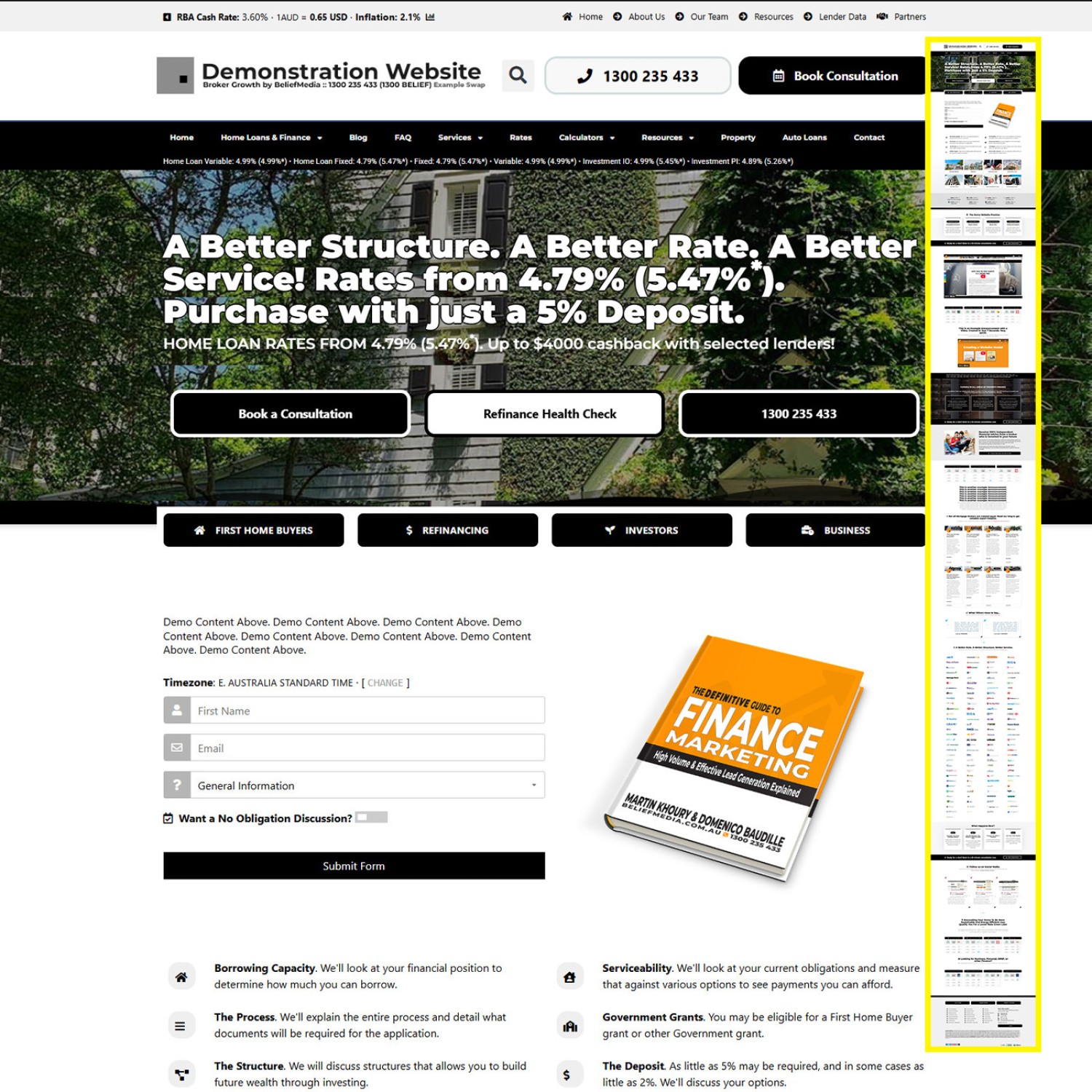
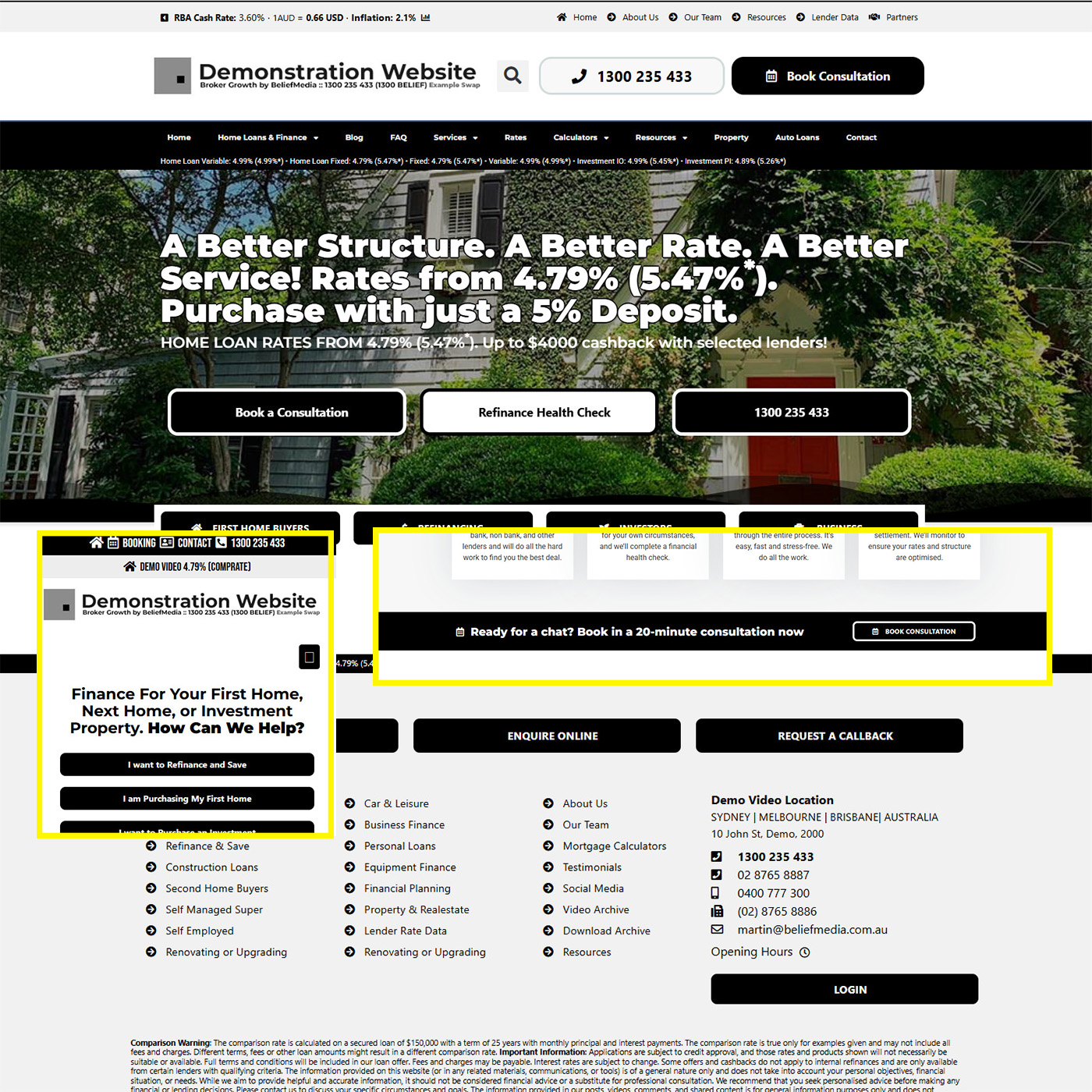
Framework Front Page: Asking what the site looks like is an entirely valid question, but it's quite difficult to answer. The website itself is built with a licenced version of Elementor, so the site can look however you want it to. The front page is usually the page that is altered first, and others are merely modified. In fact, it's possibly to emulate virtually any website ever built, and the time to do so is often just minutes.
The website is delivered as a 'framework', and the images on this page tend to illustrate the scope of that framework, but modifications, updates, or alterations, are all very easy to accomplish - with most updates managed entirely within Yabber. We don't want you mesing around with messy page code.
The Front Page
The front page of a mortgage broker website is not a digital welcome mat. It is the primary positioning asset, the first major trust event, and the central control point for the user’s journey. Most broker websites treat the front page as a static brochure: a banner, a few generic promises, a lender-panel statement, a contact button, and some vague copy about service. Our framework treats the front page as a dynamic conversion environment. It introduces the broker’s authority, presents clear pathways for the major borrower groups, surfaces relevant tools and resources, and gives every visitor an immediate reason to take the next step. The objective is not simply to describe the business. The objective is to orient the borrower, reduce uncertainty, establish credibility, and move the user into the most appropriate funnel pathway.
The power of the framework is that the front page is not necessarily the same page for every visitor. Based on traffic source, prior behaviour, campaign interaction, form submission, known interest, or inferred borrowing objective, the website can change what is shown and prioritised. A user who has engaged with nurse-specific content may see a nurse-relevant experience. A first-home buyer may be directed toward pre-approval resources, deposit education, LMI guidance, and first-home-buyer forms. A refinancer may see repayment review tools, lender comparison material, fixed-rate-expiry prompts, or a calendar-integrated review pathway. This is not decoration or basic personalisation. It is choice architecture in action: the website reduces irrelevant options and brings forward the content, tools, and conversion assets most likely to help that specific visitor continue.
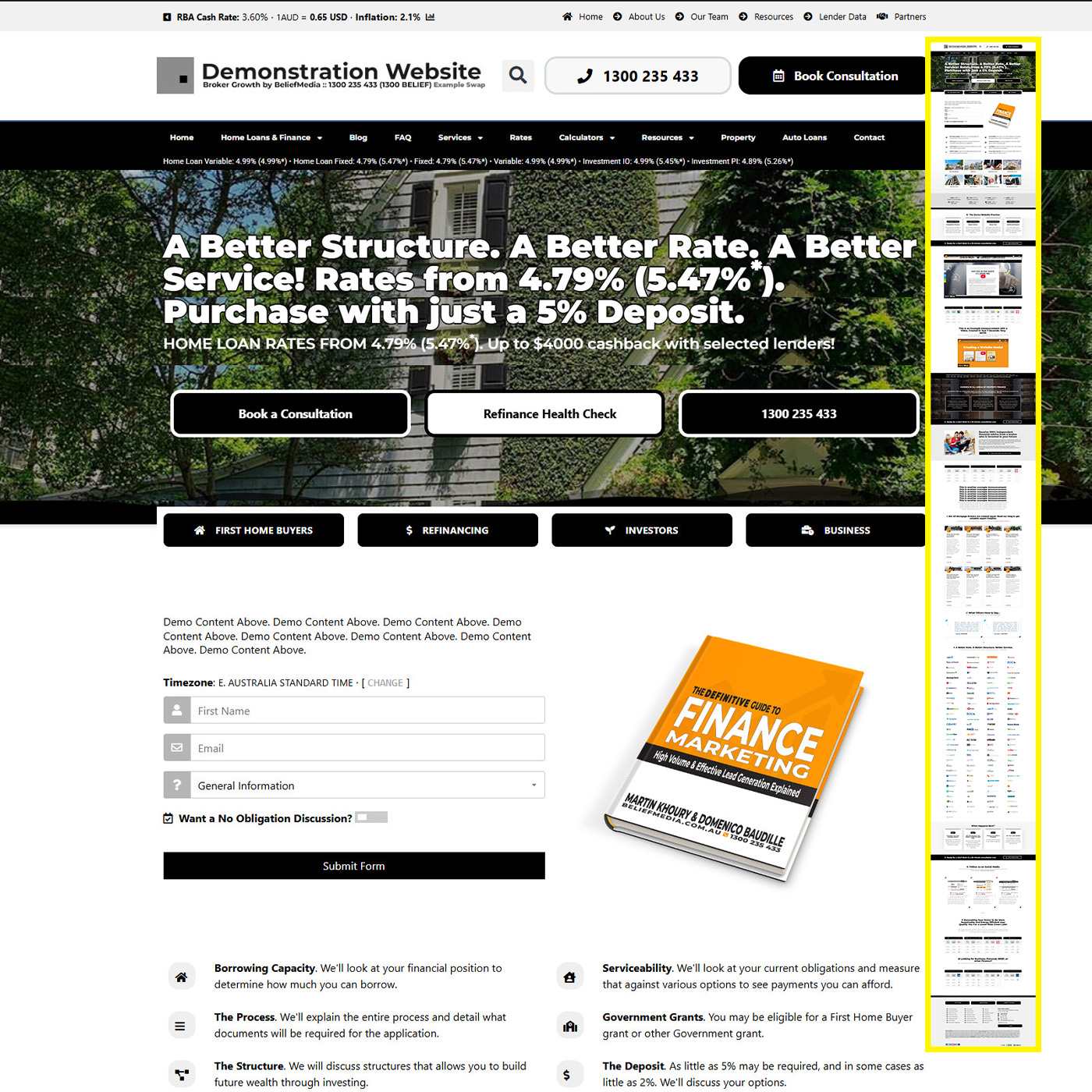

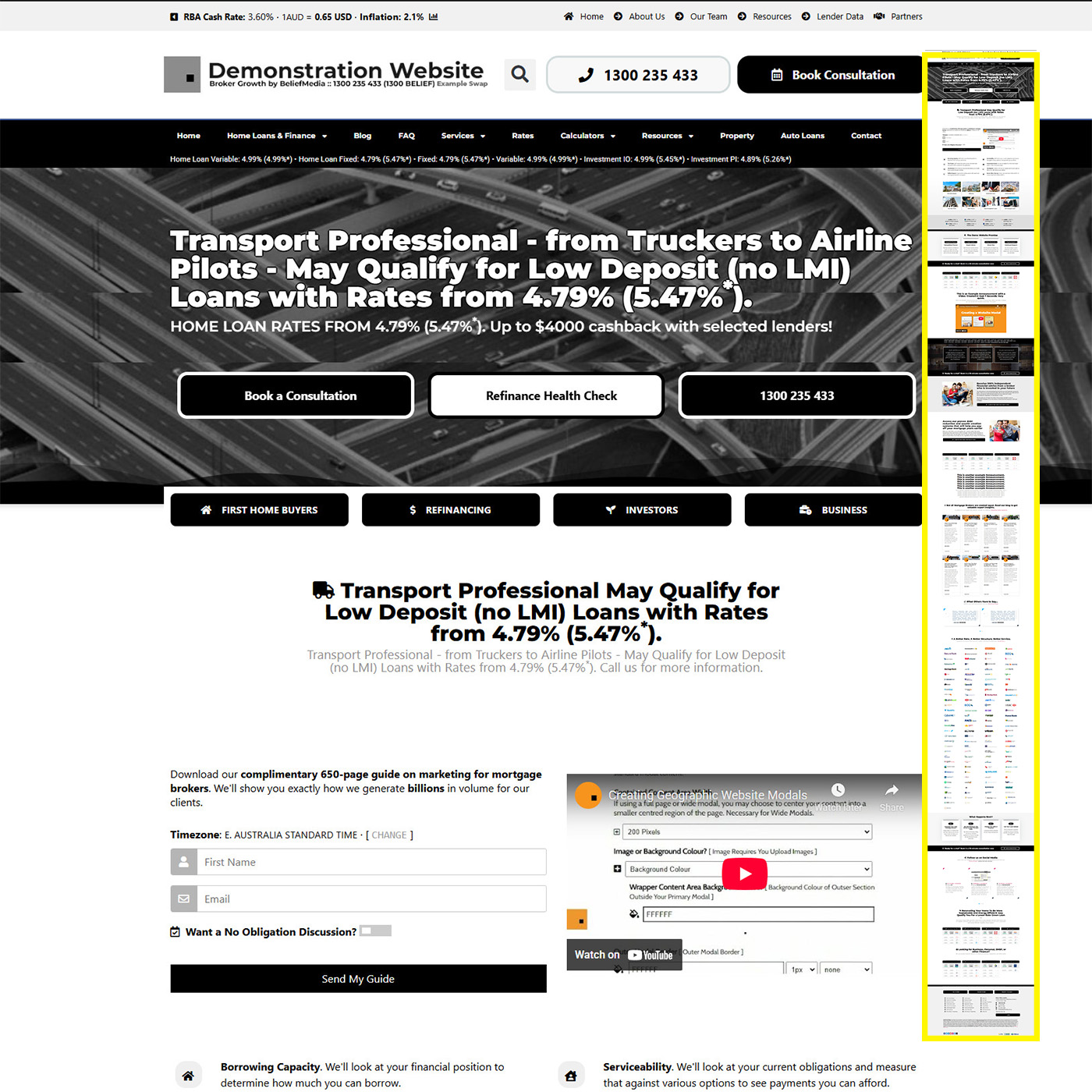
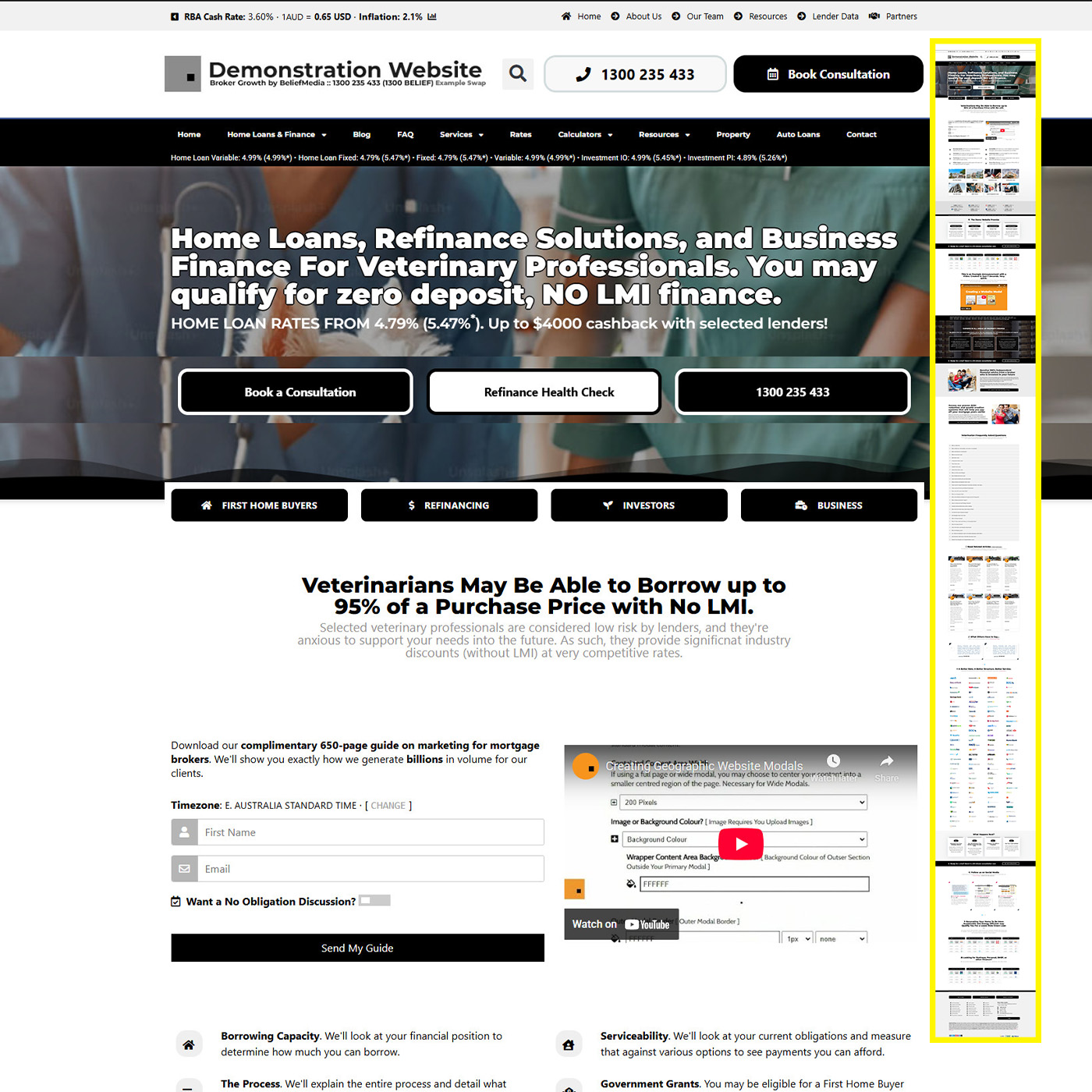
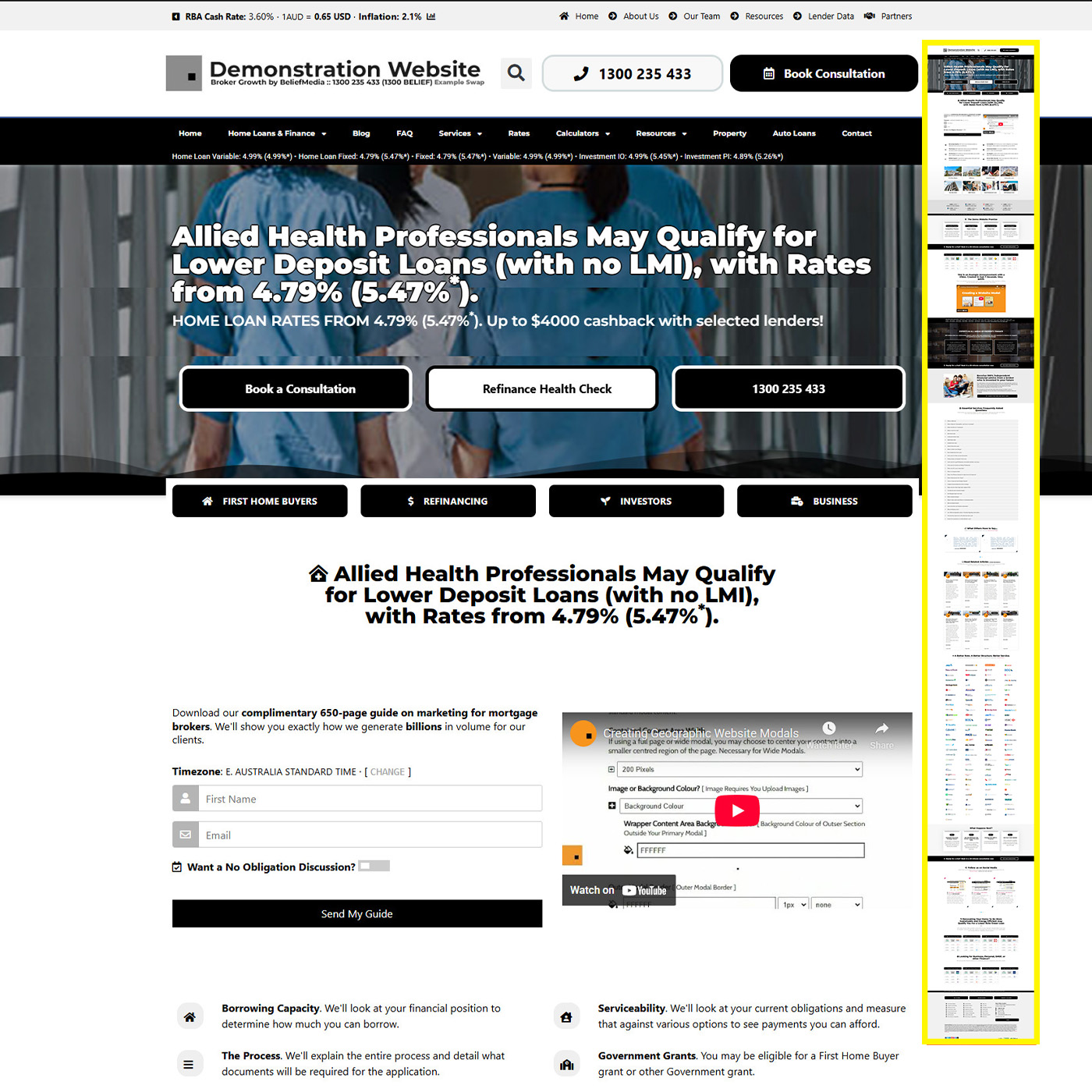
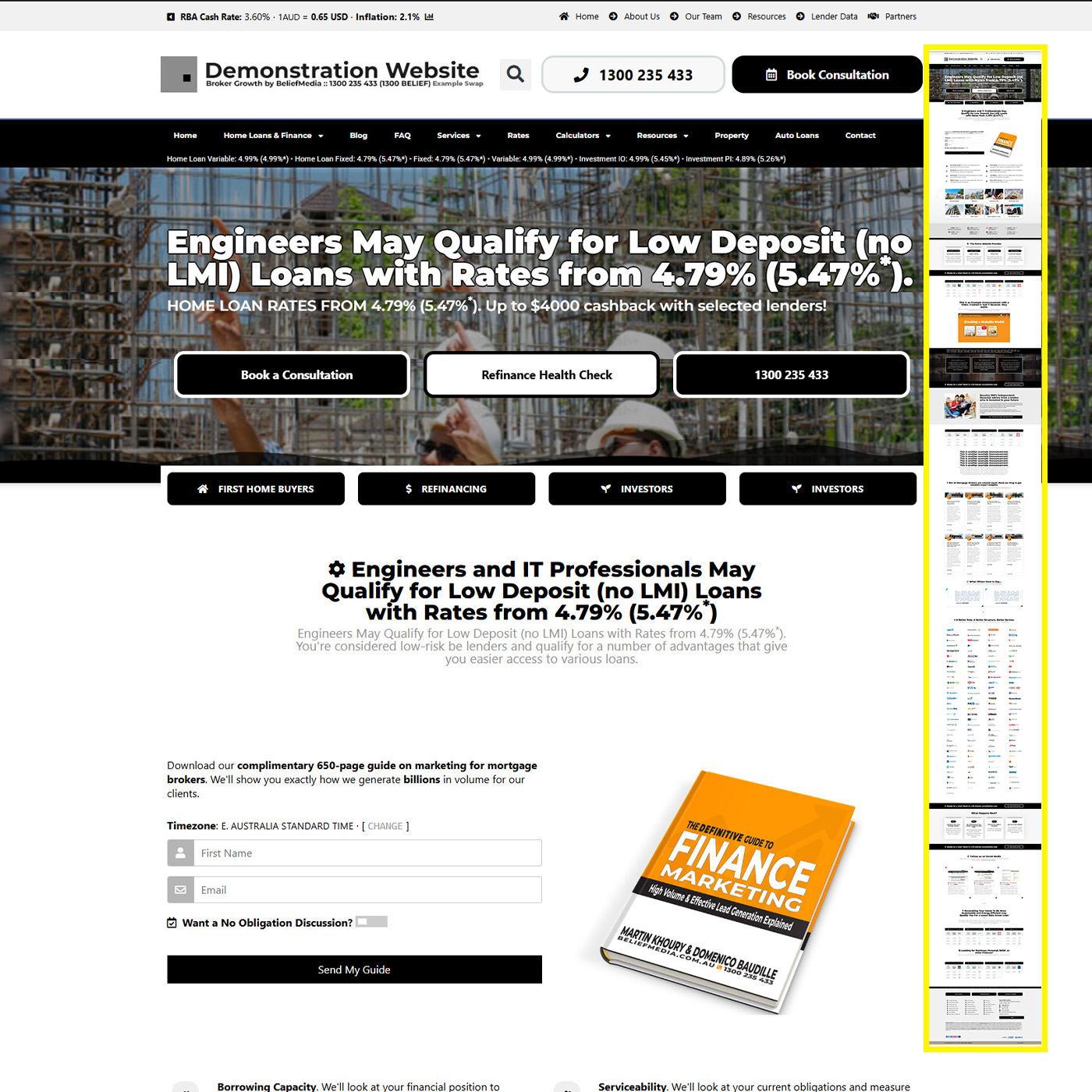
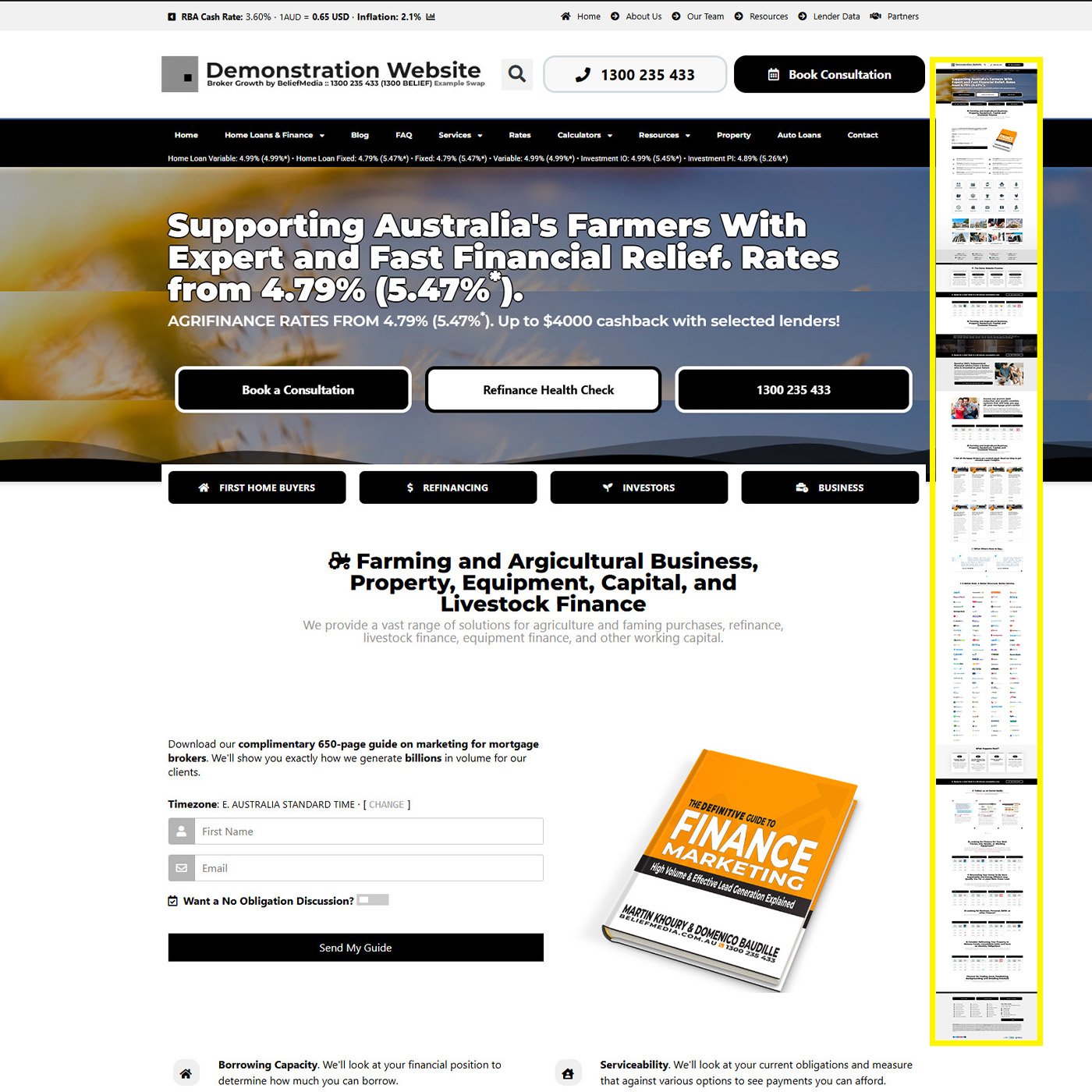
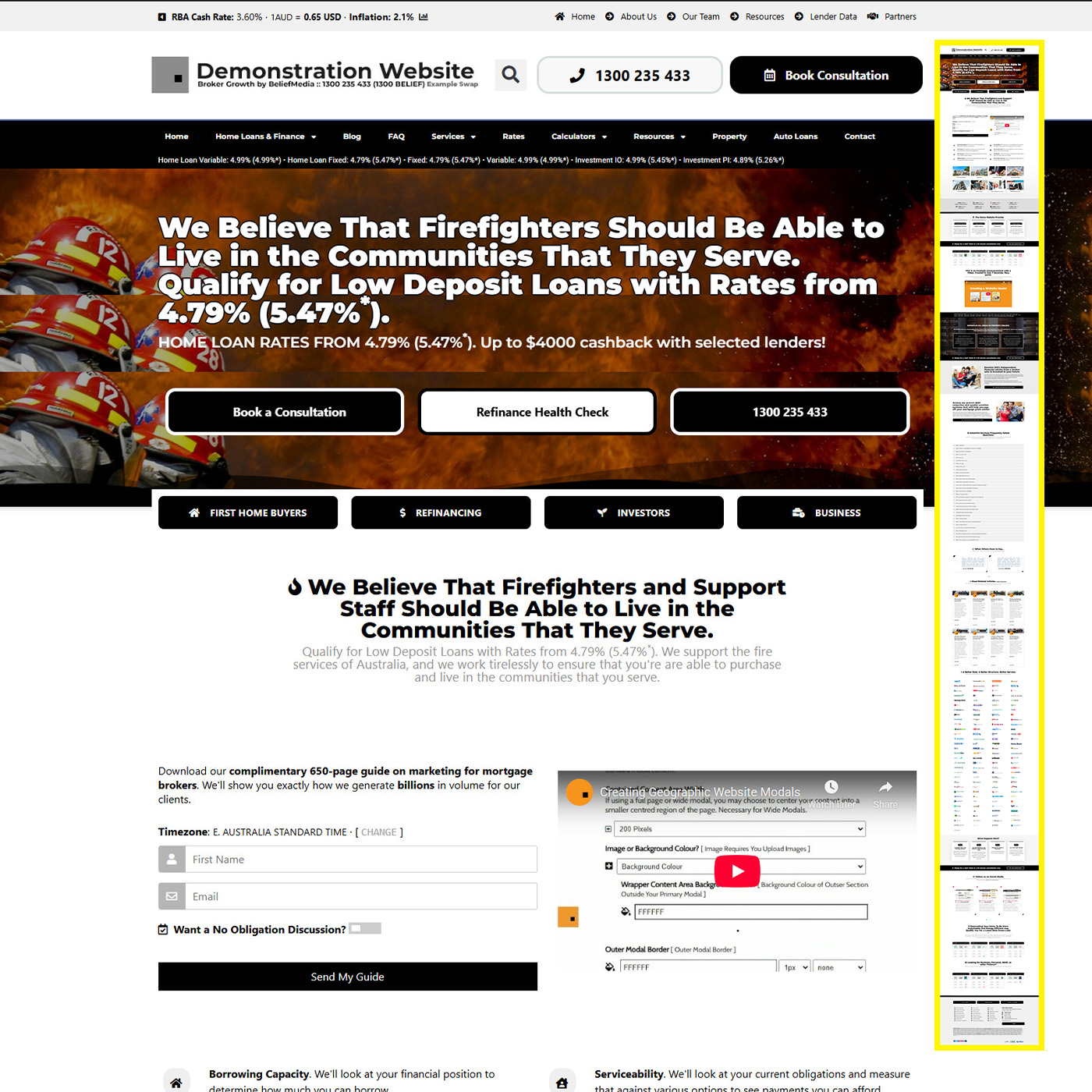
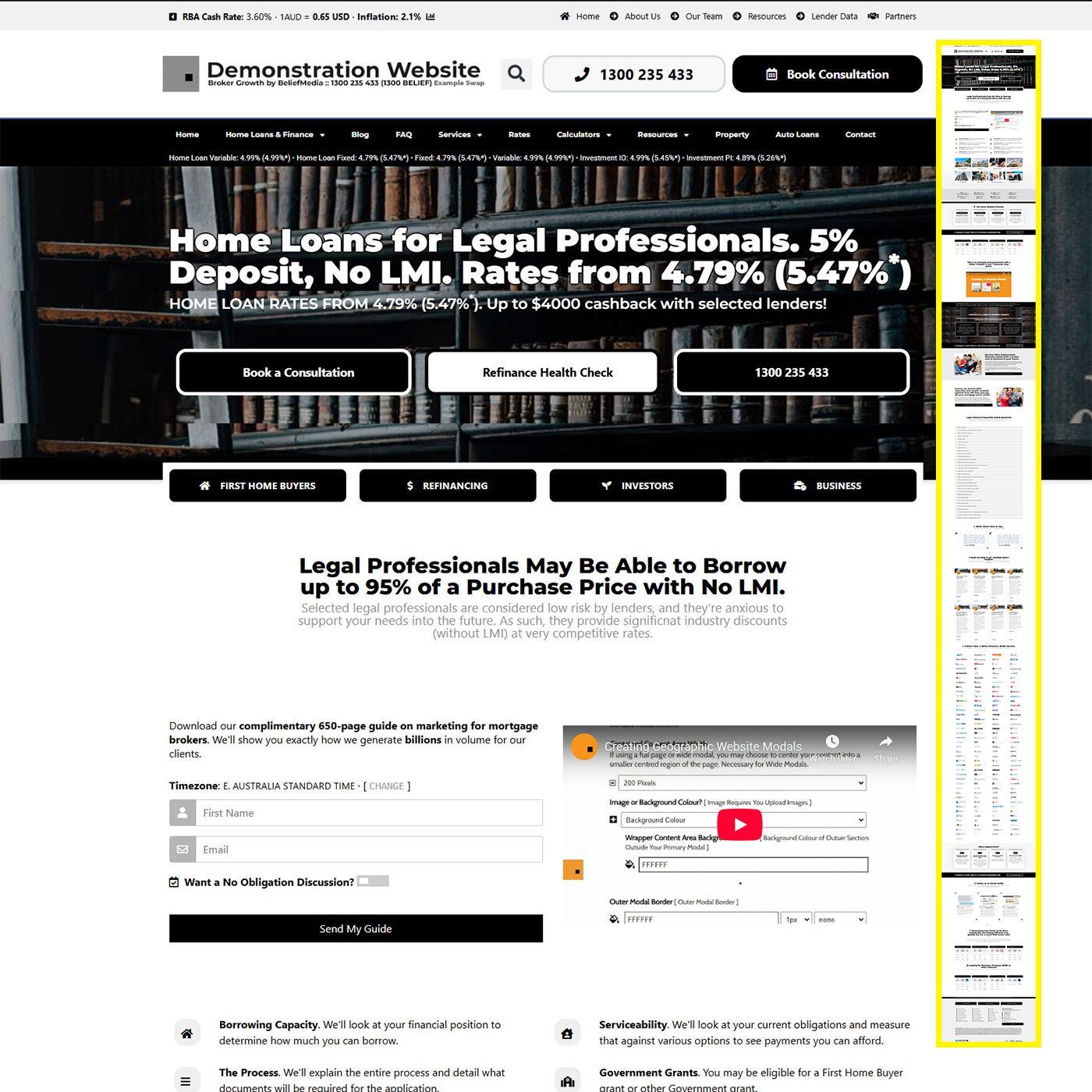
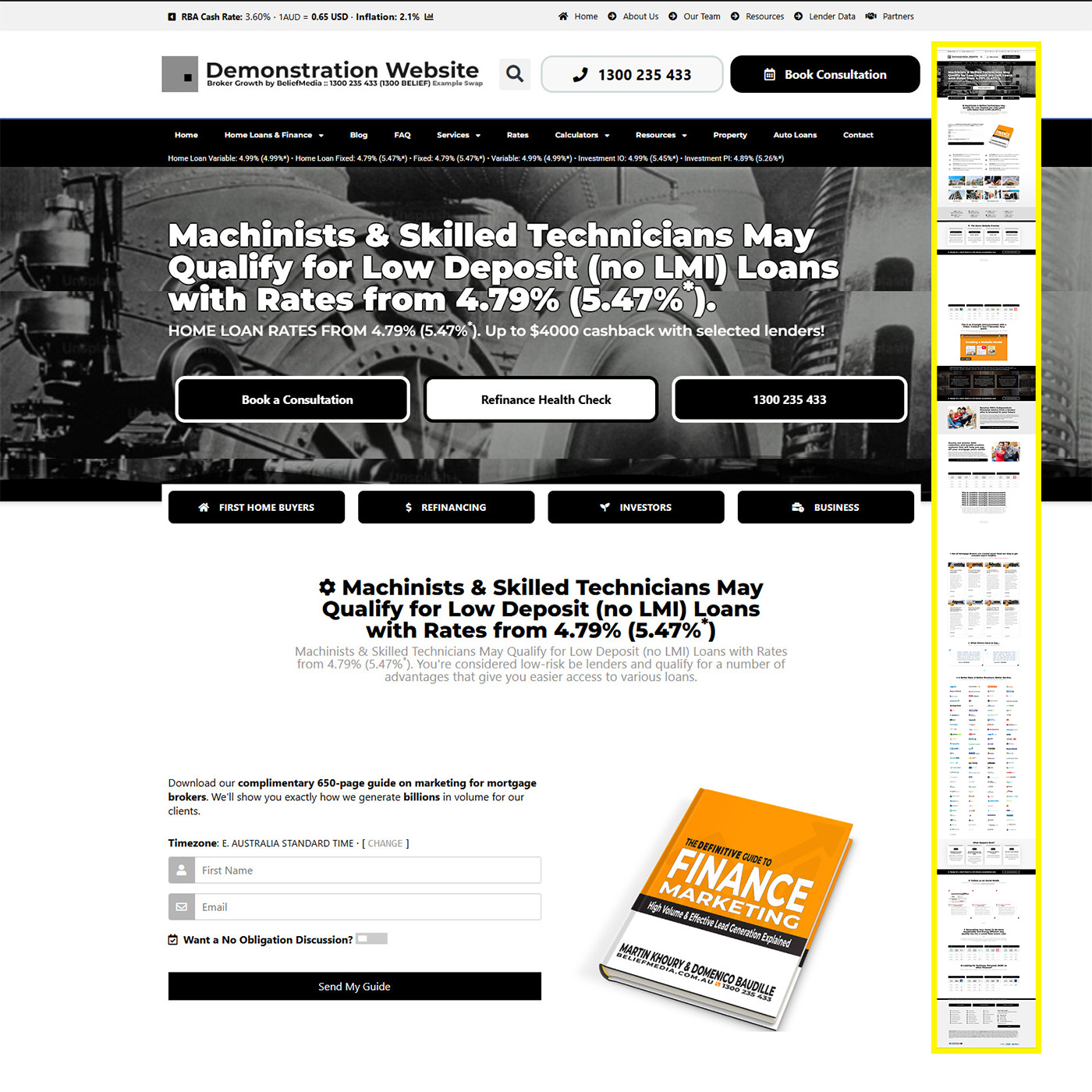
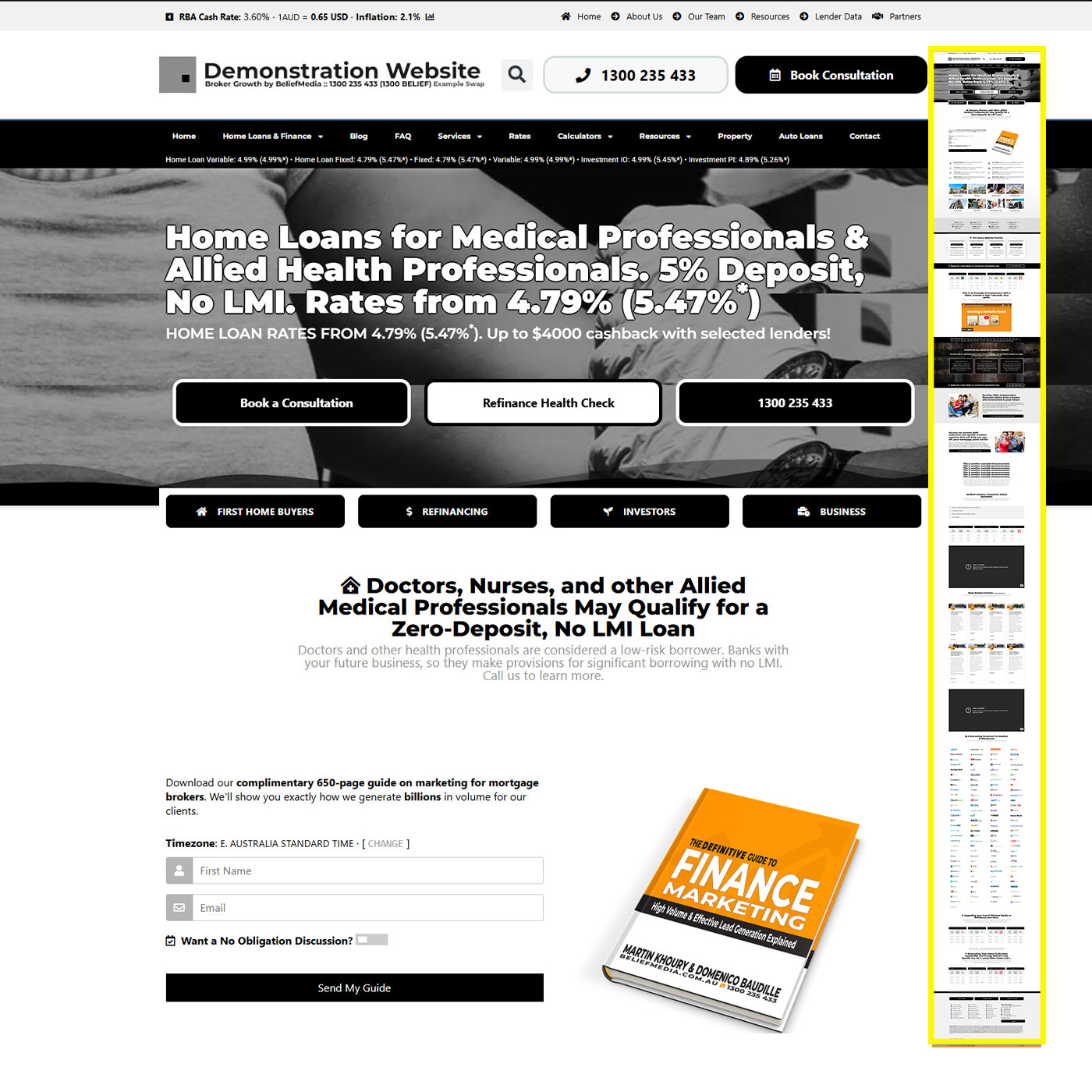
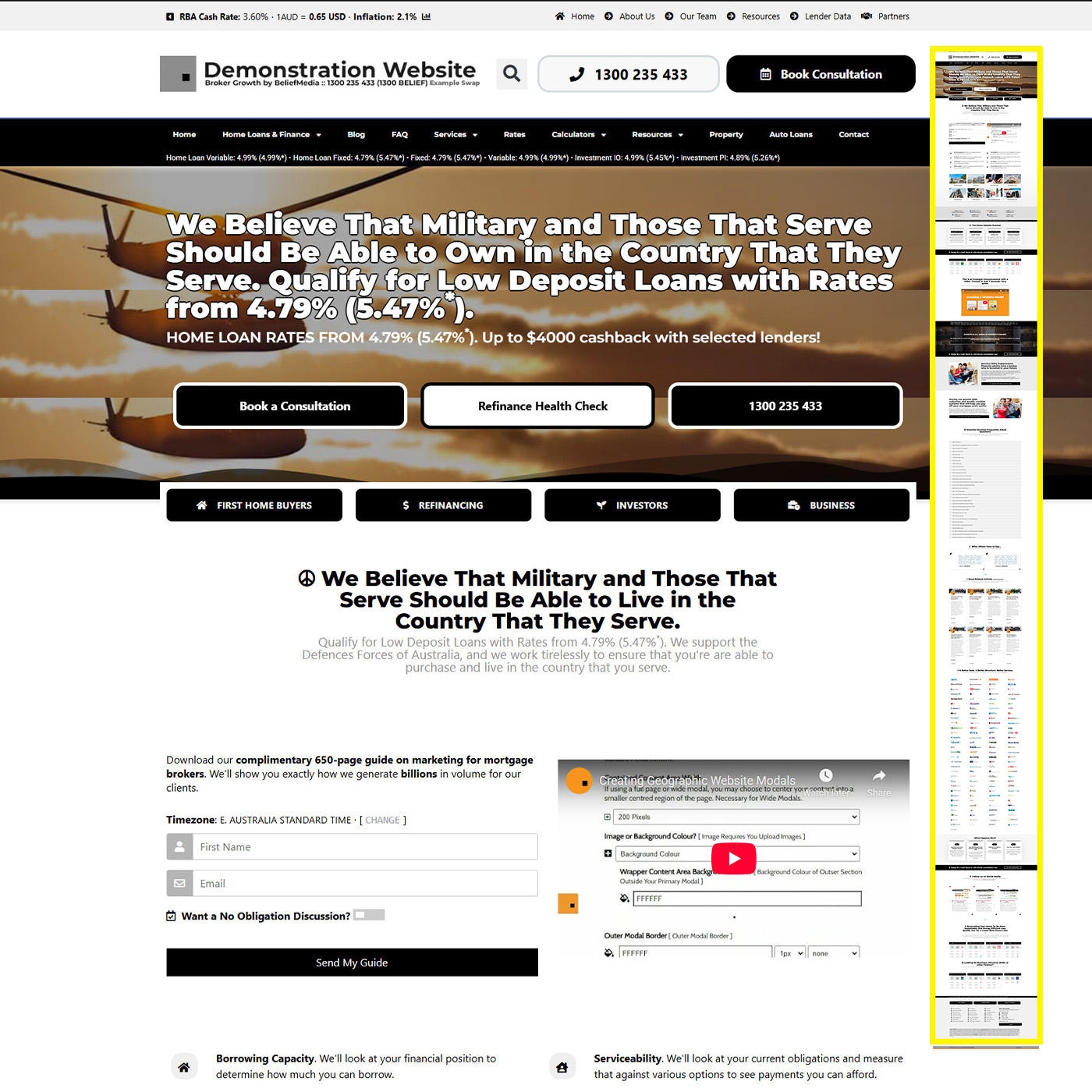
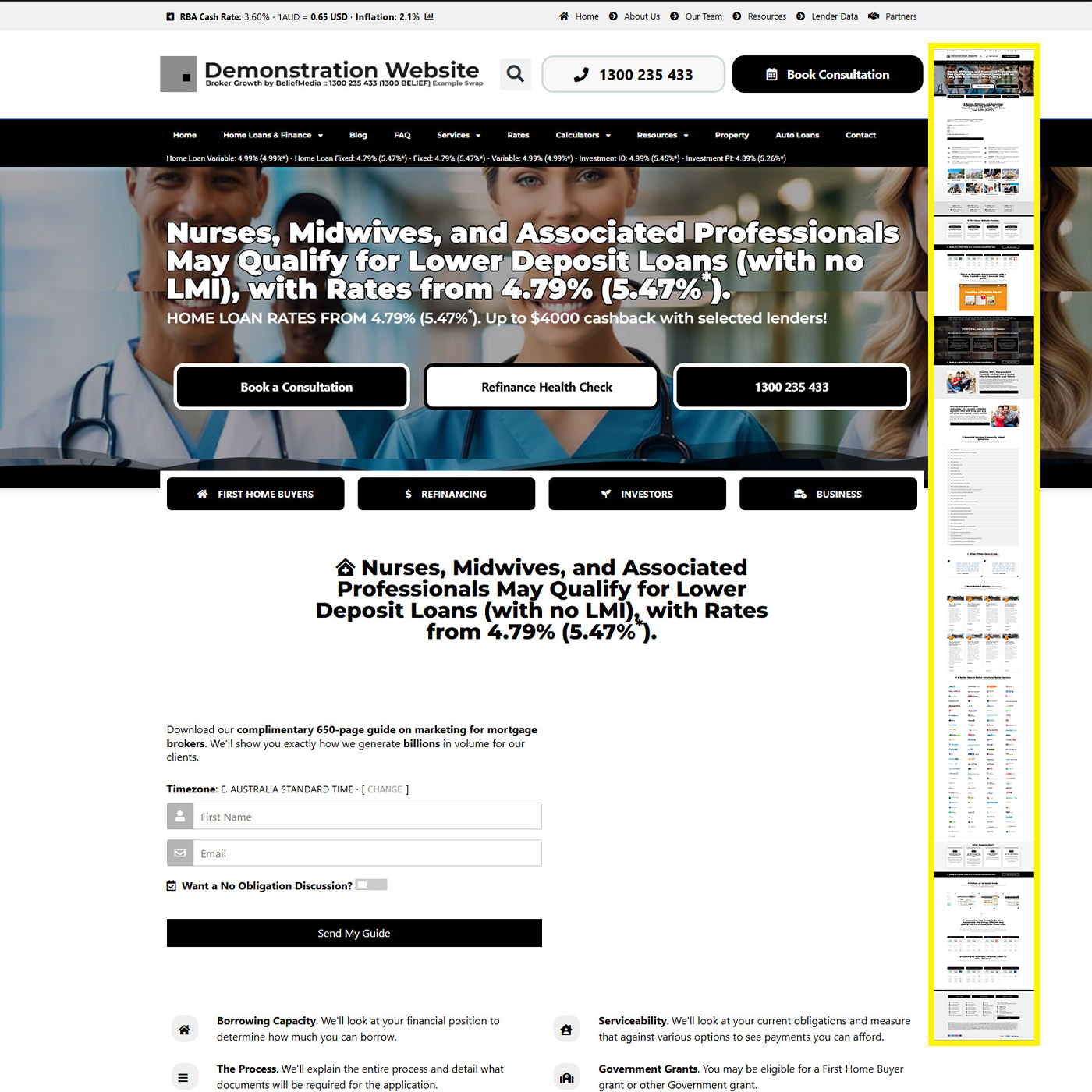
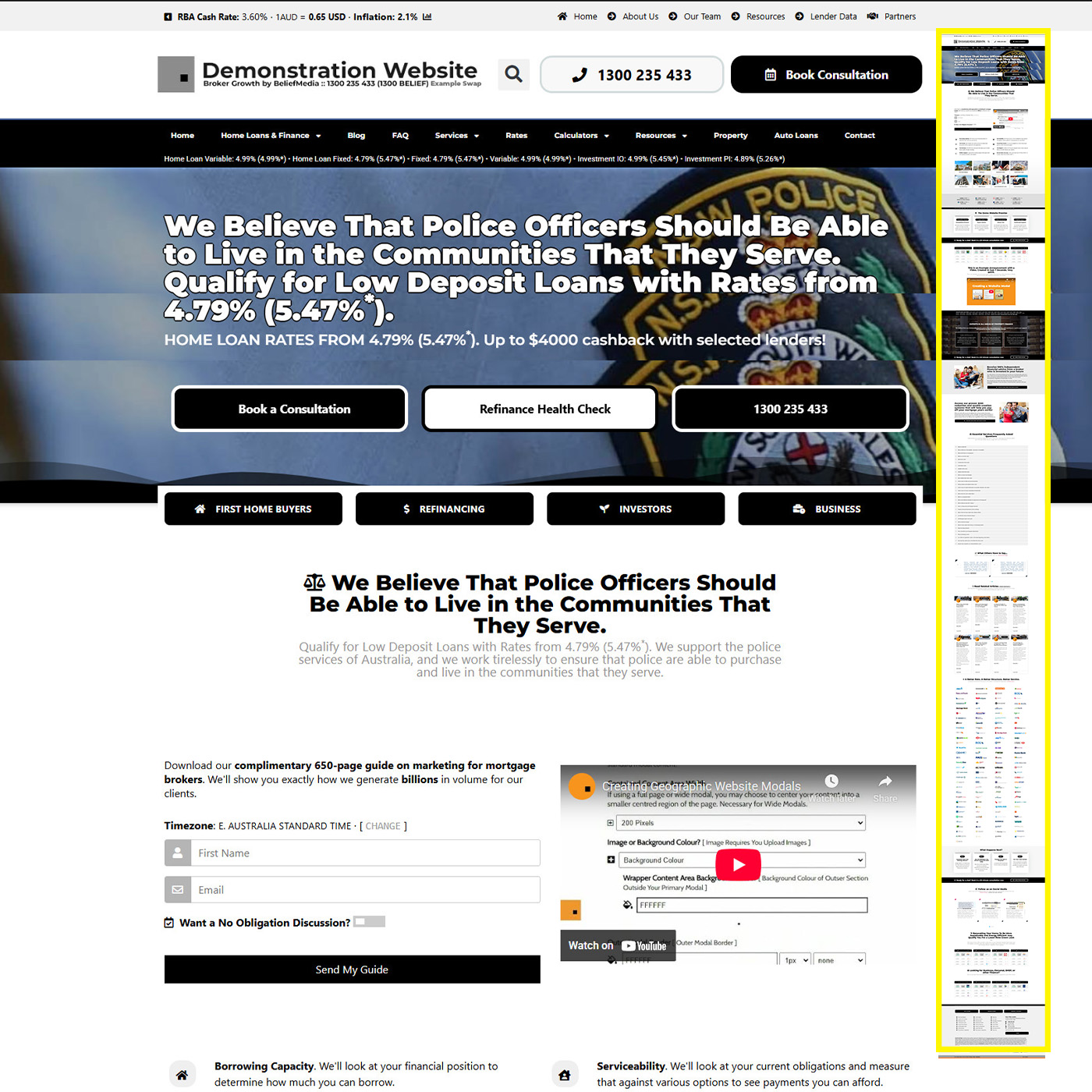
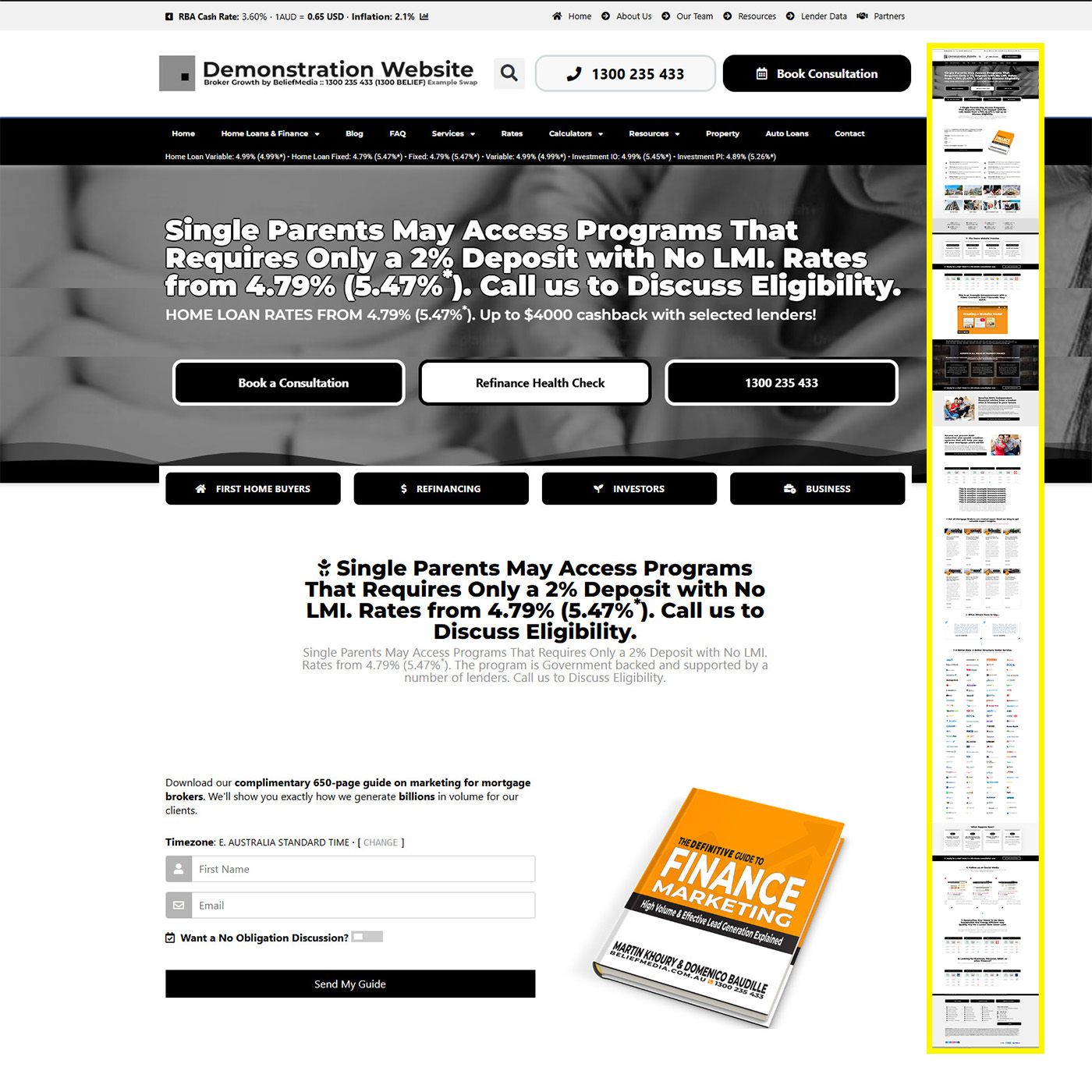
Pictured: Various font page options. All are available as your primary page, and all are turnkey integrated with the Switch module.
This makes the front page a living part of the funnel rather than a fixed entry page. It can support Form Escalation, conditional content, calendar-integrated forms, service-specific calls to action, article pathways, videos, calculators, comparison tools, and segmented follow-up. If a user has already subscribed to a form, they should not be shown the same entry-level offer again; the website should escalate them to the next appropriate commitment. If a visitor has demonstrated interest in a particular lending category, the front page should make that pathway easier to continue. The result is a website that feels more relevant, more intelligent, and more authoritative. It does what most broker websites fail to do: it turns the front page from a passive homepage into an active conversion engine.
Why Have 15 Front Pages: In fact, it's closer to 20 when you include equipment and other primary pages. In reality, any page may be set as the front page of your website. As detailed below in our section on Formly, and mentioned in brief when we introduce landing pages, any alternate front page may be set when a form of any types in any location sets their 'intent'. A nurse on a nursing landing page will have their front page set to Nursing, thus reinforcing your expertise and authoritativeness in the market in order to escalate required trust.
Standard Borrowing Pages
The primary borrowing pages are the structural pillars of the mortgage broker website. First Home Buyers, Refinancing, Investment Lending, SMSF Loans, Construction Loans, Debt Consolidation, Commercial Lending, Self-Employed Borrowing, Reverse Mortgages, and other core borrowing categories should never be treated as generic service descriptions. Each page should operate as a specialised conversion and education environment built around the borrower’s specific problem, stage of awareness, emotional pressure, and likely next step. A First Home Buyer page should reduce anxiety and explain preparation, deposit, pre-approval, LMI, grants, and buying risk. A Refinance page should address rate drift, lender loyalty penalties, retention offers, repayment pressure, and comparison logic. An Investment page should speak to equity, structure, serviceability, interest-only strategy, and future borrowing capacity. An SMSF page should introduce complexity, compliance sensitivity, structure, and specialist guidance. The page must demonstrate that the broker does not merely “do loans” but understands the distinct psychology, policy environment, and decision pathway attached to each borrowing objective.
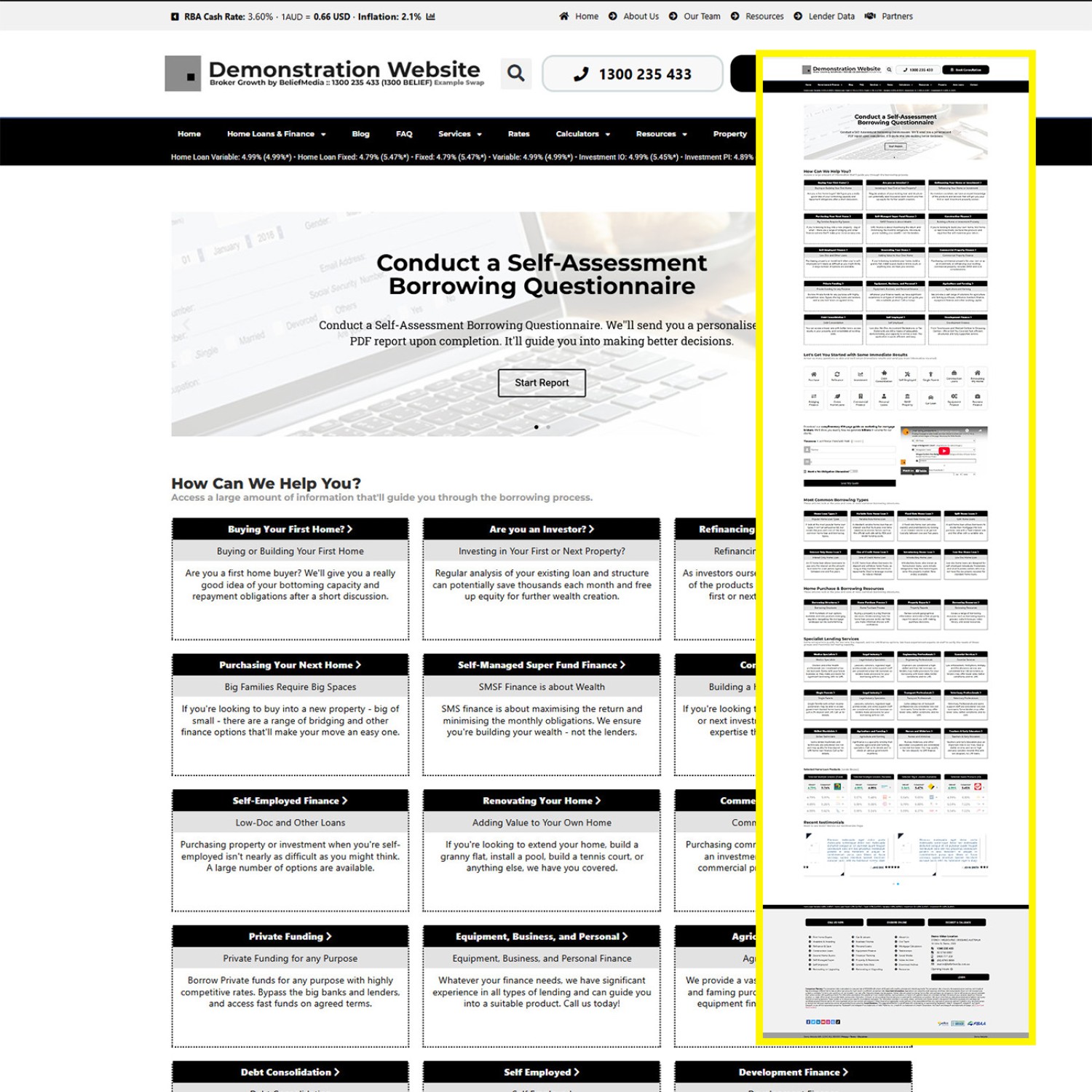
Mortgage Product Sitemap: Primary Mortgage services are accessed via the primary menu, with others listed on the Mortgage Sitemap page. The 'library' page lists those uncommon products, and some borrowing types that are a little unconventional (for SEO and completeness). Only the eight primary borrowing types are directly access via the primary menu.
In our framework, each primary borrowing page is also a funnel entry point. The page should carry its own videos, FAQs, calculators, guides, case studies, comparison tools, Formly forms, calendar-integrated booking pathways, and conditional conversion assets. A user who lands on a refinance page should be moved toward a refinance review, not a generic contact form. A first-home buyer should be moved toward readiness assessment, borrowing education, or pre-approval preparation. An investor should be moved toward an equity or portfolio pathway. The page topic determines the conversion asset, the conversion asset determines the follow-up, and the follow-up determines the funnel. When these pages are properly connected to Yabber, Formly, Nexus, conditional redirects, Form Escalation, and website content switching, they become more than information pages. They become intelligent borrowing pathways that educate, segment, qualify the broker, and move the user toward the next appropriate commitment.
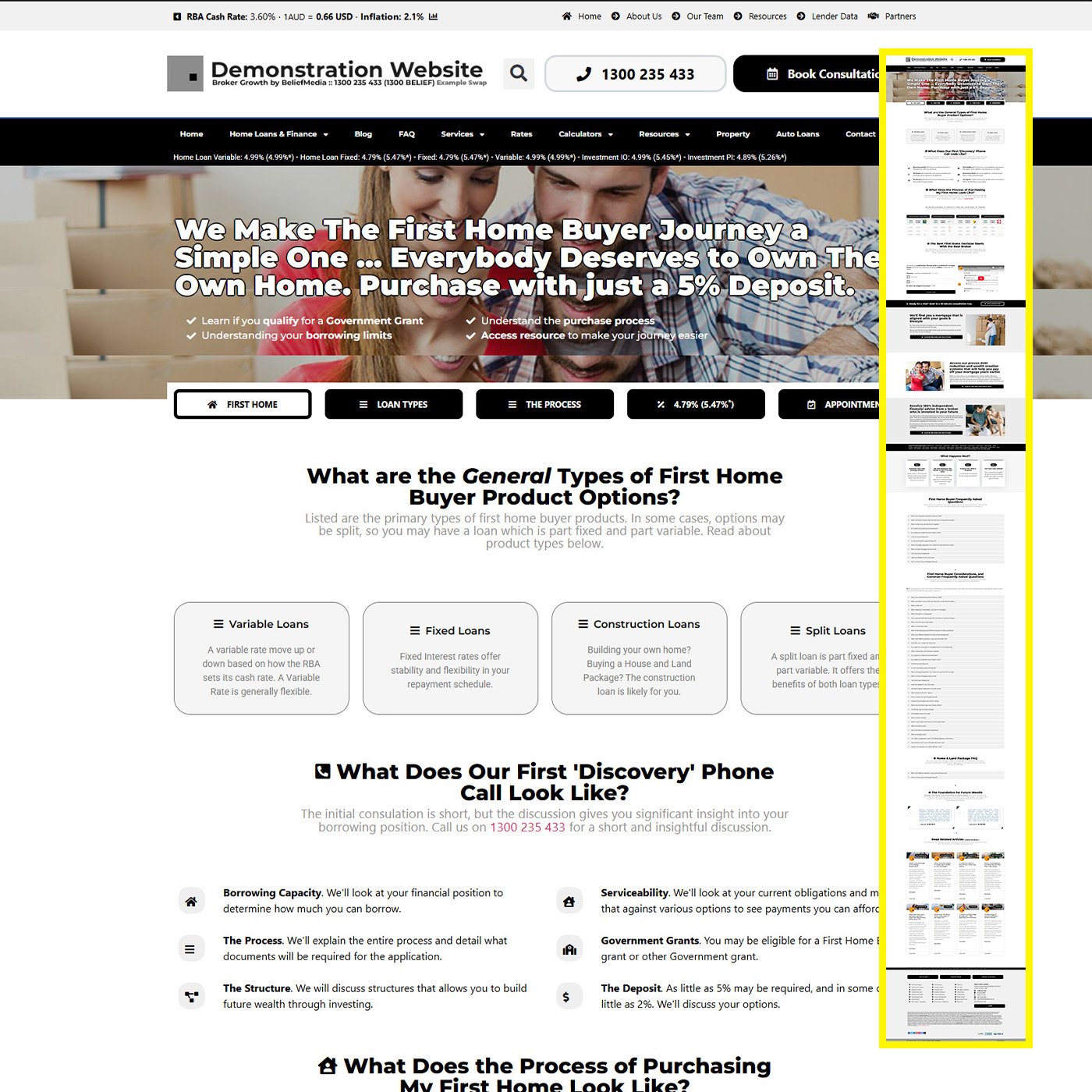
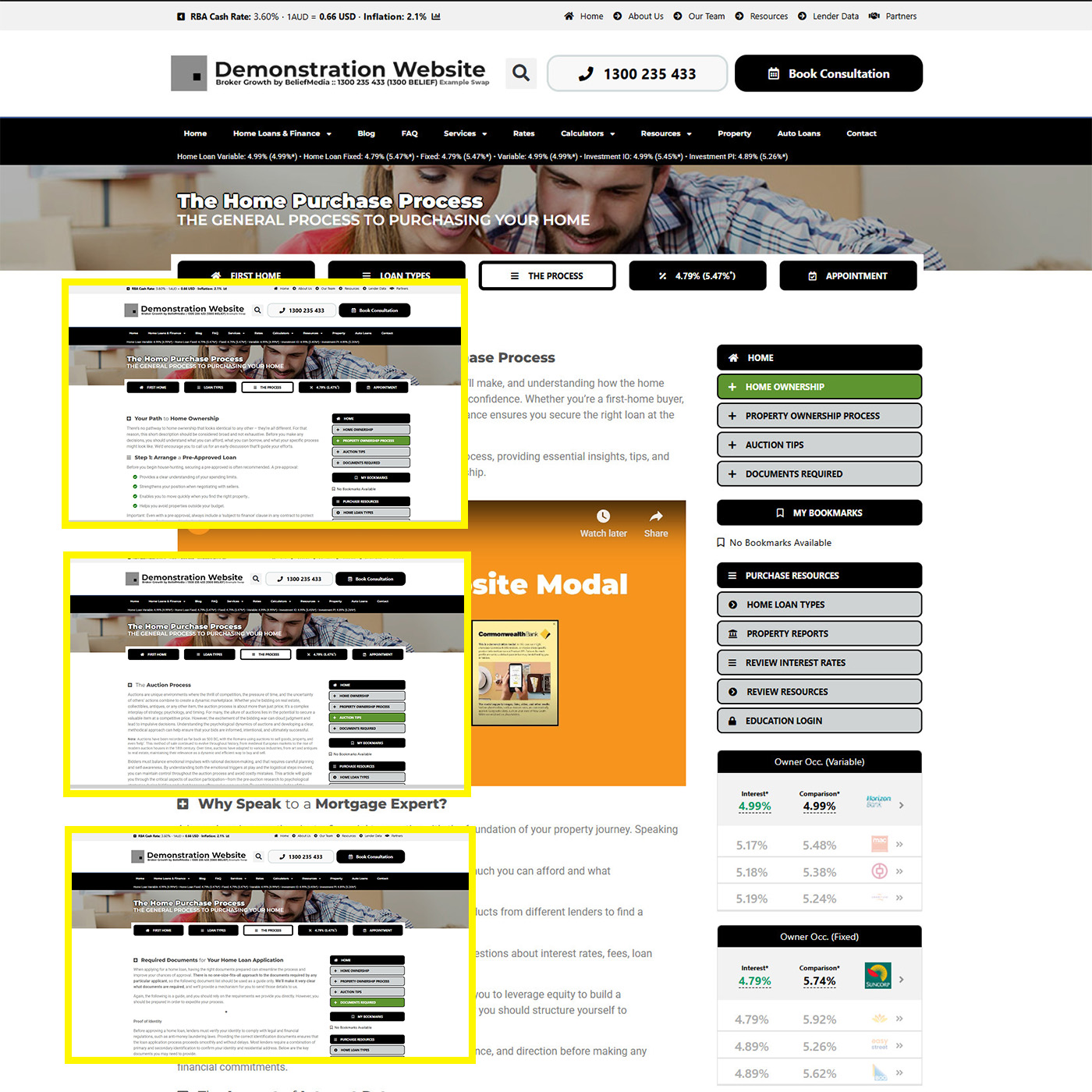
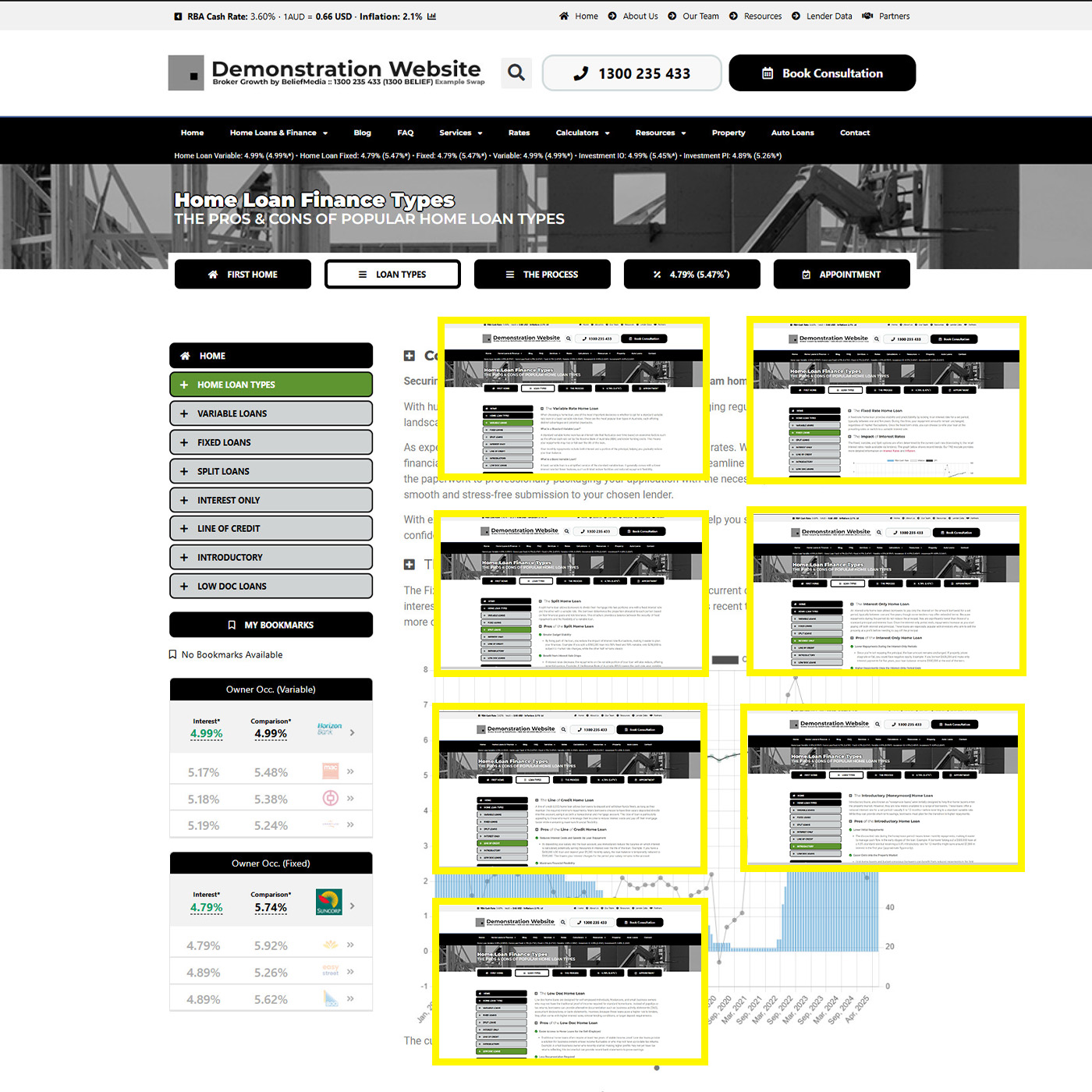
First Home Buyers: The First Home Borrower type is a little different to others. First home buyers generally require more information, so a few pages are assigned to that resource. If you're using the password-protected 'Education' module, this is a great location to build out your FHB Education Course material.
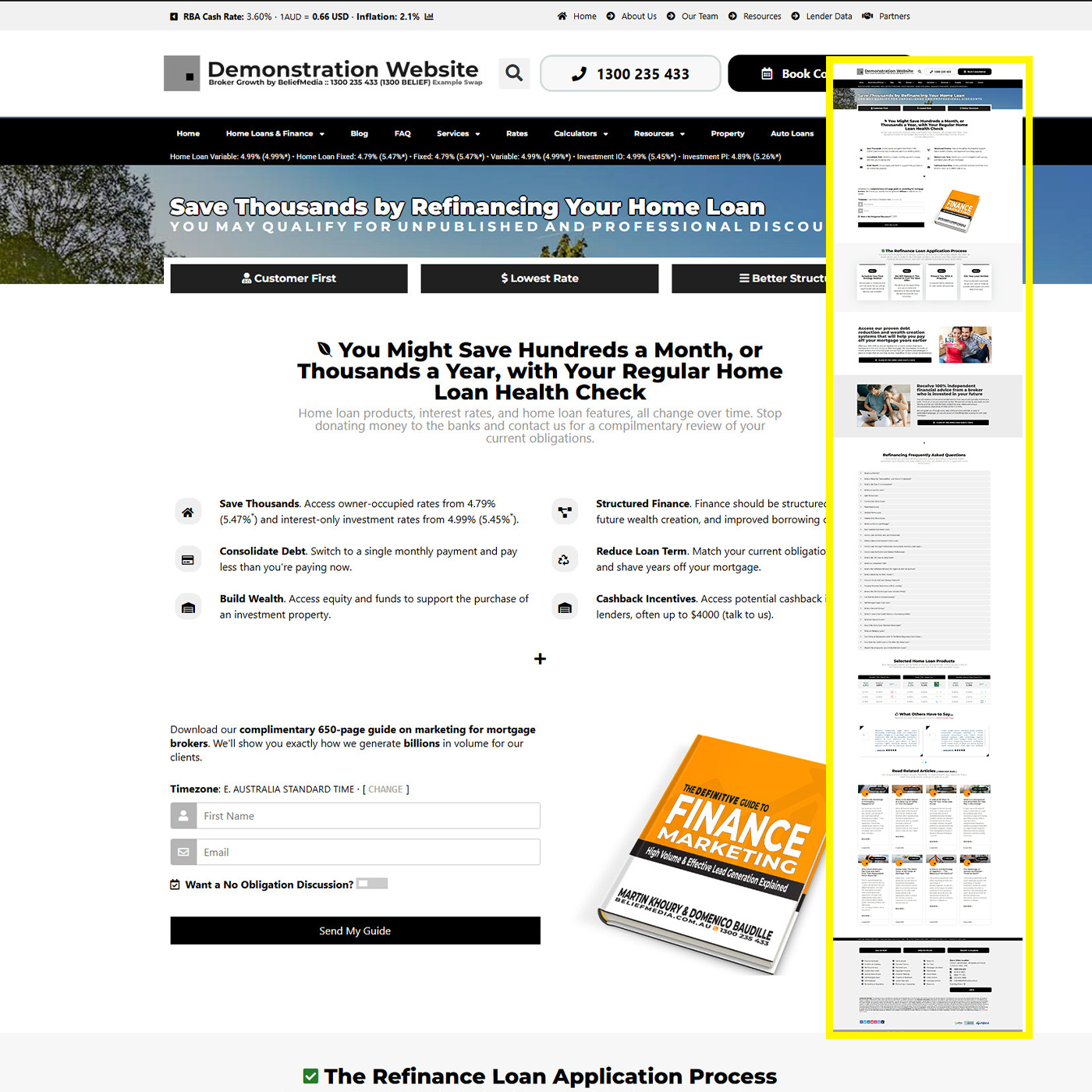
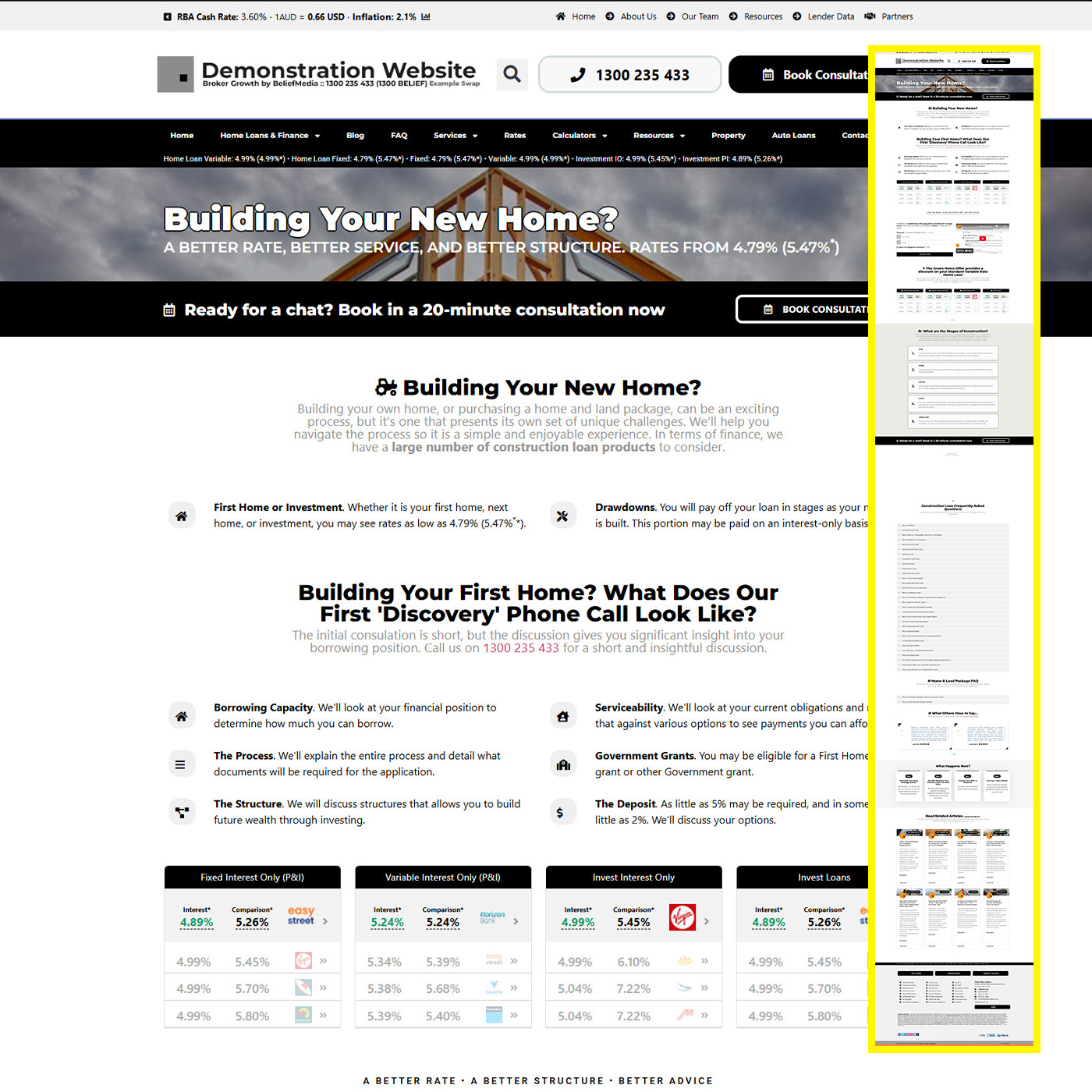
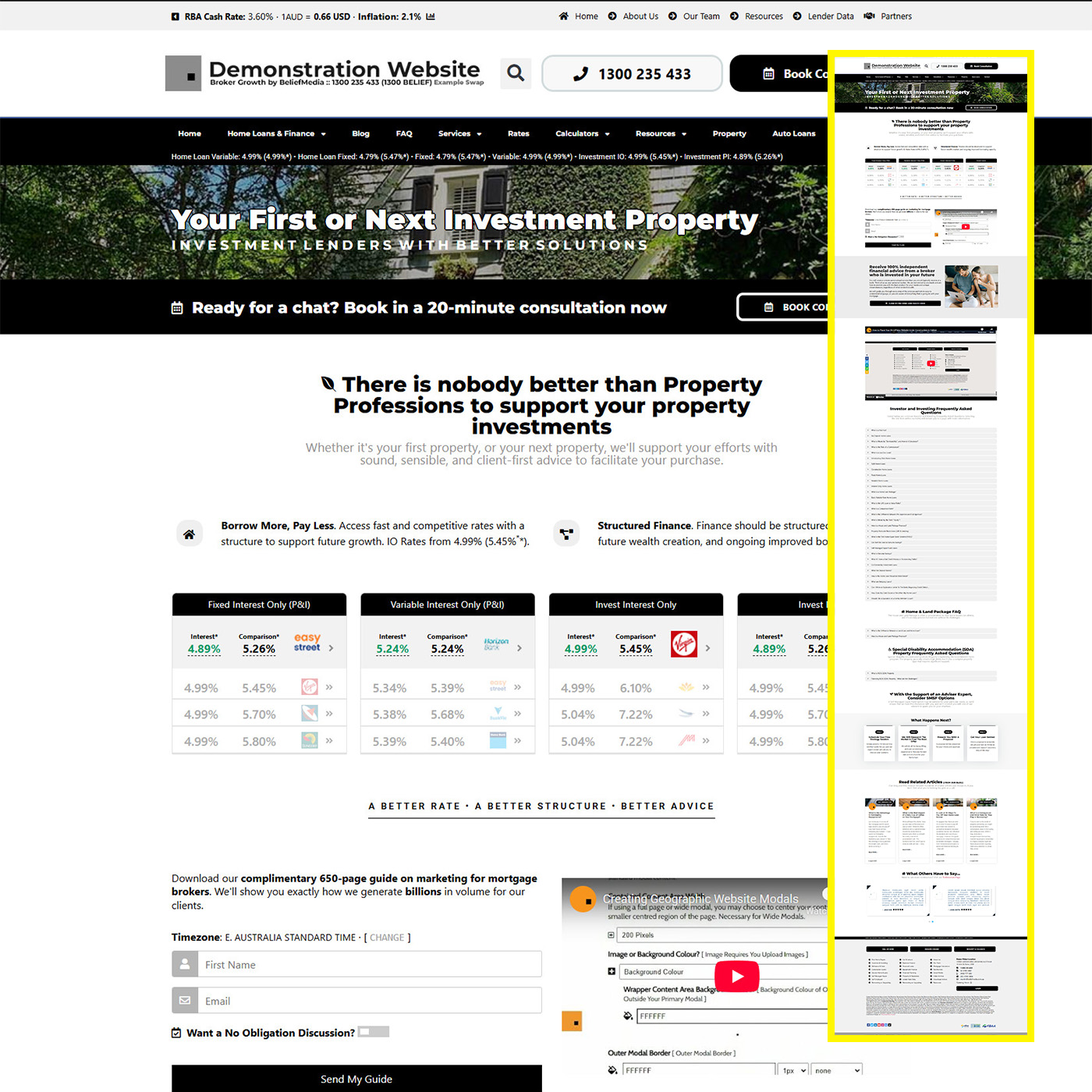
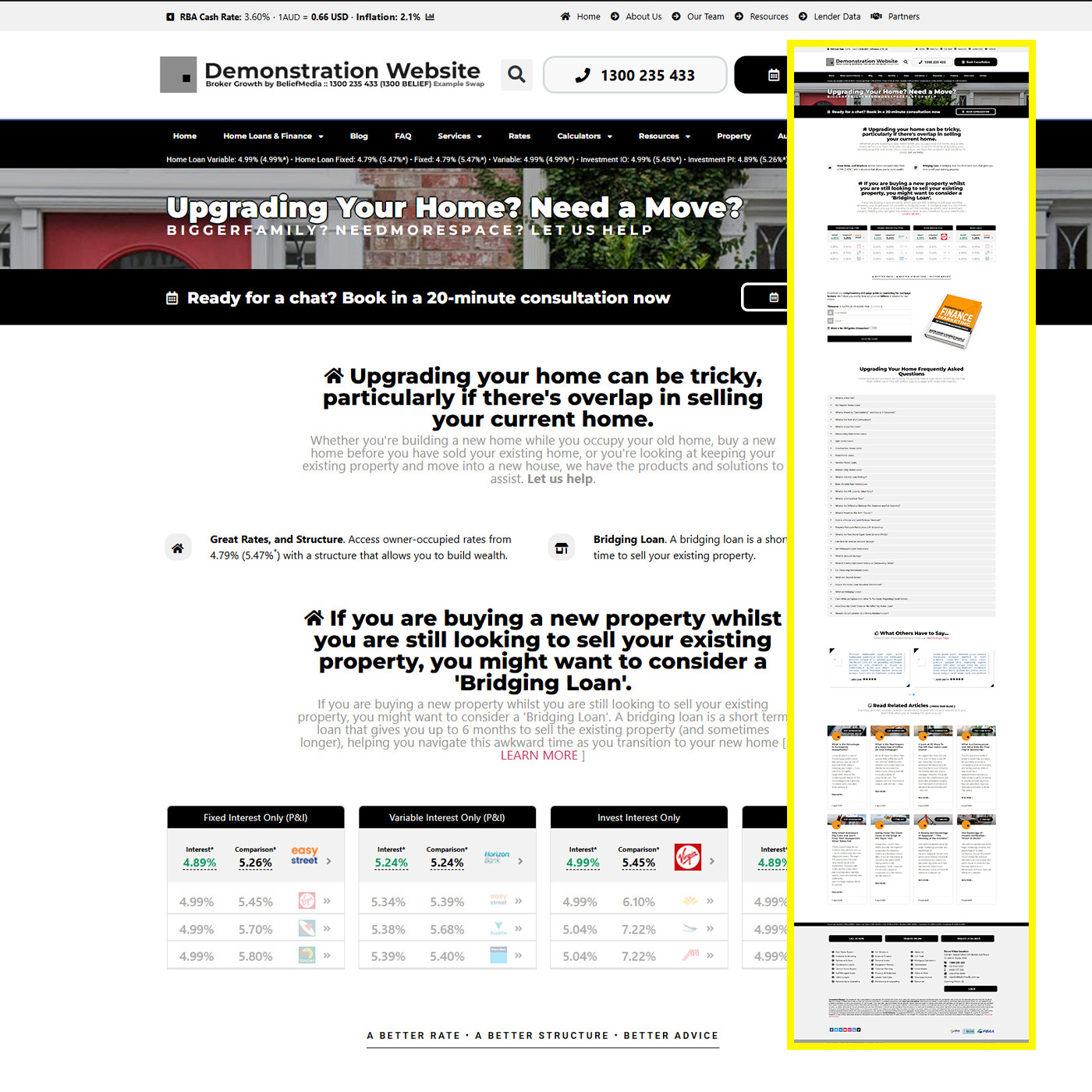
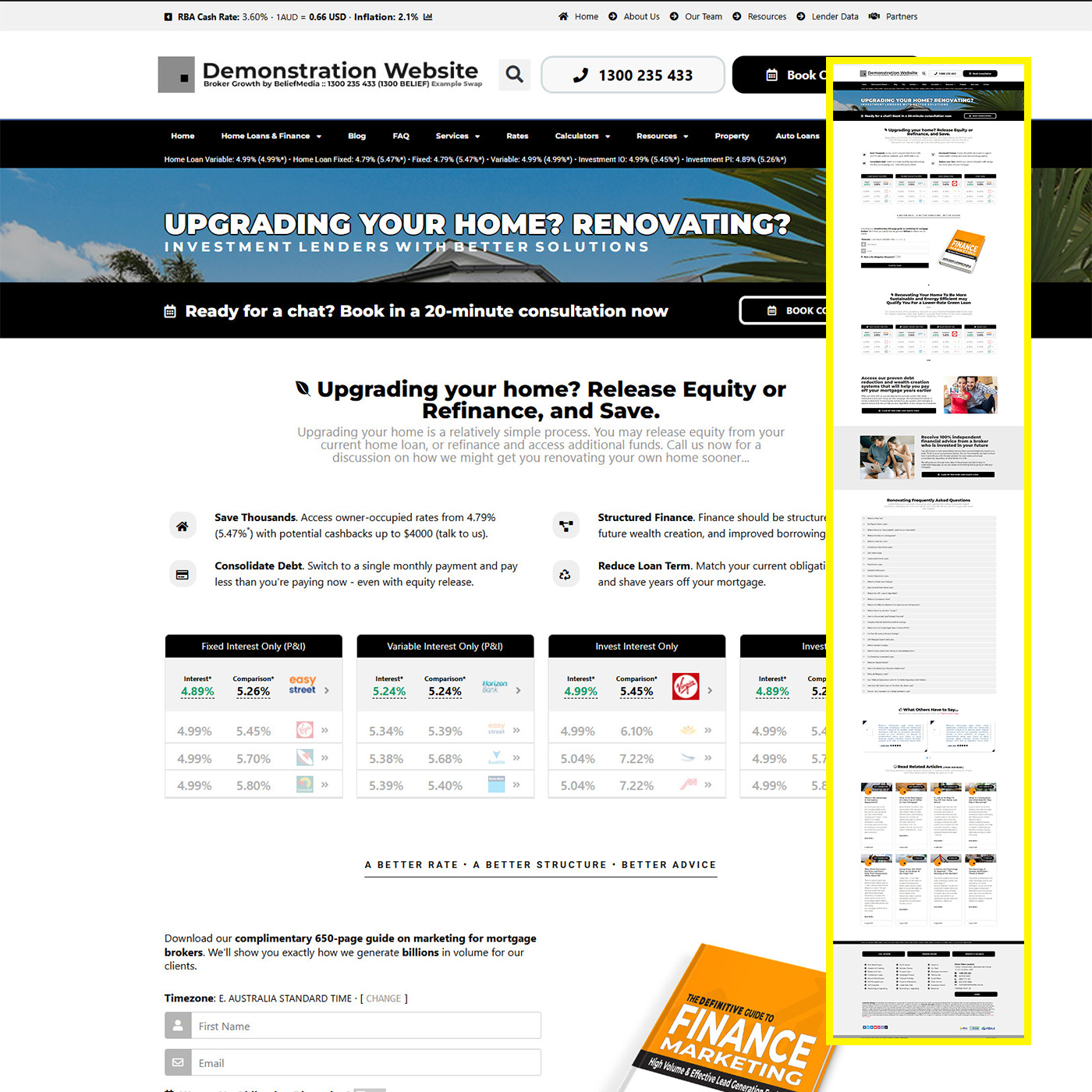
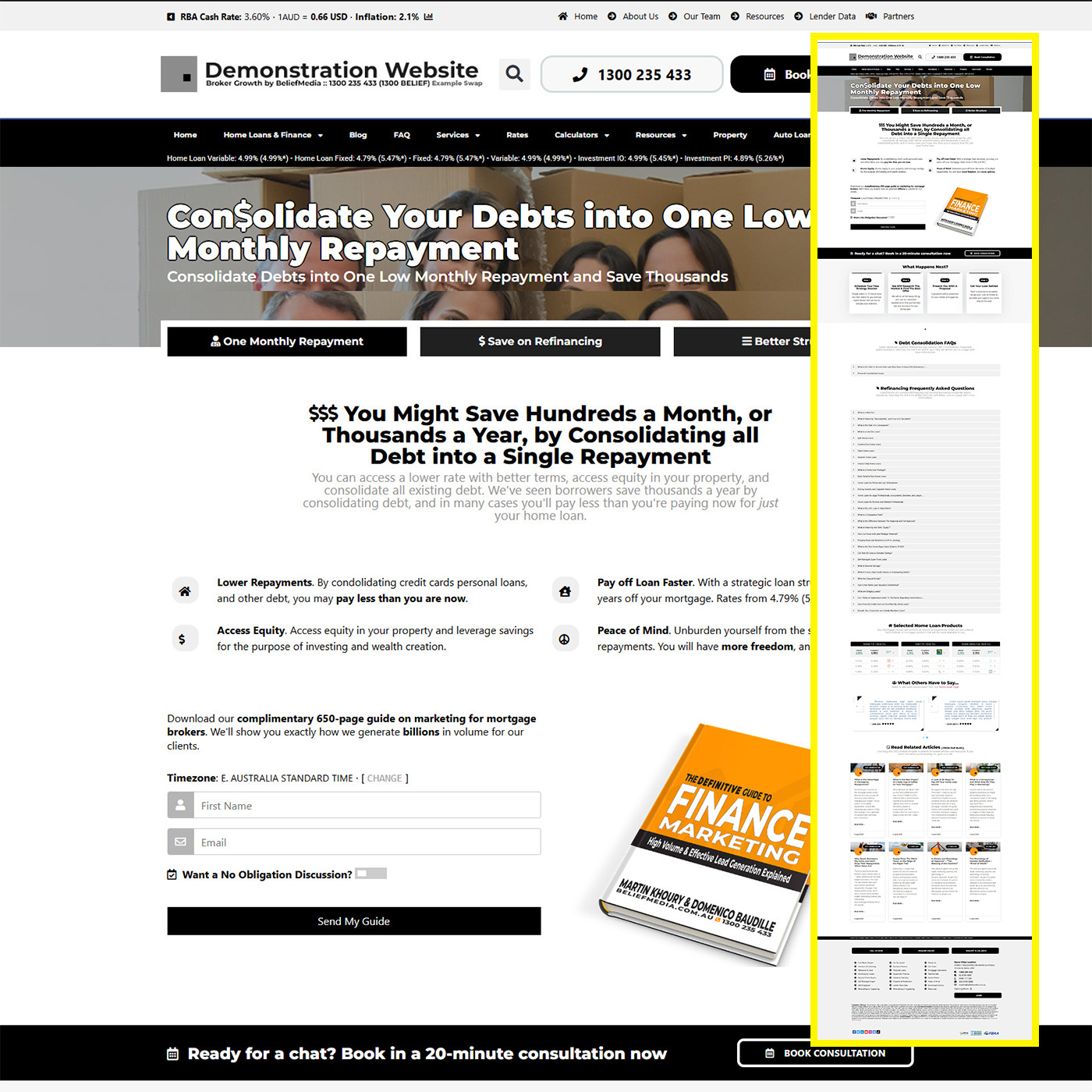
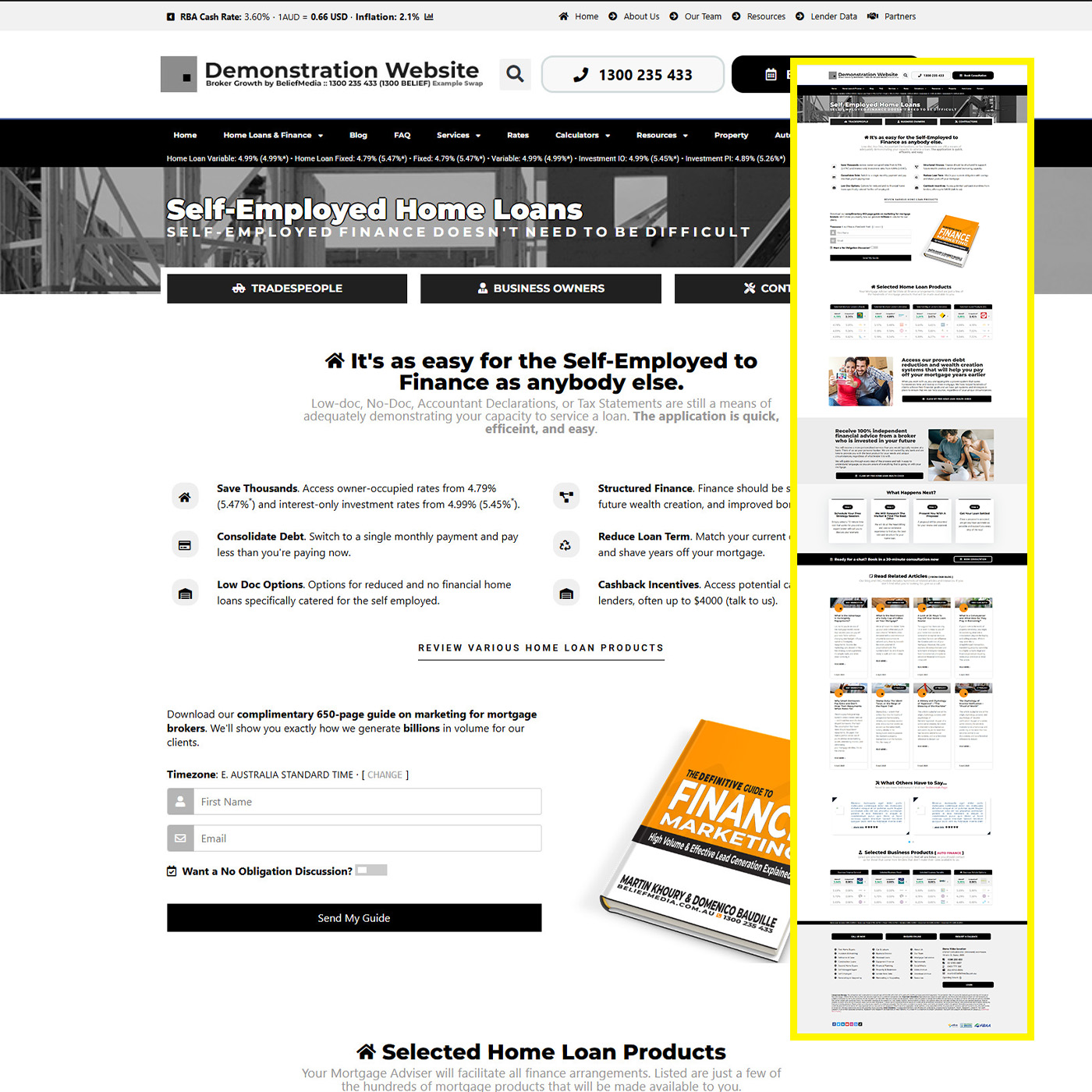
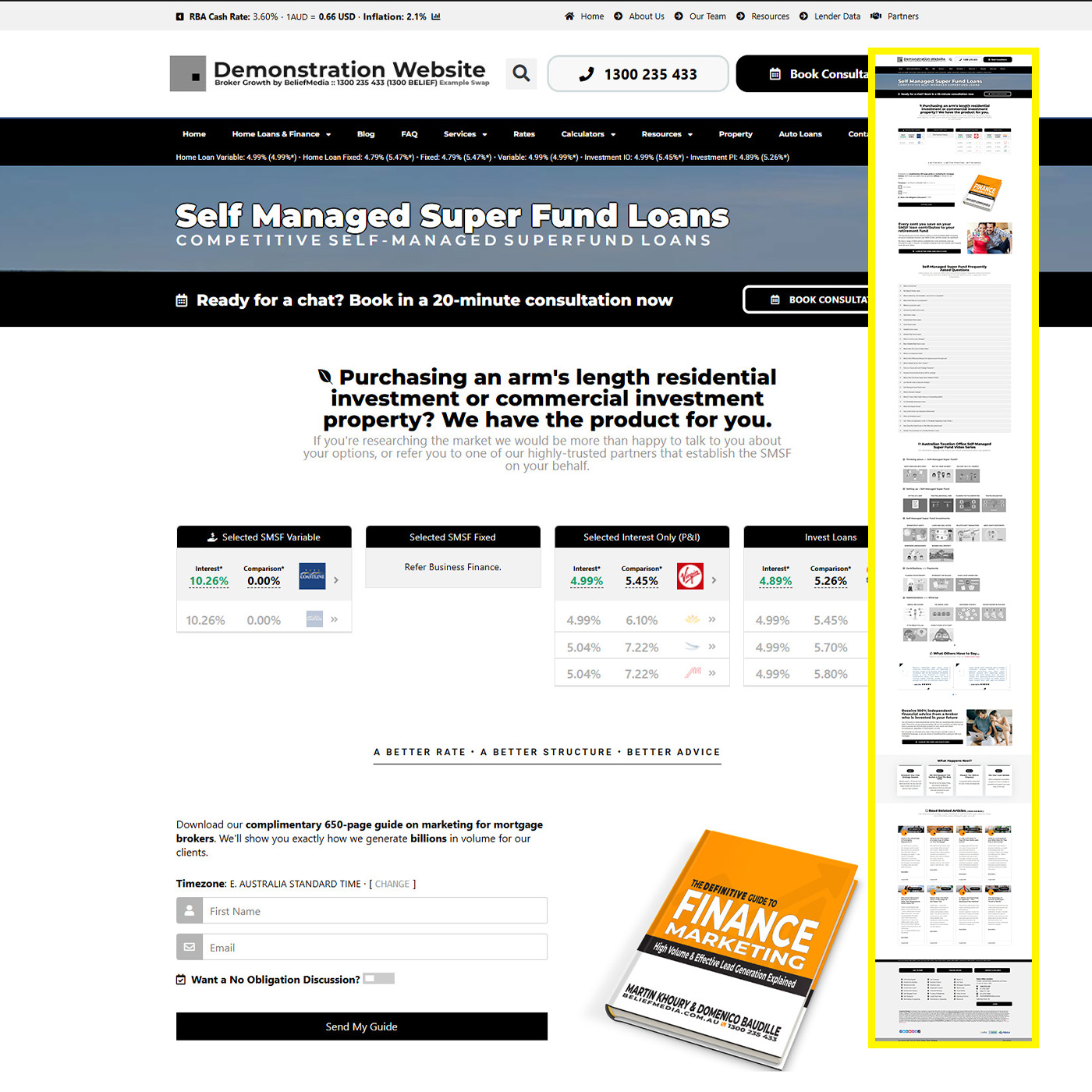
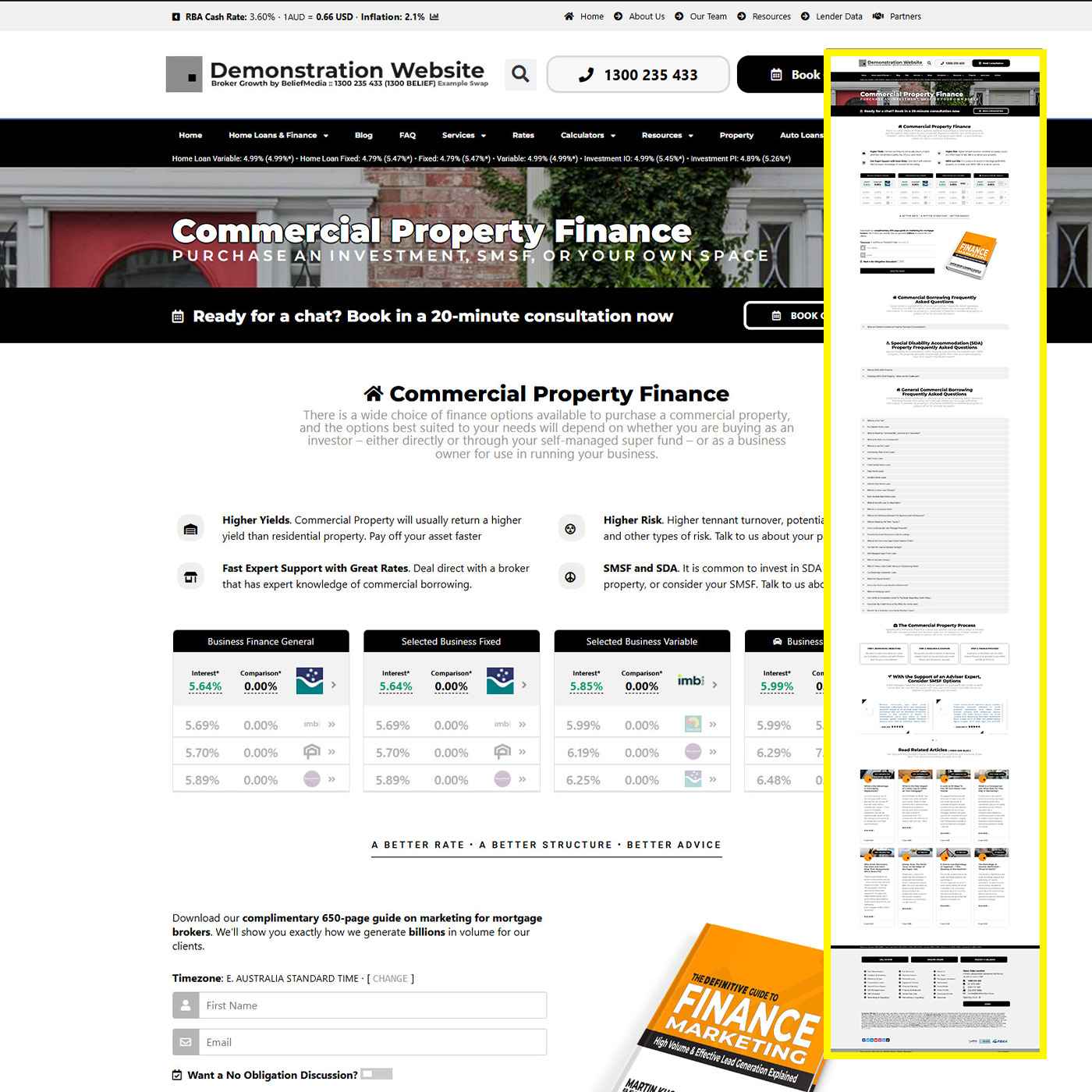
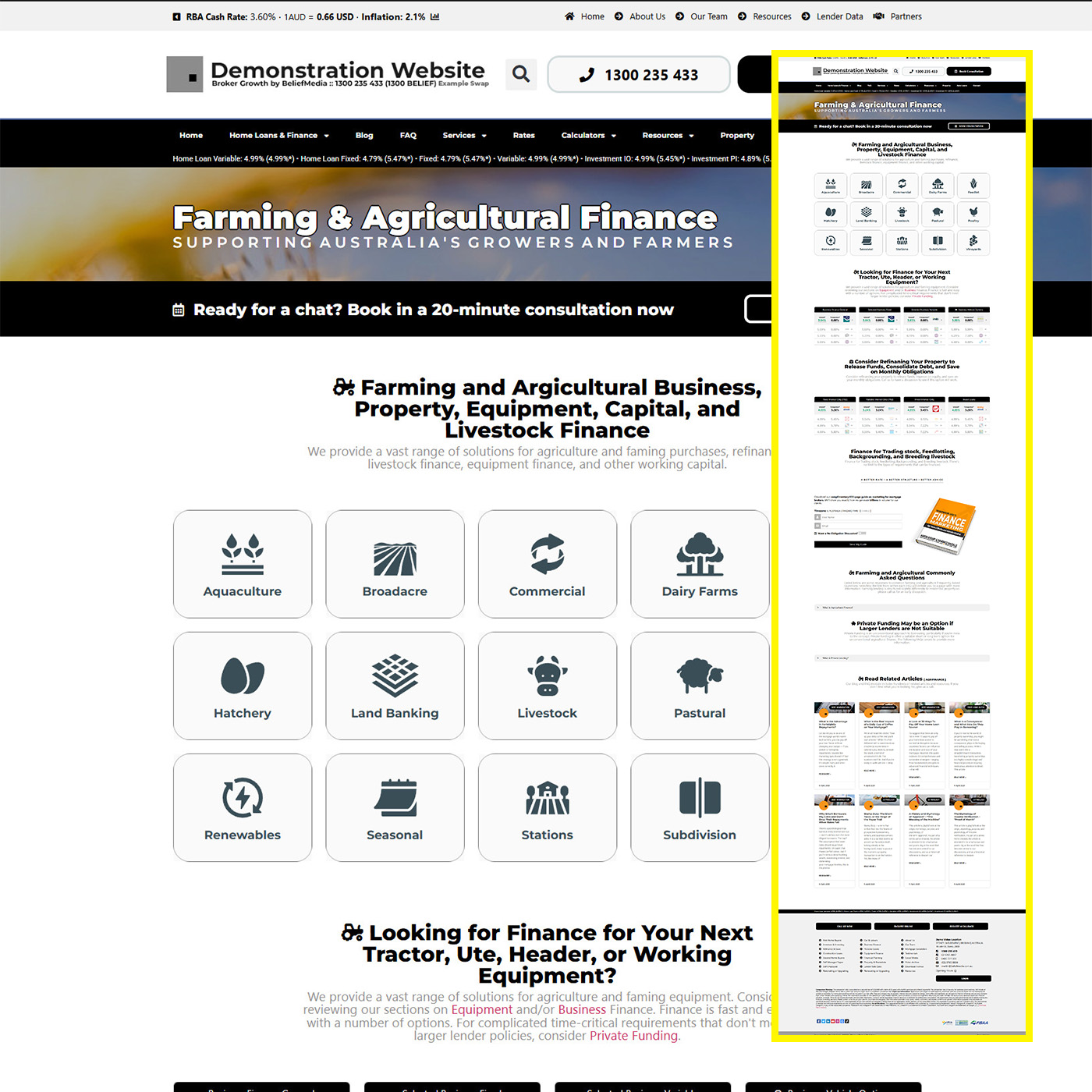
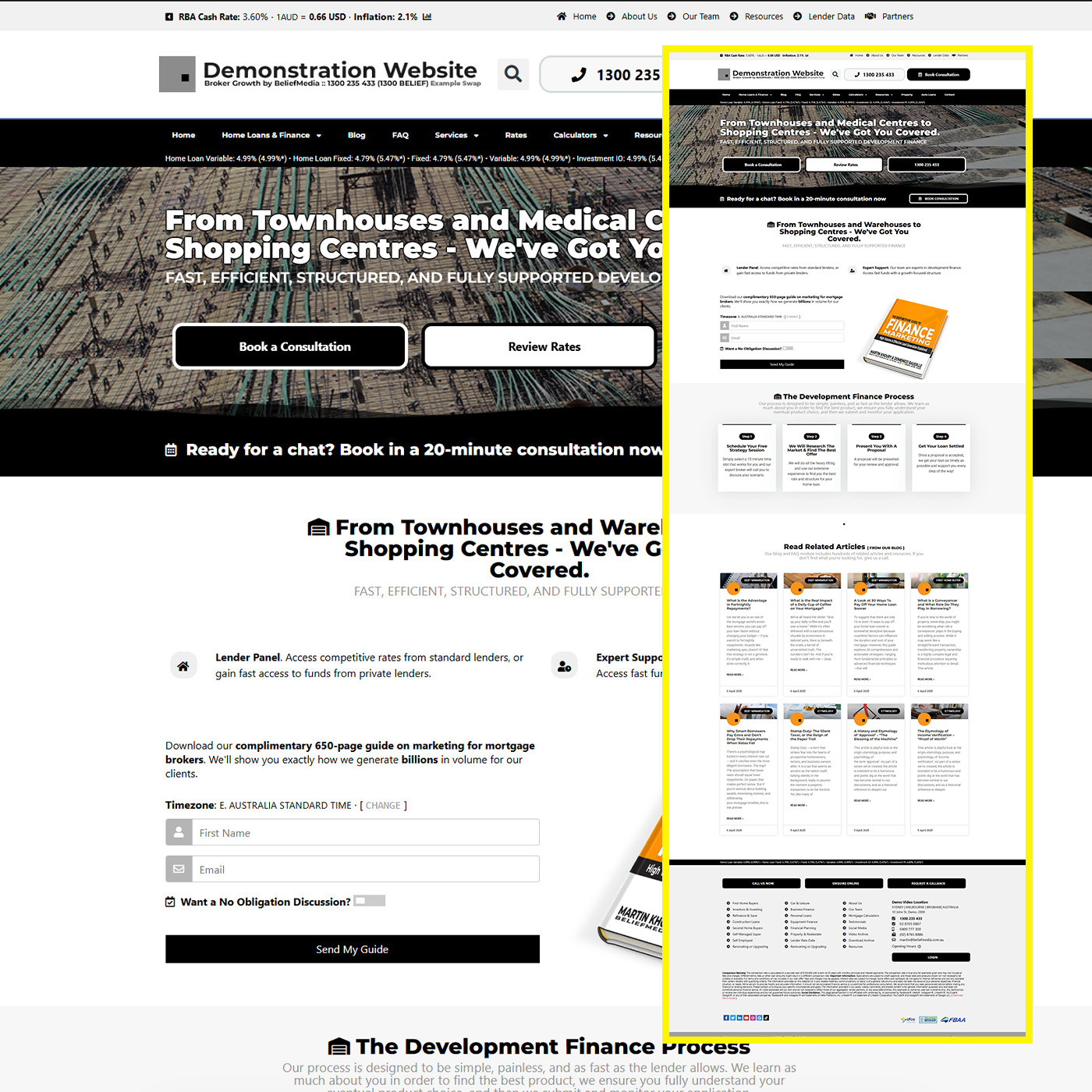
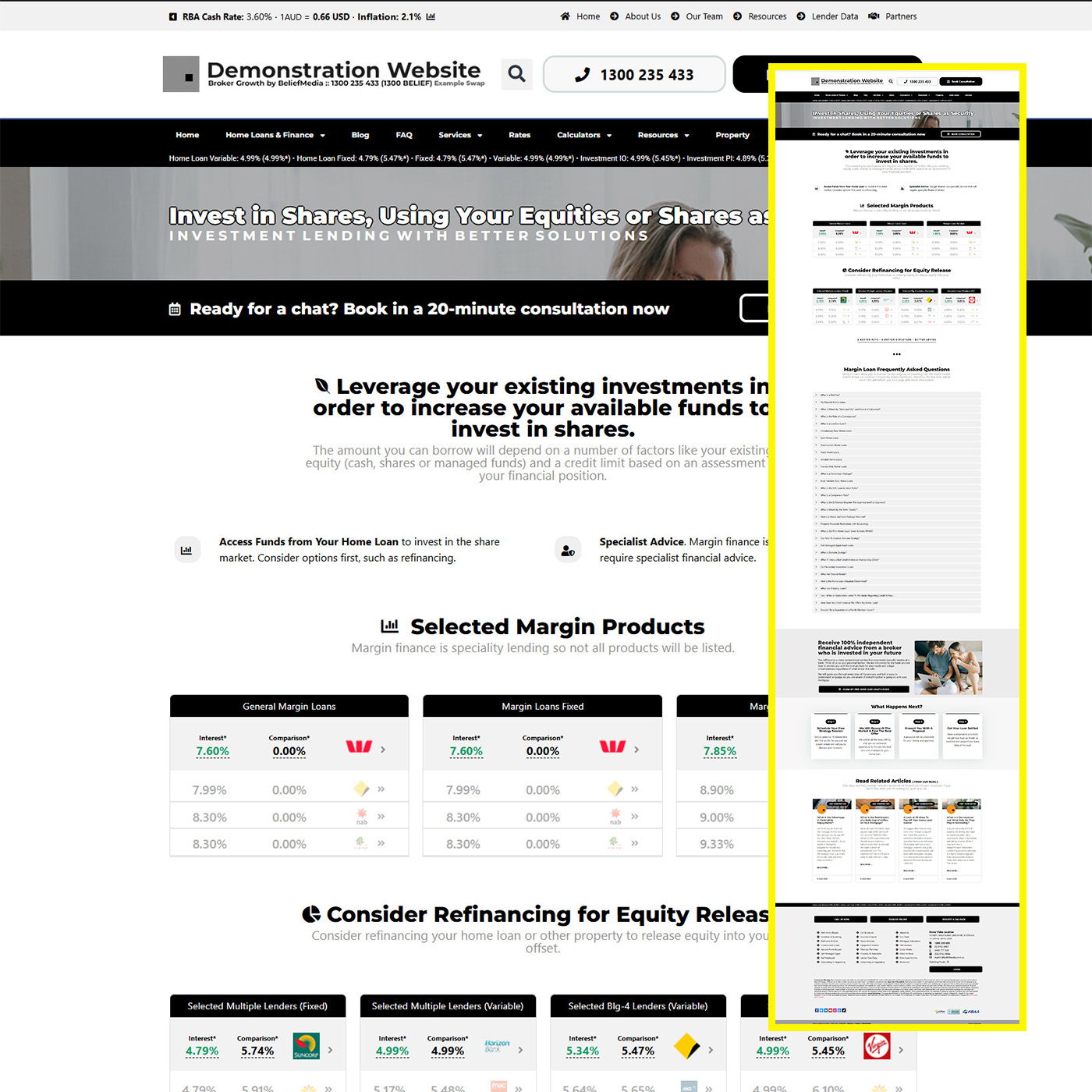
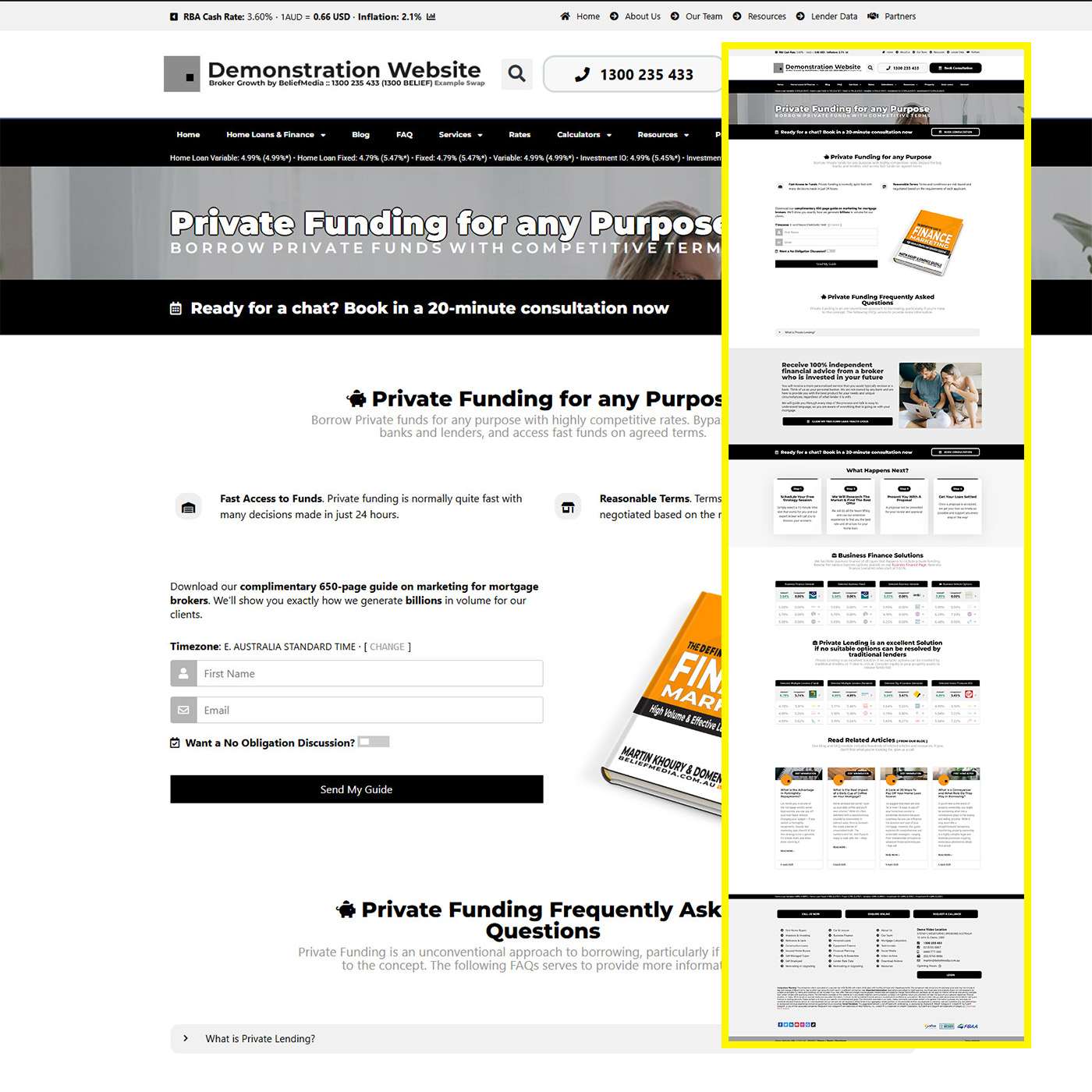
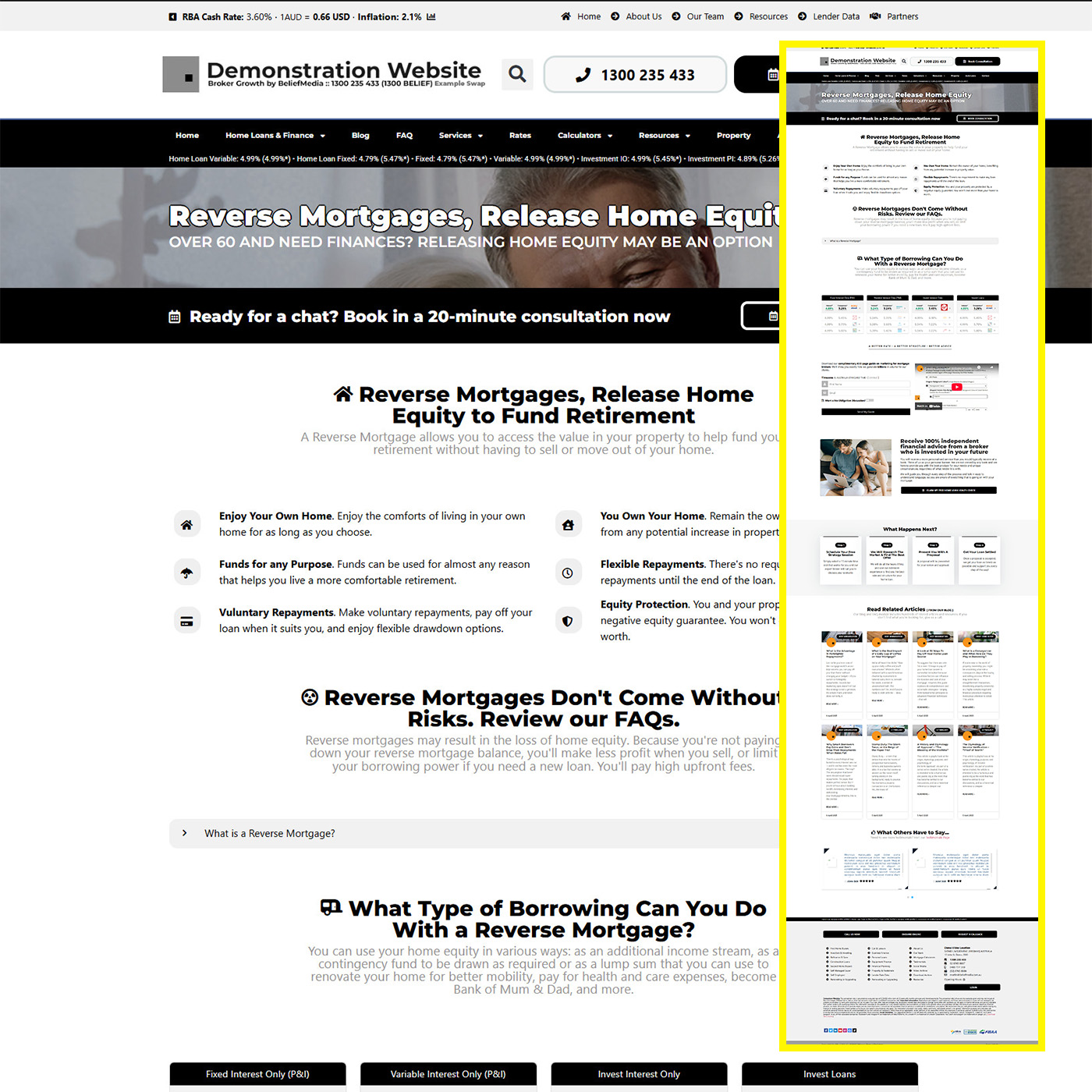
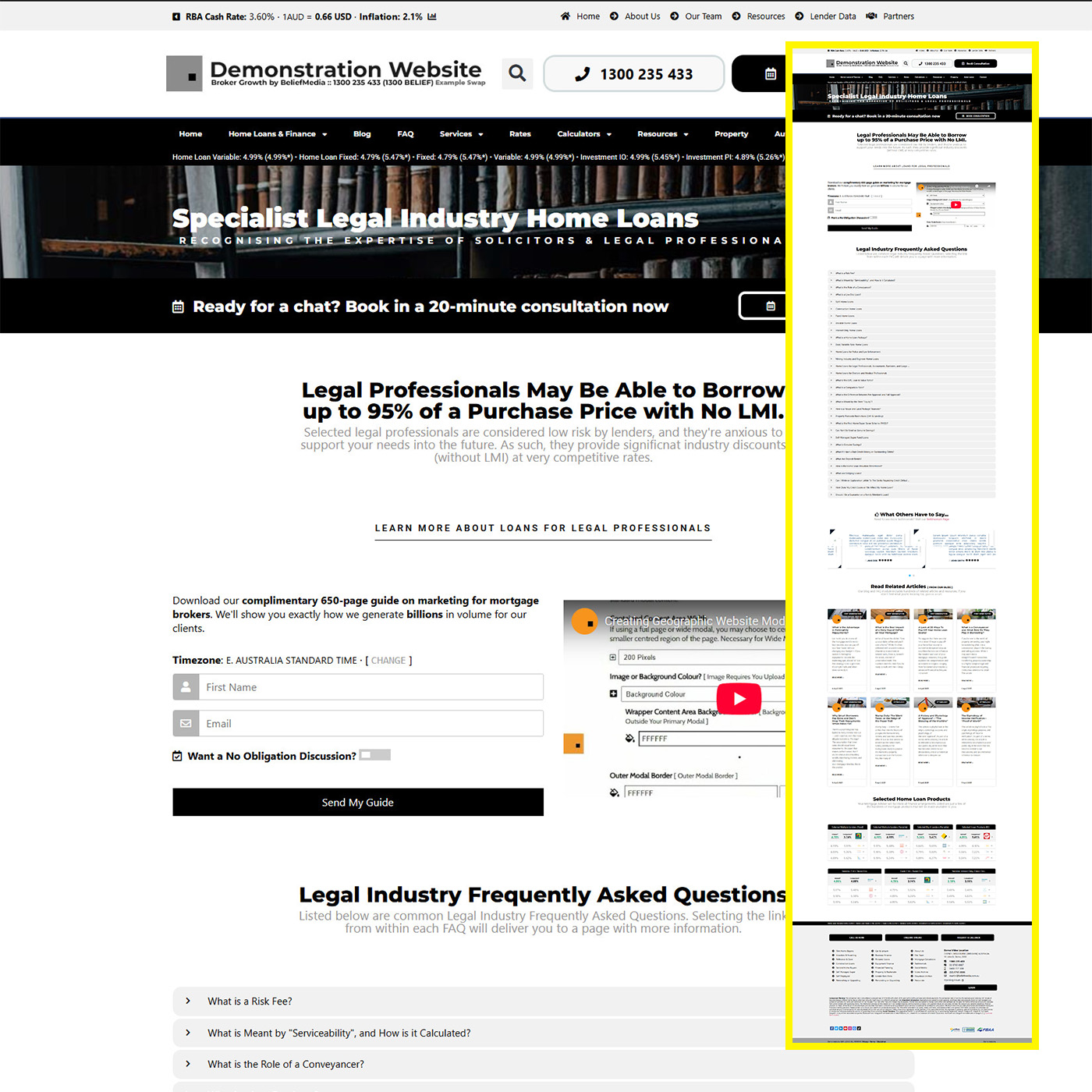
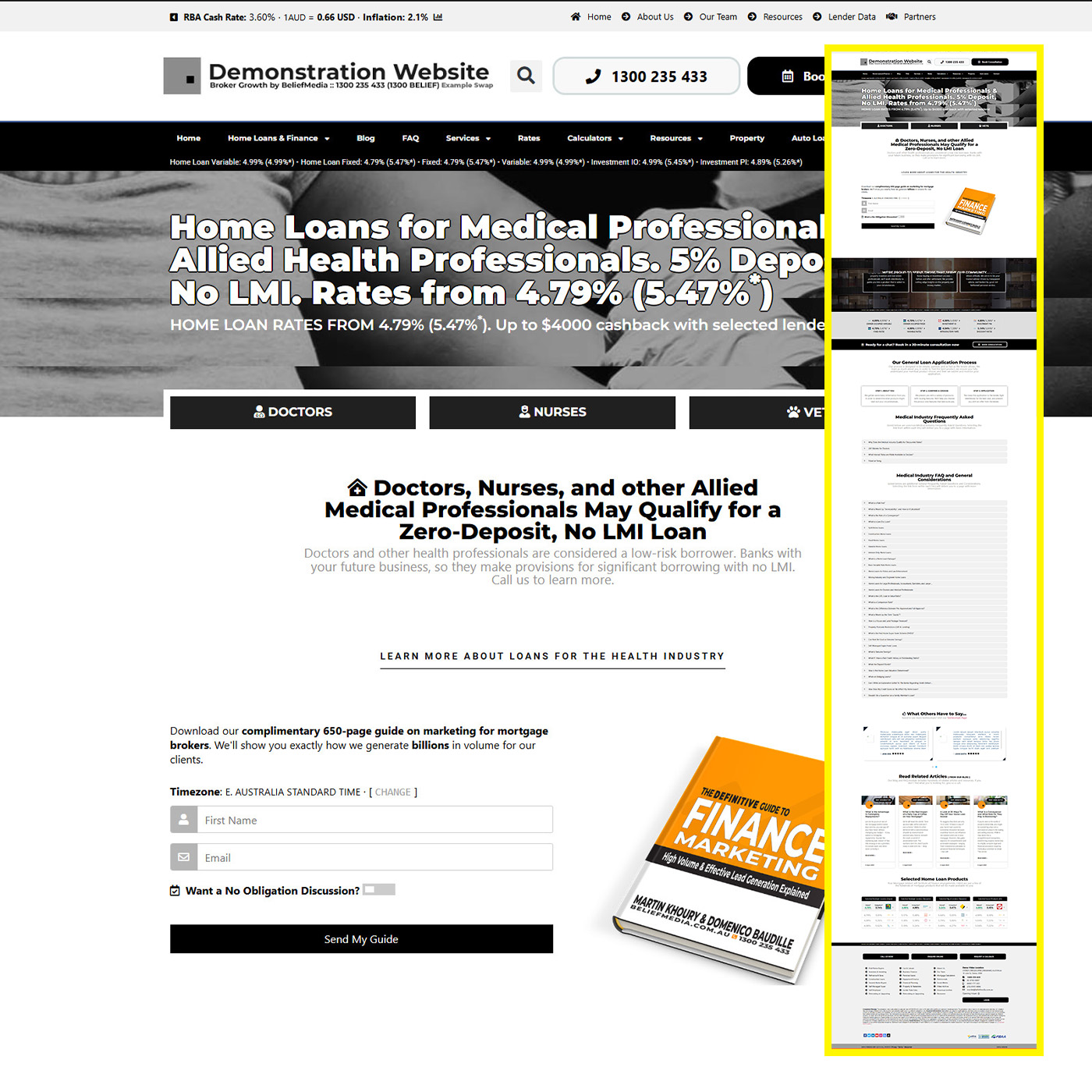
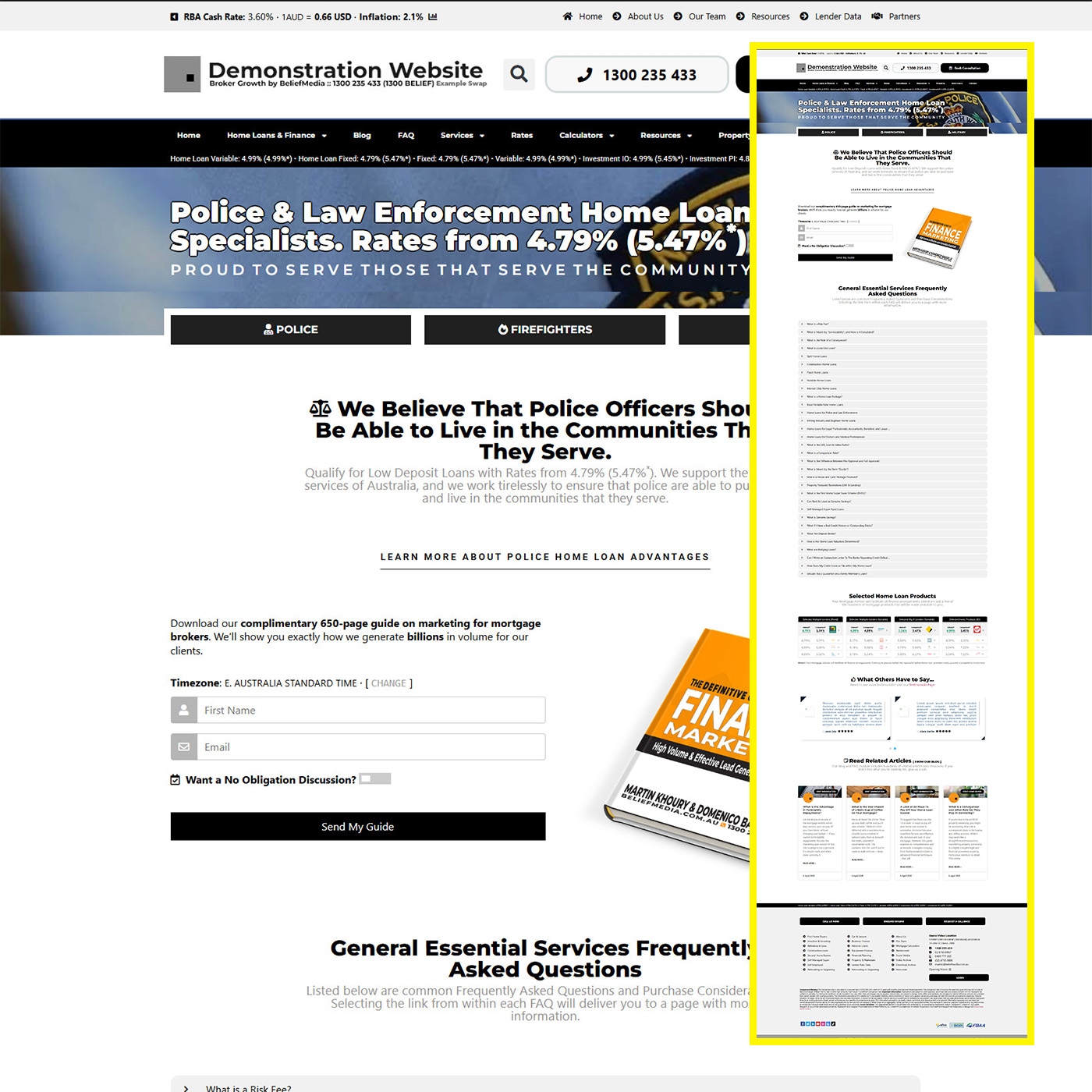
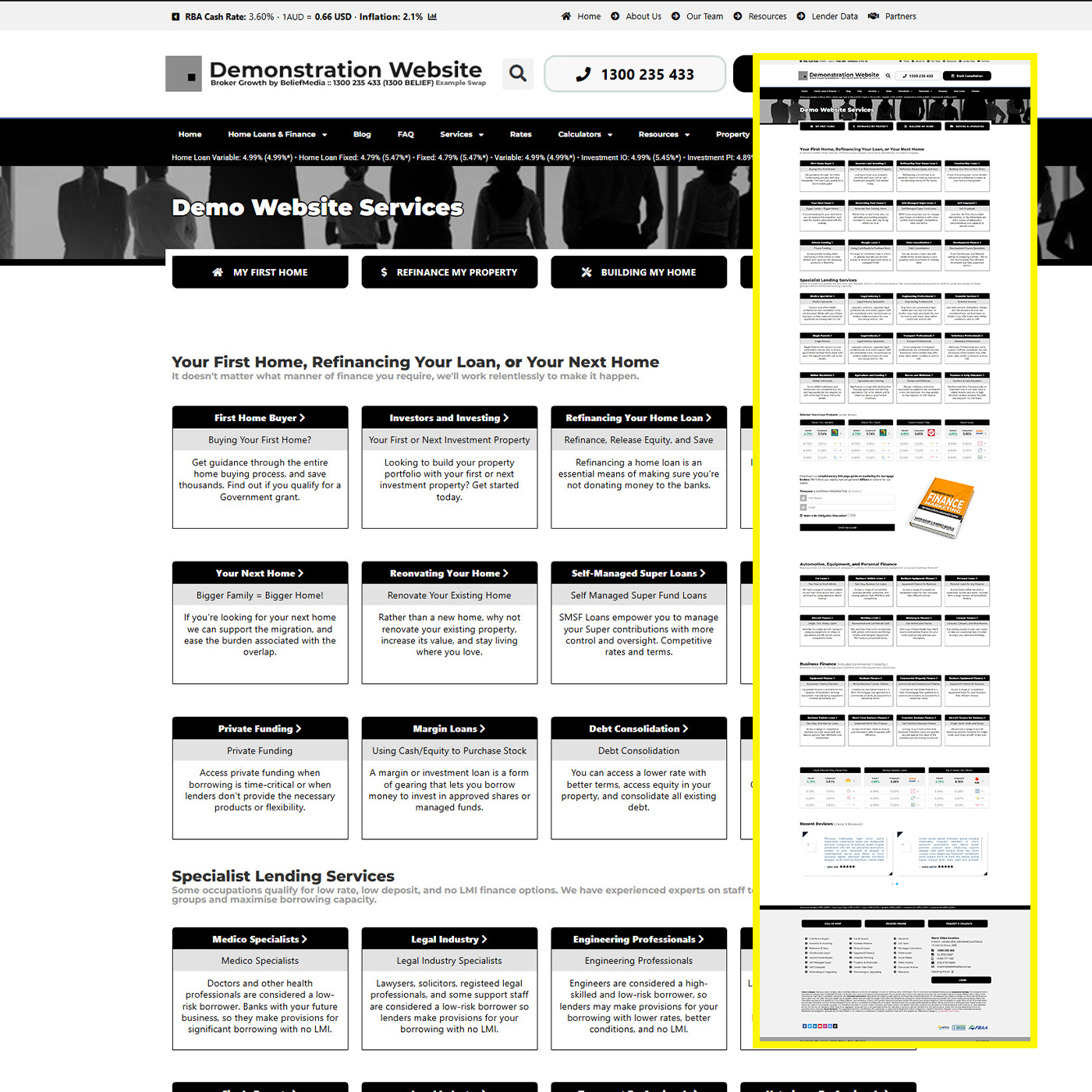
Pictured: Various font page options. All are available as your primary page, and all are turnkey integrated with the Switch module. Additional pages may be created if required.
Blog, FAQ, and Insights Library
The FAQ Library
The FAQ archive should be understood as a major educational asset, not a minor support feature. Structurally, it operates much like the blog: each FAQ exists as its own standalone resource, with its own searchable, indexable, linkable, and shareable value. This gives the website a deep layer of practical borrower education that can answer specific questions at the exact point of uncertainty. A user may arrive from Google with a narrow question about LMI, redraw, offset accounts, refinancing timing, guarantor loans, SMSF borrowing, fixed-rate expiry, or borrowing capacity, and the FAQ archive gives them a direct, useful answer without forcing them into a generic service page. That matters because high-intent users often search in questions, not service categories. The FAQ archive captures those moments of enquiry and turns them into structured pathways back into the website, the relevant borrowing page, the right form, the appropriate guide, or a booking opportunity.
The real power of the FAQ system is that it is not trapped inside the archive. FAQs can be reused throughout the website via shortcode or the Elementor drag-and-drop widget, allowing all FAQs, selected FAQs, category-based FAQs, tag-based FAQs, or manually curated sets to be rendered inside accordion panels on relevant pages. This turns the FAQ library into a modular education engine. A refinance page can show refinance-specific FAQs. A first-home-buyer page can show questions about deposits, pre-approval, LMI, grants, and buying timelines. An SMSF page can show SMSF lending questions. A fixed-rate-expiry article can surface questions about rollover risk, review timing, repayment changes, and lender retention offers. The archive feeds the pages, and the pages feed the archive. This creates internal linking, contextual relevance, stronger topical authority, better user pathways, and more meaningful engagement.
For the reader, the advantage is immediate. They are not forced to decode broker language, navigate a large website, or make contact before they feel informed enough to do so. They can explore answers at their own pace, follow related questions, move into deeper articles, compare concepts, and gradually build confidence. This is exactly how education-led marketing should behave. It empowers the borrower before it asks for commitment. It reduces anxiety, resolves confusion, and creates the perception that the broker is not simply trying to win an enquiry but genuinely trying to help the user understand their options. That perception is commercially valuable because informed users are more likely to trust the source that educated them.
The FAQ archive also supports the broader funnel by creating dozens or hundreds of small entry points into the website. Each FAQ can become a search result, a social link, an email link, a supporting resource in an autoresponder, a contextual panel on a landing page, or a follow-up link after a call or booking. Because readership is extensive and the pages are highly trafficked, the FAQ archive becomes one of the most reliable ways of keeping users engaged with practical, low-friction content. It creates familiarity through repeated exposure. It reinforces authority through specificity. It supports conversion by answering objections before they are raised. In a serious mortgage broker website framework, the FAQ archive is not filler content; it is an always-on education and conversion layer that strengthens every major pathway on the site.
Your Company Blog
The website blog is the primary home for the broker’s content library and one of the most important assets in the entire website framework. While the FAQ archive answers specific questions, the blog provides the space for deeper commentary, strategic explanation, market interpretation, borrower education, case-based discussion, opinion, product analysis, regulatory response, lender updates, rate-cycle commentary, and practical guidance. It gives the business a platform to speak regularly and meaningfully to its market rather than relying on static service pages or recycled generic articles. A serious broker website should not treat the blog as an occasional SEO dumping ground. It should be the central publishing engine that demonstrates active expertise and gives users a reason to return, read, share, subscribe, and continue through the funnel.
The blog also gives the broker a place to showcase the attributes of E+AT in a way that service pages cannot fully achieve. Expertise is demonstrated through technical clarity, lender knowledge, scenario analysis, and precise explanation. Experience is demonstrated through real-world patterns, client situations, market observations, and practical lessons. Education is delivered through guides, breakdowns, examples, warnings, checklists, and commentary that helps borrowers make better decisions. Authoritativeness is built through consistency, specificity, original thought, and the ability to interpret finance issues with more depth than competitors. Trust is earned when the reader repeatedly sees that the broker is competent, current, useful, and commercially honest. The blog gives these qualities room to breathe.
A strong blog also reveals company culture, values, tone, and personality. This is commercially important because borrowers are not only choosing a loan pathway; they are choosing a professional relationship. Articles can show whether the business is careful, assertive, conservative, educational, analytical, empathetic, direct, innovative, community-minded, or specialist. They can reveal how the broker thinks, what they value, what they reject, and how they approach borrower protection. This helps humanise the brand without weakening professionalism. A website full of sterile service pages may describe capability, but a blog gives the business a voice.
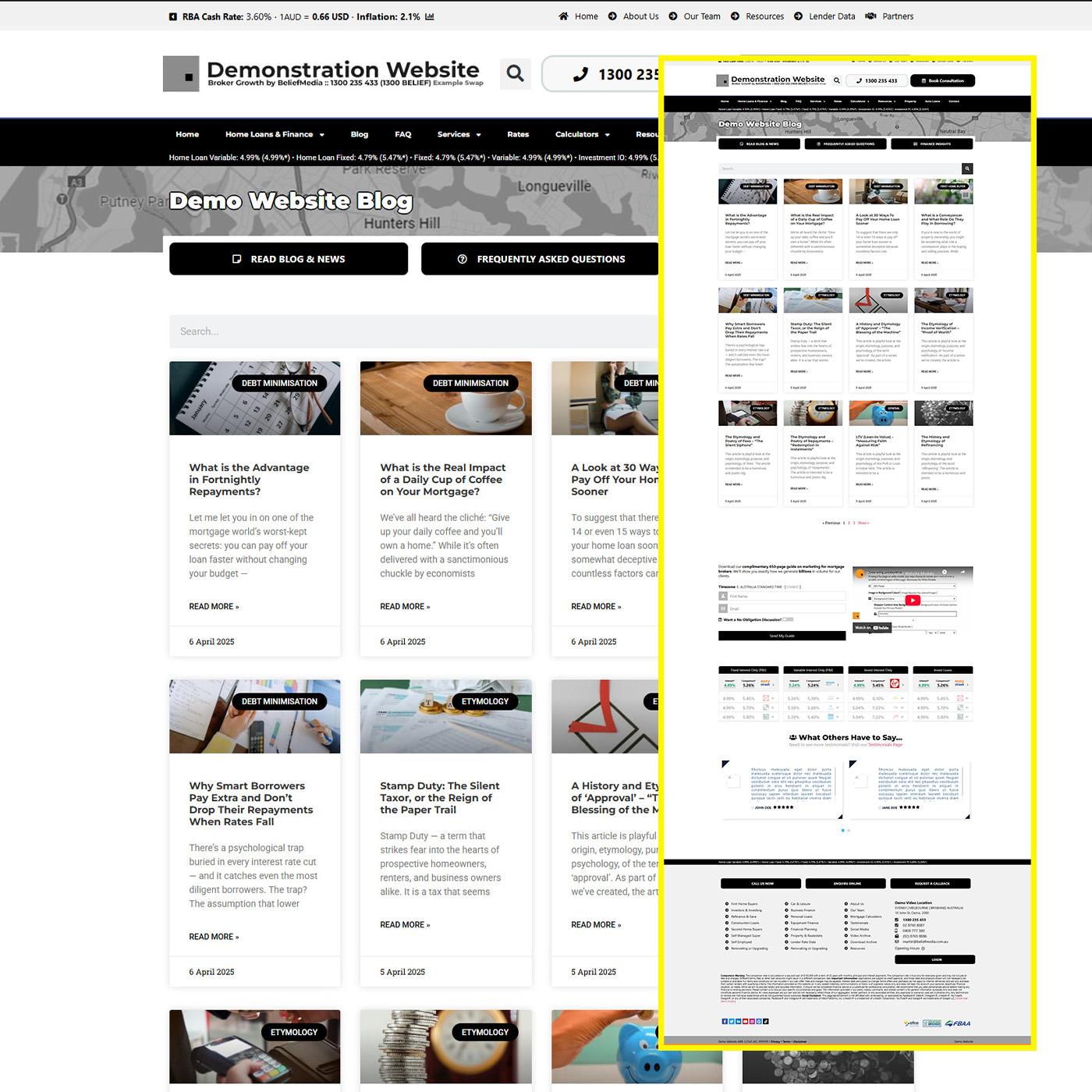
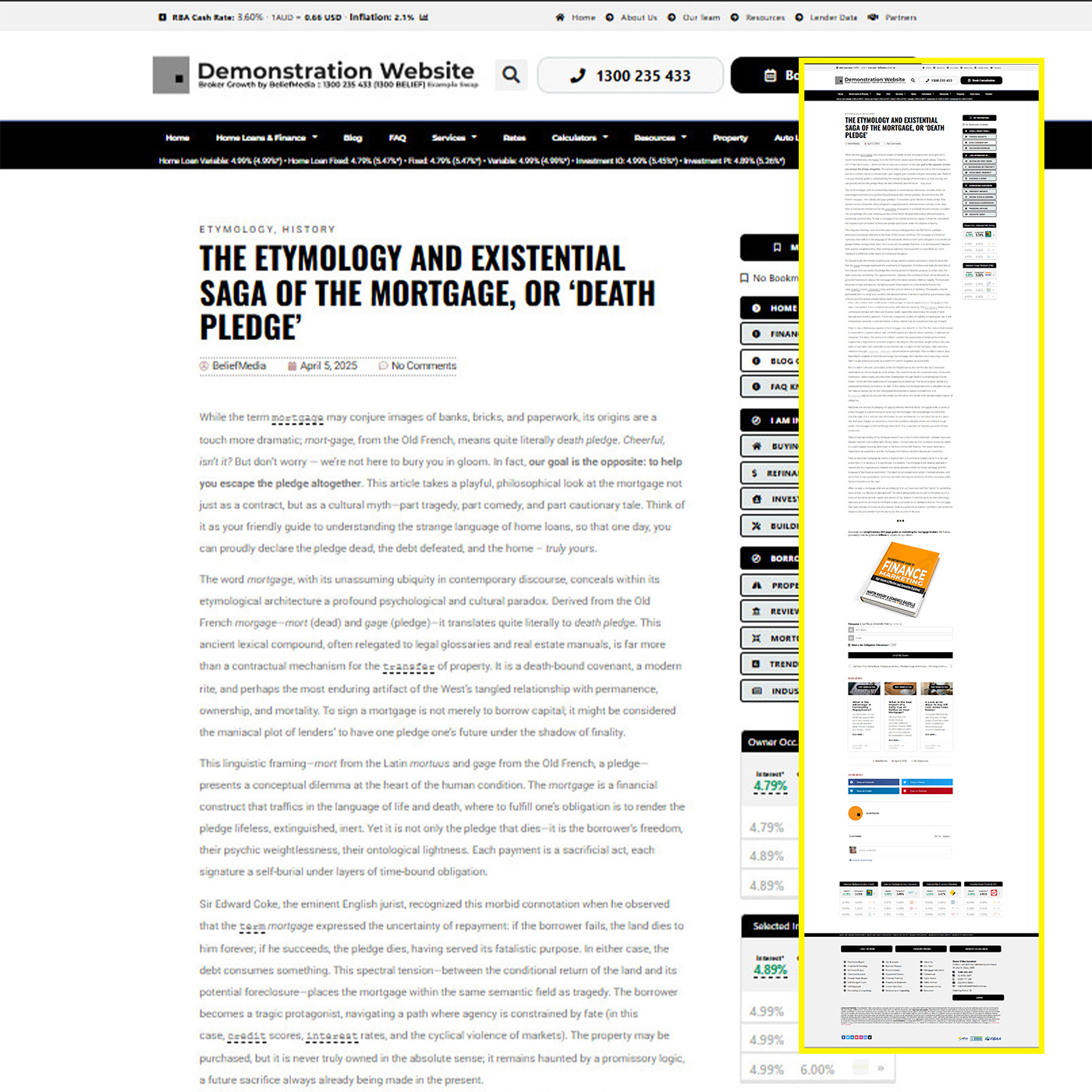
Company Blog: Your company blog is the platform upon which to build your authority for both your website visitors, Google, and other search engines. Your publish schedule, article quality, engagement, and other metrics, all contribute towards page expertise and authoritativeness - both required in order to garnish search traffic. The blog is supported by your FAQ and Insights module.
From a funnel perspective, the blog creates endless internal pathways. Articles can link to FAQs, primary borrowing pages, guides, videos, calculators, Formly forms, booking pages, landing pages, comparison tools, downloads, and related commentary. Blog articles can be used in Nexus email sequences, SMS follow-up, social campaigns, referral partner communication, post-settlement education, and reactivation campaigns. They can support every major borrower category, every stage of awareness, and every level of commitment. The blog becomes the reusable knowledge base that powers the rest of the website and funnel architecture.
The commercial value is significant. A well-maintained blog increases topical authority, supports organic visibility, improves internal linking, feeds social media, strengthens email marketing, answers objections, and gives prospects repeated exposure to the broker’s thinking. It keeps the website alive. It shows the business is active, informed, and engaged with the market. Most importantly, it turns the website from a static brochure into an ongoing publishing platform. In a modern mortgage broker website framework, the blog is not optional decoration; it is the intellectual engine of the brand.
The Insights Module
The Insights Module operates as its own dedicated archive, similar in structure to the blog and FAQ library, but with a more evidence-led and interpretive purpose. It is the natural home for case studies, market observations, borrower scenarios, campaign results, product comparisons, strategic commentary, behavioural insights, and supported analysis that requires more substance than an FAQ but may not belong in the general blog stream. Properly used, the Insights archive becomes a proof library: it shows how the broker thinks, how problems are assessed, how outcomes are created, and how expertise is applied in real situations. It can support primary borrowing pages, funnel emails, landing pages, social campaigns, referral partner communication, and post-appointment education by giving users access to deeper, more credible material. Where the blog demonstrates ongoing commentary and the FAQ archive answers practical questions, Insights should demonstrate judgement, evidence, experience, and applied intelligence. It is one of the strongest vehicles for showcasing E+AT because it allows the business to move beyond generic advice and show the reasoning, context, and professional standards behind its recommendations.
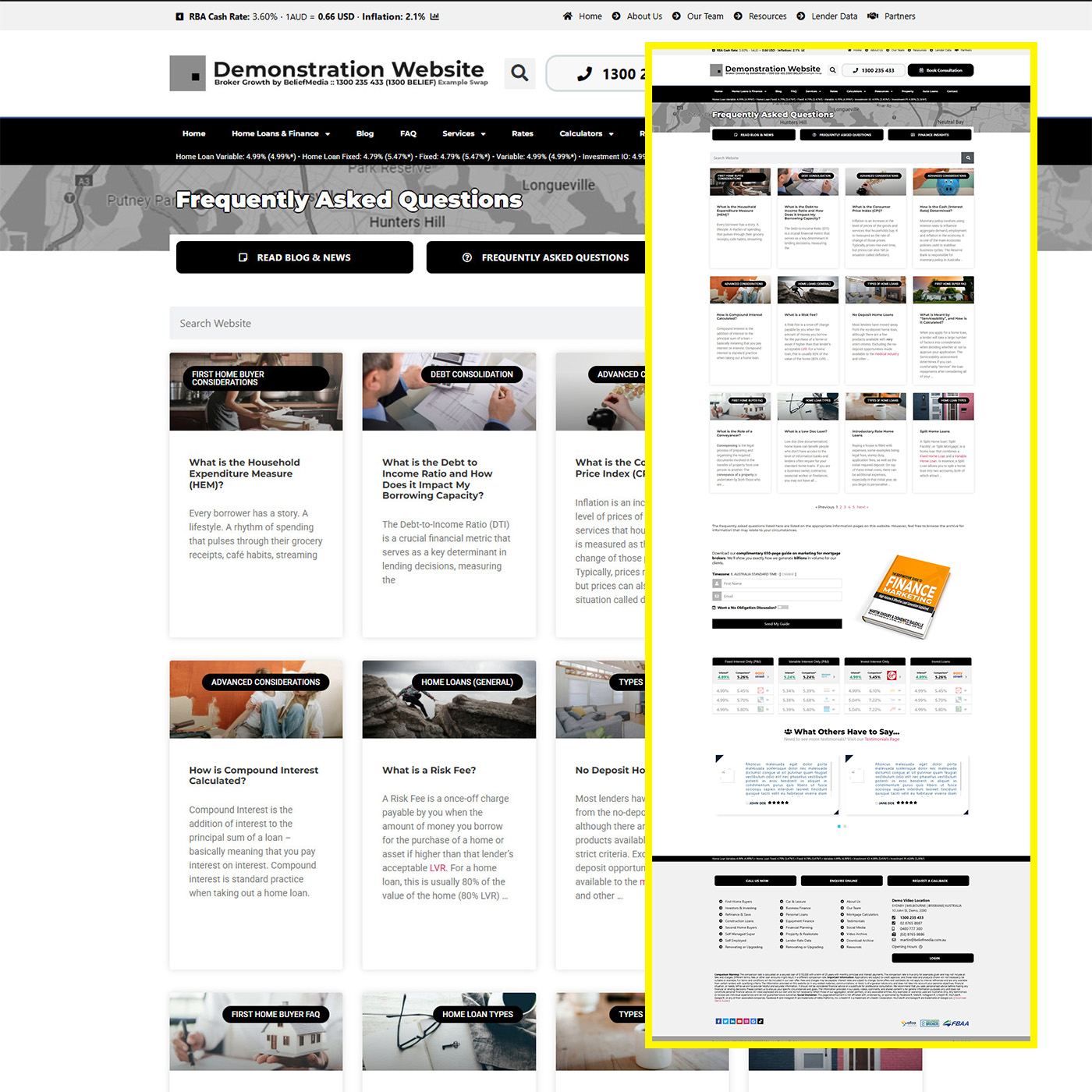
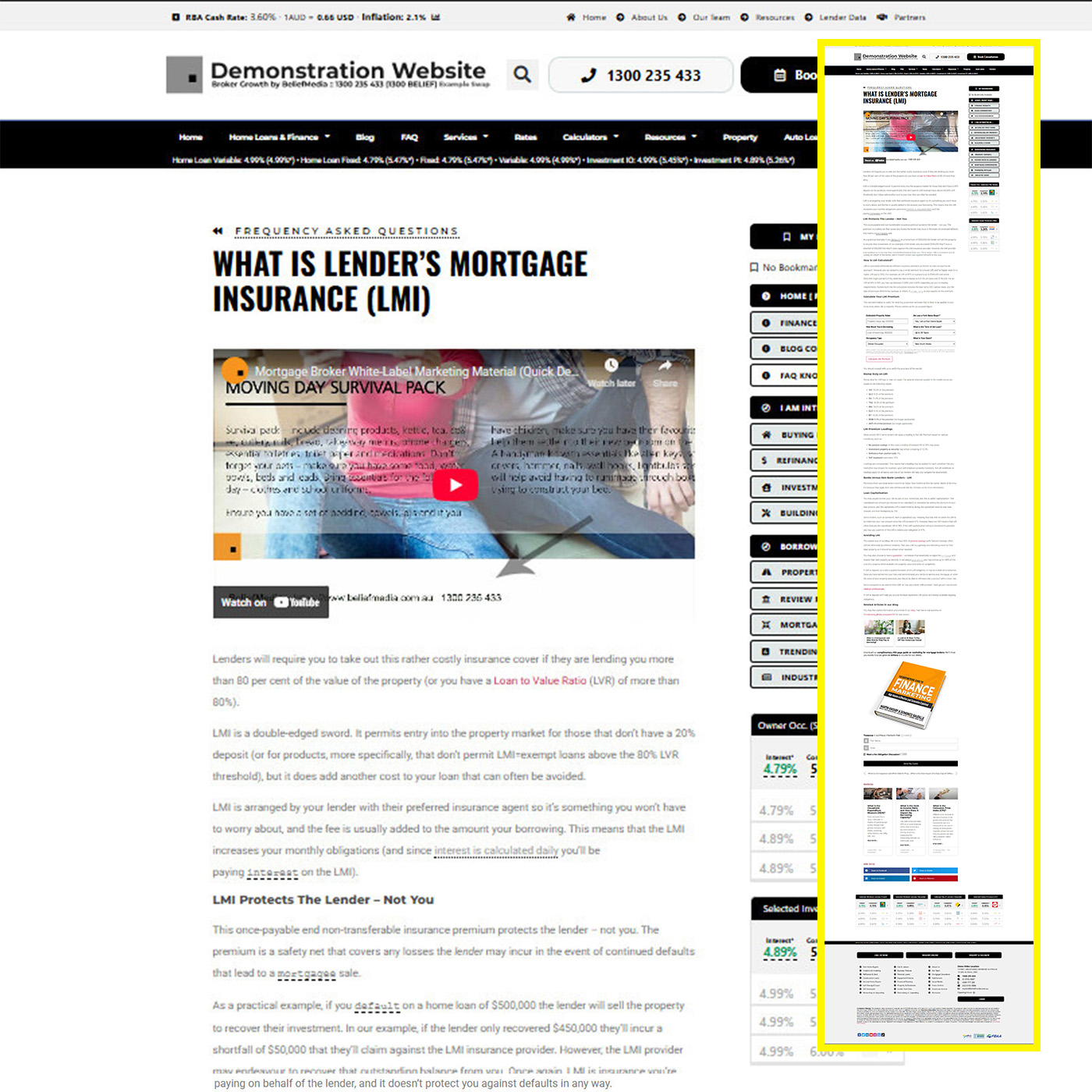
Blog, FAQ, and Insights: The Blog, FAQ Module, and Insight Module gives the broker a place to showcase the attributes of E+AT in a way that service pages cannot fully achieve. Expertise is demonstrated through technical clarity, lender knowledge, scenario analysis, and precise explanation. Experience is demonstrated through real-world patterns, client situations, market observations, and practical lessons. Education is delivered through guides, breakdowns, examples, warnings, checklists, and commentary that helps borrowers make better decisions. Authoritativeness is built through consistency, specificity, original thought, and the ability to interpret finance issues with more depth than competitors. Trust is earned when the reader repeatedly sees that the broker is competent, current, useful, and commercially honest. The blog gives these qualities room to breathe. The Blog is delivered with around 30 articles, and the FAQ module includes around 80 FAQs.
Booking and Calendar Pages
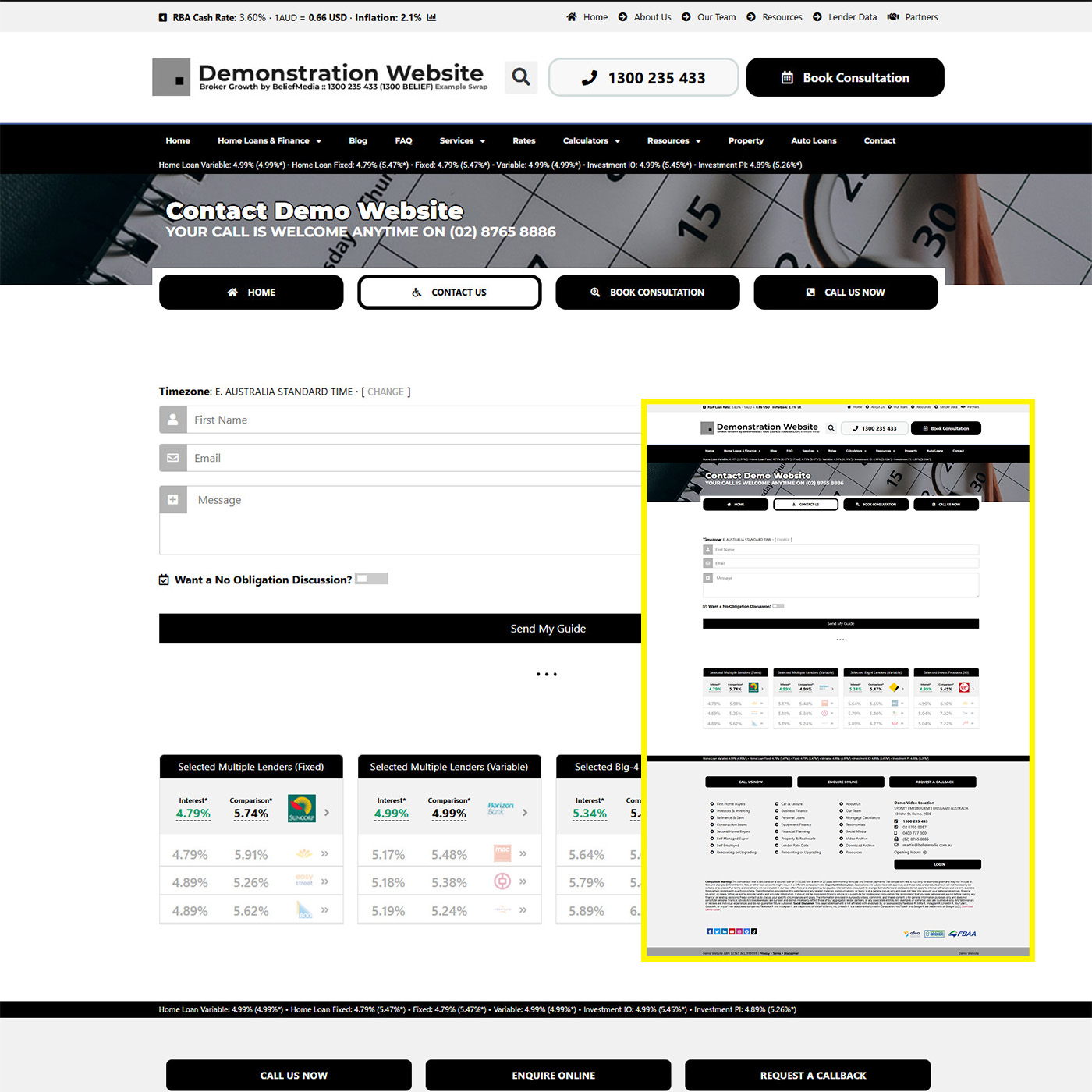
The standard Contact page and Booking page are still required, even in a website framework where every meaningful page includes a calendar-integrated form. They exist partly because users expect them, partly because they are useful destinations for shared links, and partly because external profiles and directories require them. Your Google Business Profile, for example, should have clear website, contact, and appointment pathways. Referral partners, email signatures, social profiles, printed collateral, SMS links, and general business citations also need conventional destinations that are easy to understand and easy to share. The Contact page should provide the broader communication pathway: phone, email, office or service area details, general enquiry form, and an optional calendar-integrated form for users ready to move directly into a conversation. The Booking page has a narrower purpose: it should present a full-page calendar experience where the user can select a time with minimal friction and maximum clarity.
These pages should not be treated as administrative dead ends. Every form on the Contact page and Booking page should inherit a redirect profile so the user is moved into the correct escalation pathway after submitting the form or making a booking. A general contact enquiry may redirect to a page that provides useful next steps, introduces core resources, and asks a clarifying commitment question. A booking should redirect to a pre-meeting pathway that confirms what happens next, provides preparation material, introduces video, and reinforces the decision to engage. This matters because the funnel starts here as much as anywhere else. A user who visits the Contact page or Booking page has already demonstrated intent, and that intent should not be wasted on a generic “thank you” message. The standalone pages satisfy convention, but the experience behind them must still behave like the rest of the framework: integrated, conditional, educational, and designed to escalate commitment.
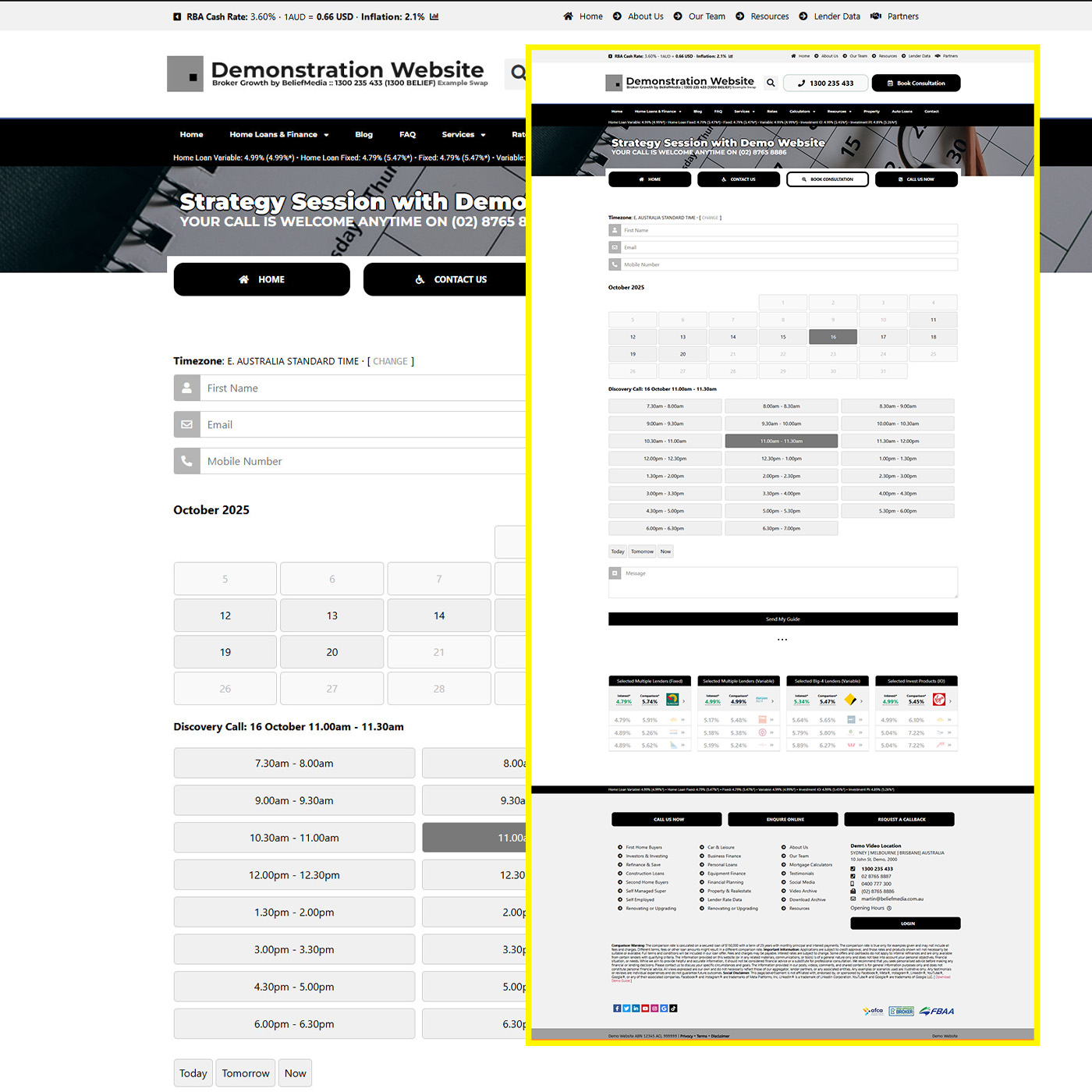
Integrated Calendars: The value of integrated Outlook calendars on every page is something that can be promoted nearly enough. It has a massive impact on the conversions you'll see from your website... assuming it has the traffic. You shouldn't be using Calendly or any other off-site third-party plugins; nor should you send traffic off-site for a booking. The integrated calendars permitted very highly refined conditional redirects and emails - a high-performing funnel feature.
Auto & Personal Finance
Auto finance and personal borrowing are not normally presented as primary mortgage broker services, but they can be included as dedicated borrowing pathways when they form part of the broker’s broader advice, referral, or finance strategy. These pages should not be treated as thin add-ons or generic “we also do this” pages. Each should include appropriate and relevant information for the product category: vehicle type, loan structure, deposit, repayment terms, secured versus unsecured options, business versus personal use, eligibility considerations, indicative process, and the risks or limitations the borrower should understand before proceeding. In the framework, these pages still operate like every other borrowing page: they educate, establish competence, provide a relevant Formly pathway, and move the user toward the next appropriate action. Whether they sit in the main navigation or in a secondary services area, they should still reinforce the broker’s capability and extend the website’s usefulness beyond residential lending.
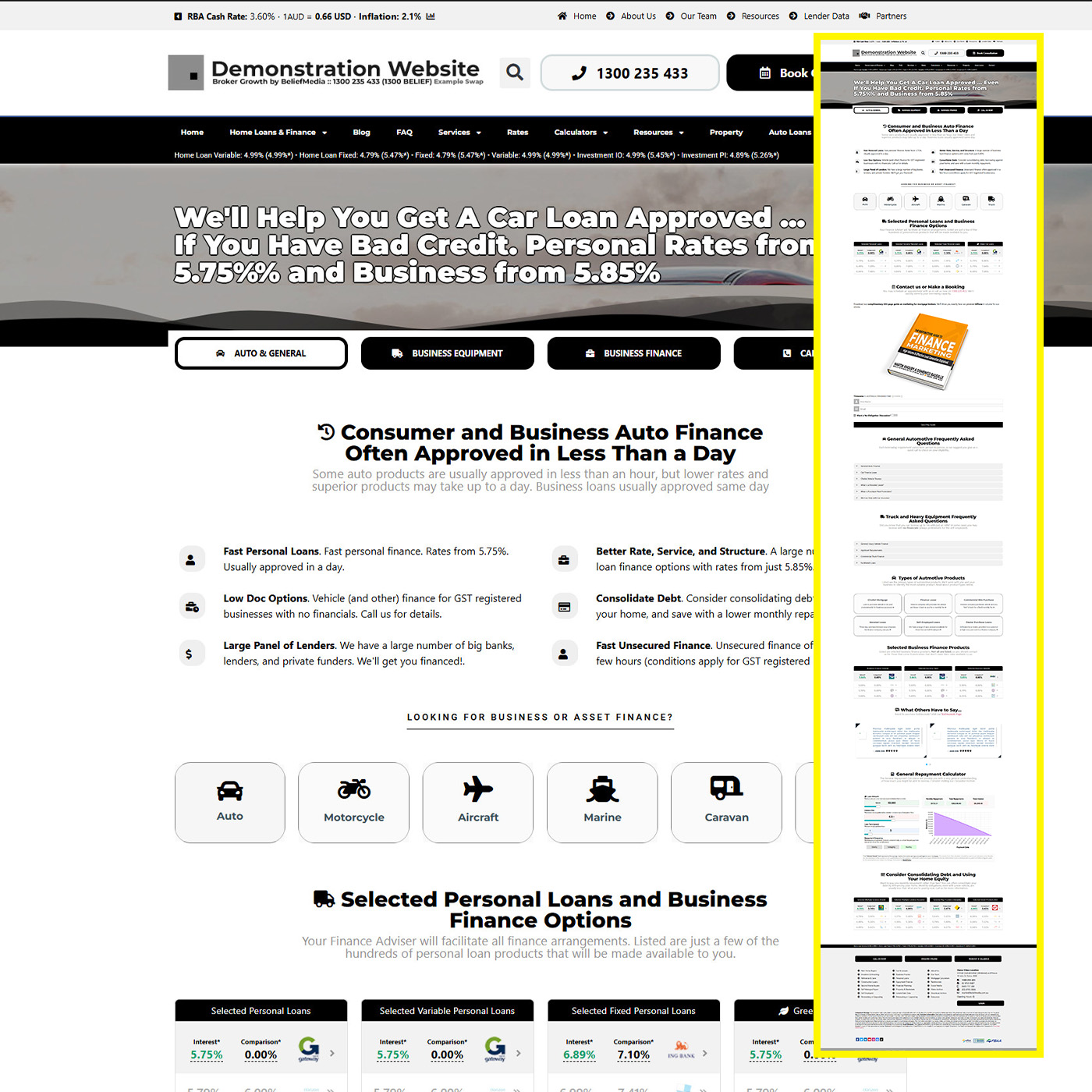
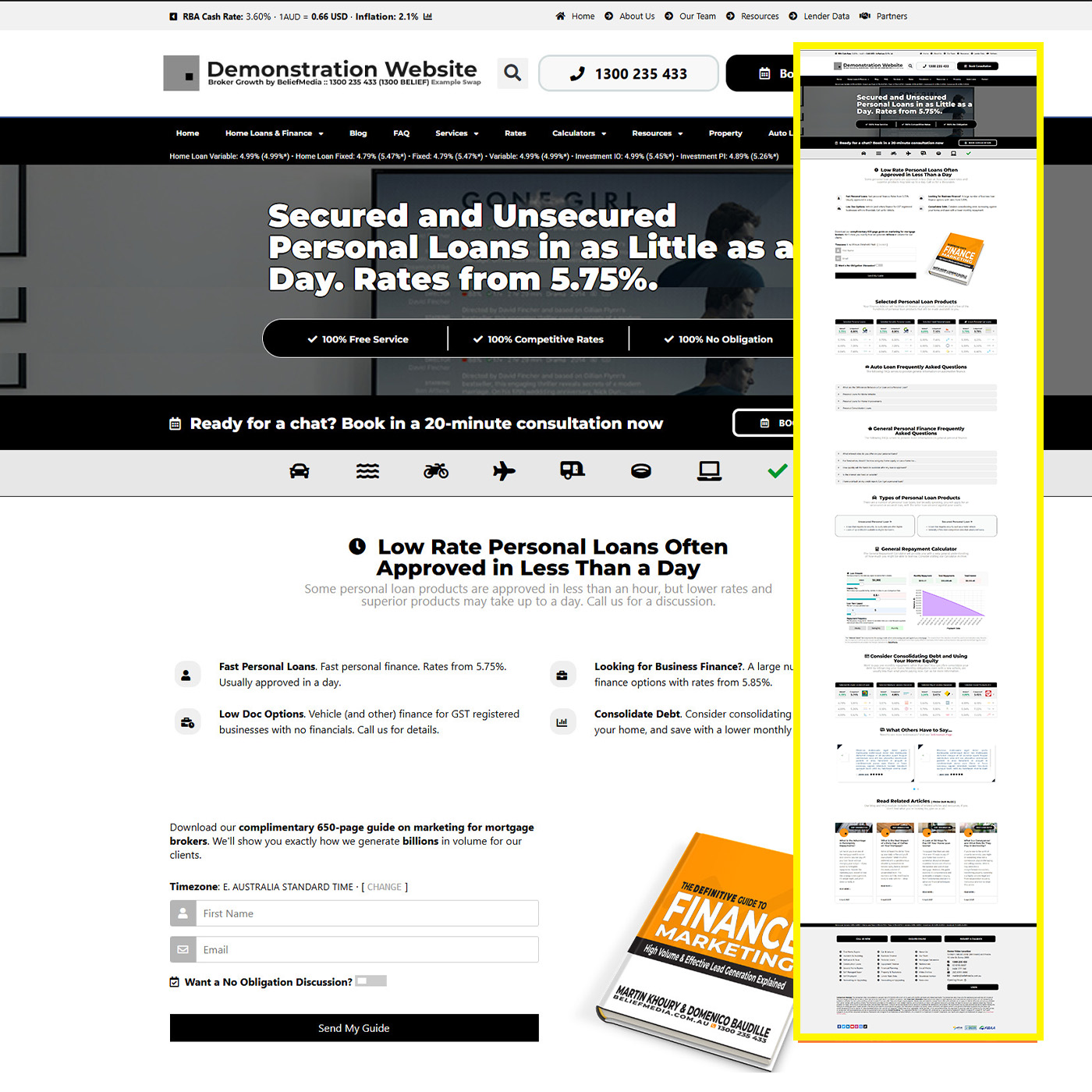
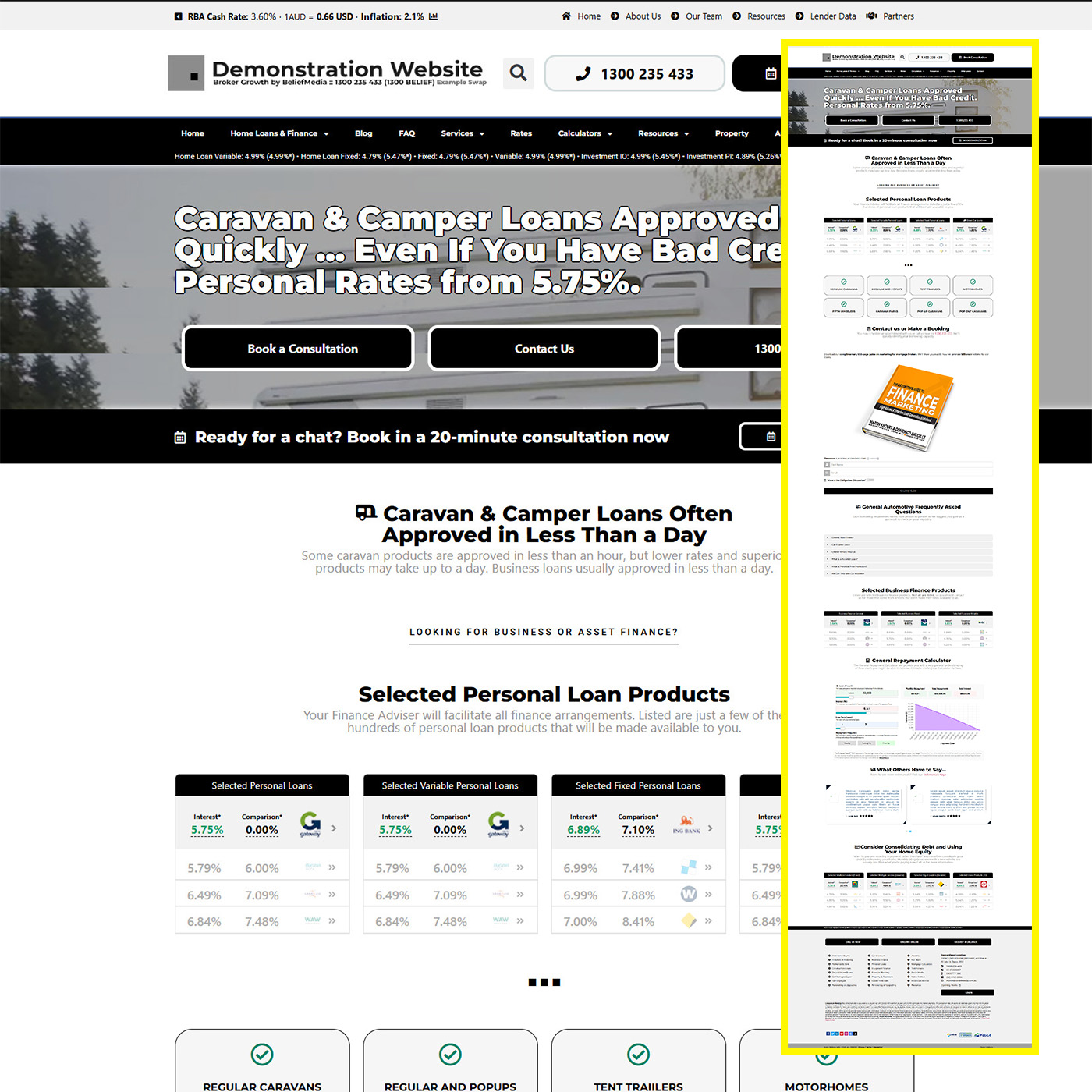
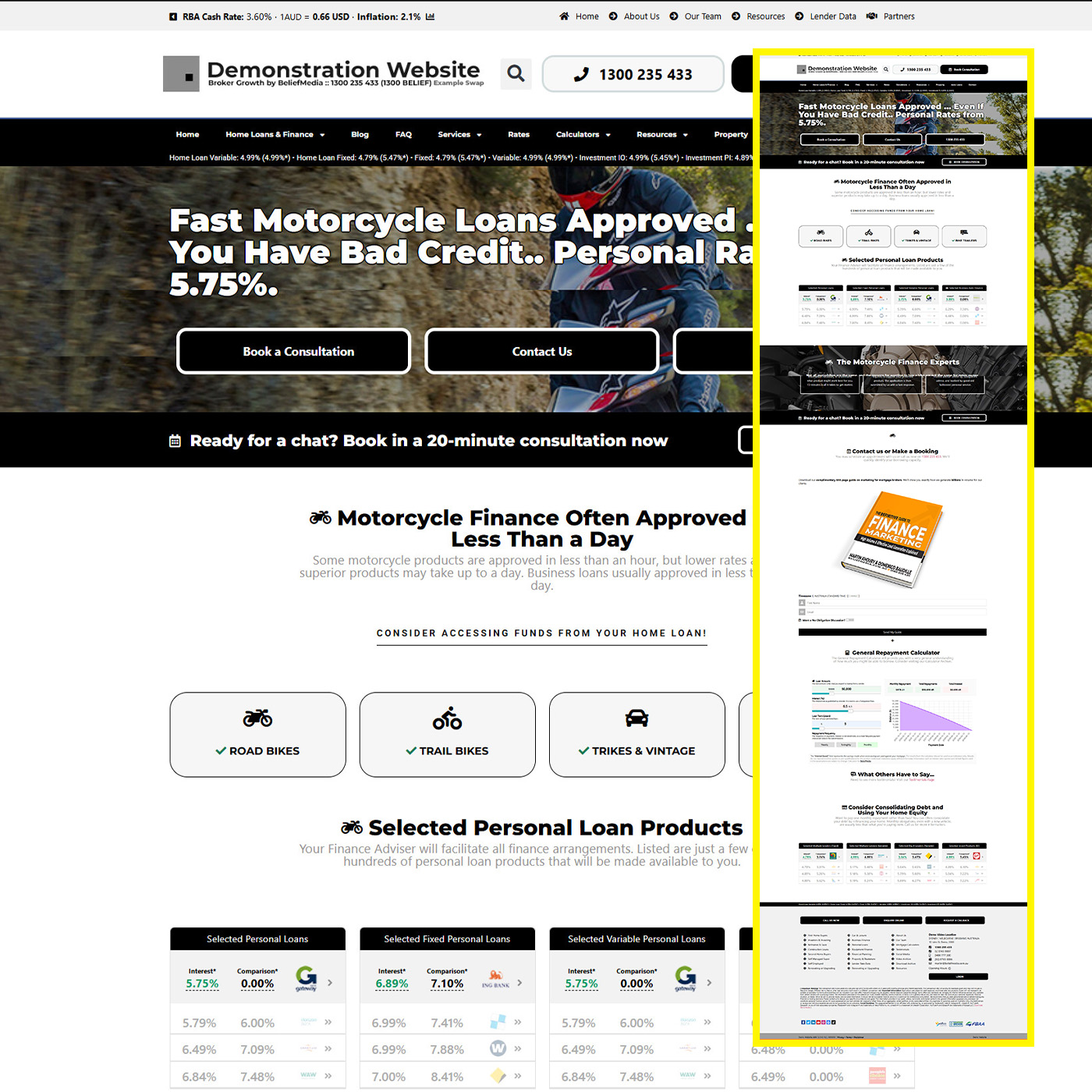
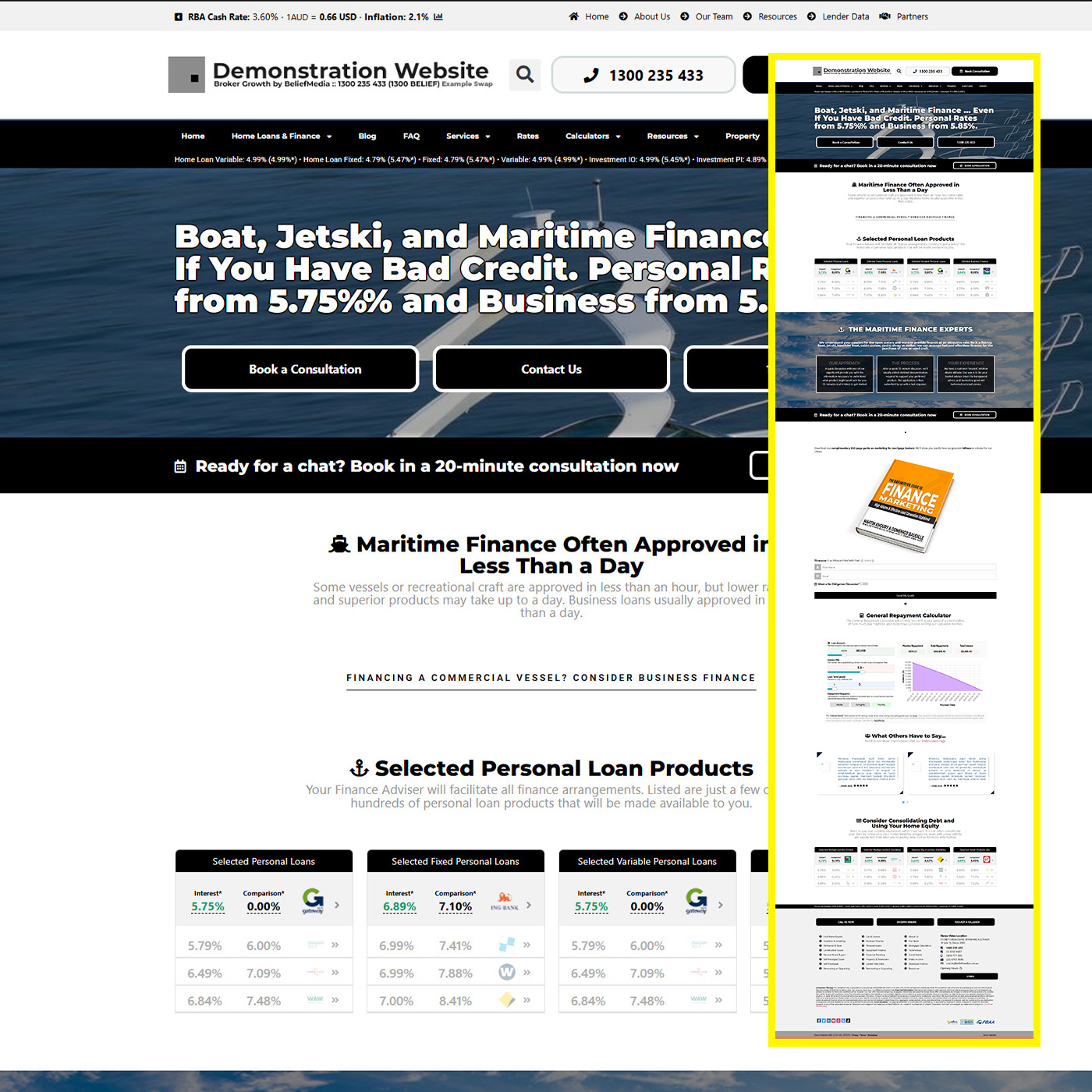
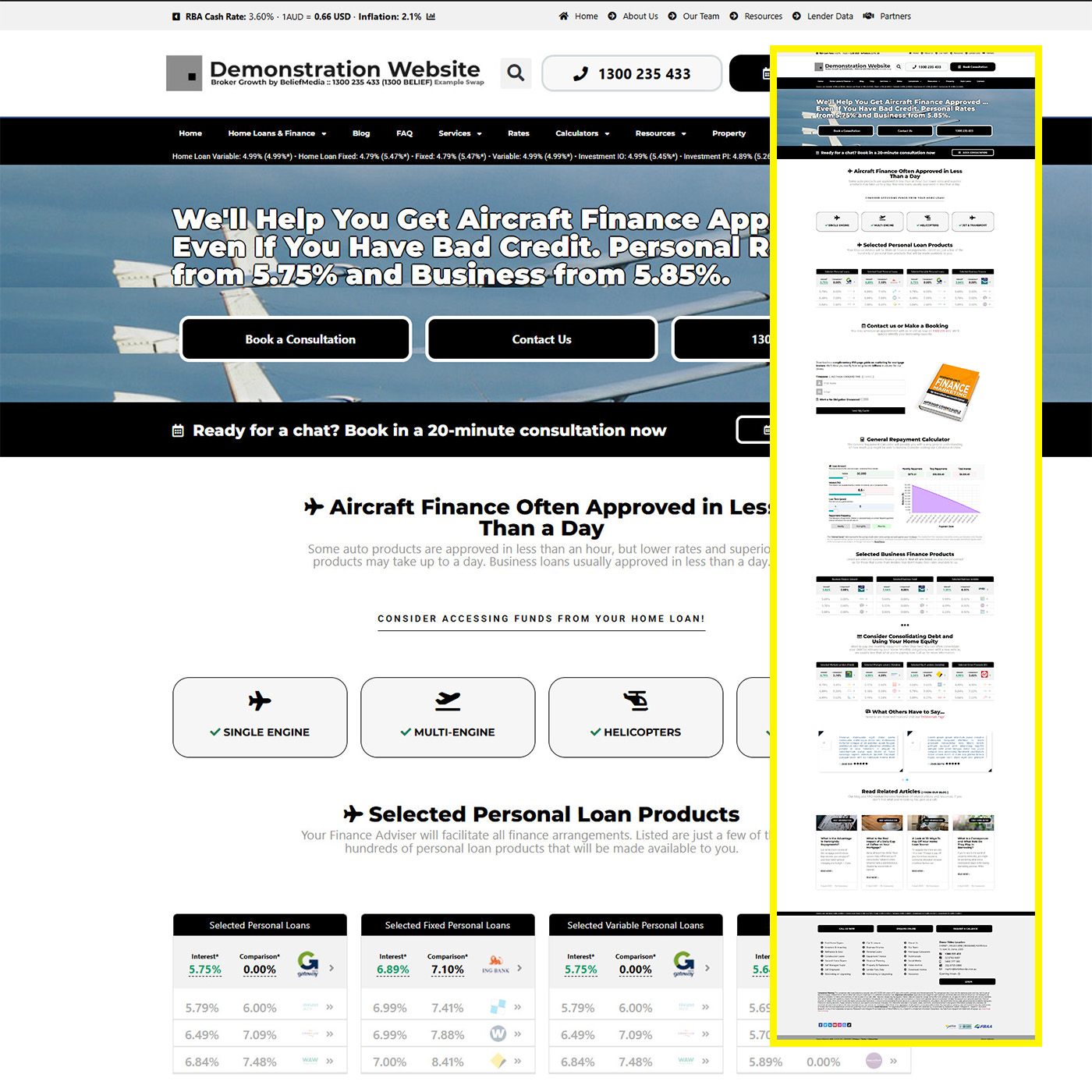
Auto and Equipment Finance: The automotive and equipment finance options are actually quite extensive with most pages hidden because of relevance. Certain pages can be moved to the fore if promonance is required.
Business and Equipment Finance
Business Finance may be included as a substantial specialist section of the mortgage broker website for brokers who choose to provide this service, and in our framework it is normally supported by around 25 dedicated pages covering the major business lending pathways. These pages may include unsecured business loans, secured business lending, equipment finance, commercial property finance, invoice finance, working capital, overdrafts, lines of credit, vehicle and asset finance, fit-out funding, franchise finance, cash-flow lending, tax debt funding, and other relevant commercial facilities.
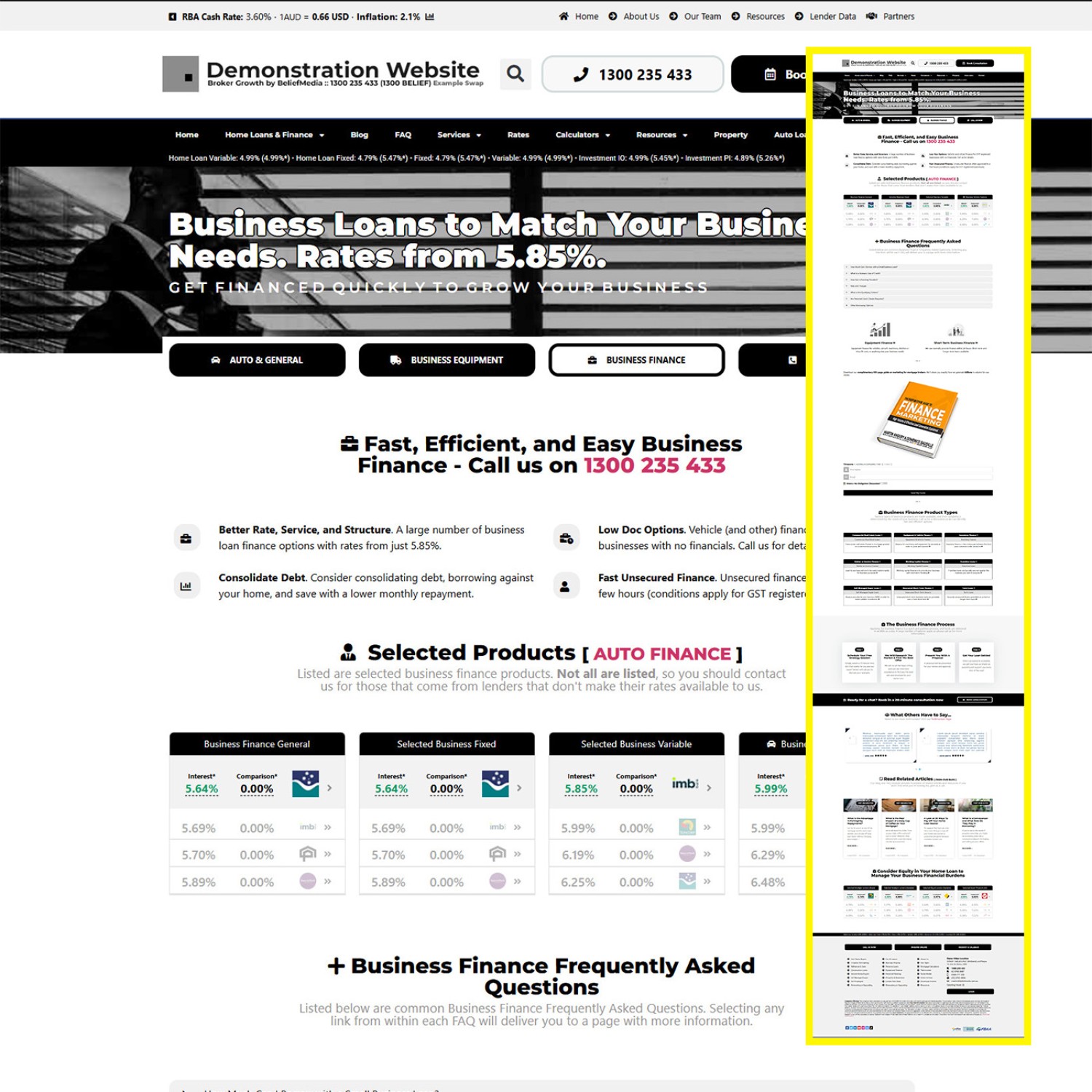
Pictured: If you're able, all borrowing of all types should be managed in-house. The relationship you develop during the process gives you cognitive leverage when it comes time for other borrowing in the future - including residential or self-employed finance. Business finance is quick and easy and takes a fraction of the time required to process a residential deal.
The purpose of business finance pages is not to bolt a vague “business loans” page onto a residential lending website, but to create a credible business finance resource that explains structures, use cases, eligibility, documentation, repayment considerations, security requirements, lender appetite, and risk. For brokers who operate in this space, the Business Finance section becomes a separate education and conversion ecosystem, complete with relevant Formly pathways, FAQs, articles, case studies, calculators where appropriate, and calendar-integrated enquiry options. It allows the broker to demonstrate commercial lending competence while keeping business borrowers inside a structured website pathway rather than forcing them into a generic contact process.
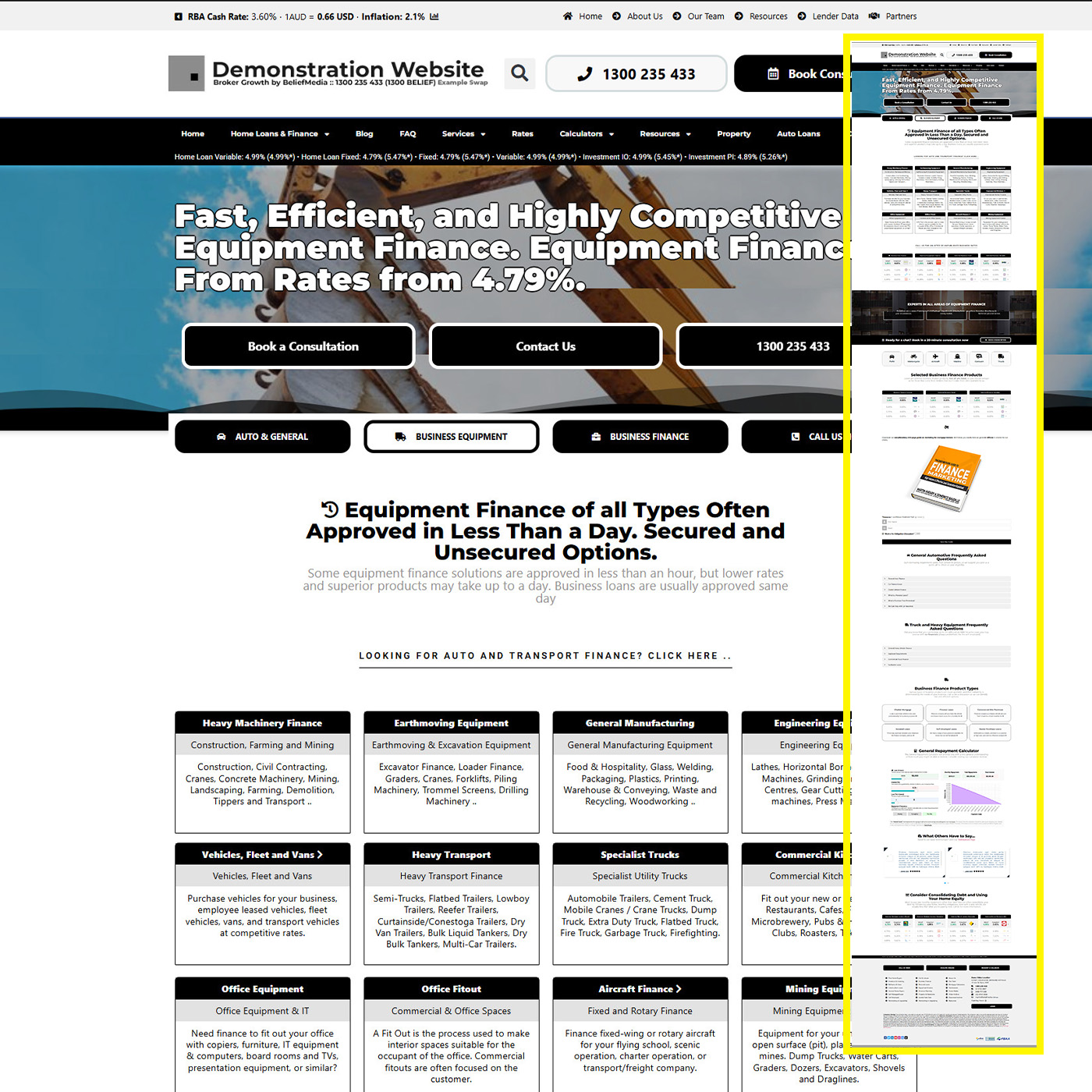
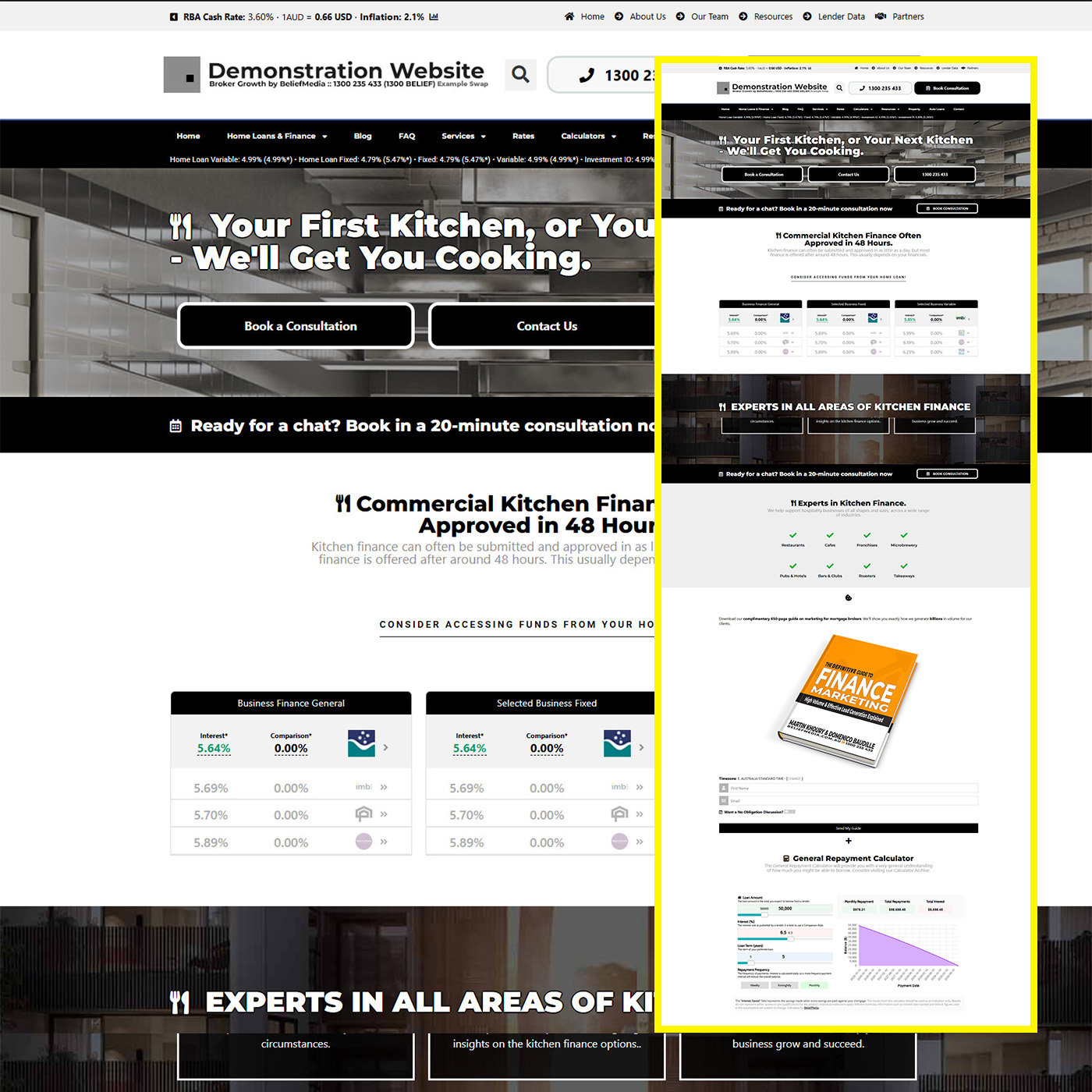
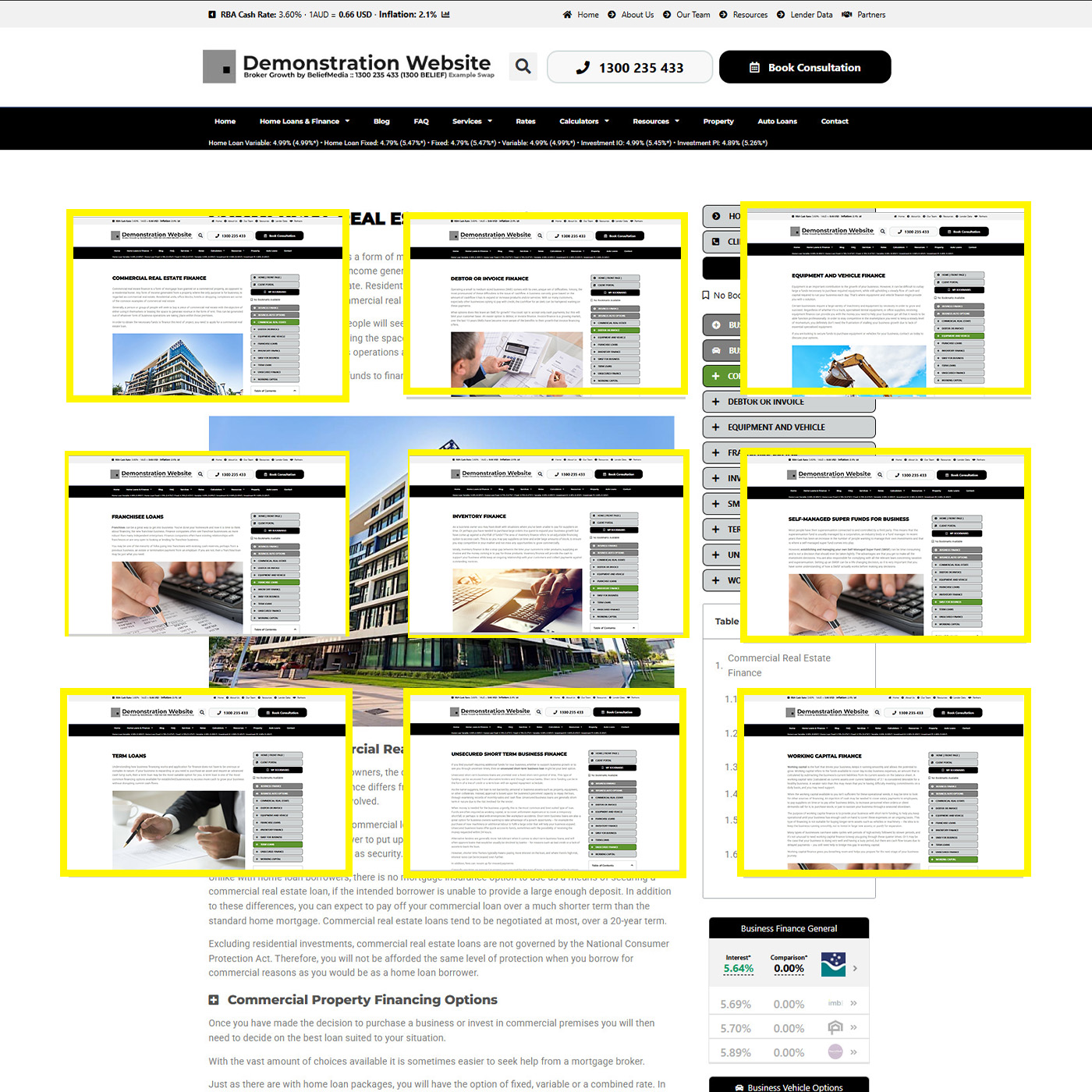
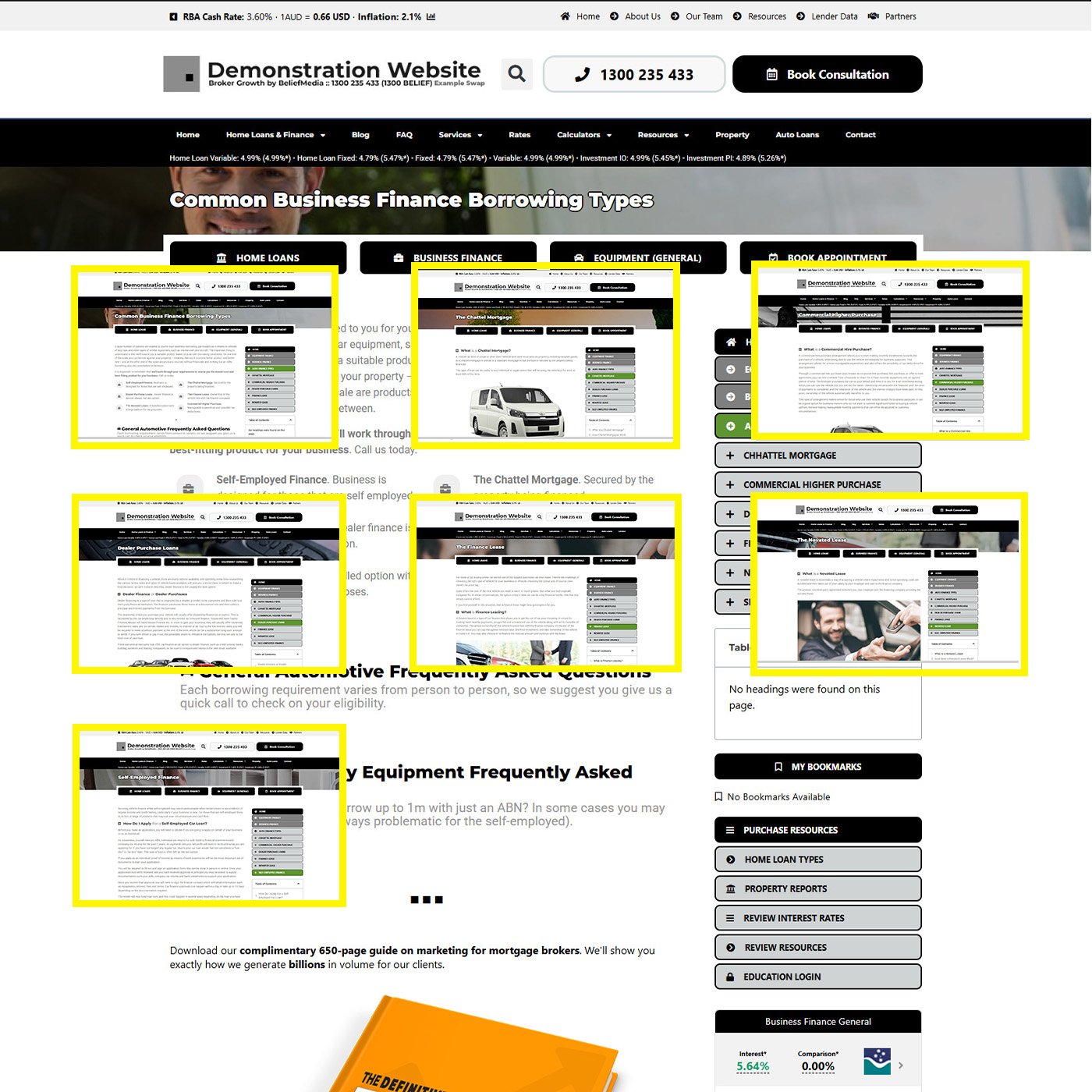
Business and Equipment Pages: The business module is rather significant with around 20 pages deep in the website architecture. If certain types of business borrowing is a focus, these pages can be migrated to an area of prominence.
The Glossary and Quotes Page
The Glossary and Quotes pages are secondary resources, but they still support the broader website framework in useful ways. The Glossary is normally presented as a single standalone page, but its greater value is in how glossary terms are applied throughout the website. Rather than interrupting the user journey by forcing a visitor away from the page they are reading, selected finance terms can be shown as tooltip links inside ordinary page content, articles, FAQs, insights, and borrowing guides. This gives the reader instant clarification without breaking flow. Terms such as LVR, LMI, offset account, redraw, comparison rate, discharge fee, pre-approval, serviceability, equity, guarantor, and fixed rate can be explained at the point of need, reducing confusion while keeping the user engaged with the original pathway. Because the glossary terms are managed from within Yabber, the system is extremely easy to maintain, update, and apply across the website. It adds an education layer that improves comprehension without adding visual clutter or unnecessary navigation.
The Quotes page has a different role. It is rarely linked from the website and is not intended to operate as a major conversion asset. Instead, it exists as a light-touch content resource that supports the entertainment component of the website’s broader E+AT framework. The page contains finance, business, money, leadership, and decision-making quotes from notable individuals, giving the website a small but useful cultural and editorial asset. Its more practical purpose is partner-site distribution: brokers can define a quote that is displayed on partner websites, and that quote can be updated at any time. This gives the broker a simple way to place a small piece of branded thought, financial perspective, or professional personality into external environments without creating a heavy content dependency. It is not a core page, but it still contributes to the website’s texture, personality, and broader content ecosystem.
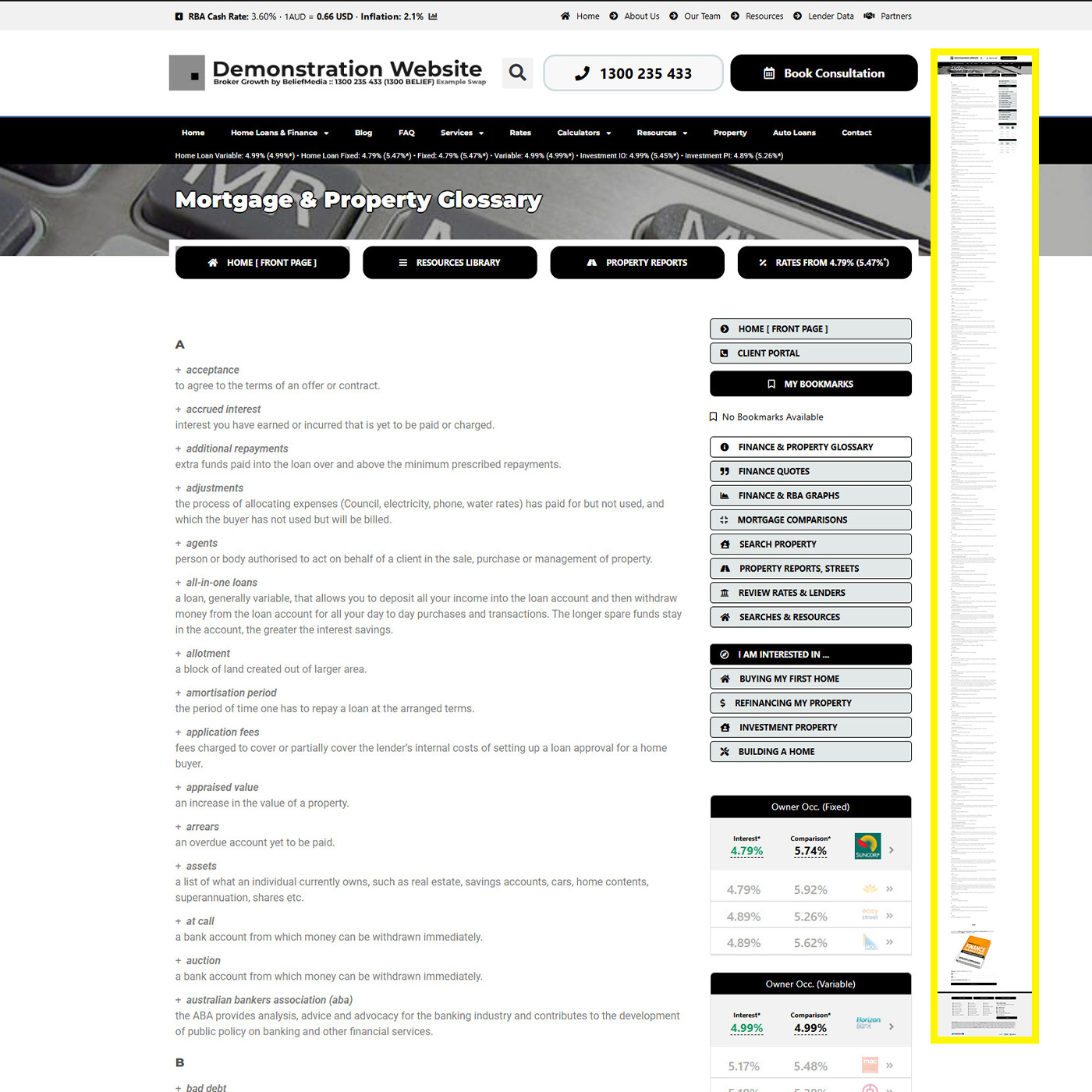
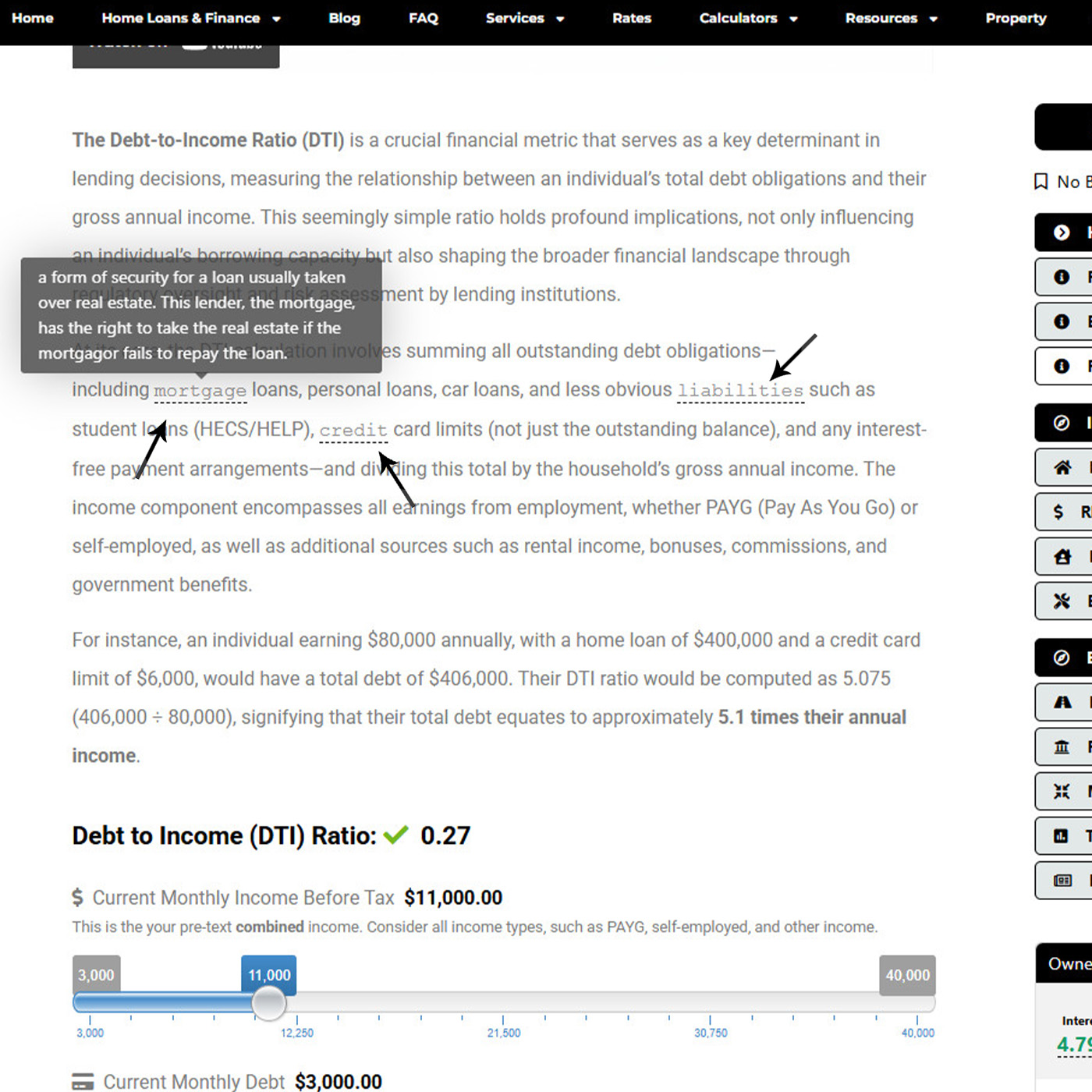
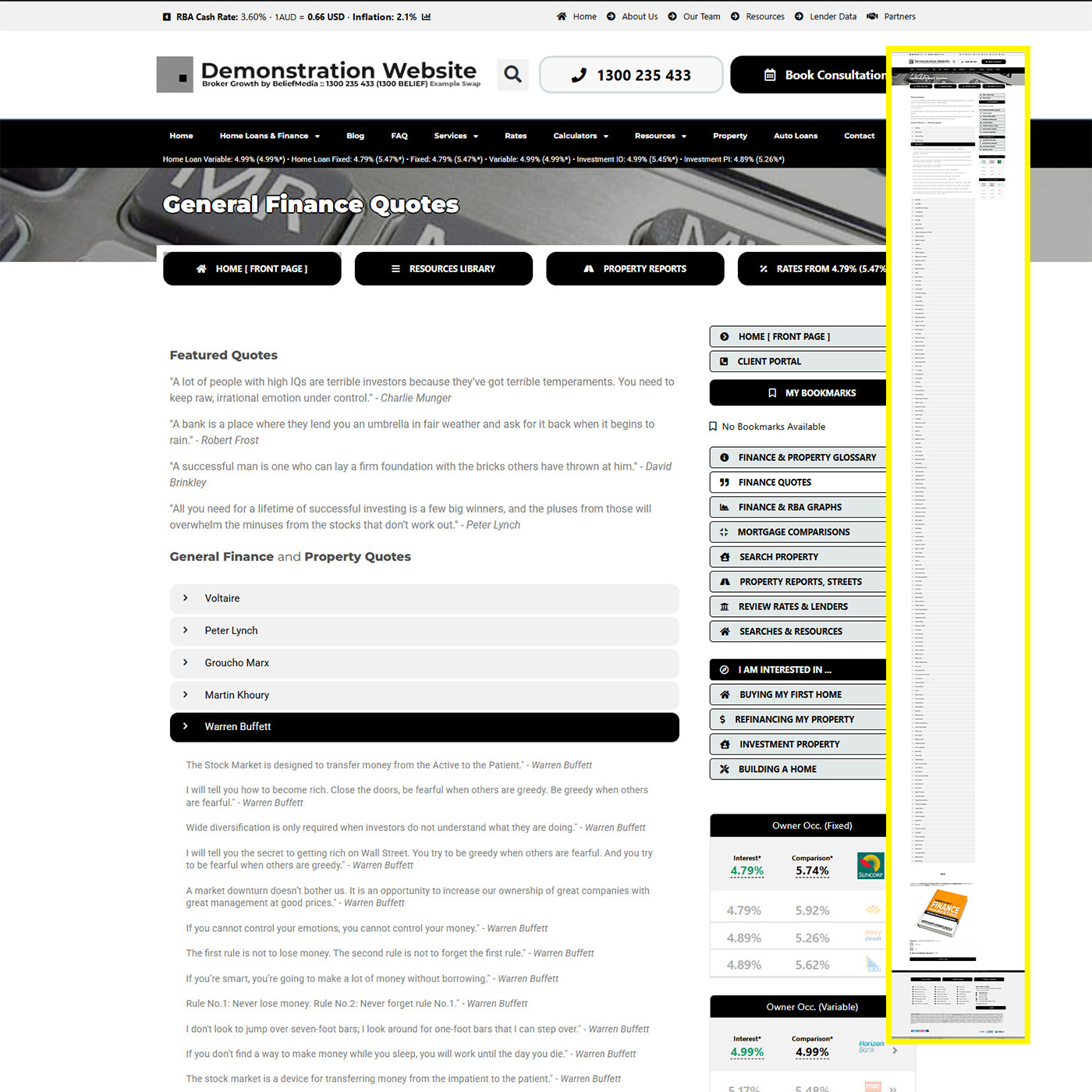
Glossary and Quotes: The Glossary is managed in Yabber. By default, about 250 definitions apply. A table in Yabber allows you to selective choose those terms that will carry an on-page modal tooltip with the definition - this prevents the user from vacating the page of interest and provides immediate context for complex words.
The Calculator Library
Mortgage calculators are a necessary part of the mortgage broker website framework, but they should be understood realistically. They are required because users expect them, Google expects them, and a finance website that claims lending expertise should provide practical tools that help borrowers model repayments, borrowing capacity, loan scenarios, LVR, stamp duty, refinance outcomes, extra repayments, offset benefits, and related financial questions. However, calculators are unlikely to deliver significant organic traffic on their own. Every broker has them. Aggregators have them. Banks have them. Major comparison sites have them. Large groups often invest heavily in calculator promotion, backlinks, page speed, schema, design, and supporting content, meaning independent brokers are often pushed into the darker, less visible regions of the search results. Calculators are useful, but they are rarely a standalone SEO weapon.
Their real value is in authority, completeness, and funnel support. Google’s E-E-A-T expectations require a finance website to demonstrate expertise, experience, authoritativeness, and trust, and calculators help satisfy part of that expectation by showing that the site provides functional, borrower-focused tools rather than thin service descriptions. A calculator page may not win the search war by itself, but it strengthens the website’s overall credibility, supports internal linking, improves user engagement, and gives articles, FAQs, borrowing pages, and email sequences something useful to reference. A refinance article can link to a repayment calculator. A first-home-buyer page can reference borrowing capacity, deposit, LVR, and stamp duty tools. A fixed-rate-expiry campaign can link to repayment comparison tools. In that sense, calculators are less about ranking individually and more about supporting the broader education and conversion architecture.
For that reason, the calculator module is quite large. It exists because a serious finance website should provide a broad library of tools that reflect the complexity of borrower decision-making. The module supports the educational layer of the website, reinforces authority, and gives users a practical way to interact with lending concepts before making contact. That said, the calculator module is due for a full update. The next version should not merely present generic calculator widgets; it should operate more intelligently inside the broader framework, with stronger page integration, better contextual pathways, clearer explanations, improved mobile usability, more relevant conversion prompts, and tighter alignment with Formly, borrowing pages, FAQs, articles, and funnel assets. Calculators are not the centre of the website, but they remain an important credibility and utility layer in a complete mortgage broker website.
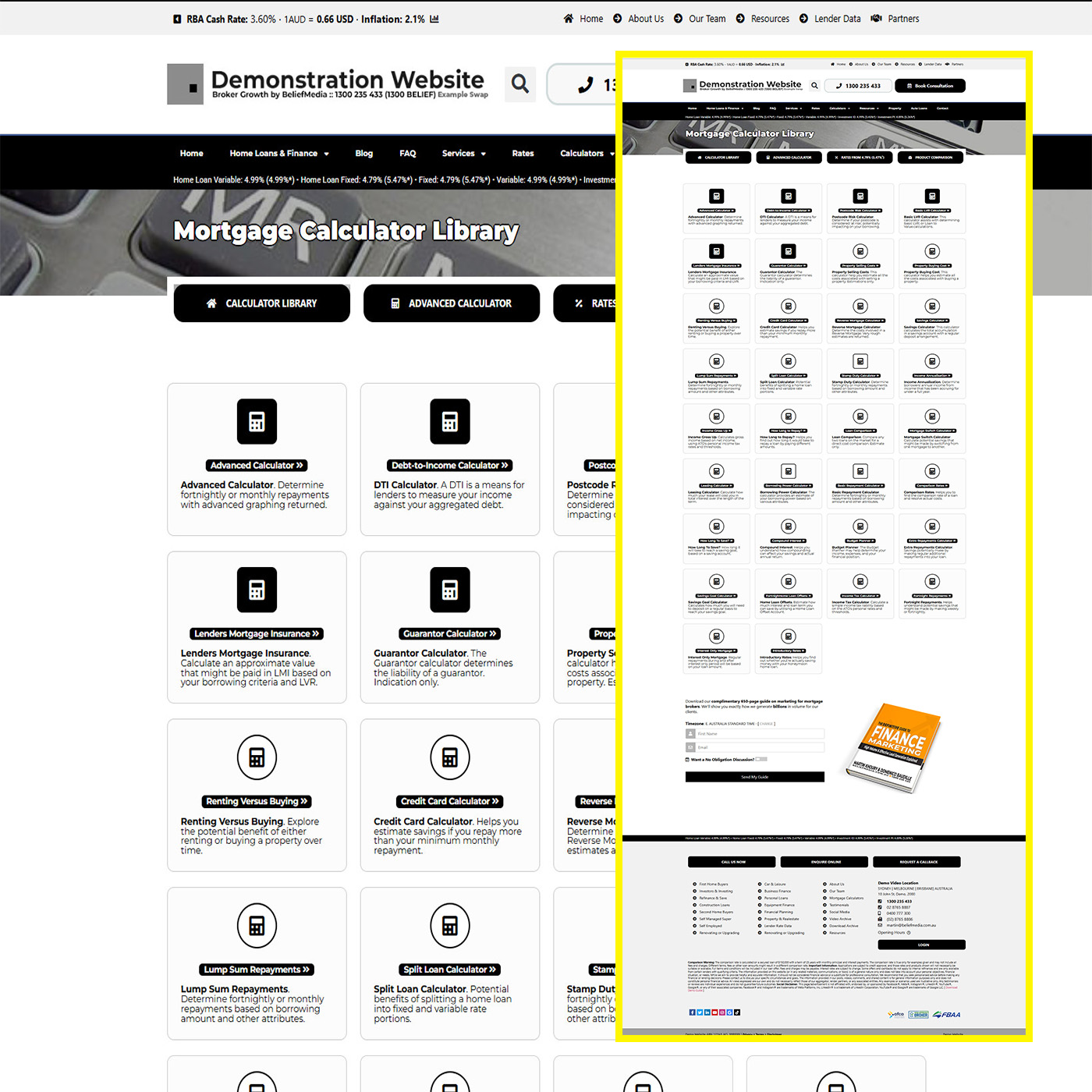
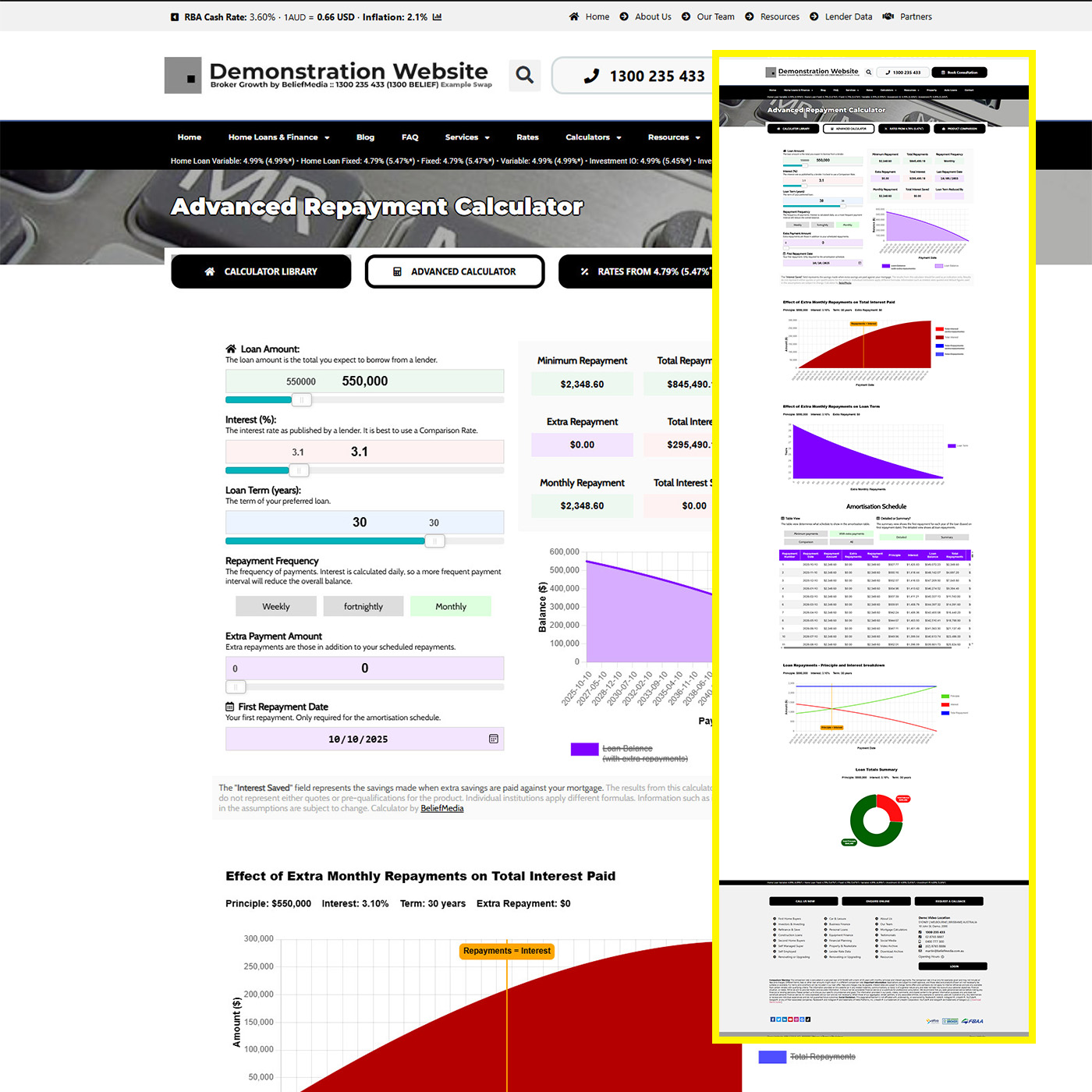
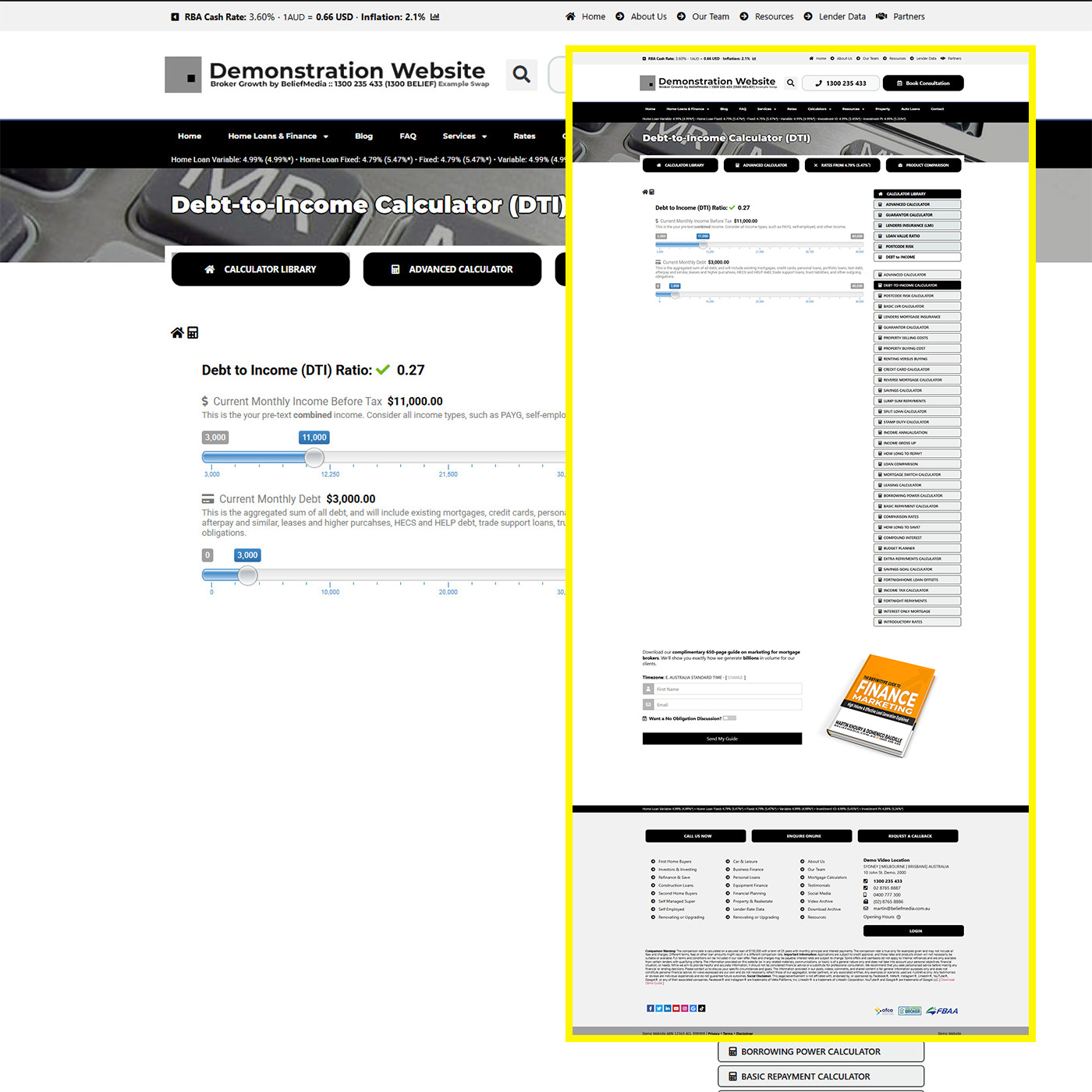
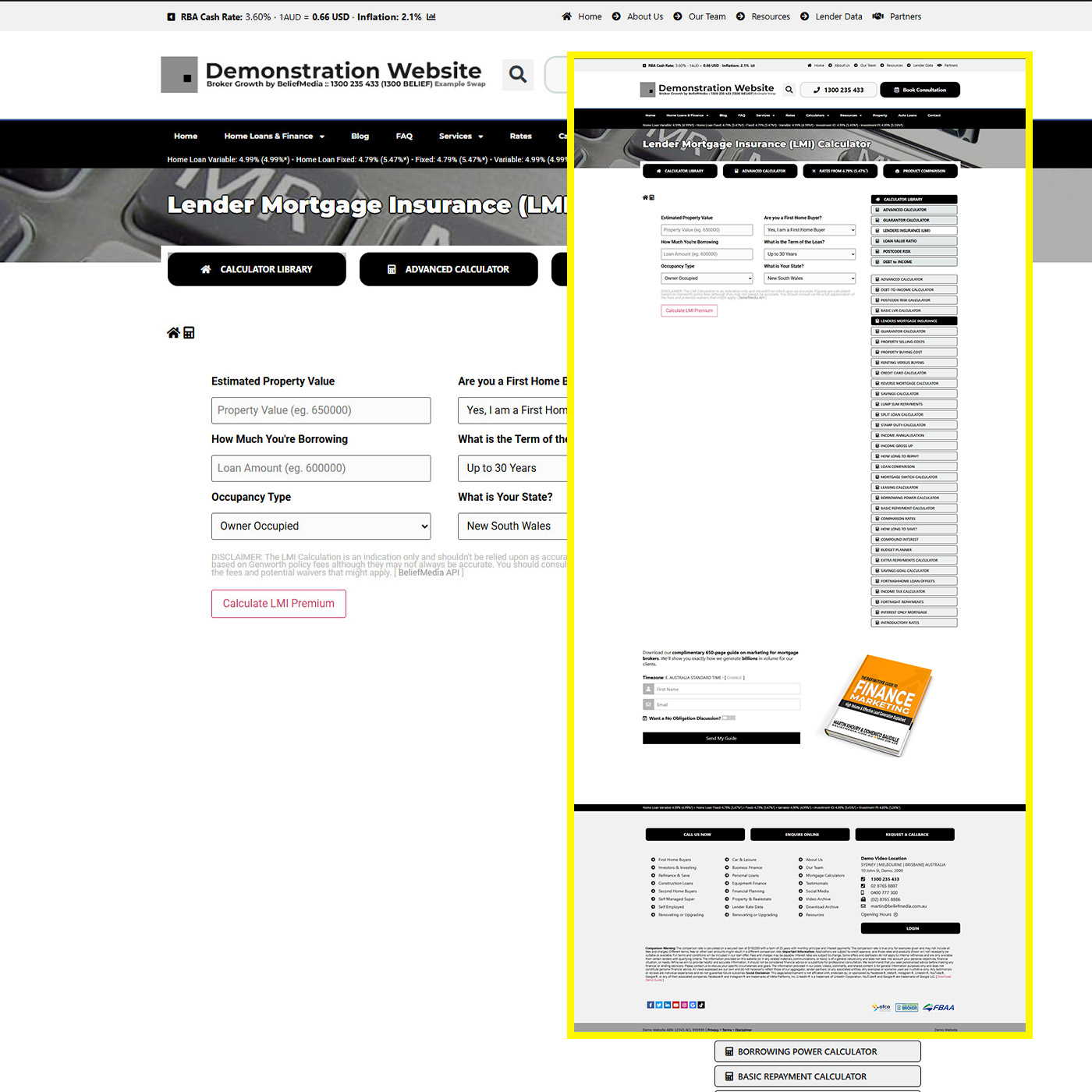
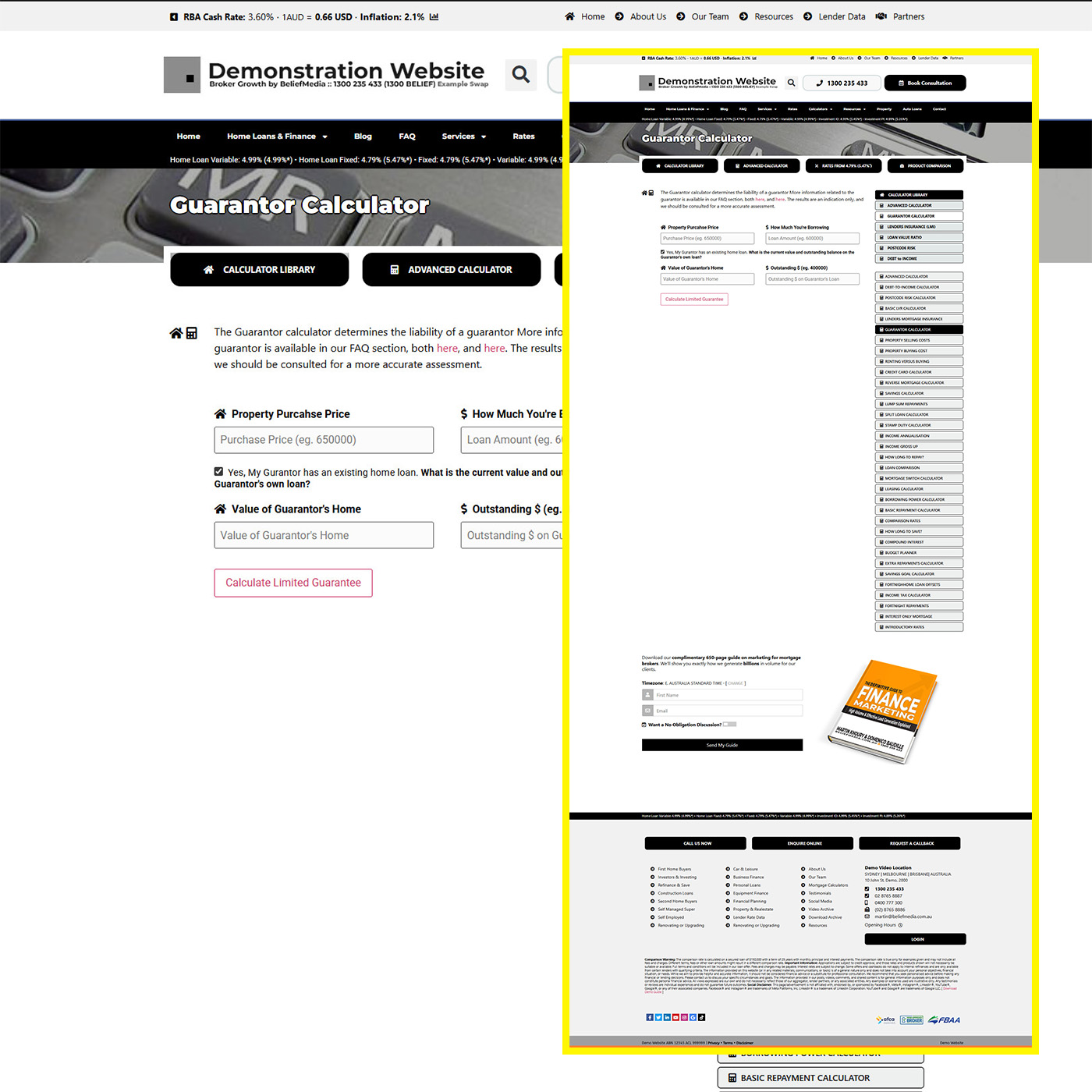
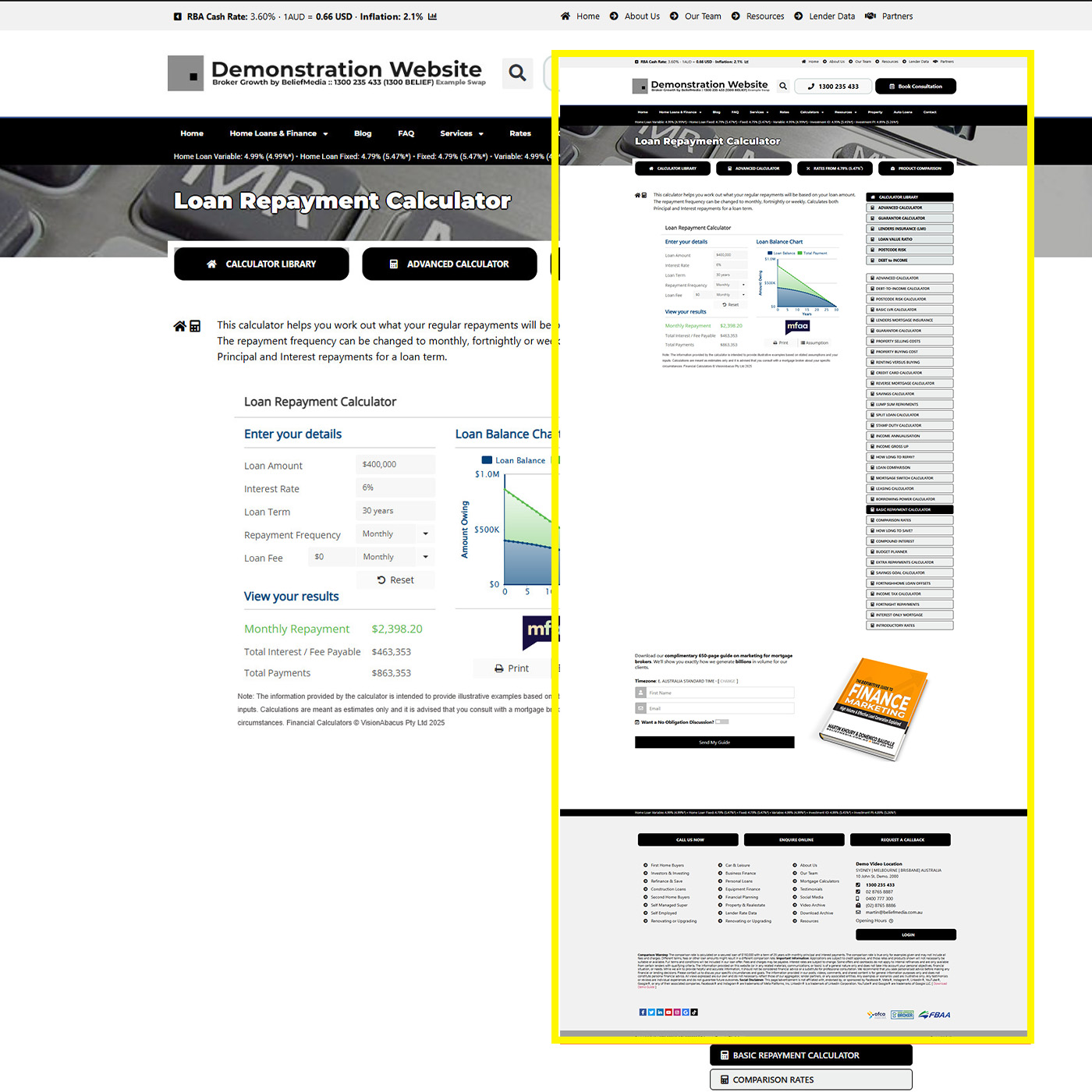
Calculator Library: Around 40 calculators are returned in the library. At the time of writing, we're moving through and completely rewriting each calculator to be consistent or exceed the highest standard in the industry. Some brokers pay a subscription for 'premium' calculators - we don't want our brokers to consider this nonsense.
Privacy, Terms, General Disclaimer, and Compliments Pages
Privacy, Terms, General Disclaimer, and Compliments pages are not decorative legal pages; they are necessary trust and compliance assets in a finance website. The Privacy page explains how personal information is collected, used, stored, disclosed, and protected, which is particularly important on broker websites because forms, calculators, downloads, CRM integrations, email subscriptions, SMS triggers, calendar bookings, and analytics may all involve personal or behavioural data. In Australia, privacy obligations may arise under the Privacy Act and Australian Privacy Principles depending on the business and data-handling context, while advertising and website representations must also be managed carefully to avoid misleading or deceptive conduct under Australian Consumer Law and financial-services advertising standards. The Terms page defines acceptable website use, intellectual property, limitations around information use, and the boundaries between general website content and personal advice. The General Disclaimer page reinforces that website material is general in nature, does not account for a user’s personal objectives, financial situation, or needs, and should not be treated as a substitute for broker assessment or credit advice. These pages should be reviewed professionally where required, but from a framework perspective they are mandatory credibility assets because they show the broker takes disclosure, privacy, compliance, and consumer protection seriously.
The Compliments page also has a compliance and trust function. It provides a formal location for users to submit positive feedback, testimonials, service comments, or experience-based remarks, and it helps separate genuine client feedback from casual website enquiry. Where complaints handling is required, financial firms generally need proper internal dispute resolution pathways before a matter proceeds externally, including through AFCA where applicable. Compliments, complaints, feedback, and dispute information should therefore be treated as part of the business’s governance layer, not as an afterthought. Separately, the footer general disclaimer is not the same as the standalone General Disclaimer page. In our framework, the footer disclaimer is a robust and conditional tool: it can change or expand depending on the page, content type, calculator, product reference, advertising pathway, rate data, form, comparison output, or campaign context. That distinction matters. The legal pages provide stable disclosure architecture; the conditional footer disclaimer provides page-level risk control, contextual warnings, and dynamic compliance support where a generic footer statement would be inadequate.
Since the sceenshots were taken, we've added a 'Compliments and Concerns' page to satisfy the AFCA requirements - previously in the Privacy Policy.
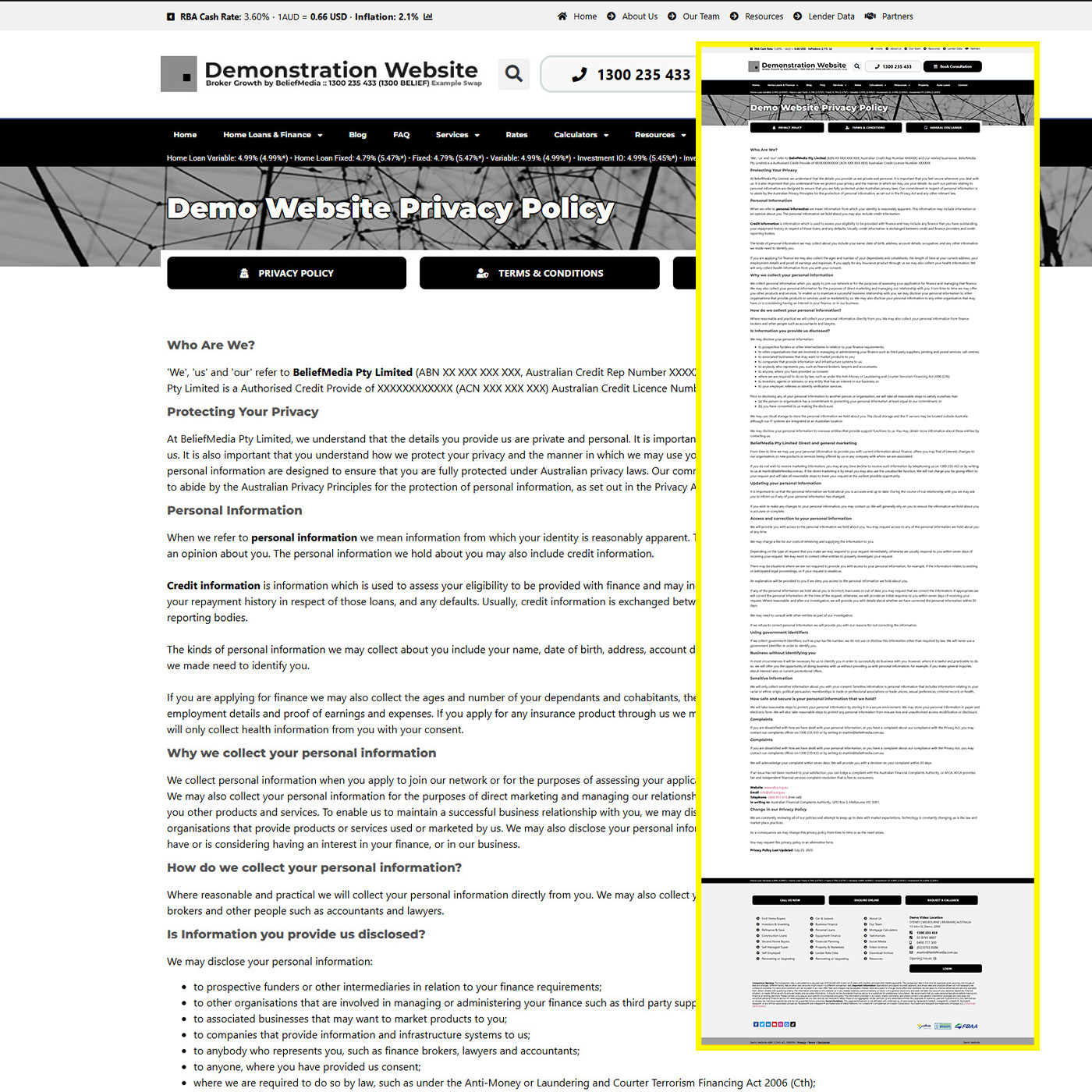
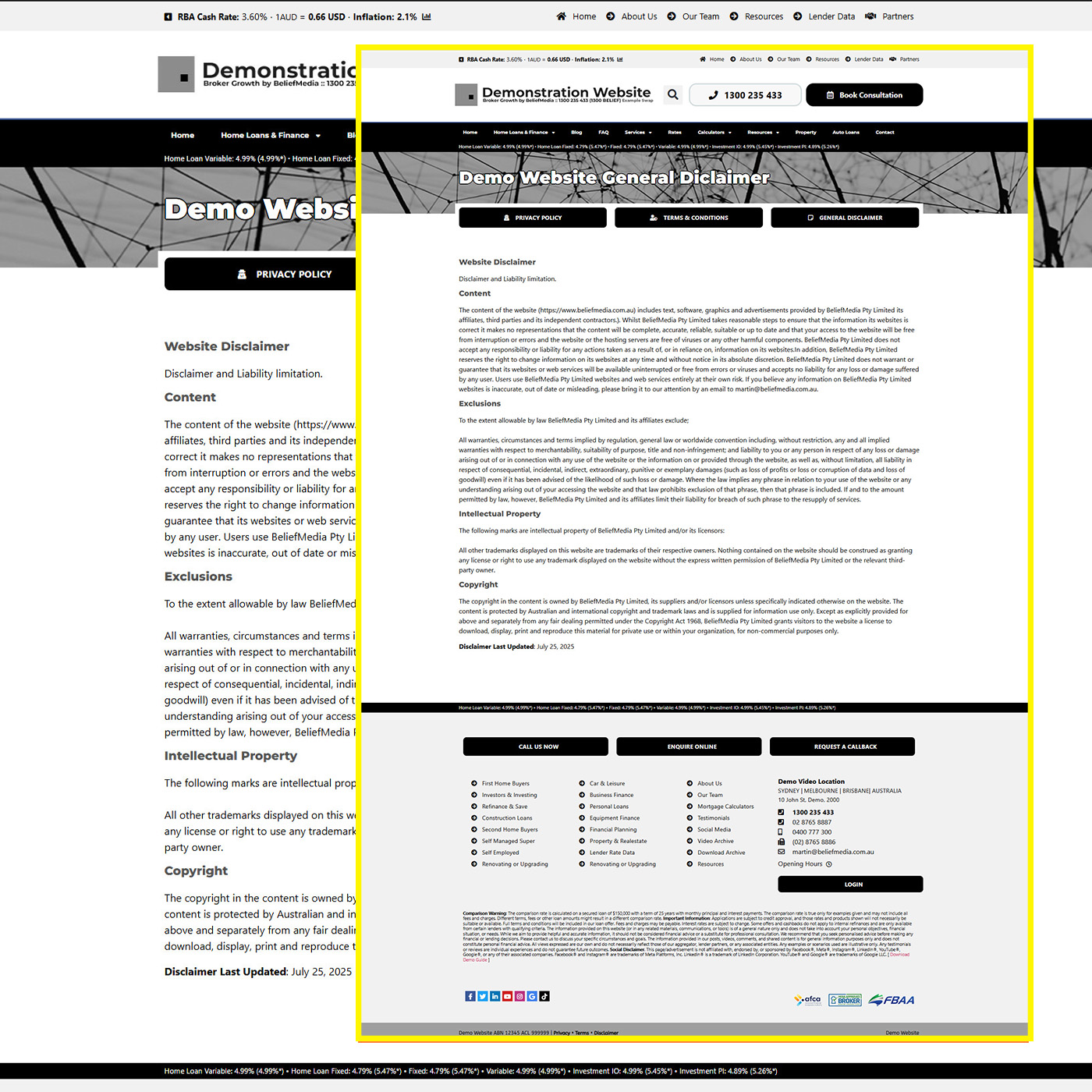
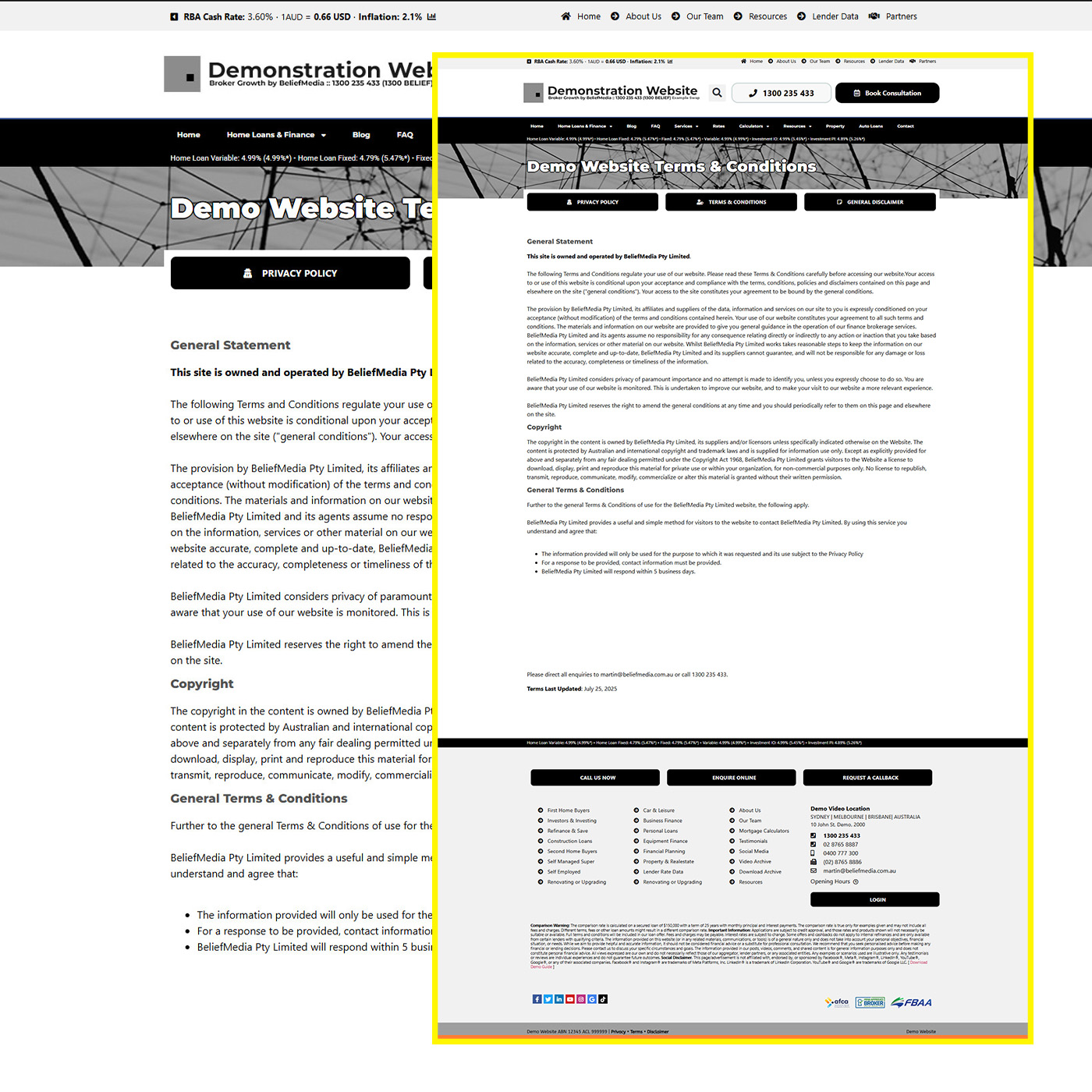
Page Disclaimers: The page disclaimers are managed from within Yabber. Quite a complete and advanced module exists to manufacture the general disclaimer shown in the footer of your website on every page.
Social, Video, and Download Libraries
The social content, downloads, and video libraries exist because content should not be treated as disposable. The idea that a broker should publish useful content to social media and then allow it to disappear beneath millions of other posts is strategically weak. Social media has value as a distribution channel, but it should not be the primary home of your intellectual property. Every piece of content that is good enough to publish should also contribute to your own website, your own authority, your own search footprint, and your own funnel architecture. In our framework, content posted through our social media tools can be archived automatically on the broker’s website, turning otherwise temporary social activity into a permanent, self-hosted content resource. Posts can then be browsed, grouped, filtered, and connected through assigned hashtags, creating a dynamic archive that gives social content a second life inside an owned environment.
The same principle applies to video. YouTube, Wistia, Vimeo, Facebook, LinkedIn, and other video platforms may be useful hosting or distribution channels, but they should not own the full value of the broker’s video library. From within Yabber, video can be sent to the website and hosted inside the broker’s own architecture, where it can support articles, service pages, landing pages, FAQs, Insights, email sequences, and funnel pathways. A video about refinancing should not exist only as a YouTube upload. It should also strengthen the refinance page, support a refinance email sequence, answer a relevant FAQ, appear in related articles, and contribute to the broker’s demonstrated expertise. This gives the video commercial purpose beyond views and allows it to operate as part of the website’s education and conversion system.
Yabber downloads follow the same philosophy. A download should never be a naked file sitting behind a button with no supporting context. Each download can be supported by a short post or resource page that explains its purpose, describes who it is for, introduces the problem it solves, and links it into the relevant borrowing pathway. This gives the download value before the user clicks, gives search engines supporting content to understand, and gives the website another useful internal pathway. A guide, checklist, report, worksheet, or template becomes more powerful when it sits inside a structured resource library rather than being treated as an isolated file.
Together, the social, video, and download libraries turn content distribution into content ownership. Social posts become website assets. Videos become education assets. Downloads become conversion assets. Hashtags, categories, tags, internal links, and contextual placement allow users to move between related resources without being pushed back into third-party platforms. The result is a website that becomes deeper, more useful, more authoritative, and more commercially defensible over time. Every post, video, and download strengthens the broker’s own ecosystem rather than donating its value to platforms that provide reach but no ownership.
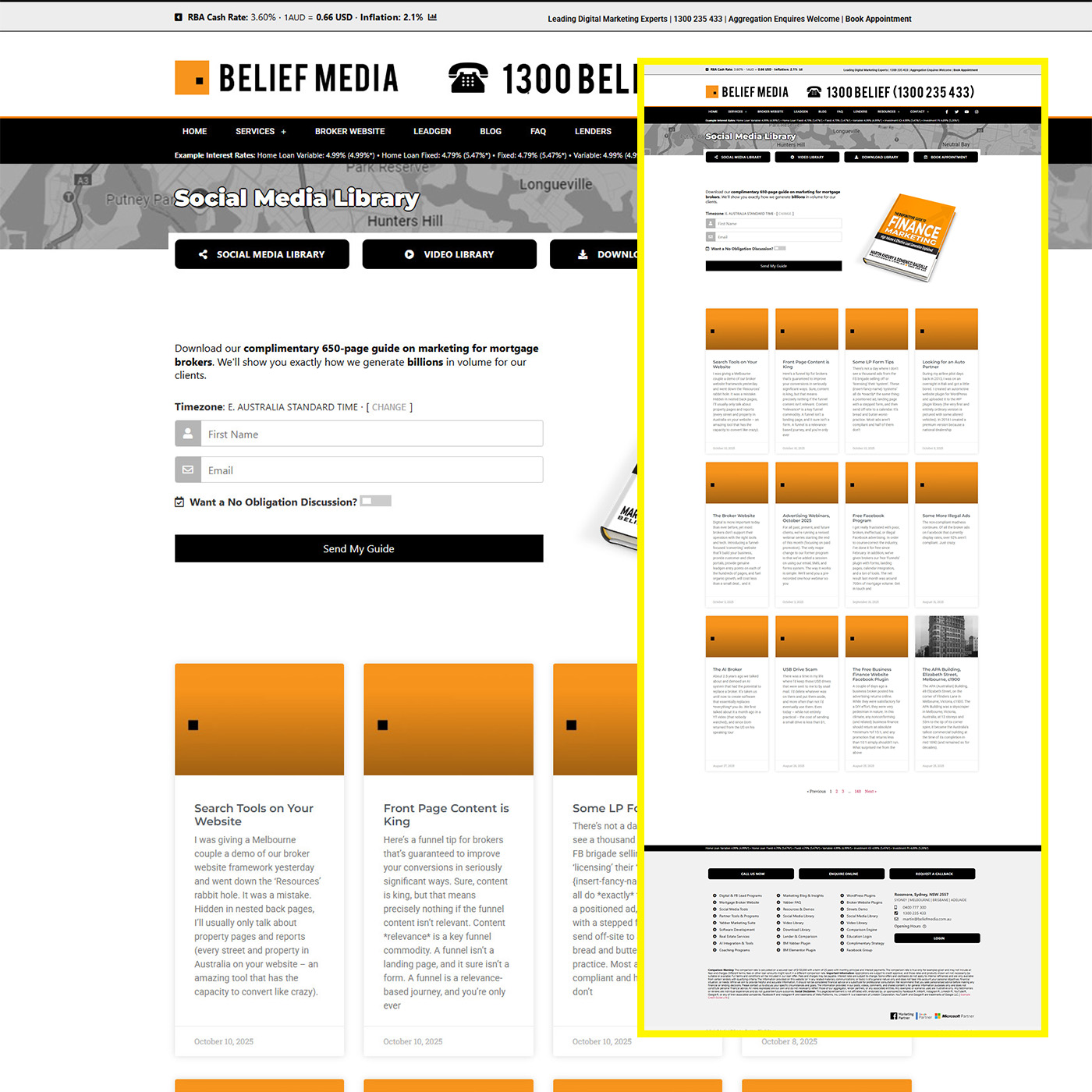
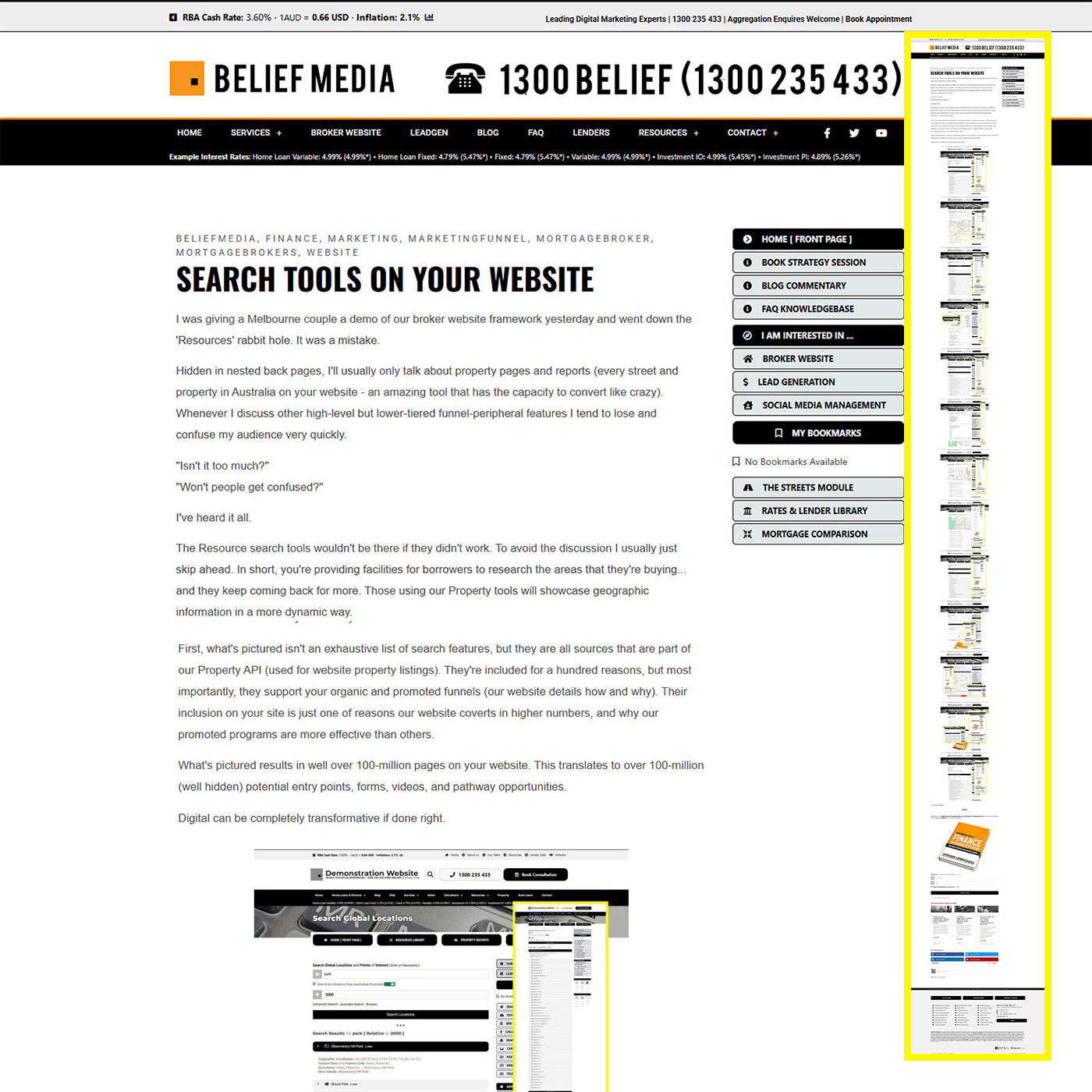
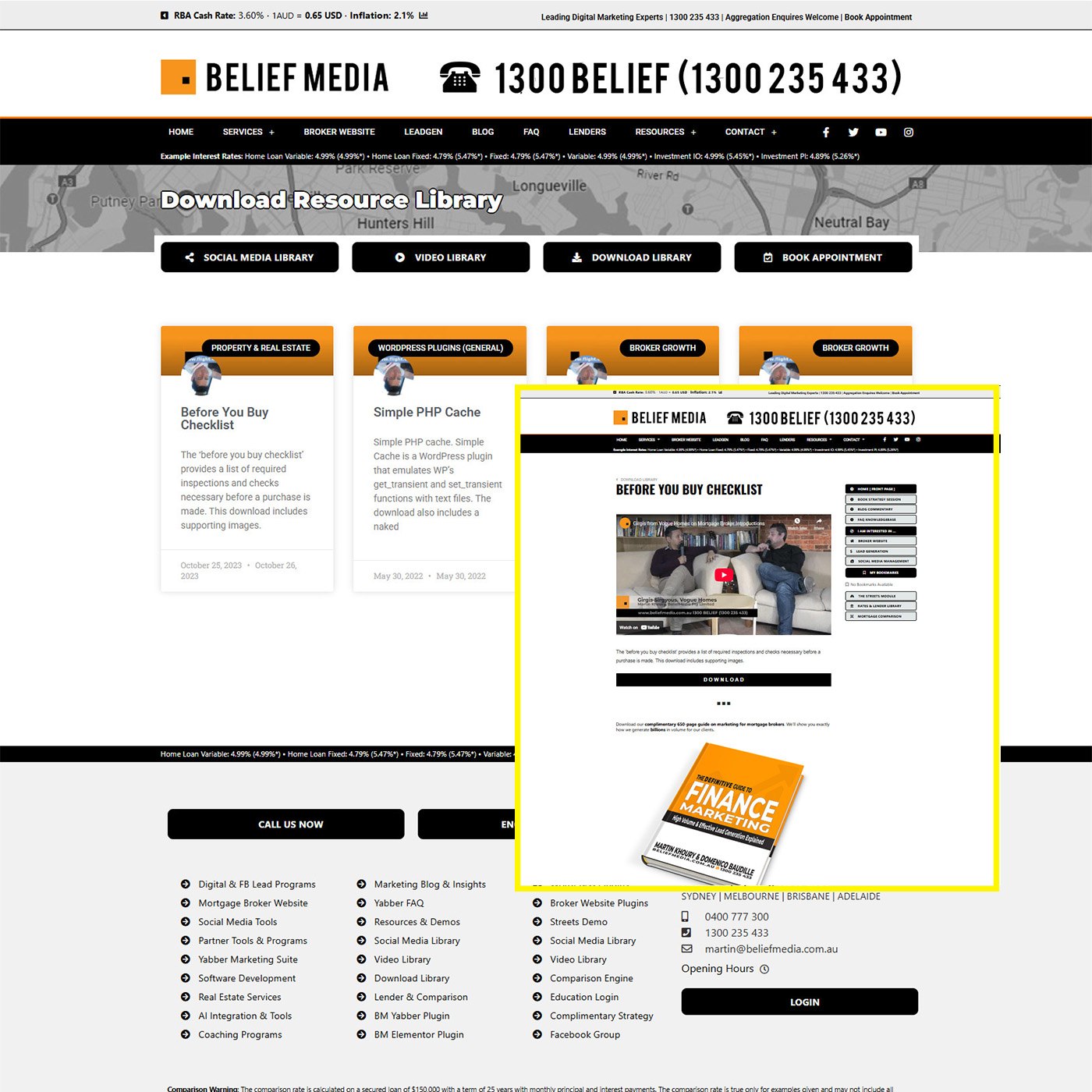
Social, Videos, and Downloads: The social, video, and download libraries turn content distribution into content ownership. Social posts become website assets. Videos become education assets. Downloads become conversion assets. Hashtags, categories, tags, internal links, and contextual placement allow users to move between related resources without being pushed back into third-party platforms. The result is a website that becomes deeper, more useful, more authoritative, and more commercially defensible over time. Every post, video, and download strengthens the broker’s own ecosystem rather than donating its value to platforms that provide reach but no ownership.
The Employment Module
The Employment module provides organisations with a dedicated framework for listing employment opportunities, broker roles, support positions, traineeships, associate pathways, and other recruitment-related opportunities directly on their own website. While it is not normally a core conversion feature for borrowers, it strengthens the business website by showing growth, structure, capability, and organisational maturity. For larger brokerages, franchises, referral groups, and finance businesses, a visible employment archive also supports recruitment marketing by giving prospective team members a professional destination that explains available roles, expectations, culture, and pathways into the business.
The broader value is in the broker recruitment framework. A brokerage that wants to introduce new brokers into its operation needs more than a job listing. It needs a structured pathway that explains the opportunity, the support model, technology, lead flow, compliance expectations, mentoring, onboarding, operating standards, and the commercial value of joining the group. The Employment module can therefore operate as both a recruitment archive and a positioning asset, helping the business attract brokers, support staff, and future partners while reinforcing the perception that the organisation is established, scalable, and serious about growth.
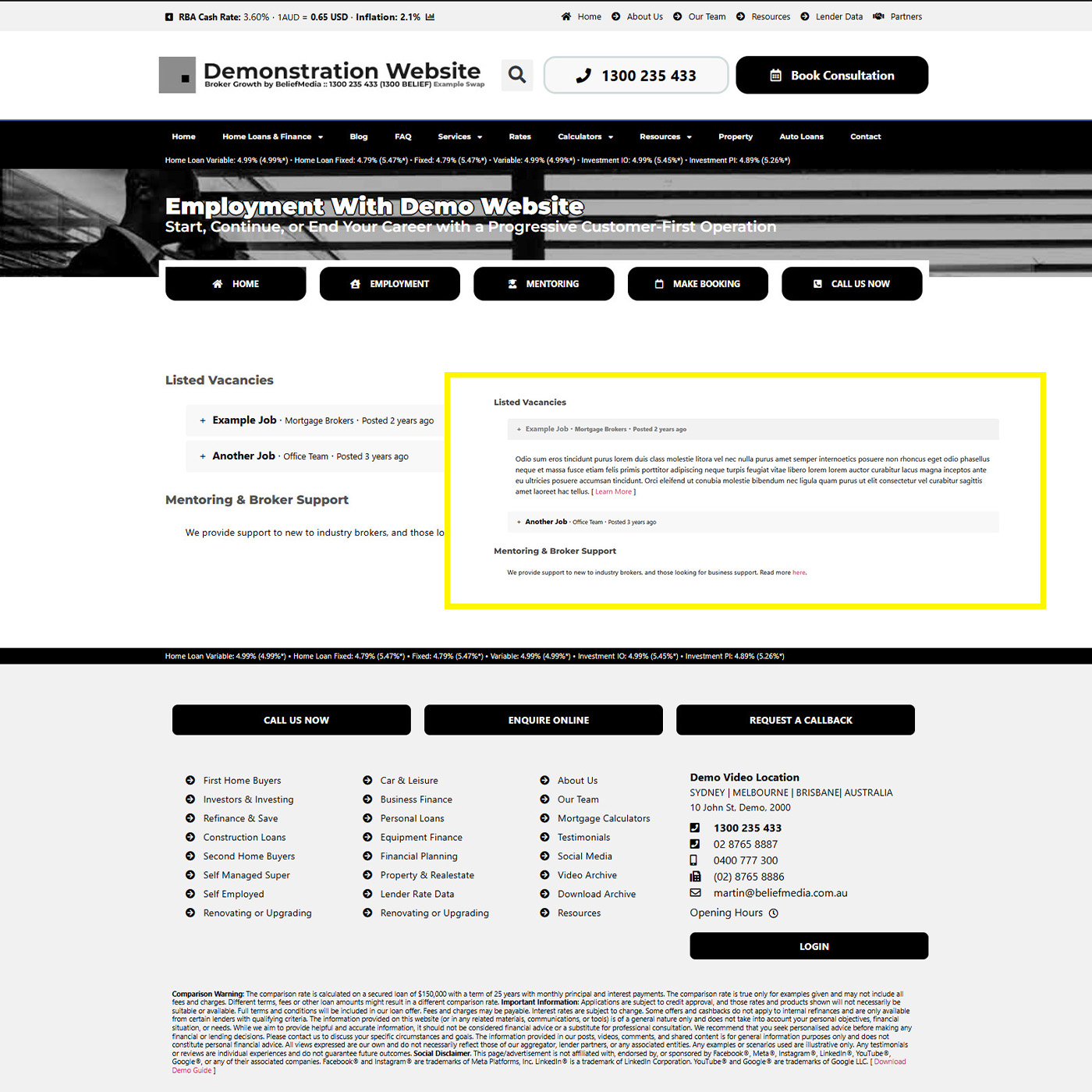
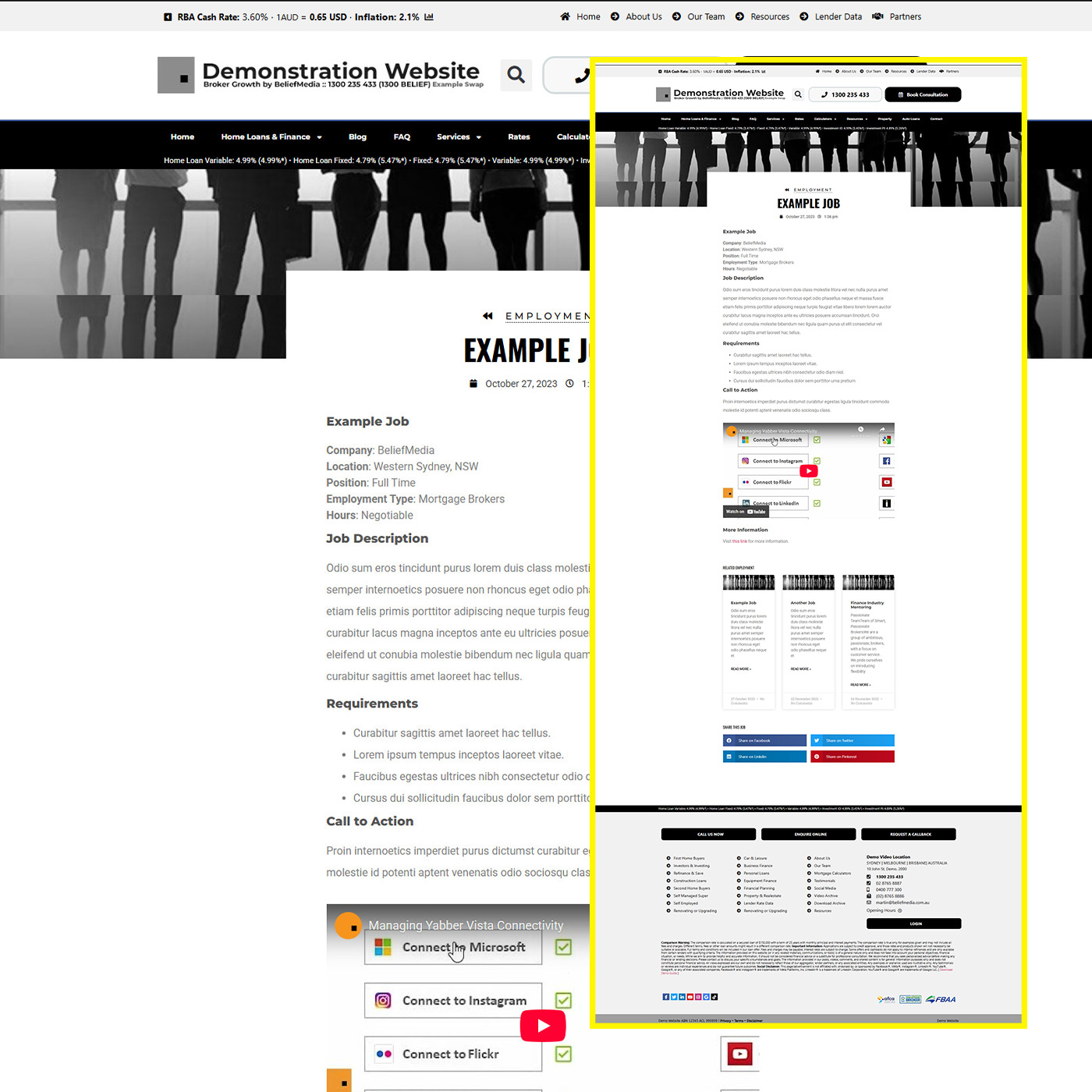
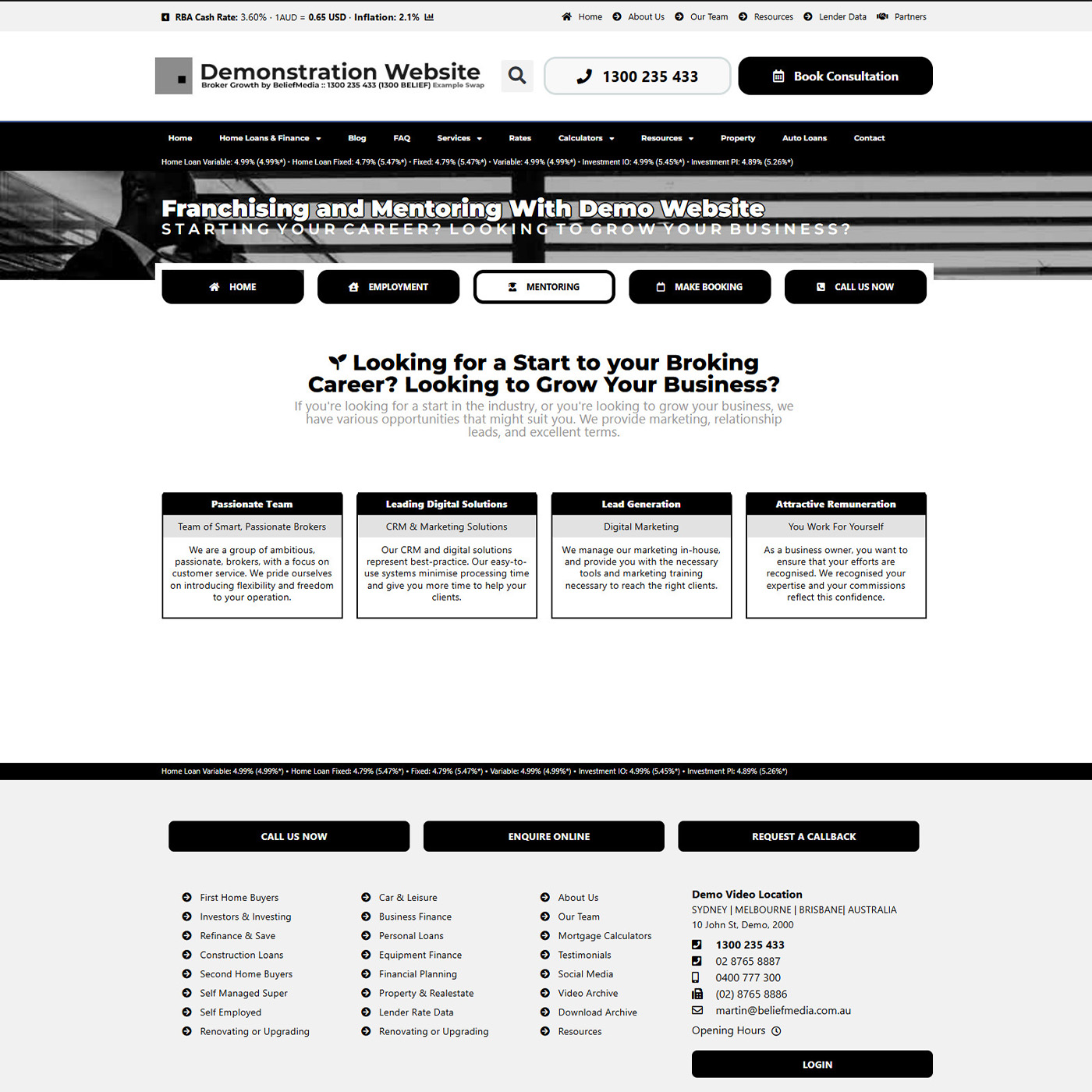
Employment Module: Supported by Yabber in full, employment pages are a third-tier module in that pages aren't accessible unless we create the pathways by way of menu items or similar. The mentoring page is supported by way of the password-protected mentoring resource should you choose to embark in that direction.
The Testimonials Module
The Testimonials module is one of the more extensive trust assets in the website framework, and it is managed directly from within Yabber. Testimonials may be organised into fully supported testimonial lists, allowing brokers to group, filter, and display client feedback by category, service type, campaign, borrowing pathway, location, or any other relevant structure. Yabber also connects with Google Business Profile and Facebook, allowing reviews and testimonials to be ingested into the system, reviewed, and selectively published or unpublished. This gives the broker control over how social proof is presented while still drawing from credible external review sources.
Each published testimonial becomes its own dedicated page within the website’s testimonial archive, which gives the feedback a permanent, searchable, and linkable location rather than burying it inside a carousel or a third-party platform. This is important because testimonials are not merely decorative proof blocks; they are evidence assets. They support trust, reinforce experience, demonstrate client outcomes, and provide useful internal pathways into relevant borrowing pages, articles, FAQs, case studies, and booking opportunities. Where available, a video testimonial may be assigned to any individual testimonial, creating a richer and more persuasive proof asset that combines written feedback with human voice, expression, and authenticity.
The module also permits the creation of Yabber testimonial images, allowing broker-approved feedback to be converted into branded visual assets for use across the website, social media, email, presentations, partner communication, and other marketing channels. This turns a single testimonial into a reusable proof asset that can support multiple stages of the funnel. Used properly, the Testimonials module becomes far more than a review display system. It is a structured social-proof library that helps demonstrate trust, experience, service quality, borrower confidence, and the broker’s real-world value in a way that can be managed, distributed, and integrated throughout the broader marketing framework.
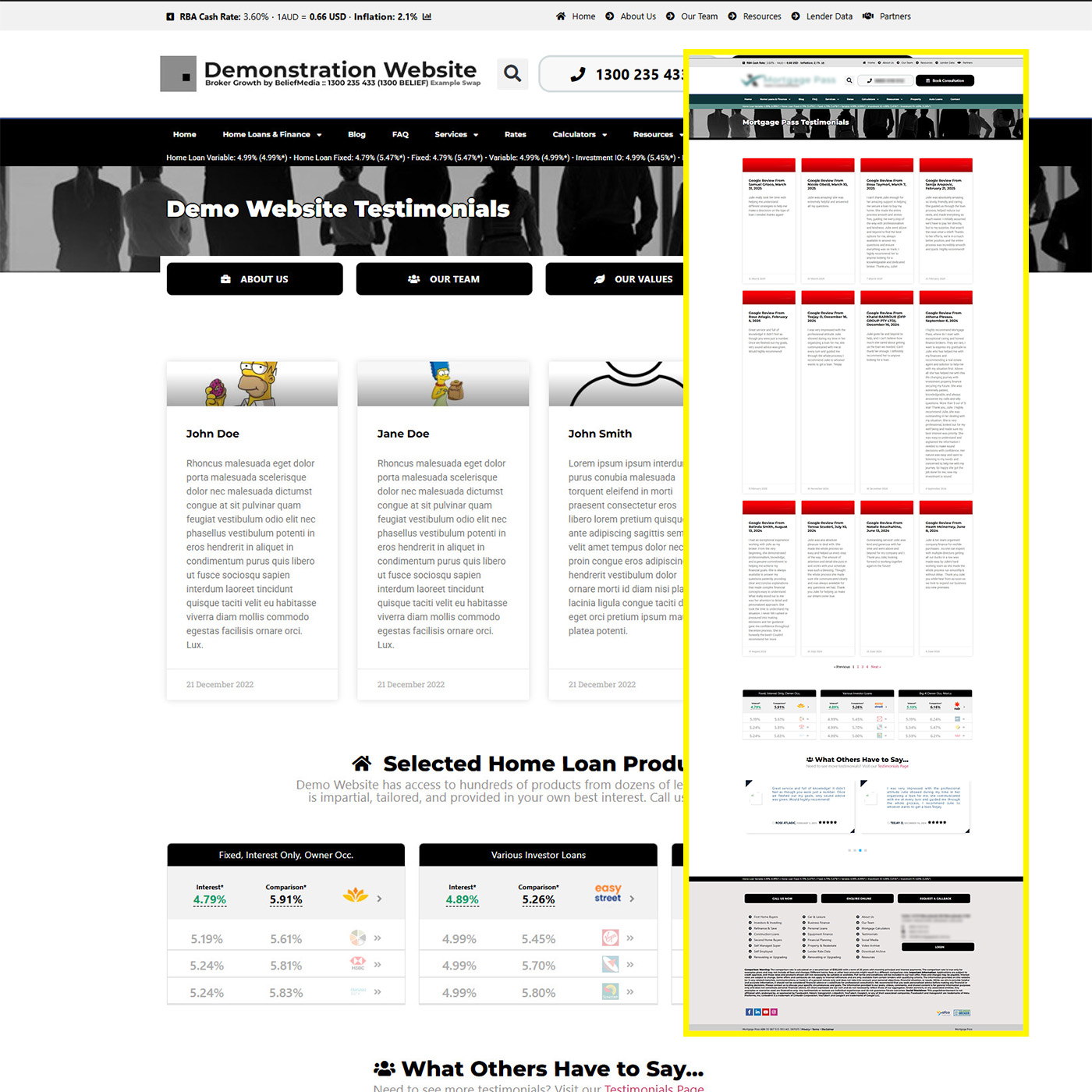
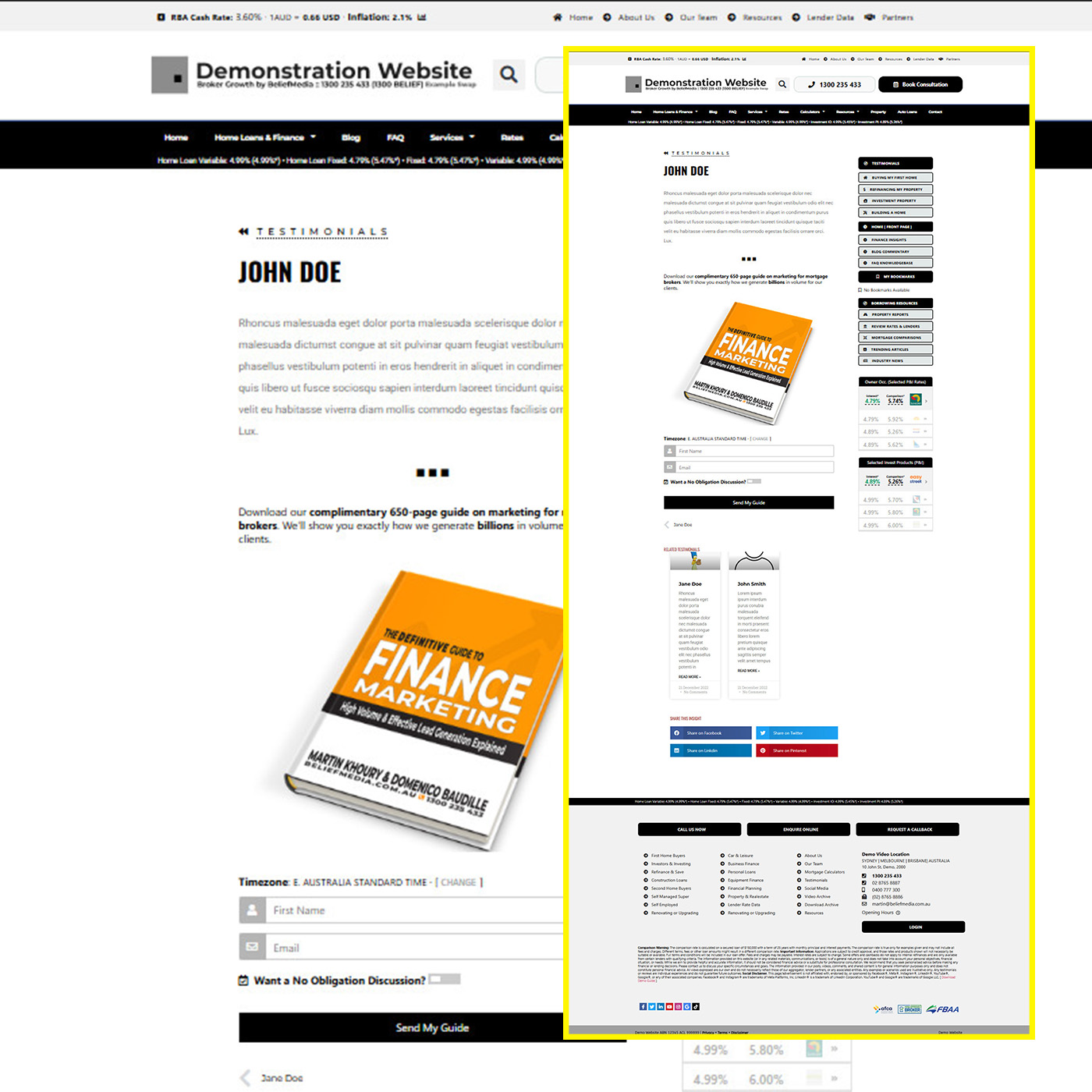
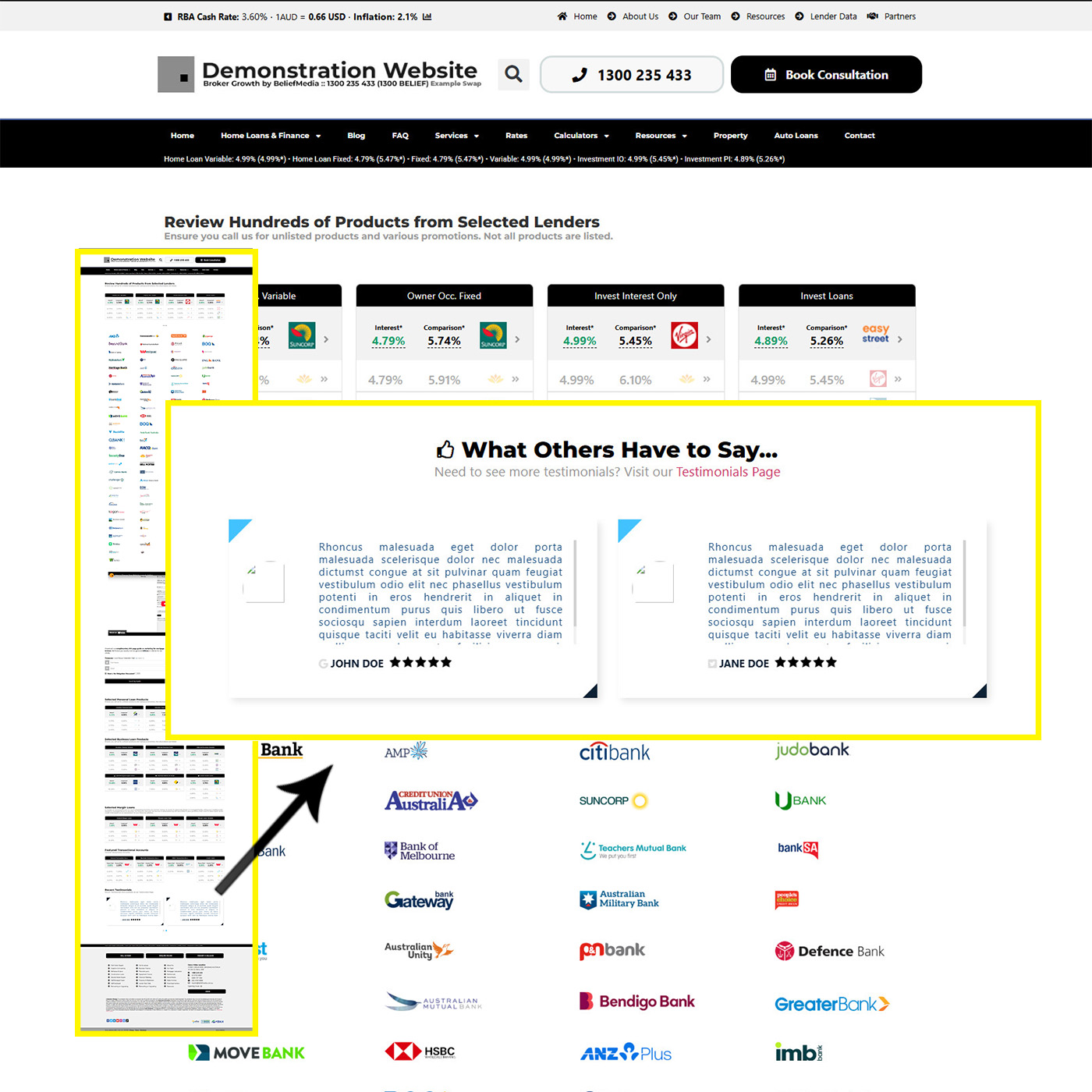
The Testimonials Module: The testimonials module is quite a large module, and Yabber is set up so the same testimonials may be filtered through to multiple websites. Specific lists of testimonials are usually created for use on purpose-specific landing pages.
Website Teams Pages
The Teams module may be presented as a simple staff page or as a more sophisticated organisational directory, depending on the structure of the business. A small brokerage may only need a clean page showing the principal broker, support staff, contact details, photos, and brief profiles. A larger organisation may need something more complex, including credit representatives, employees, franchise operators, multiple office locations, multiple companies, and even multiple legal or trading entities operating from a single location. The Teams module is designed to cater for both extremes, allowing the website to render a straightforward team page where appropriate or a more extensive people, location, and entity framework when the business structure requires it.
The module is managed from within Yabber, so team members, titles, photos, profile details, contact information, office associations, and related business information can be updated easily without rebuilding the website. Opening hours may be managed globally and applied consistently, which is particularly useful when a business operates across multiple locations or maintains shared availability rules. The practical advantage is that the system can represent the real structure of the business without creating administrative friction. It is extensive enough to support complex broker groups, franchises, and multi-location operations, but simple enough for ordinary teams to maintain. Properly used, the Teams module strengthens trust by making the business visible, human, organised, and easy to understand.
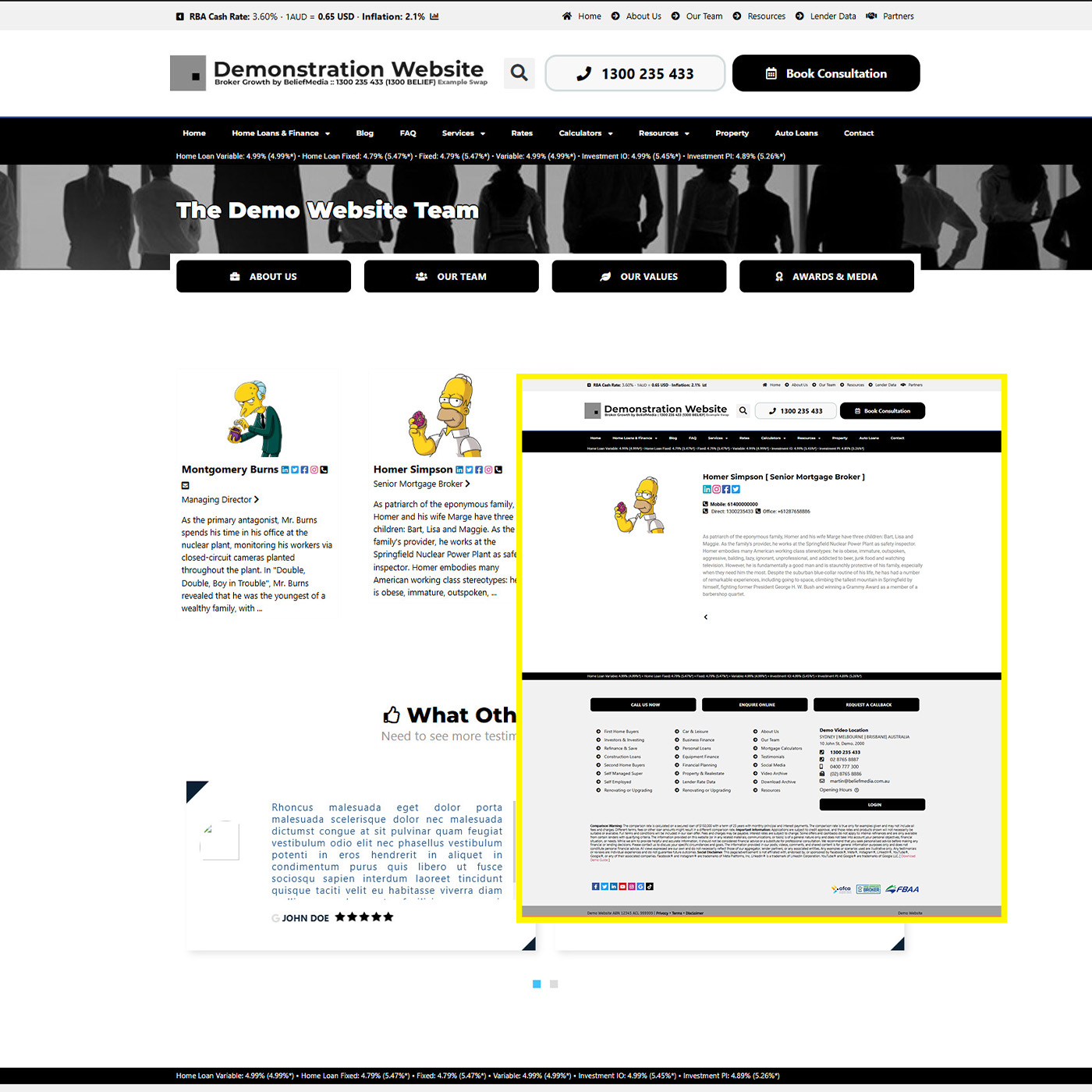
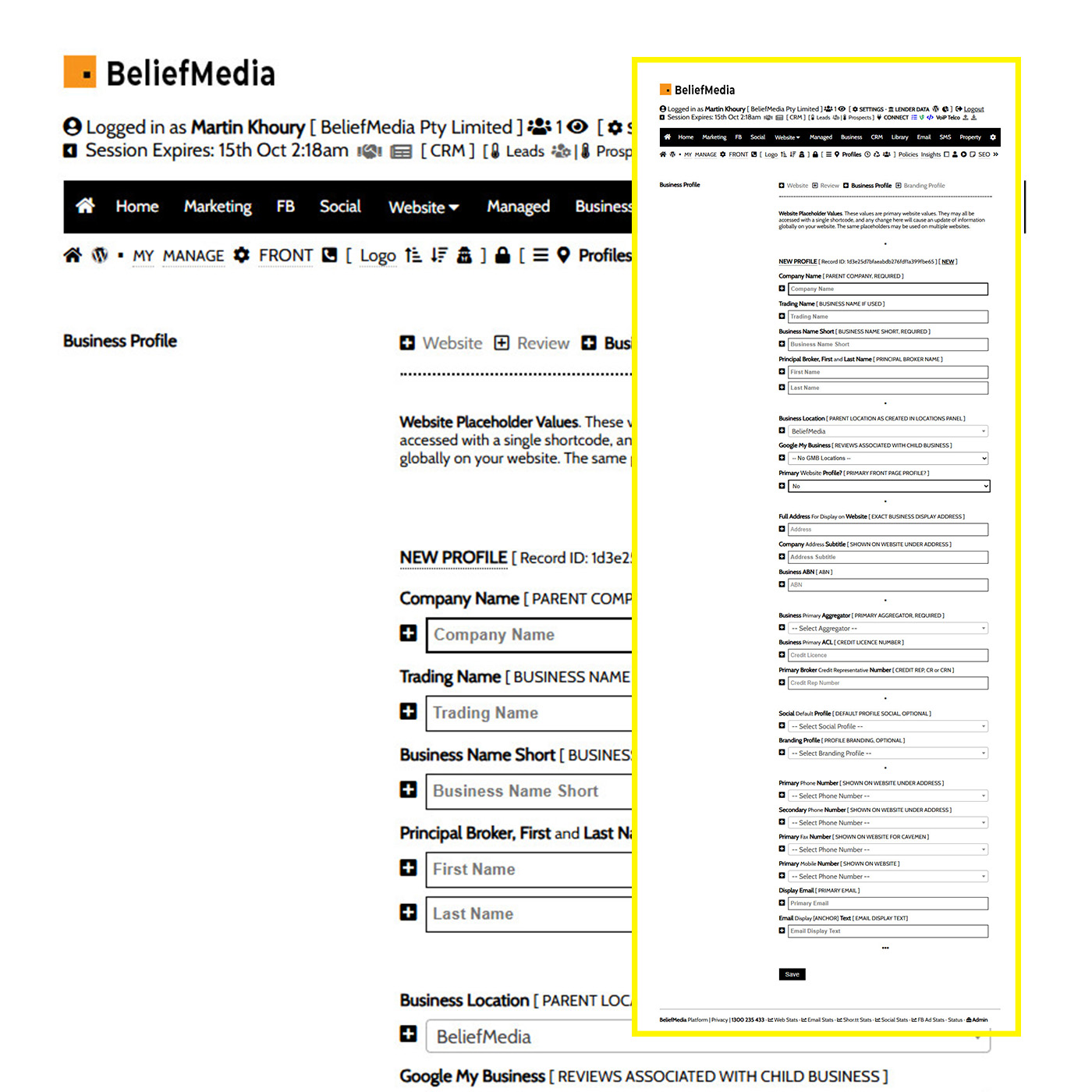
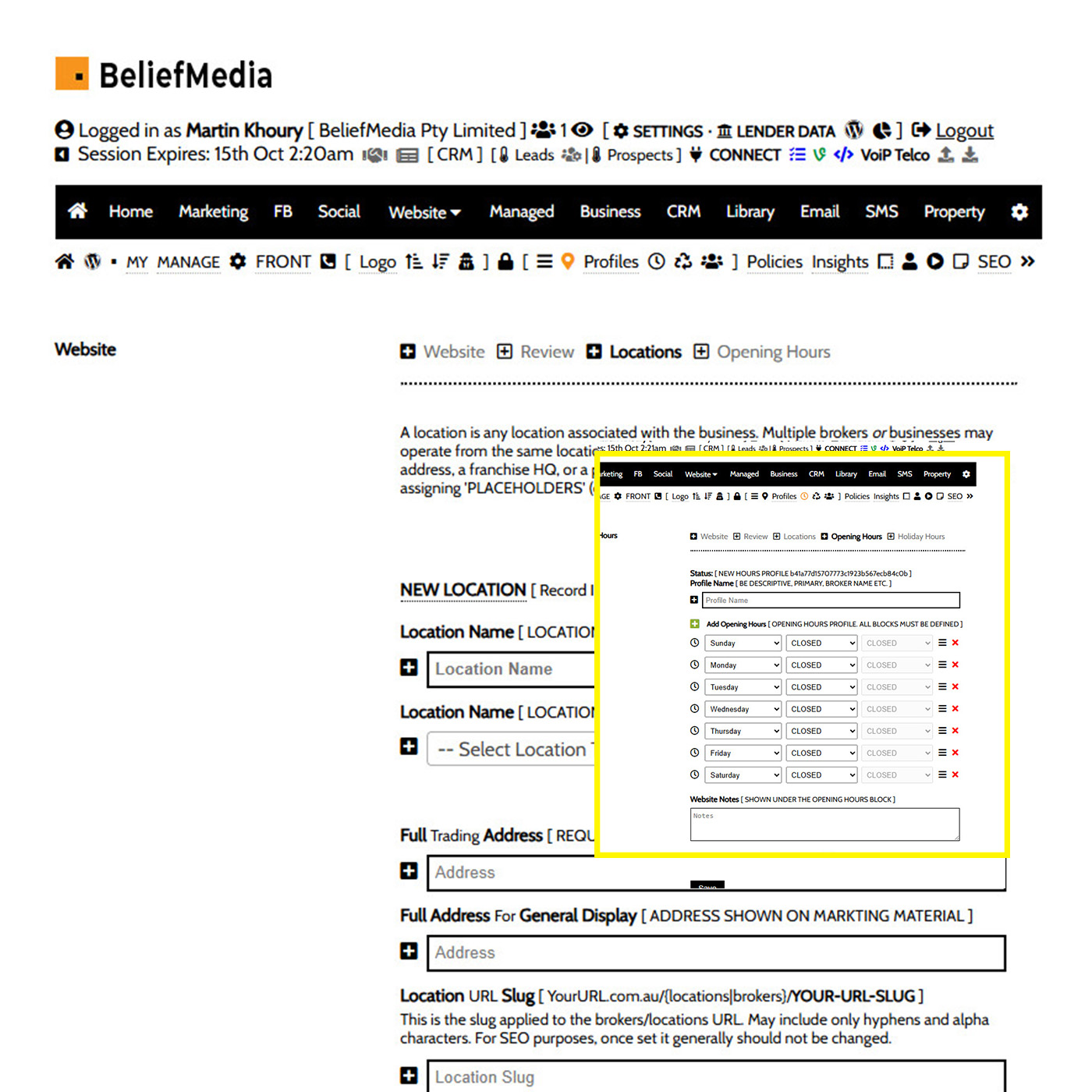
Website Teams Module: Website Teams are managed entirely in Yabber. For those that don't have a staff, the module may be disabled entirely. The module is quite extensive as evidenced by the large number of FAQs dealing with the module.
Partner Pages and Partner Portal
The Partners page is designed to attract referral partners into a dedicated partner funnel, rather than operate as a heavily designed public sales page. It is deliberately quite naked because the partner proposition should belong to the broker. Different brokers will target different referral groups, including accountants, real estate agents, buyers’ agents, financial planners, solicitors, conveyancers, builders, developers, employers, community groups, and niche professional networks. The page therefore provides the structural pathway, but the broker controls the positioning, offer, language, resources, and commercial value proposition. Its purpose is simple: introduce the opportunity, explain the benefit of partnering, establish credibility, and move the prospective partner into the next appropriate action.
The Partner Dashboard is the protected operational layer behind the program. It is a password-protected module for approved partners, with authentication managed through standard Microsoft contacts in Yabber. This allows the broker to maintain practical control over partner access without creating a disconnected membership system. The content inside the dashboard is defined by the broker and may include referral forms, contact pathways, calculators, campaign resources, co-branded material, scripts, educational downloads, market updates, settlement guides, status information, training videos, or any other material required to support the partner relationship. In practical terms, the dashboard turns a partner program from a handshake arrangement into a structured distribution system.
The value of the module is substantial because partner marketing is one of the highest-leverage growth channels in mortgage broking. Advertising buys attention one click at a time; partner relationships compound through trust, repetition, and distribution. We have added thousands of partners to the module, and the full partner methodology is detailed in the Partner Marketing Guide. The program introduces more volume to the industry than any other partner framework we are aware of, with more than a dozen of our clients now acting as custodian of over 100 partners each. That scale matters. A broker with 100 active partners is not merely running a website; they are operating a managed referral network. The Partners page and Partner Dashboard provide the infrastructure required to attract, onboard, educate, support, and retain those relationships.
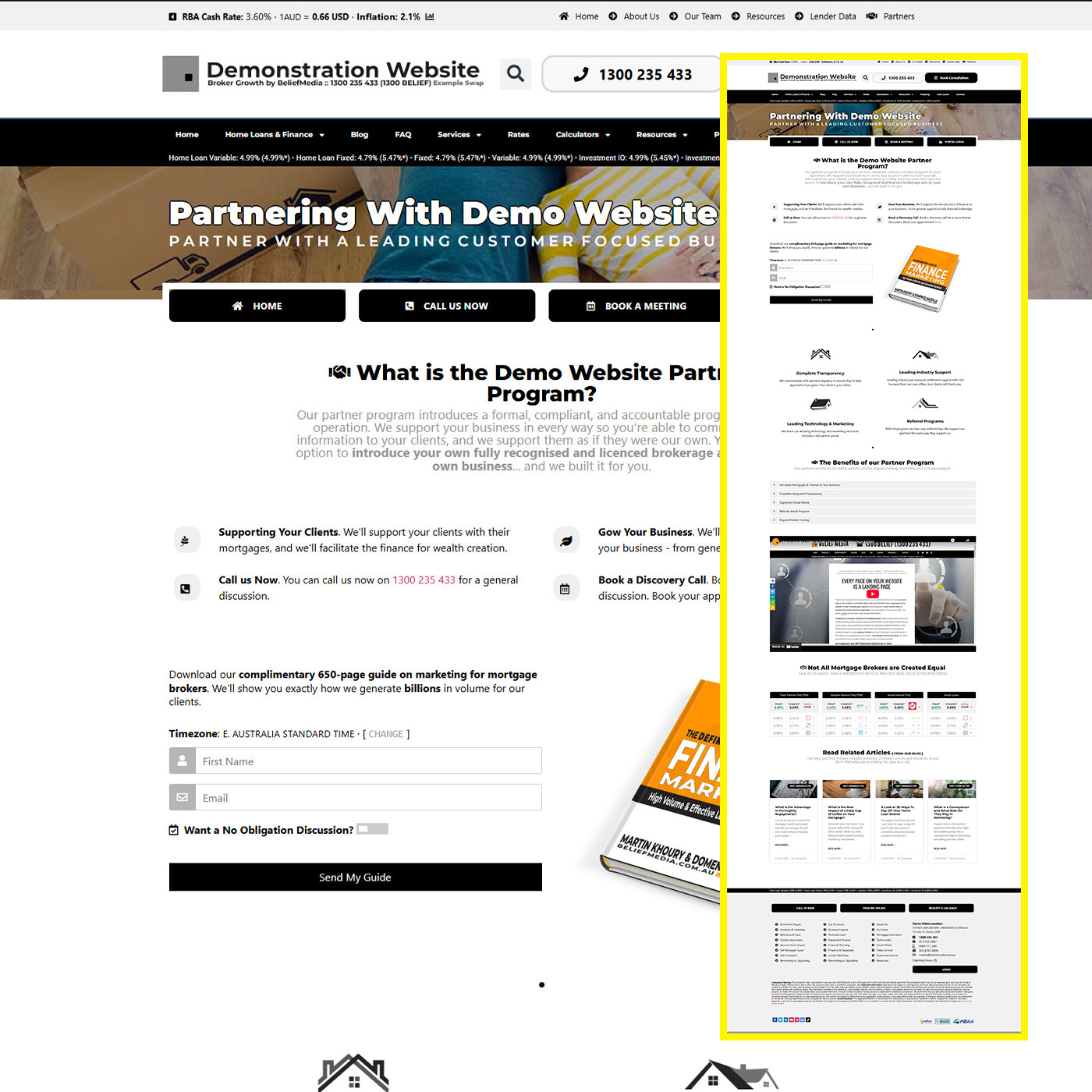
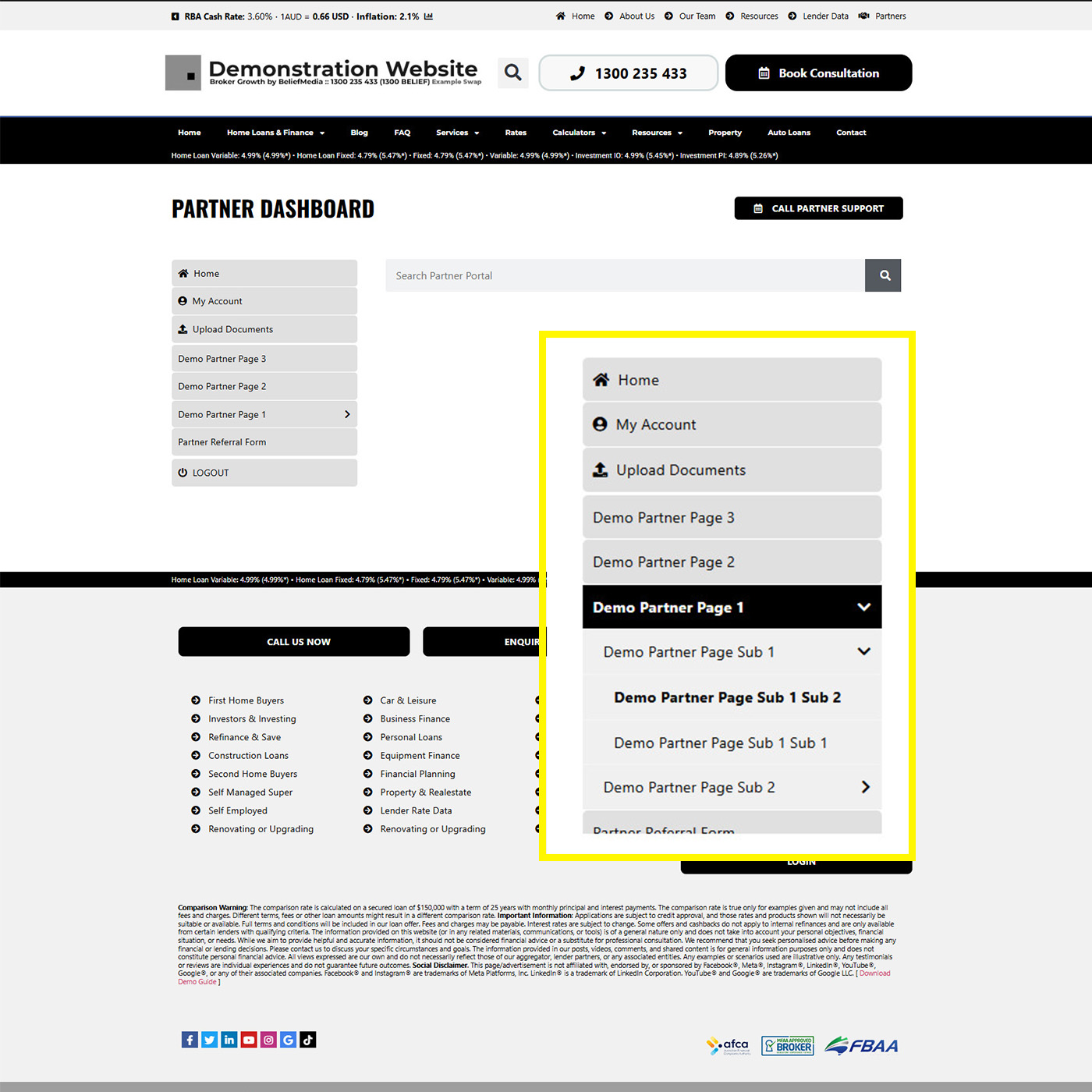
The Partner Program: The BM Partner Program returns over a billion ever month to those participating brokers with business quality far exceeding promoted or paid social media traffic. We've developed our program to be extremely effective, and the program is now introduced in our Broker Growth Workshop program by default.
General Password-Protected Resources
The website framework also includes a number of password-protected resource areas that may be used to support more advanced business models, internal systems, client communication, education pathways, and scalable operations. These include a general Portal, an Education Portal, the Yabber Dashboard, a Mentoring Dashboard, and a Client Dashboard. Each area is provided as a framework rather than a finished product, meaning the broker starts with a secure structural asset that can be developed over time according to the needs of the business. The Portal may be used as a general company resource area where required. The Education Portal is designed for funnel-based subscriptions, membership programs, borrower education, referral partner education, or gated learning pathways. The Yabber Dashboard is reserved for future integration of Nexus, statistics, reporting, and other platform tools. The Mentoring Dashboard is available for brokers who provide mentoring programs, but it may also be repurposed for employee onboarding, internal training, broker development, or structured professional education. The Client Dashboard is reserved for future client-facing access and may be developed into a controlled area for client resources, status information, education, downloads, or other support material.
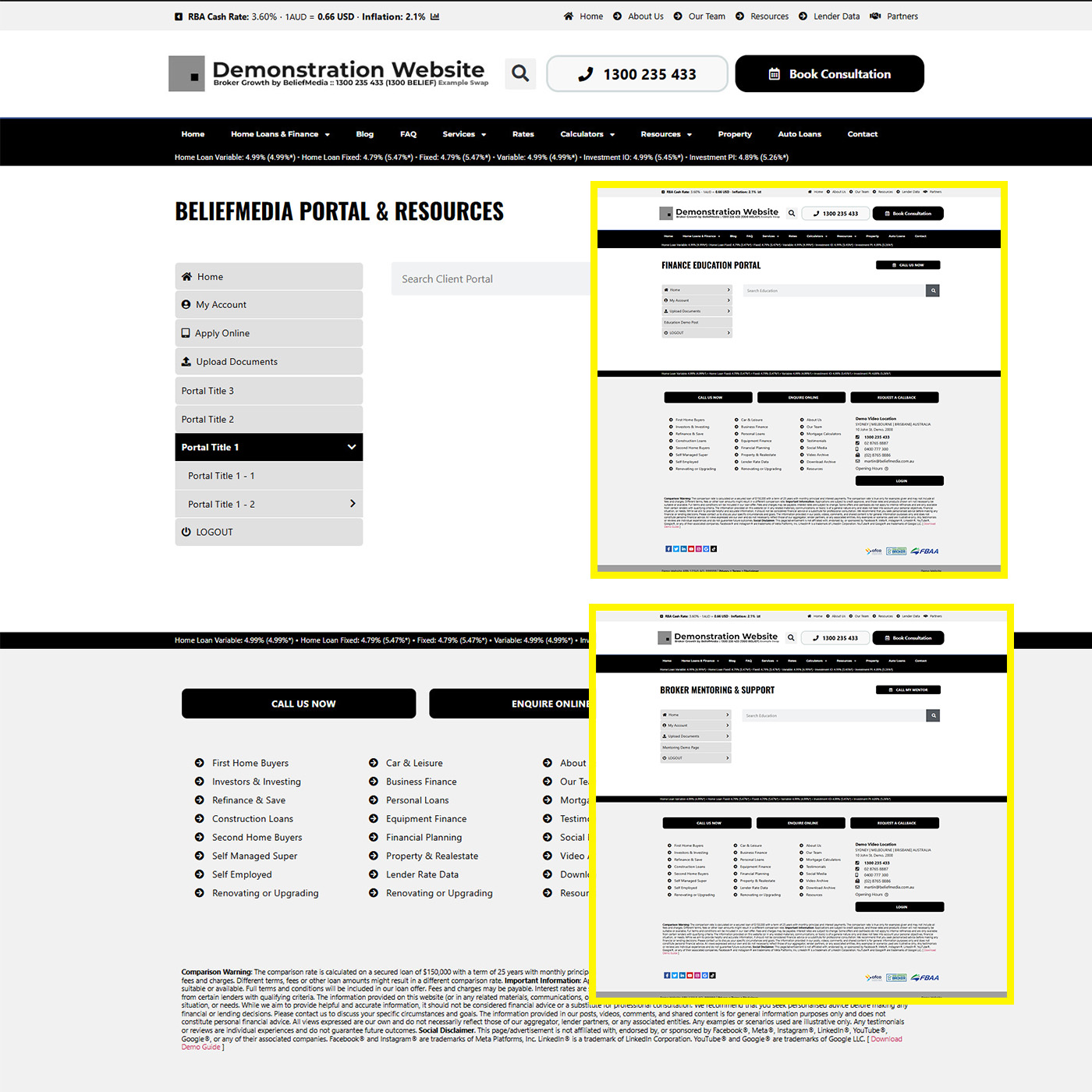
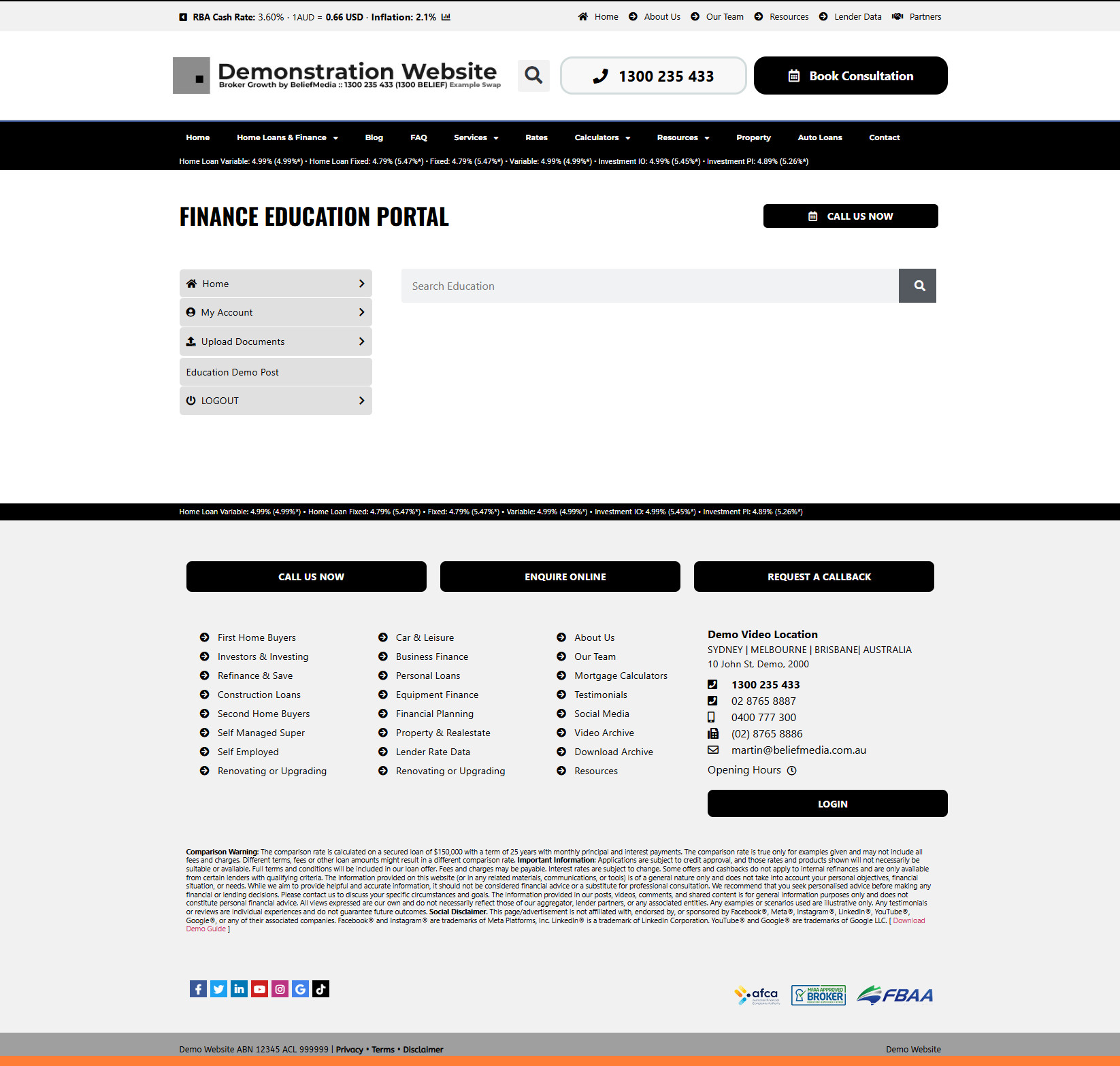
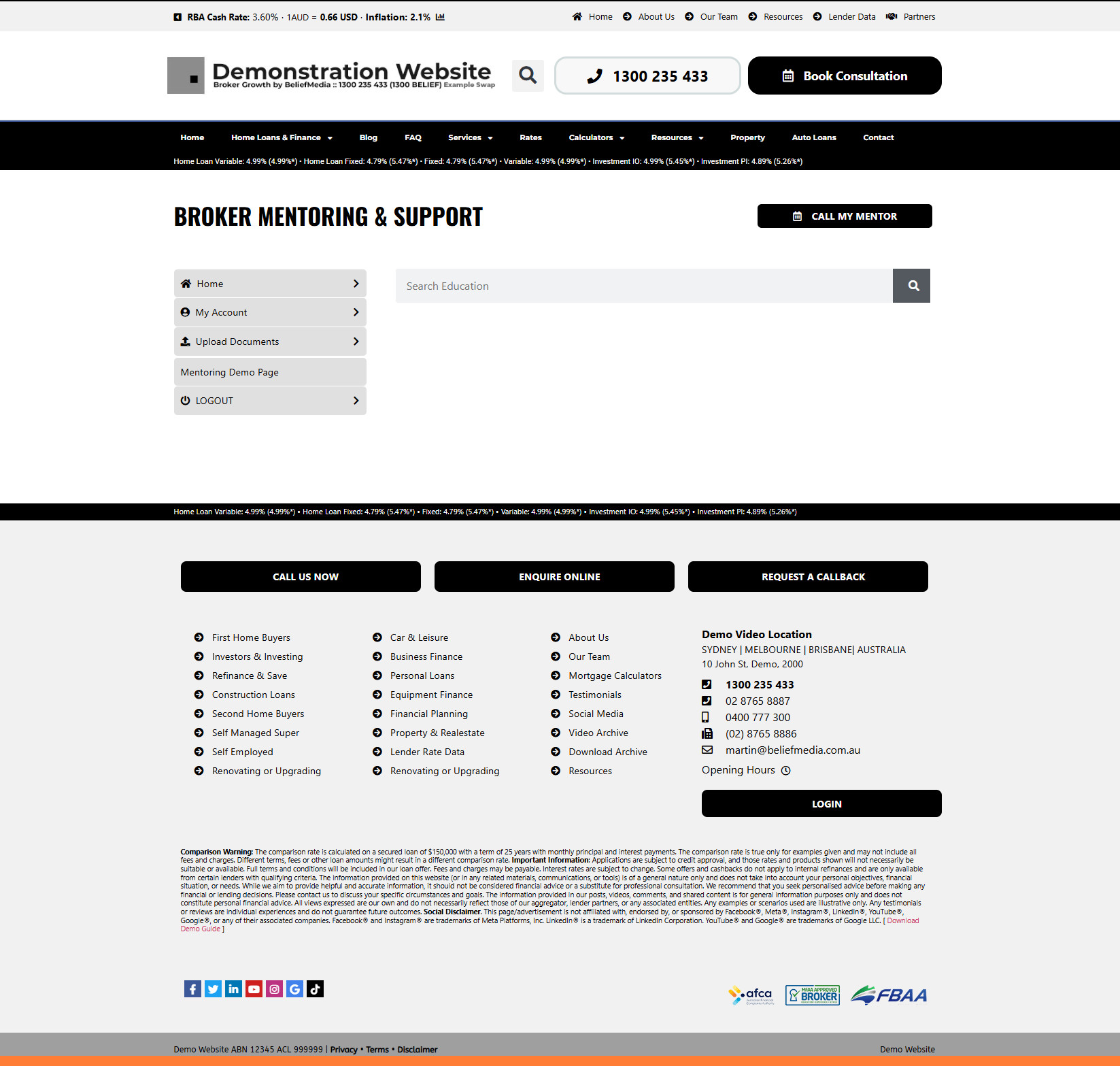
Protected Resources: The website framework includea a large number of password-protected resources for you to scale and build your operation.
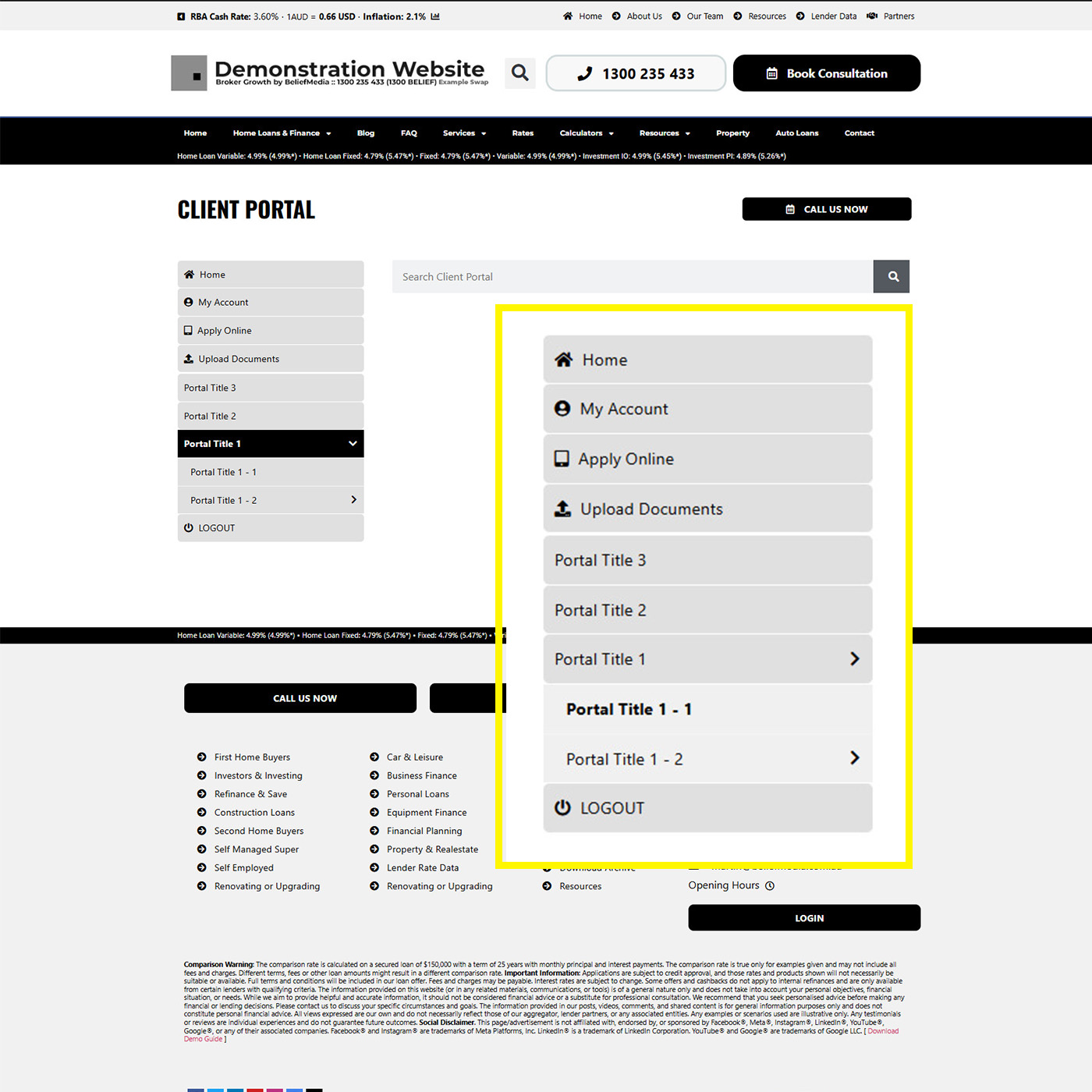
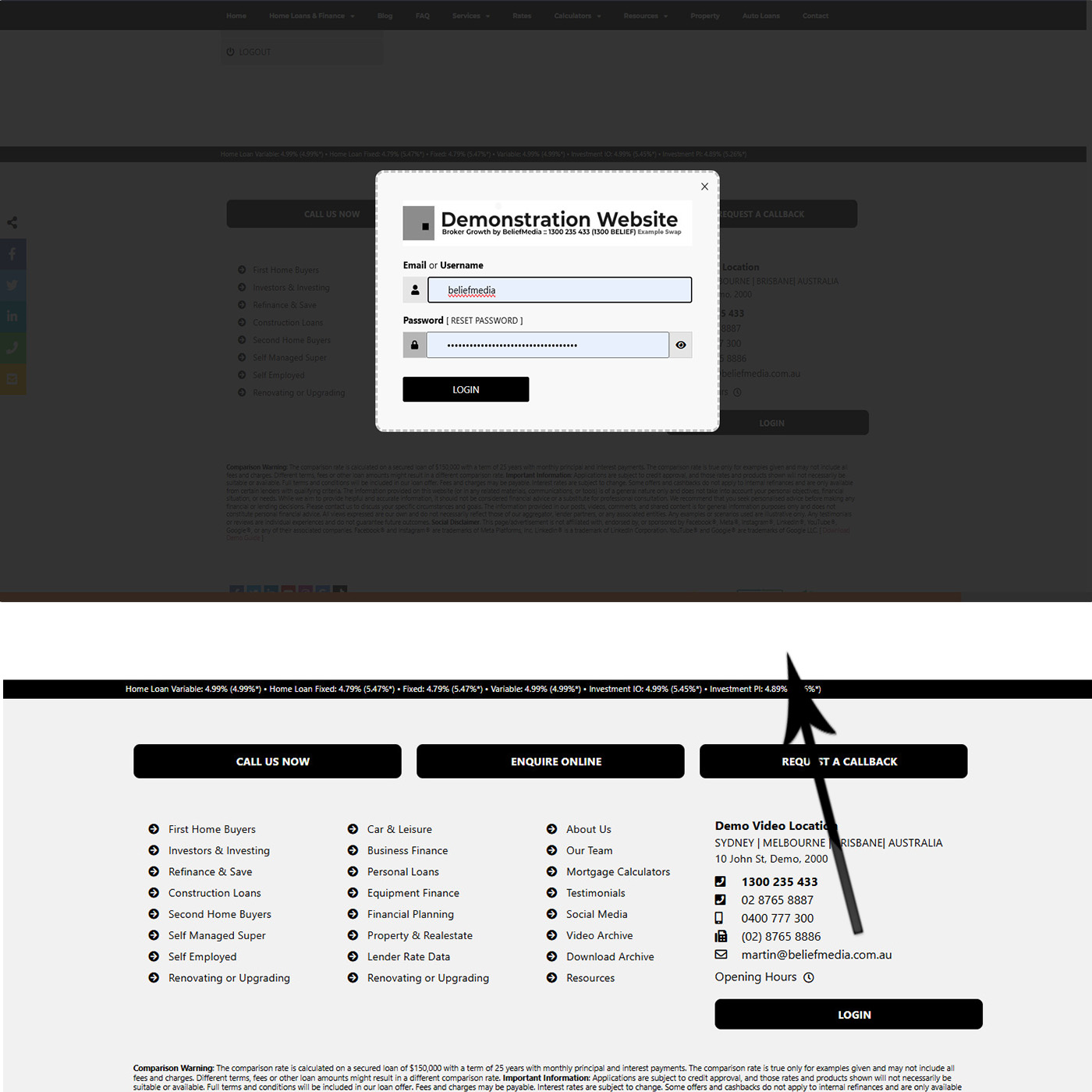
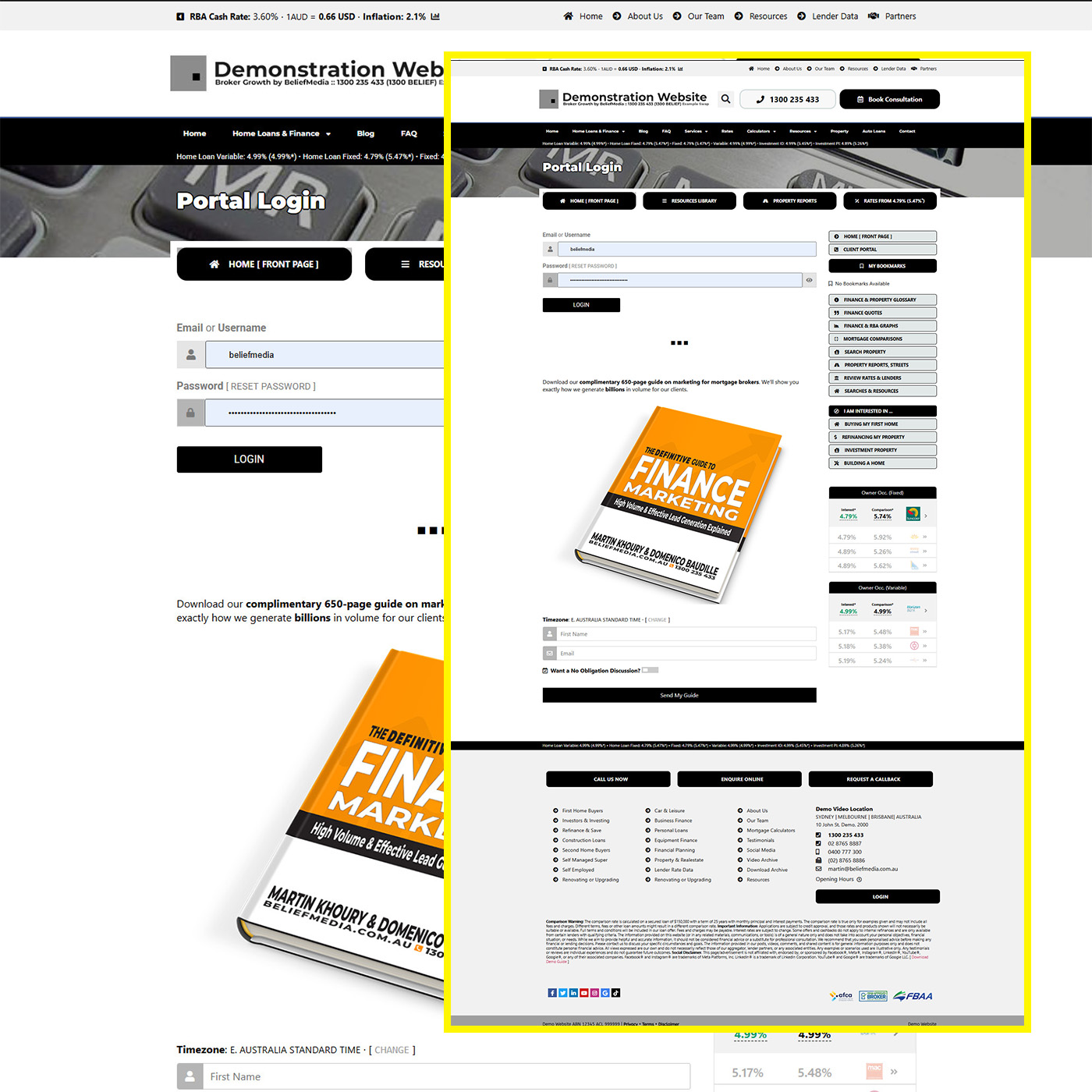
Client Portal: The Client Portal is a blank canvas upon which you can build your own client support programs and tools - it is an extremely powerful module if used. Another module called 'Explore' can be password-protected if required, but is generally dormant and ready should you choose to build content into the same format (or menu, sub-menu, and sub-sub, menu structure).
The important point is that these areas are empty by design. They are not rigid products forcing the broker into a fixed workflow. They are protected canvases that allow the business to build, test, and scale more sophisticated experiences as its operation matures. Authentication is managed through Microsoft Contacts in Yabber, which keeps access control connected to the broader Microsoft-integrated framework rather than relying on a disconnected membership plugin or third-party login system. Nexus supports the associated communication layer, including emails, password resets, and related account functions. This gives brokers the infrastructure required to create gated education, partner resources, client support areas, mentoring programs, internal training environments, and future dashboard functionality without rebuilding the website later. It is another example of the framework being designed not merely for what a broker needs today, but for the systems they may require as the business grows.
General and Resource Pages
Its' not reasonable to introduce all pages in depth, and some require a these to support their purpose rather than a simple screenshot. Some of those pages include the RBA Policy Module (a few hundred pages), the basic Fact Find Report, the Referral Form, the Property Module, the Financial Planning module (for partners), thegraphs page, and the About page.
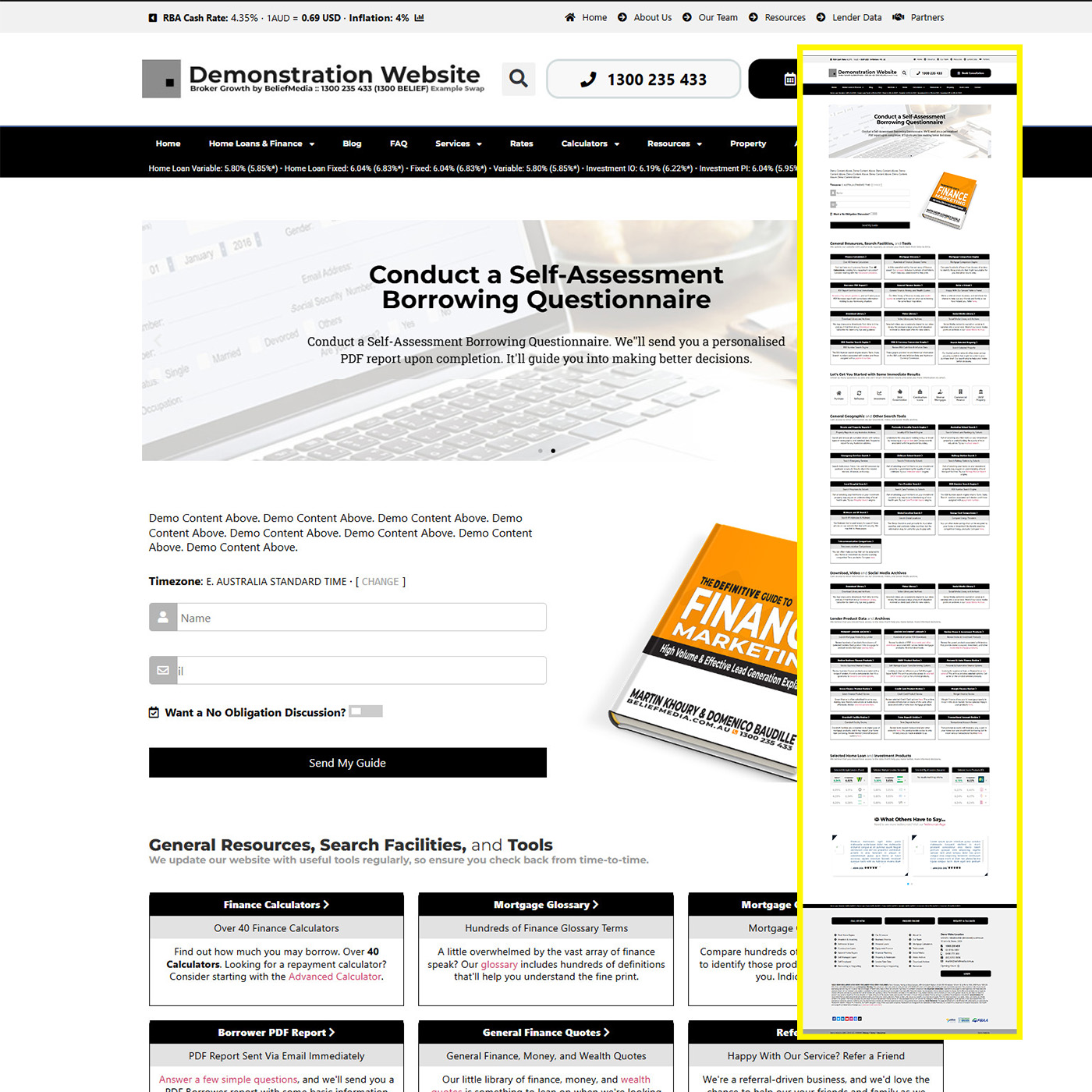
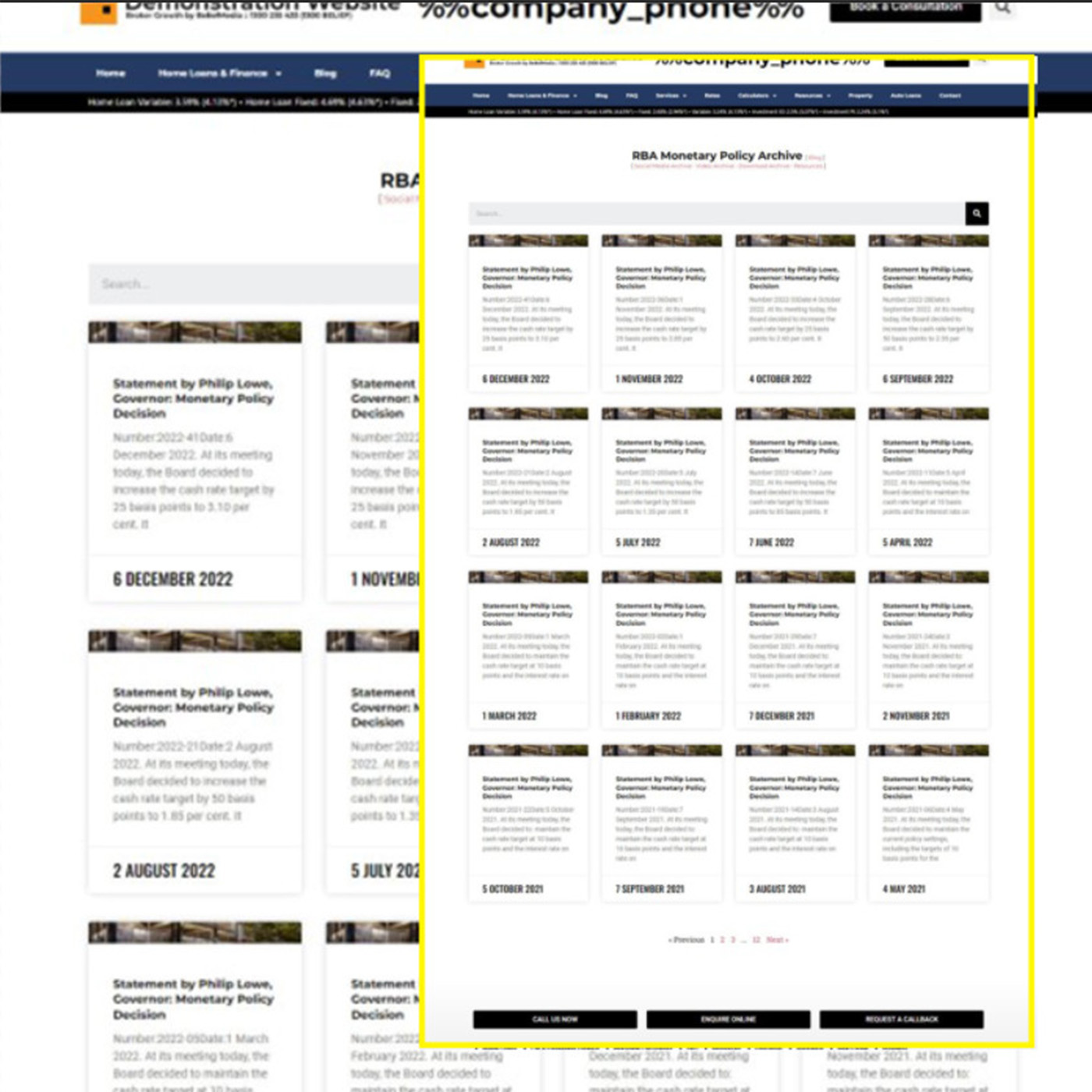
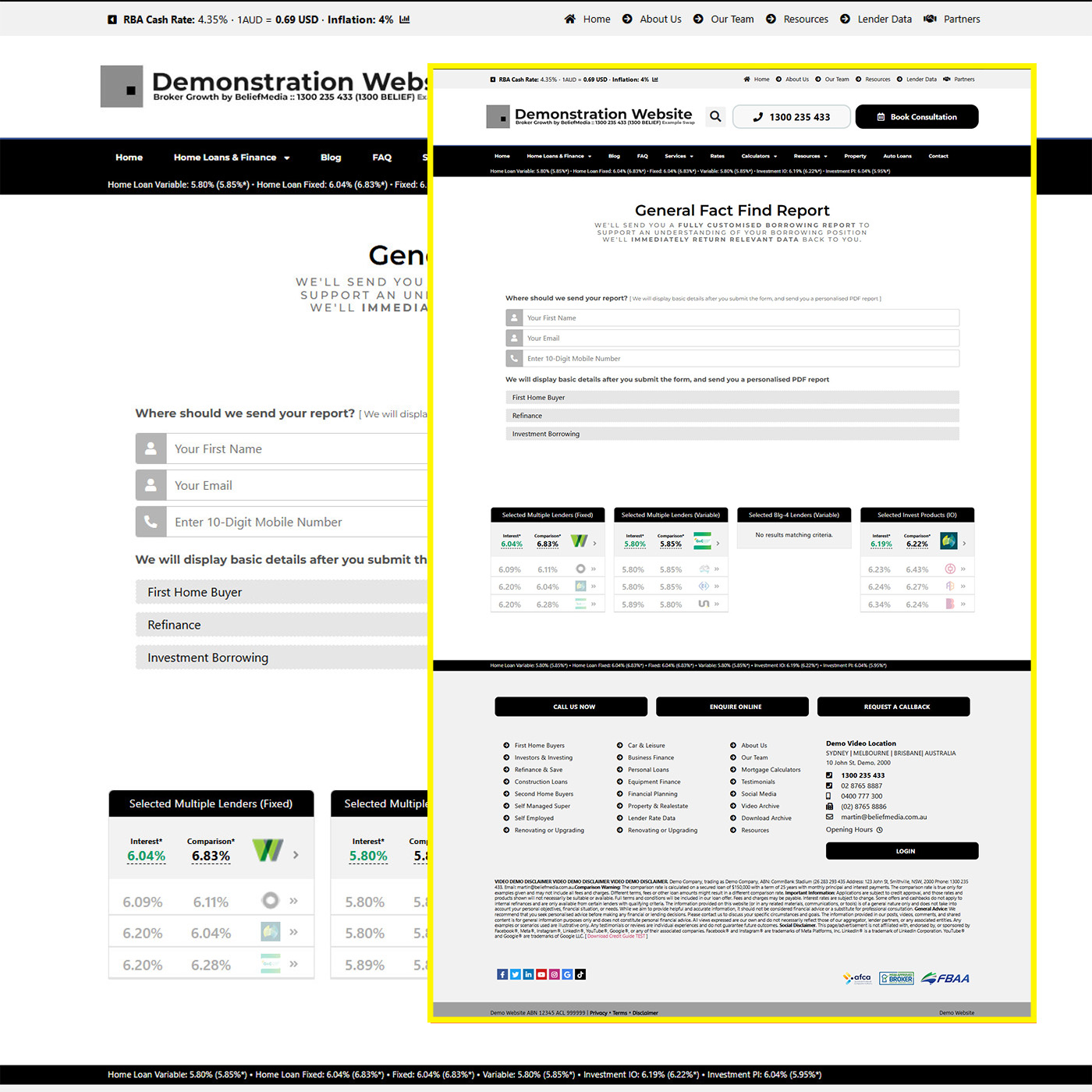
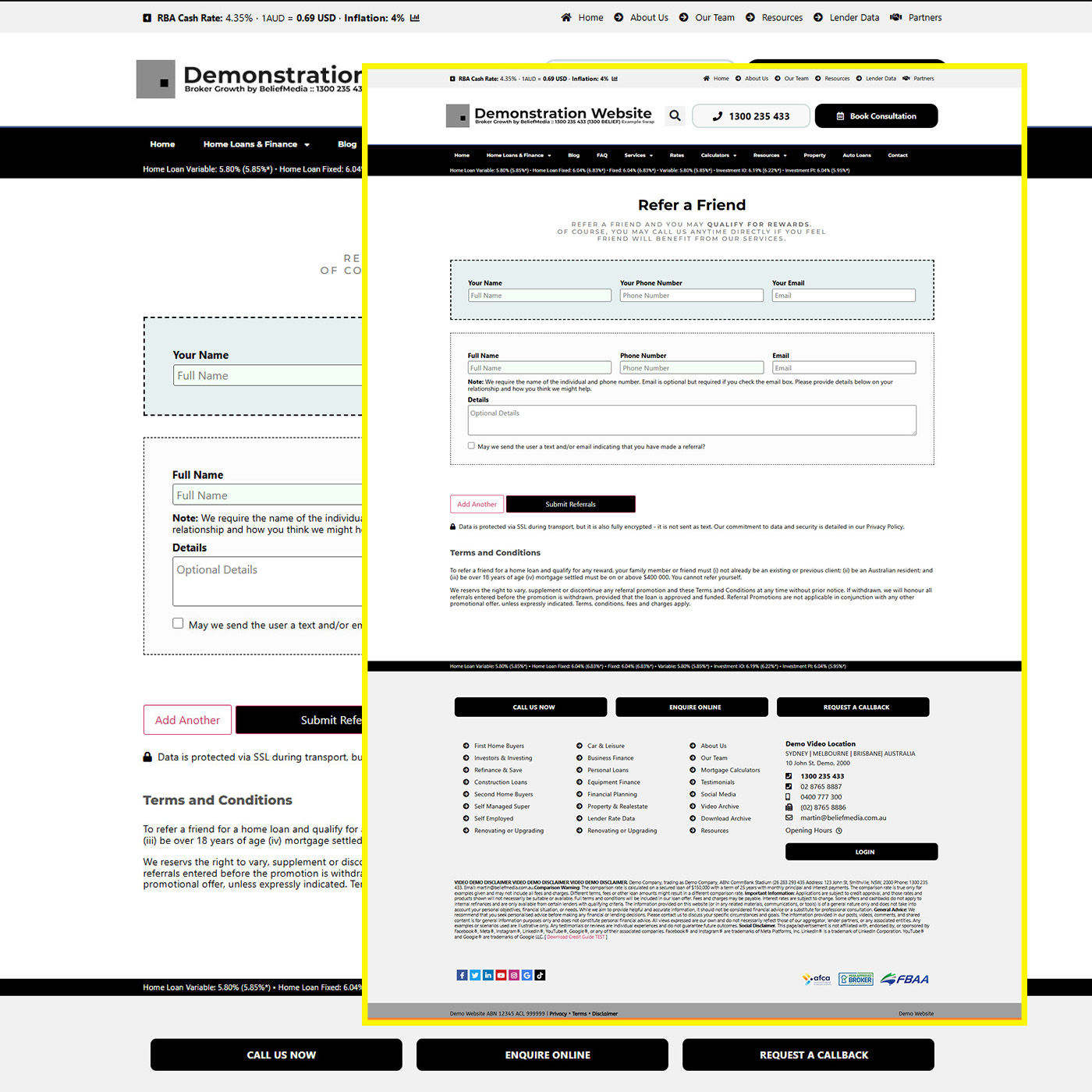
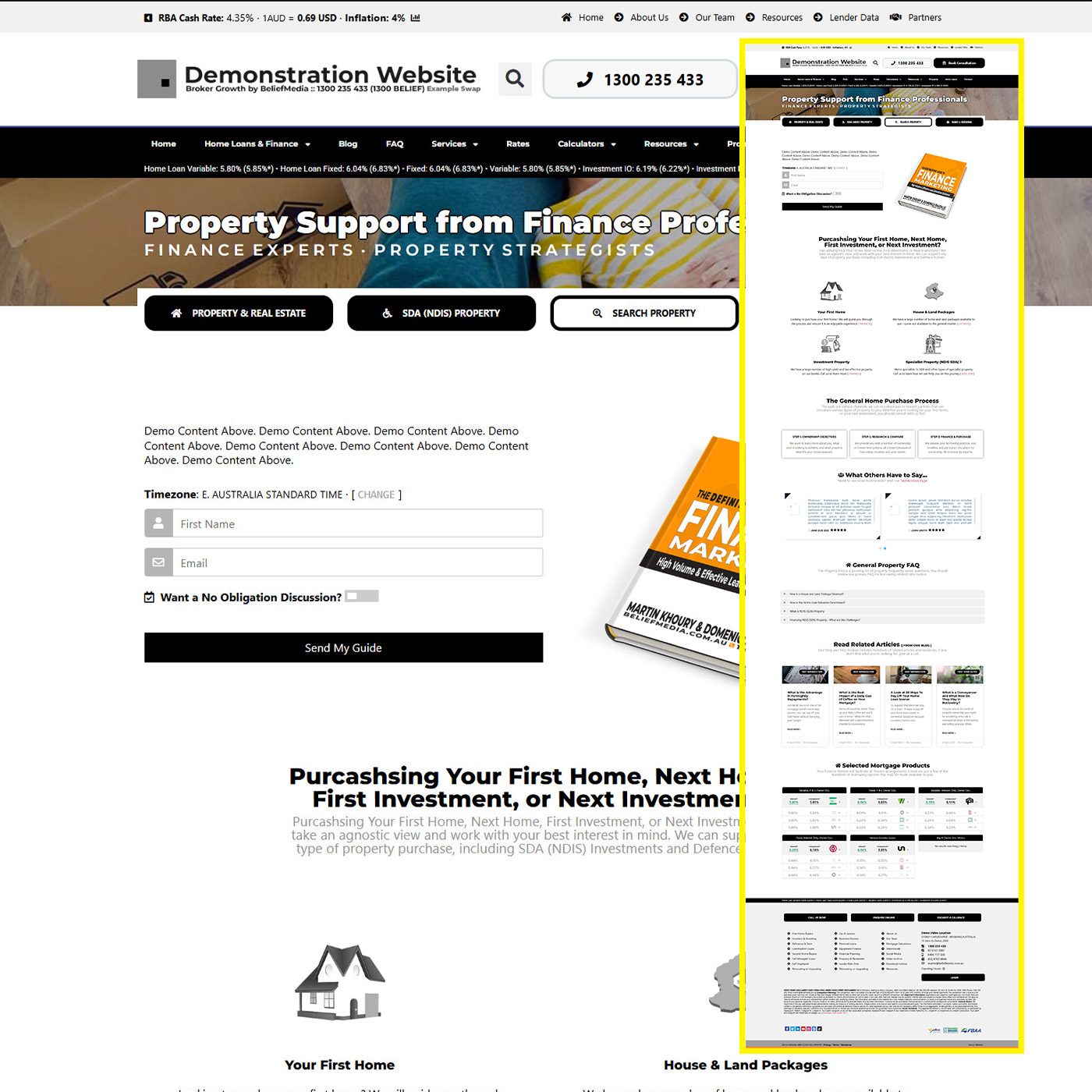
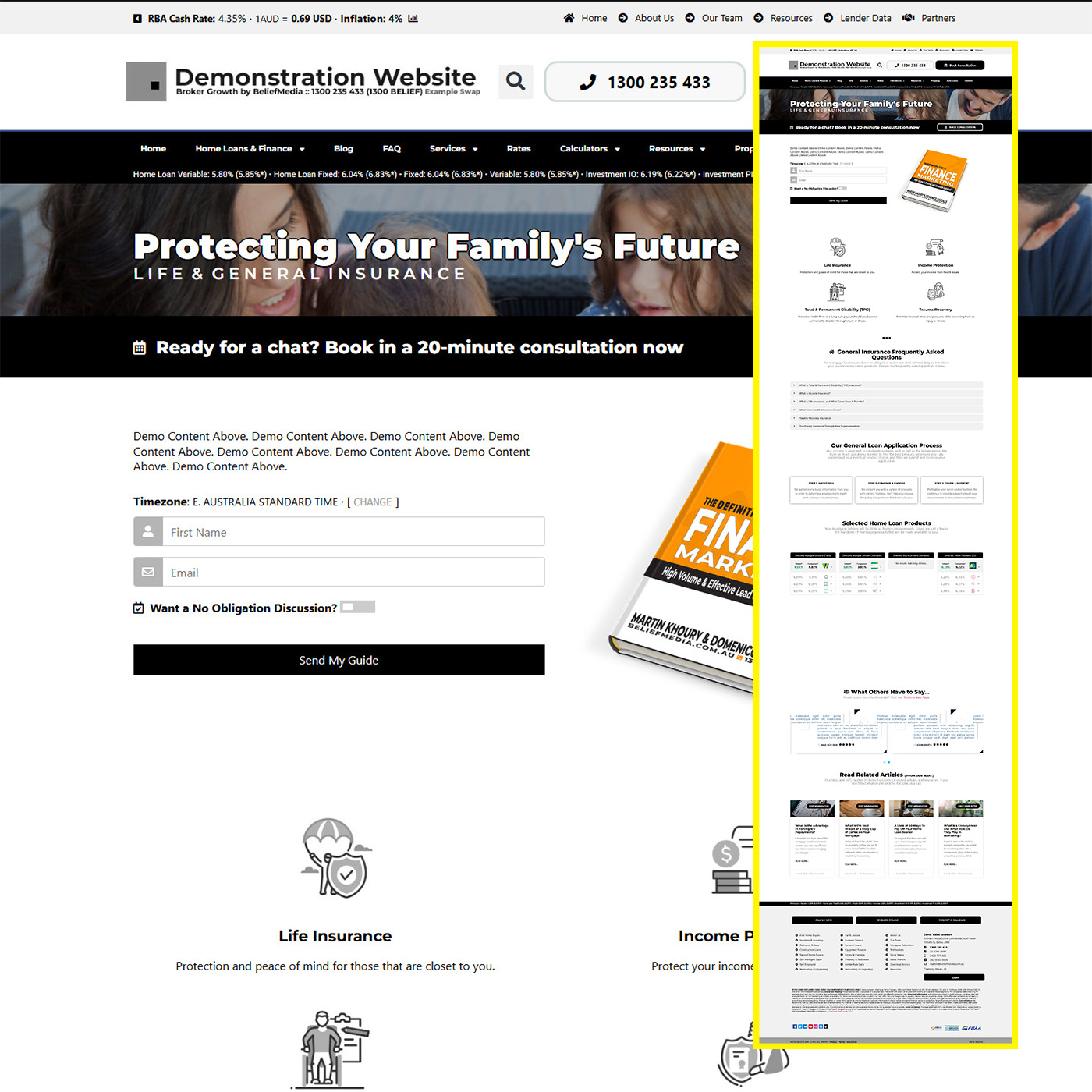
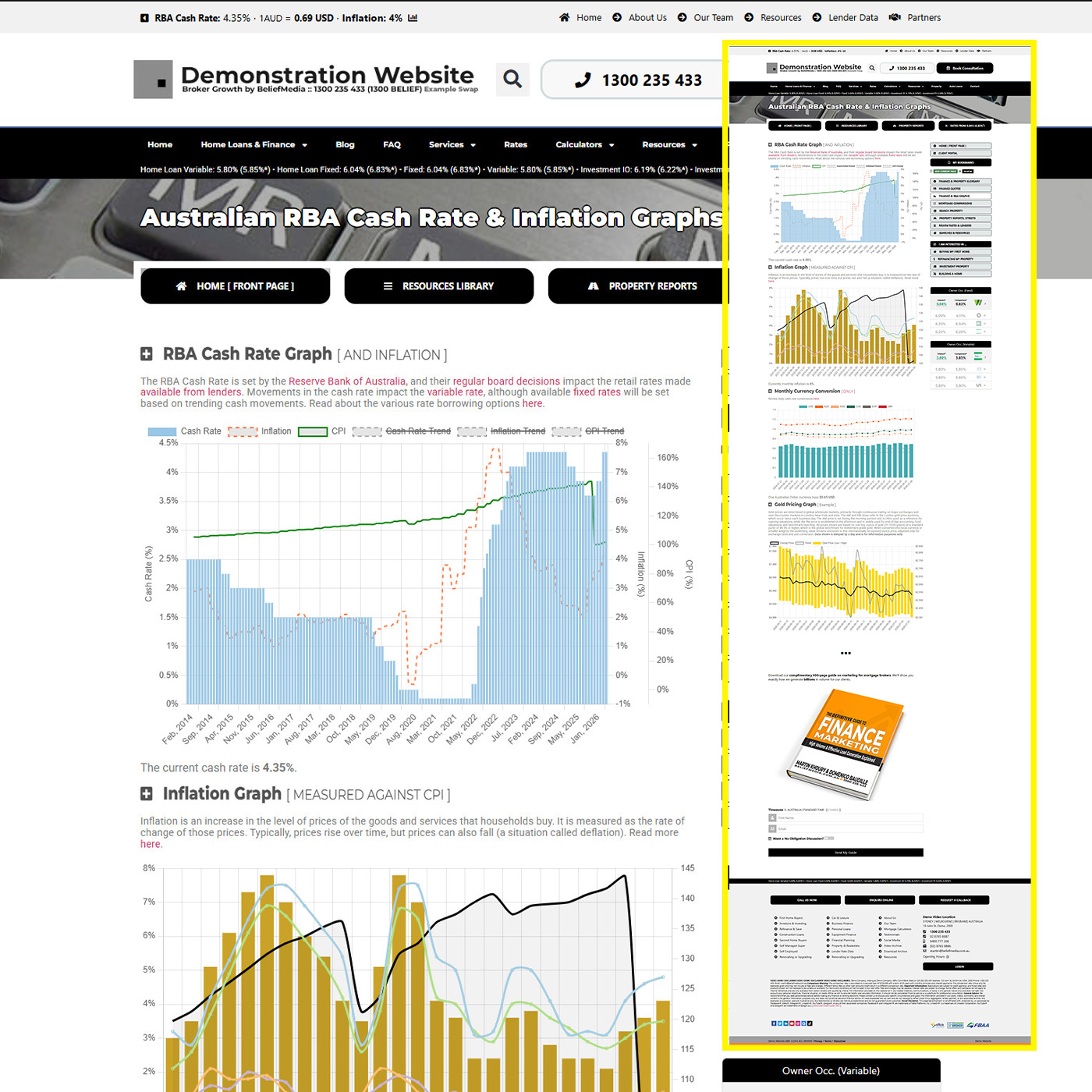
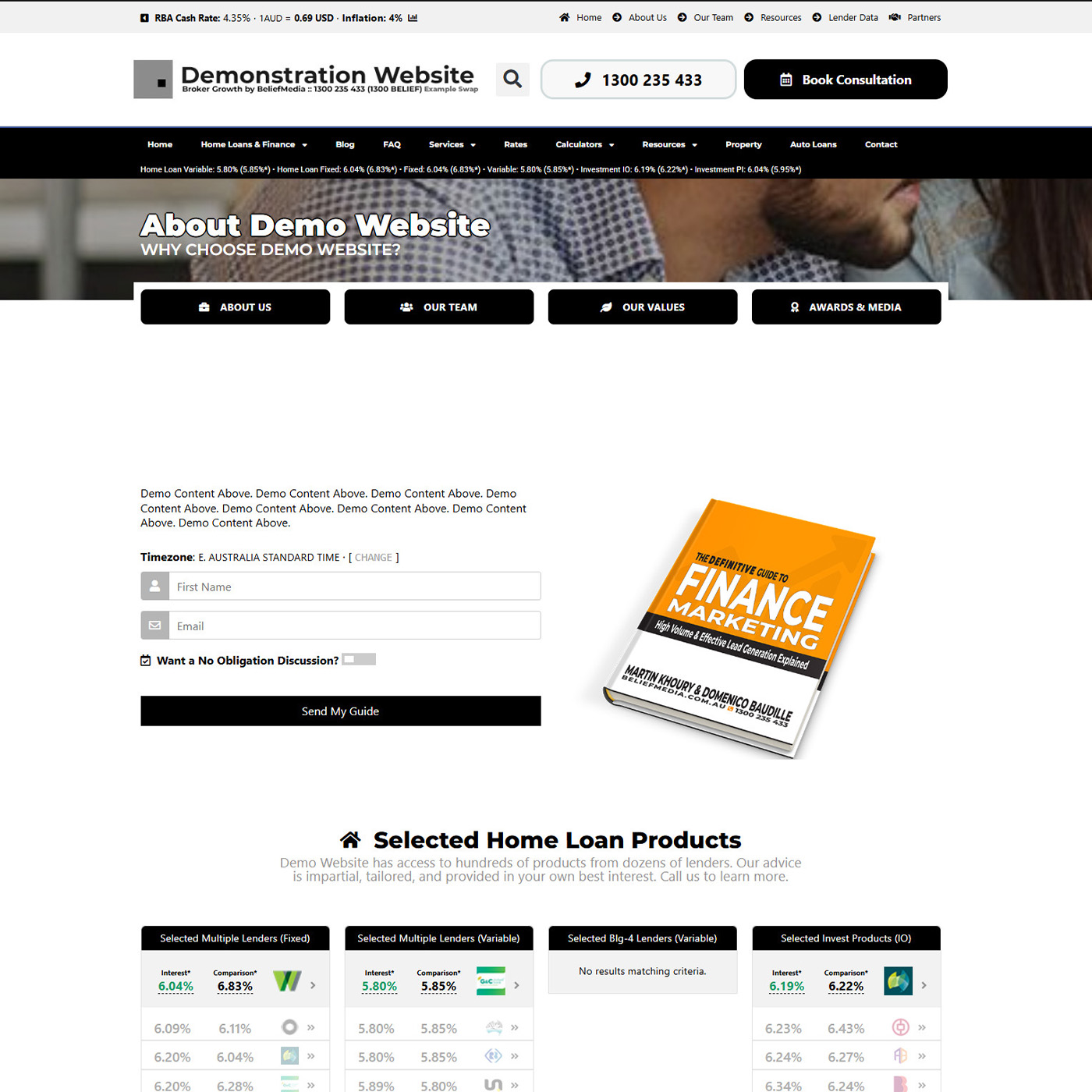
Client Portal: Its' not reasonable to introduce all pages in depth, and some require a these to support their purpose rather than a simple screenshot. Some of those pages include the RBA Policy Module (a few hundred pages), the basic Fact Find Report, the Referral Form, the Property Module, the Financial PLanning module (for partners), the graphs page, and the About page.
General Search Tools
The Streets module is one of the most powerful organic visibility and local-intelligence assets in the website framework because it creates a deep geographic archive covering suburbs, streets, properties, and location-specific property pathways across Australia. The archive lists every property in Australia and allows users to browse property and street-level information by suburb, postcode, street, and individual property, with each page supported by geographically relevant data and local context. Where appropriate, pages also include Census-based graphs and demographic information, giving the user a clearer understanding of the area in which they live, invest, buy, sell, or refinance. This makes the module both practical and educational: it gives users a reason to engage with the site before they are ready to speak to a broker, and it positions the broker as a local property and finance resource rather than just another loan provider.
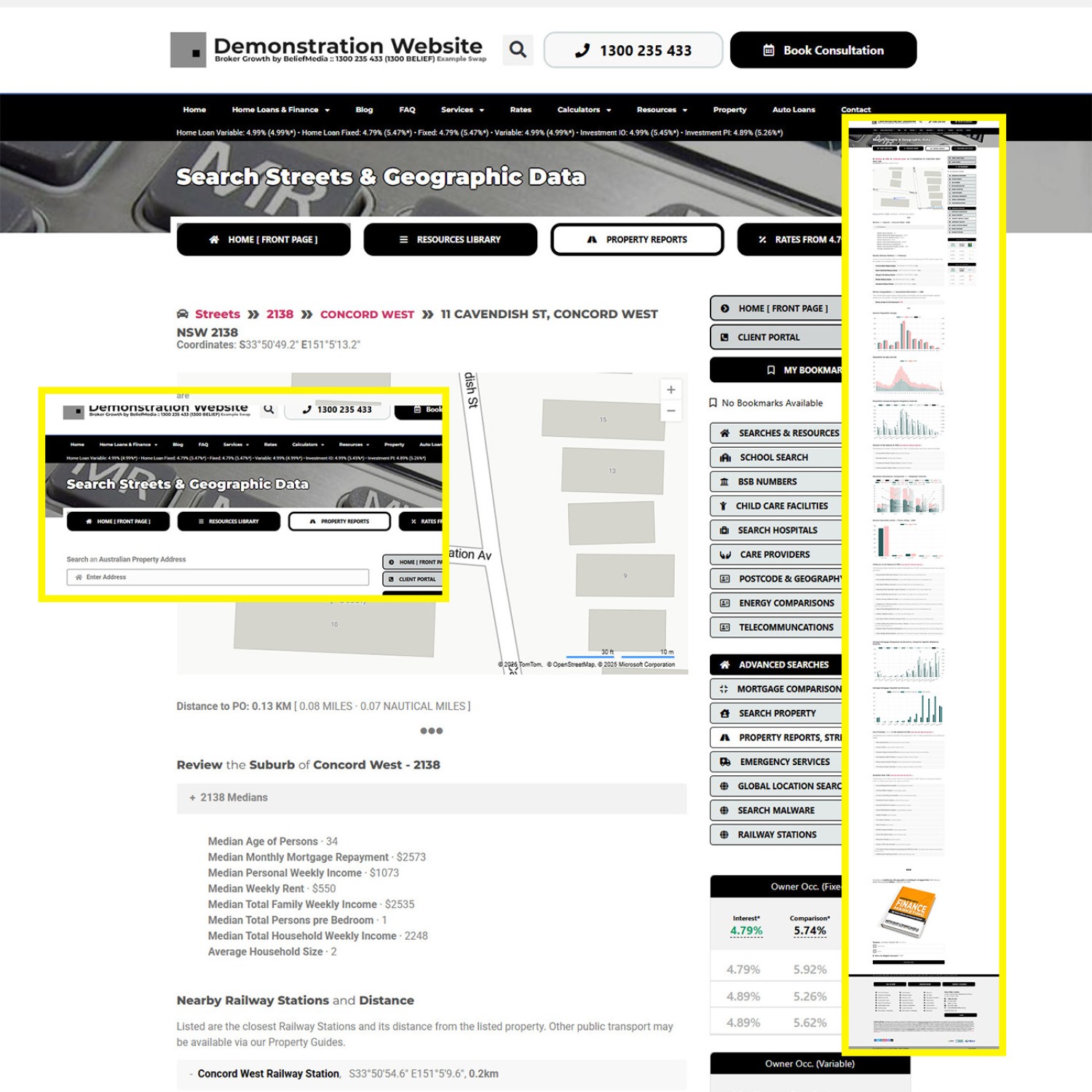
Streets Property Pages: Streets adds around 20 million pages to your website - all fitted with a high-converting conditional-redirect property form. The Streets module adds around 20-million engaging and SEO-hungry pages to your website. In an effort to stand out, this feature certainly contributes.
The strategic advantage of Streets is significant because each property, street, suburb, and postcode page becomes a potential entry point into the website. These pages are extremely highly trafficked because they satisfy a type of curiosity that exists well before formal borrowing intent. Users look up properties, streets, suburbs, values, demographics, local trends, and comparable information long before they complete a mortgage form. The Streets module captures that early-stage attention and connects it to finance relevance. A user researching a property may be considering buying. A user reviewing their own street may be thinking about equity. A user exploring suburb demographics may be planning an investment. A user checking property information may be preparing to refinance, renovate, or sell. The module therefore introduces the broker into the property research journey at a much earlier and more useful point than a generic home loan page could ever achieve.
Each page should carry a relevant form, and in most cases the form should offer a Property Report or similar location-based asset. This is where the module moves from traffic asset to conversion asset. The user is already thinking geographically. They are already engaging with property-specific information. A Property Report, suburb report, equity review, valuation guide, or local lending pathway becomes a natural next step. This is choice architecture working properly: the page does not interrupt the user with a generic “contact us” form; it offers a resource aligned with the behaviour that brought them there. That creates a cleaner value exchange, a stronger subscription event, and a more useful starting point for follow-up.
The point of difference is that the Streets module expands the website beyond conventional broker content. Most broker websites compete on the same small set of service pages: first-home buyers, refinancing, investment loans, construction, and contact. The Streets archive creates a massive long-tail property layer that gives the website depth, local relevance, internal linking, data utility, and ongoing search visibility. It also gives the broker stronger content pathways into local articles, suburb insights, property guides, partner campaigns, real estate referral relationships, SMS and email follow-up, and geographically relevant landing pages. In practical terms, it turns the website into a local property intelligence platform with finance pathways attached. That is a far stronger position than simply saying, “We help with home loans.”
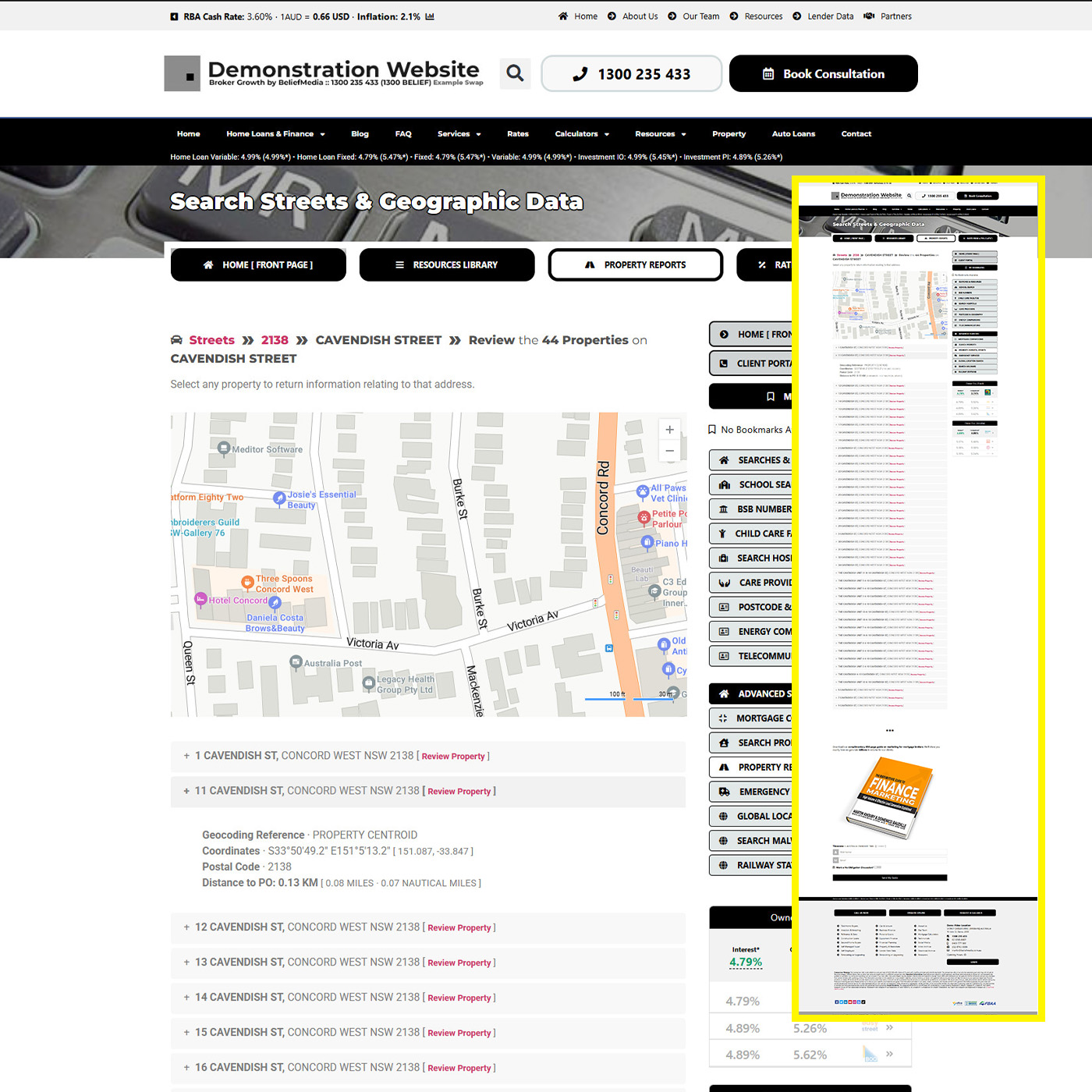
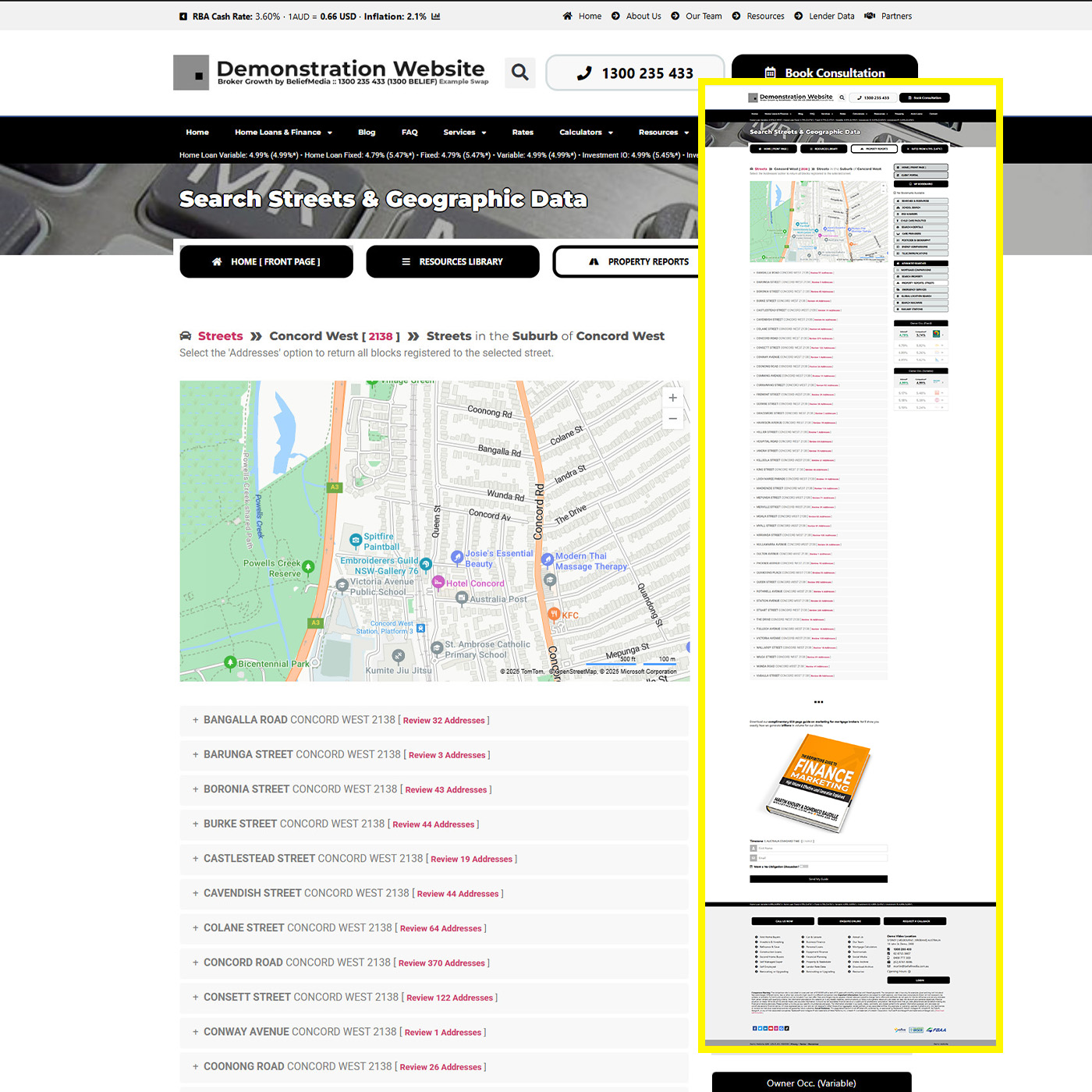
The Streets Module: Streets is supported by postcode pages, street pages, suburb pages, and other libraries. Each area provides a pathway into other areas. The module supports an education and entertainment agenda, but the Property Report on each of the individual registered block (property) pages should be a focus.
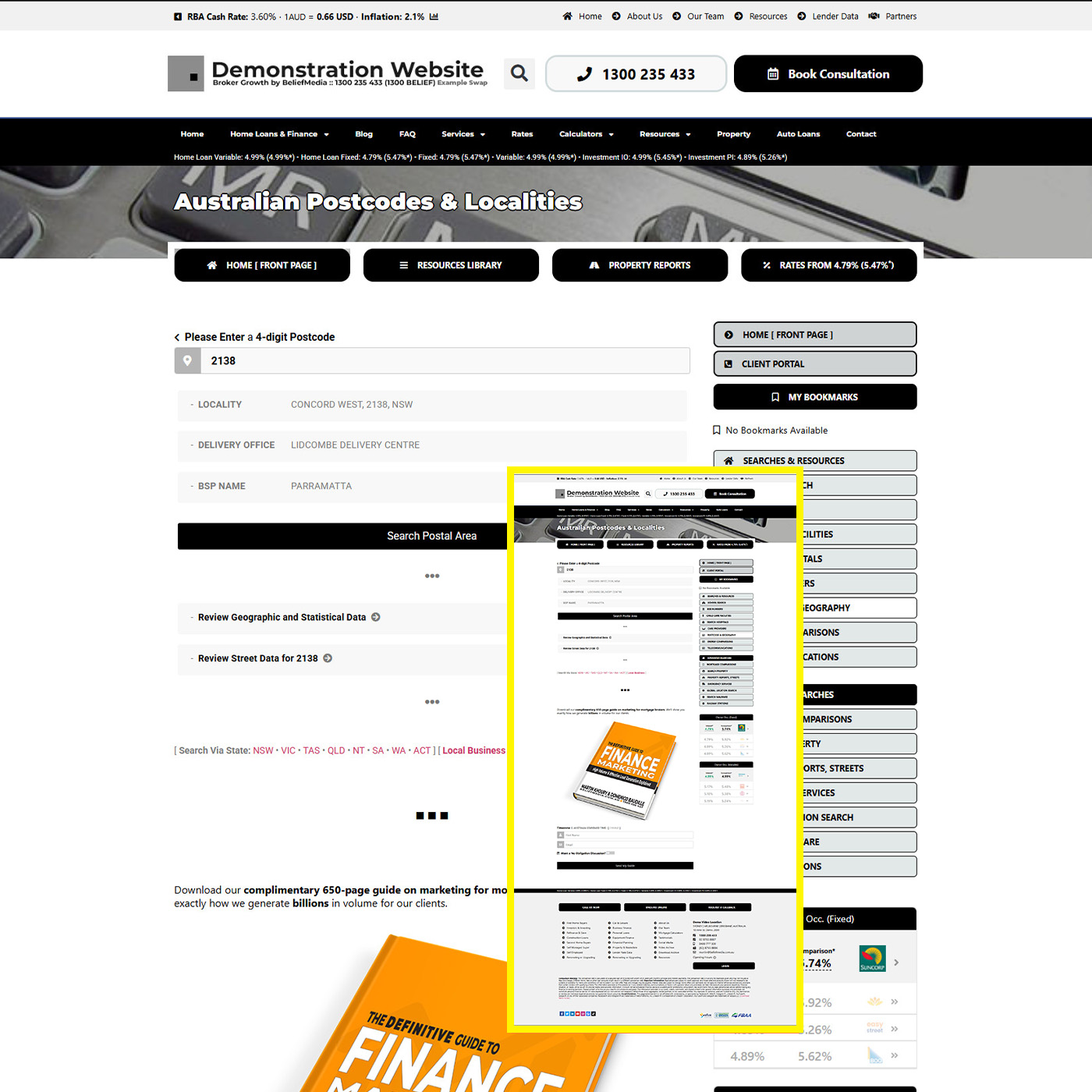
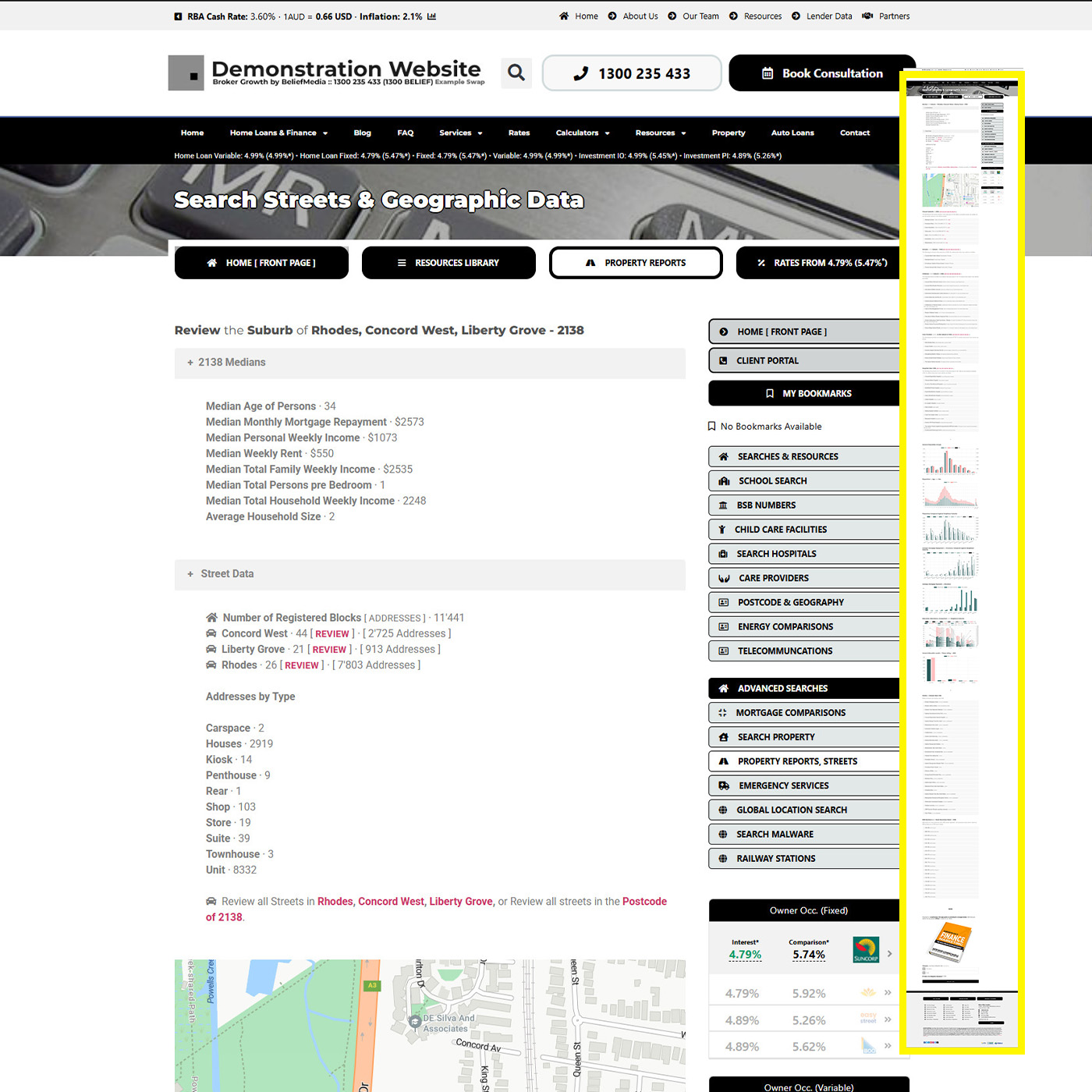
Geography by Postcode: A simple postcode search unfolds to thousands of postcode-related pages full of location geography, local utilities and points of interest, and other important information. The pages are heavily trafficked so should include the relevant form. The pages are geographically indexed so work very well with our Property Module (if listing property).
The broader location and reference modules exist because property decisions are never made on property data alone. Borrowers and investors evaluate location suitability through a much wider lens: schools, childcare access, hospitals, care providers, emergency services, railway stations, nearby facilities, points of interest, local infrastructure, banking references such as BSB numbers, and other practical signals that shape how a suburb or property is perceived. These resources answer the questions users are already asking elsewhere. A first-home buyer may want to understand nearby schools and transport. A family upgrading may care about childcare, hospitals, parks, and emergency services. An investor may look for rental appeal, infrastructure, accessibility, and amenity density. A downsizer or older borrower may care about medical access and care providers. By placing this information inside the broker’s own website environment, we keep the research journey closer to the broker rather than sending the user back to Google, government directories, school sites, map tools, or third-party property portals.
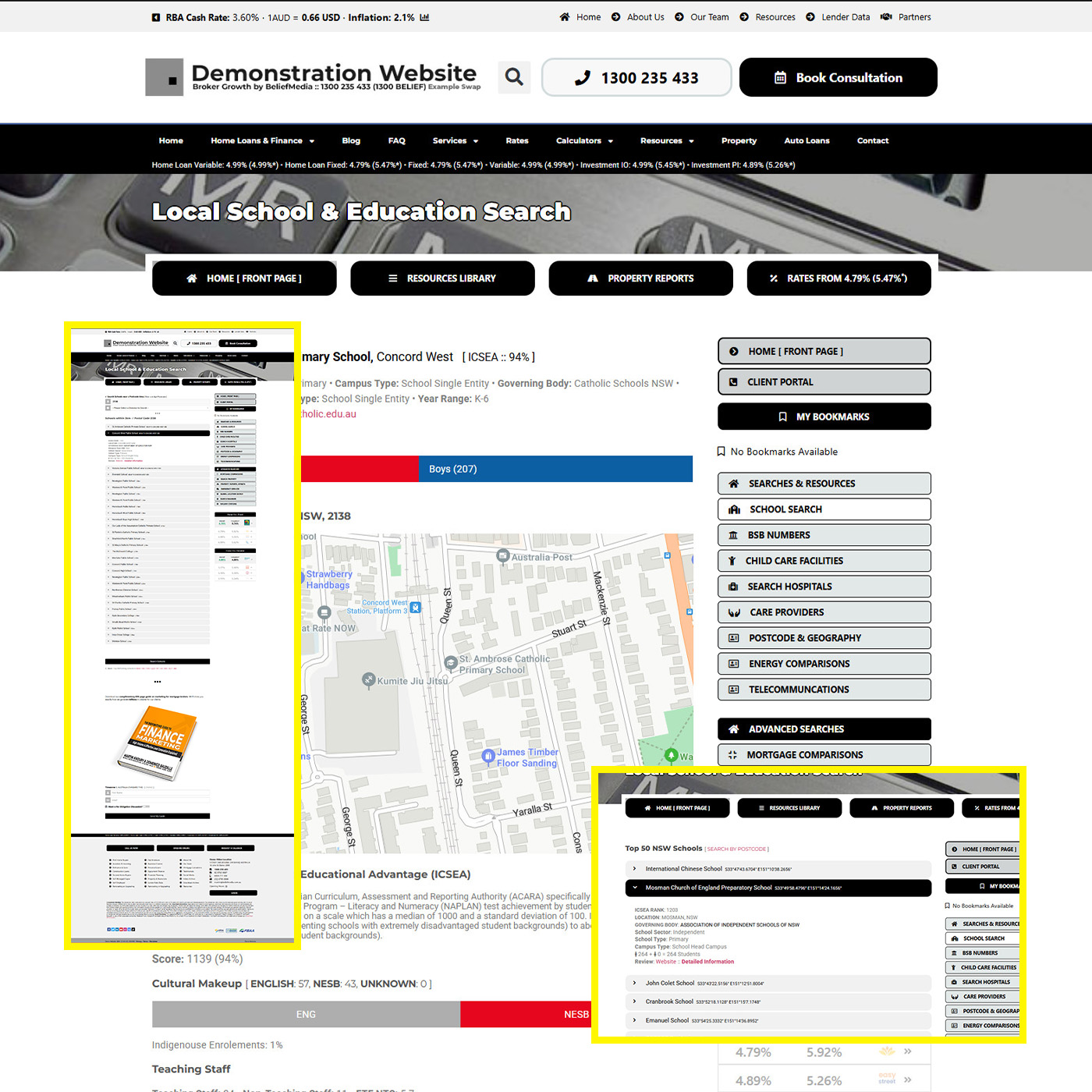
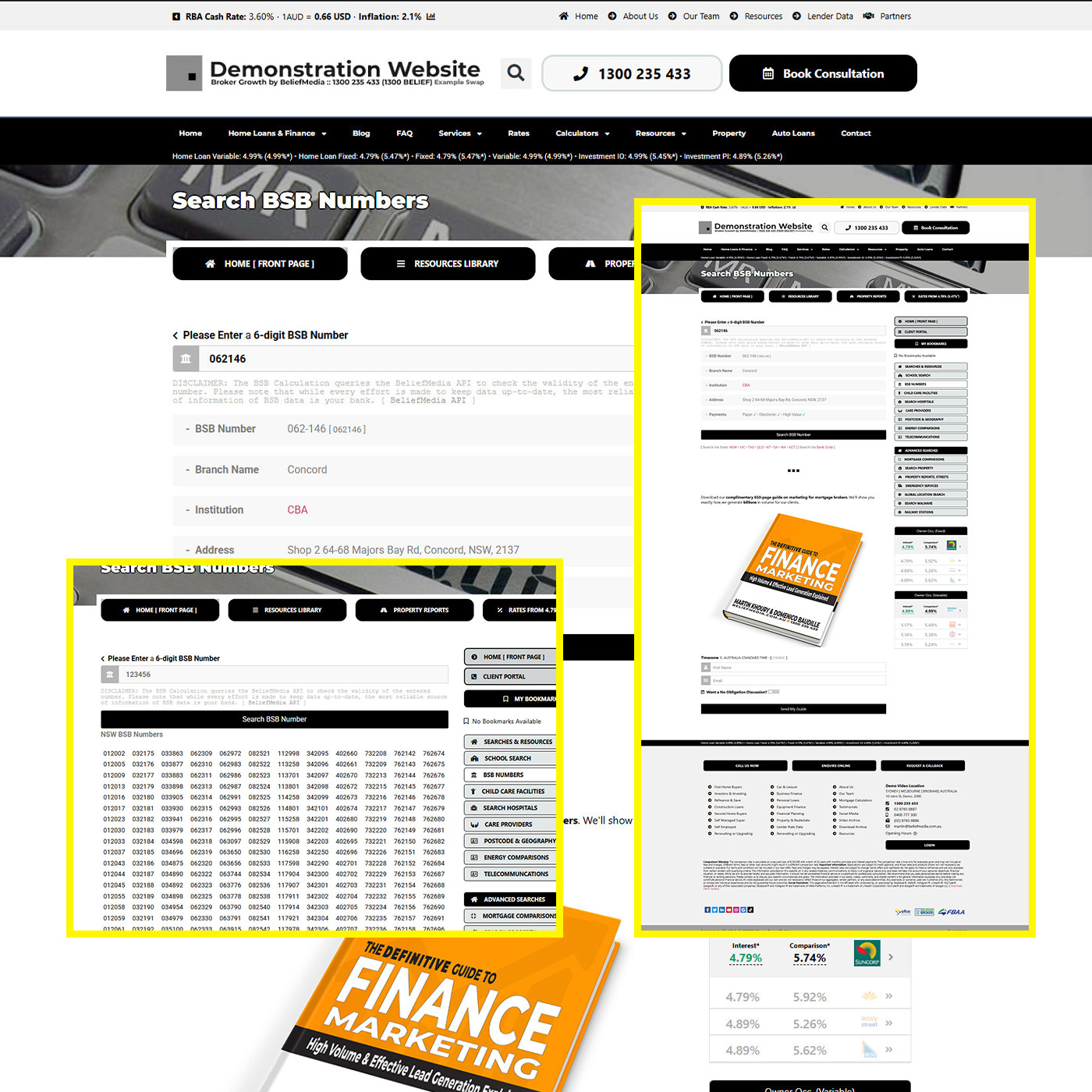
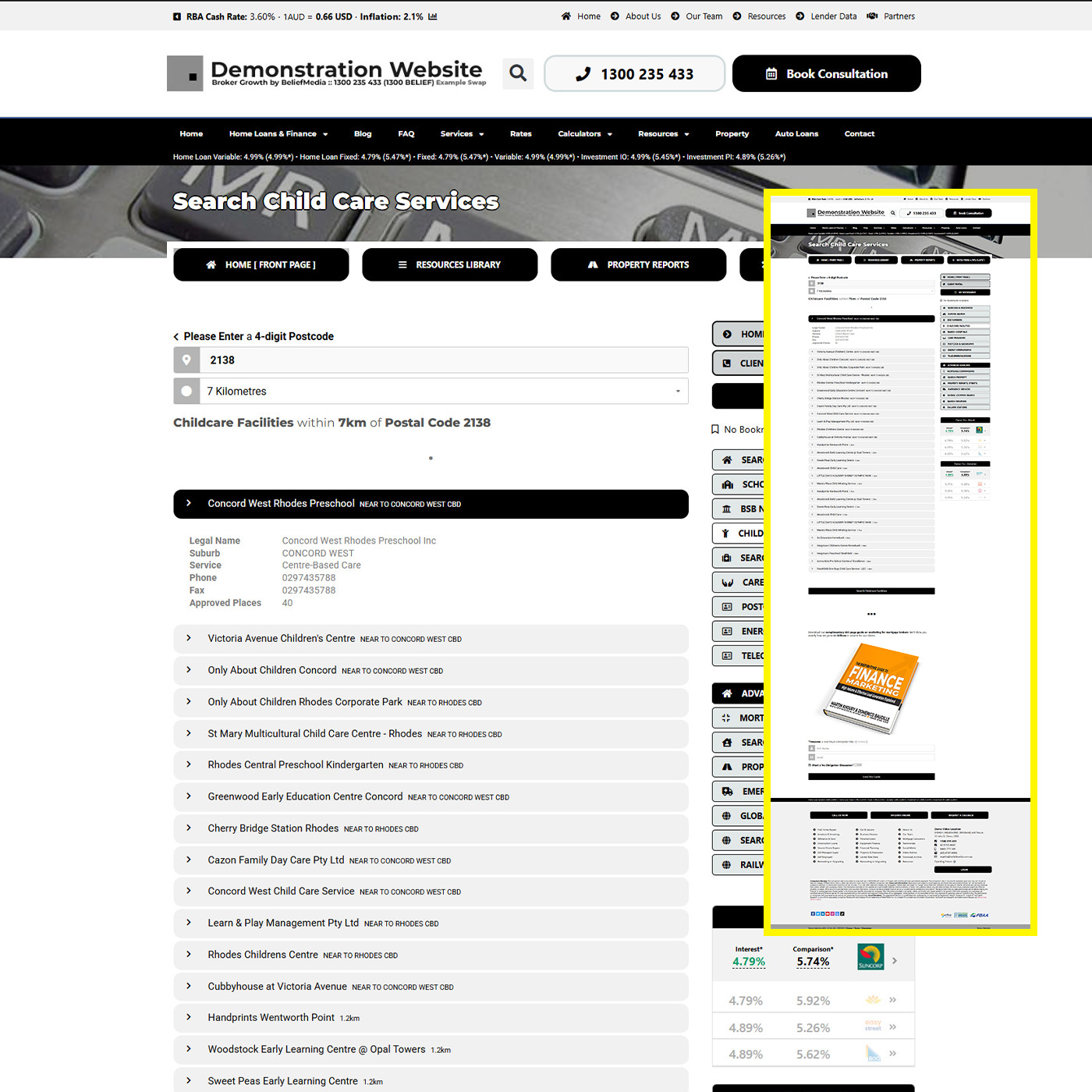
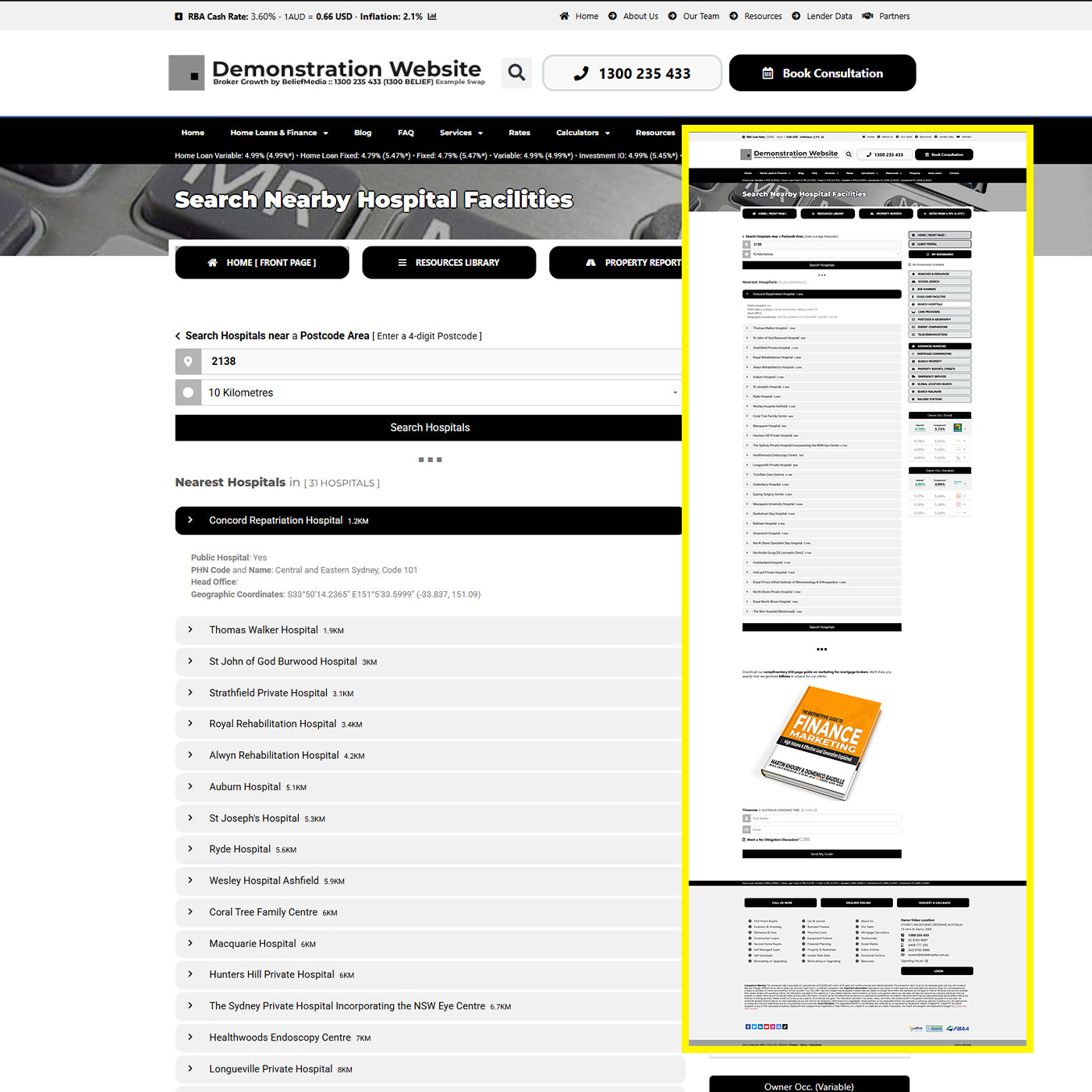
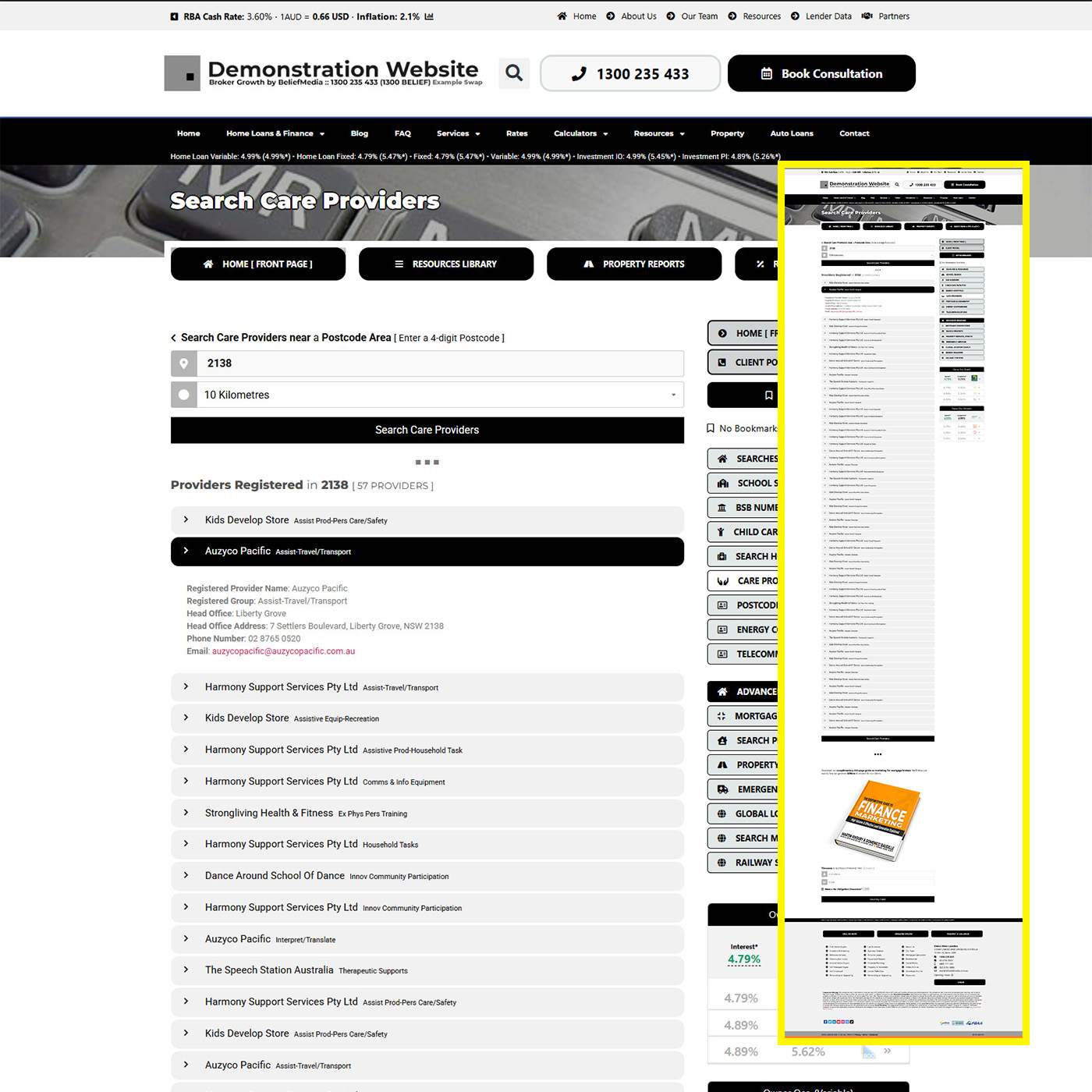
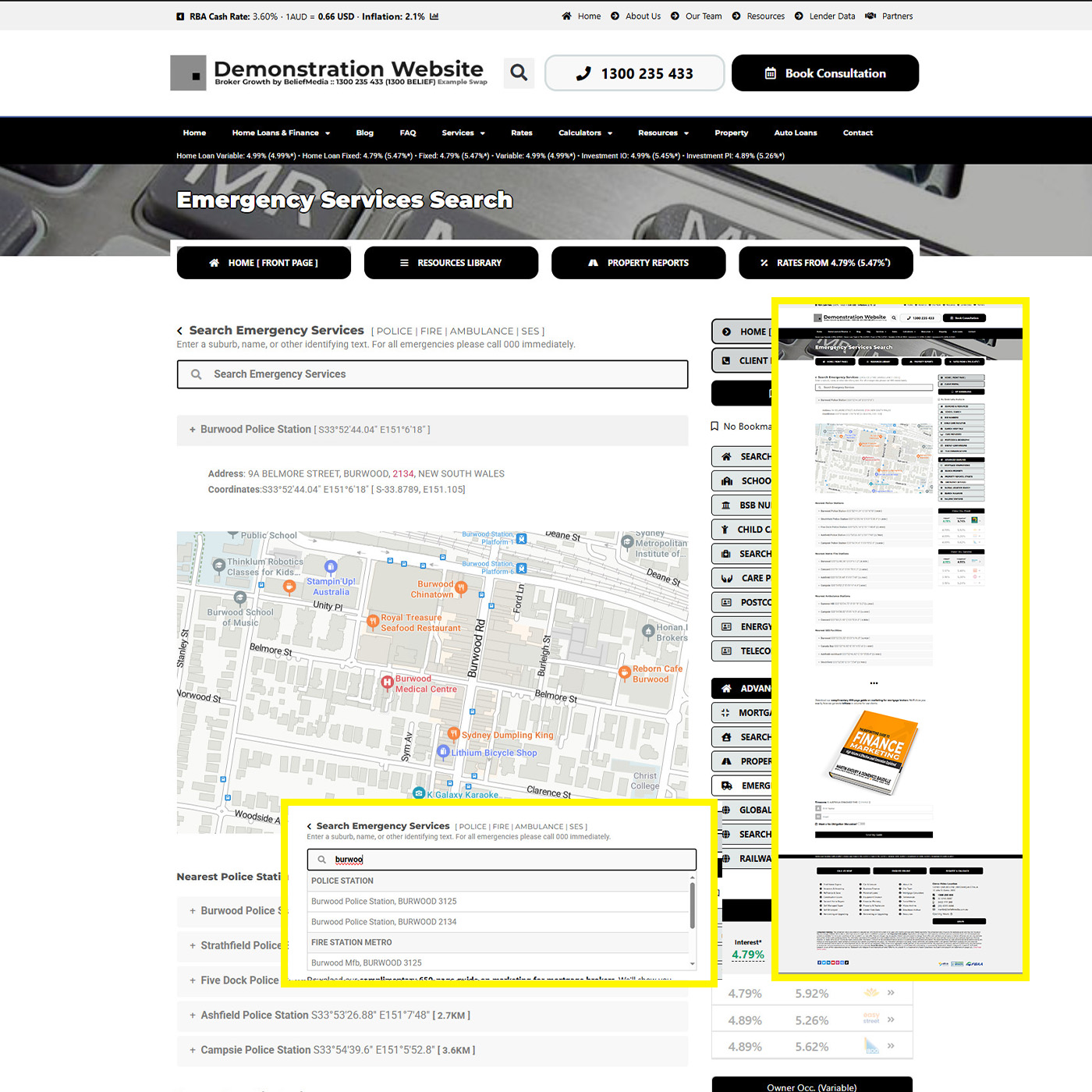
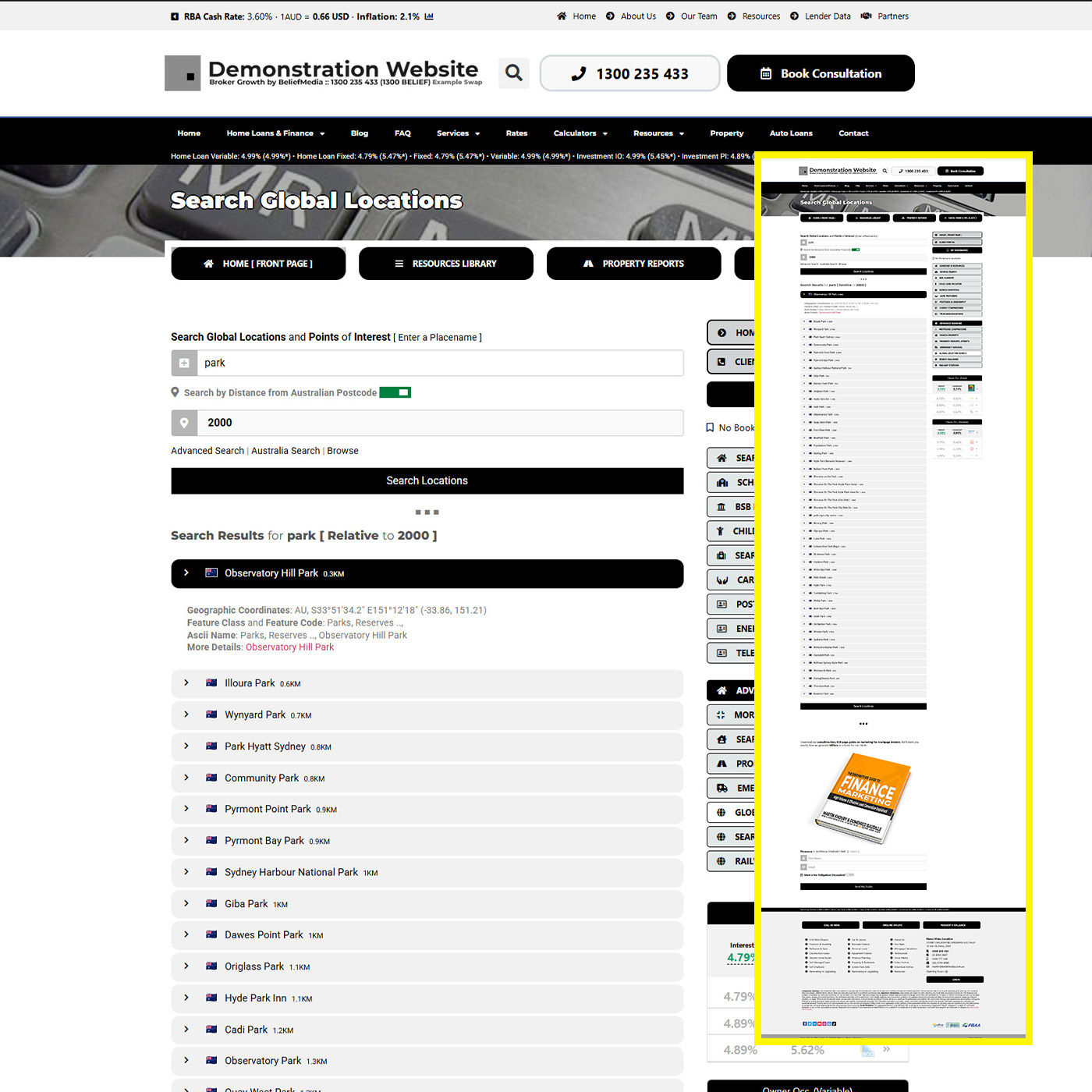
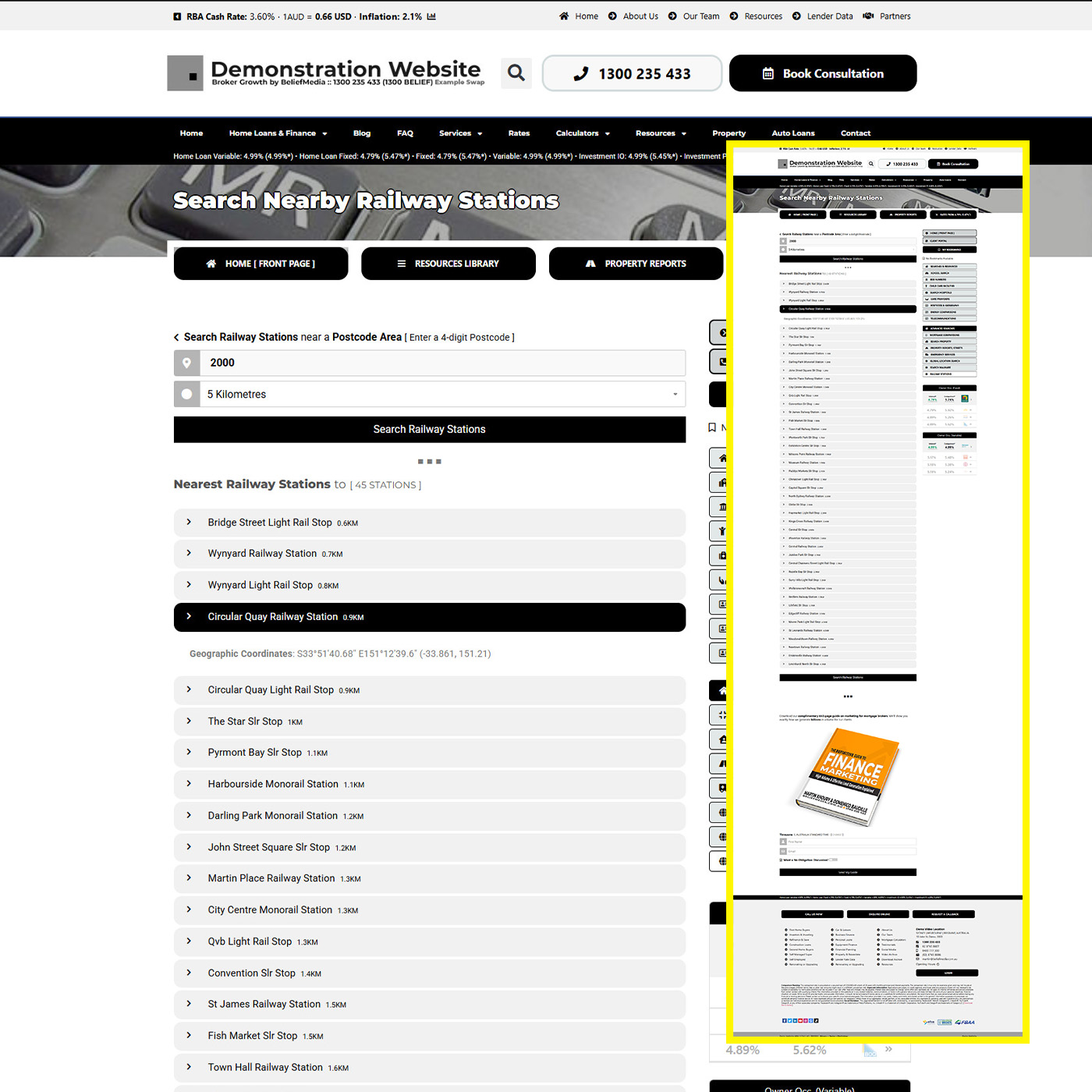
General Search Facilities: Search facilities exist for Australian schools, BSB numbers, child care, hospitals, care providers, emergency services (police, fire, ambulance, and SES), global locations with a focus on POI near local postcodes, and railway stations. Some search tools aren't shown because they aren't in any way relevant, such as the Malware and IP search, provided because they're often linked via the articles we send to your website blog (we don't like linking off-site).
Their value is psychological as much as practical. Property decisions are high-stakes, emotionally loaded, and cognitively complex. Users rarely make them through pure financial modelling. They build confidence by collecting environmental cues: “Is this a good area?”, “Will my children be close to school?”, “Is transport convenient?”, “Is there medical support nearby?”, “Would tenants find this location attractive?”, “Does the suburb feel established?”, “What services are close enough to matter?” These modules reduce uncertainty by giving the user structured answers to those contextual questions. In behavioural terms, they lower cognitive load, increase perceived control, and support decision fluency. When a website helps a borrower understand not just the loan but the living, investing, and location context around the loan, the broker becomes associated with guidance rather than transaction.
These modules also contribute strongly to E+AT. Expertise is demonstrated because the website shows an understanding of the real factors that influence borrowing and property decisions. Experience is implied through the practical breadth of resources made available. Education is delivered through structured, searchable, location-specific information. Authoritativeness is strengthened because the website becomes a deeper reference point, not a thin broker brochure. Trust is supported because the user is given useful information before being asked for a commitment. This is important because trust in finance rarely forms from a single bold claim. It forms through repeated evidence that the broker’s environment is useful, complete, relevant, and professionally maintained.
The pages are also funnel assets. They are highly trafficked because they satisfy real search and research behaviour, but they are not generally promoted as primary services unless the user goes looking for them. This means they add depth without cluttering the main website architecture. They do not interfere with the core borrowing pathways, but they create additional entry points, internal links, topical clusters, and location-based journeys that strengthen the broader website. A user may enter through a school page, childcare page, railway station page, hospital page, suburb resource, BSB page, or point-of-interest page, and each page becomes another opportunity to introduce relevant borrowing pathways, local property resources, suburb reports, investor guides, refinance reviews, first-home-buyer education, or a Property Report.
The every-page form ideology is critical here. A page about a school should not carry the same conversion prompt as a generic refinance page. A childcare or school page may support a family-home or first-home-buyer pathway. A railway station or point-of-interest page may support investor and suburb research pathways. A hospital or care provider page may support local property, employment, medical-worker, or downsizer-oriented content. A BSB page may support practical finance education, lender content, refinance pathways, or banking-related resources. The form and call to action should respect the context that brought the user to the page. This is choice architecture: the page offers the next most logical step rather than forcing the user back into a generic broker enquiry.
From a strategic perspective, these modules turn the website into a local decision-support platform. Most broker websites only compete on obvious mortgage keywords, where the search environment is saturated and expensive. These modules create broader discovery pathways around the real-world context of property decisions. They attract users earlier, support investors more comprehensively, help families research liveability, and provide useful information that would otherwise be consumed elsewhere. The broker benefits not because every visitor is ready to apply for a loan, but because the website becomes part of the user’s research habit. Repeated exposure creates familiarity. Familiarity supports trust. Trust increases the probability that when finance becomes relevant, the broker who helped frame the research is the broker most likely to be considered.
The important point is that these pages are not random directories. They are structured relevance assets. They support borrowers and investors, create organic entry points, strengthen internal pathways, reinforce E+AT, and provide contextual conversion opportunities without diluting the primary mortgage services. Used properly, they make the website bigger, smarter, more useful, and more difficult for competitors to replicate.
Landing Pages
Landing pages are divided into two categories: Yabber Landing Pages and Custom Landing Pages. Yabber landing pages are turnkey and ready-to-go right now. The compliance pages support best practice, conditional redirections, and other high-level features. They support various niches, and numerous borrowing type within each niche.
The Custom Landing Pages are pages you build yourself with the drag-and-drop Elementor widgets. We've created around 80 finance-specific widgets that makes page creation simple.
Given the scope of landing page features, we'll introduce landing pages in an article titled "The Landing Page Module is Updated to Adventus".
Most landing pages and landing flows are entirely one-dimensional. It's a method used in the absence of technology or expert support. Somebody lands on a landing page, enters details into a form, and then something happens that is entirely contradictory to any funnel-focused experience - they'll send users to an off-site or 'third-party' (white label) calendar page. The staple of marketing mediocrity. The calendar page is a literal funnel deal end, and the entire experience contributes nothing towards the website.
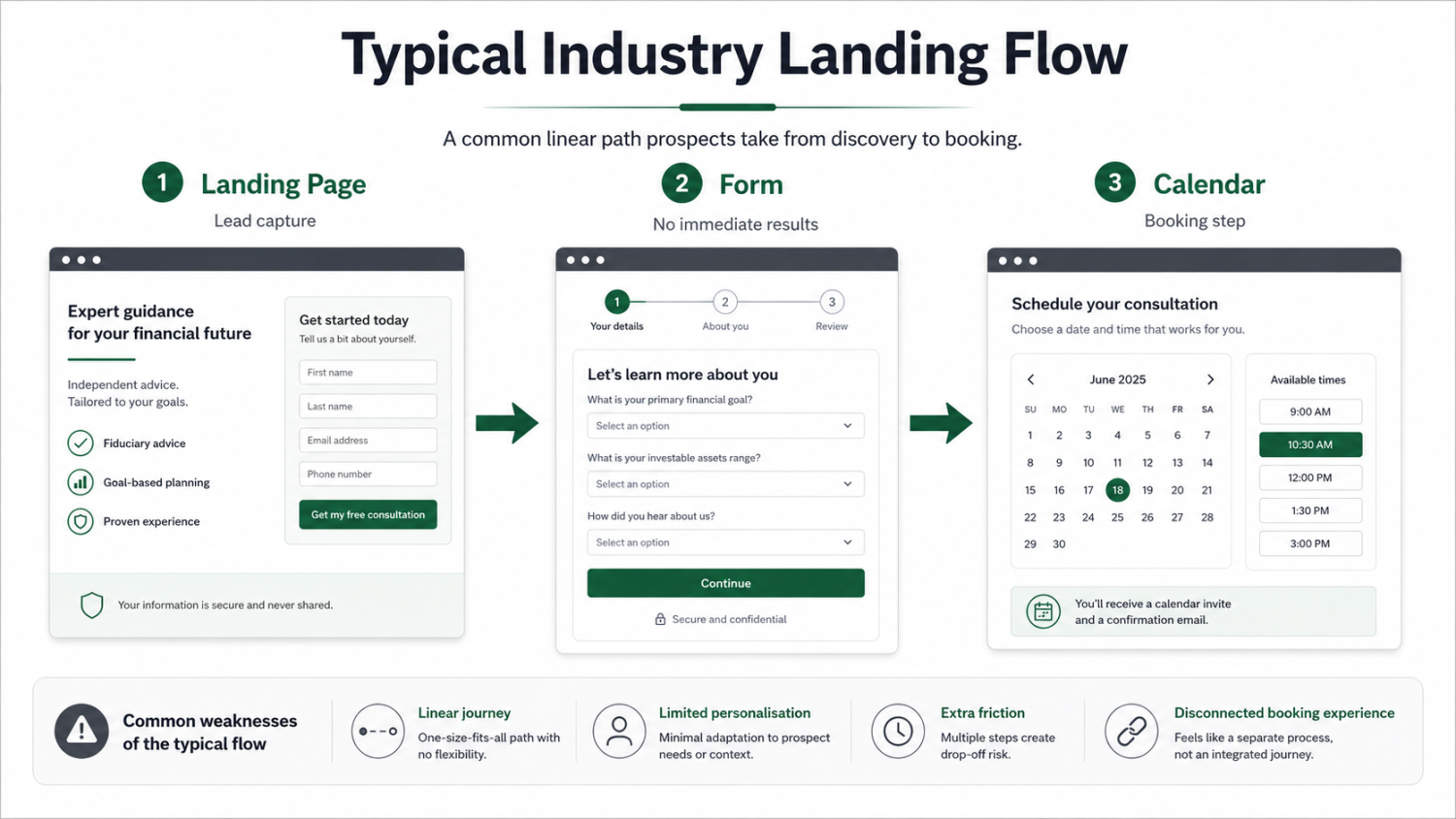
The Typical Landing Page Flow: The typical landing page flow. Most landing pages and landing flows are entirely one-dimensional. It's a method used in the absence of technology or expert support. Somebody lands on a landing page, enters details into a form, and then something happens that is entirely contradictory to any funnel-focused experience - they'll send users to an off-site or 'third-party' (white label) calendar page. The staple of marketing mediocrity. The calendar page is a literal funnel deal end, and the entire experience contributes nothing towards the website.
Some even describe this flow as 'conditional' in order to suggest best practice is applied.
The Belief flow is different. We do what resonates with the user - not something that is limited by available technology. The reason: it gets more leads, more conversions, and better results.
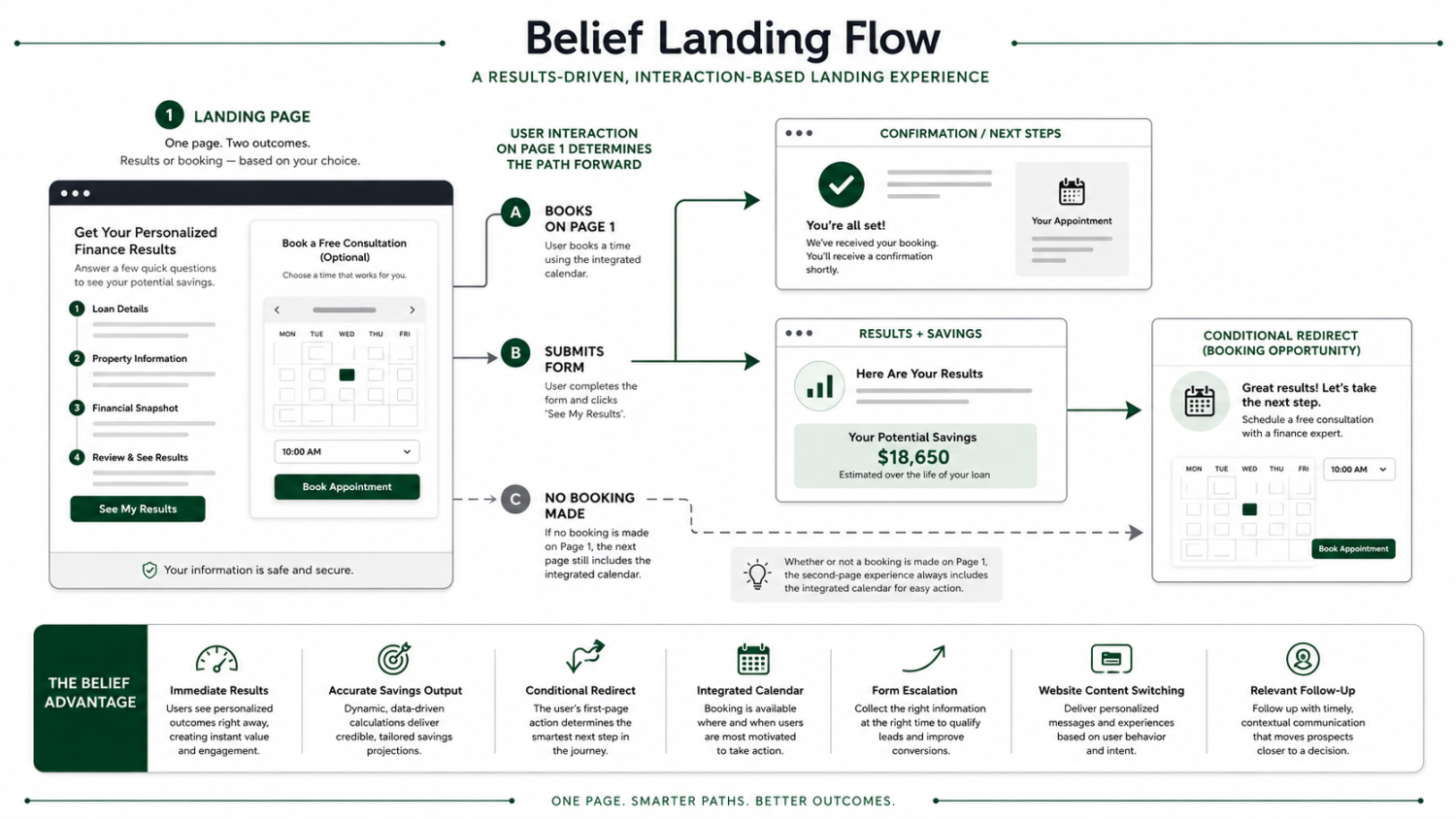
The Belief Best Practice Landing Flow: The Belief flow is different. We do what resonates with the user - not something that is limited by available technology. We integrate first page options, conditional redirections, form-based comparison results (as detailed below), and integrated conditional video. It results in more leads, more conversions, and a far higher ROAS.
Again, our landing methods are introduced in an article titled "The Landing Page Module is Updated to Adventus".
Lender Library Pages
Supported by the comparison features, comparison forms, and a large number of other features, your website includes various lender product page pathways. Despite industry rhetoric.
Properly implemented and sensibly supported, lender data showcases E+AT because it demonstrates expertise, supports education, reinforces authoritativeness, and gives users practical tools rather than vague marketing claims. Being a 'rate driven broker' and one that provides actual information on the products you sell aren't mutually exclusive. Rate driven activity is defined by your interaction with a consumer, while providing information is a marketing necessity to establish E+AT and support your business professionally. You should get a consumer on the phone based on presenting yourself in a professional manner, and then educate them as necessary.
Consumers consider rate to be the single most important attribute in their borrowing journey because that is what the overwhelming avalanche of media information will have them believe. It's your job to teach them otherwise. Any marketer or broker that doesn't understand this has to be educated by us in the same way.
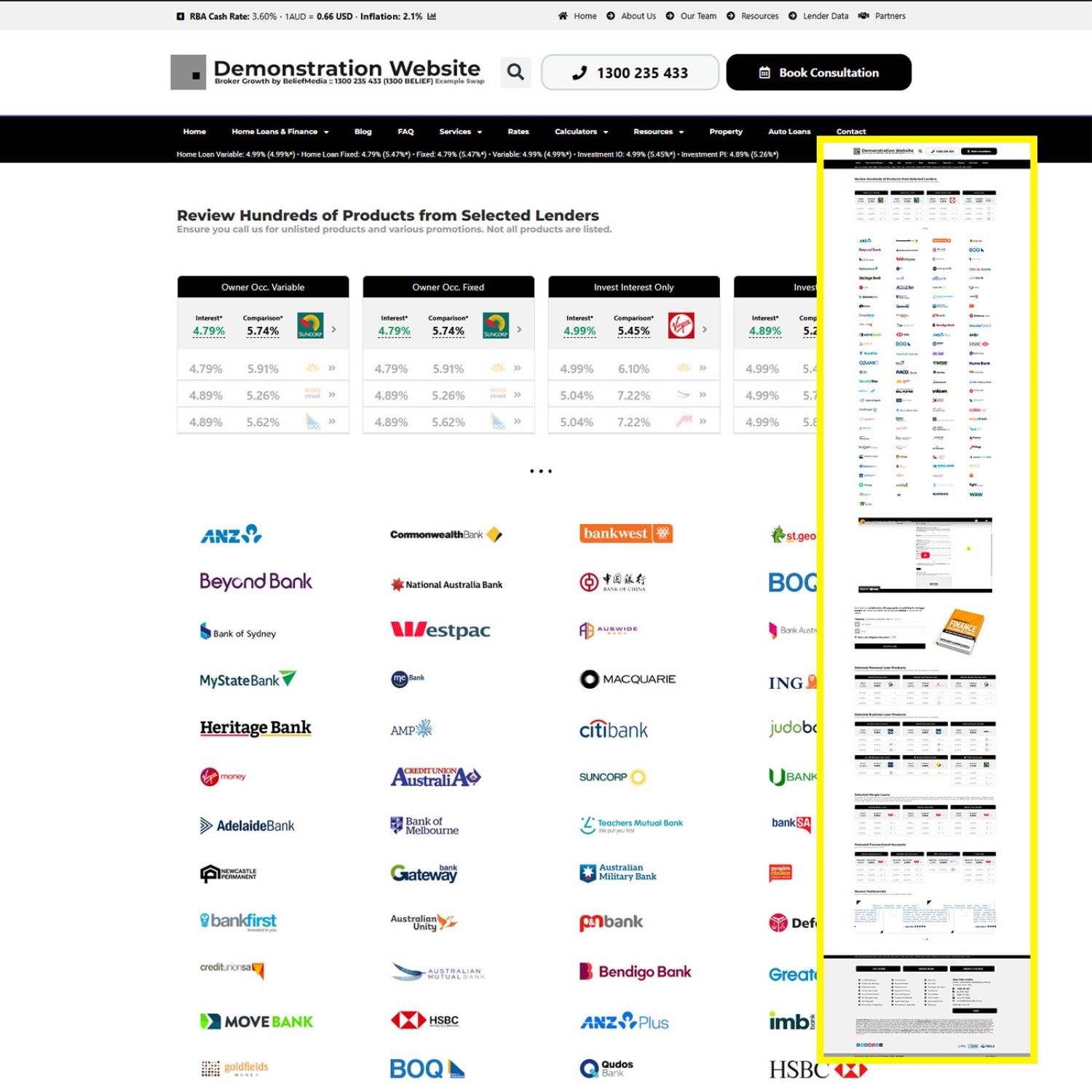
Lenders Entry Page: Those icons most brokers have on their website may be selected in our framework - they're not static images. The same icons - as defined in Yabber as 'Accredited Lenders' - are those referenced by website widgets and the comparison engine, and they're shown on a standalone page that is essentially the entry point to the lender information. A video on this page is assigned with its purpose to support the user through the minefield of information. You're the custodian of the user journey, and video is used to support and inform their browsing.
The data extensively supports SEO and engagement by creating a large, structured layer of finance content that users actively seek. A website that contains current lender data, product pages, rate information, repayment pathways, comparison explanations, and supporting education is materially stronger than those with claims of a "great rate", or even worse "a sharp rate" - the latter an industry term that is surprisingly lost on consumers.
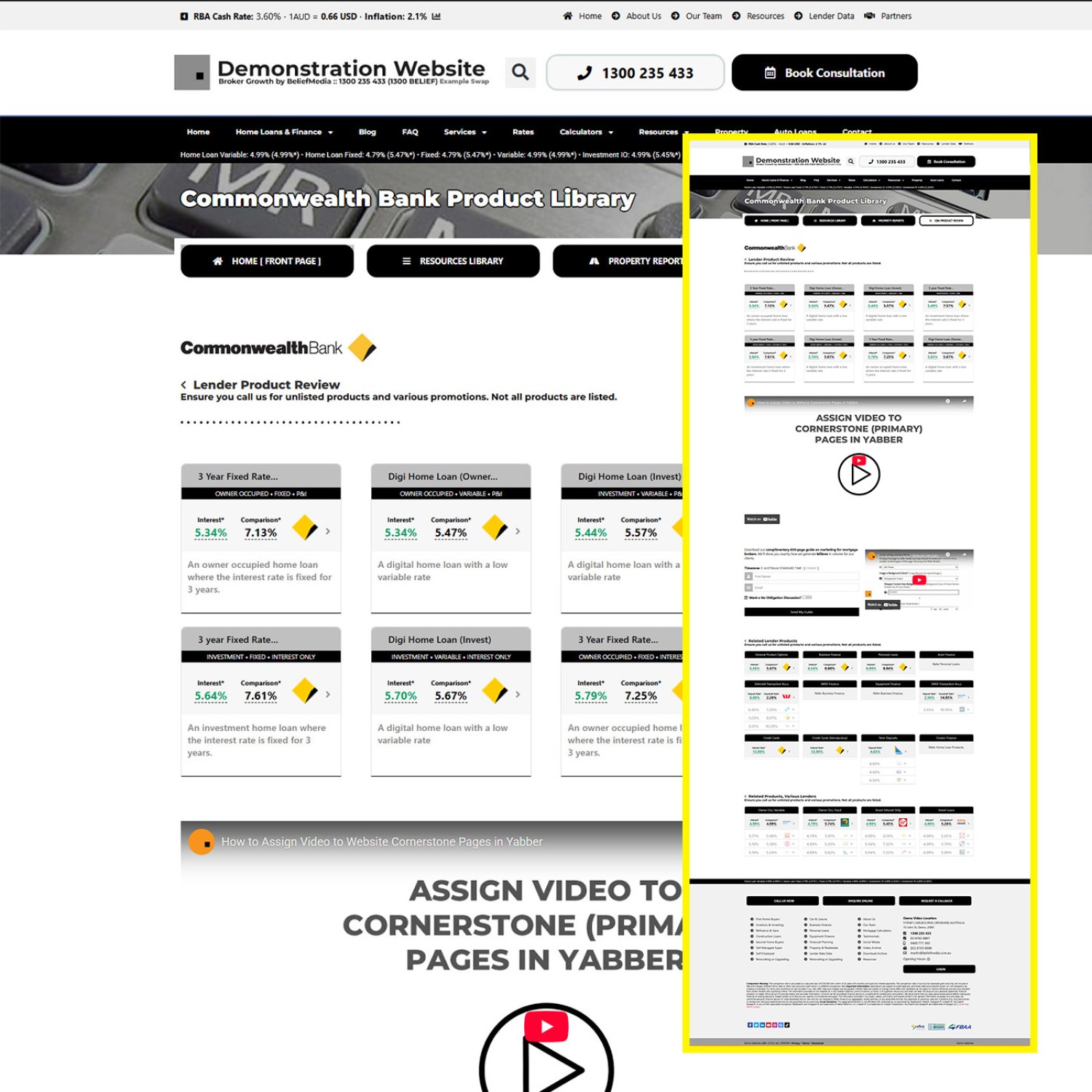
The Lender Library: The Lender Library page is an archive of those products on offer by any single lender. A purpose-assigned video is assigned to the page in Yabber, and the idea is to talk about one lender specifically, or use a video shared across a group of lenders.

The Lender Product Page: The Lender Product page provides information relating to a specific product, such as LVR and LMI criteria, eligibility, fees and charges, features, and general product information. A video should normally be assigned to this page with an emphasis on LVR and how rate varies based on risk appetite. Each page obviously includes a form, and managed correctly, each of these pages returns a large number of enquires. Lender PDF documents are shown at the bottom of the page (in a PDF container).
Given the large number of documents assigned to lenders, we've created a single 'Document Library' page with all those documents listed. This is more for your benefit rather than those of the borrower.
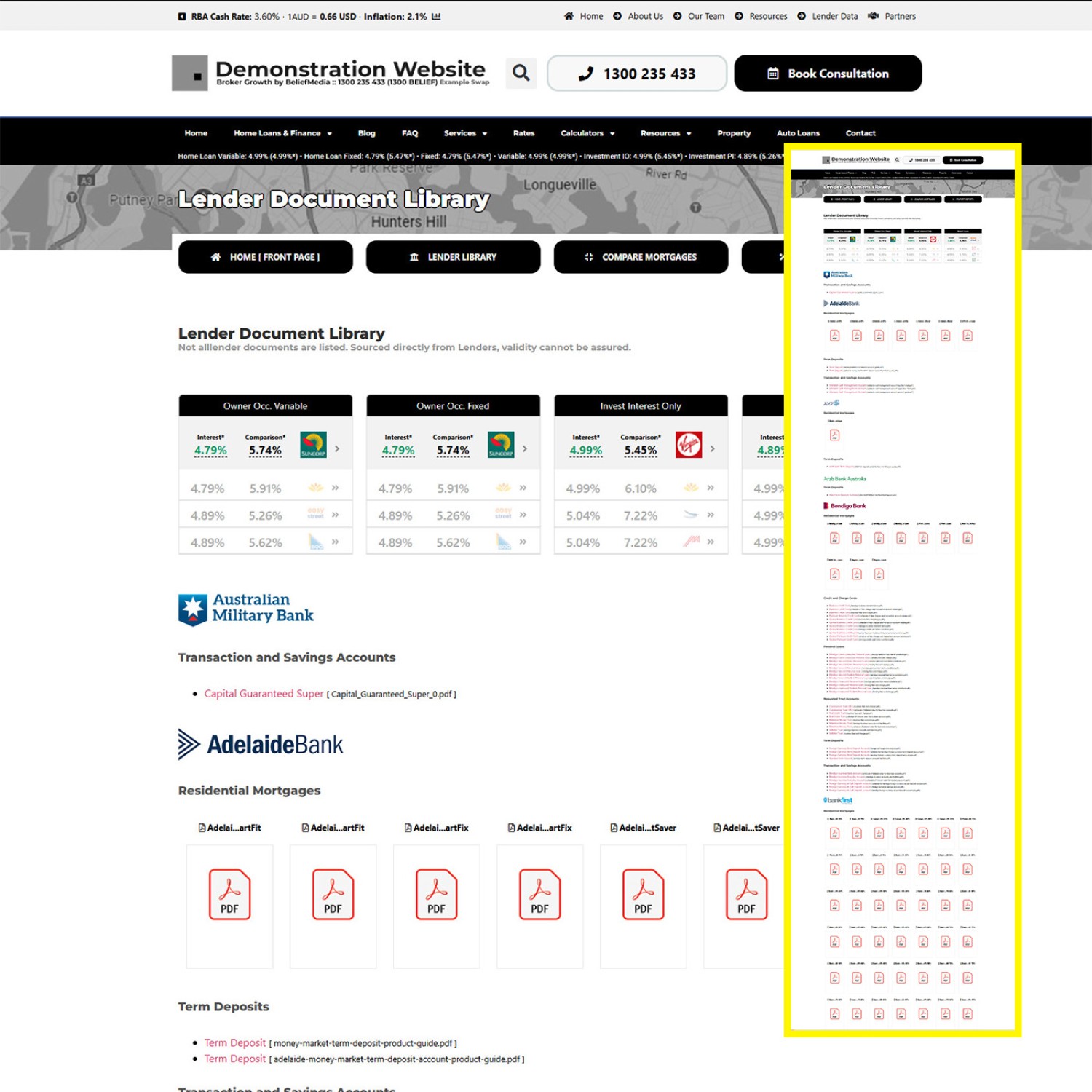
Lender Document Library Page: Given the large number of documents assigned to lenders, we've created a single 'Document Library' page with all those documents listed. This is more for your benefit rather than those of the borrower. These same documents form part of a massive archive we build to educate our AI systems.
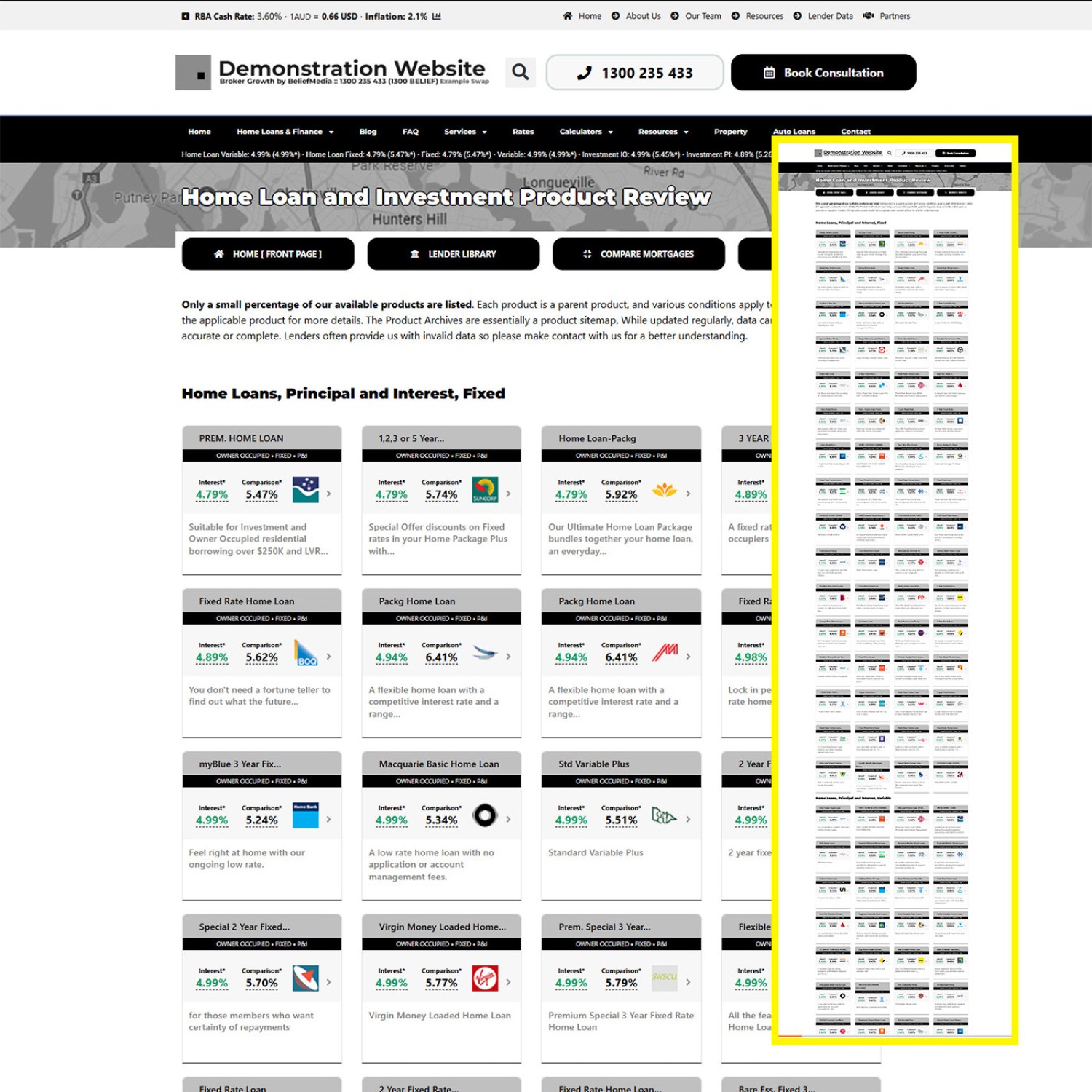
Lender Product Library Page: Each product category of product has its own full archive. This is generally not a navigation feature, but remains visible as a map of information for search engines.
Lender data is supported by a full-featured comparison engine. A comparison engine is a necessary piece of kit on any broker website. If borrowers do not use your comparison engine, they will use somebody else’s. They will go to a bank, a comparison site, a lender aggregator, a rate table, a marketplace, or a competitor’s calculator. Once that happens, you lose control of the environment, the education, the framing, the data pathway, and the conversion opportunity. Keeping comparison inside your own website allows the broker to maintain control of the asset and turn rate interest into an informed conversation. The engine should return meaningful comparison results, but it should also support those results with education, context, warnings, video, and next-step guidance. The result is not just a table of rates. It is a guided borrowing experience.

The Comparison Engine: Our Comparison Engine has undergone a large number of changes over the years, and pictured is the last iteration (with test data removed so as to not confuse). It's expected that the standalone engine will be available to all clients by September 2026 after the more recent changes are thoroughly tested by our managed broker group. There are a few engines available to market that might cost thousands a month... yet we provide it as part of our basic website product. We provide it to clients for two reasons. First, it devalues those services that capitalise on the comparison market (a group that is largely trying to undermine our business model). Second, the engine generates ridiculously good results. Because the engine is assigned to a user, we use the facility as an education tool rather than just a comparison engine. The entire comparison tool is also available as a general consumer-facing comparison engine, although we expect that the education focused presentation be maintained.
The comparison engine is not immediately available to all brokers... but it will be. Given the scope of the technology, it requires thorough testing and should be pushed to all sites in September 2026. It is currently used by our managed client base and has seen quite tremendous results.
Comparison and Lender API: We have hundreds of APIs, two of which are the Lender API and Comparison API. Both were released to the industry for free as a means to mitigate the damage done by false advertising, false qualification, and fake results.
A comparison result without education can mislead or oversimplify - this is an important distinction between what you do and what those standalone comparison websites do. A comparison result with supporting explanation and education can elevate the broker. Specific video attached to results is especially powerful because it helps the user interpret what they are seeing: why the cheapest option may not be best, why features matter, why loan purpose changes outcomes, why lender policy affects eligibility, why comparison rates can distort understanding, and why a broker review is still required. The comparison engine therefore operates as both a conversion asset and an education asset. It attracts the user with the language they understand, then moves them into the deeper framework of expertise, suitability, and trust.
Website Property Listings
The Property Listings module is designed primarily for buyers agents, real estate agents, property professionals, and mortgage brokers who support those partners. Powered by our Open Property API, the module allows property listings to be rendered inside the website framework rather than forcing users into disconnected property portals or third-party environments. For brokers, this creates a valuable extension of the partner ecosystem: a buyers agent or real estate partner can have their listings, opportunities, or property-related content supported inside a broker-controlled digital framework, while the broker retains the ability to connect that property interest back into finance pathways, borrowing education, property reports, suburb resources, calculators, forms, and calendar-integrated enquiries. The module is selectively applied at present and is not immediately available to all brokers, but this will change as the property and partner ecosystem continues to mature.
The deeper value is in the two-way API. This is not simply a listing display tool; it is infrastructure that allows property data, partner activity, website behaviour, and finance pathways to interact. A property professional may supply listing data, stock, buyer opportunities, or property intelligence, while the broker’s website can return enquiries, finance interest, borrower engagement, report requests, partner attribution, and funnel activity. That makes the module especially powerful inside the partner program because it gives referral partners more than a logo, landing page, or handshake arrangement. It gives them a functional property layer that can support their own commercial activity while keeping the broker embedded in the transaction pathway. Properly used, the Open Property API turns the website into a shared property-and-finance environment where partners gain visibility, borrowers gain information, and brokers gain earlier, more relevant access to property-led finance opportunities.
Formly Forms
Forms are one of the most important conversion assets in the mortgage broker website framework because they are the conduit between website attention and business opportunity. A page may educate, persuade, position, and build trust, but the form is where the user takes action. This is why Formly forms are not treated as generic website widgets, third-party plugins, or disconnected lead-capture tools. They are purpose-built, Microsoft 365 and Nexus-integrated forms built directly into the website framework, with the specific objective of converting user intent into structured data, compliant communication, automation, calendar pathways, and meaningful follow-up.
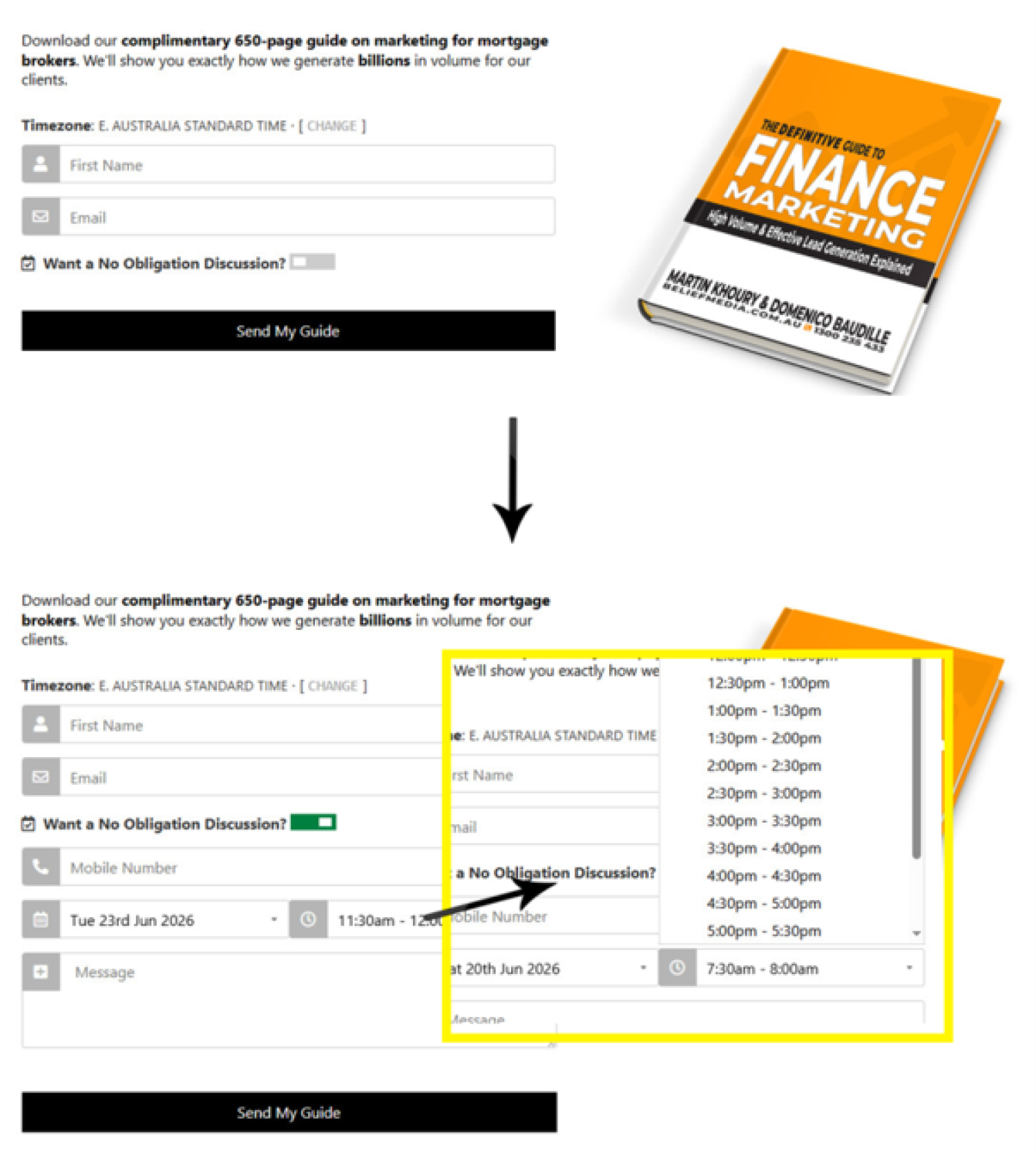
Form with Integrated Calendar: Our most basic forms include an integrated Microsoft Outlook calendar. Website traffic comes from anywhere, so every single page on your website is a type of landing page, thereforce every page requires a conversion asset requires a calendar integrated form. If the calendar doesn't exist you'll seriously compromise your website performance. Don't let poor technology dictate your effectiveness. Pictured is what we call a 'Panel', or form with an accompanying asset - in this case, a book image. Assigned in Yabber, you may assign an image, video, general content, or Instagram media.
The Formly functionality is significant. Many broker websites rely on ordinary form plugins, third-party “equipment finance” forms, embedded widgets, or generic lead forms that are disconnected from the rest of the business. These tools may collect information, but they completely fail to support a serious funnel architecture. They often fail to preserve context, fail to trigger the correct follow-up, fail to assign lists or autoresponders properly, fail to integrate with calendars, and fail to return meaningful value to the user. In finance, where the information requested may be sensitive and the user’s expectations must be managed carefully, this kind of disconnected form architecture is described as a serious technical debt.
Formly forms are designed as business infrastructure. They may support simple enquiries, subscriptions, downloads, calendar bookings, stepped forms, comparison pathways, conditional redirects, email and SMS autoresponders, list assignment, Nexus integration, Microsoft contact creation, backend workflow, and other automation. Each form can carry its own purpose, redirect profile, follow-up logic, and escalation pathway. This means a refinance form, first-home-buyer form, partner form, property report form, booking form, download form, and general contact form do not have to behave the same way. The form can reflect the page, the user’s intent, the offer, the campaign, and the next logical step.

Basic Stepped Forms: In our article on Deception Funnels, we were highly critical of stepped forms that promised answers of eligibility, qualification, or suitability, and they're all nonsense. Some brokers try and escape the legislation requirements by stating 'You may potentially be eligible for.." style of thing. Either you present an honest opportunity in front of your clients or you change your messaging. Simple. Our stepped forms return immediate results on internal pages with at least two optional videos: The applicable LVR video and the Process Video. The results is usually returned when the form is used on internal pages as an alternative to the immediate redirect (which is always applied for value-based forms). You'll see the button called "Review Results and Graphing". That last green button will redirect the user to a page will full product information and graphing for the specific request. On landing pages, this information is presented (in brief) on the second page.
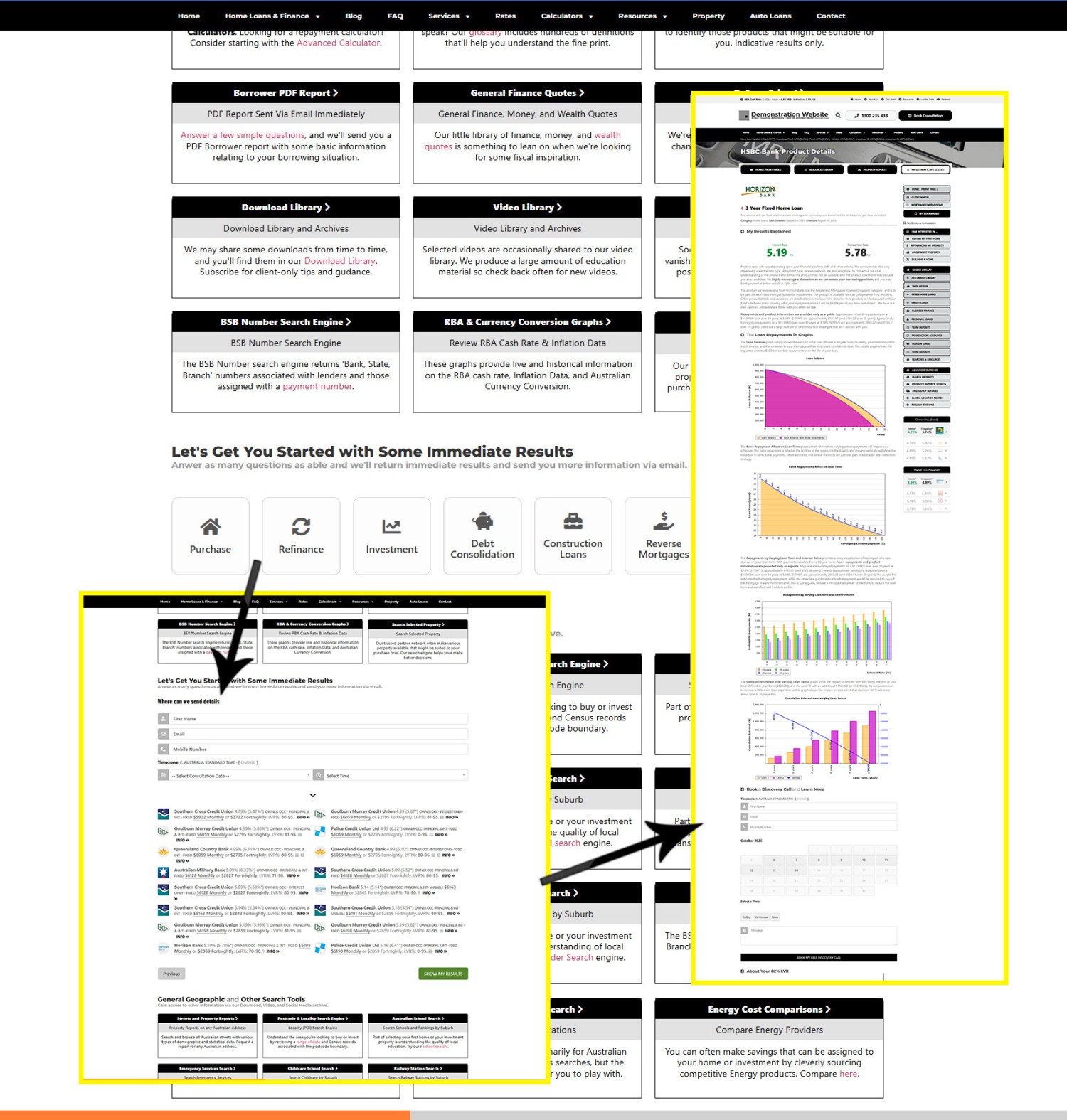
Comparison Results and Graphing: Pictured is the result of clicking on the "Review Results and Graphing" button. The second page provides a full analysis of the information provided by a user. The idea isn't to qualify the user - it's to qualify us as brokers... and we're careful to ensure that the user is setting basic results that may not be suitable in any way. No form should ask questions unless something similar is returned. The information returned on the second page in the landing flow is slightly condensed - the focus on the conditional redirection is the conversion. Maybe you can start to see why our results far exceed those of others.
This is where the form becomes more than a data collection point. It becomes a funnel decision point. It becomes a funnel entry point. It is intrinsically connected to the funnel experience. A user who completes a form should not simply see a generic “thank you” message. They should be moved into a relevant next step: a calendar, report, download, education sequence, SMS confirmation, conditional website pathway, or preparation process. The form submission should inform the website, inform Nexus, inform the broker, and inform the follow-up. In a mature framework, every form is both a conversion object and a behavioural signal.
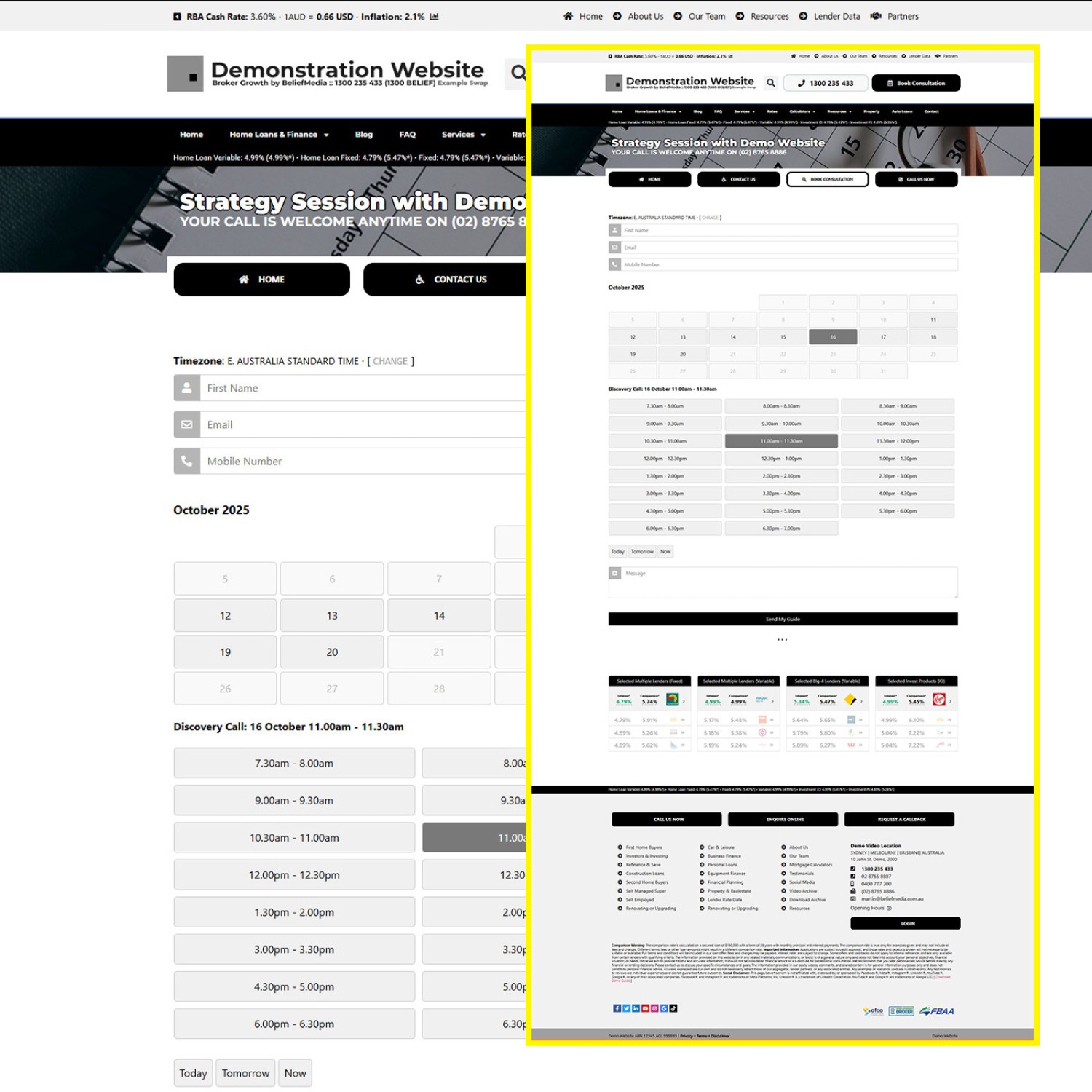
Formly Calendar Full Page Forms: The full-page calendar forms are directly integrated with Formly - a necessary funnel and website commodity.
The practical advantage is that Formly reduces friction while increasing control. Brokers can deploy forms across pages, landing pages, articles, resources, modules, and campaigns without relying on disconnected software or brittle plugins. The forms inherit the broader intelligence of the framework, including backend automation and escalation logic. This makes them more compliant, more powerful, easier to manage, and more commercially useful than ordinary website forms. In a mortgage broker website, forms are not a minor technical feature. They are one of the primary mechanisms through which attention becomes action, and action becomes opportunity.

Stepped Forms: Stepped forms are returned in multiple formats. A general profile is presented as a number of form options that launches the appliable conditional sliders and buttons. On pages such as 'Refinancing', the form will generally be open with the first slider options since we're able to resolve the purpose of the form. Profiles, styles, and automation is all managed in Yabber via simple point-and-click menus.
Forms are created in Yabber and simply assigned to various locations on your website. Turnkey landing pages have the appropriate form assigned.
We take a deep dive into Formly forms in an article titled "Formly is the Most Powerful Forms Module in the Industry".
Lender and Rate Information & Data
Rates matter. It is fashionable in parts of the industry to pretend otherwise, but borrowers do not behave that way. Over 94% of consumers consider rate to be the single most important attribute of a home loan, and that means rate must form part of the digital conversation. This does not mean the broker should reduce their value proposition to “cheap rates”, nor does it mean the website should promote rate in a careless or non-compliant manner. It means we must speak in the language borrowers already understand. A user comparing loans will almost always start with rate, repayment, fees, savings, lender, and product structure before they develop enough confidence to appreciate deeper strategic value. If the website refuses to engage with rate, the user will simply leave and find another site that does.
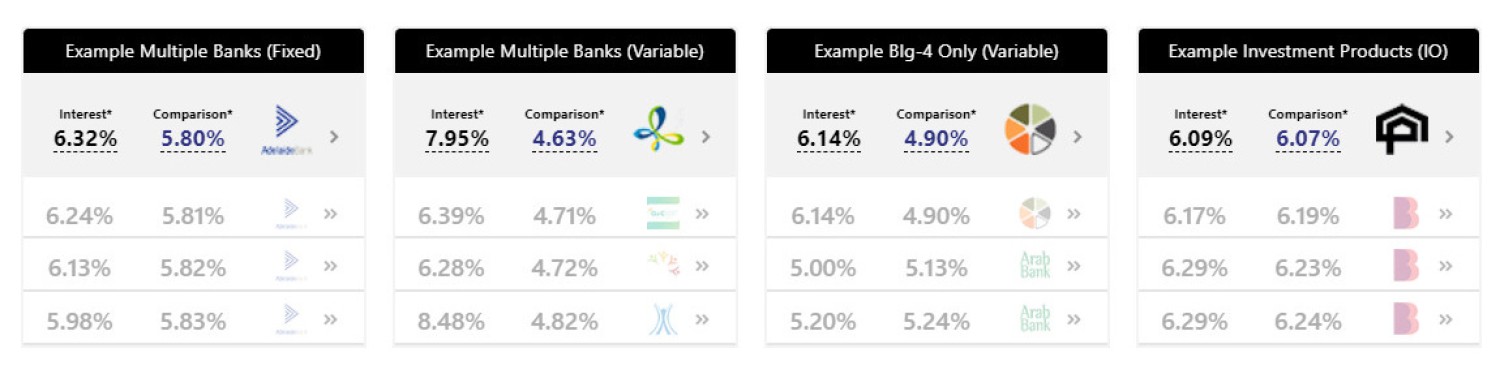
Lender Widgets: Lender widgets come in a number of flavours and are generally used on suitable pages. Lender options include same residential mortgages, business products, green products, margin prodcts, personal loans, credit facilities, and others. Each may be styled to your liking or presented based on a Yabber profile.
There is an important distinction between being a rate-driven broker and displaying rates on a website. They are not the same thing, and they should not be confused. A rate-driven broker allows price to dominate the recommendation, often at the expense of structure, policy, suitability, serviceability, flexibility, features, future objectives, and risk. A broker who displays rate data is doing something different: they are meeting the borrower at the point of interest and using that interest as the start of an education pathway. Rate can attract attention, but education must shape interpretation. The role of the broker is not to say, “Here is the lowest rate.” The role of the broker is to explain why the lowest rate may or may not be appropriate, how comparison rates work, what features matter, what policy constraints apply, what the real repayment outcome looks like, and what the borrower should consider before making a decision.

General Lender Data: General Lender Data is shown in a number of locations. Some targeted; others 'conversational'. Lender information may be shown in just about any location, such as article titles, footers, buttons, headings, and anywhere else. If you need it, it's available to you.,
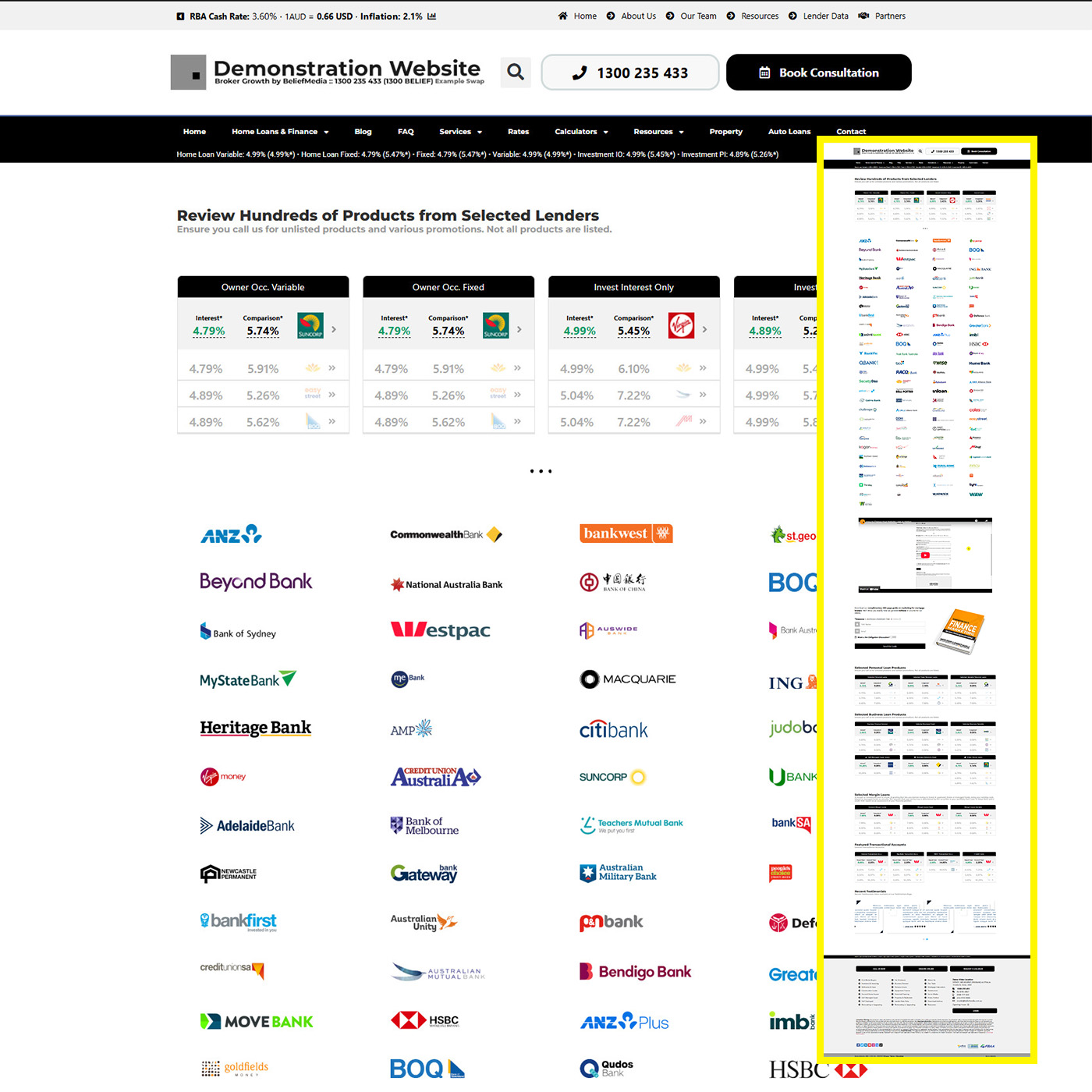
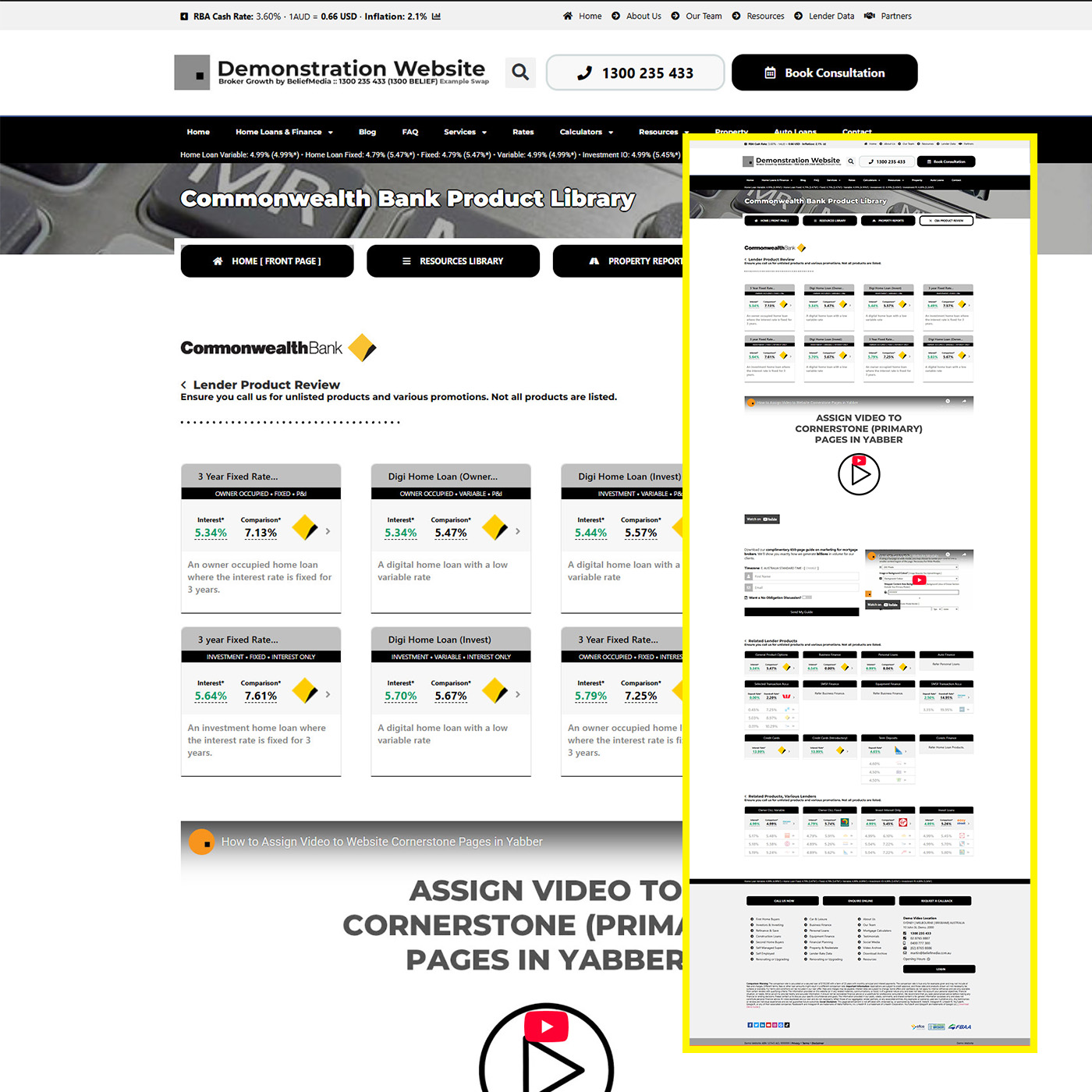
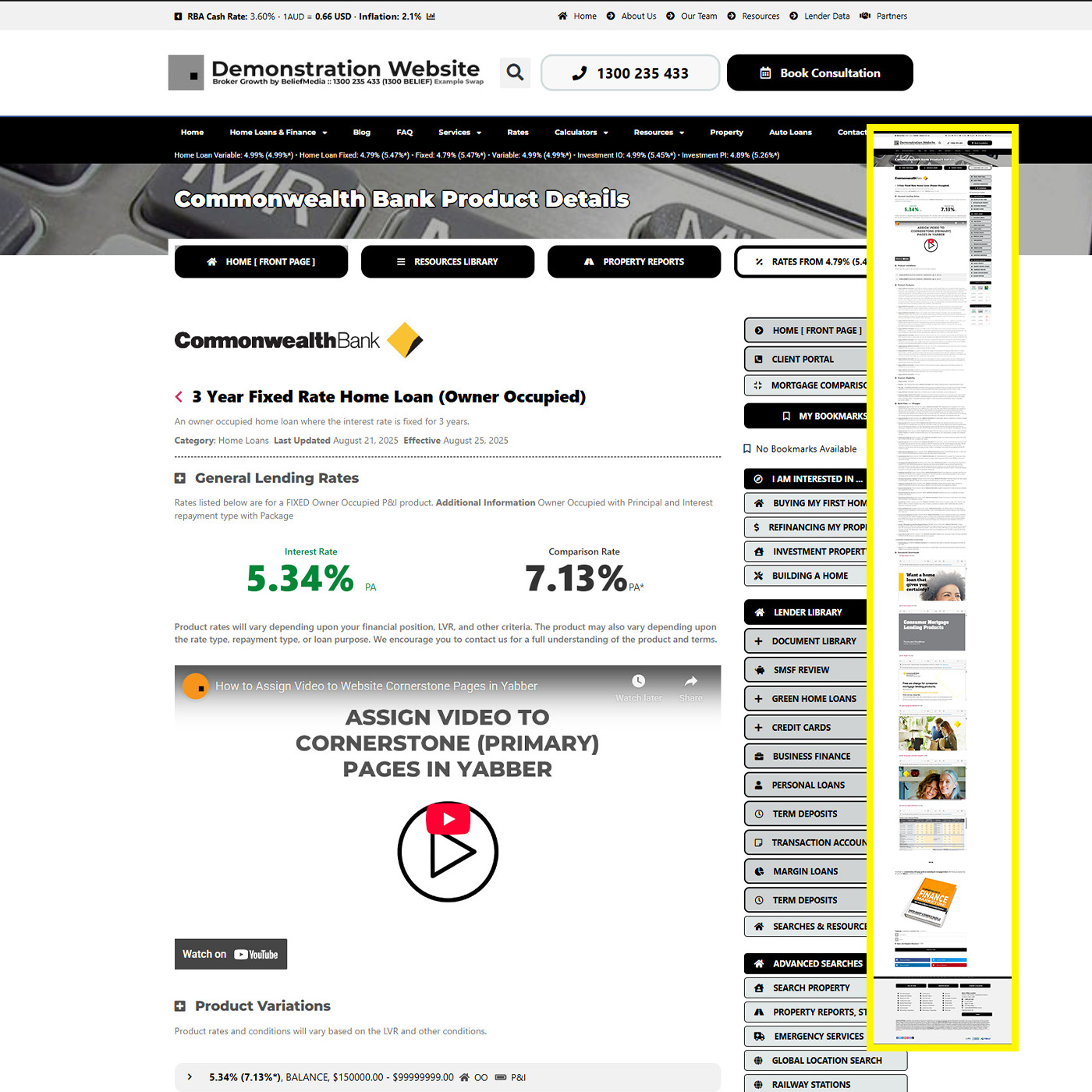
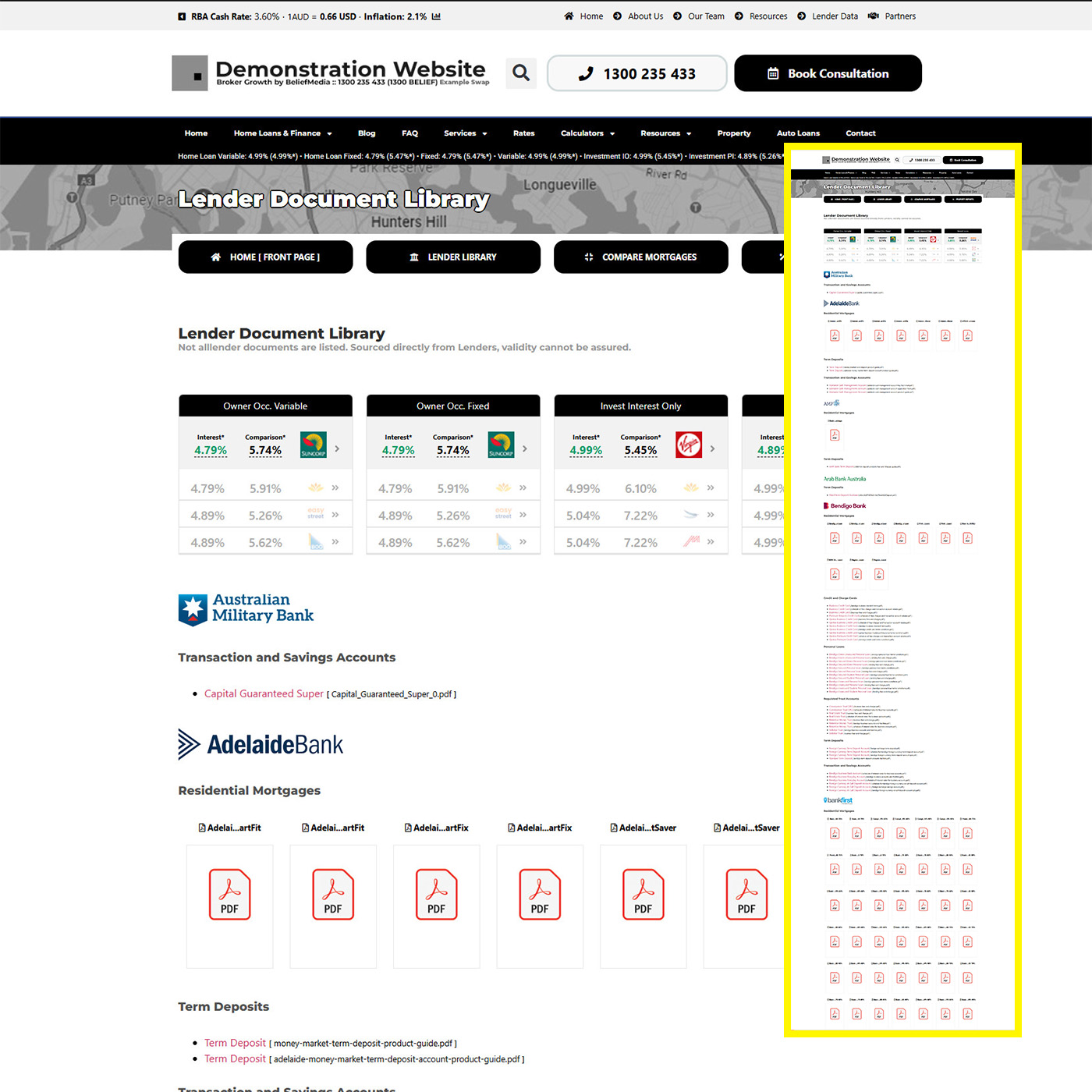
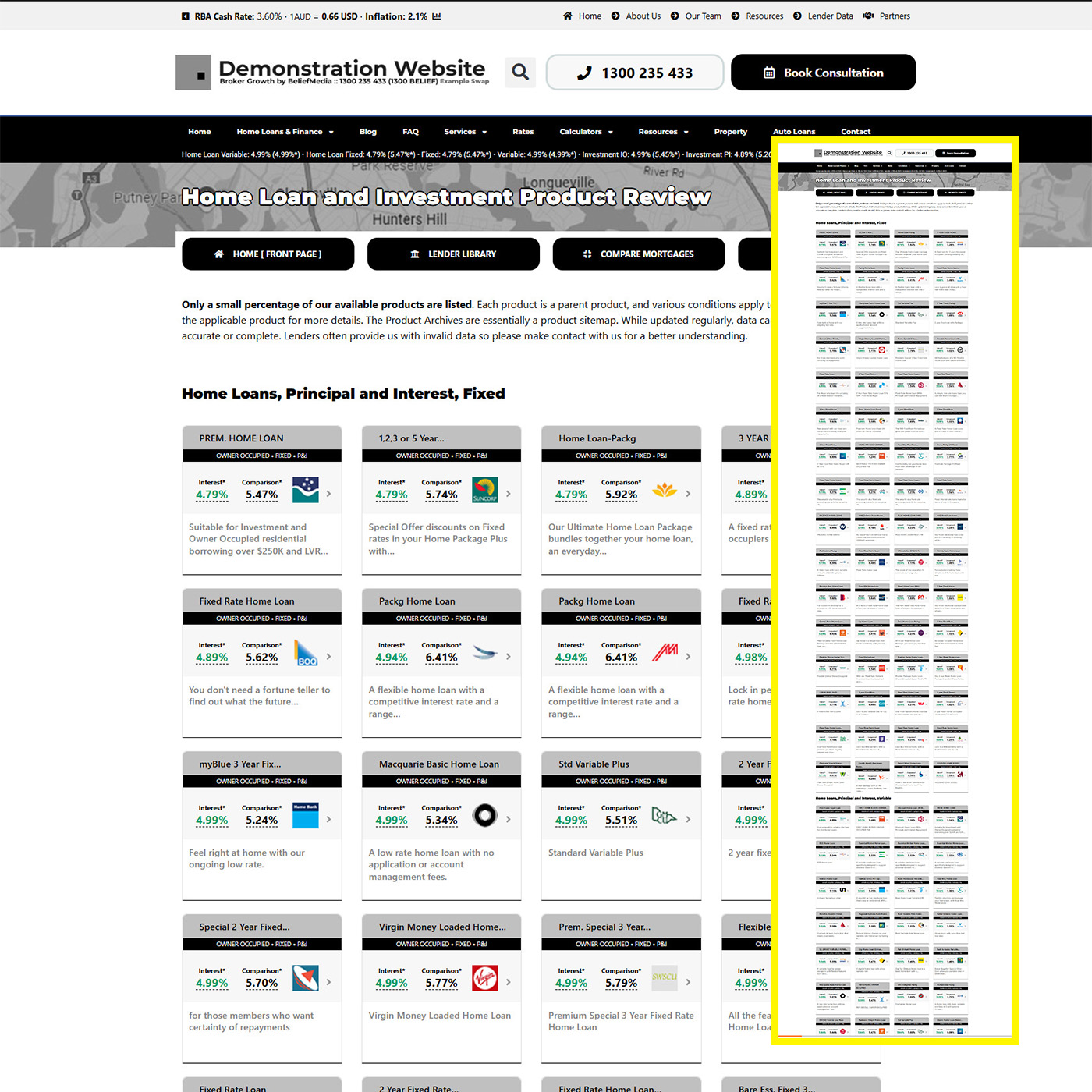
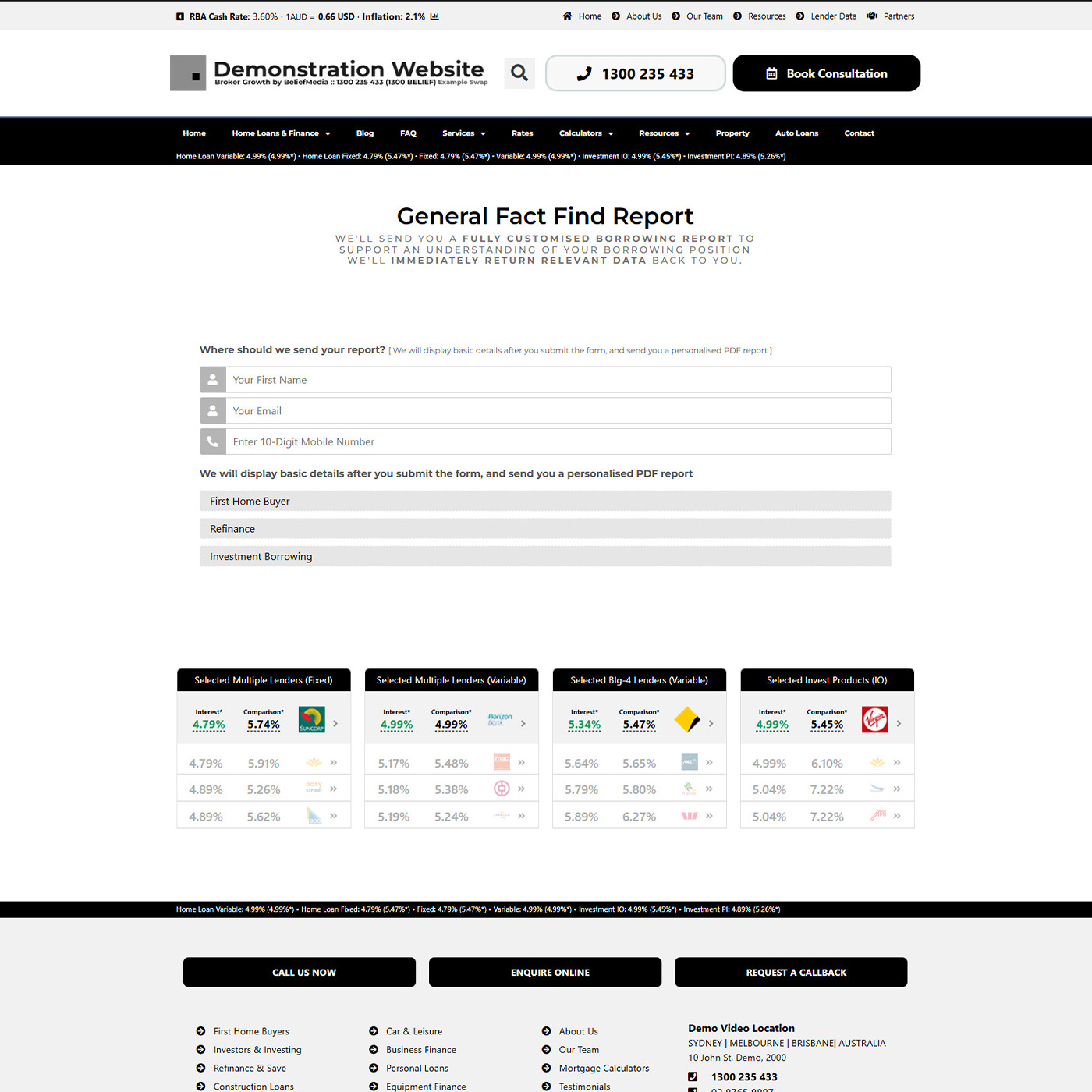
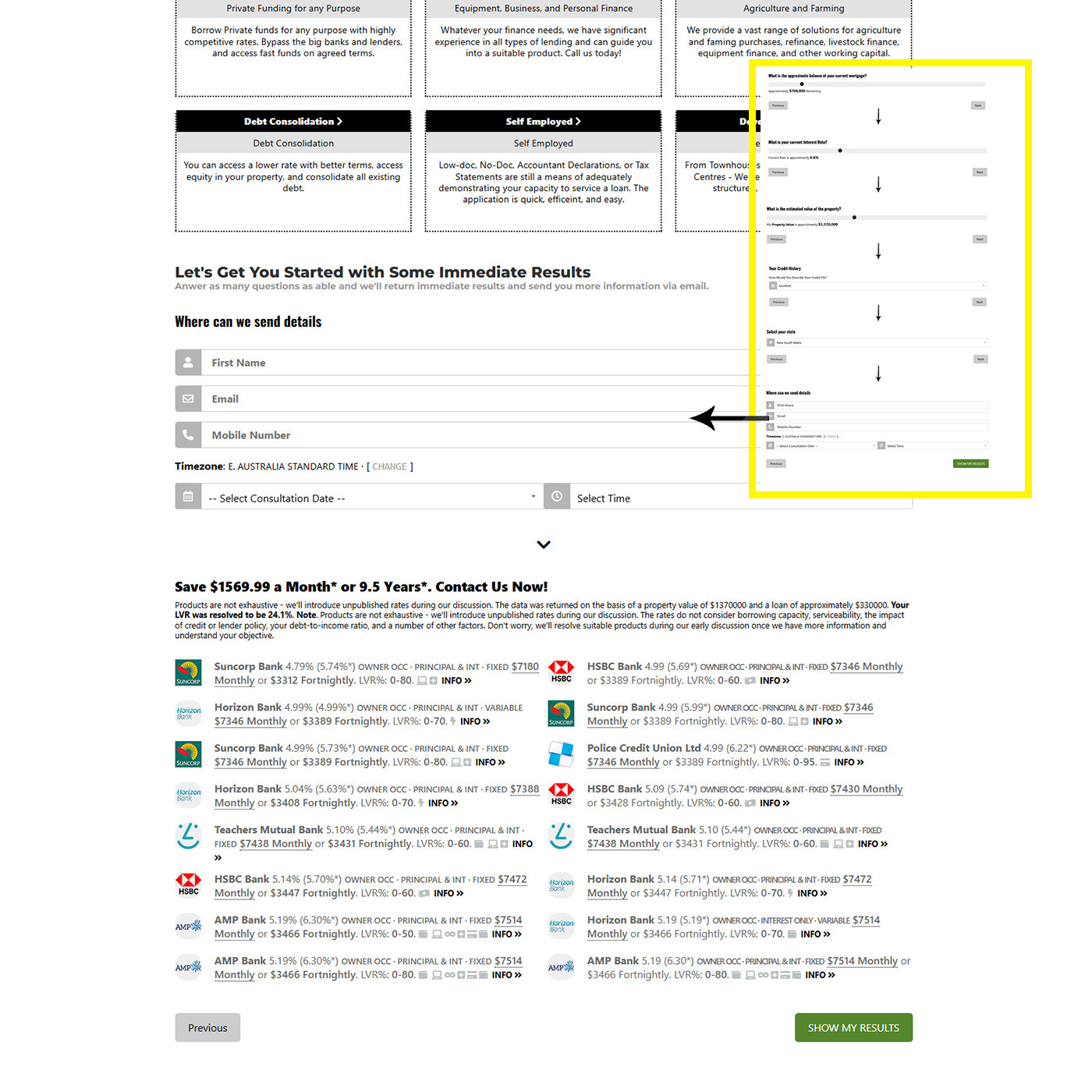
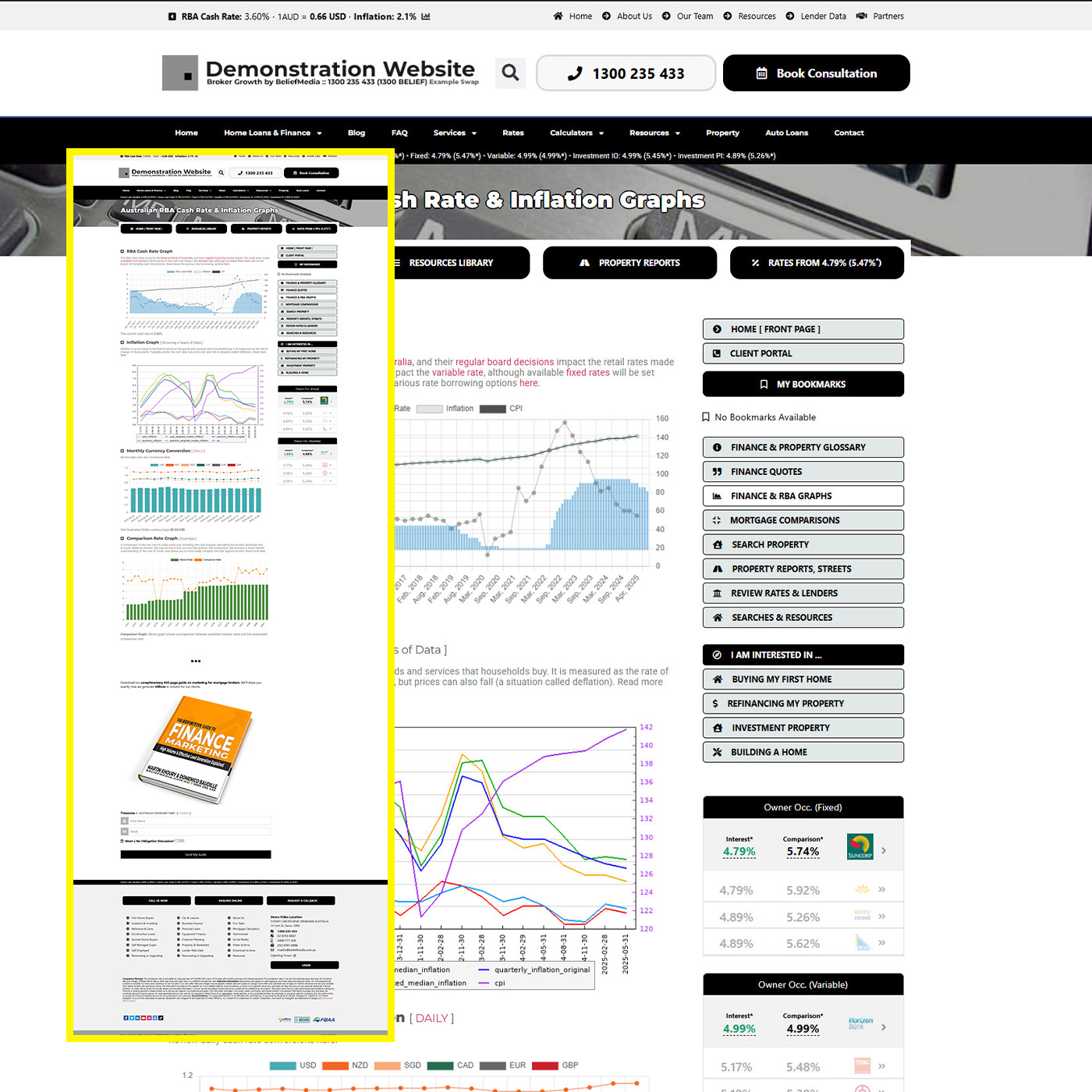
Pictured: Shown are some of the internal pages - around 35 in total. Lender icons shown on your front page, and those on the library page, link to the lender page, and each lender parent product links to the applicable product page. Data is updated every day to reflect changes.
Lender data is used across the website in widgets, pages, comparison tools, contextual text, product panels, rate tables, calculators, and campaign assets. Properly implemented, lender data showcases E+AT because it demonstrates expertise, supports education, reinforces authoritativeness, and gives users practical tools rather than vague marketing claims. It also supports SEO and engagement by creating a large, structured layer of finance content that users actively seek. A website that contains current lender data, product pages, rate information, repayment pathways, comparison explanations, and supporting education is materially stronger than a thin broker website that merely says “we compare lenders”. The data proves the capability.
The lender-data framework can add thousands of pages to the website, each with its own relevance, search value, internal linking potential, and conversion opportunity. These pages should not exist as static product dumps. Each page should carry an appropriate conditional form, stepped form, comparison pathway, calculator, or booking prompt that matches the intent of the user. A visitor reviewing a lender product should be invited into a comparison pathway. A user looking at a refinance rate should be moved toward a repayment or savings assessment. A borrower viewing owner-occupied, investment, fixed, variable, principal-and-interest, or interest-only products should see conversion assets that reflect that context. The rate page becomes a funnel entry point rather than a passive information page.
Lender widgets comes in a number of flavours and are generally used on suitable pages. Lender options include same residential mortgages, business products, green products, margin products, personal loans, credit facilities, and others. Each may be styled to your liking or presented based on a Yabber profile.
As with most lender facilities, you may build your own lender widgets  of any type with an Elementor drag-and-drop lender widget.
[link url="72032"]text[/link]. It scales and optimises the image, and it adds the SEO markup. It's one of over 70 link shortcodes.
Nexus Email & SMS Lender Rate Placeholders: To give you an idea of how lender data is applied in other modules, consider the Nexus module which permits inclusion of placeholders email outgoing communication. Rate still plays a part in the marketing journey. Given that consumers consider rate to be the single most important product attributes, their place in your email marketing will significantly and profoundly impact the number that follow links or contact you on the basis of your communication. Structure and other wealth creation are obviously more important, but consumers don't know this, so we use a shared vocabulary that'll redirect them to the appropriate education resources.
[image] shortcode. FAQ: "YouTube Modal Thumbnail Images with Image Shortcode".Website Statistics
Our website statistics are unmatched. Supported by the Xena API, the provide granular insights into website and landing page performance. The full scope of statistical integration is detailed in an article titled "The Xena Statistical Engine".
Data is the foundation of modern business intelligence, but its value is not intrinsic - it is realized only when collected, structured, and interpreted in a way that drives actionable decisions. Xena represents the apex of this process: billions of individual data points from every module, every campaign, every page, and every user interaction are unified into a single, coherent engine. Unlike fragmented solutions, Xena eliminates silos, integrating CRM activity, marketing automation, landing pages, web traffic, and user engagement metrics. This unified architecture ensures that each insight is derived from a comprehensive view of operations, allowing businesses to understand not just isolated events, but the systemic dynamics that govern performance across the entire digital ecosystem.
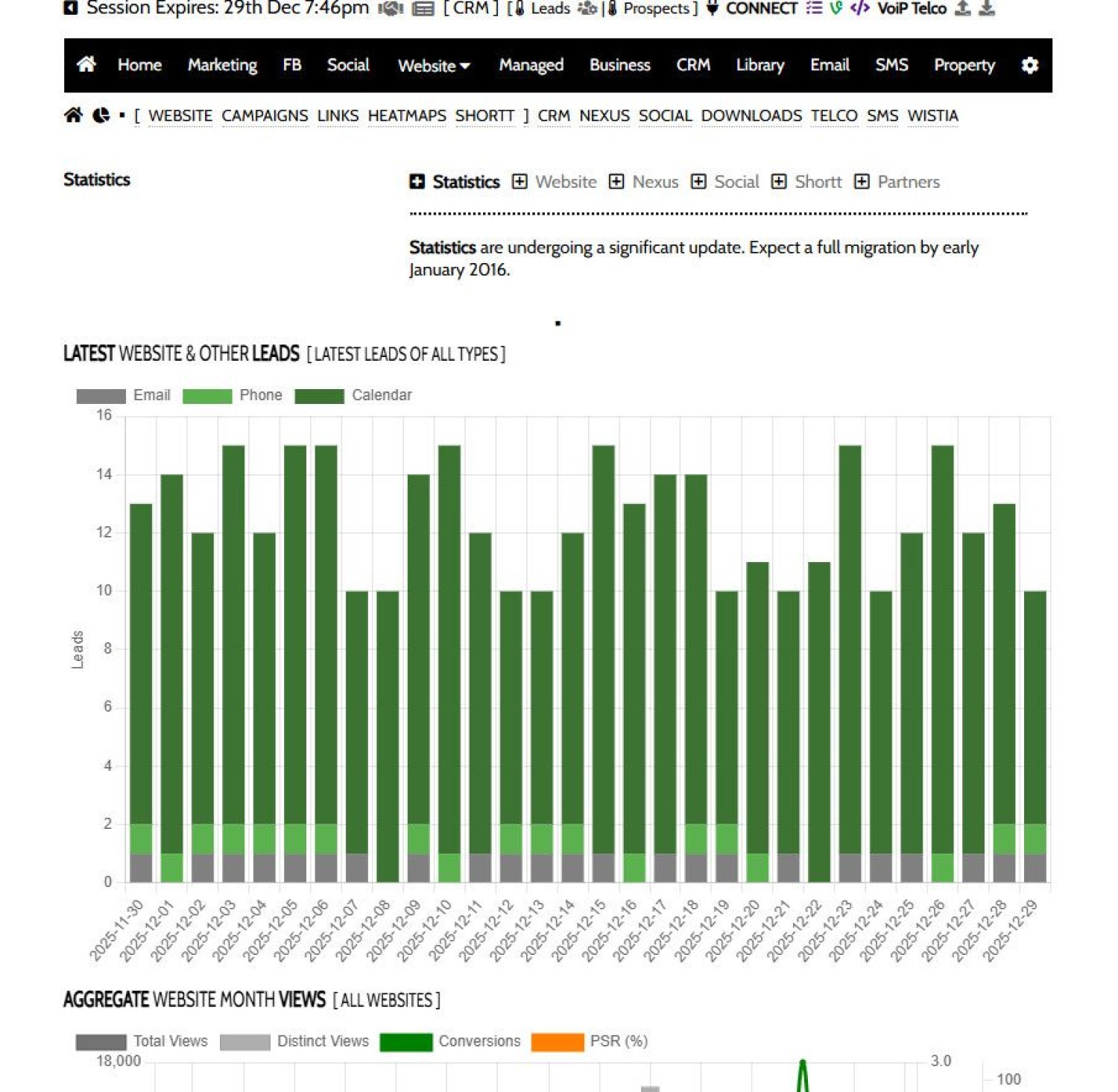
Pictured: This is how a group returned 200m in monthly volume for less than 7k. 364 paid leads. Around 35% of their monthly lead expectation. Around $17 per SMS-verified lead. A little high, but verification will do that (it also reduces lead quality by about 20%). Around 243 converted clients based on results measured to the 14th December. Expected monthly return is over $200m. About 77% of leads visited the group website, and about the same number visited more than 5 pages. Half of that group visited the site again to review bookmarked or other pages. Digital done right gets results. You shouldn't expect to break a speed record in your Corolla, and you shouldn't expect good online results with a poor customer journey. Leads are stacked based on email, phone, calendar, and contact.
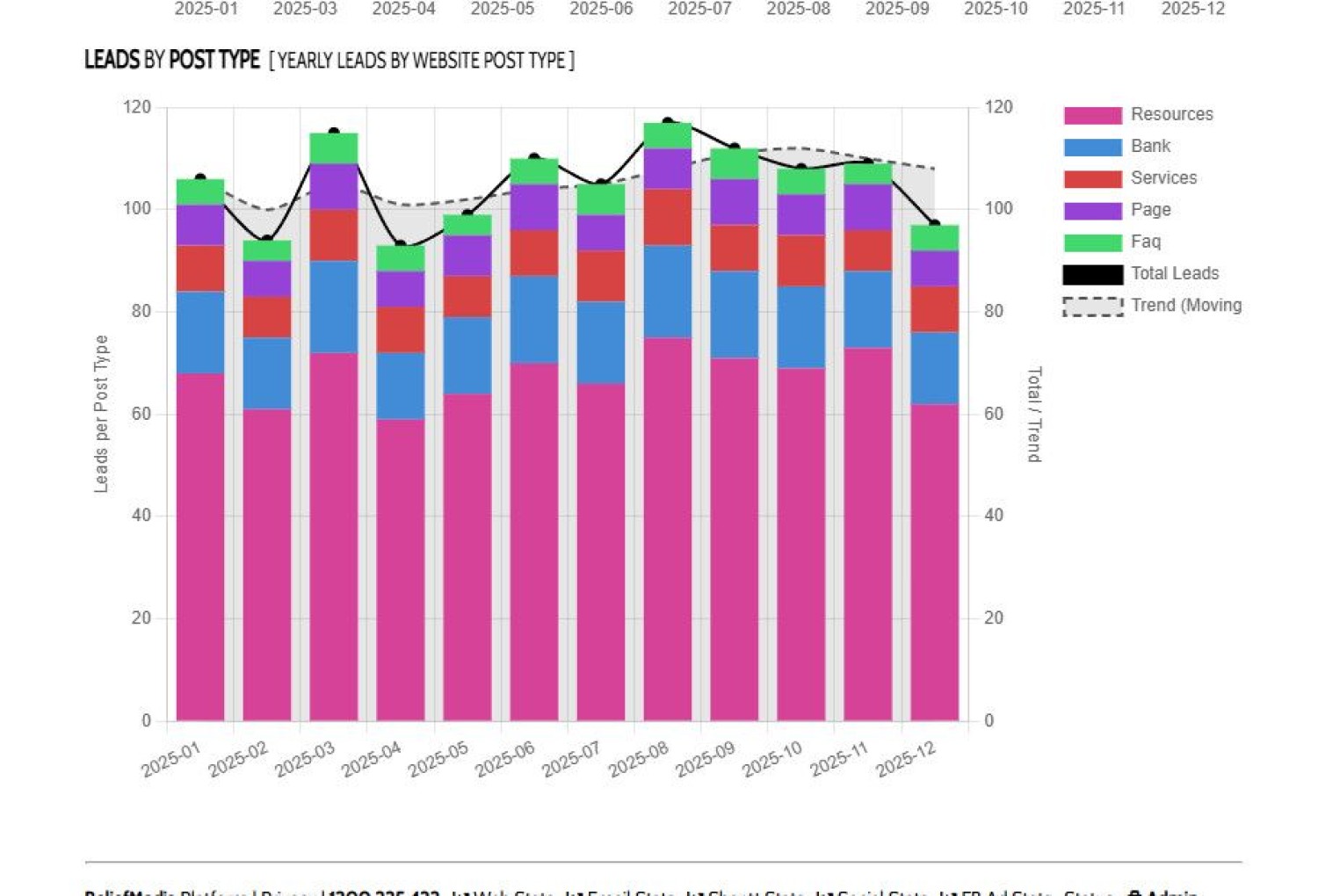
Pictured: Leads are identified by the form submitted, the page, the geography, and about 30 other primary data points. More important, we need to know what modules on our website are performing better than others, and with around 20 website modules, statistics should identify those areas where we should focus our efforts. In a broad sense, we want to know what modules, pages, and geography is performing better than others. Generic statistics simply don't provide this necessary information.
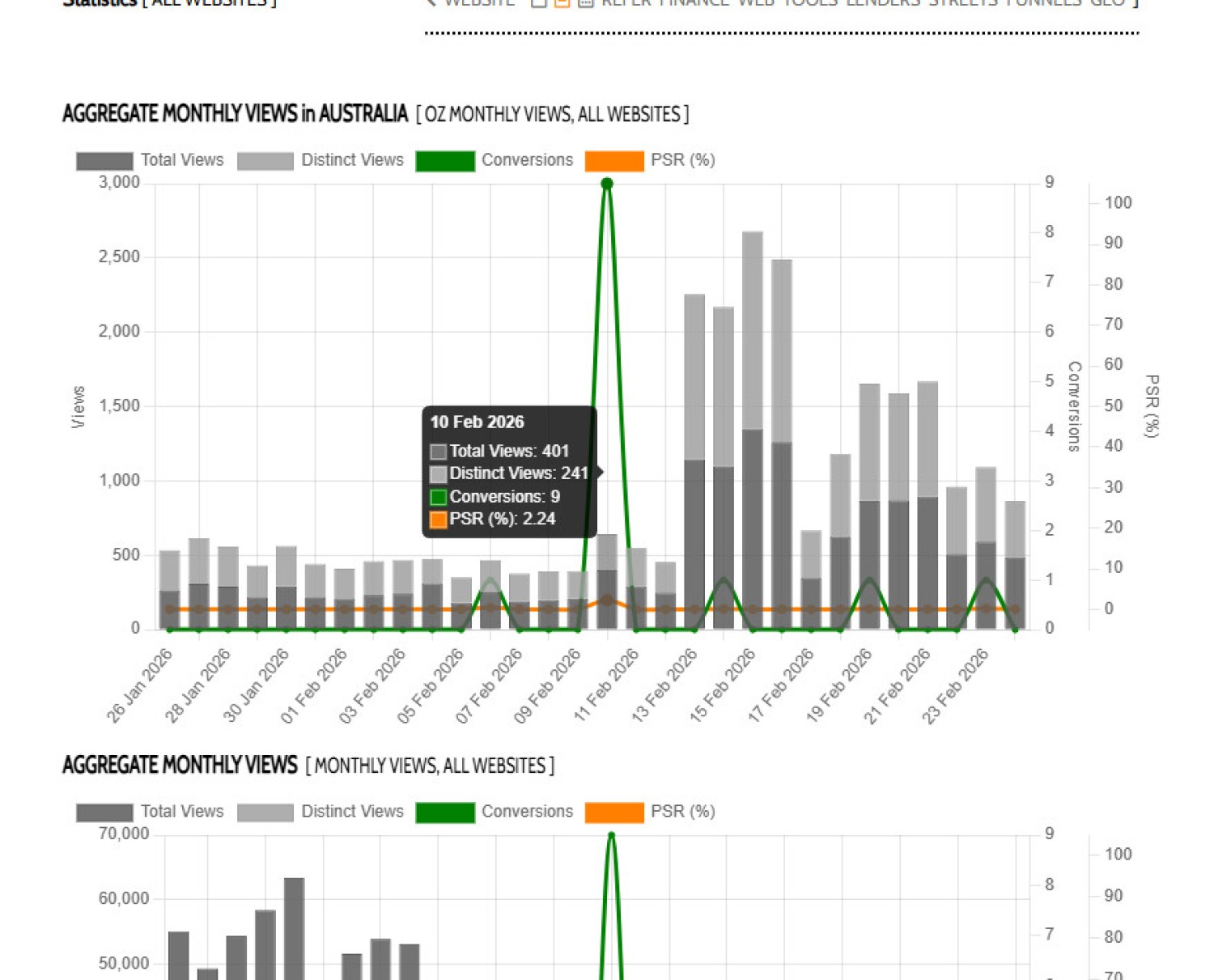
Pictured: What makes this graph interesting is that it's exactly 30 days of a broker with a new site. With a little promotion, he's already seen a daily lead average, with one day picking up 9 leads off a social media campaign (resulting in a PSR of 2.3%). General 'aggregated' stats are the bread-and-butter of your website information, and we return them for various default time periods. It's important to measure real conversions (not 'naked' leads) on these graphs. The pictured user clearly doesn't run Facebook ads (leads coloured blue in the stack).
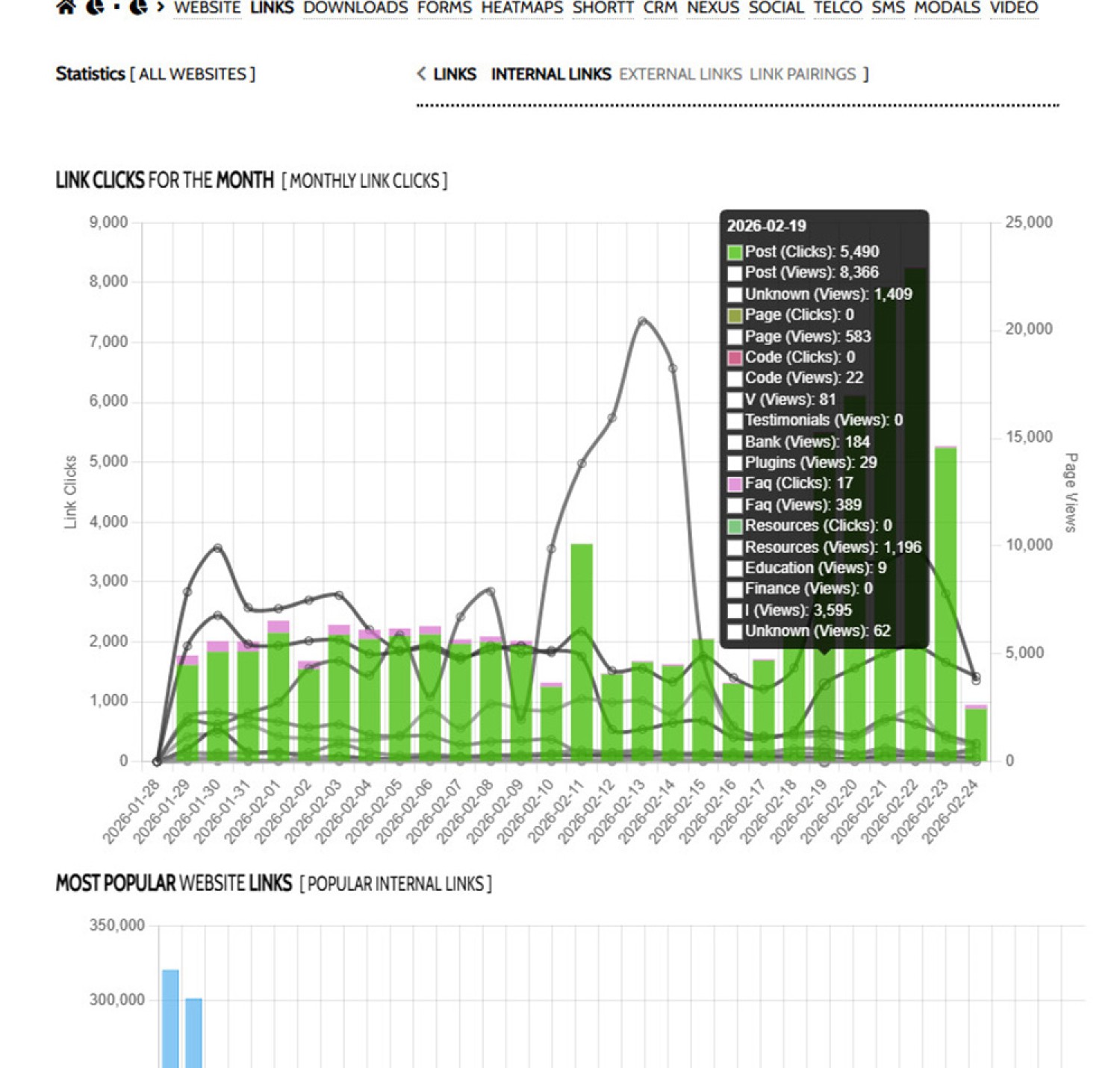
Pictured: Link clicks (both external and internal) are key performance metrics that need to be tracked. Additionally, we assess each click for the triggers that fire off other funnel-focused actions.
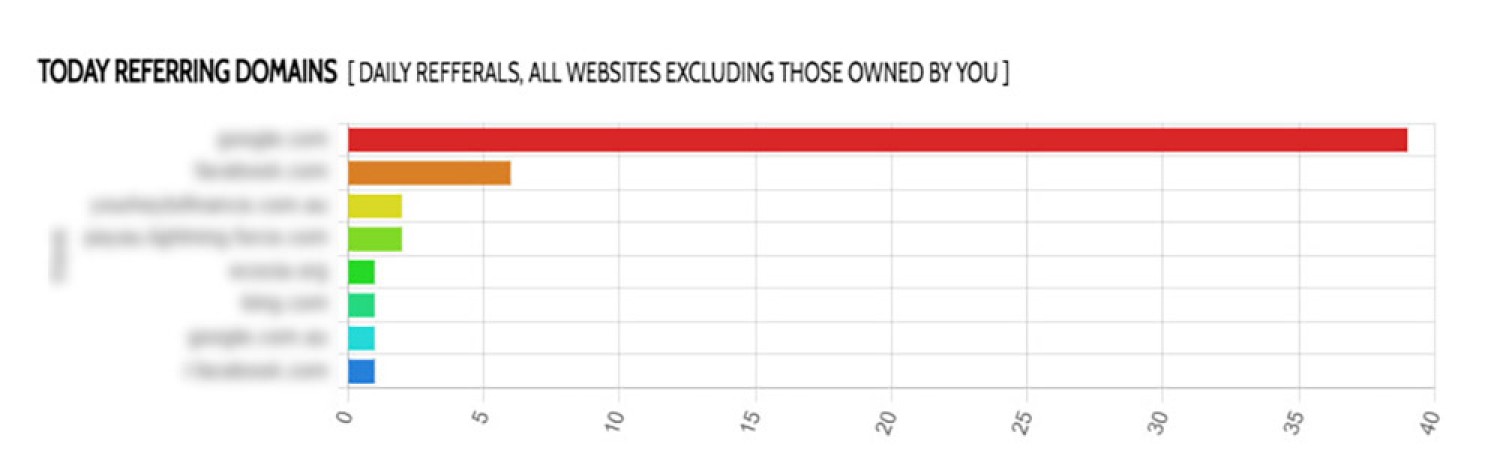
Pictured: Where is your traffic coming from? A number of graphs show referrers, search referrals, and teh most popular referred pages by filtered criteria.
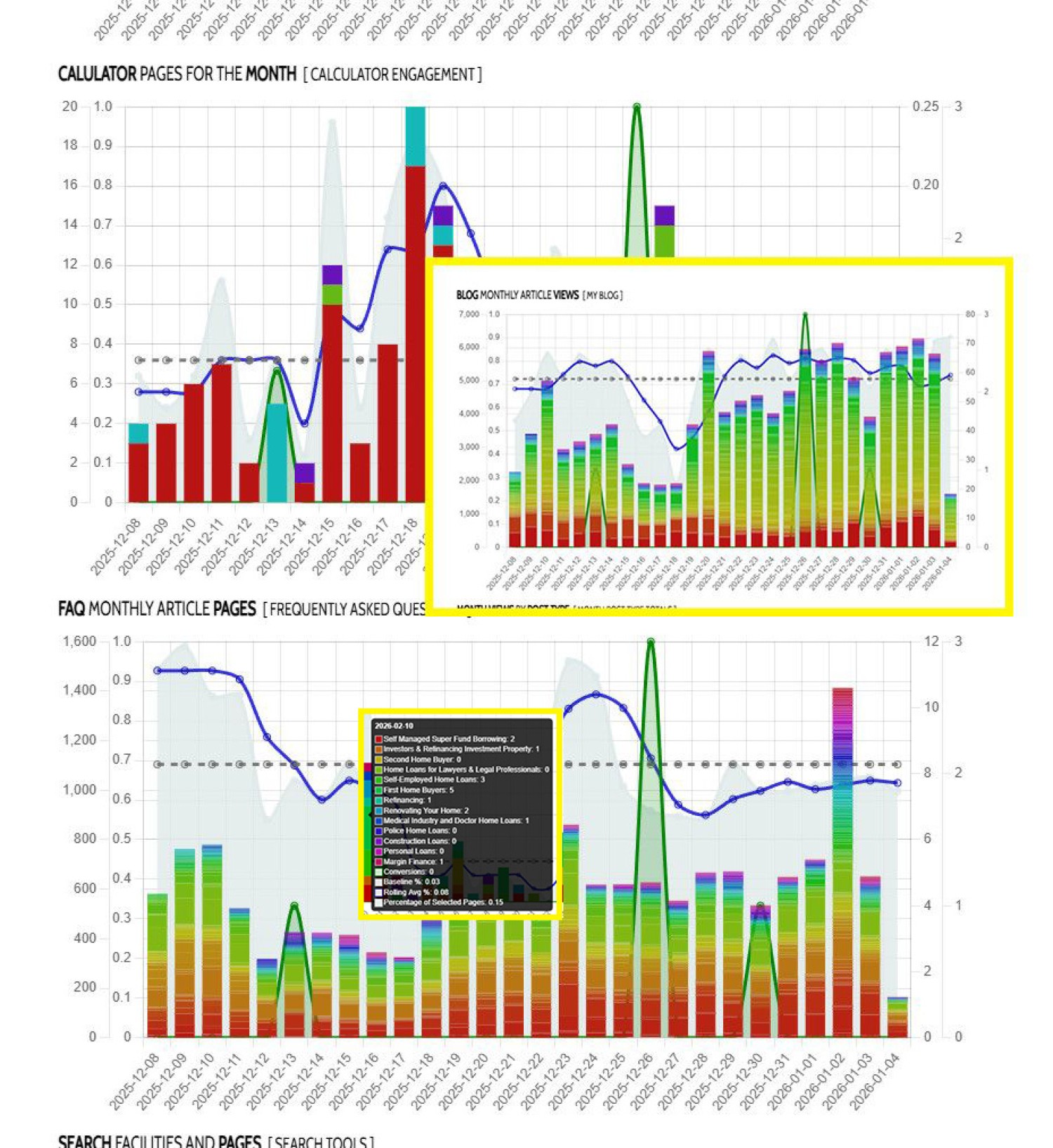
Pictured: Most modules are measured independently of others, so you're able to review the success of each module to the page level (the colours of the bar chart will indicate viewed pages with data). Pictured is the calculator page, FAQ module, and blog. Importantly, conversions are also shown measured again a 3-day trend. This calculator screenshot (taken on one of the reporting graphs, so presented a little differently) is very revealing. What does it tell us? You need to have calculators on your site to satisfy broad E+AT expectations, but they're only something you need to have, not something that'll actually be used. For a lot of brokers, 10-20 page views a day on just calculator pages might be a lot, but for our guys - while the pages should be design to convert (a whole other discussion), and should have purpose - they represent around 0.05% of all daily visits.
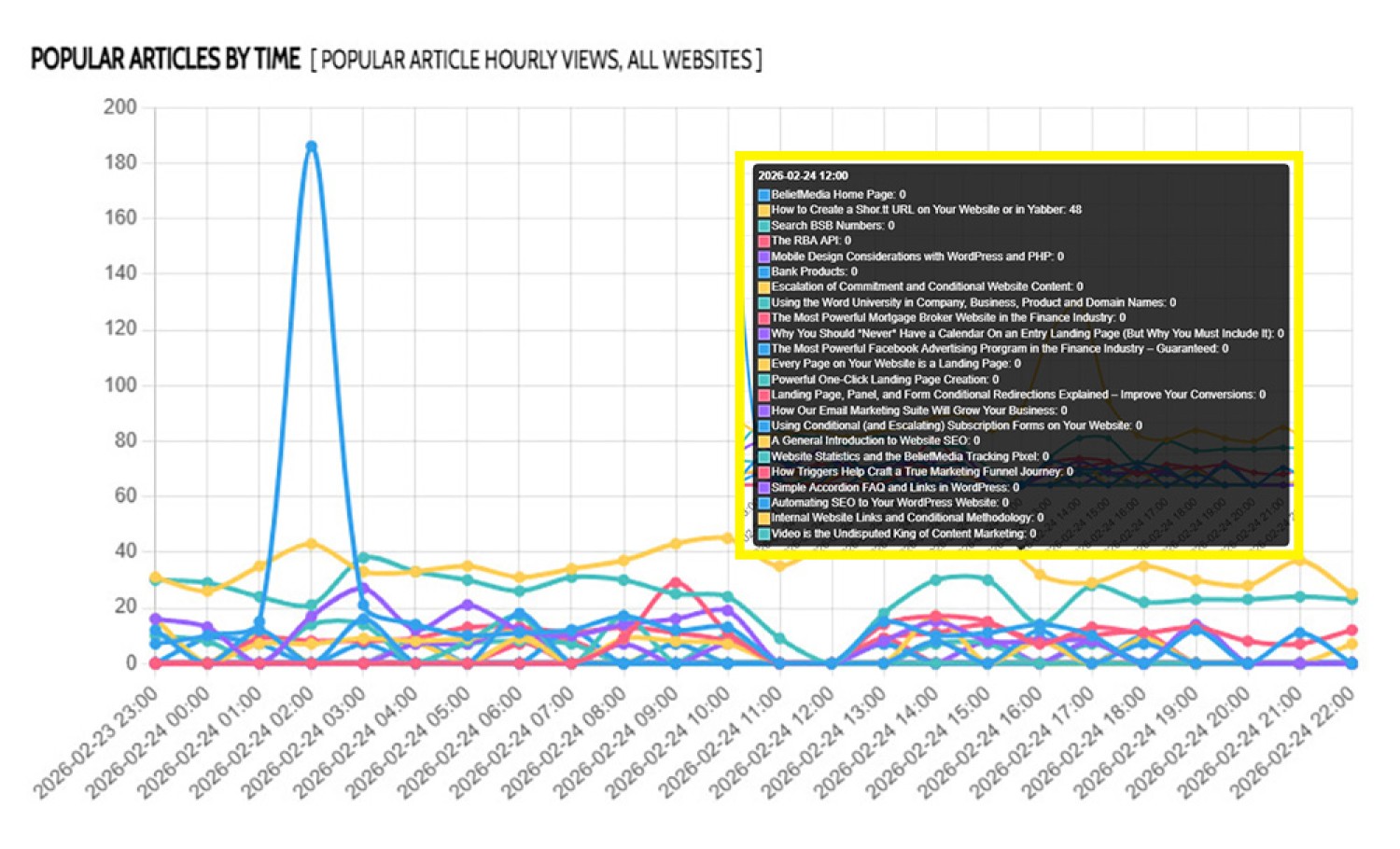
Pictured: The pictured chart is a trend of articles on our website, and it's one that I'll often refer to in order to narrow in on visitor trends. You'll note the spike; if you identify this in real time (or you have a 'Trending' trigger assigned to notify you), this is the time to narrow in on the article in question, or create a quick videos to capitalise on the interest. We regularly have news outlets links to articles, and it requires serious agility to first identify the spikes, but then to manufacture the content to maintain the momentum. It's an essential graph.
You won't garnish organic traffic if you don't have a website that is built around the pillars of expertise, education, experience, entertainment, and authoritativeness, and you won't improve on your search or social presence if you don't have a powerful SEO module that provides facilities on every page to showcase your content. You can't be expected to maintain a search presence if you don't have a clear content and social strategy in place, and if you're not using video, you'll be incrementally hidden deeper and deeper in the murky and rarely-navigated depts of search pages - normally anything other than the first page.
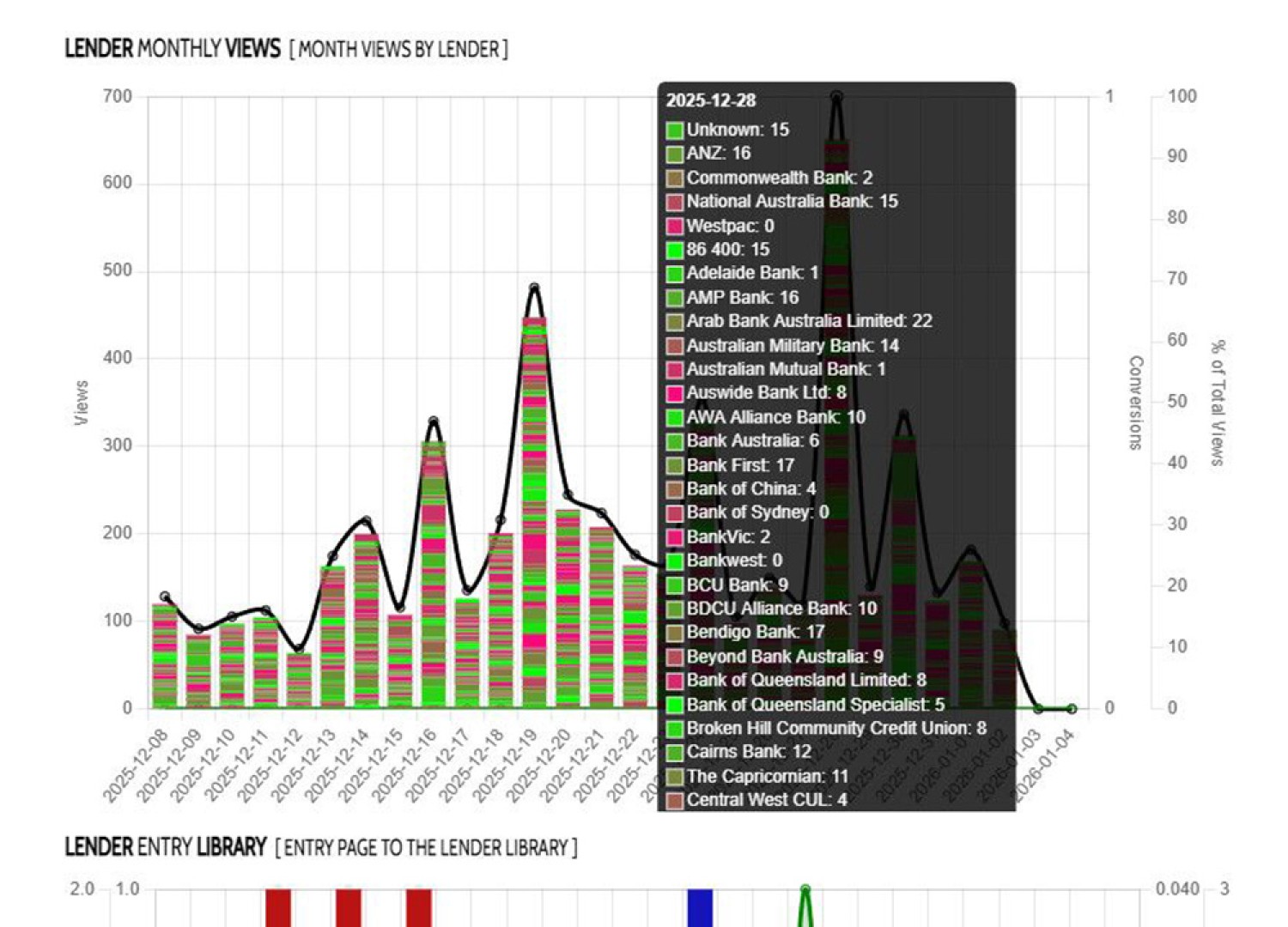
Pictured: Lender data is in strategic locations on our website. Don't confuse a 'rate-driven' ideology with the need for consumers to have access to information - the mutual exclusivity of these two competing agendas is rarely underwood. Consumers want rate data, and our average broker will see hundreds of daily visits which presents enormous opportunity to convert your visitors.
The reason your website doesn't convert is because generating business isn't your website architectural focus. Your website doesn't convert because it seeks to do nothing other than prove you exist.
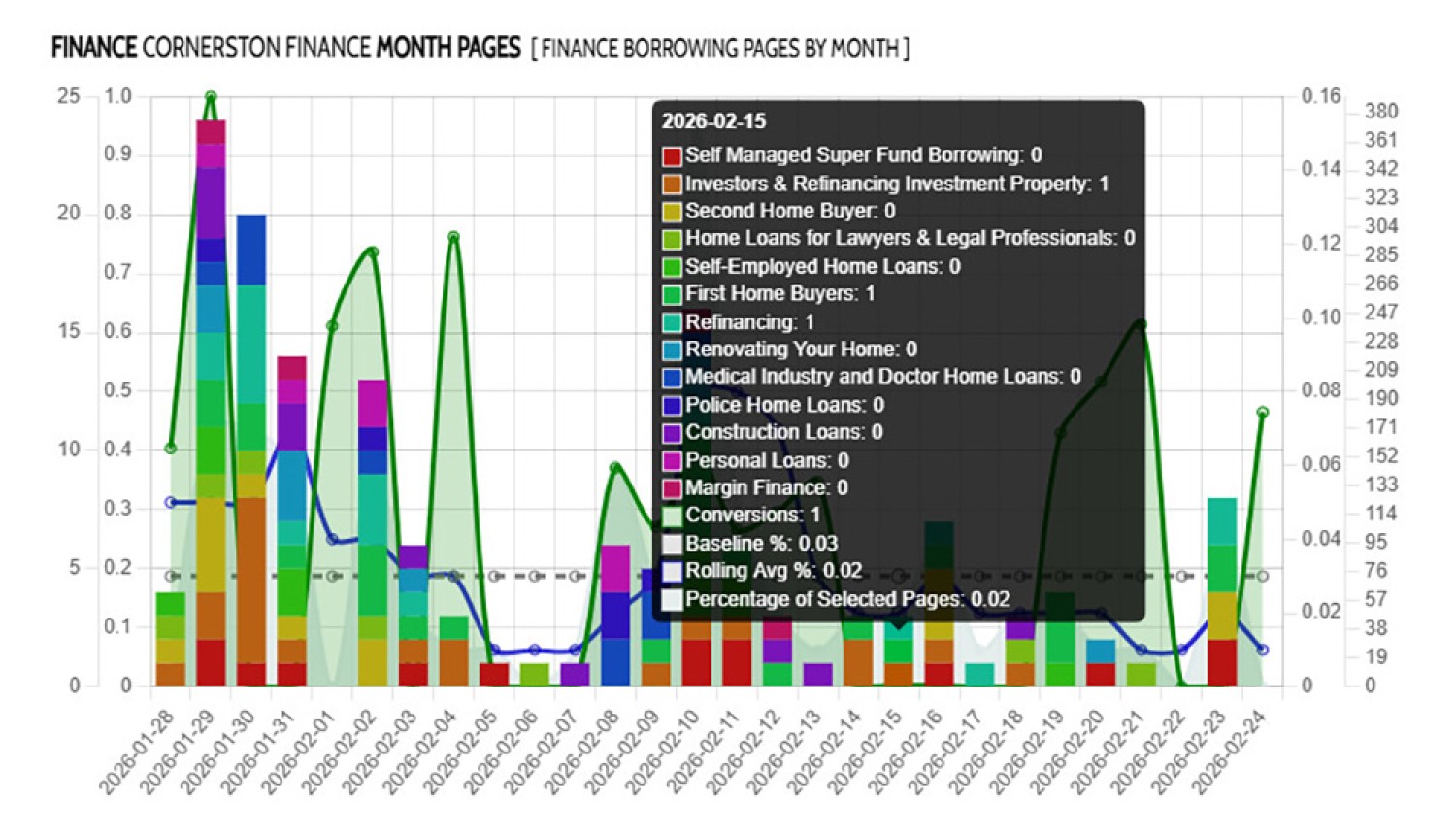
Pictured: Do you know how many visitors are viewing your First Home Buyer, Investor, or Refinance pages? You need to know this fundamental and basic piece of information in order to establish and understand your audience, and determine the predominant borrowing objective. This information shapes other areas of your business, such as content creation. Our conditional engine feeds off this engine in order to build a 'conditional' understanding of users (a big topic). We measure all evergreen and cornerstone pages, and your core finance product pages are stacked for an immediate understanding.
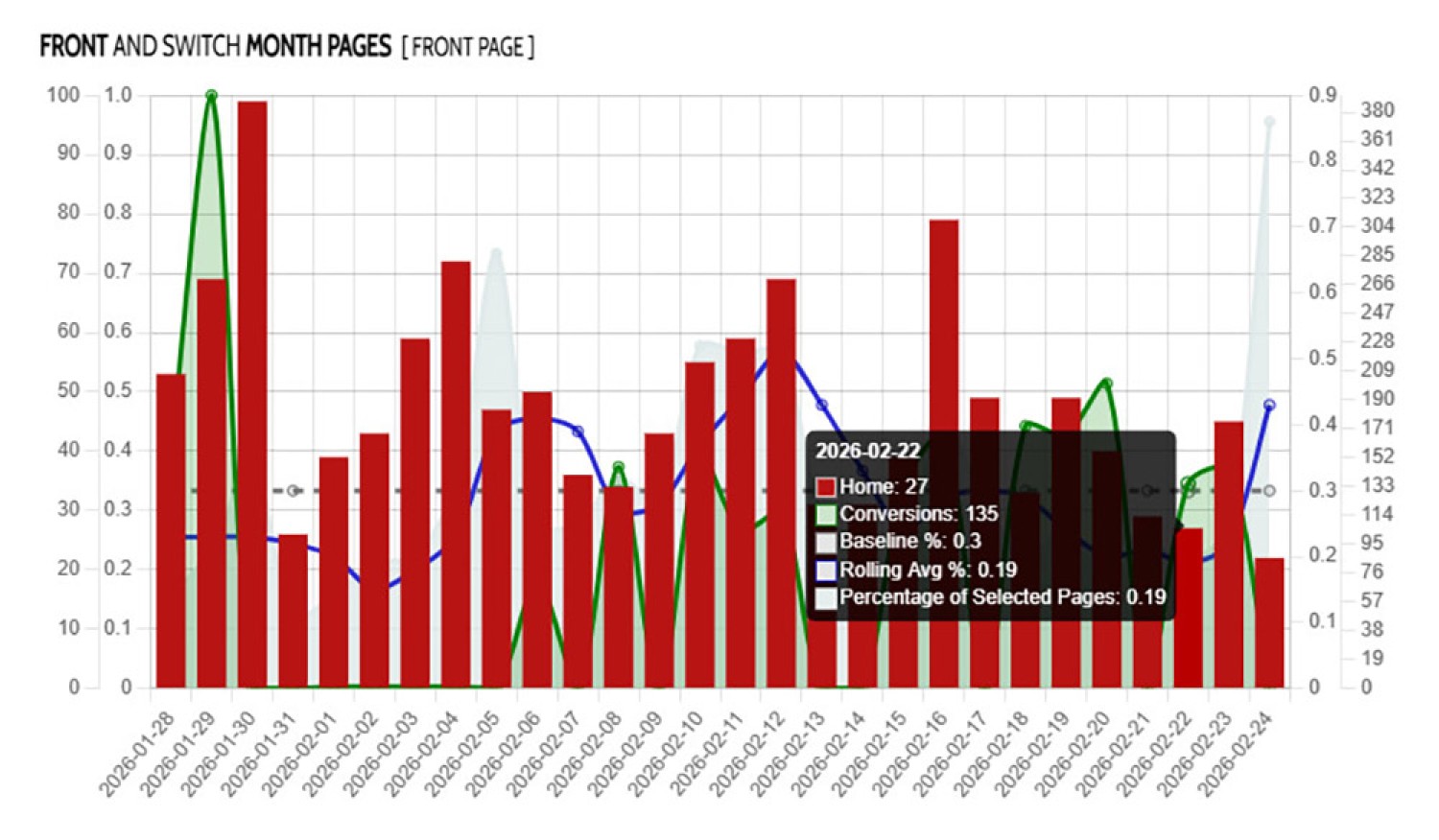
Pictured: The front page of your website is important... and your website includes at least 15 front pages. Managed via the Switch module, you may force an alternat from page for a specific user, or force an alternate front page based on the resoled interest of the website visitor. Front page stats show a stacked coloured bar chart of all front pages. The pictured user only uses their default front page. Alternate front page will be indicated by other colours, and the view/conversion count will be rendered in the tooltip.

Pictured: Your website includes a number of search tools and other single pages that need to be tracked in order to be understood. Shown is a small selection of these pages which includes Appointment and Contact pages, BSB Searches, Emergency Searches, third-tier searches, and 'General' pages. We also show stats for compliance -related pages individually. Another module allows you to group pages, meaning that you may review specific pages stacked in a single graph.
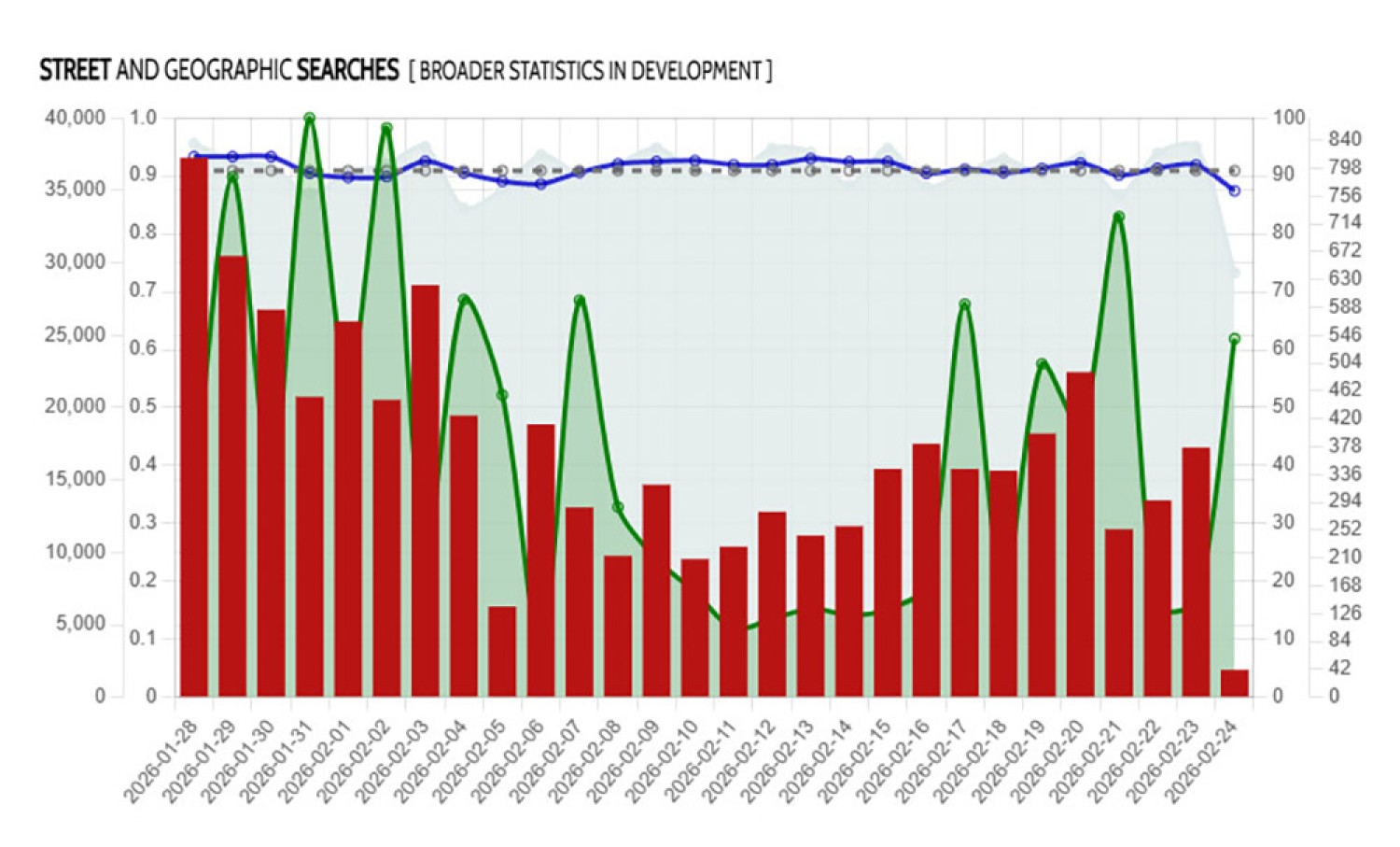
Pictured: Our Streets module is one of the most powerful tools on your website. The pictured user has a significant marketing spend and religiously sends users to the Streets pages for a property report, and this results in around 50 leads per day - all with a known address and verified phone number.
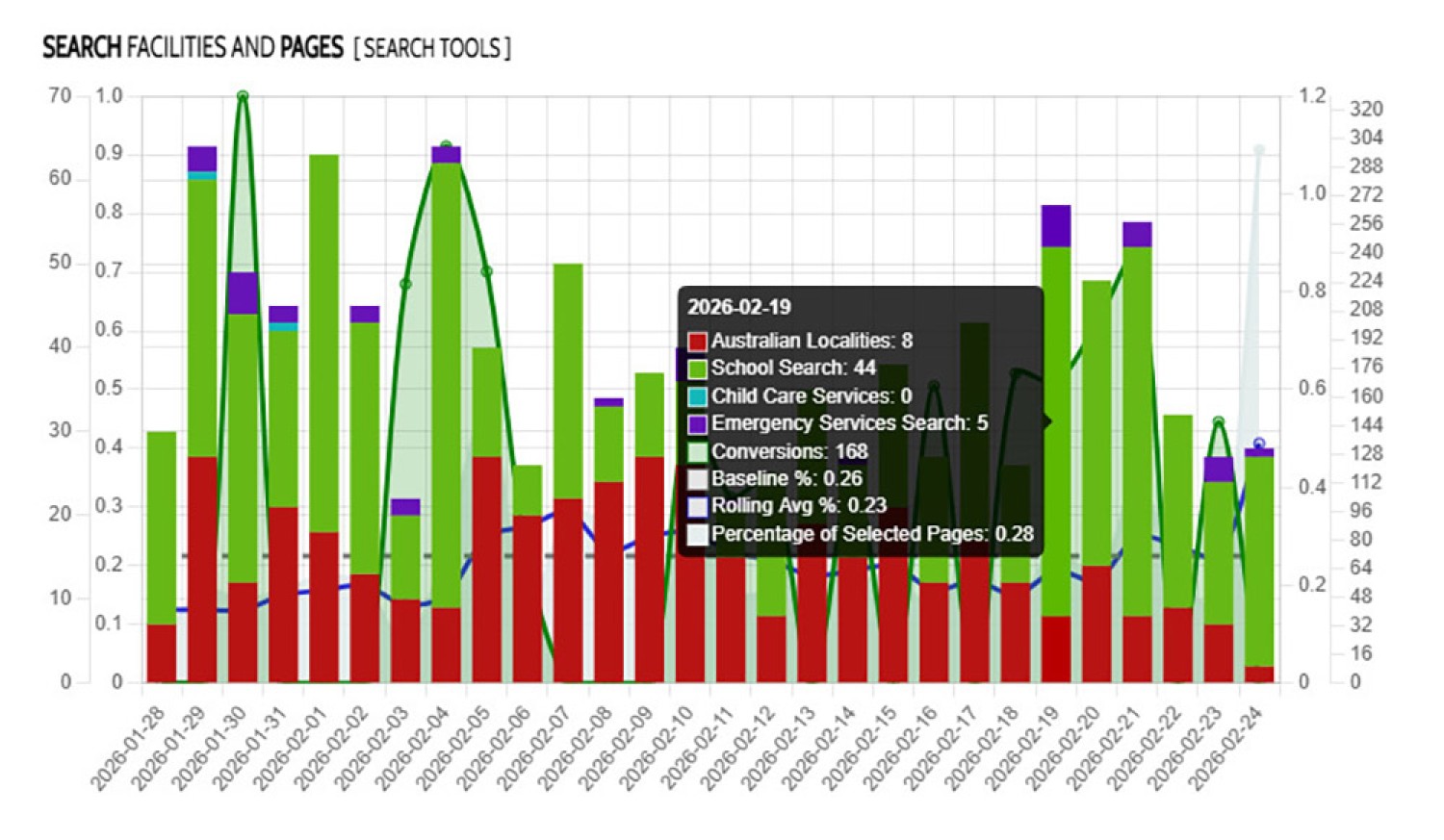
Pictured: An aggregated graph of secondary (and less-commonly visited) search facilities are bundles into a single graph so you're able to assess the performance of some 'hidden' pages.
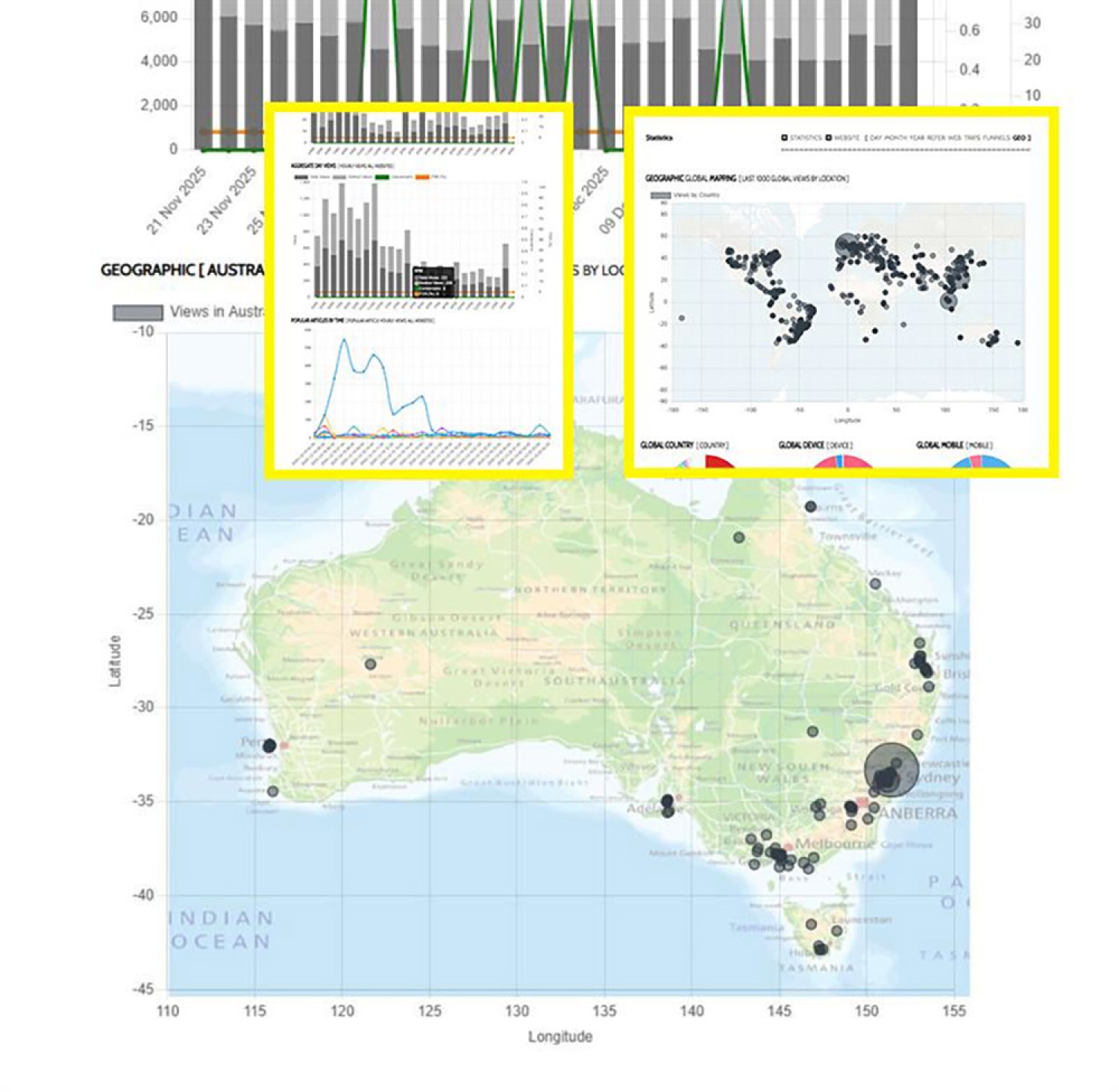
Pictured: Actions of all types are resolved to a geographic coordinate along with suburb, state, country etc., and all geographic data is returned in various formats for most modules. Where required, Australian data is shown independent of global data. A chart is also returned for visits near your business location - a tool we use for local SEO performance.
There are hundreds of articles on our website that details how and why our website converts in far higher numbers than competing solutions, and why our paid promotion programs return far, far, more leads, but that isn't the focus of this article. Instead, understand that the deeply nested Xena statistical module paints a clear picture of your performance that is unmatched by anybody else. Further, Xena is a default part of our core product. In fact, our heatmap and scroll modules alone might cost you more than $200 per month using a commercial service.
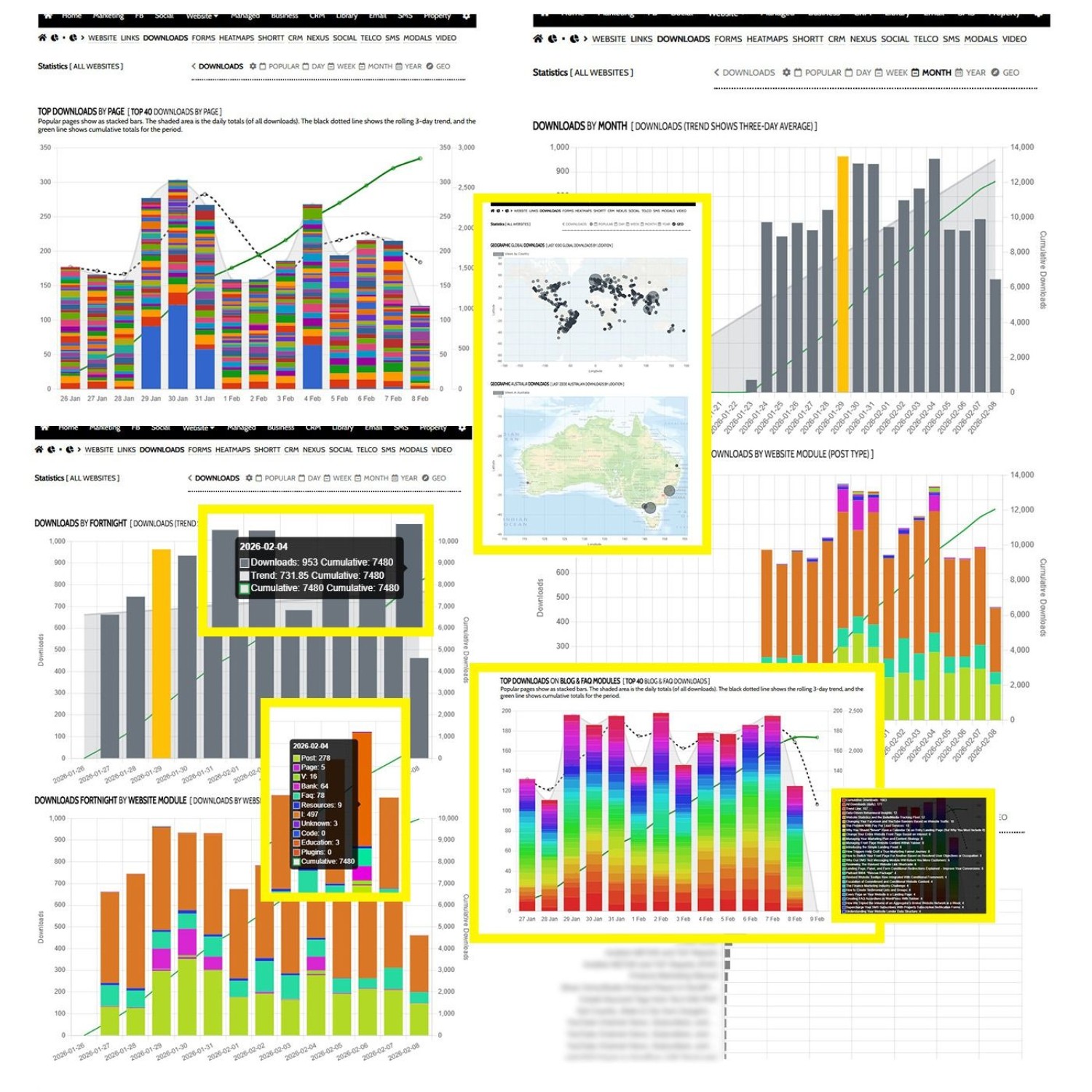
Pictured: All the data recorded for website page views are also applied to downloads, so we know the page, post type (module), geography, along with around 35 other data points. Resolved to specific users, downloads are a common marketing trigger source. The graphs include trend overlays and conversion counts. It's one of those graphs that is absolutely essential.
In a very old article titled "Data-Driven Behavioural Insights", we looked at the importance of having tactile feedback on all digital interactions in order to shape decision making of any type. If you don't have data, you're operating on rhetoric and guesswork, and this void of meaningful insights makes your agile marketing efforts as reliable as calculating the global ratio of unicorns to leprechauns. Sadly, most businesses are traversing the digital space entirely blind and completely oblivious to the opportunities that pass them by.
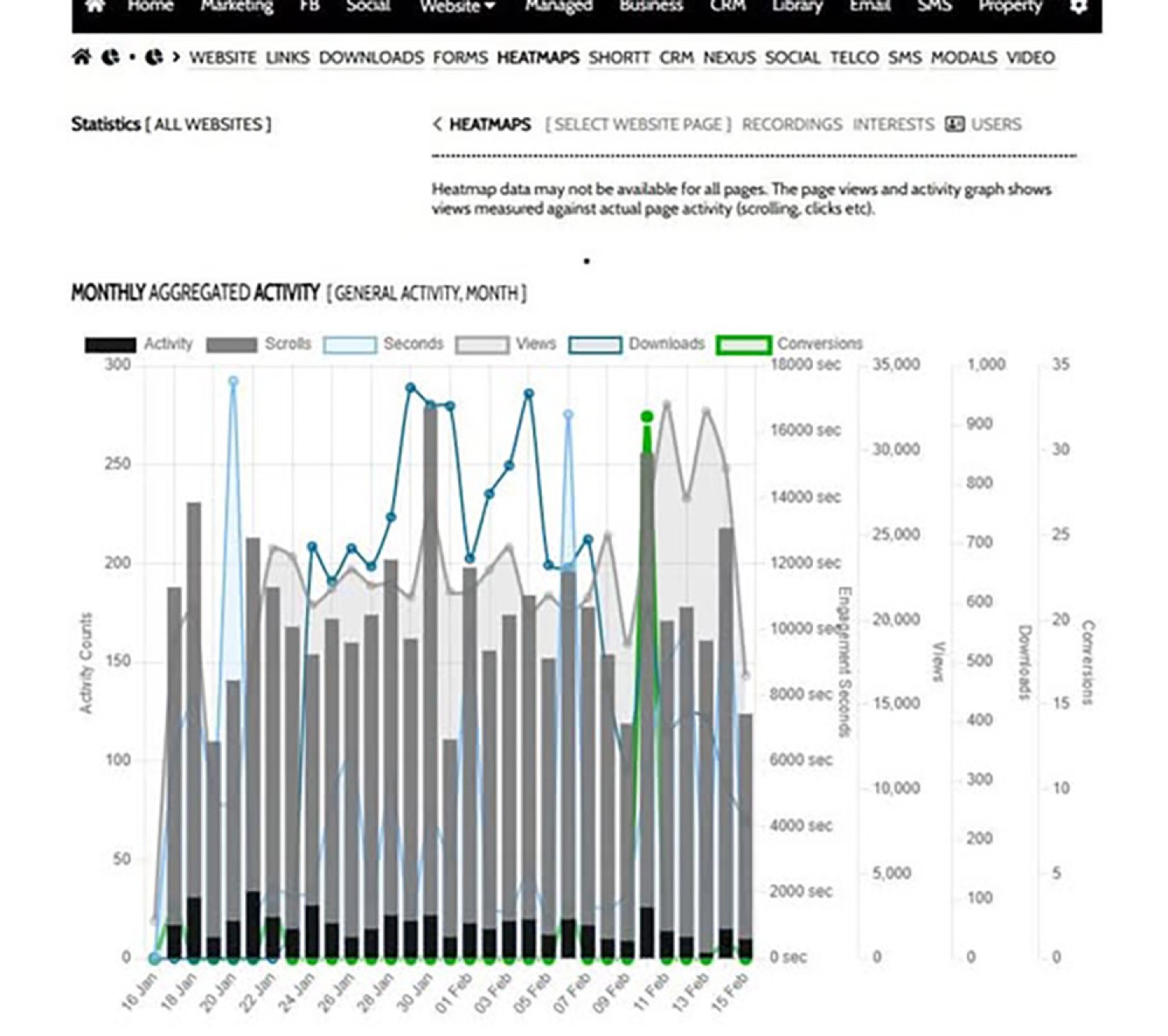
Pictured: The pictured graph is an important one, and it's a derivative of the Core Temperature Graph. The graph shows general activity, scroll movements, seconds on page, views, downloads, and conversions. As part of the heatmap module, the bar component of the graph shows page activity (essentially measuring the clicks and movements). The activity component of this graph will be updated to include basic mouse track data over the next couple of weeks.
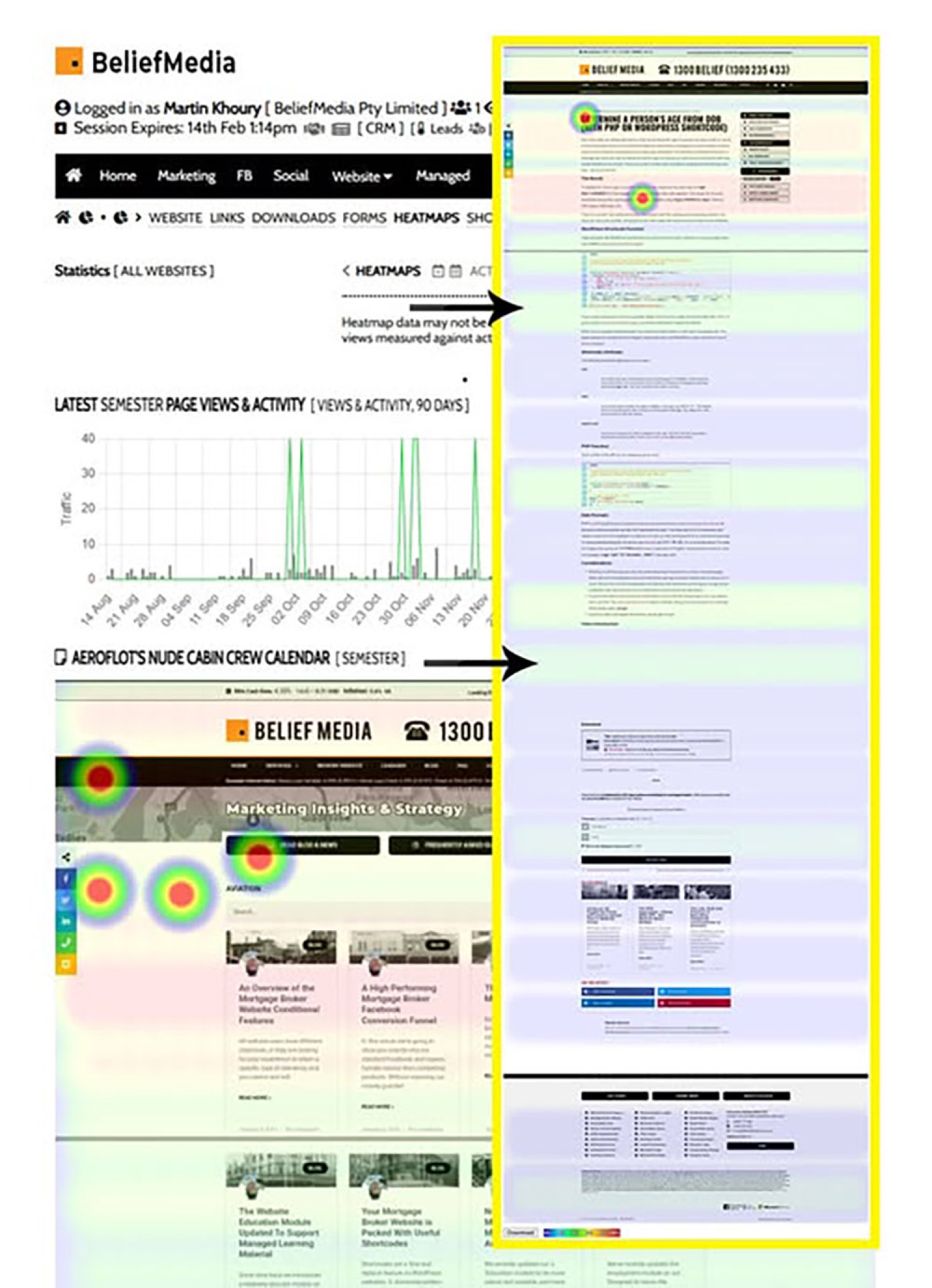
Pictured: This heatmap shows where users focus their attention on landing pages, identifying high-engagement zones and potential bottlenecks in the conversion funnel. Heatmaps are arguably one of the most important statistical modules you can use, and if you're engaged with paid promotion, any budget you throw at Facebook or elsewhere is seriously compromised unless you have heat and scroll data. It's one thing to split test landing pages - a bread-and-butter requirement - but the necessity to evaluate landing page performance simply cannot be actioned unless you're able to visually assess page interactions. I tends to get angry at the industry because I see poor performance on the back of pages that could be corrected with a very simple single heatmap. The heat module also plays back entire user sessions in real time... but this module remains the domain of our managed groups.
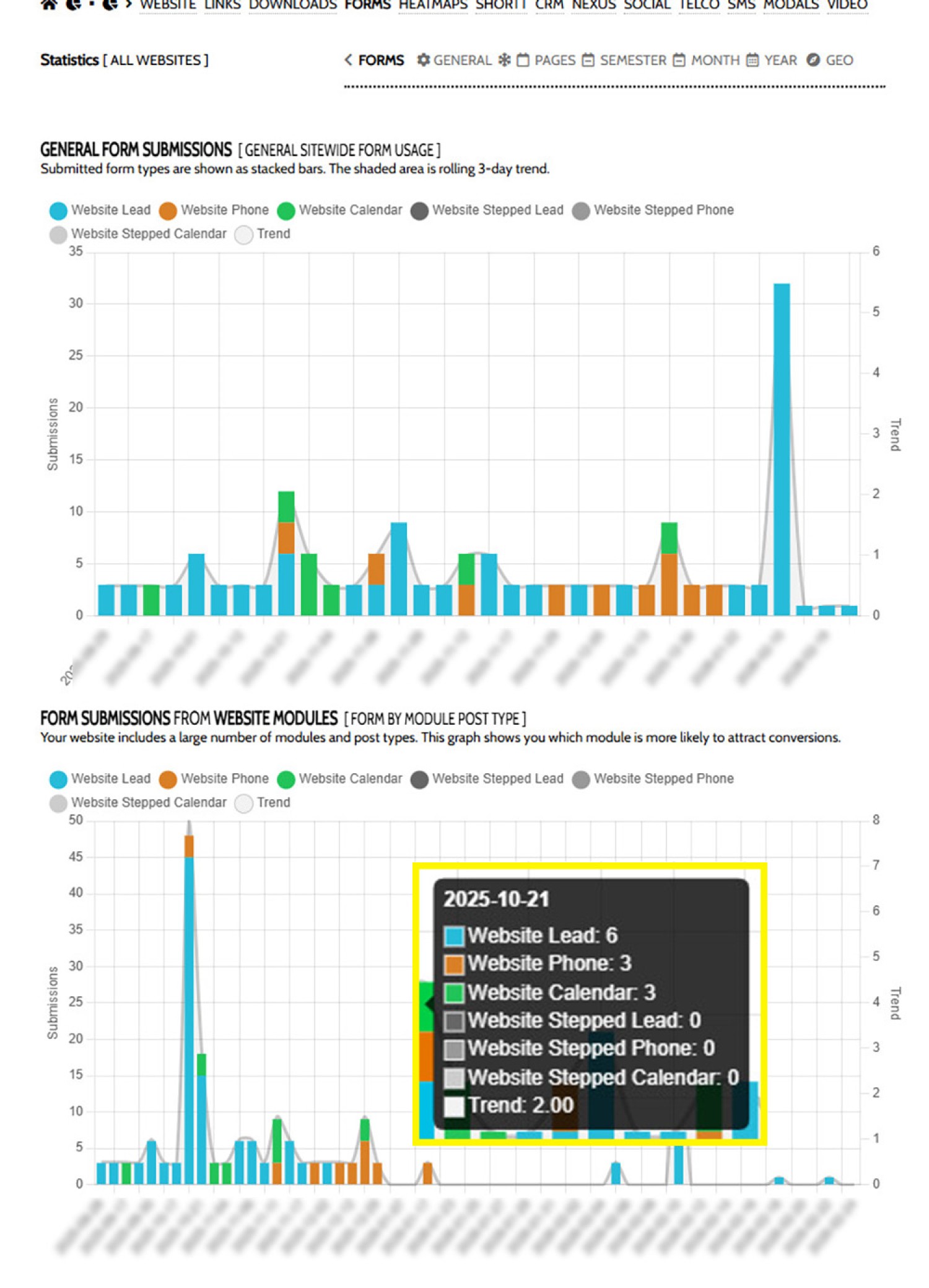
Pictured: The way the industry works is that forms are often a third-party tool that plugs into a page (or landing page) - an entirely clumsy solution. Via our Formly module, our forms, Outlook-integrated calendars, stepped forms, and all form components, are fully and entirely integrated with our Yabber system. Because of this tight native integration, we're able to measure the performance of forms by page, post type, geography, position on page, and about 30 other big-ticket attributes. The security implications of third-party tools is so significant that we've banned a number of clumsy tools on our servers. Forms are measured by lead type (email, phone, subscriber) and segregated by form type (standard form, fact find, stepped form etc).
Landing Pages and Heatmaps: The understanding of landing page traffic measured against internal website views and conversions is a core necessity that is often ignored overlooked by those that provide any flavour of leadgen service, and the data returned via our Landing Page system is unmatched in every respect. You can't improve something if you don't understand how it's performing. Scroll maps and heat data on landing pages are essential, and if your digital representation doesn't provide this data, it might be time to karate-kick them back into the pool of mediocrity where they belong.
The insights generated by Xena go far beyond basic metrics. By correlating behavioural data with transactional outcomes, the engine produces predictive intelligence, revealing which actions are most likely to generate conversions and which channels yield the highest return on investment. Features like the Singularity, user temperature mapping, and geo-resolved interaction data allow businesses to anticipate opportunities and bottlenecks with a level of precision that is simply unavailable in conventional analytics platforms. This predictive capability transforms Xena from a passive reporting tool into an active decision-making framework, enabling real-time strategy adjustment and hyper-targeted interventions across marketing and operational channels.
Bottom line: you won't be able to improve on something if you don't know how it's performing.
Website Features & Yabber Integration
The RBA Cash Rate graph is an example of a simple shortcode. We've used [bm_rba_cash_graph start="20140101" points="1000"] in this page to return the graph. It's highly customisable, with the most basic option being the start and end attribute. Knowing that client websites are supported by a range of shortcodes allows those articles we send to websites to be quite dynamic and feature rich.
The Inflation Graph: The Inflation Graph is another example of a simple and highly customisable shortcode. While we could have used the Elementor widget, we've used the shortcode of [bm_inflation width="1200" points="120" frequency="month"] to render the above.
If you think about it, it's quite absurd that brokers have their monthly banter focused on rates at least once a month, yet very few of them provide the graphing necessary to illustrate their commentary.
Of course, individual values may be returned, such as the monthly inflation of 4%, the current cash rate is 4.35%, or the USD exchange rate of $0.64 USD. A significant number of values may be returned when and if necessary.
The Gold Graph: The Gold Graph is another example of something that might ne needed at some point - it's always nice to know it's there. Another example of a rather random graphing tool is daily fuel prices; once again, you may need it one day. Gold prices are determined in global wholesale markets, primarily through continuous trading on major exchanges and over-the-counter markets in London, New York, and Asia. The AM and PM close refer to the London gold price auctions, which occur twice each business day. The AM price is set during the morning auction and is often used as a reference for opening valuations, while the PM price is established in the afternoon and is widely used for end-of-day accounting, fund valuations, and benchmark reporting. All prices shown are based on one troy ounce of gold (31.1035 grams) at a standard purity of 99.5% or higher, which is the global benchmark for investment-grade gold. When converted into local currency or smaller weights, the underlying value remains anchored to this internationally recognised ounce price, adjusted only for exchange rates and unit conversion. Data shown is delayed by a day and is for information purposes only.
The website framework includes around 1000 powerful shortcodes and over 80 broker-specific Elementor widgets. Refer to our FAQs for an introduction.
Search Engine Optimisation
Search Engine Optimisation is an extremely large topic, so we'll introduce the scope of website features in an article titled "How Our Marketing System Manages Your SEO To Attract Free Organic Traffic".
SEO has evolved enormously over the last few years, and after a couple of decades supporting businesses with organic reach, we can categorically state that SEO is no longer a service that could ever attract a fee. SEO is now determined by original content creation, video, and industry authoritativeness, and little else.
We have a 300-page guide on SEO, and more information is provided in our Finance Markteing Guide.
Your website architecture includes the most sophisticated and automated features availed to the market.
Facebook Pixel: One issue of concern I've identified with those we've in inherited from the High Level crowd is that the Facebook pixel associated with the broker's ad account wasn't assigned to their website. One gentleman in particular has assigned a pixel, but it's the same across all brokers he deals with, thus assigning all value to his own pixel for cheaper leads and useless retargeting. The Facebook pixels is one of those crossovers between SEO and paid promotion. The conduct of the Facebook charlatans is criminal.
Conclusion
A high-performing funnel is not a sequence of pages, emails, forms, and calls to action. It is a cognitive environment designed to move a person from uncertainty to clarity, from passive attention to active participation, and from curiosity to commitment. In a market where conversions are required, the broker who wins is not necessarily the one with the loudest advertisement, the lowest claimed rate, or the most aggressive sales process. The broker who wins is the one who creates the strongest psychological pathway: a journey that reduces friction, answers questions before they become objections, rewards interaction, provides an ongoing honest education, and makes each next step feel obvious, useful, and safe.
The modern borrower is overloaded. They are exposed to lender advertising, broker offers, comparison sites, social posts, conflicting advice, economic uncertainty, family opinion, and endless product noise. In that environment, attention is fragile and trust is conditional. A cognitive-driven funnel works because it does not simply ask for a conversion; it earns the right to request one. It gives the user a reason to continue. It creates small moments of progress. It provides feedback, education, relevance, and reward. It turns the journey into a structured experience where the user feels they are learning, advancing, comparing, qualifying their own thinking, and becoming more capable with each interaction.
This is where gamification becomes commercially powerful. Properly applied, gamification is not childish badges, gimmicks, or artificial urgency. It is the deliberate use of progress, feedback, curiosity, completion, sequencing, and reward to keep the user engaged. A borrower who answers questions, receives results, unlocks guidance, compares scenarios, watches the next explanation, downloads the next resource, or books after seeing their position more clearly is participating in a guided decision experience. The funnel becomes interactive rather than static. It gives the user momentum. That momentum matters because every completed micro-action increases familiarity, reduces resistance, and makes the next commitment easier.
The value of this kind of funnel is that it aligns with how people actually make decisions. Borrowers do not move logically from “need loan” to “choose broker” in a single step. They move through uncertainty, avoidance, interest, comparison, reassurance, doubt, renewed curiosity, and finally action. A strong funnel respects that behavioural reality. It does not overwhelm the user with everything at once. It does not rely on pressure. It does not leave the user stranded after a single interaction. It continuously asks the only question that matters: what comes next?
In a conversion environment, the business that fails to answer that question loses attention. Attention lost is almost always opportunity lost. A cognitive-driven funnel protects against that loss by creating a connected journey that responds to behaviour, sustains engagement, and keeps the user moving through a meaningful education pathway. It transforms marketing from a collection of disconnected tactics into a managed psychological experience. The result is not just more conversions, but better conversions: users who are more informed, more confident, more trusting, and more prepared to take the next step.
The conclusion is simple. A funnel that merely captures leads is ordinary. A funnel that teaches, adapts, rewards progress, and escalates commitment is an asset. In a market where every broker claims service, choice, and expertise, the experience itself becomes proof. A high-performing cognitive-driven funnel demonstrates competence before the first conversation, builds trust before the first appointment, and gives the borrower a reason to choose the broker long before the broker asks to be chosen.