The following section looks at advertisements from successful historic campaigns that had an impact on the manner in which the market perceived their position in the market and helped shape the brands. You should download our Marketing Guide to gain an appreciation of positioning in general and in broader advertising.
Advertising That Changes the Comparison
The most influential advertisements in history did more than communicate product features, promote temporary offers, or generate an immediate response. They changed the way the market understood the product. They altered the category, reframed an apparent weakness, attached the brand to a powerful human need, or created a new basis upon which every competing option would thereafter be judged. Dove did not merely promote moisturising soap; it created the beauty bar. Avis did not hide second place; it made second place evidence of effort. Volkswagen did not apologise for being small; it made smallness intelligent. 7UP did not claim to be a better cola; it rejected cola as the relevant comparison. Volvo did not merely install safety features; it became safety in the mind of the buyer. FedEx transformed overnight delivery into certainty at the moment failure was unacceptable. De Beers attached a physical product to permanence and commitment. Listerine owned an invisible problem. M&M’s converted a practical product feature into a benefit that could be understood, tested, and remembered immediately.
Positioning, Targeting, and Points of Differentiation in Mortgage Broker Advertising: This article supports a large number of others. An article titled "Positioning, Targeting, and Points of Differentiation in Mortgage Broker Advertising" introduces targeting, positioning, and points of diffeerentiation, and how these principles can be applied to your own advertising. The secret to better results is a secret that we've seen in plain sight for over a hundred years.
How to Create Financial Advertising That Sells, 1974: An article we wrote back in 2019 introduces Ogilvy's "How to Create Financial Advertising That Sells, by Ogilvy & Mather". The article talks about the positioning of the ad in the market, and it provides a good comparison against modern-day long-form writing.
These campaigns remain valuable because the underlying principles have not changed. Media channels have changed. Technology has changed. Audience targeting has become more precise. Production has become faster and less expensive. Advertising can now be distributed, measured, modified, and personalised at a scale that earlier practitioners could scarcely imagine. Yet none of those capabilities removes the need for a strong position. In many respects, digital advertising has weakened the discipline because platforms make it easier to publish generic messages to highly defined audiences. A broker can target nurses, doctors, teachers, investors, refinancers, business owners, first home buyers, or a specific suburb with extraordinary accuracy and still deliver an advertisement that says nothing memorable. Targeting determines who receives the message. It does not determine whether the message matters.
Positioning answers a different question. It determines the meaning attached to the business before, during, and after the advertisement is seen. It tells the market what the broker represents, what problem the business is uniquely equipped to solve, what belief it challenges, what experience it provides, and why it should be preferred over the familiar alternatives. A campaign may purchase attention, but positioning determines how that attention is interpreted. A strong position makes an advertisement feel credible, relevant, and coherent. A weak position forces every campaign to compete from the beginning with another collection of rates, lender claims, generic service promises, stock photographs, and indistinguishable calls to action.
The historic examples examined in this article are not presented so brokers can imitate famous slogans or borrow the surface style of old campaigns. Copying “We Try Harder”, “Think Small”, “The Uncola”, or “A Diamond Is Forever” would entirely miss the point. The value is found in the mechanism underneath the creative. Each campaign began with a truth: a product characteristic, a market weakness, a dominant assumption, a consumer anxiety, a cultural tension, or an operational advantage. The advertiser then interpreted that truth in a way that changed the comparison. The work did not simply say the product was better. It established why the old way of judging the category was incomplete.
This distinction is critical for mortgage brokers because the industry is saturated with expected claims. Brokers say they provide personal service, competitive rates, lender choice, tailored solutions, fast responses, experienced advice, and support throughout the process. These claims are not necessarily false, but they are category requirements rather than positions. They describe what a competent broker should already provide. When every business repeats them, they lose diagnostic value. The borrower cannot use them to distinguish one business from another, so they default to familiarity, price, speed, convenience, advertising repetition, or whichever option feels least risky.
The opportunity is to change the frame. A broker may position around borrower control rather than lender loyalty, purchase readiness rather than basic pre-approval, interpreted comparison rather than a rate table, decision safety rather than product access, structured professional referrals rather than informal introductions, or a guided digital finance experience rather than a generic callback form. The exact position will depend on the business, but it must be grounded in something real. It must emerge from the broker’s expertise, process, technology, content, audience knowledge, service model, partner network, or operating philosophy.
The advertisement is only the visible expression of that position. The website, landing page, form, video, article, comparison tool, email, SMS, booking pathway, broker response, and post-settlement experience must all provide supporting evidence. A broker cannot advertise education and present a thin website. They cannot promote intelligent comparison and offer only a contact form. They cannot claim specialisation and provide no specialist content. They cannot promise certainty while delivering slow or inconsistent communication. They cannot position around technology while sending users through the same static process as every competitor. Positioning is not created by the headline alone; it is confirmed or destroyed by what happens next.
The campaigns explored here therefore provide more than advertising history. They offer a set of strategic models. Dove demonstrates category elevation. Avis demonstrates challenger positioning. Volkswagen demonstrates reframing. 7UP demonstrates category rejection. Volvo demonstrates category ownership through proof. FedEx demonstrates urgency and operational certainty. De Beers demonstrates symbolic and cultural meaning. Listerine demonstrates problem ownership. M&M’s demonstrates tangible differentiation. Together, they show that strong advertising does not merely describe the business. It gives the market a new way to think.
For mortgage brokers, that is the real standard. The objective is not simply to publish another promotion, reach another audience, or generate another form submission. The objective is to make the business easier to understand, easier to remember, and harder to substitute. Advertising should not merely announce that the broker exists. It should establish why the ordinary alternative now feels inadequate.
If you're reading this for the Growth Workshop, ensure you review the mental gymnastics worksheet.
The Dove Effect
The Dove Effect is a useful way of explaining how positioning can elevate an otherwise ordinary product, service, or business into a distinct mental category. Dove did not win by saying, “we sell soap”. It won by refusing to be judged as ordinary soap. The famous 1957 positioning decision associated with David Ogilvy reframed Dove away from a detergent or cleansing bar and toward a beauty bar for women with dry skin; Ogilvy later described this as a deliberate choice to position Dove as a “toilet bar for women with dry skin” rather than a detergent bar for men with dirty hands. That decision matters because it did not merely advertise a product attribute. It changed the competitive frame. Once Dove became a moisturising beauty bar, ordinary soap became psychologically inferior because the category itself had changed.
This is what proper positioning does. It does not simply say, “we are better”. It changes the basis on which the market makes the comparison.
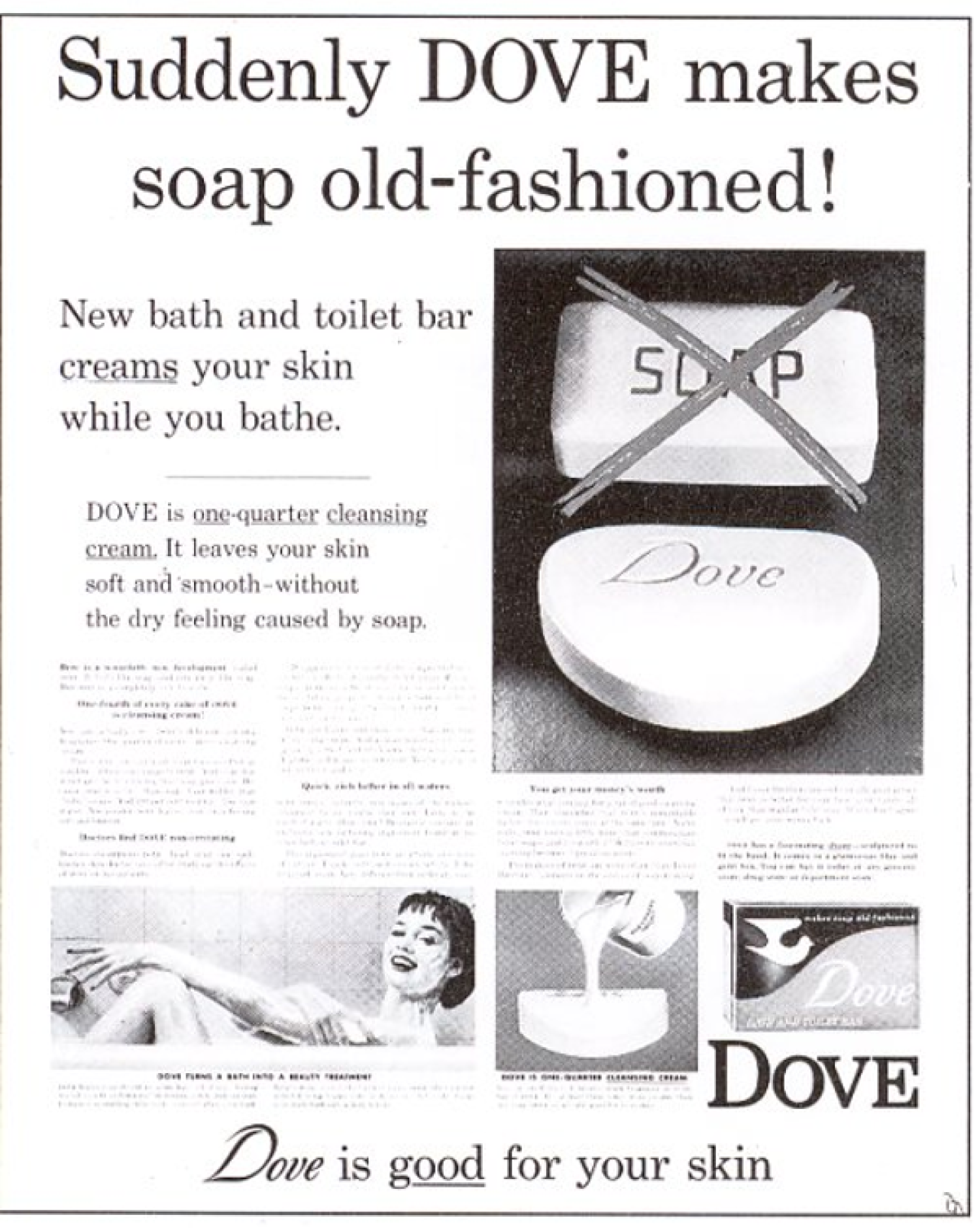
Pictured: A 1957 ad for Dove soap that positions Dove as a moisturizing beauty bar. Ogilvy essentially made soap seem inferior by positioning Dove in a product class of its own. The advert pictured above clearly targets women and emphasises the moisturising quality of the soap rather than its cleansing quality. Positioning can change a product that is otherwise neutral. Sales positioning isn’t used as widely as it once was. Modern digital marketing tends to target a known audience rather than making a product ‘different’ (and different isn’t always better, and it runs the risk of introducing exclusion to your market). Your ‘Point of Differentiation’, ‘Sales Positioning’, and ‘Unique Selling Point’ often overlap in a blur but it’s still important to identify each. Even today, Dove positions itself as a beauty bar. More recently they’ve attached themselves to the growing trend of creating a movement, or riding the coattail of one that already exists. In the case of Dove, they now promote the following: “Imagine a World Where Beauty is a Source of Confidence, Not Anxiety”. This ability to change focus without compromising on positioning is often called “The Dove Effect” – it won’t dry your skin like soap can.
Before the positioning, the consumer question was simple: which soap cleans best, smells best, costs less, or feels most familiar? After the positioning, the question became different: why would I use ordinary soap if this product is positioned around beauty, skin, moisture, and care? That is a profound shift. The product did not need to abandon its functional purpose, because it still cleaned. But the dominant meaning of the product moved away from cleaning and toward beauty. Positioning did not destroy the old category. It made the old category feel incomplete.
The power of the Dove example is that the differentiator was functional, but the position was psychological. The functional claim was moisturising. The psychological position was care, softness, femininity, beauty, and skin confidence. That is why “moisturising” alone was not the full strategy. Many products can claim a functional benefit. The genius was making that benefit the organising identity of the brand. Dove was not soap with moisturiser. It was a beauty bar. That language created separation. It allowed Dove to occupy a category with more emotional value, more personal relevance, and more defensible meaning than the generic product class.
The lesson for brokers is immediate. A broker does not create positioning by saying, “we compare loans”, “we help nurses”, “we work with doctors”, “we provide great service”, or “we access many lenders”. Those are product or service statements. They may be true, but they do not change the frame. Real positioning changes the question in the user’s mind. Instead of asking, “which broker should I call?”, the user should begin asking, “why would I deal with a broker who does not provide this level of education, comparison, technology, follow-up, partner support, property insight, and funnel experience?” That is positioning with force. It makes the ordinary alternative look underdeveloped.
The Dove Effect also shows that positioning can create category ownership without excluding future growth. Dove began with a specific product position around the beauty bar, but the brand later expanded into a broader purpose-led platform through the Campaign for Real Beauty, which launched in the mid-2000s and focused on self-confidence, body image, and broader definitions of beauty. That is important because strong positioning is not a cage. It is a centre of gravity. Dove could move from moisturising beauty bar to beauty confidence because both ideas belonged to the same psychological territory. The message evolved, but the core brand meaning remained coherent.
This is the distinction between positioning and opportunistic messaging. Weak businesses chase campaigns. Strong businesses build a position that campaigns can express in different ways. Dove could talk about moisturising, real beauty, confidence, self-esteem, body image, social media pressure, and beauty anxiety because these messages all sit inside the same strategic world. The brand did not have to reinvent itself every time the market changed. It could shift emphasis without breaking identity. More recent Dove activity has continued to attach the brand to confidence, self-esteem, and anxiety around beauty standards, including campaigns encouraging women and girls to redefine beauty for themselves.
That is the real commercial value of the Dove Effect: it gives a business permission to evolve without becoming incoherent. A broker may begin with a position around refinance authority, first home buyer education, professional lending, property intelligence, partner-led growth, or technology-enabled comparison. Over time, the broker may run campaigns around fixed rate expiry, lender loyalty, borrowing capacity, property reports, investment structure, debt consolidation, or partner education. The campaigns can change. The offers can change. The audience emphasis can change. But the underlying position must remain stable enough that every campaign strengthens the same broader perception.
A broker applying this principle must stop thinking in campaign labels and start thinking in market meaning. “Home loans for nurses” is not positioning if every broker can say it. “Finance support for nurses” is not enough. The stronger question is: what is the category we are trying to own? Are we the broker that understands shift-work income and healthcare employment structures better than generic lenders? Are we the broker that provides a nurse-specific borrowing pathway, education library, rostering-aware income explanation, lender-policy guidance, and review sequence? Are we the broker that makes healthcare workers feel properly understood before they submit a form? If the answer is yes, the position begins to have substance. If the answer is no, the campaign is just audience targeting.
The Dove Effect is also a reminder that positioning works by making competitors feel less complete. Dove did not need to attack ordinary soap directly. By calling itself a beauty bar and emphasising moisturising, it made ordinary soap feel harsh, basic, and insufficient. Brokers can do the same ethically and professionally. A technology-led broker does not need to say competitors are primitive. Your website, comparison tools, conditional forms, education assets, videos, partner dashboards, and follow-up pathways should quietly make ordinary broker websites look thin. An education-led broker does not need to say competitors are shallow. The depth of the content and education your share should make shallow advice obvious. A partner-led broker does not need to attack other brokers. The infrastructure should make unstructured referral relationships look amateur.
This is why positioning must be demonstrated, not merely claimed. Dove could not have sustained the beauty-bar position if the product experience contradicted the message. A broker cannot sustain a positioning claim if the website, funnel, forms, content, videos, advertising, and follow-up do not support it. If the business claims to be education-led, the education must be visible. If it claims to be technology-led, the technology must be experienced. If it claims to be a specialist, the specialist intelligence must be present. If it claims to support a profession, the page must prove deep familiarity with that profession’s financial reality. Positioning collapses when the evidence is missing.
The Dove Effect also shows the difference between a point of differentiation and a positioning platform. “Contains moisturiser” is a point of differentiation. “Beauty bar” is a positioning platform. “Campaign for Real Beauty” is an evolved brand movement. The first gives the user a reason. The second gives the product a category. The third gives the brand a cultural role. Brokers should understand this hierarchy. “We use better technology” is a point of differentiation. “The broker with the most intelligent digital finance experience” is a position. “Helping borrowers make confident property and finance decisions through education, comparison, and guided action” is closer to a platform. Each level is broader, stronger, and more durable than the one below it.
Modern digital advertising often weakens this discipline because it encourages hyper-targeted messages without broader strategic meaning. Platforms allow a broker to target nurses, doctors, teachers, lawyers, suburbs, income brackets, property interests, database segments, retargeting pools, and behavioural audiences. That targeting is useful, but targeting is not positioning. Targeting decides who sees the message. Positioning decides what the message means. A broker can run highly targeted campaigns and still be strategically generic. Dove’s lesson is that market meaning matters more than audience selection alone.
There is also a risk in trying to be different for the sake of difference. Different is not automatically better. A business can become so narrow, quirky, provocative, or exclusionary that it reduces its market rather than strengthening its position. Dove’s positioning worked because it was different in a way that mattered to the audience. It attached to an existing emotional tension: cleansing versus care, soap versus beauty, dryness versus moisture, ordinary washing versus skin confidence. Real positioning must attach to a meaningful tension. For brokers, that tension might be confusion versus clarity, lender loyalty versus comparison, generic advice versus specialist interpretation, cold lead capture versus guided education, or ordinary website enquiry versus intelligent funnel progression.
The broker’s task is therefore to identify the tension they can credibly own. A refinance broker might own the tension between lender complacency and borrower control. A first home buyer broker might own the tension between property anxiety and purchase readiness. An investor broker might own the tension between buying property and building a finance strategy. A partner-led broker might own the tension between random referrals and structured professional pathways. A technology-led broker might own the tension between static broker websites and conditional decision environments. The position becomes powerful when the market can feel the contrast.
The Dove Effect should also inform advertising hierarchy. The advertisement should not attempt to carry the whole position every time. It should express one part of it. Dove did not need every advertisement to explain the entire history of skin care. A broker does not need every ad to explain the whole business framework. One campaign may express the position through a refinance comparison offer. Another through a video guide. Another through a calculator. Another through a partner pathway. Another through a property report. The campaign is the tactical expression. The position is the strategic constant.
This is where long-term consistency becomes essential. Positioning does not form because a broker says something once. It forms because the market receives repeated evidence over time. The website says it. The content proves it. The advertising activates it. The video humanises it. The forms operationalise it. The follow-up reinforces it. The partner program extends it. The client experience confirms it. Positioning is cumulative. Every touchpoint either deposits into the position or withdraws from it.
For brokers, the most powerful application of the Dove Effect is to make the ordinary market look inadequate without saying so directly. A broker with a serious website framework, deep SEO architecture, integrated forms, comparison tools, lender data, conditional content, education pathways, videos, partner resources, and behavioural follow-up should not position as “another broker who cares”. That is too small. The broker should position around the superior experience and better decision environment. The message should imply that ordinary broker websites are incomplete because they do not educate deeply, interpret behaviour, return value immediately, or guide the user through a proper funnel. The market should arrive at that conclusion on its own.
The Dove Effect is not about soap. It is about the power to change the market’s frame of comparison. Dove moved from cleaning to beauty, from function to identity, from product attribute to cultural meaning. A broker can apply the same principle by moving from “we arrange loans” to a more defensible position: we create clarity, structure, comparison, confidence, and guided decision-making in a category where most competitors still present as interchangeable. That is positioning support at its highest level. It does not merely make the broker look different. It makes the old comparison feel obsolete.
Avis, Challenger Positioning and the Power of Admitted Weakness
Avis is one of the cleanest examples of challenger positioning in modern advertising. The strategic move was brutally simple: instead of pretending to be the market leader, Avis admitted it was not. The campaign was created through Doyle Dane Bernbach, with the “We Try Harder” line associated with copywriter Paula Green, and art direction associated with Helmut Krone’s Avis work. DDB had won the Avis account in 1960, when Avis was the number two car rental company, and the “We Try Harder Because We’re Number 2” idea became one of the agency’s defining campaigns.

Pictured: The famous Avis advertisement built around the line, “Avis is only No. 2 in rent a cars. So why go with us?”.
The genius of the campaign is that it did not deny weakness. It converted weakness into proof of effort. Avis could not credibly claim to be bigger than Hertz, so it made being smaller the reason to trust it. “We are not number one” became “we cannot afford complacency”. That is positioning at a very high level. The business did not merely find a slogan. It changed the interpretation of its market status. In most categories, second place looks inferior. Avis made second place look hungry, attentive, accountable, and operationally sharper.
This is why the campaign matters to mortgage brokers. Most brokers are not the biggest player in their market. They are not a major bank. They are not a household-name lender. They are not a giant comparison website. They are not a billion-dollar institution with national brand dominance. Weak brokers try to hide this. Strong brokers can use it. Independence, smaller scale, local presence, personal accountability, and challenger status can all become meaningful positioning assets, but only when the business proves that smaller actually means better for the client.
The mistake is to say, “we are small, therefore we care.” That is not enough. Smallness is not automatically a virtue. A small business can be slow, under-resourced, inconsistent, disorganised, and invisible. Avis did not position around smallness alone. It positioned around the operational consequence of being number two: cleaner cars, faster service, better attention, more effort, and fewer excuses. The burden of proof was built into the claim. The campaign worked because it translated market position into customer benefit.
That is the broker lesson. A broker cannot merely say, “we are independent.” Independence must produce something the borrower can feel. It should mean broader comparison, less institutional bias, more personalised strategy, better communication, stronger follow-up, more education, clearer explanations, and a service model that does not feel like a bank queue. If independence does not change the experience, it is not positioning. It is trivia.
Avis also understood the power of humility in a category where customers are suspicious of overclaiming. The advertisement does not sound like corporate boasting. It sounds like a candid admission followed by a promise. That is persuasive because honesty reduces resistance. A business that admits a limitation appears more credible when it claims an advantage. In psychological terms, the weakness creates believability. The user thinks, “If they are honest about that, perhaps they are honest about the rest.”
Mortgage brokers can use this structure carefully. A smaller brokerage might say, in effect, “We are not a bank. That is exactly why our job is to challenge one.” Or, “We are not a call centre. You deal with the person responsible for your outcome.” Or, “We are not trying to process thousands of anonymous enquiries. We are trying to give each borrower a clear path through a complex decision.” The point is not to copy Avis. The point is to understand the mechanism: admit the apparent disadvantage, then show why it creates a better client experience.
This is different from ordinary differentiation. Many brokers claim “personal service”, “fast response”, “many lenders”, and “tailored advice”. It’s all fart with a lot of stink. Avis did not simply list differentiators. It created a reason those differentiators had to be true. Because Avis was number two, it could not afford to be careless. That gave the differentiators a logic. For brokers, “we provide better service” is weak. “Because we are independent, referral driven, and accountable to our clients rather than a branch network, our business depends on the quality of every borrower experience” is stronger. The second version connects the business model to the client benefit.
The campaign also shows the difference between defensive and offensive honesty. Defensive honesty apologises. Offensive honesty repositions. Avis did not say, “Unfortunately, we are only number two.” It said, “Because we are only number two, we try harder.” The weakness became the reason to believe. That is the part most businesses miss. They are willing to admit a disadvantage only in a cautious, apologetic way. Avis used the disadvantage as the campaign engine.
For brokers, this could be applied to size, specialisation, geography, niche focus, or service model. A broker who is not a national brand can position around personal accountability. A broker who is not a rate comparison site can position around advice, interpretation, and guided decision making. A broker who is not a bank can position around choice and advocacy. A broker who is not a volume broker can position around depth, care, and complexity. A broker who is not trying to serve everyone can position around specialist relevance. The key is that the apparent limitation must be converted into a client advantage.
The Avis campaign also carried operational specificity. It did not rely only on abstract language. The copy talks about practical service details: clean cars, working equipment, full attention, and not wasting the customer’s time. This is why it feels credible. It moves from positioning to proof. Mortgage brokers should do the same. Do not say “we try harder” unless the website, forms, follow-up, video, comparison tools, client education, appointment process, and post settlement communication all prove it. The positioning must be visible in the system.
A broker who adopts challenger positioning should therefore build the proof before amplifying the message. The website should show depth. The refinance page should not be generic. The first home buyer pathway should educate. The forms should return value or route intelligently. The comparison tools should demonstrate substance. The video should show the broker’s judgement. The follow-up should be fast and relevant. The client should experience the claimed effort before the first appointment. That is how positioning becomes believable.
The Avis model also provides a strong answer to the common broker fear of larger competitors. A smaller broker cannot win by pretending to be a major bank, a national franchise, or a comparison platform. That comparison is structurally unwinnable. The better move is to change the frame. The big institution becomes slower, less personal, more bureaucratic, and more transactional. The broker becomes accountable, adaptive, advisory, and invested. The competitor’s size becomes a weakness. The broker’s smaller scale becomes a promise.
This must be handled with discipline. Challenger positioning should not become bitterness. A broker should not simply attack banks, aggregators, lead generators, or competitors. That is often crude.. unless you’re attacking leadgen crooks. Avis did not need to say Hertz was bad. It implied that the leader could afford complacency while Avis could not. The contrast was enough. Good positioning lets the user reach the conclusion without being forced. The broker’s advertising should do the same: show the superior experience so clearly that the ordinary alternative looks incomplete.
The strongest broker application is not “we try harder”. That line belongs to Avis. The stronger application is the strategic form underneath it: “Because we are not the default choice, we have to earn your trust properly.” That is an exceptionally powerful position for a mortgage broker, because borrowers already fear being processed, ignored, sold to, or misunderstood. A broker who can demonstrate effort before contact earns an advantage. Education is effort. Clear comparison is effort. Useful tools are effort. Responsive follow-up is effort. Partner reporting is effort. Video explanation is effort. Post settlement care is effort. The broker’s entire digital environment should make the claim self-evident.
This is where Avis becomes directly relevant to advertising architecture. A challenger campaign cannot be sent to a thin landing page and a generic contact form. That would contradict the position. If the claim is that the broker tries harder, the destination must try harder. The page must be more specific. The offer must be more useful. The form must be more intelligent. The response must be faster. The follow-up must be more relevant. The user must receive more proof, more clarity, and more confidence than they expected. Otherwise, the campaign is merely borrowing a posture it has not earned.
The campaign also explains why broad business presentation matters. Avis could make the claim because the whole brand expression supported it: the copy, tone, visual restraint, service examples, and operational promise all worked together. A broker’s equivalent is the total presentation of the business. If the advertisement says “we give borrowers clearer guidance” but the website is thin, the videos are absent, the articles are generic, the forms are ordinary, and the follow-up is slow, the position collapses. If every touchpoint demonstrates advisory care, the claim compounds.
The deeper lesson is that positioning often begins with a truth competitors would rather avoid. Avis accepted the truth: it was number two. Dove accepted the product truth: it was not ordinary soap. Volkswagen accepted the product truth: the Beetle was small. 7UP accepted the category truth: it was not cola. Strong positioning usually does not emerge from fantasy. It emerges from a disciplined interpretation of reality. Brokers should look for the truth in their own business model and ask how that truth can be reframed as an advantage.
For a boutique broker, the truth may be scale. For a specialist broker, the truth may be focus. For a local broker, the truth may be geography. For a technology led broker, the truth may be infrastructure. For an education led broker, the truth may be content depth. For a partner led broker, the truth may be professional distribution. The objective is not to invent difference. The objective is to find a real business truth and make it commercially meaningful.
Avis is not important because it created a clever line. Avis is important because it showed how a business can turn an apparent weakness into a strategic advantage by connecting honesty, customer benefit, and operational proof. For mortgage brokers, the same principle is powerful. You do not need to look like a bank, a franchise, or a national comparison platform. You need to make your actual position more valuable than theirs. The broker who can prove they are more accountable, more specific, more educational, more responsive, and more committed has a position worth advertising.
Volkswagen’s “Think Small” and the Power of Reframing the Category
Volkswagen’s “Think Small” is one of the most important positioning examples because it did not attempt to compete inside the dominant category logic of its time. In late 1950s America, the car market was built around size, chrome, power, status, visual excess, and the emotional theatre of bigger being better. Detroit sold aspiration through scale. Large cars represented prosperity, success, family comfort, and national confidence. Into that environment came the Volkswagen Beetle: small, strange, foreign, visually unfashionable, and historically complicated. A weaker campaign would have tried to disguise those facts. DDB did the opposite. It made the apparent disadvantage the entire strategic idea.

Vokswagon's Think Small Advertisement: Volkswagen's 'Think Small' advertisement for the Beetle, created by Doyle Dane Bernbach in 1959, with art direction by Helmut Krone and copy by Julian Koenig. The campaign was later ranked by Advertising Age as the top advertising campaign of the twentieth century.
“Think Small” did not simply advertise a small car. It made smallness intelligent. That is the genius. Small was no longer a compromise. Small became sensible, economical, honest, practical, understated, and self-aware. The campaign changed the question from “Why would I buy such a small car?” to “Why am I assuming bigger is better?” That is positioning at the highest level. It does not merely offer a reason to choose the product. It destabilises the assumptions that make the competitor seem superior.
This is directly relevant to mortgage brokers because the mortgage category is also full of inherited assumptions. Bigger bank equals safer. Lowest advertised rate equals best outcome. More lenders equals better advice. Faster approval equals better service. A comparison site equals true comparison. A generic online form equals convenience. A large brand equals more competence. Much of broker advertising unconsciously accepts these assumptions and then tries to win inside them. That is a poor strategic position. A broker who merely says “we have access to many lenders” is still playing inside the lender comparison frame. A broker who merely says “we find competitive rates” is still playing inside the rate shopping frame. A broker who merely says “we make it easy” is still playing inside the convenience frame.
The Volkswagen lesson is to challenge the frame itself. If the market believes bigger is better, make smallness the virtue. If borrowers believe the lowest rate is the only issue, reposition advice around decision quality, structure, suitability, lender behaviour, policy interpretation, and long-term cost. If consumers believe a bank is safer because it is large, reposition independent advice around choice, advocacy, comparison, and accountability. If users believe comparison sites are convenient, reposition the broker experience around interpretation rather than raw data. If competitors present broking as a transaction, reposition the business as a guided decision environment.
“Think Small” also worked because it was honest. It did not pretend the Beetle was a luxury car. It did not visually inflate the vehicle. It placed the small car inside a large field of white space and forced the market to confront the truth of the product. This honesty was not passive. It was strategic. The campaign said, in effect, “Yes, it is small. That is the point.” The honesty created trust because the advertisement did not sound like a manufacturer trying to compensate for weakness. It sounded like a brand confident enough to reject the market’s vanity.
Brokers can use the same discipline. A boutique brokerage does not need to pretend it is a national bank. A specialist broker does not need to pretend they serve every borrower equally. A local broker does not need to pretend they are everywhere. A technology led broker does not need to pretend the industry is already sophisticated. A content led broker does not need to pretend borrowers only want a callback. The strongest position often begins with the truth competitors avoid. “We are not a bank.” “We are not a call centre.” “We are not a rate site.” “We are not a generic lead form.” “We are not trying to be everything to everyone.” These statements become powerful only when followed by a superior alternative.
The critical lesson is that restraint can be a position. Most financial services marketing is visually and verbally overcrowded. Every page tries to say too much. Every campaign claims too many advantages. Every broker wants to be personal, experienced, fast, caring, local, independent, award winning, technology enabled, lender agnostic, specialist, approachable, and cheaper. The result is not authority. It is noise. “Think Small” shows that discipline creates strength. The advertisement is remembered not because it said everything, but because it said one thing with absolute clarity.
This matters for mortgage broker advertising. A refinance campaign should not try to explain the entire brokerage. A first home buyers campaign should not include every service line. A partner campaign should not list every lender category. A fixed rate expiry campaign should not become a generic home loan brochure. The campaign should carry one dominant idea, one audience state, one offer, one next step, and one strategic frame. The deeper business can support the campaign after the user clicks. The advertisement’s job is not to carry the whole company. Its job is to make one idea impossible to miss.
Volkswagen also turned product truth into emotional identity. The Beetle’s practical virtues were rational: economy, reliability, size, simplicity, maintenance, parking, and usability. But the position was not merely rational. It created a personality: modest, clever, anti-excess, independent minded, honest, and slightly rebellious. This is where positioning becomes culturally powerful. The buyer was not merely purchasing a small car. They were choosing a different way to think about cars. They were opting out of the category’s dominant status performance.
Brokers can apply this by recognising that borrowers are not only making financial decisions; they are also choosing what kind of advice relationship they want. Some borrowers want to feel clever for not accepting the bank’s first offer. Some want to feel safer because someone has interpreted the options. Some want to feel more in control after years of lender loyalty. Some want to feel supported because buying a first home is intimidating. Some want to feel strategic because they are building an investment portfolio. Some want to feel understood because self-employed income is more complex than a payslip. Positioning should help the borrower recognise themselves in the decision.
The danger in broker advertising is category conformity. The industry has taught itself to look and sound the same. Smiling families. Keys in hands. Generic house images. “Your local broker.” “We compare loans.” “Get a better rate.” “Book a free appointment.” “We make finance simple.” These lines are not necessarily false, but they are deadening because they reproduce category convention. Volkswagen’s ad is a reminder that the fastest way to become visible in a crowded category is often to reject the category’s expected behaviour.
For a broker, rejecting the category may mean replacing generic rate ads with educational campaigns. It may mean promoting a structured borrowing review rather than a callback. It may mean using video to explain policy rather than hiding behind stock imagery. It may mean sending borrowers to a comparison engine, property report, readiness assessment, or guided form instead of a contact page. It may mean writing long form content that demonstrates expertise rather than publishing generic syndicated articles. It may mean building partner infrastructure instead of asking for referrals informally. The rejection must be operational, not decorative.
This is where “Think Small” becomes more than an advertisement. It becomes a business discipline. The ad worked because the product could support the claim. The Beetle was small. It was practical. It was economical. The campaign did not manufacture an artificial personality from nothing. It interpreted a real product truth in a more powerful way. That is what brokers must do. A broker should not invent a position that the business cannot substantiate. If the business is education led, the education must exist. If it is technology led, the tools must be visible. If it is specialist, the specialist intelligence must be deep. If it is local, the local knowledge must be demonstrated. If it is service led, the process must prove it.
A useful broker test is this: what does the business do that competitors might dismiss as too small, too specific, too detailed, too educational, too local, too disciplined, or too niche, but which the right borrower would value? That may be the position. Competitors may chase volume; the broker can position around precision. Competitors may chase cheap leads; the broker can position around qualified guidance. Competitors may chase rate shoppers; the broker can position around decision quality. Competitors may chase generic home loan enquiries; the broker can position around a specific borrower moment. The point is not to be smaller for its own sake. The point is to make focus feel superior to breadth.
The white space in the advertisement is also worth understanding. It is not empty. It is strategic. It gives the small car authority by refusing clutter. It slows the viewer down. It gives the headline room to land. It signals confidence. Broker websites and landing pages often do the opposite. They crowd the page with too many claims, too many forms, too many buttons, too many stock images, too many badges, too many competing messages. Clutter is often a symptom of weak positioning. When the business does not know what it wants the user to believe, it says everything.
A well-positioned broker can afford clarity. The page can be more focused. The headline can be sharper. The offer can be more specific. The form can be better aligned. The video can answer the dominant concern. The proof can be selected rather than dumped. The follow-up can continue the same idea. The experience feels more intelligent because the business is not trying to win every possible argument at once.
The “Think Small” strategy is especially useful for brokers who fear being perceived as too narrow. Many brokers resist specialisation because they worry about excluding other borrowers. This fear is understandable but often overstated. Positioning does not necessarily mean refusing all other work. It means becoming memorable for something. Volkswagen did not stop being a car because it was small. Dove did not stop being cleansing because it became a beauty bar. Avis did not stop renting cars because it was number two. A broker positioned around first home buyer education can still write refinance loans. A broker positioned around refinance authority can still help investors. A broker positioned around professional lending can still help families. The position creates memory; it does not always define the entire operating boundary.
However, positioning does require discipline in advertising. If a campaign is aimed at first home buyers, it should not dilute itself by also trying to speak to refinancers, investors, upgraders, debt consolidation clients, and self-employed borrowers. If the broker wants to run multiple campaigns, run multiple campaigns. Do not collapse them into one generic message. Volkswagen did not say, “Think small, but also think large, luxurious, sporty, family friendly, powerful, and premium.” It chose the idea and made the market deal with it.
The strongest mortgage broker application of “Think Small” may be the positioning of advice against volume. In a market increasingly filled with online forms, lender portals, comparison engines, AI summaries, call centres, and lead marketplaces, the broker can occupy a more valuable position by saying, in effect, “Borrowing is too important to be treated as a commodity.” That frame allows the broker to argue for interpretation, structure, education, comparison, and personal accountability. It makes the generic alternative feel shallow. That is the same underlying mechanism Volkswagen used: make the assumed advantage of the dominant category feel less intelligent.
A broker could also apply the idea to website architecture. Most broker websites are brochure sites with contact forms. A stronger position might be: “Do not just request a callback. Start with a guided assessment that gives you clarity before the conversation.” That reframes the website from a brochure into a decision pathway. It makes ordinary contact forms feel lazy. The point is not to attack competitors. The point is to create a better frame.
The lesson for advertising is direct. A campaign should identify the market assumption it wants to challenge. For Volkswagen, the assumption was “bigger cars are better.” For a broker, it might be “my bank will look after me,” “the lowest rate is the best loan,” “all brokers are the same,” “comparison sites show the whole picture,” “I should wait until I am ready before speaking to someone,” or “a quick form is enough to get proper advice.” Once the assumption is identified, the campaign can be built to reframe it. That is much stronger than simply promoting a service.
The conclusion is straightforward. Volkswagen’s “Think Small” is not powerful because it made a small car look cute. It is powerful because it changed the meaning of small. It transformed a perceived weakness into a sign of intelligence, restraint, practicality, and independence. Mortgage brokers should study the mechanism, not merely admire the creative. The best positioning often begins where the market sees a disadvantage. The broker’s job is to reinterpret that truth so clearly that the old category logic starts to look foolish. When that happens, advertising stops begging for attention and starts changing how people think.
7UP, The Uncola and the Power of Category Rejection
The 7UP “Uncola” campaign is one of the strongest examples of positioning by category rejection. It did not try to make 7UP sound like a better cola. It refused the cola category altogether. That is the strategic brilliance. In a market dominated by Coca-Cola, Pepsi, and the cultural gravity of dark cola drinks, 7UP chose not to compete as another soft drink chasing the same mental territory. It positioned itself as the alternative. Not cola. Uncola.
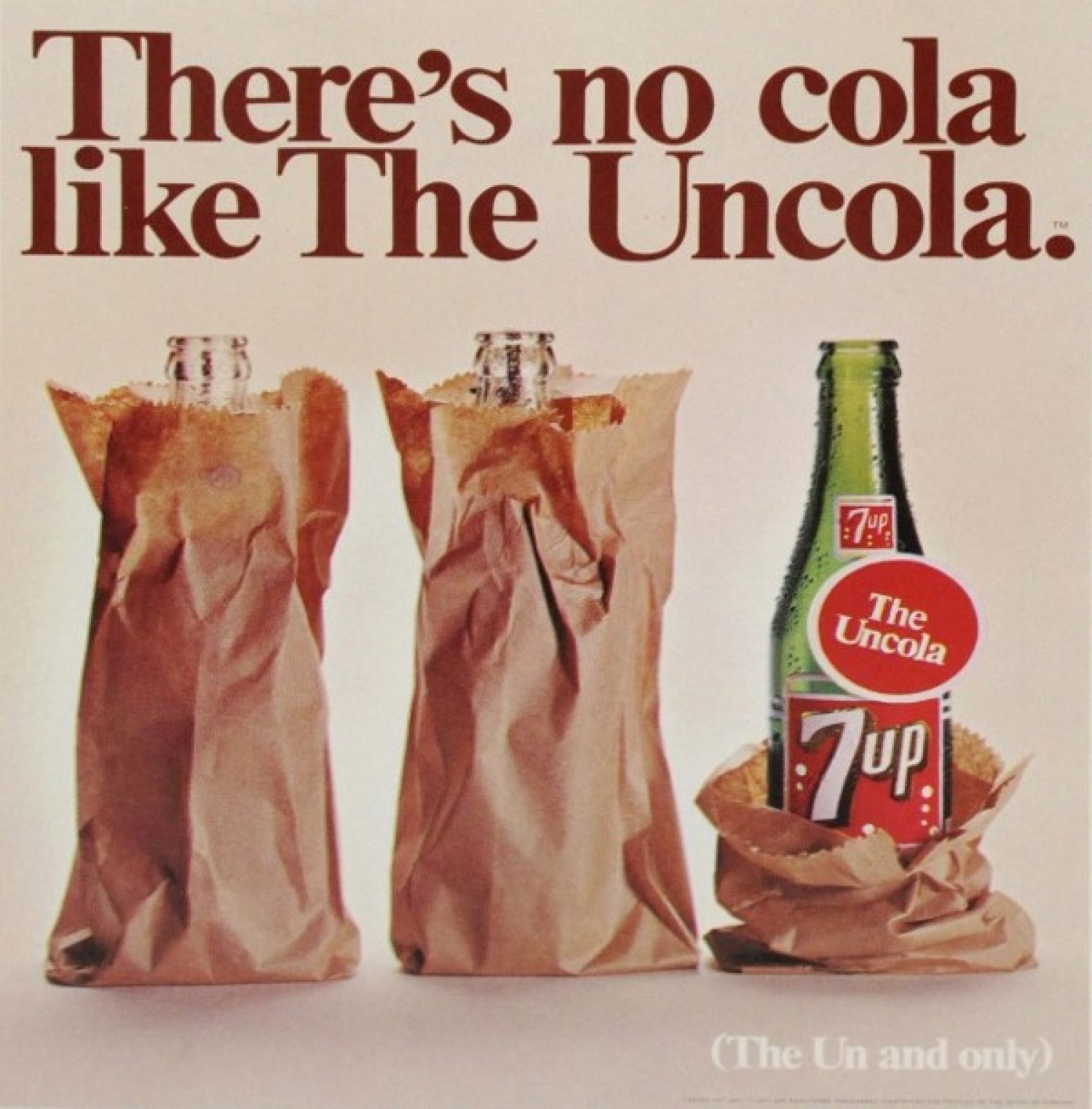
Pictured: A 7UP “Uncola” advertisement using the line “There’s no cola like The Uncola.” The broader “Uncola” campaign featured Geoffrey Holder in television advertising from the late 1960s through later decades and was designed to highlight 7UP’s difference from cola flavoured soft drinks.
This analysis is important because there’s little doubt that Commonwealth Bank modelled its Unloan product on the back of the Uncola campaign. Unloan is the opposite of Commbank.
That move is more powerful than ordinary differentiation. A standard differentiator might have said 7UP is lighter, clearer, crisper, lemon and lime flavoured, caffeine free, or more refreshing. Those are product attributes. They may be useful, but they still leave the consumer comparing soft drinks inside a familiar category. “The Uncola” did something sharper. It created an oppositional frame. The user was no longer asked to choose between cola brands. They were asked to consider whether they wanted cola at all.
This is category rejection. It works when the dominant category has become so familiar that its strengths also create fatigue. Cola was powerful because it was established, recognisable, heavily advertised, culturally embedded, and visually distinctive. But that same dominance created an opening. If cola represented the mainstream, 7UP could represent the alternative. If cola was brown, 7UP was clear. If cola was heavy, 7UP was light. If cola was the expected choice, 7UP became the self aware choice. The position did not require the product to be better on every measure. It required the product to be meaningfully outside the dominant comparison.
Mortgage brokers should study this carefully because the finance market is crowded with dominant categories that borrowers accept without interrogating them. Banks are one category. Rate comparison sites are another. Lead forms are another. Online loan marketplaces are another. Franchise broker groups are another. Generic “we compare lenders” brokers are another. Most broker advertising tries to win inside these categories. It says, “we compare many lenders”, “we find competitive rates”, “we make it easy”, “book a free appointment”, or “speak to an expert”. The problem is that every competitor can say the same thing.
The Uncola lesson is to stop competing as another version of the same thing. A broker can position against the dominant category by defining what they are not. Not a bank. Not a call centre. Not a rate site. Not a generic comparison table. Not a lead form. Not a one-page landing page. Not a transaction shop. Not a broker who disappears after settlement. But this only works if the broker then defines the superior alternative. “Not a bank” is weak if it merely becomes anti-bank rhetoric. “Not a rate site” is weak if the broker provides no better comparison experience. Category rejection must be paired with category creation.
That is the deeper mechanism behind “The Uncola”. 7UP did not simply say, “we are not cola.” It made “not cola” desirable. It gave the alternative a name, a personality, and a visual identity. The term “Uncola” was not a technical descriptor. It was a positioning weapon. It made the difference memorable. It turned absence into identity. 7UP did not lack cola flavour; it possessed Uncola status.
Brokers need the same discipline. “We are not like other brokers” is not enough. That is vague and self-serving. The broker must name the alternative category with substance. A business might position as a guided borrowing environment rather than a lead form. A decision support platform rather than a rate shop. A property finance education hub rather than a brochure website. A partner enabled advice pathway and education platform rather than an ad hoc referral arrangement. A refinance intelligence framework rather than a basic lender comparison. The words matter because they shape the frame through which the user interprets the business.
The Uncola strategy also works because it simplifies choice. Consumers are often overwhelmed by similarity. When every option appears to belong to the same category, the user defaults to familiarity, price, convenience, or brand memory. Category rejection interrupts that default. It says, “This is not another version of what you are already comparing.” That interruption is valuable because it gives the user a reason to pause.
The Uncola strategy also works because it simplifies choice. Consumers are often overwhelmed by similarity. When every option appears to belong to the same category, the user defaults to familiarity, price, convenience, or brand memory. Category rejection interrupts that default. It says, “This is not another version of what you are already comparing.” That interruption is valuable because it gives the user a reason to pause.
In mortgage advertising, that pause is commercially important. Borrowers often assume they understand the choice before they have properly examined it. They think their bank will look after them. They think the lowest displayed rate is the answer. They think a comparison website has done the work. They think a quick online form equals advice. They think all brokers are broadly similar. A strong broker position should interrupt those assumptions. It should make the user consider that the category they were using to evaluate options may be inadequate.
This is not negativity. It is reframing. There is a difference between attacking competitors and changing the comparison. A crude campaign says, “banks are bad” or “comparison sites are useless.” A sophisticated campaign says, “A loan is not just a rate. It is a structure, policy decision, servicing outcome, lender relationship, repayment pathway, and long-term financial commitment. You need interpretation, not just information.” That reframes the category. It makes ordinary comparison feel incomplete without sounding bitter.
The Uncola campaign also demonstrates the value of contrast. Contrast is one of the strongest tools in positioning because the human mind understands difference more easily than abstraction. Clear versus brown. Light versus heavy. Alternative versus mainstream. Uncola versus cola. These are simple contrasts. They make the position easy to process.
Brokers should use contrast more intelligently. Generic claims such as “great service” or “tailored solutions” are weak because they lack a sharp opposite. But “interpretation, not just comparison” has contrast. “Guided decision making, not just a callback” has contrast. “Borrowing clarity before a sales conversation” has contrast. “A website that answers, not just collects leads” has contrast. “Post settlement relationship, not transaction and goodbye” has contrast. These contrasts create mental separation.
The mistake is to create artificial contrast. A broker should not invent a false enemy or exaggerate a competitor weakness. The contrast must be anchored in a real market problem. Rate sites often provide information without advice. Banks generally promote their own products. Lead forms often collect details before creating value. Generic broker websites often ask for contact before demonstrating expertise. These are legitimate category weaknesses. A broker can position against them by building and proving a better model.
This is where the website becomes the evidence. If the broker says they are not a generic lead form, the website must do more than collect contact details. It should educate, compare, segment, guide, calculate, return useful information, offer relevant next steps, and adapt to behaviour. If the broker says they are not a rate site, the experience must explain why rates are only one part of the decision. If the broker says they are not a bank, the site must demonstrate lender choice, advocacy, and independent interpretation. Category rejection without operational proof is theatre.
7UP’s product made the position visible. It was clear. It looked different from cola. It tasted different from cola. It carried a different sensory expectation. The advertising did not have to invent every part of the distinction because the product itself supported it. Brokers need the same alignment. If the business claims to be meaningfully different, the difference must be visible before the appointment. Otherwise, the claim collapses under inspection.
That means the advertising, landing page, website, form, video, email, SMS, retargeting, and follow up must all support the new category. A broker cannot say “we are not a generic broker” and then send users to a generic page. A broker cannot say “we provide clarity” and then hide all useful information behind a callback. A broker cannot say “we are technology led” and then present the same static enquiry form as everyone else. The experience must embody the position.
The Uncola campaign is also a warning against weak imitation. Many businesses see category rejection and interpret it as clever language. They try to create a catchy anti-category phrase without building the underlying distinction. That is fragile. A phrase can create attention, but the business model must create belief. If 7UP had looked, tasted, and behaved exactly like cola, “Uncola” would have been nonsense. The term worked because it condensed a real difference into memorable language.
For brokers, the equivalent is not to invent a slogan first. The position should come from the model. What does the business genuinely do differently? Does it have deeper education? Better funnel architecture? Smarter forms? More useful comparison assets? Stronger partner infrastructure? Better post settlement care? More advanced database segmentation? More visible adviser expertise? A more serious local property framework? A clearer process for first home buyers, investors, refinancers, or self employed borrowers? The language should crystallise the advantage that already exists or is deliberately being built.
The psychological advantage of category rejection is that it gives the user permission to step away from the default choice. Defaults are powerful. People often stay with their bank because it is familiar. They accept generic rates because shopping feels difficult. They submit to comparison sites because they appear convenient. They delay action because finance feels complex. A strong alternative category reduces the emotional cost of changing behaviour. It gives the user a new script: “I am not just shopping for another loan. I am looking for a guided decision.”
This is especially useful in finance because borrowers often need a justification for taking action. Refinancing, reviewing debt, challenging a bank, seeking preapproval, restructuring investment loans, or discussing borrowing capacity can feel like effort. Category rejection helps by naming the inadequacy of the old behaviour. “Do not just accept your lender’s offer.” “Do not reduce your decision to a rate table.” “Do not enter an auction without finance clarity.” “Do not treat a first home purchase like a form submission.” These are not just advertisements. They are behavioural prompts.
The danger is that category rejection can become exclusionary if handled poorly. “Uncola” worked because it gave consumers a choice; it did not require them to hate cola. A broker should use the same restraint. The objective is not to ridicule people who use banks, comparison sites, or simple forms. The objective is to show that a more serious borrowing decision deserves a better pathway. The tone should be confident, not contemptuous. The user should feel invited into a better category, not shamed for having considered the old one.
This matters because finance is a trust category. Aggressive positioning can create attention, but it can also reduce perceived safety. Borrowers are cautious, and rightly so. They do not want a broker who sounds reckless or ideological. They want a broker who can explain why the old frame is insufficient and why the new frame is more useful. The distinction is subtle but critical. Strong positioning educates the user into a new comparison. Weak positioning merely attacks the old one.
The Uncola campaign also shows how visual presentation supports positioning. The bottle, the clear liquid, the green identity, the countercultural tone, and the distinctive language all reinforced separation. The campaign did not look like a cola advertisement with a different logo. It looked like an alternative. Brokers often fail here. They claim to be different while using the same stock images, same family on couch photography, same key handover images, same “dream home” language, same contact forms, and same generic broker claims. Visual sameness undermines verbal difference.
A broker who wants to position against the ordinary category needs visual and structural evidence. A cleaner page. Better typography. More useful calculators. Real adviser video. Screenshots of actual tools. Stronger article depth. Specific resource libraries. Real process diagrams. Client pathways that make sense. Partner pages that feel professional. A comparison engine that looks credible. A website that feels like an operating system rather than a brochure. The presentation should make the position obvious.
There is a direct advertising application. A campaign based on category rejection should identify the dominant category, expose its limitation, name the better alternative, and send the user into an experience that proves it. For example, a refinance campaign might reject lender loyalty as the default category: “Your bank does not review your loan because it loves you. It reviews your loan when it has to.” The alternative is a structured refinance review. A first home buyers campaign might reject the generic pre approval form: “Pre approval is not a strategy. It is one step in a larger buying plan.” The alternative is a guided readiness pathway. A rate comparison campaign might reject raw rate shopping: “The lowest rate is only useful if the loan is suitable, approved, and structured correctly.” The alternative is interpreted comparison.
This is not merely advertising language. It is positioning architecture. The campaign creates the contrast. The page explains the frame. The form collects relevant context. The result or response gives value. The follow up continues the education. Retargeting reinforces the new category. The website supports the broader proof. The user is moved from old thinking to new thinking through a controlled environment.
The strongest broker application of the Uncola principle may be this: stop positioning as a broker and start positioning as the alternative to inadequate finance decision making. That is much broader and more powerful. The broker is not merely another intermediary between borrower and lender. The broker becomes the mechanism by which the borrower escapes poor comparison, lender inertia, product confusion, and generic advice. That is a more valuable role.
7UP’s “Uncola” campaign matters because it showed that a brand can win by refusing the dominant category rather than competing obediently inside it. It did not say “better cola”. It said “not cola”. For mortgage brokers, the lesson is profound. Do not merely become another broker promising service, choice, and competitive rates. Build a category the market can understand: guided advice, decision clarity, intelligent comparison, education first borrowing, partner supported finance, or technology led mortgage strategy. The point is not to be different for decoration. The point is to make the old category feel inadequate and the new category feel obvious.
Volvo, Safety as the Ultimate Positioning Asset
Volvo is one of the strongest examples of positioning because it did not merely advertise safety. It became safety. Many car manufacturers have safety features. Many can point to airbags, braking systems, crash ratings, structural engineering, driver assistance, and accident prevention. But Volvo turned safety into the central organising meaning of the brand. In the buyer’s mind, Volvo did not sit beside safety. Volvo became shorthand for safety.

Pictured: A Volvo safety advertisement using the headline, “We design every Volvo to look like this.” The advertisement shows a Volvo with front and rear crash damage while the passenger compartment remains visibly intact.
That is the highest form of positioning. A brand does not simply claim a benefit; it owns the mental category. When a buyer thinks about the risk of carrying children, protecting family, surviving a crash, or choosing responsibility over spectacle, Volvo has historically been one of the first names that appears. That is not accidental. It is the result of repeated product truth, design decisions, advertising consistency, engineering proof, and cultural reinforcement over decades.
Aussie Home Loans: It could be argued that Aussie Home Loans owned the mortgage industry in the 1990s. Many mortgage brokers often had difficulty explaining what they did and who they were in a market where over 85% of borrowers went directly to a bank, so they'd often default to "we've like Aussie and do the same thing". Through a number of changes, the growth of the industry, owership shifts that came with branding dilution, and a lesser focus on marketing failed to properly preserve that position.
The advertisement is powerful because it does not show a perfect car. It shows a damaged car. That is strategically unusual. Most automotive advertising shows polished paint, beautiful roads, aspirational landscapes, speed, glamour, comfort, design, or status. This ad shows impact. It shows deformation. It shows the product after violence. The point is not that the car is untouched. The point is that the right parts of the car are damaged and the right part is preserved. The crumpled front and rear are not presented as failure. They are evidence of design intelligence.
That is what makes the headline so strong: “We design every Volvo to look like this.” It reframes crash damage as proof of competence. A normal viewer might see a ruined vehicle. Volvo asks them to see a lifesaving design principle. The damage becomes the advertisement. That is sophisticated positioning because it changes the interpretation of what the user is looking at. The car is not ugly because it is damaged. It is beautiful because the structure has done its job.
The mortgage broker equivalent is immediate. Finance is not a glamour category. It is a risk category. Borrowers are not simply trying to buy a loan. They are trying to avoid harm: overpaying, being declined, choosing the wrong structure, misunderstanding policy, trusting the wrong lender, missing settlement, mishandling fixed rate expiry, accepting unsuitable debt, or carrying repayment stress they did not properly understand. A broker who understands this can position around decision safety, not merely service.
Decision safety is one of the most powerful positioning territories available to a mortgage broker. It is broader than rate comparison and more meaningful than speed. It says: “Our role is to help you make a safer, better informed borrowing decision.” That position can support refinance, first home buyers, investors, self employed borrowers, construction clients, debt consolidation, bridging, SMSF lending, and professional borrower segments. The common theme is not the product. The common theme is protection through clarity.
Volvo’s safety position was credible because it was supported by engineering history. Volvo engineer Nils Bohlin developed the modern three-point seat belt while working for Volvo, and Volvo introduced it as standard equipment in 1959. The company also made the design available to other car manufacturers, a decision that strengthened the moral authority behind the brand’s safety position.
That proof is critical. Volvo could advertise safety because it had product substance underneath the claim. The brand was not merely using fear. It was pointing to engineering, design, testing, and real world survival logic. For brokers, the same standard applies. A broker cannot credibly position around decision safety if the business provides a thin website, generic forms, shallow articles, vague comparison language, and slow follow up. The claim must be supported by infrastructure. If the broker says they help borrowers make safer decisions, the website must educate, compare, explain, qualify, route, document, follow up, and reduce uncertainty.
This is where most broker differentiation fails. Many brokers say they provide “trusted advice”. That is not enough. Trust must be operationalised. What does the borrower actually receive that makes the decision safer? A written comparison? A borrowing summary? A lender policy explanation? A repayment stress discussion? A fixed rate expiry review? A deposit readiness pathway? A property report? A staged first home buyers sequence? A construction finance checklist? A structured post settlement review? A clear explanation of trade-offs? A transparent next step? These are the equivalents of engineering evidence. They make the position visible.
Volvo also demonstrates the power of sacrifice in positioning. To own safety, Volvo could not simultaneously lead with every possible automotive fantasy. It did not position primarily around glamour, speed, luxury, youth, rebellion, or status. Those territories belonged elsewhere. Volvo’s strength came from discipline. It accepted that safety would define the brand more strongly than other attributes. That focus created memory.
Brokers struggle with this because they want to claim everything. They want to be fast, personal, experienced, low rate, high service, local, national, technology led, family friendly, investor focused, refinance strong, first home buyer friendly, award winning, specialist, broad panel, and easy to deal with. This accumulation does not create authority. It creates blur. Volvo teaches the opposite: choose the mental territory that matters, support it relentlessly, and allow other benefits to sit underneath it rather than compete with it.
The mortgage broker who positions around decision safety can still talk about rates, lender choice, speed, service, technology, and experience. But those points become supporting evidence, not competing claims. Lender choice supports safety because it reduces dependence on one institution. Technology supports safety because it improves comparison and reduces friction. Education supports safety because it makes the borrower more informed. Follow up supports safety because it prevents confusion and delay. Reviews support safety because they demonstrate prior trust. The position organises the differentiators.
The advertisement’s visual logic is also important. Volvo does not merely say “safe”. It shows the consequence of safety engineering. The image carries the argument before the reader processes the copy. Mortgage brokers should learn from this. Abstract trust claims are weak. Visible proof is stronger. A broker’s advertising and website should show the mechanisms that create safety: comparison tables, report outputs, assessment pathways, video explanations, structured forms, lender summaries, process diagrams, education libraries, review checkpoints, partner resources, and post settlement care. The user should see the system and think, “This is more serious than a basic callback.”
There is also a strong psychological reason safety positioning works in finance. Borrowing is high consequence and low familiarity. Most borrowers do not arrange mortgages often enough to feel expert. They know the decision matters, but they do not always know which details matter. This creates anxiety. Anxiety increases the value of a guide. A broker who positions around decision safety is not simply selling access to lenders; they are selling protection against uncertainty.
That does not mean fear-based advertising. This distinction is critical. Volvo did not need to terrify the buyer with graphic injury. It showed a damaged car and a protected cabin. The emotion is controlled. The message is serious but not hysterical. Brokers should follow the same rule. Do not exploit borrower fear. Clarify the risk and present the protection. “Your fixed rate expiry may create repayment shock; here is a structured review pathway.” “A low rate can still be the wrong loan if the policy, fees, structure, and future plans are misaligned.” “Pre approval is not the same as purchase readiness.” “Debt consolidation can reduce pressure, but only if the structure is understood.” These messages are responsible because they define risk and offer a path to clarity.
Volvo’s position also created a premium logic. Safety allowed the buyer to justify paying for something more serious than a commodity. This matters for brokers because weak positioning pushes the business toward price competition. If the broker is perceived only as someone who finds a rate, the borrower will compare them against banks, comparison sites, and other brokers on speed and price. If the broker is positioned as a decision safety system, the comparison changes. The borrower is not merely buying a loan search. They are seeking guidance through a high consequence decision.
This is especially valuable in complex lending. Self-employed borrowers, investors, business owners, construction clients, SMSF borrowers, bridging clients, and clients with unusual income or property circumstances do not simply need “a good rate”. They need interpretation. They need someone to identify policy risk, servicing risk, timing risk, documentation risk, repayment risk, and structural risk. Safety positioning gives the broker permission to speak with authority about complexity rather than collapsing the conversation into price.
The Volvo model also has an ethical advantage. Safety is a client centred position. It is not built around the broker’s ego. It does not say “we are the best” or “we are number one”. It says the client’s protection matters. In finance, this is a more durable and defensible posture than empty superiority claims. The strongest broker positioning often begins with the client’s risk, not the broker’s greatness.
However, safety positioning imposes obligations. A broker who claims decision safety must be disciplined with compliance, documentation, suitability, communication, and expectation management. The business cannot use reckless claims. It cannot imply guaranteed approval. It cannot overstate savings. It cannot hide assumptions. It cannot use comparison selectively or carelessly. The position demands rigour. That is exactly why it can be powerful. Difficult positions are harder for competitors to copy because they require operational maturity.
Volvo also shows that positioning compounds through repetition. One safety advertisement would not have created Volvo’s safety reputation. The reputation came from decades of alignment between product, advertising, public perception, and innovation. Volvo’s safety milestones include the 1959 three-point seat belt, earlier laminated glass, and later developments such as rear facing child seat prototypes and booster cushions, all of which reinforced a safety-first market meaning over time.
Mortgage brokers should not expect one campaign to create a position. A decision safety position must appear everywhere. The refinance page should explain decision risk. The first home buyers page should reduce uncertainty. The investor page should discuss structure. The video library should clarify common mistakes. The comparison engine should show more than rates. The forms should collect the information needed to guide the user properly. The follow up should continue the safety narrative. The post settlement program should prove ongoing care. Positioning is not a slogan. It is cumulative proof.
The best broker application might be expressed this way: “Borrowing is too important to be treated as a form submission.” That sentence reframes the category. It implies that ordinary lead capture is insufficient for serious finance decisions. It gives the broker permission to build a more comprehensive pathway: education, guided forms, comparison, lender interpretation, video explanation, calendar integration, and post settlement review. This is the finance equivalent of Volvo showing the crash structure. It turns process into proof.
Safety positioning also helps a broker avoid gimmick advertising. Cashback offers, rate hooks, urgency claims, and “quick approval” messages may create short term attention, but they do not necessarily build long term trust. A broker positioned around decision safety can still advertise specific offers, but the offers must sit inside a broader advisory frame. A refinance review is not just “save money”; it is “understand whether your current loan is still suitable.” A first home buyers guide is not just “buy sooner”; it is “know what you can safely do before you commit.” A debt consolidation campaign is not just “lower repayments”; it is “understand the cost, structure, and consequences before rolling debt into your home loan.”
The Volvo advertisement is also a lesson in making the invisible visible. Safety engineering is often invisible until a crash occurs. The ad makes it visible by showing the aftermath. Mortgage advice is similarly invisible. A borrower may not understand the value of policy interpretation, structure, documentation, servicing, lender selection, or post settlement planning until something goes wrong. The broker’s marketing must make invisible advisory value visible before the mistake happens. That is the heart of positioning.
This can be done through examples, case studies, calculators, comparison summaries, scenario explanations, decision trees, guided forms, and video. Show the borrower what can go wrong. Show how the broker identifies it. Show the structure used to prevent it. Show the thinking behind the recommendation. Show why the cheapest rate is not automatically the safest decision. Show why preapproval is not the end of readiness. Show why fixed rate expiry requires planning before the cliff arrives. The business must externalise its expertise.
The final lesson is that safety is not a soft position. It is commercially hard. It changes the value equation. It gives the broker permission to be serious, thorough, structured, and premium. It attracts borrowers who respect judgement. It supports compliance. It strengthens content. It makes video more useful. It gives partners confidence. It makes database campaigns more responsible. It makes retargeting more helpful. It gives the website a reason to be deeper than a brochure.
Volvo’s safety positioning is powerful because it joined product truth, engineering proof, advertising discipline, and emotional relevance into one durable market idea. The damaged car in the advertisement is not a failure; it is proof that the system worked. Mortgage brokers should understand the parallel. The strongest broker positioning will not come from saying “great service” or “competitive rates”. It will come from proving that the business helps borrowers avoid poor decisions, understand risk, compare properly, and act with confidence. In a category where the wrong choice can cost a client for years, decision safety is not a slogan. It is one of the most valuable positions a broker can own.
FedEx, Urgency, Certainty, and the Positioning of Mission Critical Service
FedEx is one of the strongest examples of positioning because it did not merely advertise speed. It owned urgency. The famous line, “When it absolutely, positively has to be there overnight,” positioned Federal Express around the moment when delivery failure was not acceptable. That is materially different from saying “fast delivery”, “reliable shipping”, or “overnight service”. Those are service attributes. FedEx positioned itself around consequence. The package mattered. The deadline mattered. The sender could not afford uncertainty.

Pictured: A Federal Express advertisement using the line, “When it absolutely, positively has to be there overnight.”
That distinction is central. Speed is a feature. Certainty is the position. A company can be fast and still feel risky. A company can promise overnight delivery and still sound like a commodity. FedEx made the buyer feel that the service existed for the high stakes moment: the contract, proposal, document, medical item, legal paper, business material, or urgent package that had to arrive. The slogan worked because it captured an emotional state as much as a logistical promise. It spoke to the sender’s anxiety: “This must get there.”
The historical business model supported the claim. Federal Express began overnight operations in April 1973 with 14 Dassault Falcon 20 aircraft connecting 25 United States cities, and it carried 186 packages on its first night of operation. Its early concept was built around one carrier controlling the package from pickup through delivery, using its own aircraft, depots, sorting system, and delivery network. That matters because the advertising was not floating above the business. The promise was operational. FedEx could position around certainty because it had built a system designed to deliver certainty.
This is the mortgage broker lesson. Brokers often advertise speed, rates, lender panels, and service. These are useful, but they are rarely enough to create a durable position. A stronger broker position is built around the high stakes lending moment. Settlement cannot be missed. Auction finance cannot be vague. Fixed rate expiry cannot be ignored until the repayment cliff arrives. Construction finance cannot be loosely managed. Bridging finance cannot be treated casually. A self-employed borrower cannot be assessed through generic assumptions. A first home buyer cannot be left to guess whether they are truly ready. The broker who owns these moments is not selling “home loans”. They are selling certainty when uncertainty is dangerous.
The FedEx line is powerful because it defines the use case with precision. It does not say “for all packages”. It says “when it absolutely, positively has to be there overnight.” That phrase immediately separates routine from critical. Some letters can arrive later. Some parcels are low consequence. But some deliveries are mission critical. FedEx owned that moment. A broker should think the same way. Not every borrower needs the same level of urgency, structure, or complexity management. But some lending scenarios are mission critical, and the broker can position around those moments with authority.
This is where many brokers weaken their advertising. They try to speak to every borrower with the same message: “We can help with your home loan.” FedEx did the opposite. It focused on the moment of pressure. For brokers, pressure moments are commercially rich because the borrower is more likely to recognise the need for expertise. A borrower approaching settlement does not want vague service. They want process certainty. A borrower whose fixed rate is expiring does not want generic rate commentary. They want a clear review pathway before the new repayment lands. A buyer attending auction does not want a motivational slogan. They want finance confidence. A construction client does not want a friendly callback. They want sequencing, documentation, lender policy awareness, and progress payment discipline.
The positioning principle is simple: own the moment where failure has consequences. That is far more powerful than owning a vague category. “Mortgage broker” is a category. “Settlement certainty for complex purchases” is a position. “Home loan help” is a category. “Fixed rate expiry review before repayment shock” is a position. “Business finance” is a category. “Urgent lending support when timing, documents, and lender appetite matter” is a position. The narrower the moment, the more meaningful the message becomes.
FedEx also shows how a business can make process feel emotionally valuable. Logistics is mostly invisible when it works. Sorting, routing, scanning, aircraft scheduling, hub design, dispatch, tracking, and delivery discipline are operational details the customer may never see. The advertisement converts that invisible infrastructure into emotional assurance. The user does not need to understand every moving part. They need to believe the system will work when it matters.
Mortgage broking has the same challenge. Much of the broker’s real value is invisible before something goes wrong. Lender policy interpretation, servicing assessment, documentation review, loan structure, timing control, escalation, application packaging, repricing, approval conditions, valuation management, and settlement coordination are not always visible to the borrower. Advertising must make this invisible value visible. The broker should not simply claim “we handle the process”. They should show the process, explain the risk, and demonstrate how the business reduces uncertainty.
This is why FedEx’s positioning should not be reduced to speed. Speed alone creates a dangerous advertising model in finance. A broker who promises speed without qualification risks attracting poor fit clients, creating unrealistic expectations, and weakening compliance discipline. The correct lesson is not “be the fastest broker”. The correct lesson is “define the critical moment and prove you have the system to manage it.” Speed may support the position, but certainty is the higher value.
FedEx later became associated with package tracking and logistics technology. The company launched its first online package tracking capability in 1994, and the tracking number itself became a major part of the customer experience by making movement visible. This is highly relevant to brokers because visibility reduces anxiety. A borrower waiting on finance approval is not just waiting on an outcome. They are living inside uncertainty. The opaquer the process, the greater the anxiety. A broker who gives the borrower visible progress, clear milestones, documented next steps, and structured communication is not merely providing service. They are reducing emotional risk.
A broker can therefore learn two positioning lessons from FedEx. First, own the moment when certainty matters. Second, make the process visible enough that the client can trust the system before the result arrives. In practical terms, this means structured application pathways, milestone-based communication, clear documentation requirements, fast acknowledgement, useful email and SMS updates, client dashboards where appropriate, calendar integration, and explanations that tell the borrower what is happening and why.
The FedEx model also applies to advertising offers. A weak offer says, “Speak to a broker today.” Stronger high stakes offer says, “Review your fixed rate before expiry.” “Check your borrowing position before auction.” “Get settlement ready before you sign.” “Understand your construction finance pathway before committing to a builder.” “Clarify your self-employed borrowing position before applying.” These offers work because they attach to a moment where delay, confusion, or poor structure can carry real consequences.
The psychology is different from ordinary lead generation. The user is not being asked to enquire casually. They are being asked to reduce risk. That changes the emotional frame. A borrower may ignore a generic broker ad because it feels optional. They are less likely to ignore a campaign that describes a real decision deadline or consequence they are already facing. FedEx did not create urgency out of nothing. It attached itself to urgency that already existed. Brokers should do the same.
This is also why the phrase “absolutely, positively” matters. It intensifies certainty. It creates a rhythm of refusal: no ambiguity, no softness, no half promise. The words are memorable because they sound like the customer’s internal demand. When a deadline matters, the sender does not think, “I would prefer this to arrive promptly.” They think, “This absolutely has to be there.” Strong positioning often borrows the language of the user’s internal pressure.
Mortgage brokers should listen for equivalent borrower language. “I cannot miss settlement.” “My fixed rate is about to expire.” “I need to know before auction.” “The bank is taking too long.” “I do not know if I can borrow enough.” “I am self-employed and nobody gives me a straight answer.” “We have signed with the builder and need to know what happens next.” These phrases are campaign assets. They reveal the emotional pressure the broker can own.
FedEx also demonstrates that a premium position can emerge from reliability rather than glamour. Overnight delivery is not glamorous in the conventional sense. It is valuable because the consequence of failure is high. Mortgage broking is similar. The best broker positioning does not always need lifestyle imagery, aspirational family photography, or emotional clichés about dream homes. In many lending scenarios, the more powerful position is competence under pressure. The borrower wants someone serious, organised, responsive, and capable of navigating the system.
This kind of positioning supports stronger advertising because it is grounded in operational reality. A broker can show deadlines, process maps, document checklists, milestone sequences, lender assessment steps, application timelines, and scenario-based guidance. These assets are less decorative than generic lifestyle imagery, but they create more trust. Serious borrowers often respond to serious evidence.
There is also a compliance advantage. High stakes positioning does not require reckless claims. A broker does not need to say, “guaranteed approval” or “we will settle your loan no matter what.” That would be dangerous. The position can be framed responsibly: “When timing matters, process matters.” “Before you bid, understand your finance position.” “Before your fixed rate expires, know your options.” “Before you sign a building contract, understand how construction finance works.” These messages create urgency without overpromising outcomes.
FedEx’s positioning also illustrates the relationship between advertising and operational culture. A company cannot credibly sell certainty unless the internal system is built around reliability. The same applies to brokers. A broker cannot advertise high stakes lending support if calls are missed, forms are generic, documents are unmanaged, follow up is slow, calendars are disconnected, and clients are left uncertain. The position must discipline the business. If the claim is certainty, the operation must be organised around certainty.
That is why positioning is not merely a marketing decision. It becomes a business standard. A broker positioned around urgent, high consequence lending must define service levels, response standards, communication sequences, escalation processes, document handling, client education, and post enquiry actions. Advertising creates the expectation. The business must fulfil it.
The relevance is significant. FedEx gives brokers a way to understand advertising as promise architecture. The advertisement should not merely attract attention. It should define the risk, identify the moment, establish the business as the appropriate guide, and send the user into a funnel that proves the promise. If the ad says the moment matters, the landing page must explain why. The form must collect relevant context. The response must be immediate. The follow up must preserve urgency. The retargeting must reinforce the decision. The website must show the infrastructure. Anything less weakens the position.
This is especially important in broker campaigns around fixed rate expiry, auction readiness, urgent refinance, purchase deadlines, bridging, construction, and complex income. These are not casual browsing scenarios. The borrower’s tolerance for uncertainty is lower. The business that can demonstrate control, discipline, and clarity will be more persuasive than one that simply advertises “competitive rates”.
The final lesson is that FedEx did not position around the package. It positioned around the consequence of the package arriving. Mortgage brokers should not position around the loan alone. They should position around the consequence of the borrowing decision. A loan is not paperwork. It affects cash flow, settlement, family stability, investment strategy, business plans, repayment resilience, and long-term financial confidence. The broker who can connect advertising to those consequences will always have a deeper position than the broker who advertises only rates.
FedEx became powerful by owning the moment when delivery uncertainty was unacceptable. The slogan worked because it fused urgency, consequence, and operational proof into one promise. Mortgage brokers can apply the same principle by owning lending moments where uncertainty is costly: before auction, before settlement, before fixed rate expiry, before construction, before refinance, before application, before a major financial commitment. The broker’s position should not be “we are fast”. It should be “when the borrowing decision matters, our process gives you clarity, control, and confidence.” That is FedEx level positioning translated into finance.
De Beers, “ A Diamond Is Forever” and the Positioning of Cultural Meaning
De Beers is one of the most important positioning examples because it did not merely sell diamonds. It changed what diamonds meant. That is the highest level of commercial positioning. A diamond is a stone. It has physical qualities: hardness, brilliance, scarcity, cut, colour, clarity, carat weight, and price. But the campaign did not win by asking consumers to compare gemstones on technical merit alone. It won by attaching the diamond to romance, permanence, commitment, status, ritual, memory, and emotional proof. The product became a symbol. The symbol became a social expectation.

Pictured: A De Beers “A Diamond Is Forever” print advertisement from the mid twentieth century. The slogan “A Diamond Is Forever” was coined by Frances Gerety while working for N. W. Ayer, and De Beers used it as the foundation of one of the most influential advertising platforms in modern marketing history.
That shift is the central lesson. De Beers did not position diamonds as jewellery. It positioned diamonds as the visible proof of enduring love. “A Diamond Is Forever” is powerful because it connects the physical durability of the stone to the desired durability of the relationship. The line is not only descriptive; it is metaphorical. The diamond lasts, therefore, the love should last. The object becomes a proxy for the promise. That is far more powerful than saying “diamonds are beautiful” or “diamonds are rare”. Beauty can be compared. Rarity can be debated. A promise is harder to substitute.
The campaign also shows how positioning can convert a product into a ritual. The engagement ring was not simply sold as an accessory. It became part of the expected script of commitment. The buyer was not merely choosing jewellery; he was performing seriousness, devotion, financial sacrifice, and social legitimacy. That is why the campaign is both brilliant and ethically complex. It demonstrates the immense power of marketing to shape behaviour, but it also reminds us that positioning can create pressure as well as meaning.
Mortgage brokers need to understand this distinction with care. The lesson is not to manufacture artificial cultural pressure or manipulate people into debt. Finance is too serious for that. The lesson is that home lending also sits inside life rituals and major transitions. A mortgage is rarely just a loan. It may represent leaving rent, buying a first home, forming a family, upgrading, separating, investing, building, relocating, helping children, consolidating pressure, starting again, or preparing for retirement. A broker who advertises only “rates” is speaking at the product level. A broker who understands the life transition is speaking at the meaning level.
This is the gap in most mortgage broker advertising. It treats the loan as the product, when the client experiences the loan as part of a larger emotional and practical event. First home buyers are not simply comparing interest rates; they are seeking permission to enter the property market with confidence. Refinancers are not simply changing lenders; they may be trying to regain control, reduce pressure, challenge lender complacency, or protect household cash flow. Investors are not simply borrowing; they are trying to build a strategy. Separated borrowers are not simply restructuring debt; they may be rebuilding stability. Business owners are not simply seeking finance; they may be protecting growth, cash flow, and family security.
De Beers teaches that the strongest advertising attaches the product to the deeper consequence. The diamond is not merely a diamond. It is permanence. The mortgage is not merely a mortgage. It is access, control, security, progress, strategy, transition, and confidence. A broker who can responsibly connect lending to those deeper meanings will always have more persuasive positioning than a broker who competes only on product mechanics. At its core, a mortgage is a home.
The important word is responsibly. De Beers’ success is historically extraordinary, but it also carries a warning. When marketing creates a social expectation, it can also create anxiety, obligation, and status pressure. Mortgage brokers must not copy that darker side. The role of finance marketing is not to manufacture inadequacy. It is to clarify decisions that already matter. A broker should not make people feel incomplete without a loan, ashamed of renting, pressured into borrowing, or reckless about property. The ethical application is to identify a genuine life moment and provide structure, clarity, and decision support around it.
This makes the De Beers example especially relevant to positioning versus differentiation. A point of differentiation might be “we offer lender comparison”, “we provide fast service”, “we use technology”, or “we explain your options”. Those are useful, but they are not cultural meaning. De Beers’ point of differentiation may have included diamond quality, grading, durability, and rarity. The position was far bigger: diamonds belong to love and permanence. For brokers, the equivalent is to elevate beyond “we compare loans” into a more meaningful market role: we help borrowers make confident property and finance decisions at critical life moments.
The slogan also demonstrates the power of compression. “A Diamond Is Forever” carries product truth, emotional promise, social ritual, and brand memory in four words. That is not because it is short. It is because every word carries strategic weight. A weak mortgage broker slogan often says nothing: “Your dreams, our passion”, “Finance made simple”, “Helping you home”, or “Your trusted local broker”. These lines are generic because they do not own a specific idea. They could belong to anyone. Strong positioning language should compress a distinctive belief about the category.
For a mortgage broker, that belief might be that borrowing is too important to be treated as a form submission. Or that a home loan should be understood before it is accepted. Or that the best loan is not always the lowest advertised rate. Or that property finance is a decision pathway, not a transaction. Or that lender loyalty should be challenged with evidence. The exact words matter less than the strategic discipline: the business must own a meaningful idea that competitors do not express with equal authority.
De Beers also shows that great positioning can make the product resistant to substitution. If the user is merely buying a shiny stone, many alternatives exist. If the user is buying a culturally recognised symbol of commitment, substitution becomes harder. This is the economic power of meaning. It moves the purchase away from pure utility and into identity, ritual, and emotion.
Mortgage brokers cannot and should not try to make themselves irreplaceable through artificial symbolism, but they can make their service harder to substitute by owning a deeper role than “loan arranger”. If the broker is perceived as a rate finder, the borrower can substitute them with another broker, a bank, a comparison site, or a lender call centre. If the broker is perceived as the guide who helps the borrower interpret options, avoid mistakes, prepare properly, manage risk, and act with confidence, substitution becomes harder. The service is no longer just access to lenders. It is judgement.
The campaign also demonstrates how positioning can create a premium frame. A diamond engagement ring is not bought because it is the cheapest symbol available. It is bought because the meaning attached to it justifies the expense. That is the commercial force of symbolic positioning. In mortgage broking, premium logic does not mean charging the borrower unnecessary fees or making finance feel exclusive. It means the broker’s value should not be reduced to a commodity. Advice, structure, interpretation, process, risk management, and confidence are premium forms of value. A business that makes those visible avoids being judged purely against the cheapest lead provider or lowest advertised rate.
The De Beers model also shows why repetition matters. The slogan was not a one campaign trick. It became a long running platform, and Advertising Age later named it the best advertising slogan of the twentieth century. A position becomes strong through disciplined repetition across time, format, audience, and cultural context. It is not enough for a broker to publish one strong campaign and then return to generic advertising. If the business wants to own decision clarity, every page must reinforce decision clarity. If it wants to own refinance authority, every relevant asset must reinforce refinance authority. If it wants to own first home buyer education, the website, videos, forms, emails, and follow up must prove it repeatedly.
This is where De Beers differs from ordinary promotional advertising. A promotion creates a temporary reason to act. A position creates a lasting reason to believe. Mortgage brokers rely too heavily on promotions: cashback, rate drops, lender offers, free reviews, seasonal campaigns, and urgent booking prompts. These can and do work tactically, but they do not create deep market memory unless they are attached to a broader position. A refinance campaign should reinforce the broker’s authority around lender review and repayment control. A first home buyers campaign should reinforce education and purchase readiness. A partner campaign should reinforce professional trust and structured referral pathways. The campaign changes; the position accumulates.
The advertisement also uses aspiration differently from much modern finance advertising. It does not scream urgency. It creates atmosphere. It uses romance, beauty, mystery, permanence, and poetic language to give the diamond emotional weight. Brokers should not imitate the style, but they should understand the principle. Not every campaign should be reduced to a hard conversion demand. Some advertising exists to build meaning, authority, familiarity, and emotional readiness before the user is ready to enquire. Video, education, long form content, partner resources, and retargeting can all perform this role.
In finance, the most useful aspiration is not fantasy. It is confidence. A borrower wants to feel prepared, informed, safe, in control, and properly guided. That is the emotional territory a broker can own ethically. The broker should avoid shallow dream home clichés and instead position around the feeling that matters before a major financial commitment: “I understand my position. I know the risks. I know the next step. I have someone competent guiding me.” That is a stronger and more credible aspiration than lifestyle imagery alone.
The De Beers campaign also has a clear lesson in market creation. It did not merely take demand; it shaped demand. It influenced what people came to expect from an engagement. Mortgage brokers usually operate much more modestly, but they can still shape demand inside their own market. They can teach borrowers to expect more from a broker website. They can teach clients that a rate table is not enough. They can teach first home buyers that preapproval is not a complete strategy. They can teach refinancers that lender loyalty should be reviewed. They can teach partners that referrals should be supported by proper digital infrastructure. They can teach existing clients that finance should be reviewed as life changes.
That teaching role is powerful because education changes the standard by which the user judges alternatives. Once a borrower understands that lender policy, loan structure, repayment type, fees, offset, valuation, serviceability, timing, and future plans all matter, a raw rate comparison looks inadequate. Once a first home buyer understands the stages of readiness, a generic callback form looks thin. Once a partner sees a structured referral pathway, an informal “send me anyone who needs a loan” relationship looks amateur. Education creates a higher expectation. Higher expectations support positioning.
This is the ethical version of the De Beers lesson. Do not manufacture false need. Raise the standard of understanding around real need. A broker should not create insecurity to sell debt. A broker should create clarity so people can make better decisions. That distinction is non-negotiable. Finance marketing has to respect the client’s vulnerability, consequence, and long-term obligation.
De Beers also illustrates the overlap between positioning, point of differentiation, and unique selling proposition. The physical diamond has attributes. The campaign has a proposition. The brand owns a meaning. In broker terms, the attributes might be lender panel, technology, experience, service, content, tools, and partner systems. The proposition might be a specific campaign offer, such as a fixed rate expiry review or borrowing readiness assessment. The position is the larger market meaning: decision clarity, finance confidence, professional guidance, or structured borrowing support. When these layers align, advertising becomes strong. When they blur without discipline, the message becomes generic.
The mortgage broker application is therefore clear. Identify the life moment, define the borrower’s real emotional and practical need, connect the service to that need, and support the claim with visible proof. For first home buyers, the moment is not “loan application”; it is entry into ownership. For refinancers, the moment is not “switch lender”; it is regaining control. For investors, the moment is not “buy property”; it is strategic debt and asset planning. For construction clients, the moment is not “build a house”; it is managing a staged, document heavy financial process without chaos. For separated clients, the moment is not “finance restructure”; it is stability and transition.
De Beers matters because it shows that positioning can move a product from object to symbol, from purchase to ritual, and from attribute to meaning. Mortgage brokers should not copy the manipulation sometimes associated with the campaign, but they should understand its strategic force. A loan is not just a loan in the client’s life. It is attached to family, property, security, pressure, ambition, transition, and risk. The broker who can ethically connect advertising to those meanings will occupy a stronger position than the broker who advertises only rates, panels, and service claims. De Beers made diamonds feel inseparable from commitment. A broker’s opportunity is to make proper guidance feel inseparable from serious borrowing decisions.
Listerine, Problem Ownership and the Commercial Power of Naming the Fear
Listerine is one of the most important positioning examples because it did not merely advertise a product benefit. It owned a problem. That is a different and more powerful strategic move. A mouthwash could have been positioned around freshness, cleanliness, taste, antiseptic protection, oral hygiene, or daily routine. Listerine went deeper. It attached itself to a social fear: bad breath might be damaging your relationships without you knowing it.
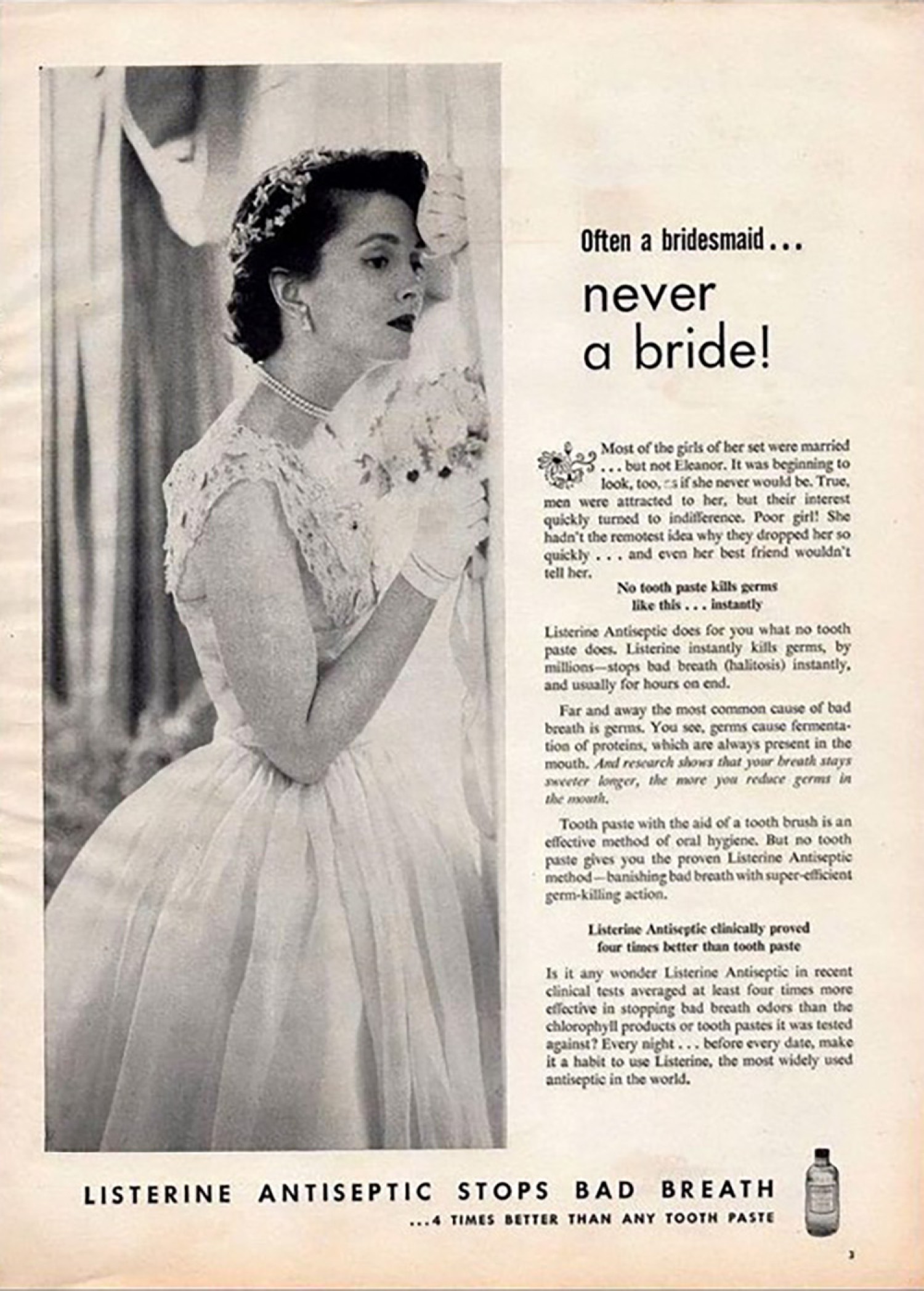
Pictured: A 1950s Listerine advertisement built around the line, “Often a bridesmaid… never a bride!” Listerine itself dates back to 1879, was promoted to dentists for oral care in 1895, and became the first over the counter mouthwash sold in the United States in 1914. Its broader household growth was driven by aggressive marketing under Gerard Lambert, with the brand later becoming closely associated with the line “Kills germs that cause bad breath.”
The advertisement is uncomfortable by modern standards. It uses social anxiety, romantic insecurity, and personal shame with a level of directness that would need far more careful handling today. The headline “Often a bridesmaid… never a bride!” implies that the woman’s failure to marry may be caused by a hidden personal defect. The copy then moves from story to diagnosis to product solution. The mechanism is clear: identify a painful social consequence, reveal an invisible cause, name the problem, then present the product as the corrective ritual.
That is problem ownership. Listerine did not simply say, “Use mouthwash.” It made people think, “Could bad breath be the reason I am being judged, avoided, or rejected?” Once that question exists in the buyer’s mind, the product is no longer optional hygiene. It becomes social protection. This is the psychological shift. The product moves from routine to risk control.
This is why the Listerine example is both strategically powerful and ethically dangerous. It shows how marketing can create urgency by naming a hidden problem. But it also shows how easily that technique can become manipulative when it exploits insecurity. Mortgage brokers should study the mechanism but reject the cruelty. Finance marketing should never manufacture shame. It should identify genuine borrower risks and provide a credible path to clarity.
The mortgage broker equivalent is not to make borrowers feel embarrassed, inadequate, or foolish. The ethical equivalent is to name real problems borrowers already face but may not properly understand: lender loyalty, repayment shock, fixed rate expiry, borrowing capacity confusion, preapproval misunderstanding, deposit uncertainty, unsuitable loan structure, policy mismatch, debt consolidation risk, construction finance complexity, or refinance inertia. These are not invented anxieties. They are real decision risks. The broker’s job is to make them visible before they become expensive.
This is where Listerine becomes useful for broker positioning. Most brokers advertise solutions before the borrower has properly recognised the problem. They say “we can help with your home loan”, “compare your options”, “get a better rate”, or “speak to a broker”. Those messages assume the user already understands why action matters. Listerine did not assume that. It first made the problem vivid. Only then did the product matter.
A broker who understands problem ownership will build campaigns around recognition. The first task is to make the borrower say, “That is me.” A refinancer should recognise the danger of staying loyal to a lender that does not reward existing customers. A borrower approaching fixed rate expiry should recognise the repayment cliff before it arrives. A first home buyer should recognise that preapproval is not the same as purchase readiness. An investor should recognise that holding multiple loans without structure may create unnecessary risk. A self-employed borrower should recognise that income assessment is not straightforward across all lenders. A construction borrower should recognise that staged finance is materially different from an ordinary purchase.
The strongest broker advertising often begins with a named tension. Lender loyalty tax. Fixed rate shock. Borrowing capacity confusion. Deposit uncertainty. Pre-approval false confidence. Rate table blindness. Refinance inertia. Policy mismatch. These labels matter because language gives shape to vague discomfort. A borrower may know something is wrong but not know what to call it. Once the problem has a name, it becomes easier to discuss, search, share, and act upon.
This is exactly what Listerine achieved with halitosis. It gave a social problem a clinical sounding frame and made the product the habitual answer. The history should be handled accurately and carefully: halitosis was not simply invented from nothing, but the campaign helped popularise the term and made bad breath a major consumer problem category. The strategic point is that Listerine gave consumers a vocabulary for an invisible anxiety.
Mortgage brokers can do the same without manipulation. A borrower may not think, “I am suffering from lender inertia.” They may think, “I have not reviewed my loan in a while.” A borrower may not think, “I am exposed to fixed rate shock.” They may think, “My fixed rate ends soon and I am not sure what happens next.” A borrower may not think, “I have a policy mismatch.” They may think, “My bank said no, but I do not understand why.” Advertising can translate those vague states into clear, useful problems. That is positioning support.
The key distinction is that the problem must be genuine, material, and addressable. Listerine’s older social fear advertising feels harsh because it frames personal rejection as a hygiene failure. Mortgage brokers must not use that model literally. The broker version should be diagnostic, not humiliating. It should say: “This is a common finance issue. It has consequences. It can be reviewed. Here is a structured way to understand your position.” That is ethical problem ownership.
The advertisement also shows the power of invisible risk. Bad breath is socially dangerous partly because the person may not know they have it. The fear is not only the condition; it is the possibility of being unaware. Finance contains the same psychological structure. Borrowers often do not know what they do not know. They may not know their bank is no longer competitive. They may not know their borrowing capacity has changed. They may not know a cheaper rate carries structural trade-offs. They may not know that a pre-approval has limits. They may not know that consolidating unsecured debt into a home loan may increase long term cost if handled poorly. They may not know that the lender most familiar to them may not be the lender best suited to them.
This invisible risk is a legitimate advertising territory when handled responsibly. A broker can say, in effect, “There may be a problem inside your current loan structure, lender position, or borrowing pathway that you cannot easily see without proper review.” That message is far stronger than “get a home loan”. It creates a reason for assessment. It positions the broker as the professional who makes hidden risk visible.
Listerine also demonstrates the commercial value of routine. The product was not positioned as a one off emergency treatment. It became a daily habit. That is important because problem ownership can build repeated use, not just one transaction. For brokers, the equivalent is post-settlement review discipline. A mortgage is not something that should be arranged once and ignored for years. The client’s rate, lender, income, equity, family situation, property value, goals, and risk profile change. A broker can position around ongoing loan hygiene: regular review, repricing checks, annual finance health checks, fixed rate expiry monitoring, investment structure reviews, and life event triggers.
This is one of the strongest broker applications of the Listerine model. Do not only advertise at the point of purchase. Teach the market that home loan review is a responsible routine. Just as oral hygiene became a repeated behaviour, finance hygiene can be framed as an ongoing discipline. That does not mean creating anxiety for its own sake. It means reminding borrowers that neglect has a cost. The phrase “set and forget” should become undesirable in the borrower’s mind. A serious loan deserves review.
The advertisement’s narrative structure is also worth examining. It does not begin with chemistry. It begins with a human story. The woman is socially admired but romantically overlooked. The problem is not introduced as a technical defect; it is introduced through consequence. Only after the emotional problem is established does the copy move to germs, antiseptic action, and product proof. This sequence is still structurally useful: consequence first, mechanism second, solution third.
Mortgage brokers usually reverse this order. They begin with products, lenders, rates, features, panels, accreditations, and service claims. The borrower often does not yet care. A stronger structure begins with consequence. “Your fixed rate expiry may change your household cash flow.” “A low rate can still be unsuitable if the structure is wrong.” “A pre-approval does not guarantee you are auction ready.” “Your current lender may be relying on your inertia.” “Self-employed income is assessed differently across lenders.” Once the consequence is clear, the broker can explain the mechanism and then offer the pathway.
This is not fear mongering when the consequence is real and the solution is educational. It is responsible framing. Consumers do not always act because an issue is technically important. They act when the issue becomes personally relevant. Listerine understood personal relevance with brutal clarity. Brokers should use the lesson with far more care but no less strategic discipline.
The Listerine example also shows why problem ownership can outperform generic benefit advertising. A benefit such as “fresh breath” is pleasant. A problem such as “bad breath may be damaging social relationships” is urgent. A broker benefit such as “we compare loans” is useful. A problem such as “your lender may not be giving you the rate it offers new customers” is more motivating. A benefit such as “we help first home buyers” is pleasant. A problem such as “you may be attending inspections without knowing your true purchase limit” is more immediate. Benefits attract interest. Problems activate behaviour.
The problem must then be resolved through a credible pathway. Listerine could offer a simple action: use the product. Mortgage broking is more complex, so the pathway must be more structured. A problem ownership campaign should not jump straight to “book a call” in every case. It may need a calculator, checklist, property report, fixed rate expiry review form, borrowing capacity assessment, refinance comparison pathway, video explanation, or educational sequence. The broker’s funnel should match the problem.
For example, a campaign around lender loyalty should lead to a current loan review pathway, not a generic contact page. A campaign around fixed rate expiry should ask expiry timing, current rate, loan balance, repayment type, and objectives. A campaign around first home buyer readiness should return staged guidance and direct the user to the next appropriate step. A campaign around self-employed borrowing should explain documentation and lender variance. The problem named in the ad should determine the form, page, result, follow up, and retargeting.
This is where problem ownership becomes positioning rather than a single campaign. If a broker repeatedly names and solves the same class of problems, the market begins to associate the business with that expertise. A broker who consistently educates around fixed rate expiry can become the fixed rate review authority. A broker who consistently explains lender loyalty can become the refinance challenger. A broker who consistently helps first home buyers avoid readiness mistakes can become the first home buyer educator. A broker who consistently interprets complex income can become the self-employed lending specialist. Positioning forms when problem ownership is repeated and proven.
There is also a clear content strategy here. Every named problem should have an article, video, FAQ, calculator, form pathway, email sequence, and retargeting sequence. A problem is not merely an ad headline. It is a content pillar. The broker’s website should become the place where the problem is explained better than anywhere else. That is how advertising and SEO reinforce one another. Paid advertising introduces the problem. Organic content explains it. Forms assess it. Follow up resolves it. Retargeting continues it. The position compounds.
The caution is that finance is a high trust category. Listerine style shame advertising would be reckless and inappropriate if applied bluntly. A broker should never imply that a borrower is stupid, negligent, or irresponsible because they have not reviewed their loan. The tone should be professional: “Many borrowers do not realise…” “A common issue is…” “Before you commit…” “It is worth checking…” “This can be reviewed…” “The right answer depends on your circumstances.” This language creates relevance without humiliation.
Modern compliance expectations also require careful claims. A broker cannot simply say “you are overpaying” unless that can be substantiated. They can say “you may be paying more than necessary” if framed properly and supported by review. They cannot imply guaranteed savings, approval, or suitability. They can invite assessment. The strongest version of problem ownership is not an accusation. It is an invitation to verify.
The mortgage broker should also avoid inventing cute labels that trivialise serious finance. Naming a problem is useful only when the label clarifies. “Lender loyalty tax” can work because it describes a recognisable market behaviour. “Fixed rate shock” can work because it describes a real repayment transition. “Rate table blindness” can work because it explains the risk of looking only at rates. But labels should not become gimmicks. The seriousness of the financial decision must remain intact.
The deepest lesson from Listerine is that positioning can be built by owning the question the user is afraid to ask. “Do I have bad breath?” was uncomfortable and powerful. In mortgage broking, the equivalent questions are: “Is my bank taking advantage of my loyalty?” “Am I actually ready to buy?” “Will my loan still be affordable after my fixed rate ends?” “Could I be declined after I make an offer?” “Is the lowest rate really the best option?” “Am I structuring this investment loan properly?” “Do I understand the long-term cost of consolidating this debt?” “Is my broker or bank showing me the full picture?” These questions are commercially powerful because they already exist in the borrower’s uncertainty.
The broker’s role is to answer them with authority. That is the ethical difference. Listerine’s old advertising intensified anxiety to sell a habit. A broker should reduce anxiety by creating clarity. The campaign may begin with a risk, but it should end with education, assessment, and informed choice. The user should leave feeling more capable, not more ashamed.
The conclusion is direct. Listerine became a positioning case study because it owned a hidden problem and made its product the ritual answer. The campaign shows the force of naming fear, making invisible risk visible, and translating social anxiety into action. Mortgage brokers should not copy the shame, but they should learn the discipline. The strongest broker advertising often begins by naming a real borrower problem more clearly than the market has heard it before. Once the borrower recognises the problem, the broker earns the right to present the pathway. In finance, problem ownership must be ethical, evidence based, and useful. Done properly, it turns vague concern into structured action, and that is where powerful positioning begins.
M&M’s, Tangible Differentiation and the Power of a Demonstrable Advantage
M&M’s is one of the cleanest examples of positioning through tangible differentiation. The line “melts in your mouth, not in your hand” works because it translates a physical product feature into an immediate consumer advantage. The candy shell is not described technically. The user is not asked to care about manufacturing, coating, handling, distribution, shelf stability, or heat resistance. The benefit is expressed in ordinary human terms: you get the pleasure of chocolate without the mess of chocolate. That is exceptionally strong positioning because it turns a small functional distinction into a memorable buying reason.

Pictured: A vintage M&M’s advertisement using the line, “Melt in your mouth - not in your hand!”.
The product history supports the claim. M&M’s came into production in the United States in 1941, and the sugar coating made it possible to carry chocolate in warm climates without melting; the long running slogan became “the milk chocolate that melts in your mouth, not in your hand.” The tagline was introduced in 1949, before becoming one of the most famous consumer product lines in advertising.
The genius is that the difference is physical, visible, and easy to test. Many brands claim superiority in vague language: better taste, better quality, more fun, more enjoyable, more convenient. M&M’s did something more disciplined. It identified a problem inherent in the category: chocolate melts. Then it presented a product mechanism that solved the problem: a hard candy shell. Then it converted that mechanism into a simple consumer promise: chocolate where you want it, not where you do not. This is differentiation with proof built in.
Real differentiation is not merely what a business claims. It is what the customer can experience, verify, or understand quickly. “Great service” is weak because it is abstract. “We care” is weak because it is unprovable at the point of advertising. “We compare lenders” is weak because it is expected of a mortgage broker. “We make finance simple” is weak because every competitor can say it. M&M’s did not say, “We make chocolate more convenient.” It said exactly how the convenience shows up in the user’s hand.
Mortgage brokers should pay close attention to this. Most broker differentiation is invisible to the client until after the relationship begins. Policy knowledge, lender strategy, structuring skill, application packaging, serviceability interpretation, repricing discipline, valuation management, and settlement coordination are all valuable, but they are difficult for a cold borrower to see. The broker’s task is to make the invisible visible. M&M’s had the candy shell. The broker needs an equivalent visible mechanism.
That mechanism might be a written loan comparison, a borrowing summary, a fixed rate expiry review, a property report, a guided assessment, a lender policy explanation, a refinance savings pathway, a construction finance checklist, a first home buyers readiness report, a post settlement review program, or a comparison engine that shows more than a table of rates. The point is not to claim better service. The point is to give the user something tangible that proves the service model is different.
This is where the M&M’s example becomes more useful than many prestige branding examples. It is not abstract. It is practical. The product solves a real friction point in the user experience. Brokers need to identify the equivalent friction in mortgage decisions. Borrowers do not know what lenders want. They do not know whether their rate is competitive. They do not know whether their bank is rewarding loyalty. They do not know whether pre approval means they are safe to bid. They do not know why one lender sees their income differently from another. They do not know whether the cheapest rate is suitable. They do not know what happens next. These are the broker’s “melting chocolate” problems.
A strong broker position should therefore convert an invisible advisory benefit into a visible user advantage. “We compare many lenders” becomes weak unless the user can see what comparison means. “We guide you through the process” becomes stronger when the website shows the steps, documents, decision points, milestones, and follow up. “We help first home buyers” becomes stronger when the user receives a readiness pathway that explains deposit, costs, borrowing range, grants, pre approval, property search, and purchase risk. “We review your loan” becomes stronger when the borrower receives a structured current loan review rather than a vague callback.
M&M’s also demonstrates the value of a sharp before and after. Before: chocolate melts in your hand. After: M&M’s melts in your mouth. That contrast is simple, memorable, and behavioural. It tells the user why the product is better in one sentence. Brokers often lack this clarity. Their advertising does not show the before and after. It says “we can help” rather than defining the condition the client is escaping and the improved state they are entering.
For a broker, the before and after might be: “Before you accept your lender’s offer, compare it properly.” “Before your fixed rate expires, understand your options.” “Before you bid, know whether your finance position is safe.” “Before you refinance for a lower rate, understand the total structure.” “Before you consolidate debt, understand the long term cost.” “Before you choose a lender, know how policy affects approval.” These lines work because they create movement from uncertainty to clarity. That is the mortgage broker equivalent of clean hands.
The slogan also works because it is not overexplained. It does not say, “Our patented candy coated shell surrounds milk chocolate, reducing hand residue under ordinary handling conditions.” That may be technically closer to the mechanism, but it is not marketable. Strong positioning compresses the technical truth into a user truth. Brokers frequently make the opposite mistake. They talk in lender, product, policy, LVR, offset, redraw, assessment, servicing, fixed, variable, IO, P&I, cashback, and comparison rate language before the borrower has a reason to care. Technical knowledge matters, but advertising must translate it.
The broker’s version should not be “we analyse serviceability policy across a diverse lending panel to identify optimal loan structures.” The user truth might be: “Different lenders assess the same income differently. We help you understand where you actually stand.” The technical work is still there, but the language moves from broker logic to borrower relevance. M&M’s did not sell coating technology. It sold clean enjoyment.
There is also a sensory quality to the M&M’s line. “Mouth” and “hand” are physical. The user can imagine the benefit immediately. That is another reason the line became so durable. It does not require education. It creates instant comprehension. Mortgage broker advertising will always be more complex than confectionery, but the principle still applies. The stronger the borrower can imagine the benefit, the more effective the positioning becomes.
“Get a loan review” is abstract. “See whether your current lender is still competitive before your next repayment cycle” is more concrete. “Check your borrowing capacity” is useful, but “know your realistic purchase range before you inspect this weekend” is stronger. “Speak to a broker” is generic, but “understand your options before your fixed rate ends” is concrete. The more specific the situation, the more the user can picture themselves taking action.
The M&M’s example is also a reminder that a unique selling proposition must be built on something real. The line is often cited as a classic USP because it gives the buyer a single, memorable reason to prefer the product, tied to a unique process or mechanism. That is the part brokers usually miss. A USP is not a slogan invented in isolation. It should be a compressed expression of a genuine operational advantage. If the business does not have a real mechanism, the slogan becomes empty.
For brokers, the genuine mechanism might be proprietary technology, deeper content, advanced forms, conditional funnels, documented comparison, stronger communication, partner infrastructure, video education, policy specialisation, lender data, or post settlement review. But it must exist. A broker cannot claim a better experience while using the same thin page, same generic form, same vague follow up, and same basic callback process as everyone else. The position must be engineered into the business.
The hard shell is also a useful metaphor for process. M&M’s protects the chocolate until the right moment. A broker’s process should protect the borrower until the right decision. The client should not be pushed into an application before their circumstances are understood. They should not be encouraged into a refinance before the cost and structure are considered. They should not be told they are ready to buy without understanding conditions, limits, and risk. They should not be treated as a lead before receiving value. The process is the shell. It preserves the integrity of the outcome.
This is particularly relevant to advertising funnels. A weak advertising funnel melts in the user’s hand. It creates interest, then loses it through friction, vagueness, delay, irrelevant follow up, generic forms, poor page continuity, or no immediate value. A strong funnel preserves intent. It captures the user’s motivation, gives them the next relevant step, returns useful information, routes them properly, and continues the conversation. The broker equivalent of M&M’s is not merely a catchy line. It is a system that prevents attention from becoming a mess.
M&M’s also shows that functional differentiation can support emotional positioning. The product promise is practical, but the outcome is emotional: enjoyment without inconvenience. In mortgage broking, the practical mechanisms are forms, comparisons, reports, policy interpretation, calendars, emails, SMS, videos, and review systems. The emotional outcome is confidence. Borrowers do not wake up wanting a structured lending pathway. They want to feel safe enough to act. They want to understand their options. They want to avoid regret. They want a competent professional to remove confusion. The mechanism must serve the feeling.
The advertisement itself is visually simple. The jar, the hand, the product, and the slogan carry the argument. There is no need for heavy explanation because the benefit is obvious. Brokers should learn from this restraint. If a page requires excessive explanation to justify the offer, the offer may not be clear enough. The best broker advertising identifies one friction point and one useful action. A fixed rate campaign should not try to sell every service. A first home buyers campaign should not become a complete mortgage textbook. A refinance campaign should not dilute itself with construction, SMSF, car loans, and business finance. Focus sharpens perceived value.
The campaign also proves that small differences can be commercially large when they matter in the user’s context. A candy shell is not a dramatic difference in the abstract. But in the context of carrying, sharing, eating, and handling chocolate, it becomes meaningful. Brokers should not assume differentiation has to be grandiose. Sometimes the strongest differentiator is a small but important improvement in the borrower experience: a clearer first response, a useful report, a more relevant form, a video explanation before the appointment, a post settlement review reminder, a partner specific pathway, or a better comparison summary. Small structural advantages become large when they remove real friction.
This is especially important because most borrowers cannot evaluate deep technical expertise before engaging a broker. They judge visible signals. Does the website feel useful? Does the page understand their situation? Does the form ask intelligent questions? Does the broker explain clearly on video? Does the follow up match the enquiry? Does the business provide something more useful than a callback? These visible signals are the candy shell. They prove the difference before the client can evaluate the deeper chocolate.
The M&M’s lesson also applies to content. A broker should not simply publish generic articles that say what every other broker says. Content should demonstrate a practical advantage. An article should answer a real borrower question in a more useful way. A calculator should lead to interpretation. A comparison should explain trade-offs. A video should reduce uncertainty. A FAQ should expose decision risk. Each asset should make the broker’s difference tangible.
The conclusion is direct. M&M’s became a positioning case study because it took a simple product mechanism and translated it into a memorable consumer advantage. “Melts in your mouth, not in your hand” is not merely a slogan. It is functional proof, user benefit, category contrast, and brand memory in one line. Mortgage brokers should learn the discipline underneath it. Do not merely claim service, choice, trust, or expertise. Build mechanisms that make those claims visible. Then express the advantage in language the borrower can immediately understand. Real differentiation is not what you say about yourself. It is the part of your business the client can see, feel, use, and remember.
Conclusion
Positioning Changes What the Market Compares.
The campaigns examined in this article succeeded because they did not accept the market’s existing frame without challenge. Dove did not compete only as soap. Avis did not conceal second place. Volkswagen did not apologise for being small. 7UP did not attempt to become another cola. Volvo did not treat safety as one feature among many. FedEx did not sell delivery speed without consequence. De Beers did not leave diamonds as decorative objects. Listerine did not wait for consumers to define the problem, and M&M’s did not settle for an abstract claim of convenience. Each brand selected a truth, tension, weakness, feature, fear, or emotional meaning and made it the organising principle of the position.
This is the difference between an advertisement and a positioning platform. An advertisement may generate attention for a short period. A position creates a durable interpretation that future campaigns can reinforce. The creative may change, the offer may change, and the audience emphasis may change, but the underlying meaning remains recognisable. That continuity allows advertising to accumulate value rather than forcing every campaign to begin again from zero.
Mortgage brokers rarely lack possible points of difference. They may possess specialist policy knowledge, a superior digital experience, stronger education, more intelligent forms, better comparison tools, deeper local knowledge, structured partner programs, faster communication, more useful reporting, or a serious post-settlement relationship. The problem is that these advantages are often hidden behind generic language. “We provide excellent service” does not reveal the system. “We use technology” does not show the user what the technology improves. “We specialise in nurses” does not prove an understanding of healthcare income, employment structures, allowances, career stages, or lender policy. A difference only becomes commercially useful when the market can see, understand, experience, and remember it.
The historical examples also show that effective positioning requires sacrifice. A business cannot own every idea with equal force. Volvo strengthened safety by allowing other automotive meanings to remain secondary. FedEx owned the mission-critical delivery moment rather than every possible delivery occasion. M&M’s focused on one demonstrable advantage instead of listing every product attribute. Brokers weaken their own position when every campaign attempts to communicate experience, rates, service, lender choice, speed, technology, awards, local knowledge, trust, and every available loan type at once. When everything is important, nothing is memorable.
Positioning must also be operationally true. Avis could not sustain “We Try Harder” if the service felt indifferent. Volvo could not own safety without engineering evidence. FedEx could not promise certainty without a network designed to deliver it. A broker cannot credibly position around education with a thin website, around technology with a generic form, around responsiveness with slow follow-up, or around decision safety with shallow comparison and careless claims. Advertising introduces the promise. The website, funnel, process, content, technology, communication, and client experience must prove it.
This is where compliance and ethics become part of positioning rather than constraints imposed upon it. Listerine and De Beers show how powerful advertising can shape anxiety, expectation, and social behaviour, but they also demonstrate the risk of exploiting insecurity. Finance advertising operates in a high-consequence category and should not manufacture shame, encourage reckless borrowing, or exaggerate outcomes. The stronger approach is to identify genuine borrower problems, explain them accurately, present a useful pathway, and allow the user to make a better-informed decision. Authority grows when the advertising is persuasive without becoming manipulative.
The practical test is straightforward. Ask whether the campaign changes the way the borrower thinks about the decision. Does it expose a limitation in the ordinary comparison? Does it make an invisible advantage visible? Does it name a genuine problem more clearly than competitors? Does it convert an apparent weakness into a client benefit? Does it give the user a reason to remember the business after the advertisement disappears? Most importantly, does the experience after the click substantiate the position expressed before it?
Historic advertising is valuable because it reminds us that the strongest campaigns were rarely built from decoration alone. They were built from disciplined interpretation. The advertisers found a product truth or market tension and expressed it with clarity, contrast, proof, and repetition. Mortgage brokers have access to better technology, faster production, richer data, more precise targeting, and more channels than those advertisers could have imagined. The opportunity to demonstrate difference has never been greater, but the strategic requirement remains unchanged.
Do not simply advertise that the business exists. Do not merely repeat the language of the category with a different logo. Build something meaningfully different, identify the truth that makes it valuable, and express that truth in a way the market can understand.
Advertising tells the market what you are offering. Differentiation proves why the offer is not interchangeable. Positioning changes the basis on which the market chooses.