I'm exposed to competing definitions of positioning, differentiation, targeting, and points of difference every day, so this article seek to provide a basic understanding of what part each of them plays in your marketing and advertising efforts. The article supports another titled "How Successful Advertising in History Helps Brokers Position Their Own Ads" that looks at how popular and successful advertising in history might be used to shape our own consumer-facing promotions.
Generally speaking, the broad quality of industry advertising is weaker right now than it ever was in the past, and compliance was never ignored as it is today.
Part of the reason your advertising is performing poorly is likley because it's supported by the mere presence of a generic advert that is nearly identical to every other message in the market. Nor do you have the necessary funnel infrastructure to support your customer journey. The level of engagement and interest in your advertising - and the subsequent engagement in the funnel - is generally proportional to the level of care that went into its creation. If you're using a generic ad, infographic, or copycat Capcut-style video, you're not getting the results your business deserves.
Part of what I'm introducing in this article will detail why our clients see far better results than the industry average.
This article looks at basic targeting, points or differentiation, and positioning as it applies very broadly to your advertising.
The Difference Between Advertising and Differentiation
Advertising is what you say in a campaign. Positioning is what the market believes about you before the campaign is even seen. That distinction is critical because a broker can run technically competent advertising and still achieve weak results if the broader business presentation is generic, confused, inconsistent, or indistinguishable from every other broker in the market. Advertising can create attention, but positioning gives that attention meaning. Advertising can promote an offer, but positioning determines whether the offer feels credible. Advertising can generate a click, but positioning influences whether the user trusts the business enough to continue. A campaign is temporary. Positioning is cumulative. It is built through every page, video, article, review, partner relationship, social post, email, advertisement, phone call, logo, headline, testimonial, and client experience associated with the business.
The Purple Cow: The Purple Cow is a concept popularised by Seth Godin, built on a simple psychological truth: the mind ignores what it sees too often. A field full of ordinary brown cows becomes background noise. There is no novelty, no interruption, no reason to stop, and no reason to remember. A purple cow changes the pattern. It violates expectation. It creates contrast. It becomes noticeable because it does not belong to the familiar set. The market is crowded with brown cows. The same claims appear everywhere: great service, competitive rates, tailored solutions, trusted advice, access to many lenders, and a friendly team ready to help. None of these statements are necessarily false, but they are psychologically invisible because they are so common. The brain treats them as category language rather than meaningful difference. They do not create memory. They do not create curiosity. They do not force the user to reclassify the business. The oppotsite of extraoadinary is what everybody else is doing. Read more about the Purple Cow in our 1000+ Page Finance Guide.
Differentiation is often mistaken for positioning, but they are not the same thing. Differentiation is the attempt to show how the business is different: more lenders, better service, faster response, sharper rates, local advice, specialist knowledge, better technology, more experience, or more personal care. These points may be useful, but they are rarely enough because most brokers make the same claims. Positioning is deeper. Positioning defines the place the business occupies in the mind of the market. It answers the more important question: “Why should this broker be the obvious choice for this type of borrower, in this situation, at this moment?” Differentiation gives the user reasons. Positioning gives the user a frame.
Users do not interpret campaigns in isolation. They interpret the advertisement through the total impression they have of the business. A refinance ad from a broker with a strong website, visible expertise, deep content, professional video, strong reviews, clear service architecture, useful tools, and a confident market presence will be received differently from the same ad run by a broker with a thin website, generic social posts, no recognisable point of view, and no clear authority signals. The words in the advertisement may be identical, but the psychological weight behind them is not. Positioning changes how advertising is believed.
Most brokers attempt to differentiate with claims that have become commercially invisible. “We care about our clients.” “We compare multiple lenders.” “We provide tailored solutions.” “We make the process easy.” “We work for you, not the banks.” None of these claims are necessarily wrong, but they are overused to the point of weakness. They do not create a distinctive market position because they are expected category statements. They describe what a broker should already do. If the claim could appear on fifty competitor websites without feeling out of place, it is not positioning. It is category noise.
A stronger position is built around a more specific commercial identity. A broker may be positioned as the refinance authority for rate-sensitive borrowers, the first home buyer educator, the self-employed lending specialist, the investment-structure strategist, the local property finance guide, the partner-led professional adviser, the high-service family broker, the technology-enabled comparison expert, or the broker who provides the most comprehensive education and decision support in their market. This does not mean the broker can only serve one type of client. It means the market needs a clear reason to remember, classify, and trust the business. Positioning creates mental availability.
Advertising should express the position, not invent it. If the business wants to advertise as a refinance expert, the website should support that claim with refinance guides, calculators, videos, rate comparisons, fixed rate expiry resources, lender commentary, FAQs, case studies, and review pathways. If the business wants to advertise to first home buyers, the broader presentation should show first home buyer education, readiness checks, deposit guidance, property reports, pre-approval content, and reassuring video. If the business wants to advertise to partners, the website should demonstrate partner infrastructure, dashboards, co-branded pathways, and professional resources. The advertisement should be the visible edge of a deeper authority system.
This is where broad business presentation becomes inseparable from advertising performance. A user who clicks an ad does not only judge the landing page. They may inspect the homepage, about page, team page, testimonials, reviews, blog, videos, calculators, FAQs, contact details, social profiles, and compliance material. They are asking, often subconsciously: “Is this business real? Is it competent? Does it understand me? Does it feel serious? Does it look current? Can I trust it with my financial situation?” Positioning is built by the consistency of those answers. If the business presentation is weak, the advertisement has to work harder. If the business presentation is strong, the advertisement benefits from accumulated trust.
Positioning also determines the quality of the offer. A weakly positioned broker is forced to compete on generic appeals: cheaper rates, free reviews, no-obligation calls, or vague promises of service. A strongly positioned broker can make sharper offers because the market understands the context. A refinance review from a recognised refinance authority feels useful. A borrowing-capacity check from a first home buyer educator feels safe. A portfolio review from an investment-lending specialist feels strategic. A partner campaign from a broker known for professional referral infrastructure feels credible. The same offer performs differently when it comes from a business with a clear position.
Differentiation still matters, but it must be evidence-based. A broker should not simply say they are different. They should prove it through assets and behaviour. If the business claims to be education-led, where is the education? If it claims technology advantage, where are the tools? If it claims local expertise, where is the local content? If it claims lender comparison capability, where is the comparison experience? If it claims partner strength, where is the partner framework? If it claims trust, where are the reviews, testimonials, videos, author profiles, and proof? Differentiation becomes believable only when the business presentation makes it visible.
Advertising without positioning tends to become offer-dependent. The broker must constantly find a new hook because the market has no stable reason to remember them. One month it is a refinance campaign. The next it is a cashback campaign. Then a first home buyer campaign. Then a rate campaign. Then a property report. Each campaign may produce activity, but the business fails to compound meaning. Positioning gives advertising continuity. It allows different campaigns to reinforce the same strategic identity rather than appearing as random attempts to chase leads.
A strong position also protects margin and quality. Brokers who fail to position themselves are more likely to be compared only on price, rate, speed, or convenience. That is a weak competitive environment because lenders, comparison sites, aggregators, and other brokers can all enter the same conversation. A well-positioned broker competes on interpretation, guidance, trust, education, strategy, service model, and relevance. The user is not just choosing a loan pathway. They are choosing a guide. That shift is commercially significant because trust-led users are usually better than bargain-led users.
The Practical Positioning Rule: The practical rule is simple. A point of differentiation should answer, “What makes us different?” Positioning should answer, “Why are we the obvious choice for this audience in this situation?” The first is a feature of the business. The second is a perception in the market. Advertising should never rely on differentiation alone because a list of differences rarely creates desire. It should use differentiation to prove a position, and then use that position to make the offer feel inevitable, credible, and relevant. A broker who understands this stops competing as another generic finance option and starts occupying a defined place in the borrower’s decision.
Positioning Can Make Advertising More Effective: Positioning is what makes advertising more efficient. A broker with no position must win attention from scratch in every campaign. A broker with a clear position benefits from accumulated meaning. Each campaign reinforces what the market already suspects about the business. The refinance campaign strengthens the refinance position. The first home buyer guide strengthens the education position. The partner campaign strengthens the professional-adviser position. The video strengthens the trust position. Over time, the business becomes easier to remember and easier to choose because the market has a clearer mental category for it.
The Fragility of Differentiation: Differentiation is also fragile when it relies on claims competitors can easily copy. “Great service” is not a strong differentiator unless the business can prove it in a distinctive way. “Access to many lenders” is expected. “We care” is meaningless without evidence. “We make it easy” is overused. Strong differentiators are usually tangible, visible, and difficult to fake. They appear in the business model, not just the copy. A proprietary comparison engine, a deep content library, a conditional website experience, a partner dashboard, a structured post-settlement program, a powerful educational video library, or a highly specific lending specialisation can become meaningful because the user can see the difference.
When Everything is Important, Nothing is Memorable: Trying to include every possible differentiator in every campaign: personal service, lender choice, experience, speed, reviews, technology, local support, awards, and no-obligation advice. The result is not strength; it is dilution. When everything is important, nothing is memorable. Strong positioning requires discipline. It chooses the most relevant difference for the audience and the moment. A refinance customer does not need to hear every reason the broker is good. They need to believe the broker understands refinancing and can help them navigate the next decision safely. The other proof points can support that claim, but they should not compete with it.
Positioning must also be consistent across channels. A broker cannot look premium on the website, casual and sloppy on social media, aggressive in paid ads, invisible on video, generic in email, and unclear in partner material. The market does not separate these touchpoints neatly. Every presentation either strengthens or weakens the position. Advertising should therefore be written and designed in a way that is consistent with the business’s broader identity. The same tone, promise, authority, visual discipline, and user experience should carry through the website, landing pages, videos, emails, SMS, partner material, and follow-up.
The relationship between positioning and advertising is ultimately sequential. Positioning tells the market who the broker is and why they matter. Differentiation provides evidence that the broker is not interchangeable. Advertising activates attention around a specific offer. The funnel converts that attention into movement. If positioning is absent, advertising becomes harder, more expensive, and less trusted. If differentiation is weak, the offer becomes generic. If the funnel is disconnected, the attention is wasted. All three must work together.
The practical test is simple. Before running a campaign, ask whether the advertisement could only credibly come from your business. If the answer is no, the campaign may still run, but it will be competing in the shallowest part of the market. Then ask whether the destination page, website, proof assets, video, content, form, and follow-up support the position implied by the ad. If they do not, the campaign is overpromising. Finally, ask whether the user will understand not only what you are offering, but why you are the right business to offer it. That is positioning doing its job.
Positioning for Efficiency: Positioning is what makes advertising more efficient. A broker with no position must win attention from scratch in every campaign. A broker with a clear position benefits from accumulated meaning. Each campaign reinforces what the market already suspects about the business. The refinance campaign strengthens the refinance position. The first home buyer guide strengthens the education position. The partner campaign strengthens the professional-adviser position. The video strengthens the trust position. Over time, the business becomes easier to remember and easier to choose because the market has a clearer mental category for it.
Advertising creates moments of attention, but positioning creates the meaning attached to those moments. Differentiation explains why the business is not the same as everyone else, but positioning makes that difference memorable and commercially useful. A broker who advertises without positioning is just another voice in the market shouting for leads. A broker who advertises from a clear position gives every campaign more authority, more continuity, and more trust before the user even clicks.
Positioning Can Be Difficult When Everybody Is the Same
Positioning becomes difficult when every competitor claims the same ground. If every broker says they specialise in nurses, then “we help nurses” is no longer positioning. If every broker says they work with doctors, then “medical professional finance” is no longer distinctive. If every broker promotes loans for teachers, lawyers, police, emergency services, accountants, or first home buyers, the category label intended for differentiation itself becomes completely meaningless. It may still define an audience, but it does not define a position. A position only has commercial power when it gives the market a reason to believe the business is meaningfully different, more relevant, more capable, or more useful than the alternatives available to the same audience.
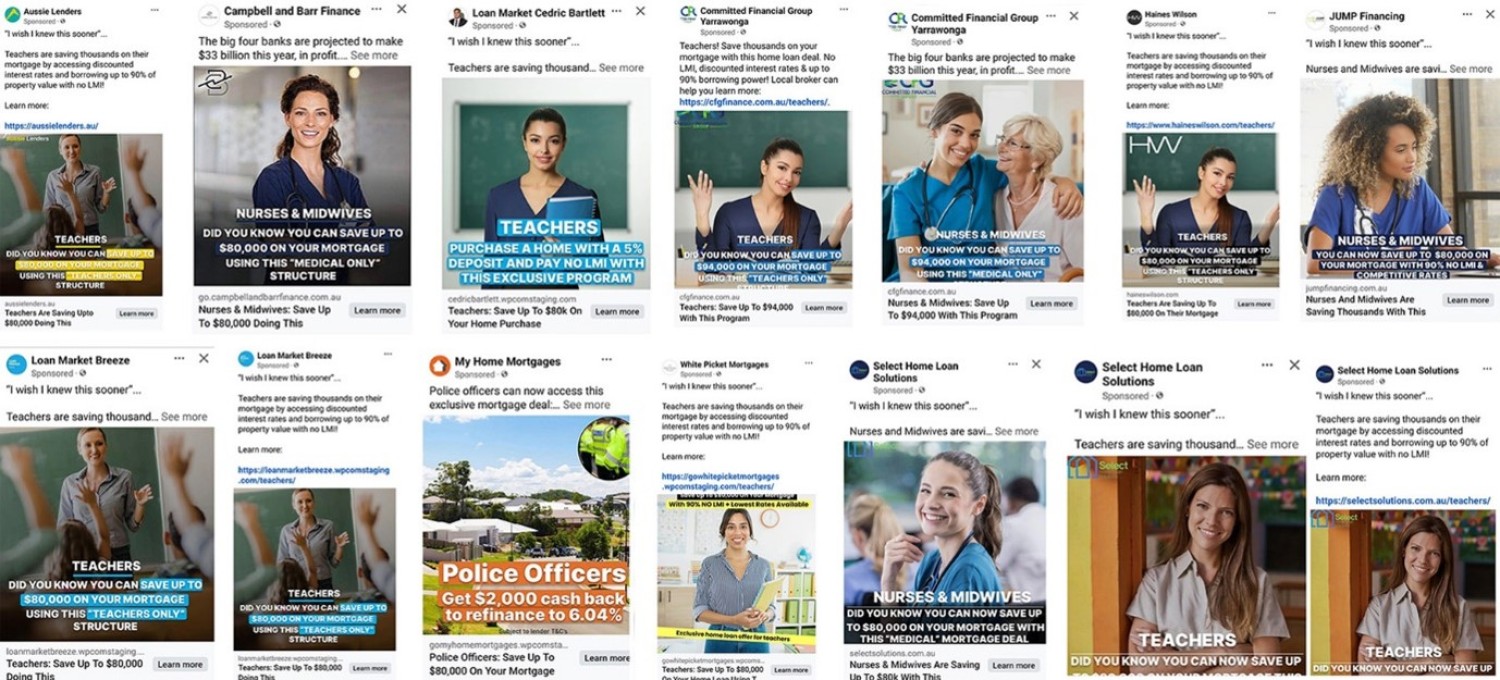
Pictured: Does your advertising stand out in any way? Are you positioned differently to any other broker? These ads are typical of Broker Grow (no connection to our program whatsoever). All are not compliance, none are unique, none are positioned, all copy is nearly and in some cases entirely identical, and the images are recycled across adverts. This is why we were able to multiple his results by 3X or refund 2-million dollars. Think different, position, and showcase your brand, personality, culture, and actually advertise. The ads from this company are still the worst in the industry, and our brokers routinely see a 10X return when measured against this style of mediocrity. Sadly, this is an industry standard. The answer to standing out is not to become another copycat Purple Cow. Note the presence of what these brokers believe is a positioned 'nurse' advertisement. In a moment, we'll detail why and how targeting nurses works, and what makes it work better.
This is one of the major weaknesses in broker advertising. Many businesses confuse targeting with positioning. Running an advertisement to nurses is targeting. Creating a landing page that says “home loans for nurses” is targeting. Mentioning nurses in the headline is targeting. None of that is positioning if every other broker can say the same thing with the same level of credibility. The question is not whether the audience is named. The question is whether the business has built a superior, visible, and defensible experience for that audience. If the page, offer, content, form, follow-up, proof, videos, case studies, calculators, partner pathways, and advice framework are no different from the generic home loan pathway, then the positioning is cosmetic.
Memorability Requires Contrast: ]Memorability requires contrast. Not gimmickry, not cheap provocation, and not difference for the sake of difference, but a visible departure from sameness. A business becomes memorable when the market can quickly understand why it should be noticed, why it is not interchangeable, and why its presence changes the comparison. This is exactly what we have already seen in the strongest positioning examples. As detailed in our advert on positioned advertising in history, Dove changed soap into a beauty bar. Avis turned second place into effort. Volkswagen made smallness intelligent. 7UP rejected the cola category. Volvo made safety the brand. M&M’s made a tangible product feature impossible to forget. Each became memorable because it gave the market a new frame.

Finance Advertising is Some of the Worst in any Industry: A digital agency that gives the same weak advertisement to every broker is not delivering strategy; it is selling negligence at scale. It is professionally absurd to claim expertise in advertising while stripping every client of the one thing advertising requires: distinction. If ten brokers in the same category are handed the same creative, the same headline, the same offer, the same landing page logic, and the same generic promise, the agency has not created a campaign; it has manufactured sameness and charged each client for the privilege of becoming less memorable. This is the opposite of positioning. It ignores audience psychology, local market context, business identity, proof, funnel architecture, offer relevance, and the basic commercial requirement that a broker must look, sound, and feel different from the competitor down the road. In any serious professional environment, this would be recognised for what it is: lazy templating disguised as marketing. A competent agency builds around the broker’s actual market position, capability, audience, and conversion pathway.

Pictured: A weak agency or brokerage recycles mediocrity, calls it efficiency, and leaves every client fighting for attention with the same, crappy, ineffectual, blunt instrument. The two ads above, amd and the others shown earlier, are the opposite of memorable. If you have an ad that looks like this, you're not compliant. Further, the advert on the left isn't assigned to the special ad category in Facebook and the parent ad account risks permanent suspension.
Real differentiation is not a label. It is a structural advantage made visible. A broker genuinely positioned for nurses might understand shift work, penalty rates, overtime treatment, income variability, employment contracts, professional progression, public versus private hospital employment, EBA arrangements, overtime, maternity leave considerations, graduate pathways, and lender policy differences that affect healthcare workers. A broker positioned for doctors might demonstrate knowledge of specialist income trajectories, contractor arrangements, practice ownership, professional packages, medico lending appetite, complex income, large loan exposure, and future borrowing strategy. A broker positioned for teachers might understand permanent versus temporary contracts, maternity leave, public-sector employment, regional placement, family purchasing patterns, and stable-income policy treatment. The audience label does not create the position. The depth of demonstrated relevance does.
Infographic-style advertisements are now so common across mortgage and finance marketing that the format itself has become difficult to remember. The same white backgrounds, coloured panels, oversized percentages, icon rows, stock photographs, generic benefit statements, and predictable calls to action appear repeatedly across competing campaigns, often with little more than a logo or occupation label changed. While the format can still organise information clearly and produce inexpensive conversions, familiarity has weakened its ability to create distinction. When every broker uses substantially the same visual language, the audience no longer sees a unique proposition; it sees another version of an advertisement it has already encountered. The creative may communicate, but it rarely positions. It may be understood, but it is seldom remembered.
Creating Inforgraphics: Most brokers still don't appreciate that a fancy-pants infographic can be created in about 30 seconds - it isn't difficult. While the infographic isn't nearly as effective as they were when we first introduced them to market (before the pretenders copied us), they have become commercially weak. Read about creating inforgraphics in an article titled "How to Create Finance Infographics for use in Advertising". An article titled "How to Publish a Nurse Refinance Advertisement in 10 Minutes" details how to create a 15-minute Nursing Refinance advert, and that ad uses the infographic - a article we use to detail the mediocrity many brokers will pay to have introduced to their business.

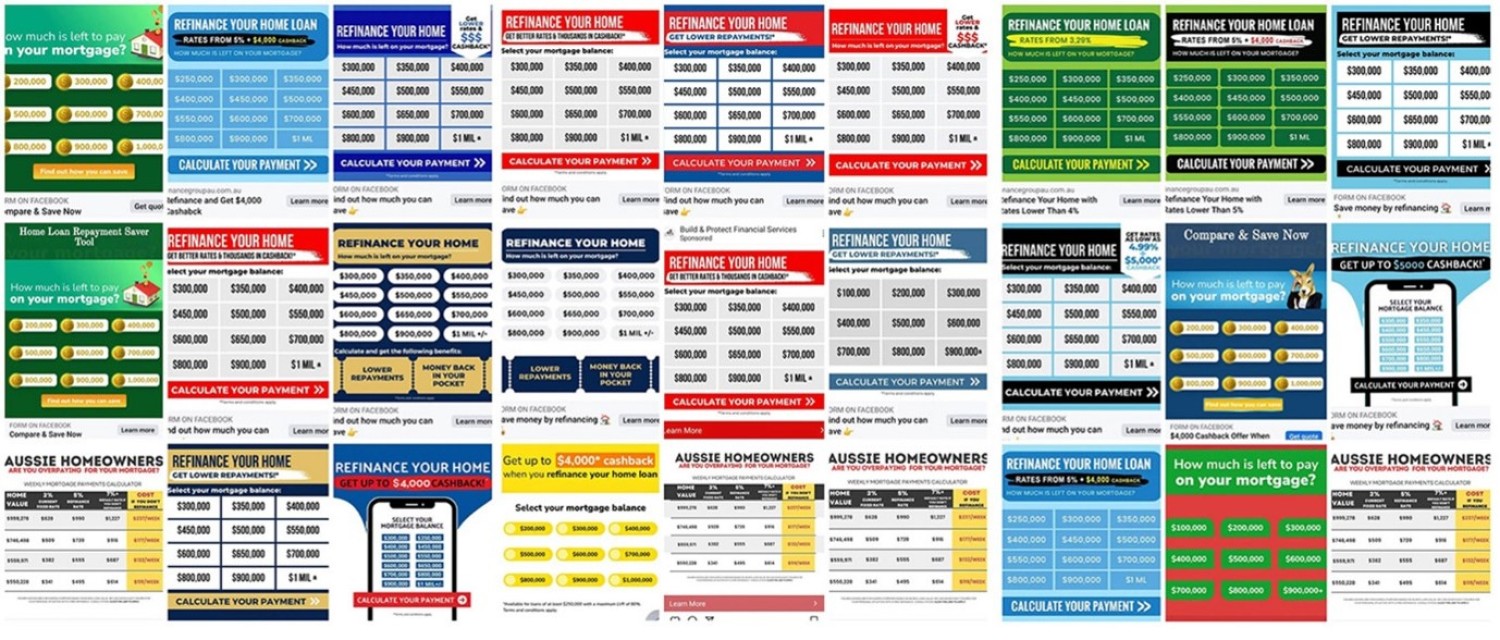
Pictured: The advertisements shown above - all drawn from our article on advertising that isn't compliant - demonstrate how quickly infographic creative becomes interchangeable when agencies reuse the same layouts, claims, imagery, hierarchy, and offers across multiple brokers. Viewed individually, each advertisement may appear clean and functional. Viewed together, the sameness becomes obvious. None creates meaningful contrast, expresses the broker’s personality, reflects a distinct brand position, or gives the market a compelling reason to remember one business over another. This is the danger of templated efficiency: the supplier saves time, but every broker becomes less visible. Infographic advertising can still work, but it must carry an original idea, a recognisable brand, a relevant offer, and a point of view that could credibly belong only to the business publishing it.
This principle applies across every profession. Lawyers, accountants, engineers, emergency services workers, construction professionals, aviation workers, and business owners all have different financial realities, but naming those groups is never enough. A broker must show evidence of insight into the way those people earn, borrow, plan, decide, and worry. Real differentiation lives in the details competitors fail to understand. It appears in the questions the broker asks, the examples they use, the forms they build, the resources they publish, the videos they record, the lender considerations they explain, the partner relationships they support, and the follow-up pathways they create. If the audience can see that the broker understands their world before speaking with them, the positioning starts to become real.
The psychological requirement is recognition. A borrower should feel that the business has described their situation more accurately than the generic market. A nurse should not merely see the word “nurse”; they should see evidence that the broker understands rostered hours, overtime, allowances, career stage, and family timing. A doctor should not merely see the word “doctor”; they should see evidence that the broker understands career progression, complex income, and strategic debt planning. A teacher should not merely see the word “teacher”; they should see evidence that the broker understands employment stability, contract status, school placement, and household planning. Recognition is what turns targeting into relevance. Relevance is what turns relevance into trust.
This is why real differentiation is difficult. It cannot be created by changing a headline or swapping an image. It requires a business to decide what it wants to be known for, then build enough proof around that claim that the market can believe it. A broker cannot credibly claim to be the leading finance specialist for nurses if the website contains one thin page and a generic enquiry form. A broker cannot claim to be the adviser of choice for medical professionals without publishing serious medical-professional content, explaining relevant lending issues, presenting suitable case studies, and creating a pathway that feels purpose-built. Positioning is not what the business says. It is what the business repeatedly proves.
The stronger test is this: could a competitor copy the claim tomorrow? If the answer is yes, the claim is not a defensible position. “We help doctors” can be copied. “We compare loans for nurses” can be copied. “We support teachers” can be copied. What is harder to copy is a deep library of profession-specific education, a structured assessment pathway, tailored form logic, profession-aware video, partner relationships, lifecycle campaigns, case-study evidence, lender-policy interpretation, and a website experience that clearly behaves differently for that audience. Real differentiation is not the sentence. It is the system behind the sentence.
Video Advertising Should Set You Apart
Video should be one of the strongest positioning tools available to a mortgage broker because it communicates more than information. It reveals voice, confidence, judgement, personality, tone, culture, and presence. Yet much of the industry has reduced video to another form of template advertising. The same talking-head format appears repeatedly: a broker stands in front of a neutral background, delivers a predictable introduction, lists three generic finance tips, ends with “speak to a broker”, and wraps the message in the same CapCut captions, transitions, stock music, icons, and animated effects used by hundreds of competitors. The medium may be video, but the result is no more distinctive than an identical image advertisement with a different logo.
This is not positioning. It is repetition at scale. If every broker speaks in the same cautious, corporate, emotionally flat language, the audience has no reason to remember who delivered the message. “Rates have changed.” “Now may be a good time to review your loan.” “Every situation is different.” “Contact us to discuss your options.” These statements may be technically acceptable, but they are category language. They communicate what a broker is expected to say rather than what this broker uniquely believes, understands, or represents. When the script could be handed to any competitor without alteration, the video is not building a position. It is merely adding another interchangeable voice to an already crowded feed.
The same principle applies to presentation. A familiar editing template does not create creative quality. Rapid captions, jump cuts, animated arrows, stock footage, generic music, and visual effects may improve pacing, but they cannot rescue an ordinary idea. CapCut has made competent editing accessible, which is useful, but accessibility has also produced a recognisable category aesthetic in which every video begins to look and feel the same. The transitions become predictable. The pacing becomes mechanical. The visual language becomes borrowed. The technology intended to make content more engaging instead reinforces the perception that every broker is following the same formula.
This is particularly wasteful because creative capability has never been more accessible. A broker can now generate storyboards, scripts, visual assets, graphics, subtitles, B-roll concepts, location ideas, hooks, diagrams, and campaign variations with basic technology and modest production resources. Differentiation should therefore be easier to demonstrate, not harder. The broker no longer needs a television budget to produce content with character. They need an idea, a point of view, a recognisable voice, and a willingness to present the business differently from the category around it. Technology has lowered the production barrier, but it has not removed the requirement for judgement.
A strong video should reinforce the promise of the business. If the broker claims to be education-led, the video should teach something meaningful. If the broker claims to understand nurses, doctors, business owners, investors, or first home buyers, the video should demonstrate specific knowledge of those audiences rather than merely naming them. If the broker claims to provide superior technology, the video should show the tools, processes, or client experience that support the claim. If the business positions itself as direct, analytical, local, premium, challenging, reassuring, or highly specialised, that character should be visible in the language, location, structure, examples, production, and delivery.
Video can also use place, story, contrast, and demonstration in ways generic talking-head content does not. A broker can film in a relevant location, walk through a real process, respond to a common misconception, explain a chart, tell an anonymised client story, challenge poor bank behaviour, compare two decision pathways, or show how the business actually operates. These choices create memory because they connect the message to context. They also make the business harder to copy because the content grows out of the broker’s own experience, market, process, and point of view.
The objective is not to eliminate talking-head video. A direct-to-camera explanation can be highly effective when the person speaking has something useful and distinctive to say. The problem is not the face on the screen. The problem is the absence of identity behind it. A broker speaking plainly, confidently, and specifically can outperform a heavily edited generic production. Conversely, a technically polished video with no original thought simply fails more slowly. It may hold attention for a few additional seconds, but it still gives the audience no durable reason to choose the business.
Every video should therefore be tested against the same positioning question applied to image advertising: could this content credibly belong to another broker? If the answer is yes, the script, concept, or presentation is not yet strong enough. Change the language. Change the frame. Add specificity. Show evidence. Use a meaningful location. Tell a story only this business can tell. Demonstrate the system behind the claim. Let the broker’s real personality and expertise become visible.
Video should not make the broker look like everybody else with better captions. It should make the business easier to recognise, easier to remember, and easier to trust. The technology is now available to almost everyone. The advantage belongs to the broker who uses it to express something that is not.
Targeting Nurses and Other Groups is NOT Positioning
Targeted nurse ads are everywhere. Targeting means nothing if every broker does it, and positioning is commercially weak if you don't support your claimed position on your website and in your funnel. At the time of writing, there are more nursing, doctor, and allied health care ads, than there are general refinance advertising. The roughly 3000+ brokers that currently have ads running on the Meta platform are generally all positioning on a portion of the market that occupies around 5% of all borrowers - so these segmented groups are hammered with copycat options. What are you doing to truly position in order to support your claims? What are you truly doing to set yourself apart where each and every ad making the same claim with the same copy and creative? The irony of the current market sentiment is that targeting general refinance candidates is more of a position than targeting nurses and some other groups directly.
When we first ran positioned ads a couple of decades ago - including those to medical groups - the returns were significant. However, the effectiveness of unsupported targeting is becoming more and more difficult, particularly when the plethora of identical ads tend to dilute the influence of even the best experiences. With the level of saturation, you have to try harder. Leads for this segment still come in routinely for under $10, but you'll have to work harder in your funnel to set yourself apart.
Targeting nurses, doctors, teachers, lawyers, police, paramedics, or any other identifiable professional group is not positioning by itself. It is only targeting. The broker has decided who should see the advertisement, but they have not yet proven why that audience should believe the broker is materially more relevant than every other broker making the same claim. This is the distinction that most campaigns fail to understand. “Home loans for nurses” is not a position. “Finance support for doctors” is not a position. “We help healthcare workers” is not a position. These are audience labels. They may improve ad relevance, but they do not create market authority unless the entire campaign environment is built around the lived, financial, professional, and institutional reality of that audience.
Niched advertising must be highly segmented and targeted, and a seed audience is always mandatory. A campaign for nurses should not speak like a generic mortgage advertisement with the word “nurse” dropped into the headline. The creative, message, imagery, timing, offer, and call to action should obviously reflect the realities of the audience. A broad healthcare worker campaign may work for reach, but serious positioning requires deeper segmentation. A graduate nurse, senior registered nurse, nurse unit manager, agency nurse, rural nurse, theatre nurse, ICU nurse, mental health nurse, midwife, nurse practitioner, and aged care nurse may all sit inside the same broad profession, but they do not necessarily share the same income pattern, roster structure, employment stability, overtime profile, career stage, risk tolerance, or borrowing question. If the campaign does not understand that, it is not positioning. It is decoration.
The landing page must continue the conversation in the language of the industry, and your website proves that the language isn't fluff. This is where most campaigns collapse. The advertisement says “for nurses”, but the page says “we offer great service and competitive rates”. That destroys the promise. The user clicked because they were led to believe the broker understood them as a nurse, doctor, teacher, or other professional. If the page immediately reverts to generic finance language, the campaign has created expectation and then failed it. A proper industry landing page should speak in the vocabulary, employment structures, concerns, and decision moments of that profession. It should demonstrate familiarity before asking for contact details. It should not merely say, “we understand nurses”. It should prove it.
The segmented, targeted, and positioned follow-up must continue in the same shared industry language. A nurse who responds to a nurse-specific campaign should not receive a generic email sequence that could be sent to any borrower. The first email, SMS, call script, booking confirmation, video, retargeting message, and post-form pathway should preserve the context. If the user entered through a healthcare-worker campaign, the response should acknowledge that context. If the campaign discussed shift income, overtime, public-sector employment, agency work, maternity leave, contract status, graduate progression, LMI options, or rostered allowances, the follow-up should continue that discussion intelligently. This is not cosmetic personalisation. It is continuity. Without continuity, targeting becomes a trick rather than a trust-building device.
Most important, broker knowledge must be real. You will be caught out if you do not speak the language. A broker advertising to nurses should understand the employment classifications, pay structures, allowances, roster patterns, public and private hospital environments, agency work, casual and permanent employment distinctions, career progression, maternity leave patterns, overtime treatment, and how different lenders may interpret variable income. A broker advertising to doctors should understand the difference between interns, residents, registrars, fellows, consultants, specialists, GPs, practice owners, contractors, salaried hospital doctors, and medical professionals with future income trajectories. A broker advertising to allied health should understand the difference between a hospital employee, private practitioner, contractor, clinic owner, mobile provider, and NDIS-linked service provider. If the broker cannot hold that conversation with authority, the campaign will expose the weakness.
This is why industry targeting works best for consistency and predictability of lead quality, not necessarily raw business volume. The purpose is not always to create a flood of enquiries. It is to reduce randomness in the pipeline. Highly targeted industry campaigns are designed to attract a more consistent class of borrower, with more predictable employment characteristics, more relevant questions, clearer professional identity, and a higher probability that the broker can build repeatable expertise around the audience. That consistency improves campaign diagnosis, page design, scripts, follow-up, partner conversations, case studies, content, and conversion pathways. A random lead pipeline is difficult to optimise. A profession-specific pipeline can be studied, refined, and improved.
Fake positioning fails quickly. A broker can get away with generic language in a generic campaign because the audience has no specialised expectation. But once the broker claims an industry, the audience raises the bar. A nurse will notice if the broker does not understand shift penalties. A doctor will notice if the broker treats all medical income as the same. A teacher will notice if the broker does not understand contract and permanency issues. A lawyer will notice loose language. A self-employed allied health practitioner will notice if the broker does not understand business income. Industry targeting creates permission to speak, but it also creates an obligation to know. The more specific the claim, the more severe the penalty for ignorance.
An article on "How to Publish a Nurse Refinance Advertisement in 10 Minutes" details the health care numbers, and it explains why those numbers work. It also shows you how to creat the same ad that a weak agency would crete for you.
Differentiation and Positioning in the Funnel
The same positioning principles are applies to broad business presentation. If the website looks like every other broker website, uses the same messagin, repeats the same vague promises, and sends users into the same generic enquiry pathway, the business is asking the market to remember something it has already learned to ignore. Familiarity is not the same as trust. In excess, familiarity becomes camouflage.
Real differentiation must be visible before the user speaks to you. It must appear in the language, structure, content, tools, forms, proof, video, follow up, and overall experience. A purple cow is not a purple sentence placed on a brown cow. It is not a slogan pasted onto an ordinary business. It is a business that presents, behaves, explains, guides, and proves itself differently enough that the market notices.
The psychological standard is simple. If the user can replace your name with a competitor’s name and the message still works, it is not memorable. If your website could belong to almost any broker, it is not positioned. If your advertising says only what the category already expects, it will be filtered out. The market remembers contrast, clarity, and usefulness. It forgets sameness.

Website Switch Module Video: The video shows the website Switch module. If a specific occupation is represented on a landing page – let’s say a nurse – and that nurse submits a form, the front page of your website will switch out to another specifically designed for nurses for the specific user. This isn’t cosmetic. This is a real effort to support differentiation. The video shows stepped forms, but these forms have evolved significantly since the video was recorded. Review the Formly forms module in an article titled "Formly is the Most Powerful Forms Module in the Industry".
The Purple Cow is therefore not an instruction to be weird. It is an instruction to be meaningfully distinct. In a market full of generic claims, the most remarkable business is often the one that is more specific, more useful, more disciplined, more educational, more visually credible, and more obviously built around the client’s decision. That is the difference between being seen and being remembered.
Conclusion
The identical advertisements shown throughout this article are not merely examples of weak creative; they are visual evidence of a deeper strategic failure. When multiple brokers are given the same image, the same headline, the same offer, the same claims, and substantially the same funnel, each business is stripped of its identity and placed into direct competition with an indistinguishable version of itself. The advertiser may still purchase impressions, clicks, and leads, but it is no longer building a brand, a position, or a durable market advantage. It is paying to reinforce the perception that mortgage brokers are interchangeable.
That is the commercial cost of sameness. When an advertisement could belong to any broker, the audience has no reason to remember the broker behind it. When the offer is identical, the user compares on price, convenience, speed, or whichever superficial variable is easiest to understand. When the landing page, form, video, follow-up, and website experience are also generic, the campaign cannot recover the distinction that the advertisement failed to establish. The broker becomes another logo attached to a category message the market has already learned to ignore.
Targeting does not solve this problem. Selecting nurses, doctors, teachers, investors, first home buyers, or refinancers may define who receives the advertisement, but it does not explain why that audience should choose one broker over another. Naming an occupation is not positioning. Changing a stock photograph is not differentiation. Adding the audience’s profession to a headline does not create relevance when the experience behind the advertisement remains unchanged. Targeting identifies the person. Positioning tells that person why the business matters. Differentiation provides the visible proof that the position is real.
The distinction is fundamental. Advertising is what the business publishes. Differentiation is what the business can demonstrate. Positioning is what the market comes to believe. The three are related, but they are not interchangeable. An advertisement may claim expertise, but the website must prove it. A campaign may promise a specialised experience, but the form, content, video, process, follow-up, and broker conversation must deliver it. A business may describe itself as different, but the user must be able to identify that difference without being instructed to believe it.
This is why true positioning cannot be fabricated at the campaign level. It must be constructed throughout the business. It appears in the subjects the broker understands, the opinions they are prepared to express, the education they provide, the tools they make available, the questions they ask, the stories they tell, the videos they record, the partners they support, and the way their website responds to different users. It is reinforced by every interaction. The advertisement is simply the most visible expression of a much larger system.
The images in this article make the problem impossible to dismiss. Identical advertisements do not become strategically sound because they are inexpensive to reproduce, convenient for an agency to deploy, or capable of generating a basic volume of leads. Efficiency for the supplier is not effectiveness for the broker. Reusing one campaign across multiple competing businesses may reduce production effort, but it also eliminates the contrast required for attention, memory, and choice. It manufactures category noise and then asks every client to pay for exposure inside it.
This is not genuine marketing. It is templated media placement.
A competent marketing partner should discover what makes the broker valuable, then make that value visible. It should examine the broker’s audience, market, experience, culture, personality, service model, technology, content, proof, location, partner network, and commercial objectives. It should identify a position the business can credibly occupy and build advertising that reinforces it. The creative should reflect the broker. The offer should reflect the audience. The funnel should reflect the promise. The follow-up should preserve the context. The wider business should substantiate every claim made in the campaign.
The practical test remains uncompromising: remove your logo from the advertisement and ask whether the market could identify it as yours. Could the same copy be given to another broker tomorrow? Could the same image be used in another suburb, by another business, for the same audience, without meaningful alteration? Could the headline sit above fifty competitor logos and remain equally plausible? If the answer is yes, the advertisement may be functional, but it is not positioned.
The same test should be applied beyond the advertisement. Could your website belong to another broker? Could your social posts be published by any brokerage? Could your video scripts be delivered by anyone in the category? Does your landing page use the same claims, questions, and calendar pathway as every other lead-generation campaign? If the identity of the business can be removed without changing the experience, the market has not been given a reason to remember it.
Real differentiation is harder because it must be earned. It requires intellectual effort, operational discipline, investment in assets, and the courage to avoid whatever the rest of the market is doing by default. It may require deeper content, original video, specialised knowledge, proprietary tools, better forms, conditional website experiences, partner infrastructure, superior follow-up, or a more sharply defined service model. These things cannot be copied as easily as a headline because they exist in the architecture of the business rather than the surface of the advertisement.
That difficulty is precisely what gives differentiation value.
The objective is not to become unusual for the sake of novelty. The Purple Cow is not an invitation to become theatrical, outrageous, or deliberately strange. It is an instruction to become meaningfully noticeable. The strongest contrast often comes from being more useful, more specific, more intelligent, more credible, more educational, more transparent, and more attentive to the borrower than the generic market. Difference without value is a gimmick. Difference connected to a genuine client advantage becomes positioning.
For mortgage brokers, the commercial consequence is significant. A generic broker must repeatedly purchase attention and compete for each new lead from the beginning. A positioned broker accumulates meaning. Every article, advertisement, video, review, campaign, and client experience reinforces the same market perception. The business becomes easier to recognise, easier to refer, easier to trust, and ultimately easier to choose. Advertising becomes more efficient because the campaign is no longer required to establish the entire value of the business in one impression.
Positioning also improves the quality of the relationship. Borrowers who respond only to a rate, cashback, or generic promise are more likely to compare the broker on equally shallow terms. Borrowers who respond to visible expertise, relevance, process, education, and trust are entering a different relationship. They are not merely looking for somebody who can submit an application. They are choosing a guide whose judgement they value. That distinction improves engagement, reduces unnecessary price comparison, strengthens loyalty, and creates a more defensible business.
The final lesson is therefore not that brokers need more advertising. They need advertising that belongs to them. They need campaigns that express a real position, creative that reflects their identity, offers that matter to a defined audience, and a funnel capable of proving the promise after the click. The market does not need another version of the same ad. It needs a clear reason to believe that one business is more relevant, more capable, and more worthy of attention than the alternatives.
Targeting determines who sees you. Differentiation demonstrates why you are not interchangeable. Positioning determines what the market remembers. Advertising activates that position, and the funnel must prove it.
Positioning is not the sentence beneath your logo. It is not the occupation named in your headline. It is not a stock image, a template, or a claim supplied by an agency. Positioning is the cumulative consequence of what the business understands, builds, communicates, and repeatedly delivers. It is not what you say you are. It is what the market can see that you have become.