Finance is rarely difficult because numbers cannot be calculated. It is difficult because numbers must be interpreted, explained, trusted and converted into decisions by human beings.
A lender may approve a loan, yet fail to explain the conditions in a manner the borrower understands. A mortgage broker may identify a demonstrably superior product, yet present it through a communication style that creates hesitation rather than confidence. A broker may construct an analytically sound borrowing strategy or structure, but lose the client because the recommendation does not address the client’s emotional perception of risk. A manager may provide technically correct instructions to a team member, only to discover that the message was interpreted as criticism, interference or indifference.
The same principle applies at the first point of contact with a prospective borrower. The initial telephone call is not merely an opportunity to introduce the business or qualify the enquiry; it is the moment in which the borrower decides whether the person on the other end of the line understands them, communicates in a way they can trust and is capable of guiding them through a consequential financial decision.
Leads are not always lost because the broker lacks competence, product knowledge or technical capability. They are often lost because the broker’s communication style is not calibrated to the borrower. A highly structured customer may want evidence and a clear process, while another may need reassurance, brevity, personal warmth or an immediate pathway to action. It does not matter how sophisticated the funnel, how efficient the workflow, how broad the lender panel, or how advanced the technology may be if the first conversation fails to establish psychological contact. When the broker cannot resonate with the borrower, the borrower is likely to continue searching until they find someone who can. We work hard on attracting a lead and often fail to optimise our communication capabilities, and it's here where I see brokers fail over and over. You can easily retain those lost leads simply by applying effort into personal development.
Losing a lead off the initial call is not necessarily failures of intelligence, competence or intent. They are failures in the process by which communication is constructed and received.
The Process Communication Model, commonly known as PCM, provides a systematic framework for understanding these failures. Developed by American psychologist Dr Taibi Kahler during the 1970s, PCM proposes that individuals possess different perceptual filters, psychological needs, communication preferences and predictable behavioural patterns under stress. The model does not merely ask what a person says. It asks how that person organises experience, what motivates their behaviour, how they prefer to be approached and what happens when their psychological needs are not met.
Financial services require a top-tier communication strategy. Finance combines complexity, uncertainty, delayed consequences, regulatory obligations, personal vulnerability and unusually high levels of perceived risk. The customer is rarely purchasing an ordinary product. They may be deciding whether to assume a 30-year debt, refinance the family home, invest retirement savings, protect dependants, disclose financial hardship or reorganise a business that employs other people.
In these environments, the communication method is not a decorative layer applied after the technical work has been completed. Communication is part of the technical work, and it's an ignored skill that requires more industry attention.
Process Communication Model is not a framework for 'sales'. It is a framework for adapting your communication to the individual you're selling to.
This article looks at PCM, but we'll also look at how the adaptive framework might shape your funnel and video presentation style. In a broader context, the PCM might dictate the way in which recommendations, email, and other correspondence is communicated.
Communication Is Part of the Financial Product: A financial product is experienced through more than its rate, fee, term, structure and contractual conditions. It is also experienced through the explanation, advice, documentation, follow-up and service that surround it. When the customer cannot understand the product, cannot identify why it is appropriate or does not feel sufficiently secure to make a decision, the practical value of the technical recommendation is diminished.
Finance and the PCM: While PCM has been applied broadly to sales, leadership and client relationships, there appears to be little substantive published material applying the model comprehensively to mortgage broking and the end-to-end finance customer journey outside of our own insights. This article connects mortgage brokers to the PCM and the Finance Funnel directly for the first time outside of our own course material and guides.
PCM Training: PCM Training is provided in our Broker Growth (Marketing) Workshop as part of the Communication webinar. We've taught the subject to airline pilots, government departments, and the corporate world for over a decade. We're available to introduce the models at PD days or online training sessions. The longer workshop includes Human Factors, Soft Training, Team Resource Management, and broader teamwork programs. The program supports our available marketing training packages.
What Is the Process Communication Model?
PCM is a personality and communication framework designed to explain how people perceive the world, communicate with others, become motivated and respond to psychological distress. It identifies six personality types:
- Thinker
- Persister
- Harmonizer
- Rebel
- Imaginer
- Promoter
The model does not suggest that each person belongs exclusively to one category. It proposes that every individual contains characteristics of all six types, arranged in a distinctive order and expressed with different levels of intensity. PCM often represents this structure as a six-storey building. The most accessible personality type occupies the ground floor, while the remaining types occupy progressively higher floors.
The metaphor is useful because it avoids the crude assumption that personality can be reduced to a single label. A person may naturally process information through logic, strongly value personal relationships, display creativity in certain environments and become highly action-oriented when circumstances require it. PCM attempts to describe which of these processes is most readily available and which communication approaches require greater psychological effort.
The official PCM framework describes the six types as elements within every person’s personality structure rather than mutually exclusive classifications. The person’s most accessible type is generally described as the Base.
PCM is also described as a non-clinical communication and management methodology. It should therefore be distinguished from psychiatric diagnosis, clinical assessment and pathology-based models of behaviour.
The Central Principle: Meaning Is Created by the Receiver
Most professionals communicate from the inside out. They organise the message according to their own preferred way of thinking and assume that clarity has been achieved because the explanation feels clear to them.
A highly analytical broker provides extensive calculations. A relationship-oriented adviser spends time establishing rapport. A decisive business banker moves immediately toward action. A detail-focused compliance manager provides a long list of requirements. Each may believe they are communicating professionally, yet each is partly communicating to themselves.
PCM reverses the orientation. It asks the communicator to begin with the receiver.
The relevant question is not simply "What information must I provide?". It is: "How must this person first be engaged so that the information can be received, processed and trusted?"
A technically complete message can still fail. It may be too abstract, too abrupt, too emotional, too detailed, too informal or too slow for the person receiving it. The customer may not consciously identify the mismatch. They are more likely to report that they "did not feel comfortable", "needed more time", "did not understand the value", "felt pressured", or "did not think the adviser understood them".
These statements - or the subjective interpretation of the borrower - are often treated as objections. They may instead be evidence that genuine psychological contact was never established.
From Sterile Information to Adaptive Communication: Mortgage broking operates within an environment defined by data, policy, documentation, compliance, serviceability calculations and procedural accuracy. These requirements are essential, but they can also produce a sterile and highly standardised communication culture in which the same rehearsed language, mirrored scripts and familiar industry patter are repeated across almost every customer interaction. The result is often a narrow and siloed communication style that reflects how brokers are trained to process information rather than how borrowers need to receive it. The objective is not to change the underlying facts, soften material risks or replace technical precision with performance. It is to take the same accurate information and construct alternative ways of presenting it - more analytical for the borrower who needs evidence, more personal for the borrower who needs reassurance, more concise for the borrower who values speed, and more reflective for the borrower who requires time and space. The information remains constant; the communication architecture changes.
The Illusion of a Clear Explanation: The speaker's confidence in an explanation does not establish that the explanation was effective. Communication should be evaluated by the receiver's comprehension, interpretation and capacity to act - not by the sender’s fluency, technical knowledge or intention.
Why PCM Is Particularly Relevant to Finance
Financial communication has characteristics that make communication mismatch unusually costly.
First, financial decisions are frequently complex. Interest rates, comparison rates, fees, loan-to-value ratios, taxation, insurance exclusions, investment volatility and product conditions may be familiar to the professional but unfamiliar to the customer.
Second, financial outcomes are uncertain. Even when historical data, forecasts and probability models are available, the future cannot be guaranteed. The customer must act despite incomplete certainty.
Third, financial decisions frequently involve loss aversion. Behavioural research consistently demonstrates that people tend to experience potential losses more intensely than equivalent gains. A customer considering refinancing may therefore focus less on the potential saving than on the possibility of making a costly mistake.
Fourth, money carries symbolic and emotional meaning. It can represent security, status, independence, responsibility, competence, family protection or personal failure. Two customers with identical financial circumstances may therefore respond very differently to the same recommendation.
Fifth, finance is regulated. Communication must be accurate, balanced and supportable. Personalisation cannot become manipulation, selective disclosure or the concealment of material information.
For brokers, the best interests obligations require brokers to act in the consumer’s best interests when providing credit assistance. ASIC’s guidance also makes clear that incomplete or inaccurate application information is inconsistent with those obligations, even where the inaccuracy might improve the likelihood of approval or access to better terms.
For financial product issuers and distributors, the design and distribution regime places the target market at the centre of product design, distribution, monitoring and review. Products should be directed toward consumers whose likely objectives, financial situations and needs are consistent with the product.
PCM does not replace these obligations. Properly used, it supports the communication process around them. It may help a professional explain the same complete and accurate information through a form the customer can more readily process.
Adaptation Is Not Manipulation: Ethical communication adaptation changes the route by which complete information is delivered. Manipulation changes, conceals or distorts the information to produce a preferred outcome. PCM should improve comprehension and autonomy, not manufacture consent.
The Six PCM Personality Types
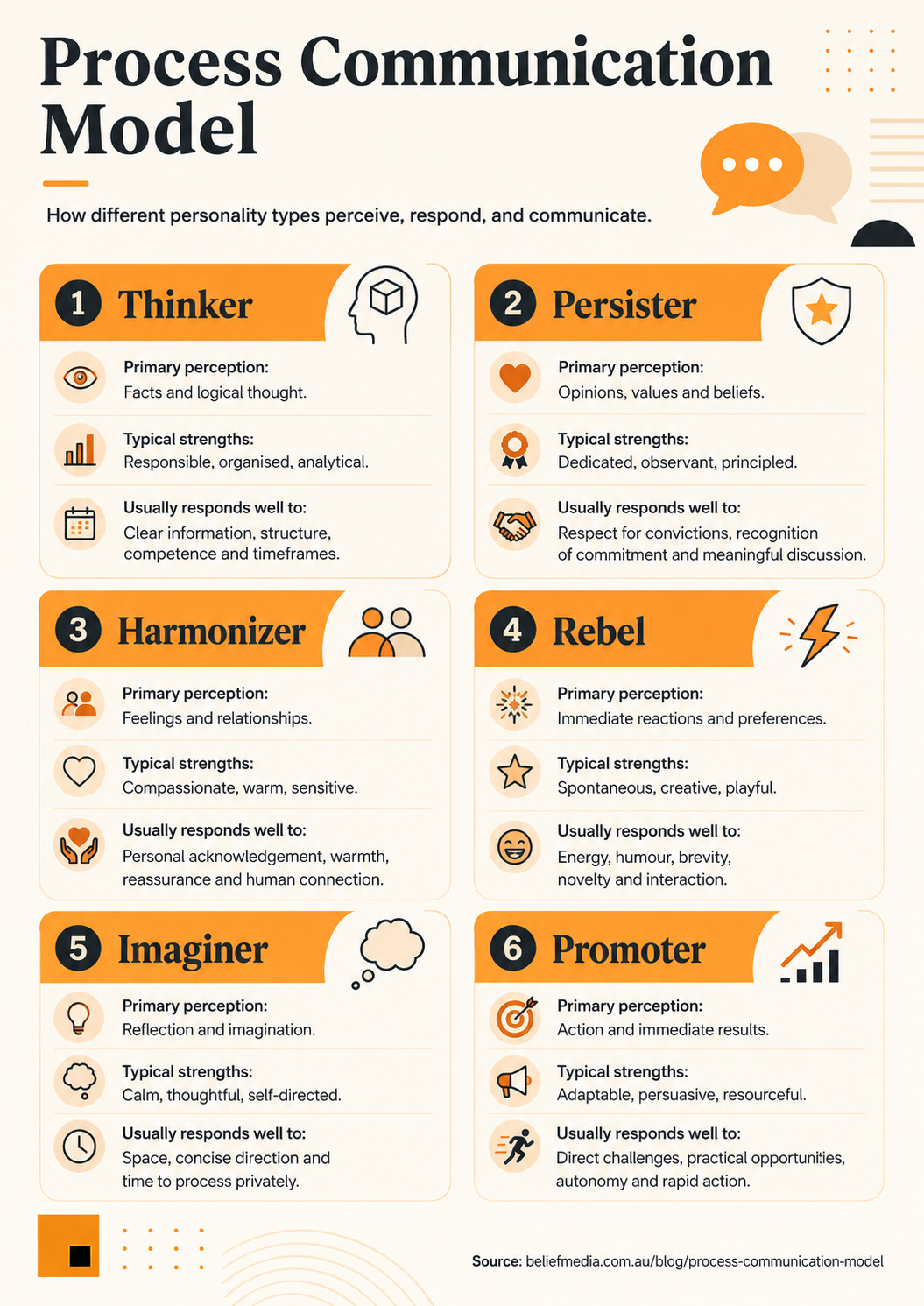
The graphic provides a broad overview of the six primary personality types. In this section we'll look at each of these personality types in a little more detail.
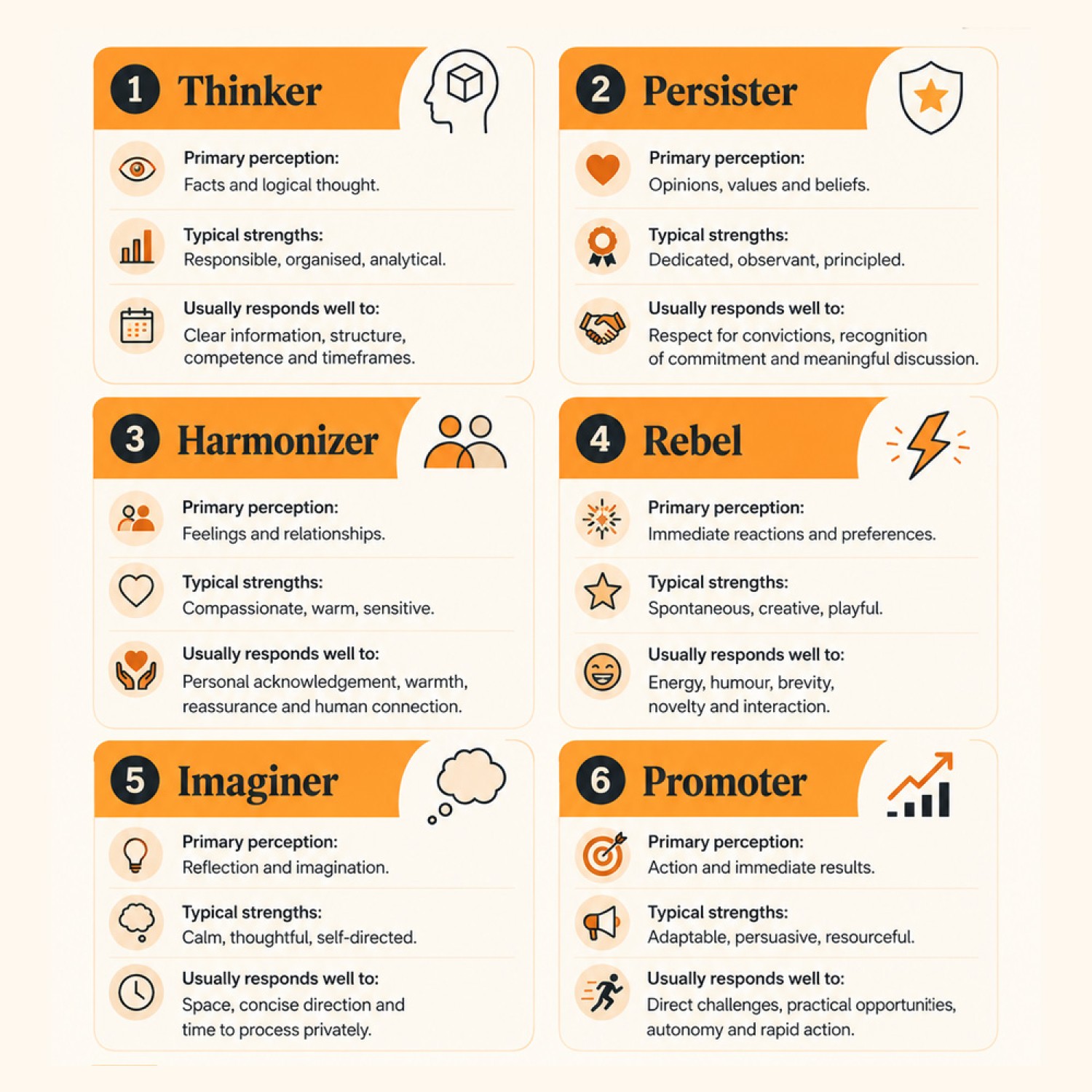
Pictured: The graphic provides a broad overview of the six primary personality types. In this section we'll look at each of these personality types in a little more detail. Download the full infographic here  .
.
The Thinker
The Thinker primarily perceives the world through facts and logical thought. Thinkers are commonly described as responsible, organised, analytical and capable of planning complex tasks. They tend to value competence, structure, reliable information and appropriate use of time. They often want to understand how a recommendation was reached, what assumptions were used and how the process will proceed.
In finance, a Thinker-oriented customer may ask:
- “What is the effective rate after fees?”
- “How was the borrowing capacity calculated?”
- “What are the repayments under different rate scenarios?”
- “What happens at each stage of the application?”
- “What is the total cost over five years?”
These basic questions used for the example should not be interpreted as the borrower challenging your method. They are frequently the means by which the person establishes trust.
A weak response to a Thinker is vague reassurance: "Don’t worry, this is definitely the best option". A stronger response is structured evidence: "Based on the current balance, remaining term and stated fees, the projected saving is approximately $286 per month. I have also modelled the outcome if the rate increases by 0.50 and 1.00 percentage points. Let us work through the assumptions".
Thinkers usually respond well to agendas, written comparisons, process maps, timeframes, clear responsibilities and evidence-based recommendations. They may become frustrated by disorganisation, imprecision, repeated delays or unexplained changes.
A finance professional communicating with a Thinker should avoid mistaking detail for communication quality. The objective is not to provide every piece of available data. It is to provide relevant data in a coherent structure.
The Thinker and Cognitive Load: Analytical customers are not immune to information overload. Their preference for evidence should not be used to justify unstructured disclosure. Good communication distinguishes material information from peripheral information and provides a hierarchy through which the decision can be evaluated.
The Persister
The Persister primarily perceives the world through opinions, values and beliefs. Persisters are commonly described as dedicated, observant, principled and conscientious. They frequently evaluate not only whether a recommendation works, but whether it is responsible, credible and aligned with their standards.
A Persister-oriented customer may ask:
- “Why do you believe this lender is appropriate?”
- “How does this recommendation support my long-term objectives?”
- “What is the lender’s reputation?”
- “Are there any practices or conditions I should be concerned about?”
- “What would you do in my position?”
A Persister is likely to respond poorly to a recommendation presented as a purely transactional opportunity. A marginally lower rate may not be persuasive if the lender, process or product structure conflicts with the customer’s beliefs about security, fairness or responsible conduct.
Communication should recognise the person’s judgment without falsely endorsing every opinion they express. A broker might say:
"You have made it clear that certainty and responsible repayment management are more important to you than maximising borrowing capacity. That priority materially influences the recommendation". In many cases, you'll follow up with information used to challenge a belief - particularly if that belief structure is flawed or limits opportunity.
Persisters often value recognition for commitment, loyalty and conviction. In a professional relationship, they may respond strongly when the adviser demonstrates integrity, consistency and preparedness.
They may also scrutinise contradictions. A finance brand that speaks extensively about customer care but delivers poor follow-up may lose a Persister’s confidence more quickly than it would lose the confidence of someone who is primarily outcome-oriented.
The Harmonizer
The Harmonizer primarily perceives the world through feelings and relationships. Harmonizers are commonly described as compassionate, warm and sensitive. They tend to value personal acknowledgement, trust, reassurance, sensory comfort and human connection.
A Harmonizer-oriented customer may not begin with the interest rate. They may begin with the consequence:
- “I want to know that my family will be secure.”
- “I am worried that we have left this too late.”
- “I do not want the process to become stressful.”
- “I need someone who will explain this without making me feel foolish.”
The professional error is to regard these statements as peripheral to the “real” financial issue. They are often central to the decision.
The Harmonizer may need to feel that the professional understands the personal context before they are ready to process technical detail. This does not require sentimental language. It requires recognition. A suitable response might be:
"It makes sense that you are concerned. This affects your home and your family’s monthly position. We will work through the options carefully, and I will explain each step before anything proceeds".
The same customer may disengage when immediately confronted with ratios, forms and product tables. The information remains necessary, but the communication sequence matters.
Harmonizers may place significant weight on continuity and responsiveness. A warm initial meeting followed by impersonal automated communication can create a sense of relational inconsistency. In finance, where customers disclose income, debts, hardship and personal objectives, that inconsistency may be experienced as a breach of trust.
Reassurance Must Remain Truthful: Reassurance in finance should reduce unnecessary uncertainty, not deny legitimate risk. Statements such as “There is nothing to worry about” may be psychologically comforting but professionally inappropriate. Better reassurance explains what is known, what remains uncertain and how the uncertainty will be managed.
The Rebel
The Rebel primarily perceives the world through immediate reactions and preferences. Rebels are commonly described as spontaneous, creative and playful. They often engage through energy, humour, novelty and active interaction. Their initial reaction may be expressed through simple evaluative language:
- “That sounds good.”
- “That seems painful.”
- “I hate paperwork.”
- “This lender is impossible.”
- “Can we make this easier?”
The Rebel may disengage from dense, formal explanations, even when the underlying information is important. This does not mean the professional should omit detail. It means the detail may need to be divided into short, interactive and visually accessible components.
A suitable communication style may include:
- “Here are the three things that matter.”
- “This option is cheaper, this one is more flexible and this one is easier to exit.”
- “I will handle the difficult part. You need to complete these two actions.”
Rebels often respond well to visual comparisons, short videos, interactive tools, progress indicators and concise messages. They may be particularly sensitive to repetitive administration and long periods without visible movement.
The risk is that a finance professional may become excessively casual in an attempt to create engagement. Humour can establish contact, but it should not trivialise debt, risk, hardship or contractual commitment.
A Rebel customer may also agree enthusiastically before fully evaluating the decision. The adviser must therefore distinguish engagement from informed commitment.
The Imaginer
The Imaginer primarily perceives the world through reflection and imagination. Imaginers are commonly described as calm, thoughtful and self-directed. They may prefer space, concise direction and time to process information privately.
An Imaginer-oriented customer may say little during a meeting. This silence should not automatically be interpreted as agreement, disengagement or lack of understanding. The person may be internally processing the information.
Pressure for an immediate response can impair rather than improve communication.
A suitable approach might be:
- “I have reduced the comparison to the two most relevant options. I will send the summary today. Take some time to review it, and we can speak on Thursday.”
- Imaginers often respond well to clearly defined tasks:
- “Please provide the two documents listed here.”
- “Review pages two and three before our next conversation.”
- “Consider whether repayment certainty or flexibility is more important.”
Ambiguous invitations such as “Let me know what you think” may be less effective because they provide no specific point of engagement.
Within a finance team, an Imaginer may work effectively when given a defined objective and uninterrupted time. Continuous meetings, persistent messages and unnecessary social interaction may reduce their productivity.
The communication challenge is to respect reflective space without allowing the matter to disappear. The professional should provide a clear next step and a defined reconnection point.
The Promoter
The Promoter primarily perceives the world through action and immediate results. Promoters are commonly described as adaptable, persuasive and resourceful. They often respond to direct challenges, practical opportunities, autonomy and rapid action.
A Promoter-oriented customer may ask:
- “What can we do now?”
- “How quickly can this be approved?”
- “What is the opportunity?”
- “What is stopping us?”
- “What is the bottom line?”
Promoters may become impatient with lengthy background explanations and procedural detail. A broker might therefore begin with the outcome:
“You appear eligible for a materially lower repayment. The fastest path is to verify income today, submit tomorrow and obtain an initial lender response within the expected assessment period.”
The process detail should still be provided, but it should be connected to action.
Promoters may be comfortable with risk, speed and negotiation. That confidence can be commercially useful, but it can also create exposure where the customer underestimates constraints or focuses on the immediate gain.
The professional should not imitate urgency merely to preserve momentum. A decisive communication style must remain attached to responsible analysis:
“This can move quickly, but only after we verify the liabilities and confirm the servicing position.”
Speed Is Not the Same as Pressure: A fast process can serve the customer. Artificial urgency serves the seller. The ethical distinction is whether speed removes friction from a sound decision or prevents the customer from properly considering it.
Base and Phase: Personality Structure vs Current Motivation
Two of PCM’s most important concepts are Base and Phase.
The Base represents the most foundational and accessible element of the personality structure. It influences the person’s characteristic communication style, perceptual frame, preferred environment and means of establishing contact.
The Phase represents the psychological needs that are most motivationally important during the person’s current period of life. The Phase may be the same as the Base, but it need not be.
This distinction explains why a person’s natural communication style and current motivation may appear inconsistent.
A customer may have a Thinker Base and communicate through facts, structure and logic. However, a Harmonizer Phase may mean that their present motivation is strongly connected to security, acceptance and family relationships. A purely numerical recommendation may satisfy the Base while failing to address the current emotional need.
Similarly, a Harmonizer Base customer experiencing a Promoter Phase may still prefer respectful personal engagement but currently be motivated by decisive action and immediate opportunity.
The practical lesson is that communication cannot be reduced to a static personality label.
The Base may help determine how to make contact.
The Phase may help explain what currently motivates the person.
PCM-affiliated descriptions emphasise that the Base is associated with the preferred communication channel, while the Phase is associated with present psychological motivation and distress behaviour.
Psychological Needs and Financial Behaviour
PCM has a formal and standardised methodology, including an authorised personality profile that examines the individual’s complete structure across all six personality types, together with concepts such as Base, Phase, perceptions, psychological needs, preferred communication channels and predictable distress patterns. That formal assessment has a legitimate place in accredited training, coaching, leadership development and deeper organisational work. In an ordinary finance conversation, however, it would be neither practical nor appropriate to suggest that a broker can reproduce the formal model through a few questions, isolated language cues or casual observation.
Our purpose is considerably narrower and more practical. We are not attempting to assign borrowers to fixed categories, infer a clinical condition or practise amateur psychology. We are seeking to raise personality and communication awareness so that the same accurate financial information can be presented more effectively. A borrower who asks for detailed calculations may benefit from greater structure; another may require reassurance, a clear explanation of the process, private time to consider the options or a more direct statement of the next action. These observations should be treated as working communication hypotheses rather than definitive conclusions about personality.
Used in this way, PCM becomes an adaptive communication framework rather than a labelling system. The professional listens for patterns, asks direct questions about communication preferences, tests an appropriate style and observes whether comprehension, trust and engagement improve. The objective is not to decide what a person “is”, but to determine what the communication needs to look like in that particular interaction. This preserves professional boundaries while still capturing PCM’s practical value: greater sensitivity to how different people receive information, interpret risk and become sufficiently comfortable to make an informed financial decision.
Awareness Rather Than Diagnosis: The formal PCM Profile provides a structured and authorised method for examining personality, and we'll look at this next. A finance professional does not need to administer or imitate that assessment to benefit from the model. The practical objective is simply to become more attentive to differences in language, motivation, pace, information preference and response under pressure. PCM should help the professional adapt communication, not attach a permanent label to the borrower.
We'll now look at how the format model compares to our practical assessment.
The Format Assessment
There is an official, standardised PCM assessment, and it is the closest thing to a definitive PCM questionnaire. It's not something you'll use or need to use. Instead, knowing that the formal assessment is required to establish personality gives us insight into how effective or ineffective our own conclusions will be. The idea isn't to be precise - it's to be more effective through adapted communication skills. Keepin mind that PCM isn't always about diagnosing the borrower, but understanding how you communicate yourself.
The formal instrument is generally called the PCM Profile questionnaire or Process Communication Model Profile. The current official version contains 45 questions and produces a computer-generated personality profile rather than assigning the respondent to one simple category. The official PCM organisation describes it as a validated questionnaire used to identify an individual’s complete Personality Structure.
What the official PCM questionnaire measures
The assessment is intended to establish the respondent’s six-level personality structure. It normally reports:
- The ordering and relative accessibility of all six PCM personality types.
- The person’s Base personality type.
- The person’s current Phase.
- Characteristic strengths.
- Primary perceptions.
- Preferred communication channels.
- Environmental and interaction preferences.
- Psychological needs.
- Likely distress sequences and warning signals.
- Management, leadership or relationship implications, depending on the profile purchased.
The profile is therefore not equivalent to a quiz that concludes, “You are a Thinker.” Every person is represented as containing all six types in a particular configuration. Official PCM material refers to thousands of possible personality structures or combinations (recognised PCM coaches are not entirely consistent about the precise number quoted).
The completed assessment is usually accompanied by a detailed report and a debrief with an accredited PCM professional. PCM Oceania describes the profile as covering strengths, perceptions, communication preferences, psychological needs and distress sequences.
Is the questionnaire publicly available?
The official item set and scoring framework are not released as an open public-domain questionnaire. The assessment is administered through PCM’s authorised system and generally obtained from PCM or an accredited trainer, coach or provider (you'll find them with an online search). The official framework is proprietary and is owned and maintained by Kahler Communications, which owns the rights to PCM and its related personality-assessment methodology.
What is considered the definitive framework?
Within PCM itself, the definitive framework is not merely the list of six types. It is the combined structure of:
- Personality Structure.
- Base.
- Phase.
- Perceptions.
- Communication channels.
- Parts of personality.
- Interaction styles.
- Environmental preferences.
- Psychological needs.
- Drivers and distress sequences.
- Intervention strategies.
A serious PCM assessment should therefore identify more than preferred vocabulary. Language signals such as “I think”, “I feel” or “let’s move” can assist with conversational adaptation, but they do not establish a formal PCM Profile.
The official model is derived from Taibi Kahler’s work in transactional analysis and from his earlier Process Therapy Model. PCM is described by its governing organisations as the non-clinical communication and management application of that underlying research.
The practical hierarchy of PCM identification
There are effectively three levels of assessment.
1. Formal PCM Profile
This is the definitive PCM method. It uses the official questionnaire, proprietary scoring and an individual profile report. It is appropriate for personal development, leadership, team development, coaching and substantive training.
2. Structured conversational assessment
This is an informed observational process used by someone trained in PCM. The practitioner listens for language, perceptions, interaction style, psychological needs and distress indicators, then forms and tests a working hypothesis.
This can be highly useful in sales or mortgage conversations, but it should not be represented as equivalent to the formal profile.
3. Informal communication preference check
This is the practical finance version:
- “How would you prefer me to explain this?”
- “Would you like the numbers first or the broad recommendation?”
- “Do you want to work through it now or review it privately?”
- “Is certainty, support, simplicity or speed most important?”
This does not identify a PCM personality structure. It identifies the most useful communication approach for the immediate conversation.
Profile Versus Communication Hypothesis: The official PCM Profile identifies a structured configuration across all six personality types, including Base, Phase, psychological needs and distress behaviour. A brief client conversation cannot reliably reproduce that assessment. In finance, the appropriate objective is usually narrower: identify and test the communication channel most likely to help the borrower understand, trust and act upon the information presented.
Could you create an Internal PCM-style finance questionnaire?
Yes, but it should be described accurately as a PCM-informed communication preference questionnaire, not as the PCM Profile or a validated personality assessment. A useful finance questionnaire could assess six immediate preferences:
- Evidence and structure.
- Principles and credibility.
- Personal reassurance.
- Simplicity and engagement.
- Reflection and processing time.
- Action and momentum.
For example:
“When reviewing a financial recommendation, what helps you most?”
A. Detailed calculations and a clear sequence of steps.
B. Confidence that the recommendation is responsible and well founded.
C. Knowing that my concerns and personal circumstances are understood.
D. A simple, engaging explanation without unnecessary complexity.
E. Concise material I can review privately before deciding.
F. A clear recommendation and immediate next action.
A short set of questions in this format could guide:
- The first telephone call.
- The density of financial explanations.
- The order in which information is presented.
- Autoresponder content.
- Video selection.
- Form outcomes.
- Follow-up timing.
- The balance between reassurance, evidence and action.
However, the result should be expressed as:
“Preferred communication emphasis: evidence and structure.”
It should not state something like “Your PCM Base is Thinker.” That conclusion requires the authorised assessment.
How definitive is PCM scientifically?
There are two different meanings of “definitive” here.
Within the PCM ecosystem, the official 45-question PCM Profile is the definitive instrument. It is the standard assessment administered through accredited providers and used as the prerequisite or foundation for many PCM training programs.
Within personality psychology more broadly, PCM is not the universally definitive model of personality. Trait models such as the Five-Factor Model have a considerably larger independent academic evidence base. PCM has practitioner adoption, proprietary validation claims and a developing research literature, but its complete scoring methodology and validation evidence are not as openly documented as some major academic inventories.
The PCM Profile: PCM has an official assessment known as the PCM Profile. The current questionnaire contains 45 questions and generates an individual Personality Structure across all six PCM types, including Base, Phase, communication preferences, psychological needs and distress patterns. It should be distinguished from abbreviated online quizzes and conversational observations. In a mortgage or finance conversation, language and behavioural cues may support a provisional communication hypothesis, but they absolutely do not replace the formal PCM Profile or establish a definitive personality classification.
Effective Communication with PCM
PCM proposes that each personality configuration is associated with psychological needs. When those needs are satisfied constructively, the person is more likely to function productively. When they remain unmet, the person may attempt to satisfy them through less productive behaviour.
This is especially relevant in finance because the financial decision may itself become a vehicle through which a psychological need is pursued.
A customer may seek recognition through property ownership. Another may pursue certainty through excessive cash retention. Another may repeatedly refinance because action provides stimulation. Another may avoid reviewing an unsuitable loan because the process threatens their sense of competence. Another may overvalue loyalty to a lender because loyalty is part of their self-concept.
The finance professional should not attempt amateur psychological diagnosis. However, recognising that the stated financial objective may contain a psychological dimension can improve questioning.
Rather than asking only “What rate are you looking for?”, the professional may ask:
- "What would a successful outcome change for you?”
- “What concerns you most about the present arrangement?”
- “What would make you confident enough to proceed?”
- “Which part of the decision feels most difficult?”
- “Is your priority certainty, flexibility, speed, total cost or something else?”
These questions reveal meaning rather than merely collecting data.
Don't Diagnose in a Conversation
The fastest practical method is not to try to diagnose a complete PCM personality structure during one call. The formal PCM Profile uses a validated questionnaire because every person contains all six personality types in a different order and strength. In conversation, the more defensible objective is to form a provisional hypothesis about the person’s most accessible perception and preferred communication channel, test it, and adapt according to their response.
A useful method is a short Ask–Listen–Test–Confirm sequence. The general nature of this sequence is described below.
1. Ask an open decision question
Begin with a question that permits the borrower to reveal what matters without forcing them into a category:
- “What is most important to you in reviewing the loan?”
- “What would a good outcome look like?”
- “What concerns you most about the current position?”
- “How would you prefer me to explain the options?”
Their first substantive answer often reveals the perceptual frame through which they are approaching the matter.
A response centred on figures, comparisons, mechanics or timing suggests a Thinker-oriented entry point. A response centred on what is right, responsible, fair or credible suggests Persister-oriented communication. A response centred on family, security, stress or being supported suggests a Harmonizer-oriented approach. A response expressed through immediate preferences—“I hate paperwork”, “I just want this made simple”—may suggest a Rebel-oriented approach. A request to receive material and think privately may suggest an Imaginer-oriented approach. A response centred on speed, opportunity and immediate next steps may suggest a Promoter-oriented approach.
The idea is to adapt our own communication in a way that is most suited to the borrower. We should vacate the standard patter we've used hundreds of times and sharpen or soften our approach as required.
2. Listen for perceptual language
Formal PCM training specifically places emphasis on the concrete words people use, non-verbal behaviour, psychological needs and defensive patterns.
Listen for repeated language rather than isolated words.
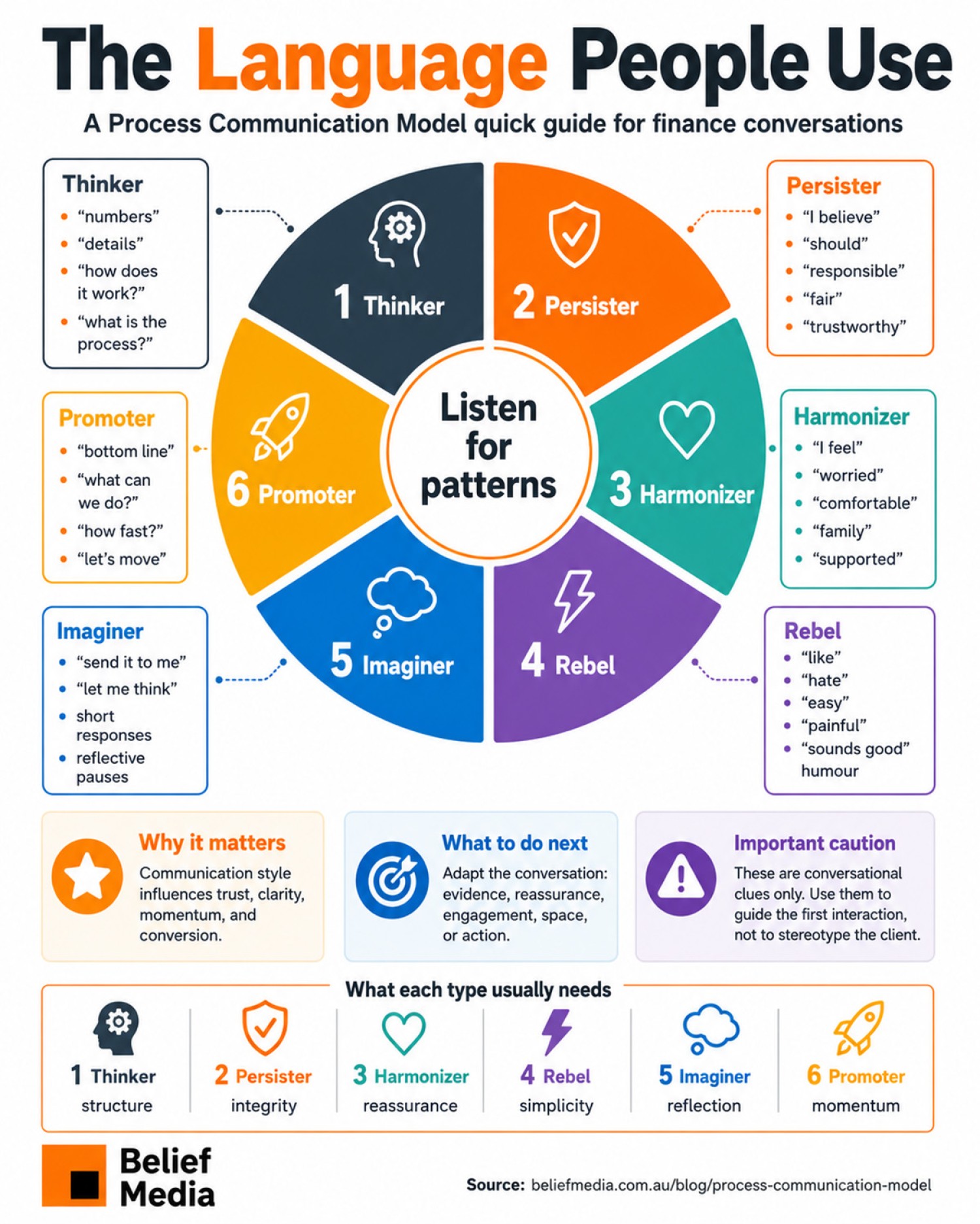
Pictured: A likely orientation based on the type of language used. Thinker: “numbers”, “details”, “how does it work?”, “what is the process?” Persister: “I believe”, “should”, “responsible”, “fair”, “trustworthy”. Harmonizer: “I feel”, “worried”, “comfortable”, “family”, “supported”. Rebel: “like”, “hate”, “easy”, “painful”, “sounds good”, humour. Imaginer: “send it to me”, “let me think”, short responses, reflective pauses. Promoter: “bottom line”, “what can we do?”, “how fast?”, “let’s move”
Do not classify the borrower from vocabulary alone. Language is evidence, not proof. For example, a borrower facing an urgent settlement may sound action-oriented because of circumstance rather than personality.
3. Offer two contrasting communication options
A fast way to test the hypothesis is to give the borrower a choice between communication formats:
- “Would you prefer that I take you through the detailed figures, or begin with the broad recommendation and next steps?”
- “Would you like to work through this together now, or should I send a concise comparison for you to review privately?”
- “Is your priority understanding every part of the process, or identifying the fastest practical path forward?”
These questions reveal more than asking, “What personality type are you?” They identify the communication behaviour required in the present interaction.
4. Test a channel and observe the response
Briefly change the way you communicate.
For a possible Thinker:
“I will set out the assumptions, figures and timeline.”
For a possible Persister:
“I want to make sure the recommendation remains consistent with the priorities you have described.”
For a possible Harmonizer:
“I understand why this feels significant. We will work through it carefully.”
For a possible Rebel:
“There are really only three things we need to resolve.”
For a possible Imaginer:
“I will send the two relevant options and give you time to consider them.”
For a possible Promoter:
“There is a possible saving here. The immediate next step is to verify the figures.”
Then observe whether the borrower becomes more engaged, gives fuller answers, relaxes, asks better questions or begins moving forward. If contact improves, the channel is probably useful. If the borrower becomes less responsive, test another approach.
5. Confirm directly
The fastest reliable confirmation is often explicit:
- “Is this the level of detail you need?”
- “Would you prefer a more concise explanation?”
- “Does it help if I show you the figures, or would you rather focus on the process?”
- “Would you like some time to consider this before we continue?”
Direct preference questions are generally safer than silently assigning a type.
Identify the Channel, Not the Label: During an initial finance conversation, the operational objective is not to pronounce that the borrower “is a Thinker” or “is a Harmonizer”. It is to identify the communication channel most likely to establish contact in that moment. The borrower’s complete PCM structure is more complex than a brief exchange can reveal, and situational pressure may temporarily alter how they communicate.
A compact call sequence could be:
- “What prompted the enquiry?”
- “What matters most in the outcome?”
- “Would you prefer the detailed figures first, or the broad recommendation?”
- “Would you like to work through it now, or review something privately?”
- “How quickly are you hoping to act?”
Within two or three minutes, these questions usually reveal whether the borrower presently requires evidence, values alignment, reassurance, engagement, space or action. That is enough to improve the first conversation materially without pretending that a formal personality assessment has occurred.
Financial Capacity & Psychological Readiness
What is the difference between financial capacity and psychological readiness? A customer may be financially capable of proceeding but psychologically unready to do so. This distinction is frequently overlooked. Consider these limited states of psychological readiness:
- A borrower may qualify for a loan but feel deeply uncomfortable with the repayment.
- A business owner may have the capacity to invest but remain concerned about loss of control.
- A retiree may hold sufficient assets but experience ordinary market volatility as a threat to personal security.
- A refinancing customer may understand the projected saving but fear making an irreversible mistake.
Financial capacity is typically assessed through income, expenses, assets, liabilities, product rules and legal obligations. Psychological readiness concerns comprehension, confidence, perceived control, trust and emotional tolerance.
PCM can assist with readiness by helping the professional determine which form of communication is likely to make the decision cognitively and emotionally manageable.
For the Thinker, readiness may require evidence.
For the Persister, it may require alignment with values.
For the Harmonizer, it may require trust and reassurance.
For the Rebel, it may require simplicity and engagement.
For the Imaginer, it may require private processing time.
For the Promoter, it may require a clear route to action.
A Delayed Decision Is Not Necessarily an Objection: Hesitation may indicate insufficient evidence, unresolved values, inadequate trust, excessive complexity, insufficient processing time or the absence of a clear next action. Treating every delay as a sales objection can intensify the actual communication failure.
Communication Channels and the Problem of Mismatch
PCM places considerable importance on the communication channel through which contact is established.
A channel can be understood as the relational pathway used to initiate an effective exchange. Different people may respond more readily to factual inquiry, recognition of values, personal warmth, playful engagement, clear direction or decisive action.
A mismatch occurs when the sender uses a channel that suits the sender but not the receiver.
Consider the following opening:
“Let me take you through our comprehensive product-comparison methodology.”
A Thinker may welcome it.
A Promoter may hear delay.
A Rebel may expect boredom.
A Harmonizer may wonder whether the broker understands the family’s concern.
A Persister may ask what principles drive the methodology.
An Imaginer may prefer the comparison in writing.
The statement is not inherently good or bad. Its effectiveness depends partly on the recipient.
This principle has significant implications for scripted financial communication. Scripts can improve consistency, accuracy and compliance, but rigid scripts can produce mechanical interactions. The better model is controlled adaptability: the required information remains stable, while sequence, emphasis, examples, pace and language respond to the customer.
Applying PCM Throughout the Finance Customer Journey
To support this section, you might refer to our article on how to create a nurse refinance advert in around 10 minutes. The article describes what the funnel and web experience might look like, and how me might leverage communication in the funnel to be more effective.
The PCM in the Funnel
A finance funnel rarely begins with sufficient information to identify the communication preferences of an individual borrower. It can, however, begin with an informed communication hypothesis based on the audience being targeted. Occupation, industry, loan purpose and financial circumstances provide useful contextual signals that can guide the language, tone, structure and emphasis of the initial message. A funnel designed for engineers may reasonably place greater emphasis on evidence, systems and analytical clarity, while a funnel directed at nurses may give more prominence to practical support, time constraints, personal security and continuity of service. Communication directed at accountants may emphasise accuracy, control and measurable outcomes, while a campaign for police or emergency-services personnel may favour direct language, defined processes and decisive next steps.
These starting assumptions should not be treated as fixed personality classifications. An occupation does not determine an individual’s PCM type, and every professional group contains considerable psychological diversity - but we can create a majority hypothesis. Industry targeting merely provides a rational starting point from which the communication style can be designed. The funnel can then refine that initial hypothesis as the borrower answers questions, selects priorities, interacts with content and progresses through conditional pathways.
Most finance funnels do not use even this preliminary level of communication design. They remain psychologically monotone, presenting the same headline, sequence, proof, form, follow-up and call to action to every borrower. The result is a one-size-fits-all system that may be technically functional but communicates through a narrow institutional voice. It assumes that every customer is motivated by the same proposition, interprets risk in the same way and requires the same form of evidence or reassurance before proceeding.
The funnel should instead be crafted around both the intended audience and the nature of the financial problem. A refinance campaign for engineers should not necessarily use the same communication architecture as a refinance campaign for nurses, even where the underlying product and objective are similar. The factual proposition may remain unchanged, but the language, examples, supporting evidence and sequence can be adjusted to reflect the professional context and likely communication preferences of the audience.
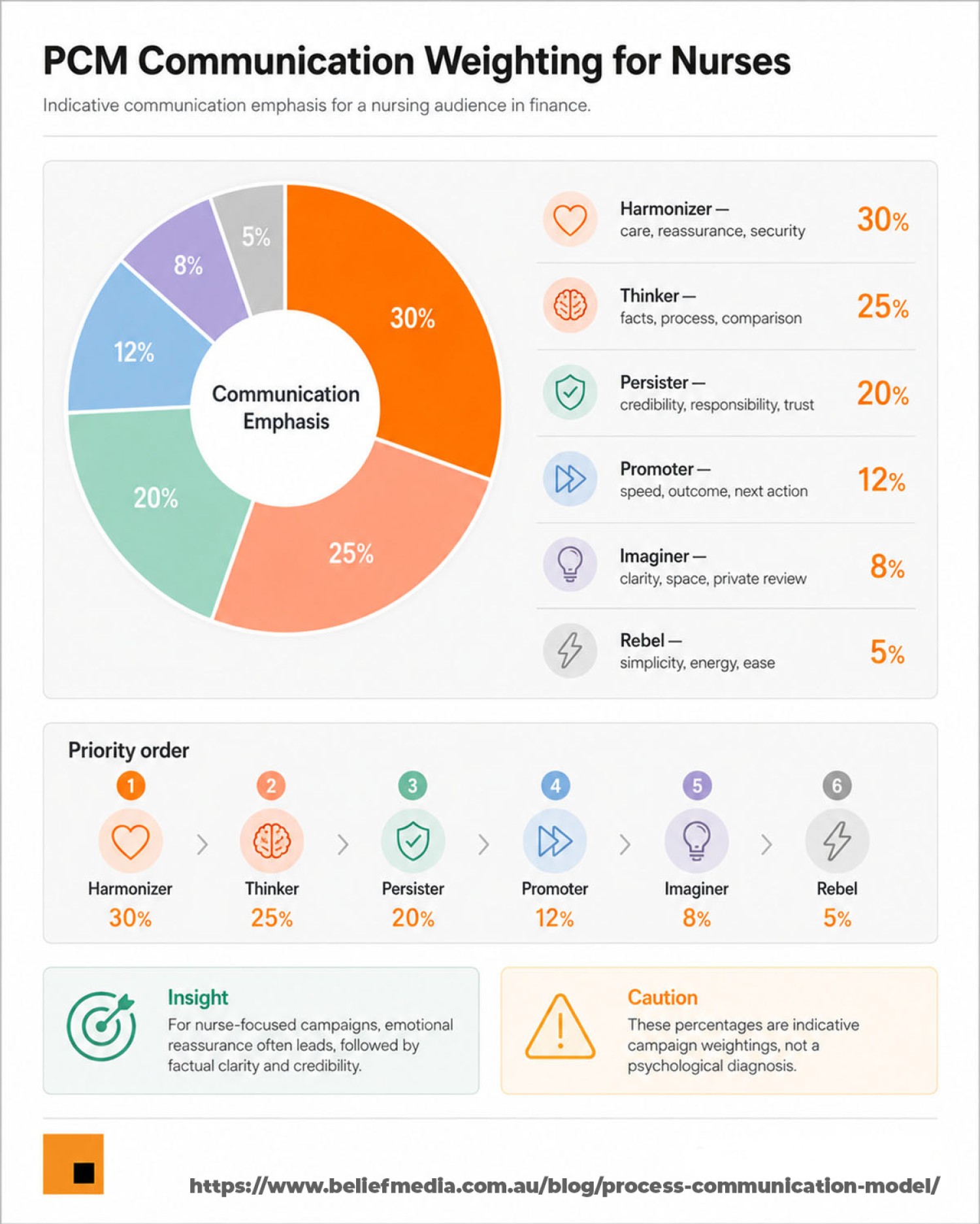
Pictured: There is no defensible 'average' PCM stack for nurses. PCM does not infer a person’s structure from occupation; it requires the individual 45-question profile because every person contains all six types in a unique order and strength. The official PCM material explicitly cautions against generalisation. For marketing and funnel design, however, you can construct a working audience hypothesis rather than claim a typical personality profile. Our stack might be described as a generic communication hierarchy for campaign design, not as the average psychological structure of a nurse. The rationale is that nursing is relational and patient-centred, which supports beginning with Harmonizer themes such as care, family security, reassurance, recognition and personal support. However, nursing is also highly procedural, evidence-based and accountability-driven, making Thinker and Persister communication particularly important. Broader research across health professionals finds a combination of cooperative, agreeable and self-directed traits, while nursing is also associated with assertiveness, time urgency and practical decisiveness. That evidence does not map directly onto PCM, but it supports a message architecture that combines human consequence with competence, credibility and action. The following are generic examples. Harmonizer opening: “You spend your working life caring for others. Your home loan should support the life you are building". Thinker substantiation: “Review your current rate, repayment, fees and likely refinancing costs”. Persister reassurance: “Receive a clear, responsible recommendation based on your circumstances”. Promoter action: “Check your position and identify the next practical step". This sequence uses the relational context to establish relevance, then quickly introduces evidence, professional credibility and a clear action path. The pictured percentages are not PCM research findings. They are a practical creative weighting for constructing a nurse-targeted funnel or advertisement. The weighting may also change according to the loan purpose. For a straightforward refinance campaign, Thinker and Harmonizer may dominate. For debt consolidation, Harmonizer and Persister should become more prominent because reassurance, dignity and responsible restructuring matter. For an urgent property purchase, Promoter and Thinker should rise because the borrower needs speed, sequence and execution. For a written educational funnel, Imaginer should receive greater emphasis through concise material and private review.
Our Language is Repeatedly Copied: Advertising copy such as "You spend your working life caring for others", "You work long shifts caring for others", "You've worked hard to get where you are" (for doctors), "You Save others money" (for accountants) etc. (all parapgrased) has been used by our clients for nearly two decades. We're seeing more and more businesses blatantly copy our campaigns - often word-for-word - and this is because they perform well. They're obviously missing the required funnel components and technology, but that's not the point. All our campaigns and campaign proposals includes (in part) demographic breakdowns, audience numbers, and a PCM analysis. It's the later analysis that guides creation of the ad, creative, copy, funnel, email program, and subsequent communication. You can easily improve conversations overnight (often doubling in a single day) by simply speaking in a language that the audience understands, and communicating in a manner that is more relatable and comforting. PCM plays a part in the building stage, and improved flow obviously supports better conversions.
Occupation Is a Starting Hypothesis, Not a Personality Diagnosis: A nursing qualification does not establish a person’s PCM Base, Phase or full personality structure. Occupation can nevertheless guide the initial communication architecture because professional environments shape language, expectations and decision context. For nursing audiences, a useful starting hypothesis is to combine Harmonizer-led recognition and reassurance with Thinker-style evidence, Persister-style credibility and a clear Promoter-oriented next step. The individual borrower’s responses should then refine the communication style.
Loan purpose introduces a further layer of differentiation. Refinance, debt consolidation, credit repair, first-home lending, investment finance and commercial lending each carry different practical and psychological implications. A refinance enquiry may be driven by cost, dissatisfaction or a desire to regain control. Debt consolidation may involve stress, embarrassment and fear of judgment. Credit repair may follow rejection, financial disruption or a loss of confidence. The communication style must therefore reflect both who the audience is and what financial condition they are attempting to resolve.
Industry Provides a Starting Hypothesis: Occupation and industry can inform the initial communication style of a funnel, but they should not be used as deterministic personality labels. They provide a practical starting hypothesis about language, professional identity, evidence preferences and decision context. The borrower’s individual communication needs should then be refined through observed behaviour, direct questions and conditional form responses.
As the borrower progresses, the funnel can move from audience-level assumptions toward individual-level communication. Responses concerning preferred detail, urgency, risk, support and decision-making can determine which explanations are prioritised, which case studies are shown, which videos are delivered and how the first telephone conversation is approached. The funnel therefore begins with communication designed for the audience and progressively adapts to the person.
The funnel should therefore be constructed around more than the a finance type. It should account for the emotional condition, industry, occupation, informational needs, and likely decision process associated with that product type and borrower position. On as basic level, a debt-consolidation funnel should not simply reproduce a refinance funnel with different terminology. A credit-impaired borrower should not be directed through language that implicitly assumes financial confidence, perfect credit conduct or familiarity with lending processes. The communication architecture must reflect the problem as the borrower experiences it, not merely the category under which the business records the lead.
PCM provides a useful framework for introducing this adaptability. Again, a funnel intended for analytically oriented customers may lead with calculations, comparisons, eligibility criteria and process transparency. A values-oriented audience may respond more strongly to responsible decision-making, long-term suitability and the integrity of the recommendation. A relationship-oriented customer may require reassurance, personal recognition and a clear sense that they will be supported. A more reactive audience may engage through concise language, visual simplicity and immediate relevance. Reflective customers may prefer a quieter process that allows private review, while action-oriented customers may require a direct statement of the opportunity and the next step.
A dynamic funnel can alter its content according to information already supplied by the borrower. Conditional pathways may change the order of questions, the density of explanation, the type of proof presented and the call to action. A borrower who indicates that cost is the dominant concern may be shown repayment comparisons and projected savings. A borrower who is anxious about the process may be shown a clear timeline and explanation of what happens next. A borrower who wants to act quickly may be given a concise document checklist and a direct booking pathway. The same compliant and accurate information remains available, but its prominence and sequence are adjusted.
This adaptation should continue beyond the landing page. The answers collected in the funnel can determine the autoresponder sequence, educational material, videos, case studies and tone of the first telephone call. A customer who prefers detailed analysis should not receive only broad promotional statements. A customer who has expressed concern about judgment should not receive aggressive urgency-based follow-up. A customer who wants speed should not be placed into a slow sequence dominated by long educational emails. The funnel should operate as the first stage of a continuous communication system rather than as an isolated lead-capture mechanism.
The Funnel Should Diagnose as Well as Convert: A finance funnel should do more than capture contact details and establish basic eligibility. It should collect enough information to identify how the borrower prefers to communicate, what they fear, what they value and what must be resolved before they are ready to proceed. Conversion is more likely when the funnel diagnoses the communication requirement before the first substantive conversation occurs.
The practical objective is not to build a separate funnel for every possible personality type. This is not practical. It is to create deliberate variation where the audience, loan category and customer condition justify it. A refinance funnel for accountants should not sound identical to a debt-consolidation funnel for nurses. A campaign directed at borrowers with credit impairment should not use the same assumptions, emotional framing or call structure as a campaign for high-income investors. The product may be financial, but the decision remains human.
A funnel becomes effective when the borrower recognises themselves within it. The language feels relevant, the process feels manageable and the next step feels proportionate to their level of confidence. Where that recognition is absent, even a highly optimised funnel may simply deliver more people into a communication process that was never designed for them.
With all the potential permutations in mind, let's have a look at some basic considerations.
Advertising for Mortgage Brokers
Advertising is the first communication filter. A finance advertisement framed entirely around a low rate appeals principally to calculation and immediate gain. It may fail to engage customers who are motivated by certainty, values, simplicity or personal security.
The same underlying proposition can be expressed through different perceptual frames. The below examples are provided for generic information only - they're not headlines we'd actually use.
For a Thinker: “Compare your current rate, monthly repayment and total interest cost".
For a Persister: “Make sure your home loan still reflects your long-term financial priorities”.
For a Harmonizer: “Create more breathing room in the family budget”.
For a Rebel: “Still paying the loyalty tax? Let us check".
For an Imaginer: “Review your loan privately with a concise written comparison”.
For a Promoter: “Check your position today and act if a better option is available”.
This does not necessarily require six independent campaigns. A strong campaign can integrate several frames while preserving a single clear proposition.
The PCM in Advertising: When advertising to a defined industry, profession or borrower segment, the message should not be manufactured from demographic data alone. Occupation often provides useful clues about the language, decision environment, professional identity and dominant communication preferences likely to exist within the audience. Engineers may respond more readily to structure, evidence, systems and technical clarity. Accountants may place greater weight on accuracy, defensibility, control and measurable financial consequences. Nurses may be more receptive to communication framed around care, security, service, time pressure and the practical realities of shift work. Police may respond to directness, credibility, procedure and decisive action. Borrowers experiencing credit impairment may require communication that preserves dignity, reduces shame, explains options without judgment and restores a sense of control. These are not rigid personality classifications, and no profession should be reduced to a stereotype. They are communication hypotheses used to shape the first version of the message. In practice, one PCM communication style may be more dominant within an advertisement than the others because the campaign is designed to establish immediate relevance with a specific audience. A campaign for engineers may therefore lead with facts and structure, while a campaign for nurses may place greater emphasis on reassurance and personal consequence. The underlying product information, disclosure obligations and factual claims remain unchanged; what changes is the communication architecture used to make the message psychologically accessible. The objective is not to tell different audiences different truths. It is to present the same truth through language, emphasis and framing that the intended borrower is more likely to recognise, trust and act upon.
ASIC’s advertising guidance applies broadly to communications intended to inform consumers about or promote financial products, financial advice services, credit products and credit services. Personalised communication architecture does not reduce the requirement that claims remain accurate, balanced and supportable.
Finance Marketing Guide: Our Finance Marketing Guide includes a couple of hundred pages on advertising, and it includes the necessary framework upon which PCM can be applied.
Lead Response
The first response to an enquiry is often treated as an administrative step. It is actually a high-value diagnostic event. The customer’s language may indicate the most appropriate initial communication process.
“I want to understand the numbers” suggests a factual entry point.
“I do not think my bank has treated me fairly” suggests a values-based entry point.
“I am worried about the repayments” suggests an emotional entry point.
“I just want to know whether this is worth doing” suggests concise evaluation.
“Send me something to look over” suggests reflective processing.
“I want to get this moving today” suggests action.
These signals should not be treated as definitive personality diagnoses. They are communication hypotheses. The professional should test them by observing the response.
A rapid call without context may be less effective than a slightly later call supported by relevant information. Conversely, excessive research can become an excuse for failing to contact the customer promptly. The objective is informed speed: make contact early, but arrive with enough context to make the conversation useful.
Discovery and Fact-Finding
A finance fact-find is often approached as data extraction. The professional collects income, expenses, debts, assets, objectives and identity information. PCM suggests that fact-finding should also reveal how the customer makes decisions. Useful questions include (as an example):
- “How do you prefer information to be presented?”
- “Would you like the detailed figures first or the broad recommendation?”
- “Do you prefer to work through options together or review them privately?”
- “What would make this process feel well managed?”
- “How quickly are you hoping to act?”
- “Who else needs to feel comfortable with the decision?”
- “What matters more: lowest cost, certainty, flexibility, speed or service?”
These questions improve both communication and recommendation quality.
Stepped forms can extend this principle into the digital fact-find itself, or our own stepped forms. A form does not need to present every borrower with the same questions, explanations or result screens in the same order. Conditional behaviour can change the emphasis according to the customer’s responses and apparent communication preference. A highly analytical borrower may benefit from calculations, comparisons and detailed explanatory data, while another borrower may respond more effectively to a clear description of the likely outcome, the process that follows or the immediate action required. The underlying information remains accurate and complete, but the presentation is adjusted so that the form gives greater prominence to evidence, reassurance, process, simplicity or action where appropriate. In this sense, the stepped form becomes more than a mechanism for collecting data; it becomes an adaptive communication environment.
The answers to these questions can also inform what happens after the form is submitted. A borrower who prefers detailed figures may enter an autoresponder sequence containing comparisons, calculators and written analysis. A borrower who values reassurance may receive a short explanatory video, a personal introduction and a clearer description of what to expect. A borrower who wants speed may receive a concise action list and an immediate invitation to proceed. These preferences can guide which emails are sent, which videos are shared, how the first call is structured and how frequently follow-up communication occurs. When the broker has an informed view of the person before contact is made, the opening questions can be selected more carefully, unnecessary friction can be removed and trust can be established more quickly. The borrower is put at ease not because the broker is performing a rehearsed script, but because the conversation begins in a form that feels relevant, controlled and psychologically safe.
Presentation of Recommendations
A recommendation should be technically consistent while psychologically adaptive.
For a Thinker: Begin with analysis and process.
For a Persister: Connect the recommendation to principles and stated priorities.
For a Harmonizer: Acknowledge the personal consequence and establish security.
For a Rebel: Simplify the comparison and maintain interaction.
For an Imaginer: Provide concise written material and processing time.
For a Promoter: State the opportunity, decision and next action early.
The recommendation should ultimately contain the same material information. Adaptation affects emphasis and sequence, not truth.
Document Collection
Document collection is one of the most common points of friction in lending. A generic request such as “Please send all supporting documents” creates ambiguity. PCM-informed communication can reduce the burden.
For a Thinker: provide a categorised checklist and explain why each document is required.
For a Persister: Connect completion to accuracy and responsible submission.
For a Harmonizer: Reassure the customer that assistance is available.
For a Rebel: Divide the task into small actions and make progress visible.
For an Imaginer: Provide a concise list without repeated interruption.
For a Promoter: Identify the minimum immediate actions required to move the application.
The document process itself may not change, but the method we ask for documents may vary.
Application Updates
Silence is rarely neutral. In the absence of information, customers construct their own explanations.
The Thinker: The Thinker may assume the process is poorly managed.
The Persister: The Persister may question the professional’s reliability.
The Harmonizer: The Harmonizer may feel forgotten.
The Rebel: The Rebel may lose interest.
The Imaginer: The Imaginer may withdraw further.
The Promoter: The Promoter may bypass the broker and contact another provider.
A meaningful update does not require a major event. It can state:
- What has occurred.
- What remains outstanding.
- Who is responsible.
- When the next update will occur.
A structured communication rhythm reduces uncertainty and prevents the customer from having to pursue the professional.
Declines and Adverse Outcomes
A decline tests the communication system more severely than an approval. The customer may experience shame, anger, confusion or fear. The professional must explain the outcome without becoming defensive, blaming the lender or offering false hope.
The Thinker: A Thinker may require the factual basis and possible alternatives.
The Persister: A Persister may focus on fairness and whether the decision was properly reached.
The Harmonizer: A Harmonizer may require acknowledgement of the emotional consequence.
The Rebel: A Rebel may need the issue simplified into manageable parts.
The Imaginer: An Imaginer may need private time before discussing alternatives.
The Promoter: A Promoter may immediately ask what can be done next.
The communication should preserve dignity and agency:
“The application cannot proceed under this lender’s current policy because of the servicing result. That is disappointing, but it gives us a defined issue to address. There are three possible next steps.”
We discuss the style of Radical Candour (bluntness) and Ruinous Empathy (avoidance) in our Finance Marketing Guide. The above statement sites somewhere in the middle - it is factual, diplomatic, and truthful.
Settlement and Ongoing Service
Settlement is not the end of communication. It is the point at which the customer evaluates whether the promises made during acquisition were genuine.
The Thinker: A Thinker may value an annual numerical review.
The Persister: A Persister may value evidence that the professional remains committed.
The Harmonizer: A Harmonizer may value personal follow-up.
The Rebel: A Rebel may engage with concise, useful and varied communication.
The Imaginer: An Imaginer may prefer low-frequency but purposeful contact.
The Promoter: A Promoter may respond to opportunities and decisive review triggers.
The same generic newsletter cannot satisfy every communication preference. Segmentation should therefore account for more than product type. It may also account for communication behaviour, preferred channel, frequency and decision style.
PCM and Financial Vulnerability
Financial vulnerability should not be treated as a permanent category occupied by a small group of consumers. Vulnerability may arise from illness, bereavement, unemployment, family violence, cognitive impairment, language barriers, financial hardship, major life transitions or situational stress. We're all financially vulnerable in some respect.
ASIC has repeatedly emphasised the importance of protecting vulnerable customers and has identified shortcomings in lenders’ support for consumers experiencing financial hardship.
Stress can materially affect comprehension, memory, attention and decision-making. A customer who would ordinarily process information analytically may become overwhelmed by detail. A decisive customer may become impulsive. A relationship-oriented customer may agree merely to end an uncomfortable interaction.
PCM’s distress framework can help a professional notice that the customer is no longer communicating from their normal strengths. However, personality adaptation should not substitute for formal vulnerability procedures.
Appropriate responses may include slowing the process, reducing information density, confirming understanding, offering alternative communication channels, allowing a support person, documenting consent carefully and referring the customer to suitable assistance.
AFCA’s complaint-resolution guidance recommends accessible complaint channels and electronic communication that is readily understandable.
Vulnerability Changes the Communication Obligation: When vulnerability is present, the objective is not merely to preserve conversion. It is to protect comprehension, voluntariness and procedural fairness. A customer’s willingness to proceed is not sufficient where the communication environment has impaired their capacity to understand the consequences.
Distress Sequences: Communication Under Pressure
One of PCM’s most distinctive contributions is its description of predictable distress behaviour. The model proposes that when psychological needs are not met, individuals may move through recognisable patterns of unproductive behaviour. Their ordinary strengths become exaggerated, distorted or temporarily inaccessible.
A responsible Thinker may become controlling, critical or excessively focused on detail.
A principled Persister may become suspicious, judgmental or preoccupied with perceived failures.
A caring Harmonizer may become overly accommodating, self-doubting or emotionally distressed.
A creative Rebel may become disruptive, blameful or careless.
A reflective Imaginer may withdraw, wait passively or fail to act.
A resourceful Promoter may manipulate, take unnecessary risks or disregard consequences.
These descriptions should be treated as behavioural hypotheses rather than fixed predictions. The professional’s role is not to label the person but to recognise that escalating behaviour may indicate an unmet need or a failing communication process.
When a customer becomes critical, the instinctive response is often to defend the recommendation. When they withdraw, the professional may increase contact. When they become impulsive, the professional may accelerate the transaction. Each response can intensify the distress pattern.
A better response is to restore productive contact.
Provide structure to the overwhelmed Thinker.
Acknowledge the concern of the Persister.
Re-establish safety for the Harmonizer.
Reduce friction and restore positive engagement for the Rebel.
Provide a specific, manageable direction to the Imaginer.
Set clear boundaries and consequences for the Promoter.
PCM in Finance Leadership and Team Management
The finance industry contains professionals whose roles require very different cognitive and interpersonal strengths: brokers, advisers, credit analysts, compliance personnel, marketers, processors, relationship managers, lenders and customer-service staff.
Conflict frequently emerges because one role interprets another through its own standards.
- The broker wants speed.
- The credit analyst wants evidence.
- The compliance manager wants defensibility.
- The marketer wants attention.
- The processor wants completeness.
- The customer wants confidence.
None of these objectives is inherently illegitimate. Problems arise when one perspective is treated as the only rational perspective.
PCM can help managers distinguish performance failure from communication mismatch.
- A Thinker employee may need defined responsibilities and planning time.
- A Persister may need recognition for standards and commitment.
- A Harmonizer may need relational trust and personal acknowledgement.
- A Rebel may need interaction, variety and shorter feedback cycles.
- An Imaginer may need uninterrupted work and specific instructions.
- A Promoter may need autonomy, challenge and visible results.
Fair management does not necessarily mean communicating identically with every employee. It means maintaining consistent standards while creating conditions in which different people can meet them.
Consistency Does Not Require Uniformity: A manager can maintain the same performance expectations, legal obligations and service standards while adapting instruction, recognition and feedback to the employee. Uniform treatment may appear fair but produce predictably unequal comprehension and motivation.
PCM in Complaint Management
Complaints are often treated as disputes about facts. Many are also disputes about recognition, process and trust.
A Thinker complainant may want a chronology and evidence.
A Persister may want accountability and acknowledgement of principle.
A Harmonizer may want to know that the human impact has been understood.
A Rebel may want the matter simplified and resolved without bureaucracy.
An Imaginer may prefer a carefully written response and time to consider it.
A Promoter may want a decision, remedy and deadline.
A technically accurate response can aggravate a complaint when it does not address the customer’s underlying perception.
For example:
“Our records indicate that the disclosure was issued on 14 May.”
This may answer the factual issue but not the relational issue.
A stronger response may be:
“Our records show that the disclosure was issued on 14 May. However, we recognise that receiving the document does not necessarily mean the explanation was sufficiently clear. We have reviewed the communication sequence and set out below what occurred, what should have occurred and how we propose to resolve the matter.”
AFCA generally expects consumers to raise complaints with the financial firm before escalating them and encourages firms to maintain accessible and understandable complaint processes.
PCM and Digital Communication
Digital finance has increased speed and scale but often reduced contextual sensitivity.
Automated emails, text messages, chatbots, portals and workflow systems usually communicate in one institutional voice. The customer is expected to adapt to the system.
PCM suggests that digital communication can be more adaptive without becoming intrusive.
A customer might select:
“Give me the detailed explanation.”
“Show me the main points.”
“Let me review this privately.”
“Talk me through it.”
“Tell me the fastest next step.”
The system can vary message length, sequence, frequency and format while preserving the required content.
A Thinker may receive a detailed comparison and timeline.
A Harmonizer may receive a short explanatory video from the broker.
A Rebel may receive a visual progress tracker.
An Imaginer may receive a concise summary without repeated reminders.
A Promoter may receive a direct action list.
The objective is not to infer sensitive personality attributes secretly from behavioural data. Transparent preference collection is safer and more respectful than covert psychological classification.
The Evidence Base and Appropriate Caution
PCM has a substantial practitioner history and is used in training, coaching, leadership and organisational communication. It is also widely associated with NASA’s astronaut selection and training activities. PCM-affiliated accounts state that Dr Terry McGuire introduced Kahler’s work into NASA astronaut assessment during the late 1970s.
That history is relevant, but it should not be treated as independent proof of every proposition attached to the model.
PCM does not possess the same breadth of independent psychometric literature as major trait frameworks such as the Five-Factor Model. A 2024 study examining creativity and PCM personality characteristics described the model as widely used in practice but comparatively underrepresented in scientific literature, concluding that it warranted further investigation.
A 2025 study involving 90 participants examined physiological responses to different communication processes using skin-conductance measures. The results suggested that participants could receive each communication process, but emotional responses varied according to PCM Base Type. This is relevant emerging evidence, although it does not by itself validate every component or application of PCM.
The intellectually responsible position is neither uncritical acceptance nor casual dismissal.
PCM should be used as:
A communication hypothesis.
An observational framework.
A vocabulary for discussing motivation.
A method for adapting message delivery.
A tool for recognising possible distress patterns.
It should not be used as:
A clinical diagnosis.
A fixed judgment of character.
A substitute for evidence.
A covert manipulation system.
The sole basis for employment, lending or advice decisions.
A reason to stereotype customers.
A Model Is a Map, Not the Customer: PCM reduces complex behaviour into a usable structure. That reduction creates practical value, but it also creates error. The model should guide observation and questioning, not overrule what the individual explicitly communicates about their own needs and preferences.
How to Apply PCM Without Profiling People Recklessly
Professionals should avoid announcing personality conclusions after a short conversation. Statements such as “You are clearly a Promoter” or “She is a Harmonizer” can become reductive and self-confirming.
A more disciplined process is required.
Begin with observation. Notice the customer’s language, pace, questions, preferences and response to different forms of explanation.
Form a tentative communication hypothesis.
Adapt one element of the communication.
Observe whether engagement improves.
Ask the customer directly how they prefer information.
Continue adjusting.
This approach treats personality as dynamic evidence rather than a label.
A customer who requests figures may be a Thinker, but they may simply be completing due diligence.
A customer who wants fast action may be a Promoter, but they may be facing a settlement deadline.
A customer who becomes emotional may be a Harmonizer, but they may simply be experiencing an emotionally significant event.
Context must precede classification.
A Practical PCM Framework for Finance Professionals
A useful financial communication process can be built around five questions.
1. What is the customer perceiving?
Are they primarily focused on facts, values, relationships, reactions, reflection or action?
2. What does the customer need to feel understood?
Do they require evidence, recognition, warmth, energy, space or decisiveness?
3. What is motivating the present decision?
Is the customer seeking security, validation, control, relief, opportunity, simplicity or progress?
4. What signs of distress are visible?
Has the customer become critical, suspicious, overly accommodating, disruptive, withdrawn or impulsive?
5. What communication adjustment is appropriate?
Should the professional add structure, acknowledge values, restore personal contact, simplify the interaction, create processing space or define immediate action?
These questions should be incorporated into training, scripts, CRM notes, review processes and quality assurance.
A PCM-Informed Finance Conversation
A robust conversation may proceed in the following sequence.
First, establish contact using the customer’s preferred communication process.
Second, identify the financial objective and the meaning attached to it.
Third, determine the customer’s preferred level of detail, pace and decision process.
Fourth, provide complete and accurate information through an appropriate structure.
Fifth, test understanding rather than merely asking whether the customer understands.
Sixth, recognise hesitation or distress and adapt before escalating pressure.
Seventh, agree on a specific next action and communication timeframe.
The quality of the conversation depends on the integration of technical competence and psychological awareness. Neither is sufficient alone.
The Strategic Value of PCM in Finance
PCM is sometimes presented as a technique for improving rapport. Its strategic significance is broader. For starters, it'll improve:
- Effective communication can improve:
- Customer comprehension.
- Quality of discovery.
- Accuracy of information collection.
- Confidence in recommendations.
- Document completion.
- Application momentum.
- Complaint prevention.
- Employee performance.
- Leadership flexibility.
- Customer retention.
- Referral behaviour.
- Brand trust.
However, these outcomes should not be understood as the product of persuasive tricks. They emerge because the organisation reduces the gap between what it communicates and what the recipient can meaningfully receive.
In a competitive finance market, product access is increasingly commoditised. Many brokers can access similar lenders. Many advisers use similar software. Many firms publish similar educational content. Many customer journeys contain similar digital tools.
Communication quality becomes a differentiator precisely because it is difficult to standardise.
A business can purchase a CRM - it cannot purchase genuine attention. It can automate an email - it cannot automate judgment. It can build a product comparison - it cannot assume the comparison has created understanding. It can generate a compliant disclosure - it cannot infer that the disclosure produced informed confidence.
PCM offers a method for improving that judgment.
Conclusion
Finance Is a Human Communication System.
The Process Communication Model begins with a proposition that is simple in theory but demanding in practice: people do not receive, interpret or act upon communication in identical ways. The same financial information can produce confidence in one borrower, uncertainty in another and resistance in a third. The distinction is rarely explained by the quality of the information alone. More often, it is explained by the relationship between the form of the message and the perceptual framework through which the recipient evaluates it.
Some customers establish confidence through evidence, structure and logical consistency. Some require alignment with values and principles. Some respond first to warmth, recognition and personal trust. Others engage through energy, immediacy, reflection or a clear pathway to action. These are not superficial stylistic preferences. They influence how risk is perceived, how credibility is assigned, how much information can be processed and whether the borrower feels sufficiently understood to proceed.
The finance professional who communicates in only one dominant mode may still appear highly effective because that communication style will resonate strongly with a proportion of the market. The analytical broker will convert analytical borrowers. The highly relational broker will connect naturally with customers who prioritise personal trust. The decisive broker will perform well with borrowers who value speed and action. The difficulty is that the same broker may incorrectly interpret all remaining customers as hesitant, disorganised, uncommitted, distrustful or simply poor-quality leads.
This is one of the central commercial consequences of communication mismatch. A lead may appear to have been lost because the borrower was “shopping around”, “not ready”, “only interested in rate” or “difficult to contact”. In reality, the borrower may have remained commercially viable but failed to experience the degree of psychological contact required to continue the relationship. They did not necessarily reject the product, the recommendation or the competence of the broker. They may simply have encountered a communication style that did not allow them to recognise that competence.
PCM provides a disciplined method for examining this failure. It helps the professional move beyond a narrow assessment of what was said and consider how it was said, how it was sequenced, what was emphasised, what was omitted and how the borrower was likely to interpret the interaction. It directs attention toward the architecture of communication: the language, pace, tone, detail, emotional register, structure and call to action through which the technical information is delivered.
The more sophisticated approach is therefore adaptive rather than uniform.
Be structured without overwhelming the borrower.
Be principled without becoming judgmental.
Be warm without obscuring risk or material information.
Be engaging without trivialising the significance of the decision.
Allow reflection without abandoning momentum.
Be decisive without manufacturing pressure.
This adaptability is not cosmetic. It is not a matter of polishing a script or introducing superficial rapport techniques. It requires the finance professional to recognise that the borrower’s communication needs are part of the decision environment. A technically accurate recommendation delivered through the wrong process may remain commercially ineffective. Conversely, the same recommendation, presented through an appropriate perceptual channel, can become clearer, more credible and easier to act upon.
The first human conversation is especially important. In an increasingly automated finance environment, the initial telephone call remains a critical biological touch point. It is the first moment in which the borrower encounters the business as a person rather than as an advertisement, landing page, form, email or automated sequence. The borrower begins to assess tone, confidence, competence, intent and trustworthiness almost immediately. That assessment is not always conscious, but it is consequential.
A broker may have an exceptional funnel, strong technology, efficient workflows, broad lender access and technically superior processes. None of these capabilities will fully compensate for a first conversation that fails to resonate. When the borrower does not feel understood, the wider commercial infrastructure becomes largely invisible. The customer does not experience the quality of the CRM, the sophistication of the automation or the breadth of the lender panel. They experience the person speaking to them.
This is why better communication can produce greater volume without necessarily requiring greater lead volume. The conventional response to poor conversion is often to purchase more enquiries, expand advertising or increase follow-up frequency. Those interventions may increase activity, but they do not correct communication failure. Where the principal weakness exists at the human point of contact, adding more leads simply increases the number of opportunities exposed to the same defect.
A more efficient strategy is to retain a greater proportion of the leads already being generated. Even a modest improvement in first-call resonance, trust formation and communication fit can materially affect appointment rates, document completion, application progression and eventual settlement volume. The commercial effect compounds because each recovered lead has already passed through the expensive stages of awareness, interest and enquiry. The business is not creating demand from nothing; it is preventing viable demand from being lost unnecessarily.
This is the practical meaning of the proposition that better communication creates more volume. It does not imply that persuasive language can manufacture suitability, override policy or convert every enquiry. Rather, it recognises that a proportion of lost opportunities are not lost because the borrower was unsuitable or because the broker lacked capability. They are lost because the communication process failed before that capability could be properly understood.
PCM creates a framework for identifying and reducing this leakage. It can inform the funnel, the fact-find, the autoresponder sequence, the educational material, the presentation of recommendations, the first telephone call and the ongoing service relationship. It helps determine when the borrower requires evidence, reassurance, brevity, reflection, recognition or action. It provides a language through which communication can be deliberately designed rather than left to habit, personality or rehearsed industry patter.
This is particularly valuable in finance because the industry frequently mistakes standardisation for consistency. Consistency requires that information remain accurate, complete and compliant. It does not require that every borrower receive the information in precisely the same tone, sequence or format. PCM allows the business to preserve the integrity of the message while adapting the method of delivery. The truth should not change. The communication architecture should.
PCM is not a complete theory of personality, a clinical instrument or a substitute for professional judgment. Its categories should not become rigid labels, and its value should not be overstated beyond the available evidence. It should be used as a communication hypothesis: a structured means of observing, testing and adapting. The individual borrower remains more important than the model used to understand them.
Used critically, however, PCM provides a powerful explanation for why technically correct financial communication or advertising so often fails, and why funnel effectiveness is not universally successful across industry types. It reveals that communication failure does not necessarily arise from ignorance, incompetence or poor intention. It can arise because the message was delivered through a channel that the recipient could not readily use.
The enduring principle is that communication is not complete when the message has been transmitted. It is complete only when the recipient has received, interpreted and understood it sufficiently to make an informed decision. In finance, this standard should apply to advertising, discovery, recommendations, disclosures, complaints, hardship conversations and every other meaningful point of contact.
A business that understands this principle does not merely communicate more. It communicates with greater precision.
It wastes fewer viable opportunities.
It establishes trust faster.
It reduces unnecessary friction.
It retains far more of the leads it has already paid to acquire.
It converts far more enquiries into substantive conversations.
It moves far more suitable borrowers through the process.
It produces greater volume not by applying more pressure, but by becoming easier to understand, easier to trust and easier to engage. In finance, that distinction is not merely psychological. It is commercial, ethical, operational and professional.