Back in 2015, we migrated our legacy email marketing facilities to a proprietary facility in Yabber that integrated directly with the Microsoft 365 architecture. We handled the email marketing while leveraging the powerful Microsoft infrastructure to support compliance, deliverability, and reliability. The completely integrated system has operated flawlessly since its introduction with millions of emails sent and received. However, as with all things - and since the introduction of our powerful data-driven Xena modules - we resolved areas of improvement, compiled tickets from clients, identified where others had failed, and we listened to the feedback of those using other solutions.
The results is Nexus - a completely ground-up next-generation rebuild of the core Email API which further strengthens the power of systemwide client functionality and is more aligned with your business compliance requirements and commercial objectives.
Marketing: It is important to reinforce that we deliver some of the most effective and technically advanced marketing solutions available to the finance industry. The communication demands of this sector require more than isolated tools; they require an integrated framework aligned with recognised best-practice marketing objectives. Because communication is intrinsically connected to every aspect of a finance business, our communication tools are designed to operate as part of the broader Yabber ecosystem, supporting deeper integrations, stronger automation and more consistent customer engagement. We maintain an integration-first philosophy, which means our technology is built to work cohesively across systems rather than being constrained by the technical debt, fragmented processes and platform limitations that define many competing solutions.
What is Nexus? [ Finance Email & SMS Marketing Suite ]
Driven by the need for complete compliance with high deliverability rates, ease-of-use, and total integration with all of our Yabber modules and the full suite of Microsoft tools, we updated the email and SMS marketing modules to Nexus - an extremely powerful Email and SMS module. Yabber provides a unified facility for all email requirements - and all connected directly to your existing and primary email account - while the API provides extraordinary scalability with the flexibility to support virtually anything you ask of it. To be clear, it doesn't matter if an email is associated with general marketing, autoresponders, repricing, BDM contact, general client notifications, or anything else - it is all sent through your single, compliant, and unified primary email accounts with Nexus providing the conduit.
Your data belongs to you, and we worked tirelessly to develop solutions where we removed the need for duplicate information, synchronisation, or the need to manage simple tasks from within a standalone dashboard, so the first thing we did was eliminate traditional email (and SMS) lists. Instead, we now further integrate the Microsoft Outlook connectivity by using Contact Categories for distribution lists, and those same categories are used to manufacture website, communication and other user groups (more on this shortly). This solution mitigates the messy and discombobulated mess of stray contacts across multiple platforms that claim to sync but rarely do.
We last talked about email compliance back in 2021, and the article details why we did away with our former proprietary software in favour of a Microsoft-driven solution. With the introduction of Nexus, we've further ratified email integration meaning that your email marketing platform, emails, contacts, and lists, now truly belongs to you. We simply provide a scalable and feature-rich API to seamlessly integrate with your business and marketing efforts. Yabber provides the full features necessary for enterprise-level email campaigns (as it always has done), and the updated functionality ensures that you are returned with unmatched triggers and statistics. Nexus is the only system designed specifically for the finance and property industry (rate placeholders, for example, may be used in autoresponder sequences), and ongoing updates and features will continue to support the broader industry.
Nexus supports managed email services in a more effective manner, provides easier access to templated and placeholder content, and directly connects to all your marketing assets - such as website articles, videos, and downloads - so you never have to create a link. The list of features is significant, and the impact it'll have on your workflow is potentially game-changing.
Technology for Brokers by Brokers: A distinguishing characteristic of Nexus with our integrated funnel methods is its rejection of the increasingly common tendency for digital experiences to be dictated by the limitations, preferences, or convenience of the underlying technology stack. In many contemporary implementations, the development process becomes an exercise in adapting consumer behaviour to fit the constraints of software platforms, customer relationship management systems, automation workflows, or analytics frameworks. The result is a form of technological determinism in which the architecture of the funnel is shaped not by how human beings naturally evaluate information, build trust, manage cognitive load, or make decisions, but rather by what is easiest and 'cheapest' to implement, measure, or automate. This represents what may be described as a "tail wagging the dog" phenomenon, whereby the enabling technology assumes primacy over the psychological and behavioural objectives it was intended to serve. Nexus - and the part it plays in our broader choice architecture and funnel - inverts this relationship entirely. It begins with a detailed examination of human cognition, behavioural economics, decision science, and consumer psychology, recognising that successful conversion pathways are fundamentally human systems rather than technical systems. Every stage of the experience is therefore constructed around the way individuals process uncertainty, seek reassurance, establish credibility, compare alternatives, and progressively develop commitment. Technology is viewed not as the architect of the customer journey, but as a subordinate mechanism whose sole purpose is to facilitate a psychologically coherent and behaviourally optimised experience. This distinction is critical because mortgage conversions are managed with compliant perceptions, emotions, expectations, and mental models. Consequently, the effectiveness of email marketing and the funnel is not determined by the sophistication of its underlying technology, but by the extent to which that technology unobtrusively supports the natural processes through which borrowers evaluate risk, establish trust, and arrive at decisions. By placing seamless and effortless behavioural function ahead of best-practice technical implementation - all of which functions out of the box - our funnel method seeks to create conversion environments that are aligned with the realities of borrower decision-making rather than the operational preferences of software systems, resulting in experiences that are simultaneously more intuitive, more persuasive, and ultimately more effective.
Windows Solutions: Feedback from our clients suggested that they don't like interface introduced by way of SAAS software with pesky monthly subscriptions, so we've created a standalone Windows executable that installs email marketing solutions direct to your PC - something we're trailing now with a small group of brokers. If successful, and if we can justify the effort that goes into maintenance, we'll likely make this available with Yabber. We'll also create mobile applications at some point, but the current position is that it isn't required.
Nexus Is an Evolving Module
We still need a couple of hundred thousand emails sent in order to have the necessary data to build a comprehensive suite of statistical graphs. The data we collect is significant - very significant. And we aggregate statistics in standalone tables for parent campaigns (groups of campaigns), email campaigns, autoresponders, and so on, meaning that the most granular of statistics may be queried at lightning speed and returned without limitation.
Nexus Statistics: When the suite of graphs is introduced to Yabber, we'll update this article and modify it appropriately. The fully integrated statistics - meaning that website visits and triggers are all tied to Nexus - gives you an understanding of your marketing efforts that is unrivalled.
The plan is to migrate all email functionality into the Yabber portal on your website, thus negating the need to log into Yabber to send email or SMS messages, and the API was built to support this out of the box.
Yabber: Yabber provides a comprehensive suite of GUI tools to manage your marketing efforts, but at its core it is an API that provides two-way connectivity to all your business and marketing tools. All core Yabber features will be integrated directly into the Yabber portal on your website.
Microsoft Connectivity
Nexus is connected to your own standalone Microsoft application (and your own parent Tennant) by default for the purpose of sending email and managing calendar access. However, in order to synchronise contacts in real-time via the Microsoft webhook (subscription) feature, we require that you activate a subscription for the applicable Outlook email accounts - a simple one-step process.
Any incoming email is evaluated by our system, and the sender is added as a CRM contact if they don't exist. This action connects that user to other actions within Yabber. Additionally, our hAIlo module (soon to be renamed as a result of others that took a liking to it) also has the capacity to action automatic replies... although this level of AI is provided to our managed clients until it can be relied upon for compliance.
Email Triggers: Full integration with Microsoft means that we can action Yabber triggers on the basis of incoming emails. An important marketing and business tool, we can evaluate the email title, sender, domain, body, or other attribute to trigger various actions. Certainly, all emails are indexed against a client record forming a compliance library of all communication - regardless of source. More on this feature another time.
Unlike others, we don't put limitations on the number of contacts, and your send rate is only limited by the allowance afforded to you via Microsoft - currently about 10'000 emails per day. we don't charge for additional email users, and we don't have any limitations on the number of lists, campaigns, or anything else.
Nexus Functions and Features
Nexus is integrated with Formly, so any subscription via your website or anywhere else will add that contact as a Microsoft contact and assign them to applicable contact lists (Microsoft Categories). Autoresponder sequences obviously apply and come directly from your MS365 Business Email. It's super-simple and absolutely compliant.
Nexus is integrated with all Yabber modules, so it performs additional features that supplement 'standard' email marketing. Some of Nexus' power is illustrated by the array of powerful functionality listed below.
- Comprehensive and lightning-fast real-time statistics
- Direct syncing of contacts to Outlook
- Manage contacts and Nexus lists from within Outlook
- Market update alerts
- Website form (Formly) autoresponders
- General client education
- Client engagement tracking.
- ASIC-compliant templates
- General SMS and email campaigns
- CRM integration
- Review & referral automation
- RAX, or Relationship Manager bulk emails
- Partner email management and campaigns
- HTML and Standard text editor
- Placeholders for live rate product data of various types
- CRM and Property data placeholders
- Direct access to website article and page links
- Direct access to YouTube video links
- Direct access to Download links
- Extensive email trigger options, with a large number of supported URL parameters
- Yabber and custom email templates
- Send frequency and time rules
- Unlimited email signatures
- Unlimited contacts
- Send up to 10 thousand emails per day
- Optionally include sent emails in 'Sent Items ' folder
- Conditional Campaign and Autoresponder redirects on unsubscribe
- Blacklist domains and emails
- Unlimited email lists and list groups
- Unlimited campaigns
- Directly integrated with website Formly forms
- Split test unlimited emails for any single campaign
- Send exclusions based on past opens, clicks, or emails received
- Full review tables (emails, campaigns, lists etc.)
- Direct campaign and autoresponder integration with website content
- Website Conditional Content integration
- Direct landing page integration with turnkey facilities
- Mirroring of Nexus Lists as Facebook for Custom Audiences (and Website Groups)
Because Nexus is relatively new, we're progressively introducing new features every month.
There are email solutions that'll charge you over $100 a month for something that is generic in nature, not as feature-rich, and then they'll impose limitation on something as simple as the number of contacts. We don't impose arbitrary cost-based limitations because their inclusion only serves to negatively impact your commercial outcomes.
Let's Start with Contacts [ Outlook Contacts ]
In previous interactions of Yabber we had Microsoft Contacts, CRM Contacts, and SMS Contacts, which were all aggregated into 'Yabber Contacts', but this wasn't ideal because our own system was working with multiple sources while (at the same time) I was telling businesses to stick with one single CRM data platform. What we were telling businesses, and what we were doing, were in complete in contradiction to our rationalised and integrated compliance-based data model.
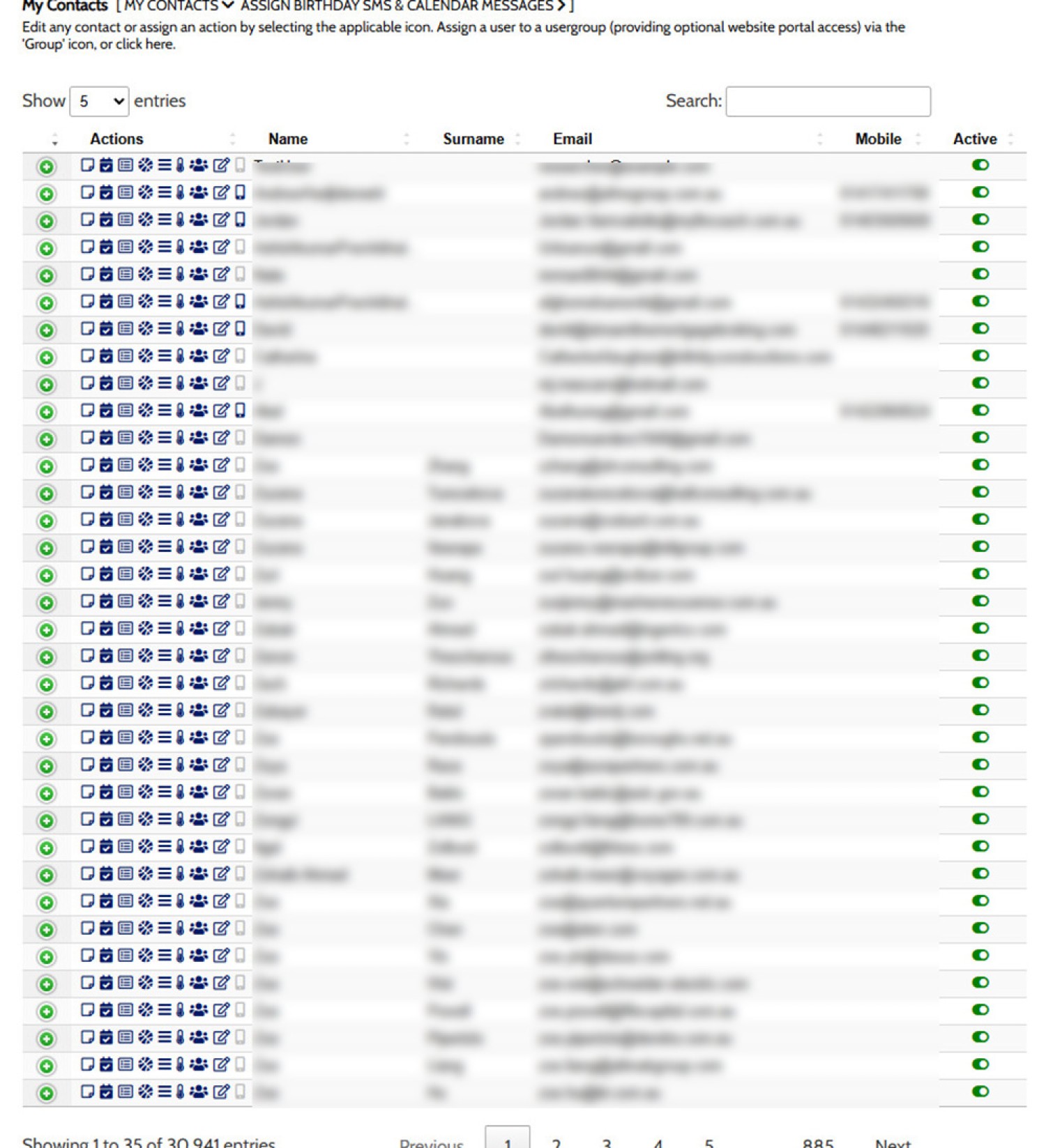
Pictured: Yabber is not a CRM... but it does map CRM users to those contacts registered in Outlook. This enables a compliance library to be manufactured on the basis of all interactions. The basic contact panel in Yabber provides links for sending emails and texts, updating the contact status, managing assigned lists, and other features. Each panel expands to reveal more details. CRM contacts in Yabber are synced in real-time to your primary Outlook installation. All contacts and leads are sent to a nominated address book in Outlook by default.
The solution to the mess of contacts common to most businesses was to migrate all contacts into a system you already own - Microsoft Outlook. Outlook has a contact feature that isn't often used, but it's also very good. We now use your Contact source for all your leads, contacts, and CRM contacts, and this method is now the primary method of managing leads and contacts of all types. Yabber Contacts are now fully deprecated.
Contact Migration: We've migrated all contacts of all types from the various modules in Yabber directly to Microsoft. If you look at your Microsoft Contacts, all your Yabber leads sit there in perfect synchronisation with Yabber). Sending a contact was once a trigger-based form option - it's now actioned by default.
The Category component of Microsoft Contacts are now 'Nexus Lists', and a list may be used for any group of contacts within Yabber, and the list itself is applied to email marketing, SMS marketing, and other grouped features.
Nexus Marketing Lists are also Facebook Audiences
Nexus Marketing Lists used for email and SMS are now mirrored as Meta Custom Audiences, creating a direct connection between the audiences managed inside the business and those used for Facebook and Instagram advertising. Rather than maintaining separate lists across Outlook, the website, marketing platforms and Meta, the same audience structure can be used throughout the entire marketing environment. This reduces operational friction because users no longer need to repeatedly export, clean, reformat and upload customer data into multiple systems. It also removes unnecessary dependencies on manual processes, third-party integrations and disconnected audience databases. In essence, the industry-leading facility removes the technical debt that is common to most implementations.
The model is built around Outlook contact categories (the source of Nexus Marketing Lists), making Outlook the single source of truth for audience membership. When a contact is added to, removed from, or reclassified within an Outlook category, that change can flow through to the associated Nexus list and, in turn, to the corresponding Meta Custom Audience. An option remains to keep users on lists after the Nexus list is updated since - at some point - the user was part of an audience we're targeting. This maintains far greater accuracy than periodically uploaded spreadsheets, which are often incomplete or outdated almost as soon as they are created. A single-source architecture also reduces technical debt: there are fewer duplicate databases to maintain, fewer integrations to reconcile and fewer opportunities for conflicting audience definitions to emerge between platforms. It improves operational efficiency in a way that makes you more competitive in the market.
Aws introduced earlier, Formly extends this model by associating every form with one or more Nexus lists. When a person completes a form, they can automatically be assigned to an audience that reflects the nature of their enquiry, interest or relationship with the business. A refinance form might place a user into a refinance audience, while a first home buyer, investor, commercial borrower or asset-finance enquiry, can be assigned to a more relevant segment. This means audience creation occurs as a natural consequence of the customer journey rather than as a separate administrative task performed after the fact.
This capability also changes the way Nexus lists should be used. Lists should no longer be reserved only for typically broad categories such as clients, prospects or newsletter subscribers. A more liberal and granular audience structure may include occupation groups, service interests, enquiry types, lifecycle stages, borrowing objectives or other commercially meaningful classifications. The objective is not to create (perceived) complexity for its own sake - because it eliminates complexity and reduces your business burden - but to build an audience taxonomy that allows marketing to reflect the real differences between customers and prospects in absolute real-time without double-handling of data.
The result is more relevant communication and stronger campaign performance. Email, SMS and Meta advertising can operate from the same underlying audience logic, allowing messages to be coordinated across channels, existing customers to be excluded from acquisition campaigns and specific groups to receive content aligned with their demonstrated needs. There is no other Australian provider delivering this level of integration between Outlook contact categories, website forms, email and SMS lists, and Meta Custom Audiences. The advantage is practical rather than cosmetic: the system reduces friction, lowers technical debt, improves data accuracy and gives advertisers a stronger foundation for segmentation, retargeting and conversion optimisation.
Creating and Managing Autoresponders
An autoresponder email is one created for the purpose of including it within an autoresponder sequence. Any number of autoresponder emails may be stacked by time into a sequence, and once a user is subscribed to that program, each email will send as scheduled.
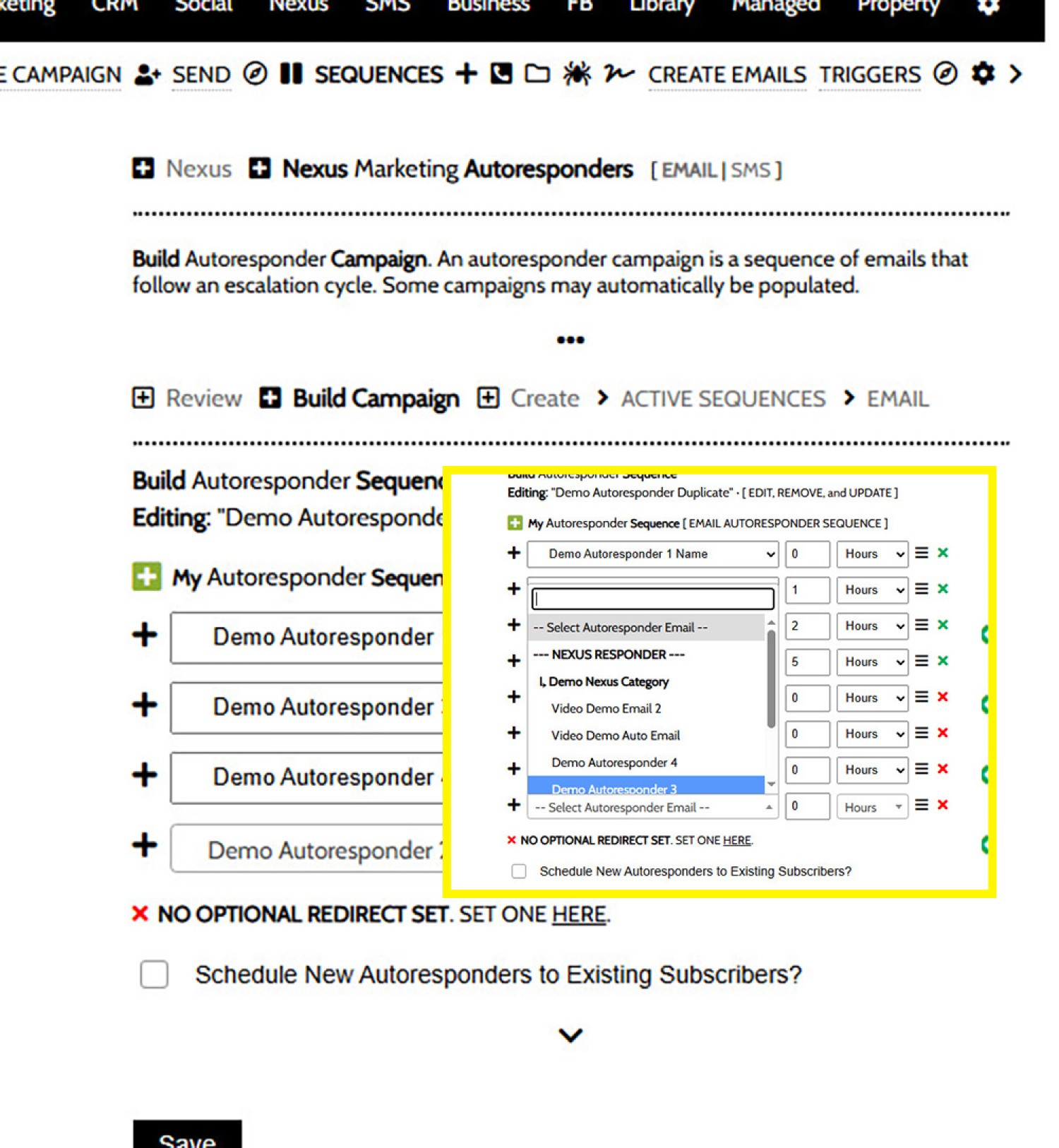
Pictured: The creation of Email and SMS Autoresponders are identical, and the method of creating or updating any sequence is simple. We've created the panel to be entirely intuitive without any needless complexity.
The sequence forms one part of the post-subscription nurturing education program supported by SMS and other tools. Of course, the purpose of an autoresponder education program is to have the user sent back to your website so that they're exposed to content specifically crafted for the sequence with conditional content shown to users coming off certain email campaigns, autoresponder emails, or internal email links. Each destination page is crafted specifically to carry on with the digital conversation as presented in the email - this is the purpose of a funnel.
Creating and Sending an Email Campaign
We experimented with a large number of options when it came to writing emails - from block-based drag-and-drop systems through to a basic text editor... and we settled on the latter for one reason above all others: we write emails and don't build them. The system was designed so you could send email to your Nexus lists in just a couple of minutes.
The standard email editor contains a large number of tools that make email creation a breeze, and HTML templates may be used if you prefer magazine-style or a consistent email format.
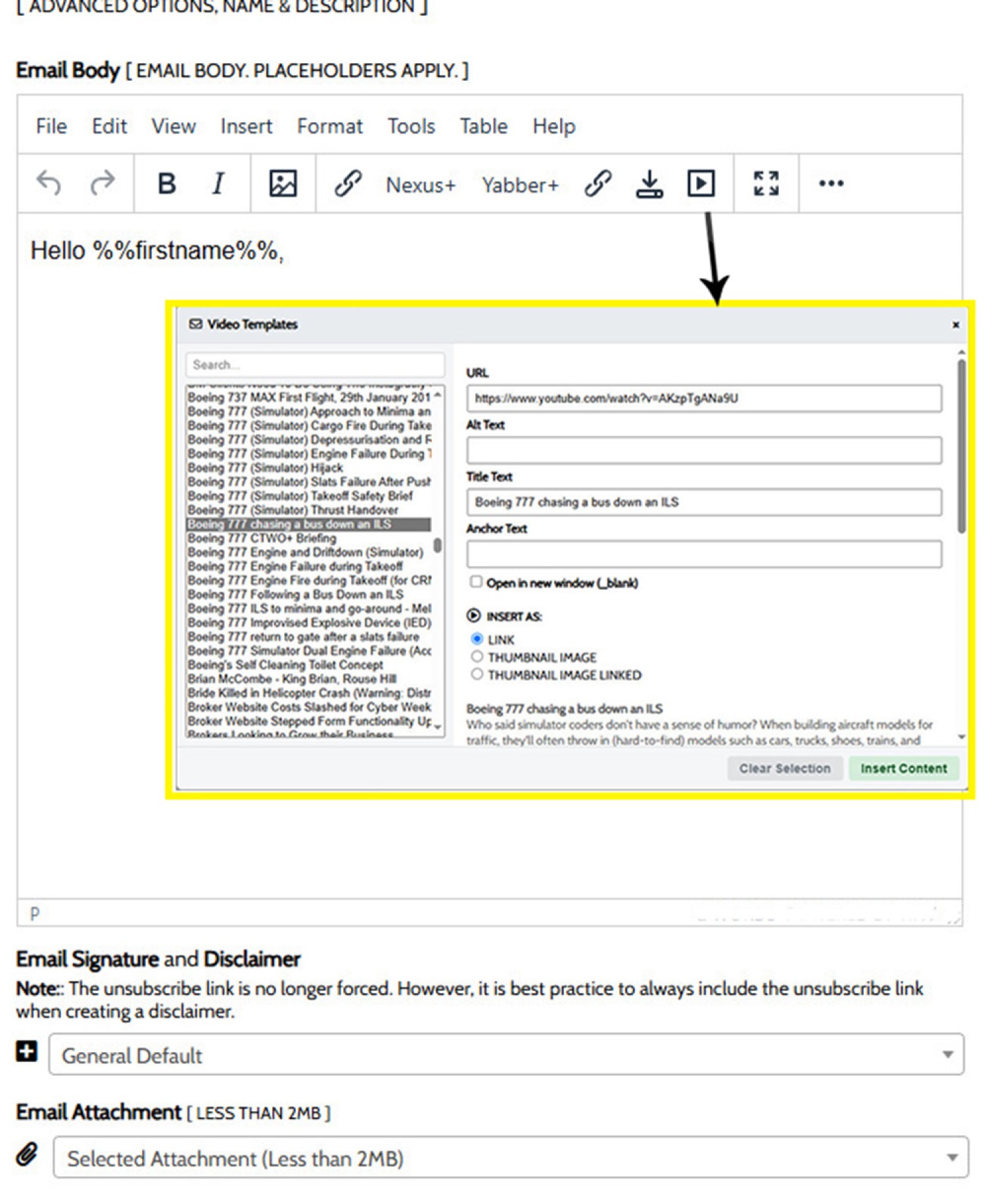
Pictured: The standard email editor contains a large number of tools that make email creation a breeze, and HTML templates may be used if you prefer magazine-style or a consistent email format. Modals present options to create direct links to website articles, Yabber downloads, YouTube videos, or CRM and Rate Placeholder. The rate placeholders in nurturing education emails, in particular, have proved extremely effective, and they have a profound impact on the number of visitors that escalate to contact. Placeholders are introduced (in brief) in the video below.
Nexus Email Placeholders: Placeholders allow you to include email templates as a starting point for creating an email, and turnkey link facilities exist for website articles, downloads, YouTube videos, and CRM/Rate placeholders. Each link introduced via a placeholder is evaluated and used for the purpose of providing Yabber and website marketing triggers.

Nexus Lender Rate Placeholders: Rate still plays a part in the marketing journey. Given that consumers consider rate to be the single most important product attributes, their place in your email marketing will significantly and profoundly impact the number that follow links or contact you on the basis of your communication. Structure and other wealth creation are obviously more important, but consumers don't know this, so we use a shared vocabulary that'll redirect them to the appropriate education resources.
Modals present options to create direct links to website articles, Yabber downloads, YouTube videos, or CRM and Rate Placeholder. The rate placeholders in nurturing education emails have provides extremely effective, and they have a profound impact on the number of visitors that escalate to contact.
Each email is evaluated for a large amount of data via Xena, so word counts, character counts, links, and readability are all recorded by Xena so the information can be measured against engagement statistics. Each links is recorded when the email is sent which enables triggers on the basis of link clicks, email opens, and other actions.
High Level Features [ Aggregation, Franchises, and ACL Holders ]
Despite our history of providing automated services for market updates, RBA updates, and general news, we've always preferred that brokers spend the few minutes necessary to write their own email in their own voice, and Nexus supports quick email creating and sending. Having that generic email sent isn't having the impact you think it does. In many cases, we've seen emails sent to clients that link off-site, and that destination page includes links to other broker websites. The only way of complete and compliant control over your communication is to take control of your own efforts - it isn't hard.
The above said, we do have facilities for aggregation groups, ACL holders, and Franchises, to send emails to borrowers on behalf of their credit representatives and brokers. For those brokers that subscribe to the parent program, any email created will send to recipients directly through their everyday Microsoft email account, thus giving the broker ownership and authority over the communication.
Integration with Formly
Formly is our Yabber and website forms module, and it is fully integrated with Nexus email functionality. It provides full website form creation with full Microsoft, email, SMS, calendar, and trigger support, and it's supported by drag-and-drop standard and stepped Elementor website form widgets. It's better than what you're using now! The end result: more business from your organic consumer-facing assets - simple as that.

Generally speaking, each form potentially has up to five Nexus emails assigned, three of which are conditional (so, only one is used). The response email, or the very first email sent once somebody subscribes, is a conditional email that sends on the basis of the user providing just a name and email, with the latter two catering for those cases where a phone number or calendar booking is made (with the subscription also supported by a conditional redirect meaning that the user is redirected to another page based on their form interaction). This early interaction supports relevance and the underlying escalation of commitment ideology that underpins our broader conversion efforts. The second and third emails are optionally created and send before the user is passed off to the applicable autoresponder program.
The conditional emails may be replaced with a single email, and the second and third emails are optional, and this information is defined when creating the Formly form, but if we're looking at maintaining a laser-like relevance in that early subscription in order to immediately differentiate our market position when measured against those other competing experiences that borrowers will likely be subscribed, all emails should be created.
Formly: Formly replaces the older forms module. It isn't entirely new, but we haven't introduced it properly in our blog. You can read more about Formly in "Formly is the Most Powerful Forms Module in the Industry". The use of stepped mortgage forms, and the language used with those forms, is generally used in an entirely deceptive manner, so they generally shouldn't be used, and they certainly don't need to be used, unless they perform a page-related function, yet none of them do. Our stepped forms return comparison results - a vital ingredient to convert those passing through your website or landing pages - and this essential feature is discussed in an article titled Stepped Mortgage Forms That Deliver Comparative Lender Results.
Each form has a purpose and objective, so each relevant page form should be presented in a way that crafts out an early website pathway. With Outlook-integrated calendars built directly into each and every form, we should use the form interaction to carry on with the conversation started by way of the commitment signal. This method wasn't introduced because it's a great feature... it was created because it works and converts in higher numbers.
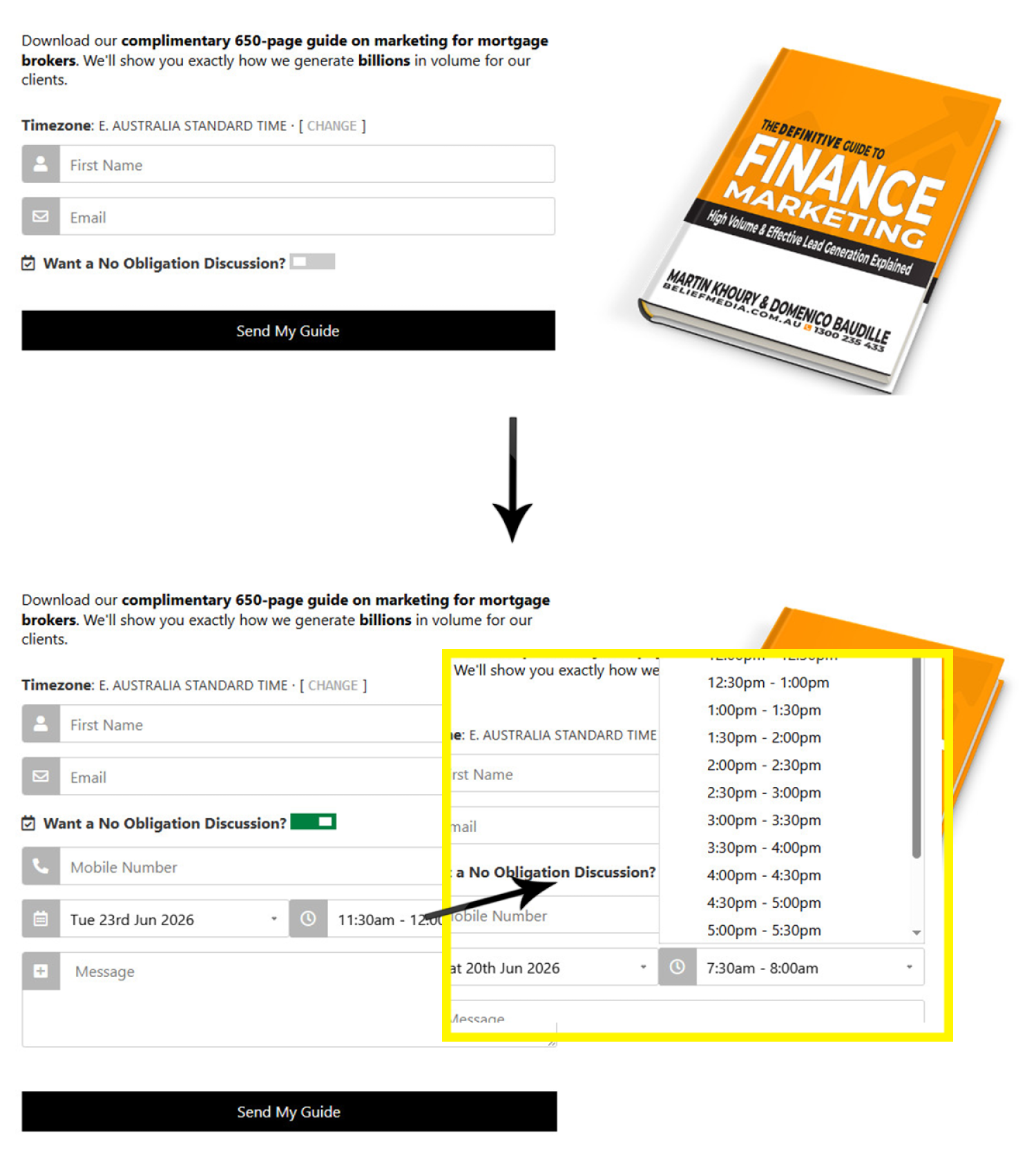
Pictured: Each form has a purpose and objective, so each relevant page form should be presented in a way that crafts out an early website pathway. With Outlook-integrated calendars built directly into each and every form, we should use the form interaction to carry on with the conversation started by way of the commitment signal. This method wasn't introduced because it's a great feature... it was created because it works and converts in higher numbers. All form components may be modified, including text, fields, style, calendar integration, redirects, and about every other feature.
Any form is the primary conduit to your business on any page - whether that be a standard internal website page or landing page - and the presence of an Outlook-integrated form is an operational necessity.
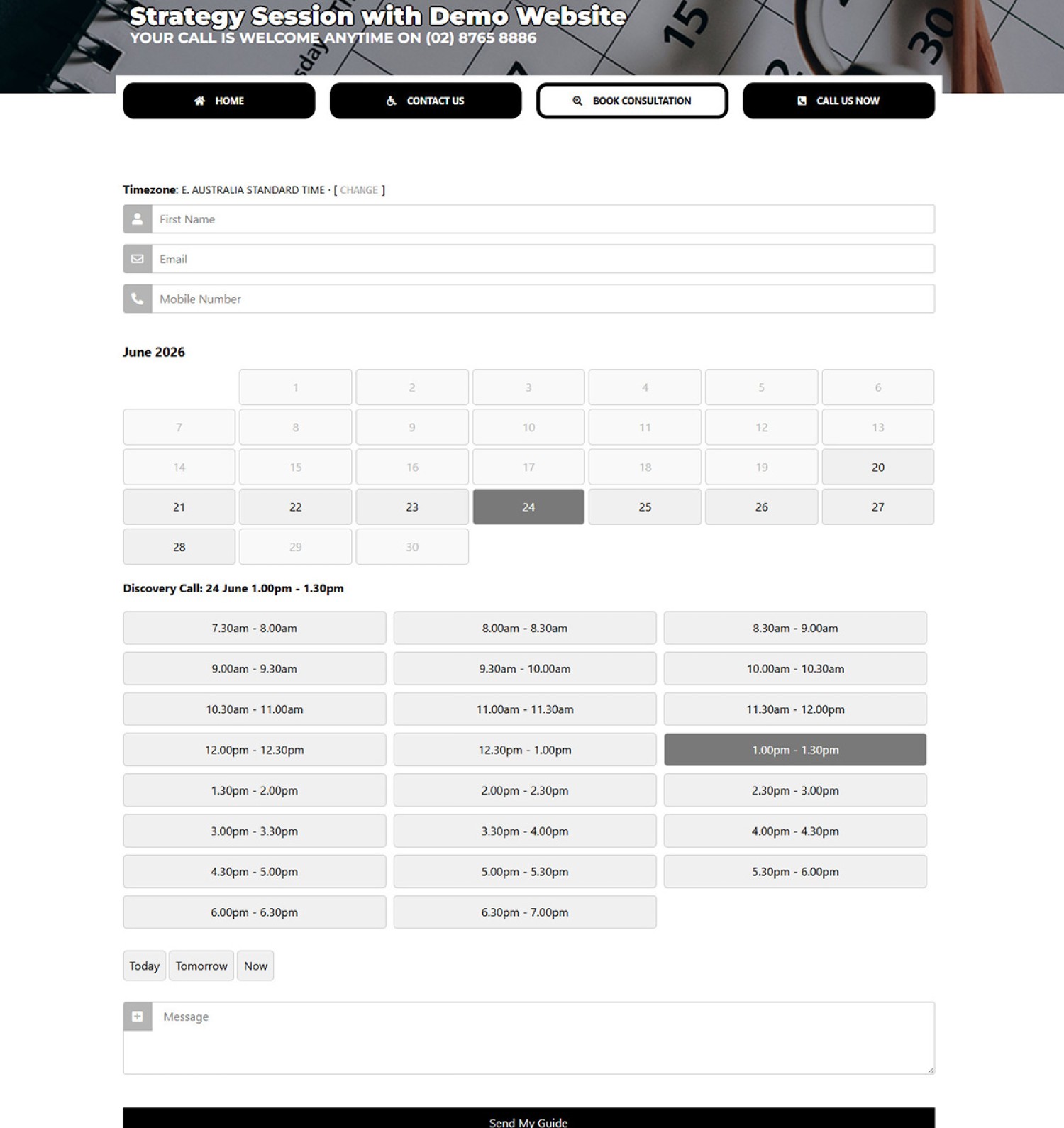
Pictured: It is utterly absurd that any broker will use a third-party tool to manage bookings and calendar integrations when you have the capacity to support that feature by way of solutions you already own. Our 'full page' calendar is part of the Formly framework and is also directly linked to the conditional Nexus components. Don't use Calendly - in most cases it isn't a compliant or practical solution... and it should never ever form part of your landing page flow.
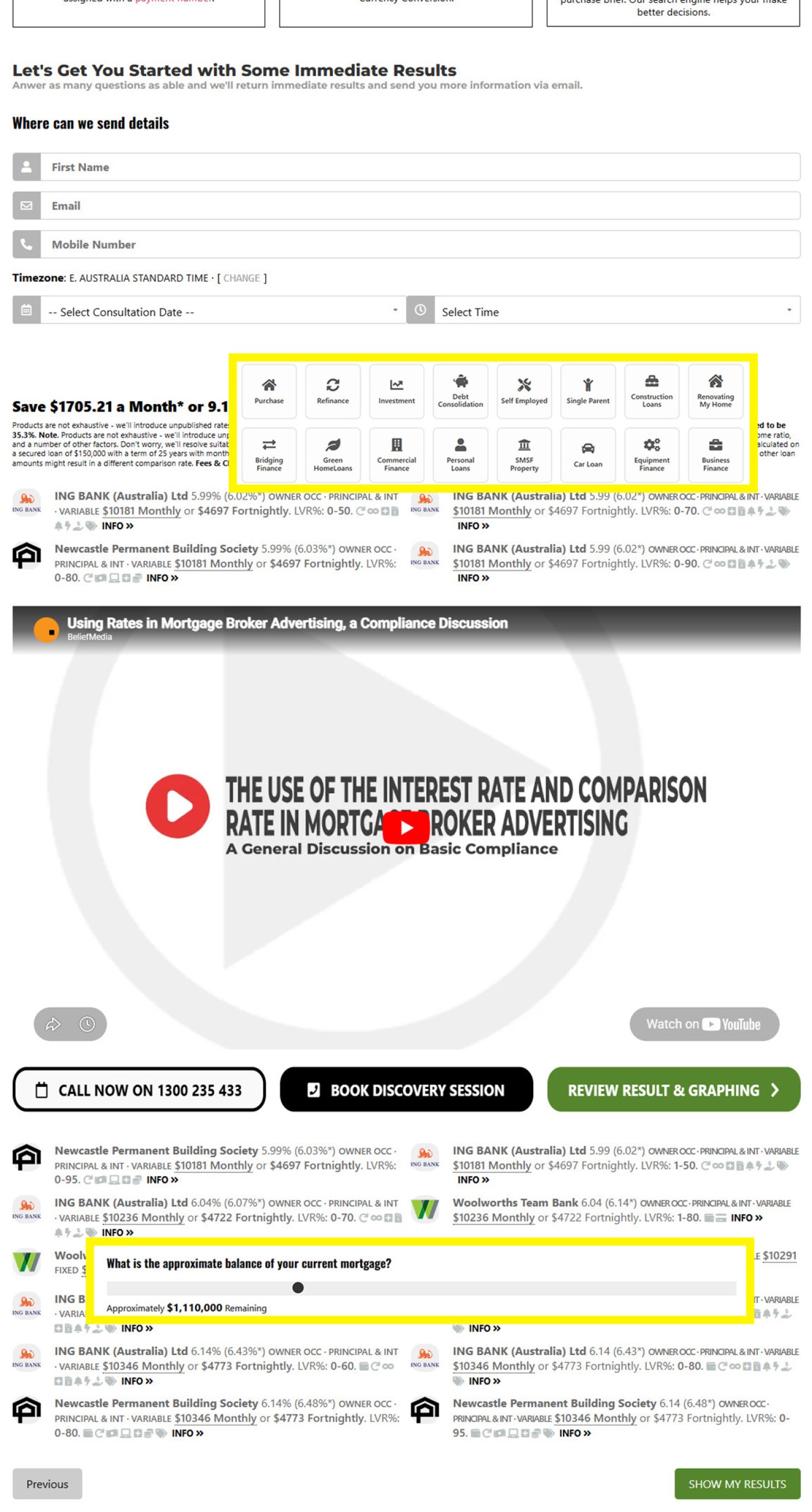
Pictured: Formly includes stepped forms that result in comparison results returned on the basis of accredited lenders. This mechanism is also associated with the single-source Nexus email by default. It's important to note that the video shown in the result panel is shown on the basis of resolved LVR, and the graphing page links to a full product page with graphs drawn as a result of user-defined values.
Formly is discussed in an article titled "Formly is the Most Powerful Forms Module in the Industry",and the basic stepped comparison forms are introduced in an artitle titled Stepped Mortgage Forms That Deliver Comparative Lender Results.
The Cost [ Yabber | Email Marketing | SMS ]
Until recently, we've never actually charged anybody for Yabber. We've always provided a website, Facebook campaigns, social, and general marketing webinars - with everything in between - and Yabber was always provided at no cost for the first 12 months - essentially making our website free. After a year, a small fee was meant to apply... but we never actually applied it. Our historical generosity changed recently and Yabber now attracts a fee from $79 to around $110 a month after the first year (subject to change), and email marketing is a small part of that package. The monthly fee represents potential savings of thousands when you consider the vast number of Yabber features.
We've ensured that the opportunity to engage with Nexus comes at a cost that is far, far less than competing content-based solutions. One popular email service will charge for additional users, or they apply additional tiered fees based on the number of 'active contacts', so we have guys that have migrated to Nexus and saved themselves over $600 a month... and their deliverability rates and email quality improves significantly.
All our clients of all types have access to Nexus. It's heavily integrated with our Facebook marketing campaigns, landing pages, and other consumer-facing functions. It is provided by default at no charge for website clients for a full 12 months (along with all other Yabber tools).
Conclusion
The evolution from our original Microsoft-connected email architecture to Nexus reflects a broader reality confronting modern businesses: fragmentation is no longer merely inefficient; it is commercially, operationally, and compliantly unsustainable. Every disconnected contact database, duplicated subscriber list, synchronisation process, standalone dashboard, and isolated communication platform introduces friction into an ecosystem that should instead function as a single coherent system. While the software industry continues to promote increasingly specialised point solutions, the practical consequence for many businesses is a growing accumulation of technical debt, duplicated administration, inconsistent data, compliance exposure, and reduced organisational agility. The cumulative cost of these inefficiencies is rarely visible in a monthly subscription fee, yet it manifests daily through lost productivity, compromised reporting, fragmented customer experiences, and the perpetual effort required to reconcile information that should never have been separated in the first place.
Nexus was built upon a fundamentally different philosophy. Rather than creating another destination for contacts, campaigns, communication records, and marketing assets, it unifies them. By leveraging the Microsoft ecosystem that businesses already own and utilise every day, Nexus transforms email marketing, SMS communication, automation, website engagement, CRM activity, and behavioural tracking into interconnected components of a single operating environment. The result is not simply greater convenience, but a profound increase in organisational clarity. Every communication originates from the same authoritative source. Every contact exists within the same ecosystem. Every interaction contributes to the same compliance record. Every marketing activity becomes part of a broader and measurable commercial strategy rather than an isolated event.
This level of integration creates extraordinary flexibility. Businesses are no longer constrained by the limitations of disconnected software vendors, arbitrary contact thresholds, synchronisation schedules, or platform-specific restrictions. Communication programs can evolve as business requirements evolve, supported by an API architecture specifically designed for expansion rather than limitation. Whether the objective is sophisticated behavioural automation, enterprise-level nurturing programs, large-scale client engagement, franchise distribution, aggregation management, or highly personalised communication journeys, Nexus provides a framework capable of adapting without requiring businesses to continually replace or rebuild their underlying infrastructure.
Scalability, however, remains the defining advantage. Most communication platforms become increasingly expensive, increasingly complex, and increasingly restrictive as organisations grow. Nexus inverts this model. Because it is built upon your own Microsoft tenancy and your own business assets, growth does not require the continual migration of contacts, the reconstruction of databases, or the adoption of progressively more expensive subscription tiers. The architecture is designed to accommodate expansion from the outset, allowing communication capabilities to scale alongside business objectives without introducing corresponding operational complexity. In practical terms, this means businesses can focus on growth rather than on the limitations of the systems intended to support that growth.
Equally important is the compliance foundation underpinning every aspect of the platform. In highly regulated world of finance and property, communication cannot be treated as an isolated marketing activity. Every email, SMS message, trigger, contact interaction, and campaign forms part of a broader compliance framework that must withstand scrutiny. Nexus recognises this reality by ensuring that communication records, contact ownership, consent management, engagement activity, and client correspondence remain unified, traceable, and attributable. The compliance outcome is therefore not achieved through additional administrative processes, but through the architecture itself. Compliance becomes a natural consequence of integration rather than a burdensome afterthought.
Ultimately, Nexus represents more than a new email and SMS platform. It is the continuation of a long-held belief that technology should reduce complexity rather than create it. The future belongs to systems that consolidate rather than fragment, unify rather than duplicate, and empower rather than constrain. By bringing together communication, data, automation, compliance, marketing, and customer engagement within a single integrated framework, Nexus provides a foundation capable of supporting not only today's requirements, but the evolving demands of tomorrow's business environment. The result is a communication ecosystem that is simpler to manage, easier to scale, more compliant by design, and substantially more effective at supporting meaningful commercial growth.
Compliant integration is no longer a luxury. It is a commercial necessity.
[image] shortcode. FAQ: "YouTube Modal Thumbnail Images with Image Shortcode".