We have never run a Facebook or Instagram advertising campaign without first installing, configuring and testing the Meta Pixel on the destination website. Not once. The advertisement does not go live and the budget does not start spending until we know that the website is recording the events that matter and that those events are being transmitted tp Meta correctly.
We also won't allow clients to launch campaigns without completing the much broader preparation required to support effective advertising. For example, customer and prospect data is uploaded where it may lawfully and appropriately be used, Custom Audiences are created, and those audiences are highly segregated according to their relationship with the business, their position in the customer journey and the objective of the campaign. Existing clients, previous leads, unconverted prospects, website visitors, segmented industry groups, engaged users and other relevant groups, should not simply be thrown into one undifferentiated audience. But they should always be used. Always.
Our Broker Growth Workshop teaches you how to build the foundations for a high-performing campaign. Exclusions are established. Retargeting groups are defined. Conversion events are identified. Landing pages are reviewed. Forms are tested. Campaign objectives are aligned with real business outcomes. Tracking parameters are prepared. The journey from the advertisement to the website and through to the final conversion is examined before the first dollar is spent. A business is supported through a number of significant actions before an advertising campaign is launched.
Of all the pre-launch actions, installing the Meta Pixel is generally the easiest. That is why inheriting a large number of advertising clients whose websites did not have a Pixel installed is very concerning. It did not simply mean that a small technical task had been overlooked. It meant that campaigns may have been operating without one of the most fundamental components required for measurement, optimisation, retargeting and informed decision-making.
It doesn't matter if you're not using a third-party service for landing pages - something that is itself a ludicrous method - you should still ensure your Meta Pixel is installed on your website and tested for errors. The pixel is trained on your website traffic and becomes a significant asset over time. Advertising without the Meta Pixel is not merely incomplete. In many cases, it means the advertiser is paying for activity without properly recording what that activity produces.
We'll Install It For You: Your leadgen guys probably didn't install your Pixel - they're idiouts. We'll happily give you a plugin that makes it easy, or we'll install it for you. Advertising without it will seriously compromise your results and your understanding of campaign performance.
But I Don't Advertise Yet: There is significant value in installing the Meta Pixel well before advertising begins. The Pixel can start recording website visits, page-level behaviour and selected conversion events, allowing Meta to develop a clearer picture of the types of users interacting with the business and the actions they take on the website. It can also begin populating website Custom Audiences, establish a baseline of event activity and provide data that may later support retargeting and audience development. This means the advertiser is not necessarily commencing with an entirely empty data environment when the first campaign is launched. However, this should not be overstated: historical website traffic does not replace the campaign learning phase, and general page-view data is not as valuable as accurate lead, application or purchase events. Meta will still need sufficient campaign and conversion activity to optimise delivery effectively, but installing the Pixel early can provide a materially better starting position - effectively allowing the advertiser to begin at a running pace rather than from a standing start. Bottom line: install your pixel now. If you need help, I'll donate my time and do it for you.
Pixel Compliance and the OAIC: The Office of the Australian Information Commissioner’s recommendations on tracking pixels, although recently reinforced through its investigation of healthcare providers, should be treated as a broader warning to every organisation operating in a market characterised by vulnerability, trust and information asymmetry - including financial services, mortgage broking and consumer credit. The OAIC does not prohibit tracking pixels, but makes clear that the website operator remains responsible for how a pixel is configured and what it collects or discloses: organisations should undertake appropriate due diligence and a Privacy Impact Assessment, adopt privacy by design, map and document their data flows, collect only the minimum personal information reasonably necessary, prevent the transmission of sensitive information without express consent, provide clear and intelligible collection notices, offer a simple opt-out from targeted advertising, consider overseas disclosures, and continuously audit pixels rather than treating them as a “set and forget” marketing tool. The OAIC’s June 2026 findings are particularly significant because they establish that browsing behaviour, URLs, searches, button clicks and hashed identifiers may be personal information - and may reveal or permit highly consequential inferences - even where an organisation assumes the data is anonymous or pseudonymised; the Commissioner consequently recommends reconsidering tracking technologies altogether where an organisation handles sensitive information, serves vulnerable communities or provides services in which confidentiality is fundamental. While ordinary financial information is not automatically classified as “sensitive information” under the Privacy Act, visits to pages dealing with mortgage stress, hardship assistance, debt consolidation, arrears, impaired credit, bankruptcy, family violence, unemployment or urgent borrowing can expose intimate indicators of financial distress and enable platforms to profile or target people at precisely the time they are most susceptible to influence or exploitation. This is especially relevant because ASIC identifies the protection of vulnerable consumers from poor conduct, predatory lending and credit-related harm as an enduring regulatory priority. Accordingly, finance businesses should apply the OAIC’s recommendations conservatively by excluding or tightly restricting pixels on application forms, calculators, document-upload pages, customer portals and hardship or vulnerability pathways, and should only permit tracking where its necessity, proportionality, transparency, consent arrangements and technical safeguards have been formally assessed and documented. Given the scope of Xena with in-depth statistical integration, and our significant usage of Meta's APIs, we include the appropriate tools into our website framework for implied compliance.
The purpose of this article is to simply look at why the pixel is important, and detail (in short) the part it plays in your advertising.
Matrix and Insights API: Our Insights API records every ad from every broker every day. The Matrix API crawls finance websites an measures their effectiveness. We selected 250 random businesses from Insights and had Matrix assess for the presence and correct integration of the Meta Pixel. Of the 250 websites evaluated, 12 had it installed. That's less than 5%. If you're running ads, it's likely not installed. As we'll detail, this is a massive mistake that needs to be fixed. We've created a record of the survey and will publish the findings to our public Facebook Group  .
.
Video: This video to our clients is the communication that prompted this article. Your Meta Pixel should be installed whether you're advertising or not, but if you're running ads and don't have the pixel installed, you're losing essential signals that contribute towards effective high-converting campaigns.
The Quick Read
The Facebook Pixel - now formally called the Meta Pixel - is not technically essential for every website, but it is a foundational requirement for any business advertising through Facebook or Instagram. Without it, Meta receives little to no reliable information about what happens after an advertisement is clicked, limiting measurement, targeting and campaign optimisation. This section is relevant if you're after the nasty bullet-points rather than the full story.
- It measures actual advertising outcomes. The Pixel records meaningful website actions - such as page views, enquiries, registrations, bookings, applications and purchasesrather than measuring campaign success purely through impressions and clicks.
- It connects advertising expenditure with conversions. Without conversion tracking, a business may know that an advertisement generated traffic but cannot reliably determine whether that traffic produced leads, sales or revenue.
- It allows Meta to optimise campaigns for the correct objective. When conversion events are sent back to Meta, its delivery system can learn which users are more likely to complete the required action and progressively direct advertising towards similar users.
- It improves lead quality, not merely lead volume. A campaign optimised around completed applications or qualified enquiries gives Meta a materially better signal than one optimised around clicks, landing-page views or superficial engagement.
- It enables website retargeting. Businesses can advertise to people who previously visited the website but did not enquire, purchase or complete another important action. Retargeting is particularly valuable because these users have already demonstrated awareness or intent. :contentReference[oaicite:0]{index=0}
- It supports behavioural audience segmentation. Visitors can be grouped according to the pages they viewed, products or services they considered, actions they completed and their approximate position within the conversion journey.
- It allows high-intent audiences to be isolated. For example, a mortgage broker could distinguish between a general blog reader, a visitor who viewed a refinance page, a visitor who used a borrowing calculator and a user who started - but did not complete - an enquiry form.
- It allows existing customers and converted leads to be excluded. Excluding people who have already completed the desired action can reduce wasted impressions, avoid repetitive advertising and improve the efficiency of acquisition campaigns.
- It provides seed data for audience expansion. Conversion and website-engagement data can help Meta identify patterns among valuable users and locate broader audiences exhibiting similar characteristics. The quality and consistency of the source audience materially affect the usefulness of this type of modelling. :contentReference[oaicite:1]{index=1}
- It helps reveal where the funnel is failing. Tracking events across the journey - such as landing-page views, calculator usage, form commencement and form completion - makes it easier to identify abandonment points, weak pages and unnecessary friction.
- It supports meaningful campaign comparison. Advertisers can compare audiences, placements, advertisements, offers and landing pages according to cost per conversion rather than relying on less valuable indicators such as click-through rate.
- It improves budget allocation. When conversion data is available, expenditure can be redirected towards the campaigns, advertisements and audience groups that produce commercially meaningful outcomes.
- It helps establish realistic acquisition costs. Accurate event tracking provides the foundation for calculating cost per lead, cost per application, cost per sale and return on advertising expenditure.
- It creates valuable historical data. The Pixel should ideally be installed before advertising begins. Even when campaigns are not currently active, compliant collection of website-event data can create useful audiences and performance baselines for future campaigns.
- It supports more relevant advertising. Advertisements can be aligned with the user’s demonstrated interest rather than repeatedly serving the same generic message to every visitor.
- It allows campaign learning to compound. Each legitimate conversion provides another signal that can help the advertising platform better understand the characteristics and behaviour associated with successful outcomes.
- It reduces dependence on platform-level vanity metrics. Meta may report strong reach, engagement or click volumes, but the Pixel allows those numbers to be tested against activity occurring on the business’s own website.
- It complements first-party analytics. The Pixel should not replace website analytics, CRM reporting or internal attribution. It provides an additional advertising-specific dataset that can be reconciled with those systems.
- It supports more advanced advertising strategies. Event data can be used for sequential retargeting, funnel-stage campaigns, abandoned-action campaigns, product or service-specific messaging and conversion-value optimisation.
- It makes advertising more accountable. Without reliable website-event tracking, campaign management becomes heavily dependent on assumptions. The Pixel converts advertising from a largely promotional activity into a more measurable acquisition system.
The Pixel should generally be deployed alongside the Meta Conversions API, which provides server-side event transmission and can recover some of the measurement signals lost through browser restrictions, ad blockers and connection failures. It must also be implemented with appropriate consent controls, privacy disclosures and data minimisation. The OAIC has specifically warned that website operators remain responsible for ensuring that information shared through tracking pixels is consistent with users’ reasonable expectations, particularly where sensitive information may be involved.
What Is the Meta Pixel?
The Meta Pixel, still commonly referred to as the Facebook Pixel, is a small piece of tracking code installed on a website. It records selected actions taken by website visitors and communicates those events to Meta. These events may include viewing a page, visiting a particular service, starting an enquiry, submitting a form, making a booking, registering for an event, downloading a resource, completing an application or making a purchase.
The Pixel does not exist merely to count and identify website visitors. Standard analytics platforms and Xena can already provide substantial information about localised traffic. The Meta Pixel has a more specific advertising function: it connects behaviour on the website with the advertising system responsible for generating or influencing that behaviour.
This connection allows Meta to receive feedback about what happens after an advertisement is viewed or clicked. Without that feedback, Meta may know that it displayed an advertisement and generated a click, but it has a far more limited understanding of whether that click produced a meaningful commercial result.
Clicks Are Not Conversions
One of the most common advertising mistakes is treating advertising clicks as though they are outcomes. A click is not an enquiry. A landing-page view is not an application. A video view is not a customer.
An advertisement may generate hundreds of clicks while producing very few qualified leads. Another advertisement may attract fewer clicks but generate substantially more valuable enquiries. Without conversion tracking, the first advertisement may appear to be the stronger performer simply because it generated more visible activity.
This is where advertisers become vulnerable to vanity metrics. These vanity metrics are the data sources that leadgen companies use to define their worth, and they'll assign blame back onto your processes as a result.
Reach, impressions, engagement, video views and click-through rates can amd are all be useful diagnostic indicators, but none of them necessarily represents commercial value. A business does not ordinarily advertise because it wants people to click buttons. It advertises because it wants qualified prospects, appointments, applications, sales or some other measurable outcome.
The Pixel allows campaign performance to be assessed against those outcomes.
Instead of asking which advertisement generated the most traffic, the advertiser can ask which advertisement generated the most completed enquiries, which audience produced the lowest acquisition cost, which landing page converted most effectively and which campaign contributed the greatest commercial value.
The Pixel Teaches Meta What Success Looks Like
Meta’s advertising system requires signals.
When a campaign is optimised for a specific conversion event, Meta attempts to identify people who are more likely to complete that action. The quality of this optimisation depends heavily on the quality of the information being returned to the platform.
When a website records and sends legitimate conversion events, Meta can begin identifying patterns among the users who complete those events. Those patterns may involve behaviour, interests, engagement, device usage, platform activity and numerous other signals available within Meta’s advertising ecosystem.
The advertiser does not manually evaluate every one of these characteristics. The platform uses the conversion data to improve delivery.
If the advertiser optimises only for clicks, Meta will generally find people who are likely to click. That does not necessarily mean it will find people who are likely to enquire, qualify, purchase or become profitable customers.
Cheap traffic can be expensive when it does not convert. More expensive traffic may be significantly more valuable when it consistently produces qualified business.
The Meta Pixel helps move campaign optimisation away from superficial activity and towards the actions that matter.
The Pixel Creates the Foundation for Retargeting
Most website visitors do not convert during their first visit. This is not necessarily because they are uninterested. They may be researching, comparing alternatives, gathering information, waiting for the right time, discussing the decision with another person or simply distracted before completing the required action.
Without the Pixel, many of these visitors disappear from the advertising system as soon as they leave your website.
With the Pixel installed, the advertiser can create audiences based on the pages and services those visitors considered. A person who visited a refinancing page can be treated differently from a person who read a general article. Someone who started an application can be treated differently from someone who viewed the homepage for several seconds.
This allows follow-up advertising to reflect demonstrated intent.
A visitor who viewed a specific service does not necessarily need to see another generic brand-awareness advertisement. They may benefit from a case study, an explanatory article, a comparison guide, a client testimonial or a direct invitation to complete the next step.
Retargeting is not simply the repetition of the original advertisement. When implemented correctly, it creates a progressive communication sequence that responds to the user’s apparent level of knowledge and intent.
The Pixel provides the behavioural information required to support that sequence.
Audience Segregation Is an Essential Part of Campaign Preparation
Installing the Pixel is only one component of a properly prepared campaign. Before launching advertisements, we also establish and segregate Custom Audiences wherever the necessary data is available and its use is appropriate. Segregation matters because not every person associated with a business should receive the same advertising.
An existing customer should not necessarily receive an advertisement designed to acquire a first-time customer. A person who has already submitted an enquiry should not continue seeing advertisements that repeatedly ask them to submit the same enquiry. A long-term client may be suitable for a retention, education or referral campaign, while an unconverted prospect may require a different message entirely.
Audiences may include these non-exhaustive groups:
- Existing clients.
- Previous customers.
- Current prospects.
- Unconverted leads.
- Website visitors.
- Visitors to specific services or product pages.
- People who started but did not complete a form.
- People who completed a conversion.
- Users who engaged with Facebook or Instagram content.
- Users who watched a meaningful proportion of a video.
- Subscribers, members or event attendees.
These groups should not automatically be combined.
When audiences are highly segregated, the advertiser can control inclusion, exclusion, messaging, frequency and sequencing with far greater precision.
Facebook Audience Maintenance: Audiences are often uploaded and forgotten... yet keeping them accurate is an operational imperative. Some CRM systems will maintain lists on the basis of forms (admittedly, the association with a form is method we once used... but it certaonly wasn't good enough). Our proprietary method of maintaining audiences are now paired with Nexus Categories (or Nexus Marketing Lists used for email and SMS lists). This means that you can manage youe Facebook audiences dynamically, and the lists themselves will change on the basis of user interactions. This is a highly powerful feature that ensures your audiences are always up-to-date, easily maintained, and controlled by the funnel environment that the user is engaged. You can essentially manage your Facebook audiences by altering their assigned categories in your desktop Outlook installation.
The Pixel adds another layer to this segmentation by creating audiences based on actual website behaviour.
Exclusion Is Often as Important as Inclusion
Advertising efficiency is not determined only by who is targeted. It is also determined by who is excluded. A campaign that continues advertising an introductory offer to people who have already converted may waste budget and create a poor customer experience. It may also distort reporting by repeatedly serving acquisition advertisements to users who no longer belong in the acquisition stage.
The Pixel allows converted visitors to be excluded from relevant campaigns.
It can also support exclusions based on particular actions, pages or stages of the funnel. A person who has already completed an application may be removed from a campaign encouraging applications and placed into an onboarding, education or follow-up sequence.
This creates a cleaner advertising architecture. Rather than treating every user as a permanent prospect, the system responds as users move through the journey.
Facebook Exclusions: Facebook Exclusions are now managed in the same way as Inclusions. You may exclude Nexus categories or exclude on the basis of a status in Yabber. The former method is normally preferred since most don't use a Yabber Contact Status - your CRM is normally reserved for this function. So, a single tag assigned to a Microsoft contact excludes them from your campaigns. However, an exclusion list may be used for targeting your existing clients directly.
The Pixel Reveals Problems in the Conversion Funnel
The value of the Pixel extends beyond advertising attribution. A properly implemented event structure can reveal where users abandon the conversion process.
Consider a website that records the following events:
- A user views the landing page.
- The user opens engages with a comparison form.
- The user begins an enquiry form.
- The user reaches the final form step.
- The user submits the enquiry.
If a large percentage of users view the landing page but very few begin the form, the offer, content or call to action may be weak.
If many users begin the form but fail to complete it, the form may be too long, confusing, intrusive or technically unreliable.
If users reach the final step but do not submit, the website may be introducing friction at the point where the user is asked to disclose personal information, accept terms or make a commitment.
These are not merely advertising problems. They are conversion-experience problems. Without event tracking, the business may incorrectly blame the campaign when the real problem exists on the website. The Pixel helps separate traffic-generation performance from landing-page and funnel performance.
Historical Data Cannot Be Recreated After the Event
One of the strongest arguments for installing the Pixel immediately is that historical data cannot simply be reconstructed later. If a website operates without the Pixel for twelve months, the business cannot later install it and retrieve the behavioural audience data that was never collected. Those visitors are lost to the Meta advertising environment. Their page views were not recorded as Pixel events. Their movement through the funnel was not captured. Retargeting audiences were not populated. Conversion signals were not available to support campaign learning.
The longer a website operates without the Pixel, the greater the volume of potentially useful advertising data that is forfeited. This is why the Pixel should not be viewed as something to install shortly before a major campaign. It should be part of the website’s foundational marketing infrastructure. Even when a business is not actively advertising, the Pixel can begin building eligible website audiences and establishing a baseline of activity, subject to appropriate privacy and consent requirements. When the business is ready to advertise, it is then working with an existing data foundation rather than starting from zero.
If your website doesn't have the pixel properly installed, do so now. If you're advertising, do it yesterday.
Pixel Survey: To provide completeness to this article, we went through and measured websites linked to ad accounts and then parsed for the pixel with the Matrix API. I've refrained from publishing the list, but of the 250 accounts we surveyed, only 12 had a working pixel installed. That's less than 5%. The figure reinforces what we've always said about the quality of leadgen in the industry, and it's why you'll have to install the pixel yourself - your campaigns will thank you.
Why Missing Pixels Are So Concerning
When we inherit an advertising client and discover that no Pixel has been installed - which is almost a certainty - the issue raises broader questions that genuinely irritate me.
- How were conversions being attributed?
- How were website audiences being created?
- How were previous visitors being retargeted?
- How were converted users being excluded?
- How was Meta being given the information required to optimise delivery?
- How was the advertiser determining which campaigns generated real business outcomes?
- How were landing-page and form-performance problems being identified?
The list goes on.
It is possible to run an advertisement without a Pixel. It's also possible to marry an inflatable doll. Meta will accept the campaign, display the advertisements and spend the budget. That does not make it good practice, and it certainly won't return the highest-value conversions.
The ability to launch an advertisement should never be confused with the readiness to launch an advertisement. Advertising platforms make it deliberately easy to begin spending money. The responsibility for ensuring the campaign is strategically, technically and commercially prepared remains with the advertiser.
Third Party Landing Pages: No client of ours will ever host their landing pages on a third-party service. Not ever. It erodes trust, excludes pathways, eliminates integrated audience functionality, and limits brand exposure. It's just ludicrous... yet it's common practice by industry pretenders. That said, and I'll repeat this again, even if you are using a third-party landing service, ensure that the pixel is installed on your primary website. Your website is the primary source of organic traffic, and it's the source of traffic movement for users in your funnel. How can you possibly measure audience behaviour in the funnel if you don't have the pixel installed?
Installation Is Only the First Step
A Pixel should not merely be pasted into a website and assumed to be working.
It must be tested.
The base code should be confirmed across the appropriate pages. Events should be triggered intentionally and verified. Duplicate events should be identified. Form submissions should be tested. Thank-you pages, event parameters and conversion priorities should be reviewed.
Where possible, testing should confirm that the same action is not being accidentally reported multiple times.
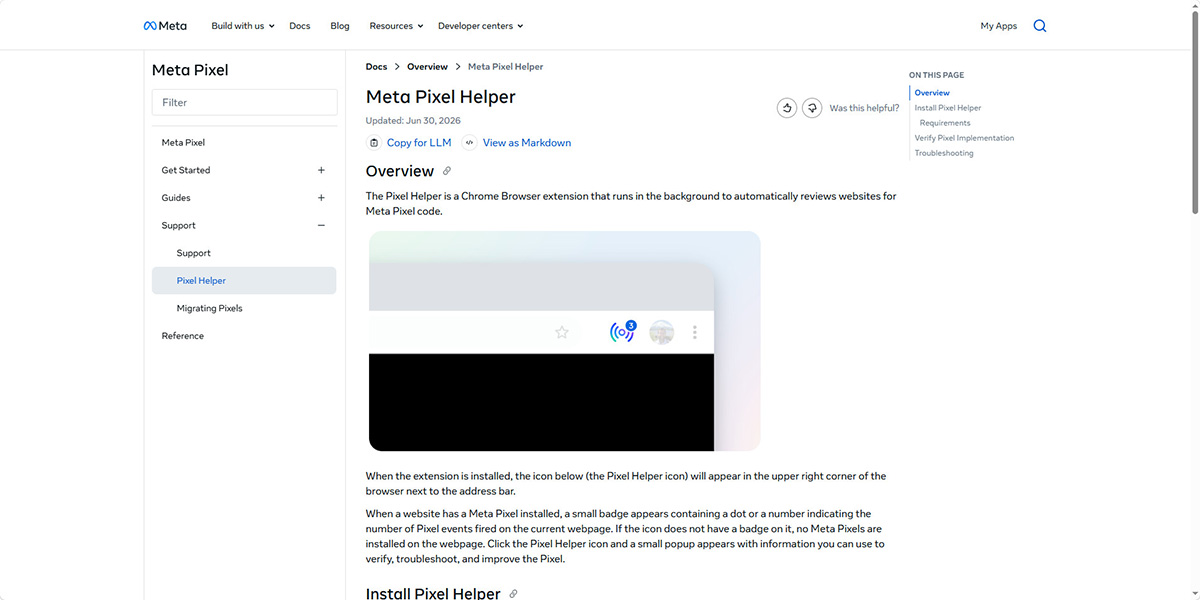
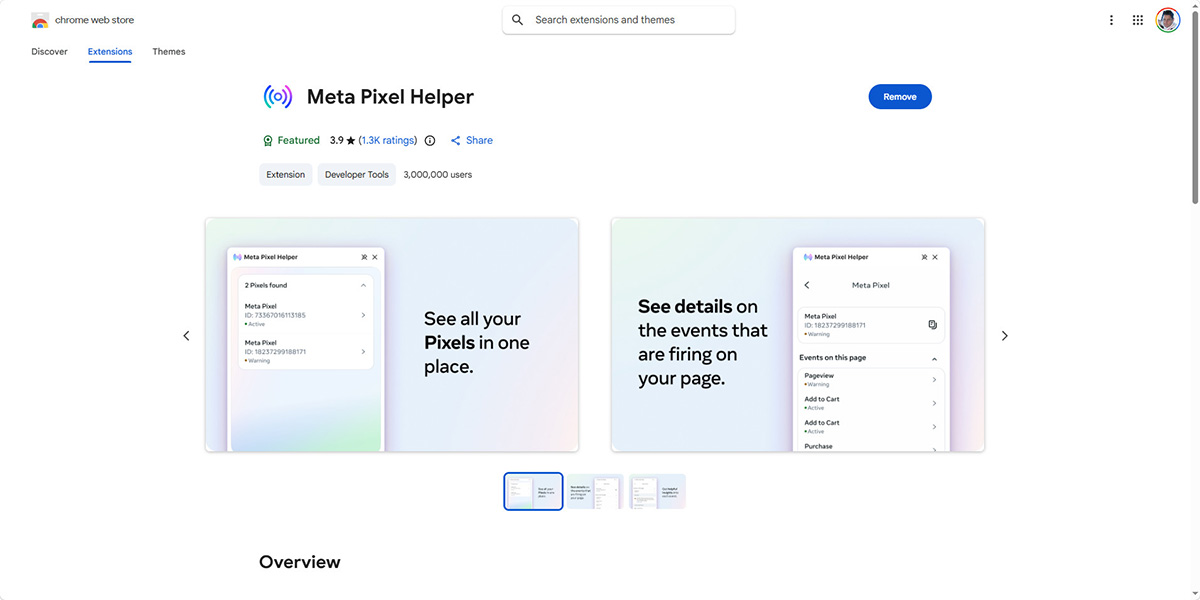
Pictured, the Meta Pixel Helper: The Pixel Helper is a Chrome Browser extension that runs in the background to automatically reviews websites for Meta Pixel code. Learn more on Facebook's website . The browser plugin is available on the Chrome Store  .
.
For example, a lead event should not necessarily fire every time a user refreshes a thank-you page. A button click should not be treated as a completed enquiry if the form subsequently fails. A page-view event should not be mistaken for evidence that a visitor meaningfully engaged with the content.
The objective is not to create the highest possible number of events.
The objective is to create accurate events.
Incorrect tracking can be more dangerous than no tracking because it creates false confidence. Campaigns may appear to be producing conversions when they are actually counting duplicated, incomplete or irrelevant actions.
That is why our standard is not simply that the Pixel must be installed. It must be installed and tested before advertising begins.
The Role of Yabber and our Broker Website
Yabber simplifies the pixel process by allowing users to create a Meta Pixel and assign it to a website. This means the Pixel can be managed as part of the broader website and marketing environment rather than treated as an isolated piece of code that is manually inserted and subsequently forgotten.
The ability to assign the Pixel to the appropriate website makes implementation far easier, particularly for businesses managing multiple websites, brands, campaigns or digital assets. However, ease of implementation does not eliminate the need for verification. Once the Pixel is assigned, the installation should still be tested against the actual website journey. The required events should be confirmed, conversion actions should be validated and the advertising account should be checked to ensure that the data is being received correctly.
Yabber makes one of the most essential advertising tasks significantly easier. The remaining responsibility is to ensure that the tracking architecture reflects the real objectives of the campaign.
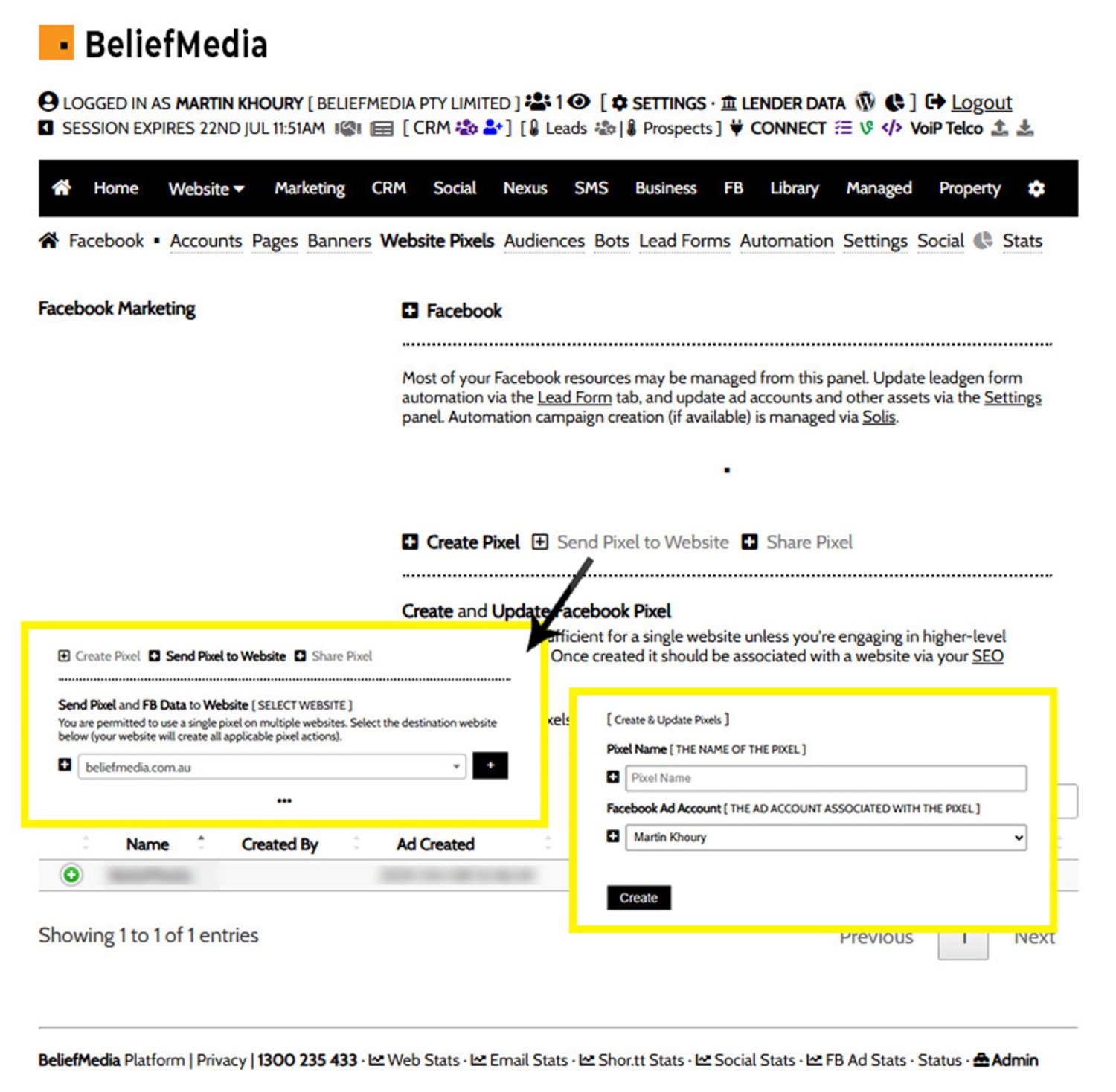
Pictured: Facebook management in Yabber is easy. You may create a pixel, update pixels, and assign them to applicable websites. Once the pixel is assigned, your funnel-centric and Facebook-optimised website architecture takes care of the rest. Better results are often derived from better. integrated, and simple features.
Because our Mortgage Broker Website is a framework with a known architecture, we integrate the Marketing API and Conversions API directly. This enables all the appropriate signals to be sent directly to Facebook without any messy monkey work on the backend.
Yabber & Website Framework: If you're using Yabber and our website, your advertising is already optimised. Simply maintain your custom audiences in Outlook or Yabber and the rest will take care of itself.
Pixel Data is Connected with the Wider Marketing System
The Meta Pixel should not operate as the only source of truth. Meta reporting, website analytics, CRM records, form submissions, telephone enquiries and internal sales data should be reconciled wherever possible.
No advertising platform has perfect visibility. A user may view an advertisement on one device and convert on another. A person may submit a form after several interactions across multiple channels. Privacy settings, browser restrictions, consent choices and technical failures can reduce the amount of observable data. For this reason, the Pixel should be considered one component of a broader measurement system.
The strongest advertising environments combine (at the very least):
- Meta Pixel data.
- Server-side event data where appropriate.
- Website analytics.
- Campaign tracking parameters.
- CRM records.
- Lead-source information.
- Call tracking.
- Sales and revenue outcomes.
The Pixel provides the advertising platform with the signals it requires, while internal systems allow the business to determine whether those signals ultimately correspond with qualified and profitable outcomes.
The Meta Conversions API
For more robust measurement, the Meta Pixel may be supported by the Meta Conversions API. The Pixel primarily records browser-based activity. The Conversions API allows selected events to be sent from a server or another controlled system. This can improve the resilience of event transmission where browser restrictions, connection failures or other technical limitations prevent some browser-based events from being recorded.
The Pixel and Conversions API should not be treated as competing alternatives. They can operate together. Where both systems report the same event, appropriate identifiers and deduplication controls are required so that Meta understands that the browser event and server event relate to the same action. The principle remains the same: the objective is not to send the greatest quantity of data. It is to send accurate, relevant and appropriately governed data.
Privacy and Consent Remain Essential
The commercial importance of tracking does not override privacy obligations.
Businesses must ensure that their use of the Meta Pixel is reflected in their privacy documentation and consent architecture. The information collected, the purpose for which it is used and the parties with which it may be shared should be considered carefully.
Sensitive information should not be transmitted through event names, URLs, parameters or form data.
Businesses operating in regulated sectors - including finance, health, legal services and other areas involving sensitive personal information - must be particularly careful about what their websites communicate to advertising platforms.
A strong tracking system is not one that necessarily collects everything. It is one that collects the minimum information required to support a legitimate and clearly defined purpose.
Advertising Requires Preparation, Not Just Promotion
The Meta Pixel is one of the easiest parts of campaign preparation, but it is also one of the most consequential.
A professional advertising campaign should not begin with the advertisement itself. It should begin with the infrastructure required to measure, segment, exclude, test and learn. The absolute basics will include the following:
- The Pixel should be installed.
- The installation should be tested.
- Meaningful events should be defined.
- Custom Audiences should be uploaded and appropriately segregated.
- Existing customers and converted prospects should be excluded where required.
- Retargeting audiences should be established.
- Landing pages and forms should be reviewed.
- Reporting should be connected with actual business outcomes.
Only then should the campaign be activated.
The preparation may not be visible in the final advertisement, but it materially influences everything that follows.
Conclusion
The Meta Pixel is not an optional enhancement that can be added after a campaign has been running for several months. For any business investing in Facebook or Instagram advertising, it is a foundational measurement and optimisation tool.
Without it, the advertiser loses visibility over website conversions, limits the platform’s ability to learn, weakens retargeting, reduces audience control and sacrifices historical data that cannot later be recovered. Again, this is why we have never run an advertisement without first installing and testing the Pixel. Inheriting programs where this simple yet imperative process is bypassed is seriously troubling, and those that support it are genuinely professionally negligent.
It is also why we do not consider Pixel installation, in isolation, to represent complete campaign preparation. Custom Audiences must be uploaded where appropriate, those audiences must be carefully segregated, exclusions must be established and the broader conversion journey must be tested.
A great deal of work goes into preparing an effective campaign. The Pixel is simply the easiest place to start, and there is absolutely no defensible reason to skip it.
When the supporting systems are set up correctly, you can focus on what matters most: creating compelling campaigns.
It's no secret our campaigns return better results than others in the industry, and while our built-for-purpose systems are objectively better than others, some of our success comes down to the general marketing incompetence of those that claim to provide a service, and failing to install the pixel or use it correctly is one of the many things they consistently get wrong.