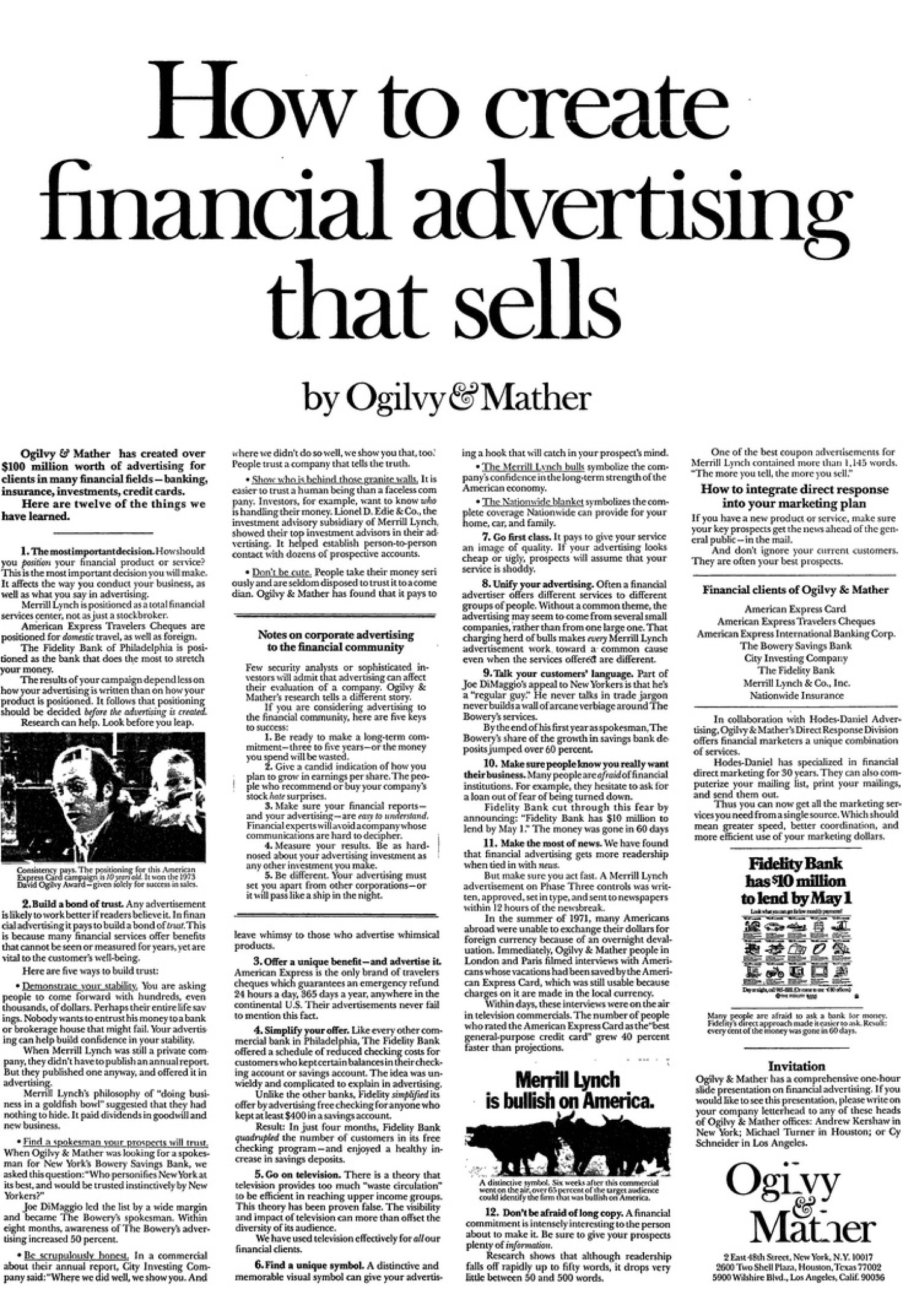
"How to create financial advertising that sells" was a 1974 advertisement from New York based advertising agency Ogilvy & Mather.
The ad was one of a number of Ogilvy's long-form advertisements that were used as a means of demonstrating their expertise and providing industry-specific social proof. The long-form advertising was a technique widely avoided by many in the in fear that they were giving too much away.
How to Create Financial Advertising That Sells, 1974
Ogilvy & Mather’s 1974 advertisement, “How to Create Financial Advertising That Sells”, is one of the most relevant historical advertisements a finance professional can study. It belongs to the same family of long-form agency advertisements as “How Direct Response Advertising Can Increase Your Sales and Profits”, with both ads reproduced. These advertisements were not merely promotional. They were demonstrations of competence. Ogilvy & Mather did not simply claim to understand advertising; they proved it in public, using the advertisement itself as the evidence.
That is the first lesson for mortgage brokers: the content should prove the claim.
The advertisement operated as a form of long-form authority marketing. It provided a structured argument, industry-specific insight, practical instruction, and a visible philosophy of advertising. It gave the reader enough substance to infer that Ogilvy & Mather understood the financial sector at a level deeper than most agencies. In doing so, the advertisement became both content and credential. It educated the market while positioning the agency as the natural expert to consult.
This is the essence of a high-performing lead magnet or education-led advertisement. It does not merely say, “We can help.” It shows the audience how the advertiser thinks. It reveals method. It creates intellectual authority. It reduces the perceived risk of engagement because the prospect can see evidence of competence before making contact.
For brokers, this principle is critical. A broker who says “we provide personalised advice” is making a claim. A broker who publishes a detailed explanation of how lender selection, policy interpretation, repayment risk, credit scoring, living expenses, borrowing capacity, offset strategy, and refinance timing interact is demonstrating expertise. The first is advertising. The second is positioning.
The Ogilvy advertisement understood that distinction.
Its most important line may be: “How should you position your financial product or service? This is the most important decision you will make. It affects the way you conduct your business, as well as what you say in advertising.”
That statement is as true now as it was in 1974.
Positioning is not a tagline. It is not a slogan. It is not a colour palette. It is not a logo. It is not a claim to offer “great service” or “access to many lenders”. Positioning is the strategic decision that determines how the market should understand you, why you are relevant, what problem you own, what risk you reduce, what value you represent, and why the consumer should choose you instead of everybody else.
This is where mortgage brokers routinely fail. The finance industry often presents as a personality-deprived sea of suits, rate talk, lender logos, stock photography, generic promises, and recycled language. The vast majority of brokers claim to be different by saying exactly what every other broker says: personalised service, competitive rates, multiple lenders, simple process, trusted advice, local expertise, and a commitment to finding the right loan. These are not positioning statements. They are category expectations. They are points of commonality.
If every broker says the same thing, it cannot differentiate you.
Ogilvy’s financial advertising lesson is therefore more relevant now, not less. Modern distribution has changed, but the strategic problem has not. Brokers still need to decide what position they own in the mind of the borrower. The difference is that the modern broker must now compete not only with other brokers, but with lenders, comparison sites, AI tools, aggregator campaigns, fintechs, lead-generation platforms, social media creators, property influencers, and algorithmically delivered noise.
The method of delivery has changed. The method of persuasion has not.
Ogilvy’s agency was built on principles of research, information, clarity, and selling through substance. Ogilvy became famous for the belief that consumers should be treated as intelligent, not patronised with empty theatrics. His widely cited line, “The customer is not a moron. She’s your wife”, reflected his rejection of loud, exaggerated, insulting advertising in favour of persuasion that respected the audience’s intelligence. That principle is brutally relevant to finance marketing. Borrowers are not fools. They know when they are being pushed into a funnel. They know when a “free guide” is thin. They know when an ad is a template. They know when the broker has nothing to say beyond the same claim they saw from five competitors.
This is why “creative” is called creative for a reason. Creativity is not random decoration. It is not noise. It is not gimmickry. It is not emojis, stock images, and a borrowed headline from a Facebook ads course. In financial advertising, creativity is the disciplined act of making a serious, complex, high-trust proposition visible, memorable, and persuasive without weakening credibility. The broker’s challenge is not to make mortgages silly or superficial. The challenge is to make the right borrower stop, recognise the problem, feel the consequence, trust the source, and take the next step.
Ogilvy’s long-form financial advertising approach also challenges one of the laziest modern assumptions: that people do not read. People do read when the subject matters, the promise is relevant, and the copy respects their problem. They do not read irrelevant copy. They do not read self-indulgent copy. They do not read generic copy that fails to create a reason for attention. In finance, where decisions are complex and risk is personal, longer copy often has an advantage because it gives the advertiser room to educate, prove, qualify, reframe, and reduce fear.
Ogilvy is commonly associated with the principle that “the more facts you tell, the more you sell”, a doctrine connected to his broader insistence on rational, information-rich advertising. A New Yorker reflection on Ogilvy’s advertising philosophy describes his commitment to fact, research, and rational persuasion, contrasting it with creative showmanship untethered to a selling proposition. This matters because finance is not a low-consideration category. Borrowers are not buying a soft drink. They are making decisions that affect debt, cash flow, property ownership, family security, and long-term financial risk. In this environment, facts matter, but only when arranged into a persuasive structure.
The broker’s task is not to dump information. The task is to organise information into clarity.
That is where many finance advertisements fail. They either say too little and become meaningless, or they say too much without structure and become exhausting. Good long-form advertising is not long because the writer lacked discipline. It is long because the decision requires more proof. It anticipates objections. It explains risk. It creates authority. It makes the reader smarter. It earns the right to ask for action.
The 1974 Ogilvy advertisement did this in a way that still feels strategically modern. It used the agency’s own knowledge as the offer. Its call to action was not crude. Interested readers were invited to a one-hour slide presentation. By today’s standards, that process sounds slow: a written response, probably on company letterhead, posted to an agency department, followed by an invitation to a physical presentation using static slides. But that slowness also created perceived seriousness. The exchange had weight. It did not feel like spam. It felt like access.
That is one of the great tensions in modern digital marketing. We can now register a prospect for a webinar in seconds. We can retarget them instantly. We can serve different ads to different audiences. We can deliver landing pages, calculators, videos, email sequences, SMS reminders, AI follow-up, and comparison experiences immediately. We can do in minutes what would once have taken days or weeks. But the easier something becomes, the easier it is for the market to devalue it. Your challenge is to make the claim valuable.
Speed creates opportunity, but it also creates suspicion.
A modern webinar can feel valuable, or it can feel like another disposable funnel. A downloadable guide can feel like expertise, or it can feel like bait. A broker’s video can feel authoritative, or it can feel like a sales script. The difference is not the technology. The difference is the positioning, framing, copy, design, audience fit, and value exchange.
Ogilvy’s one-hour slide presentation was a lead magnet with status. The modern broker must recreate that perceived value in a faster and more sceptical environment.
This is where the historical advertisement becomes practical. The question is not “How do we copy Ogilvy’s format?” The question is “How do we apply Ogilvy’s principles through modern channels?”
If Ogilvy could be proud of pressing an advertisement within 12 hours of a newsbreak, a modern broker should be able to respond to an RBA decision, policy change, lending shift, property-market development, or major economic announcement within minutes. But speed alone is not enough. The response must have interpretation. A broker who simply posts “rates are on hold, call us if you need help” has not used the moment. A broker who explains what the decision means for refinancers, first-home buyers, investors, fixed-rate expiries, borrowing capacity, repayment pressure, and lender behaviour has turned speed into authority.
The same applies to video. In 1974, “going on television” implied access, expense, production friction, and broadcast gatekeeping. Today, going on television simply means creating video and distributing it through owned and paid channels. The opportunity is extraordinary, but only if brokers stop treating video as a casual social obligation and start treating it as a trust asset. A good broker video should not merely fill the feed. It should demonstrate judgement, simplify complexity, and give the borrower a reason to believe the broker understands their problem.
The same applies to targeting. Ogilvy referred to the problem of wasted circulation because print advertising inevitably reached many people who were not relevant to the offer. Today, digital platforms allow brokers to reduce that waste through audience targeting, retargeting, search intent, behavioural segmentation, CRM audiences, lookalikes, website engagement, page-specific lead magnets, and conditional follow-up. Yet many brokers still waste their advantage by showing generic messages to broad audiences. They have modern targeting tools but old, undifferentiated messaging.
The technology has improved. The discipline often has not.
This is why the Ogilvy advertisement remains so important. It exposes the difference between tools and method. The tools have changed dramatically. The method remains stable: position clearly, know the consumer, respect their intelligence, lead with value, prove expertise, provide useful information, create trust, make the next step logical, and sell through education rather than noise.
For mortgage brokers, this should shape every advertisement, article, video, lead magnet, landing page, email, SMS, webinar, and social post. The question should never be, “What can we quickly publish?” The better question is, “What position are we reinforcing, what problem are we solving, what fear are we reducing, what authority are we proving, and what next step are we making easier?”
This is the strategic discipline missing from most broker advertising.
A campaign that says “get a better rate” is not enough. A campaign that explains why the lowest advertised rate may not be the safest, fastest, or most suitable lender pathway begins to educate. A campaign that says “we compare lenders” is not enough. A campaign that shows how lender policy differences affect approval outcomes begins to differentiate. A campaign that says “first-home buyers welcome” is not enough. A campaign that exposes the hidden mistakes that cause first-home buyers to lose properties begins to create urgency. A campaign that says “book a free call” is not enough. A campaign that earns the call by resolving uncertainty first begins to build trust.
That is Ogilvy’s relevance to mortgage brokers.
His financial advertising lesson was not that long copy is always better. It was that serious decisions require serious persuasion. Finance advertising must not be lazy because the consumer’s risk is not trivial. The borrower must be informed, reassured, challenged, guided, and given a reason to believe the advertiser can be trusted with a consequential decision.
Ogilvy & Mather’s own history reinforces this discipline. The agency built its reputation around quality advertising, research, long copy, large images, clean layouts, and the belief that advertising should sell through information and persuasion rather than mere entertainment. That is precisely the philosophy finance marketers should recover. The modern equivalent is not a newspaper page filled with small print. It is a properly structured ecosystem of educational advertising, landing pages, videos, lead magnets, email sequences, AI-assisted tools, comparison experiences, and retargeted content that all serve the same strategic position.
The delivery has changed from print to pixels, from letters to forms, from slide presentations to webinars, from television to video, from broad circulation to targeting, from delayed response to instant conversion, from static copy to adaptive journeys. But the persuasive foundations have not changed.
Position first. Respect the consumer. Educate before you ask. Use facts to build trust. Make the value specific. Make the next step logical. Differentiate through substance, not decoration.
That is why “How to Create Financial Advertising That Sells” remains highly relevant. It is not a vintage curiosity. It is a reminder that the best financial advertising has always understood what much of the modern broker market has forgotten: the sale begins when the consumer feels understood, informed, and safer than they felt before they encountered the message.
■ ■ ■
Advert Reproduction
Ogilvy & Mather has created over $100 million worth of advertising for clients in many financial fields – banking, insurance, investments, credit cards.
Here are twelve of the things we have learned.
1. The most important decision
How should you position your financial product or service? This is the most important decision you will make. It affects the way you conduct your business, as well as what you say in advertising.
Merrill Lynch is positioned as a total financial services center, not as just as stockbroker.
American Express Travelers Cheques are position for domestic travel, as well as foreign.
The fidelity Bank of Philadelphia is positioned as the bank that does the most to stretch your money.
The results of your campaign depend less on how your advertising in written than on how your product is positioned. It follows that positioning should be decided before the advertising is created.
Research can help. Look before you leap.
Consistency pays. The position for this American Express campaign is 10 years old. It won the 1973 David Ogilvy award – given solely for success in sales.
2. Build a bond of trust
Any advertisement is likely to work better if readers believe in it. In financial advertising is pays to build a bond of trust. This is because many financial services offer benefits that cannot be seen or measured for years, yet are vital to the customer’s well-being.
Here are five ways to build trust:
- Demonstrate your stability. You are asking people to come forward with hundreds, even thousands of dollars. Perhaps their entire life savings. Nobody wants to entrust his money to a bank or brokerage house that might fail. Your advertising can help build confidence in your stability.
When Merrill Lynch was s still a private company, they didn’t have to publish an annual report. But the published on anyway, and offered it in advertising.
Merrill Lynch ‘s philosophy of “doing business in a goldfish bowl” suggested that they had nothing to hide. It paid dividends in good will and new business.
- Find a spokesman your prospects will trust. When Ogilvy & Mather was looking for a spokesman for New York’s Bowery Savings Bank, we asked this question: “Who personifies New York at its best, and would be trusted instinctively by New Yorkers?”
Joe DiMaggio led the list by a wide margin and became The Bowery’s spokesman. Within eight months, awareness of The Bowery’s advertising increased 50 percent.
- Be scrupulously honesty. In a commercial about their annual report, City Investing Company said: “Where we did well, we show you. And where we didn’t do so well, we show you that, too. People trust a company that tells the truth.
- Show who is behind those granite walls. It is easier to trust a human being than a faceless company. Investors, for example, want to know who is handling their money. Lionel D. Edie & Co., the investment advisory subsidiary of Merrill Lynch, showed their top investment advisors in their advertising. It helped establish person-to-person contact with dozens of prospective accounts.
- Don’t be cute. People take their money seriously and are seldom disposed to trust it to a comedian. Ogilvy & Mather has found that it pays to leave whimsy to those who advertise whimsical products.
3. Offer a unique benefit – and advertise it.
American Express is the only brand of travelers cheques which guarantees an emergency refund 24 hours a day, 365 days a year, anywhere in the continental U.S. Their advertisements never fail to mention this fact.
4. Simplify your offer
Like every other commercial bank in Philadelphia, The Fidelity Bank offered a schedule of reducing checking costs for customers who kept certain balances in their checking account or savings account. The idea was unwieldy and complicated to explain in advertising.
Unlike other banks, Fidelity simplified its offer by advertising free checking for anyone who kept at least $400 in a savings account.
Result: In just four months, Fidelity Bank quadrupled the number of customers in its free checking program – and enjoyed a healthy increase in savings deposits.
5. Go on television
There is a theory that television provides too much “waste circulation” to be efficient in reaching upper income groups. This theory has been proven false. The visibility and impact of television can more than offset the diversity of its audience.
We have used television effectively for all our financial clients.
6. Find a unique symbol
A distinctive and memorable visual symbol can give your advertisement a hook that will catch in your prospect’s mind.
- The Merrill Lynch bulls symbolises the company’s confidence in the long-term strength of the American economy.
- The Nationwide blanket symbolises the complete coverage Nationwide can provide for your home, car, and family.
7. Go first class
It pays to give your services and image of quality. If your advertising looks cheap of ugly, prospects will assume that your service is shoddy.
8. Unify your advertising
Often a financial advertiser offers different services to different groups of people. Without a common theme, the advertising may seem to come from several small companies, rather than from a large one. That charging her of bulls makes every Merrill Lynch advertisement work toward a common cause even when the services offered are different.
9. Talk your customers’ language
Part of Joe DiMaggio’s appeal to New Yorkers is that he’s a “regular guy”. He never talks in trade jargon never builds a wall of arcane verbiage around The Bowery’s services.
By the end of his first years as spokesman, The Bowery’s share of the growth in savings bank deposits jumped 60 percent.
10. Make sure people know you really want their business
Many people are afraid of financial institutions. For example, they hesitate to ask for a loan out of fear of being turned down.
Fidelity Bank cut through this fear by announcing: “Fidelity Bank has $10 million to lend by May 1.” The money was gone in 60 days.
11. Make the most of news
We have found that financial advertising gets more readership when ties in with news.
But make sure you act fast. A Merrill Lynch advertisement on Phase Three controls was written, approved, set in type, and sent to newspapers within 12 hours of the newsbreak.
In the summer of 1971, many Americans abroad were unable to exchange their dollars for foreign currency because of an overnight devaluation. Immediately, Ogilvy & Mather people in London and Paris filmed interviews with Americans whose vacations had been saved by the American Express Card, which was still usable because charges on it are made in the local currency.
Within days, these interviews were on the air in television commercials. The number of people who rated the American Express Card as the “best general-purpose credit card” grew 40 percent faster than projections.
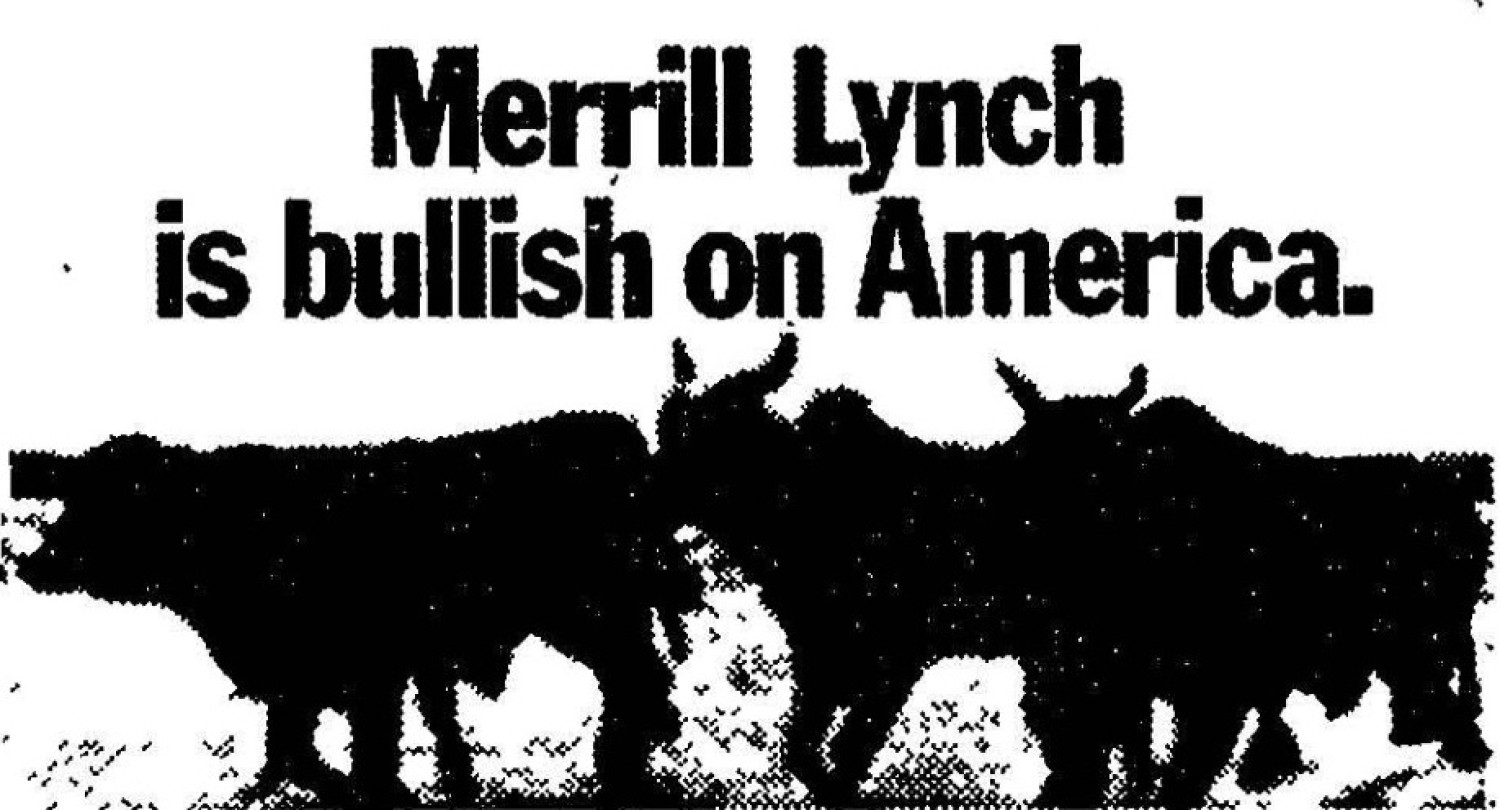
A distinctive symbol. Six weeks after this commercial went on the air, over 65% percent of the target audience could identify the firm that was bullish on America.
12. Don’t be afraid of long copy
A financial commitment is intensely interesting to the person about to make it. Be sure to give your prospects plenty of information.
Research shows that although readership falls off rapidly up to fifty words, it drops very little between 50 and 500 works.
One of the best coupon advertisements for Merrill Lynch contained more than 1,145 words. “The more you tell, the more you sell.”
How to integrate direct response into your marketing plan
If you have a new product or service, make sure your key prospects get the news ahead of the general public – in the mail.
And don’t ignore your current customers. They are often your best prospects.
Financial clients of Ogilvy & Mather
- American Express Card.
- American Express Travelers Cheques.
- American Express International Banking Corp.
- The Bowery Savings Bank.
- City Investment Company.
- The Fidelity Bank.
- Merrill Lynch & Co., Inc.
- Nationwide Insurance.
In collaboration with Hodes-Daniel Advertising, Ogilvy & Mather’s Direct Response Division offers financial marketers a unique combination of services.
Hodes-Daniel has specialised in financial direct marketing for 30 years. They can also computerise your mailing list, print your mailings, and sent them out.
Thus you can now get all the marketing services you need from a single source. While should mean greater speed, better coordination, and more efficient use of your marketing dollars.
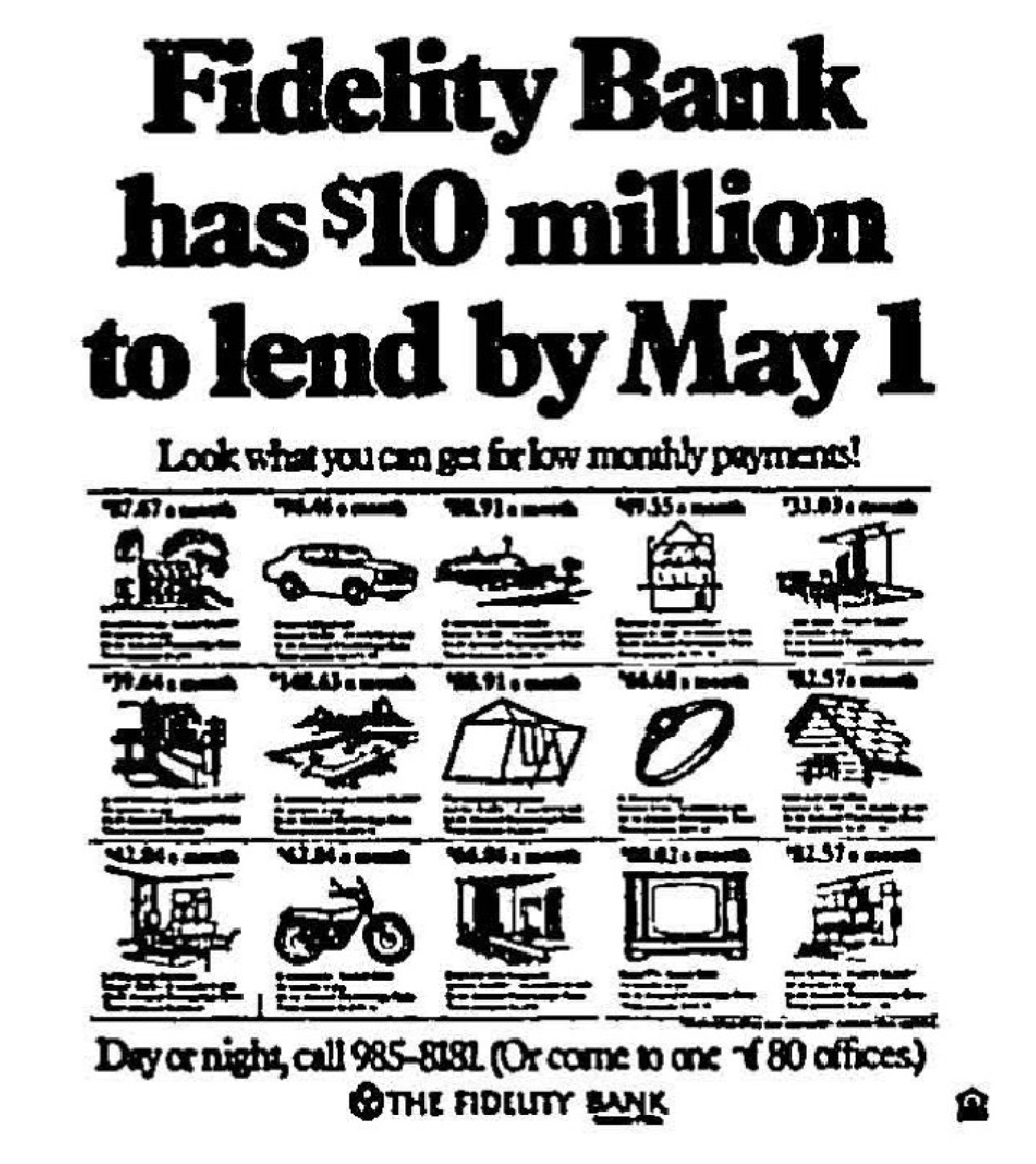
Many people are afraid to ask a bank for money. Fidelity’s direct approach made it easier to ask. Result: every cent of the money was gone in 60 days.
Invitation
Ogilvy & Mather has a comprehensive on-hour slide presentation on financial advertising. If you would like to see this presentation, please write on your company letterhead to any of these heads of Ogilvy & Mather offices: Andrew Kershaw in New York; Michael Turner in Houston; or Cy Schneider in Los Angeles.
Ogilvy & Mather
2 East 48th Street, New York, N.Y. 10017
2600 Two Shell Plaza, Houston, Texas 77002
5900 Whilshire Blvd., Los Angeles, Calif. 90036
■ ■ ■
Notes on corporate advertising to the financial community (Ogilvy)
Few security analysts or sophisticated investors will admit that advertising can affect their evaluation of a company. Ogilvy & Mather’s research tells a different story.
If you care considering advertising to the financial community, here are five keys to success.
- Be ready to make a long-term commitment – three to five years – or the money you spend will be wasted.
- Give a candid indication of how you plan to grow in earnings per share. The people who recommend or buy your company’s stock hate surprises.
- Make sure your financial reports – and your advertising – are easy to understand. Financial experts will avoid a company whose communications are hard to decipher.
- Measure your results. Be as hard-nosed about your advertising investments as any other investment your make.
- Be different. Your advertising must set you apart from other corporations – of it will pass like a ship in the night.
Advert Reproduction
following is the original 1974 advert reproduction. If you would like a copy of this reproduction you may download it here  (it's the same copy of this article we provide to our clients with six other documents on day 18).
Conclusion
"How should you position your financial product or service? This is the most important decision you will make. It affects the way you conduct your business, as well as what you say in advertising." This principle applies today as it did when it was authored. We work with the financial industry that is generally perceived as a personality-deprived sea of suits and ties - how does one stand out in an industry that by its very nature is boring? We'll often tell brokers that "creative is called creative for a reason" - yet so many are investing into stock advertising. The plethora of identical ads, lead generation harvesting websites, and lack of any creative effort yields ordinary results by accident - not on or by purpose.
Of interest is Ogilvy’s line "the more you tell, the more you sell" (top right). While Dr Charles Edwards might have said it first, Ogilvy made it famous. There’s no question that long-copy sells if you’re selling the right product. There are occasions (the finance market is one of them) where short-form well and truly outperforms the long-form alternative. In essence, if you’re detailing the virtues of your offer, the long-form does work. However, long versus short copy is beyond the scope of this article (discussed briefly on our introduction to lead magnets).
Everything about this advert is vintage except for the core principles that have withstood the test of time and still form the foundation for financial advertising. When Ogilvy and Mather printed the article they essentially took ownership of the principles discussed despite being commonly used by others at the time. However, they took the long-form approach when others were printing small ads that weren’t nearly as readable or compelling.
The principles aren’t entirely different to many that we introduce and work with, such as positioning your brand (Unique Selling Point), having a company spokesperson (or celebrity financier), honesty, and so on.
What’s fascinating about this advert is that the end result would be a campaign costing in the hundreds of thousands without coming close to the success (and far higher ROI) one would enjoy today for a mere fraction of a fraction of the cost.
The notion that the company is proud that they might have an advert pressed “within 12 hours of a newsbreak” was a remarkable achievement in 1974 – but would be considered a missed opportunity by today’s standard. Social media, blogging, and the immediacy of advert creation and targeted delivery means you should have your message sent to a relevant audience within just minutes. The same can be said of having video interviews shown on television within days of being shot.
“Going on television” by todays’ standards simply means creating video. And the “wasted circulation” Ogilvy speaks of is largely avoided because of highly refined targeting options – we can reach who we determine is our ideal audience... then retarget them appropriately based on relevance.
The call to action should put our current opportunity into perspective. A letter - written to a department head on a company letterhead - was sent via snail-mail so one might eventually receive an invitation to a one-hour slide presentation. And this was a true static slide presentation – not some fancy PowerPoint. We can have a lead registered to a webinar and watching with interactive features in less than a minute. While we might see this immediacy as an opportunity – and it most certainly is – we’re also appealing to a more sophisticated and discerning audience that will often associate advertising with spam (the vintage process added a certain value, importance, and exclusivity to the exchange). Our modern mission is to create compelling copy that rises above those other ads that a user might scroll past and demonstrate clear and unique value. Additionally, the way social targeting works is that we’re often competing alongside our competition – we must stand out. Still, even with modern day consumer hesitation and reluctance to engage with digital advertising, it’s still far more effective than anything printed in 1974. The same core principles as described in Ogilvy’s advertisement applied in modern day yields exceptional results.
We'll be publishing a large number of vintage Ogilvy advertisements under the post tag of Ogilvy  although it's always worth researching the modern day application of the concepts via our Finance tag. If you've ever engaged in any kind of advertising it'd be prudent to read about everything David Ogilvy has ever written.
David Ogilvy died in July 1999 so he lived to see the birth of the Internet, but never saw the development of Internet speed and infrastructure necessary to fully appreciate the impact it would have upon the industry he helped create.