The advertising of mortgage interest rates occupies a unique position within consumer protection law. Unlike most forms of commercial advertising, the promotion of credit products is subject to an unusually prescriptive legislative framework that attempts to reconcile two competing realities. On one hand, consumers require simple and accessible indicators by which to compare competing mortgage products, and on the other, the true cost of credit is inherently multidimensional, incorporating not merely interest charges but also establishment fees, ongoing fees, discharge fees, package costs, offset account structures, redraw conditions, and numerous contingent expenses.
Not Legal Advice: Nothing in this article is legal advice of any kind. Legislation and Financial Marketing enjoy significant overlap, so this article deals with the legal position of general advertising. Seek your own independent legal advice for all financial marketing compliance matters.
The Deception Funnels in Financial Advertising: This article follows on from one titled "The Deception Funnels in Financial Advertising Used to Deceive Consumers Needs to Stop", and it's in a series of compliance related discussions. Another article deals with website footer compliance, and another scheduled article, titled "How We Multiplied the Results of Broker Grow Advertising by 10X" talks about the low-performing and nom-compliant programs delivered to market (so bad that we offered a 2 million 3X guarantee against their results). The latter article - supported by a large number of client videos - is published simply to distance our long-established Broker Growth program with somebody that is leveraging our product brand to deliver a far inferior product.
Rescue Program: Last year was defined by our Rescue Program: we triple results or give you a million dollars. This year we increased it to 2 million, and we're currently looking at a 5 million dollar program. The rescue program includes those that claim a specialty in the industry when their reality is defined by non-compliance, poor performance, AI video and graphics, and deceptive funnels. Rescue includes Bizleads, Broker Grow, Marketing Transformers, Sunbear, King Kong, wereU, and a number of others. One defining feature of all of those in Rescue is that they are not compliant solutions. As an example of how your own efforts can outperform any paid representation in minutes, read "How to Publish a High Yield First Home Buyer Advertisement in 10 Minutes".
The legislative response to this 'rate tension' was the creation of the comparison rate regime under the National Credit Code. The comparison rate was intended to function as a corrective mechanism against the behavioural tendency of consumers to focus exclusively upon headline interest rates. In psychological terms, legislators sought to counteract the cognitive bias known as anchoring, whereby consumers disproportionately weight the first numerical value encountered during decision making. The comparison rate regime therefore attempts to force advertisers to present a more comprehensive measure of borrowing cost alongside the headline rate.
The Foundational Prohibition: The Foundational Prohibition in financial advertising as defined in Consumer and Financial legislation is clear: "A person must not, in trade or commerce, engage in conduct that is misleading or deceptive or is likely to mislead or deceive". Competition and Consumer Act 2010 (Cth), Schedule 2, especially Section 18 - misleading or deceptive conduct, and Section 29 - false or misleading representations, and in the ASIC Act 2001 (Cth), particularly Section 12DA and Section 12DB prohibits the engagement in misleading conduct. Legally, the contravention occurs at the time the misleading representation is communicated, published, displayed, broadcast, or otherwise conveyed to consumers. In other words, the breach crystallises upon publication or exposure, and you cannot retrospectively erase the original contravention.
Despite the apparent simplicity of the legislative framework, widespread non-compliance remains observable throughout the mortgage broking industry. Some breaches are technical. Others are substantive. Others are deliberate. Many arise not from deliberate misconduct but from a profound misunderstanding of how legislation interacts with broader prohibitions against misleading and deceptive conduct.

APR, Comparison, and Quantitative Compliance Infractions are Ubiquitous: Of the 18000+ advertisements currenting run by over 3200 brokers (as of the date of publication), not a single advert published that includes a rate or other numeric or quantitative statement is compliant (outside our own compliant clients). Not one.
Compliance is one thing you can control, and technology should work for finance businesses. That's our focus. We focus on the results through broker education, and we build everything around us in terms of technology to support better commercial outcomes. Nobody else can say the same.
This article examines common aspects of rate advertising within the mortgage market and establishes a framework for best-practice compliance.
Infographic Advertising: You're going to see a number of 'infographic'-style advertising  in this article - a format we used for years until it was adopted by others (none of the linked ads are compliant, but we'll come to that later). First, usage of this format is created by AI in seconds so it is commonly used, but the information returned has to be property scrutinised for basic legislated compliance. Ogilvy's "The More You Tell, The More You Sell" (directed at copy - not creative) seems to have migrated to the creative field in the last few years, and this has given rise to a range of expressions we coined internally, such as "The More You Claim, The More You Must Explain" and "The More You Quantify, The More You Must Justify". Infographics are based on larger amounts of information, so ensure you don't tickle the thin green line. Second, because infographics play a larger industry role - especially in advertising - we've created a free 'Finance Infographic Generator' with results returned, or a series of prompts for various engines in JSON format.
You Will See Changes: We're quite public with our criticism of the quality of advertising, and each time we record reviews or publish information you'll see a scurry of activity as those that follow our lead try desperately to catch up - all of which we heavily document. To those agencies that are delivering a known mediocre experience to brokers - which includes anyone using High Levell or Calendly - we suggest you find yourself an industry that doesn't require a regulated experience. We and other great agencies we deal with every day outperform you with creative, conversions, and tech, so consider vacating the industry and allow brokers to engage with an experience that is free from the technical debt that defines your 'product'. Let mortgage brokers engage with a compliant experience that'll deliver them better results.
A Note on the Example Screenshots
The examples contained throughout this article are not published for the purpose of ridicule, humiliation, or public shaming. The overwhelming majority of brokers and financial professionals genuinely want to operate ethically and in the best interests of consumers, yet many are unknowingly exposed to significant compliance risk through shonky marketing advice, flawed advertising systems, templated lead-generation funnels, or clueless third-party agencies that prioritise conversion metrics over regulatory integrity. The purpose of this analysis is therefore educational rather than punitive. By examining real-world advertising practices in their unedited form, it becomes possible to illustrate how misleading impressions are actually created in practice, how regulators are likely to interpret those experiences, and where seemingly minor wording or design decisions can produce substantial legal consequences under Australian consumer and financial services law.
Importantly, many of the issues identified in this article arise not from deliberate dishonesty, but from a broader industry culture in which behavioural manipulation, exaggerated savings claims, artificial urgency, fake personalisation, fabricated testimonials, and misleading “AI-powered” experiences have become increasingly normalised within digital marketing ecosystems. Over time, these practices can begin to appear commercially acceptable simply because they are widespread. The fact that a particular tactic is commonly used, however, does not make it compliant. Financial services operate within one of the most heavily regulated advertising environments in Australia precisely because consumers are making decisions involving large financial commitments, information asymmetry, and long-term economic consequences. Compliance therefore cannot be treated as a superficial legal formality appended after the marketing process - it must form part of the architecture of the consumer experience itself.
If your advertisement, landing page, or funnel appears within this article, we invite you to view that inclusion not as criticism, but as an opportunity to strengthen both your compliance position and your commercial performance. Any broker featured in this analysis will receive a 25% discount on our Broker Growth program. The reason for that offer is simple: the overwhelming majority of the issues identified throughout this article were entirely avoidable, and your conversions were compromised by poor ads and offensive technology. More importantly, many of these same practices are not merely compliance liabilities - they are commercially inefficient. Misleading funnels of any type and weak disclosure structures frequently damage long-term trust, reduce conversion quality, increase consumer scepticism, and ultimately produce lower-value relationships. Ethical and transparent marketing is not merely safer - it performs better.
Our framework is built upon a fundamentally different philosophy: genuine value creation through truthful representation, transparent communication, psychologically intelligent user experience design, and the delivery of real, visible consumer outcomes. Rather than manufacturing the illusion of analysis, savings, or personalisation, we believe financial marketing should substantively deliver what it promises. In our experience, when brokers operate with a higher standard of honesty, clarity, and disclosure from the very beginning of the customer journey, consumers respond with greater trust, stronger engagement, improved lead quality, and higher long-term conversion performance. The objective is not merely to avoid regulatory scrutiny but it is used to build a business capable of sustaining public confidence in an industry where trust has become one of the most commercially valuable assets of all.
Insights API: Insights records every single advertisement from every single broker in the country every single day. What has resulted is the most complete archive of broker advertising in existence. AI integration reads text from images, measures the advert in its entirety against our compliance benchmarks, and assigns a score based on compliance, sentiment commonality (and copy overlap), and effectiveness. The API itself is available to those that are required to provide advertising oversight.
Rates & Numbers Play a Valuable Role in Marketing
There has emerged a somewhat simplistic tendency to equate any consumer-facing use of interest rates with “rate-driven” broking or reductive financial marketing. Such a characterisation fails to recognise both the behavioural realities of consumer decision-making and the legitimate informational role that rates continue to play within the borrowing process. Interest rates are not merely marketing devices imposed upon reluctant consumers by the finance industry; they are among the primary variables through which consumers themselves conceptualise and compare lending products. Extensive behavioural and market research consistently demonstrates that borrowers regard rate as the single most influential product attribute when initially evaluating finance options, often assigning it substantially greater importance than secondary considerations such as product flexibility, structural features or ancillary benefits. To entirely ignore rates within consumer communication would therefore not represent sophistication or ethical restraint, but rather a failure to engage consumers through the financial language they most readily recognise and understand.
This behavioural reality is reinforced by the broader media and economic environment within which consumers form their financial perceptions. Public discourse surrounding mortgages is overwhelmingly rate-centric. RBA announcements, monetary policy commentary, mainstream news coverage and comparison platforms routinely frame the mortgage market through the lens of percentage movements, pricing cycles and repayment impacts. Consumers are therefore conditioned to interpret lending products initially through numerical pricing signals, even where those signals may ultimately represent only one component of a far more complex borrowing decision. In this sense, the use of rates within advertising functions not merely as promotion, but as a form of communicative alignment with the vocabulary already dominating public financial consciousness. Rates provide an accessible cognitive entry point through which consumers begin engaging with otherwise highly technical financial products.
Importantly, the ethical use of rates does not require that rates become the sole or dominant basis upon which lending recommendations are ultimately made. There is a fundamental distinction between using rates as an initial engagement mechanism and constructing an entire advisory framework around simplistic price competition. A consumer may first respond to an advertisement because of a rate representation, yet the subsequent advisory process may appropriately expand the discussion toward loan structure, repayment flexibility, offset functionality, cash-flow management, investment strategy, risk tolerance, long-term financial objectives and broader suitability considerations. In practice, sophisticated consumer engagement often involves precisely this progression: the rate captures attention because it aligns with the consumer's existing financial frame of reference, while the advisory conversation itself introduces the deeper structural and strategic considerations necessary for informed decision-making.
The regulatory framework itself implicitly recognises the legitimacy of rate-based advertising, provided that such representations are used transparently, accurately and in conjunction with the disclosures necessary to contextualise them appropriately. The National Credit Code does not prohibit the advertisement of rates; rather, it regulates the manner in which rates are presented so as to minimise the risk of consumers forming misleading impressions regarding cost, availability or suitability. Similarly, ASIC's Regulatory Guide 234 does not advocate for the elimination of pricing representations from financial advertising. Instead, it emphasises balance, substantiation and the avoidance of selective emphasis that distorts consumer understanding. Ethical rate advertising therefore does not involve abandoning rates altogether, but using them within a disclosure framework that respects both consumer psychology and consumer protection principles.
Accordingly, the mere presence of rates within advertising should not be mistaken for evidence of a “rate-driven” philosophy. To the contrary, refusing to acknowledge the persuasive and informational power of rates may itself represent a failure to appreciate how consumers actually navigate financial decision-making. Effective and ethical advertising does not ignore consumer behaviour; it recognises it, engages with it transparently, and then responsibly broadens the conversation beyond the initial numerical trigger. When used with appropriate disclosures, contextual explanations and a genuinely client-focused advisory process, rates can serve as a legitimate and highly effective gateway into more sophisticated financial discussions rather than as an endpoint in themselves.
From a practical perspective, this approach is also reflected in our own commercial outcomes. Ethical engagement frameworks that responsibly utilise rate-based messaging while subsequently educating consumers on broader structural considerations consistently demonstrate strong engagement and conversion performance because they align persuasive communication with informed advisory conduct rather than placing the two in opposition. The objective is not to manipulate consumers through isolated numerical representations, but to use familiar financial reference points as the beginning of a more comprehensive and strategically informed lending conversation. In this sense, properly contextualised rate advertising does not undermine ethical finance practice; it facilitates consumer engagement with it.
We Use Lender Data Everywhere: We use lender and rate data in a large number of locations, from our website framework and comparison engine (and Comparison API) through to placeholders in email autoresponders. When rates are a language and metric that borrowers understand and consider more important than any other mortgage attribute, we ensure that we communicate using a shared and common language. We support this data with large amounts of information and video. It's in the discussion you have with clients that you educate them on structure, capacity, eligibility, serviceability, and other big-picture considerations.
The Legislative Purpose of Comparison Rates
The National Credit Code requires comparison rates because legislators recognised a fundamental economic reality: interest rates alone rarely communicate the "true cost of borrowing".
ASIC explains that comparison rates are intended to incorporate interest charges, most fees and charges, the term, and a standardised calculation methodology, thereby allowing consumers to make more informed comparisons between competing credit products. The policy objective is therefore not merely disclosure. It is behavioural intervention. The comparison rate regime seeks to mitigate anchoring bias, framing effects, salience bias, presentational distortion, and information asymmetry. From a consumer psychology perspective, comparison rates represent one of Australia's earliest attempts to use disclosure law as a form of behavioural regulation.
The True Cost of Credit or Borrowing: Although neither the National Credit Code nor the National Consumer Credit Protection Regulations expressly employ the phrase "true cost of credit", the comparison-rate regime is founded upon that underlying concept. The legislative scheme proceeds from the recognition that an annual percentage rate represents only one component of a borrower's financial obligation and may therefore provide an incomplete basis for product comparison. By requiring the disclosure of a comparison rate whenever an annual percentage rate is advertised, Parliament has effectively acknowledged that the economic cost of credit extends beyond interest charges alone. The comparison rate serves as a statutory approximation of that broader cost, incorporating prescribed fees and charges into a standardised disclosure intended to provide consumers with a more accurate understanding of the financial consequences of borrowing. When read alongside the prohibitions against misleading or deceptive conduct contained in the ASIC Act and Australian Consumer Law, the comparison-rate provisions reveal a clear legislative objective: consumers should not merely be informed of the interest payable under a credit contract, but should be placed in a position to understand, as accurately as reasonably practicable, the overall cost implications of the credit being offered. In short, the comparison rate requires disclosures that includes the interest rate, and the rate itself triggers comparison obligations - that's the interpretation established by law, and brokers should never lean on rates or "rate bait" in order to unduly coerce a conversion of any type.
When Must a Comparison Rate Be Displayed?
The most misunderstood provision in Australian credit advertising is Section 160 of the National Credit Code. Section 160(1) states that "[a] credit advertisement must contain the relevant comparison rate in accordance with this Part if it contains an annual percentage rate" (and, discussed shortly, if the repayment amount is stated in the advertisement). The practical consequence is profound. If an advertisement contains any numeric rate figure, such as 5.49%, 5.84% p.a. variable rate 5.69%, fixed rate 5.39%, rates between 5.69% and 6.02%, or any other annual percentage rate representation, the comparison rate is required as prescribed in legislation.
Many marketers and brokers incorrectly assume that the obligation arises only for lenders. The legislation instead focuses upon publication of the advertisement itself. Mortgage brokers are therefore not exempt merely because they are intermediaries.
An equally important, yet frequently overlooked, aspect of the comparison rate regime is that the legislative obligation operates asymmetrically. Section 160 of the National Credit Code creates a one-way trigger: the publication of an annual percentage rate compels the inclusion of a comparison rate... but the converse is not expressly mandated. That is, the legislation does not state that the publication of a comparison rate automatically requires the publication of the corresponding interest rate. This distinction has occasionally led some advertisers to conclude that a comparison rate may be presented in isolation as a means of avoiding the broader compliance obligations associated with rate advertising. Such an interpretation is inconsistent with both the purpose and structure of the legislation - the exclusion does not represent the 'true cost of credit', so usage of the comparison rate subsequently requires an Annual Percentage Rate (APR).

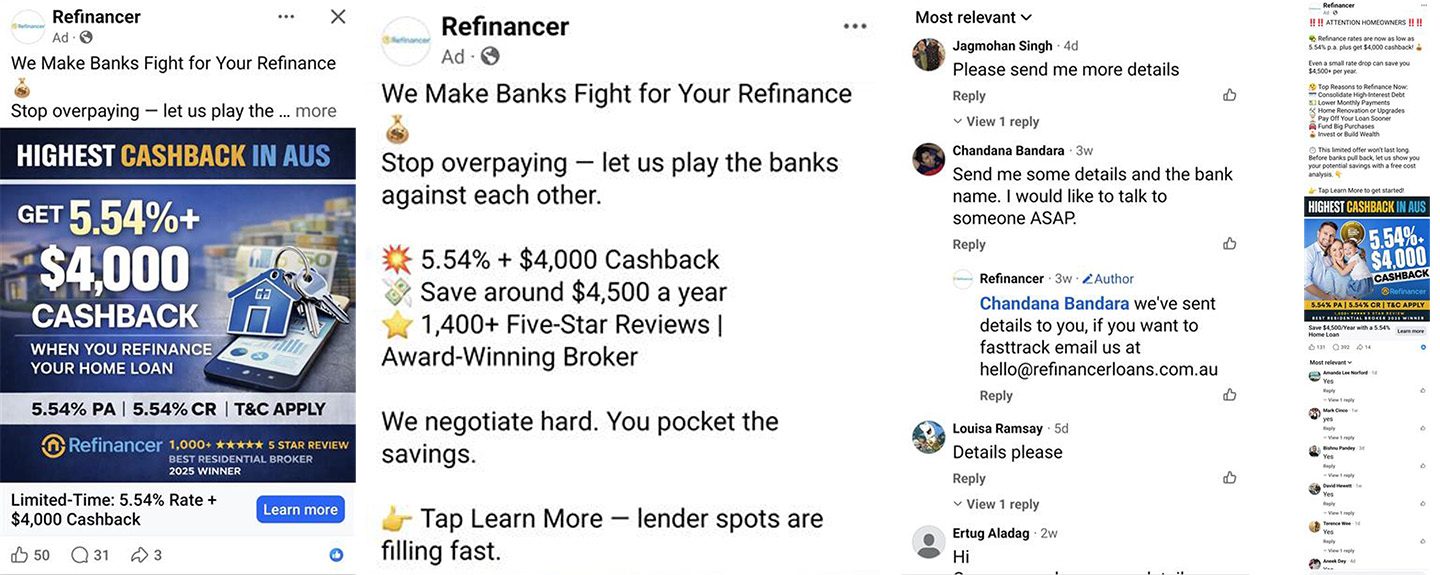
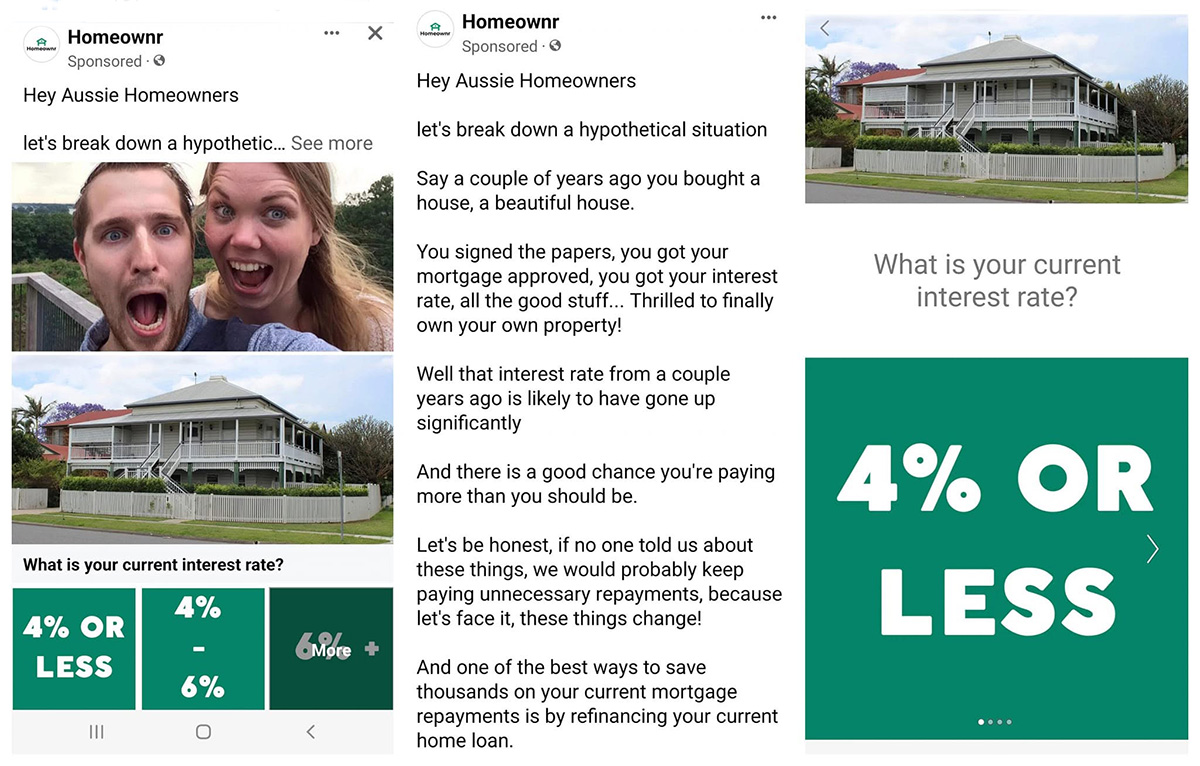
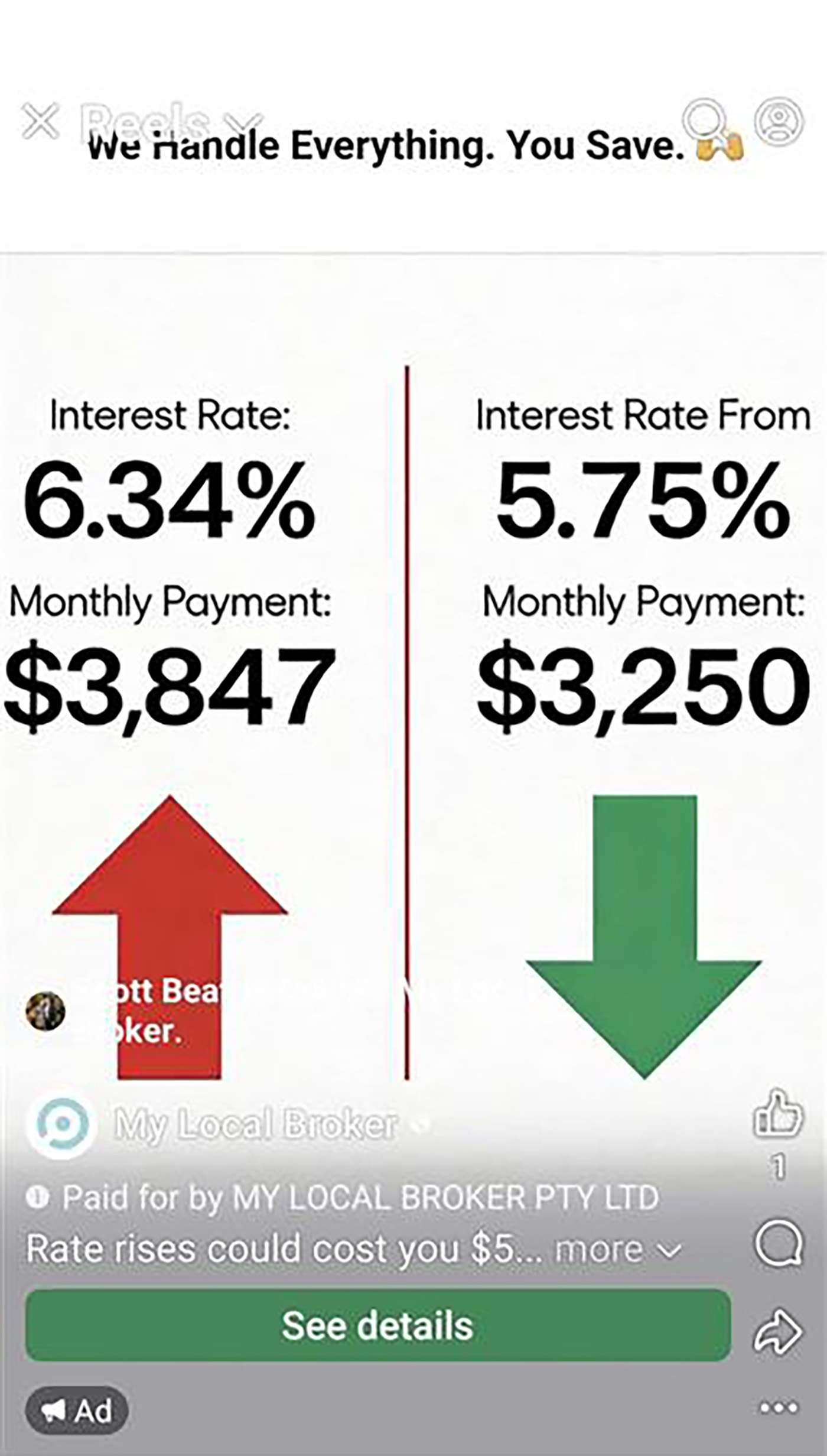
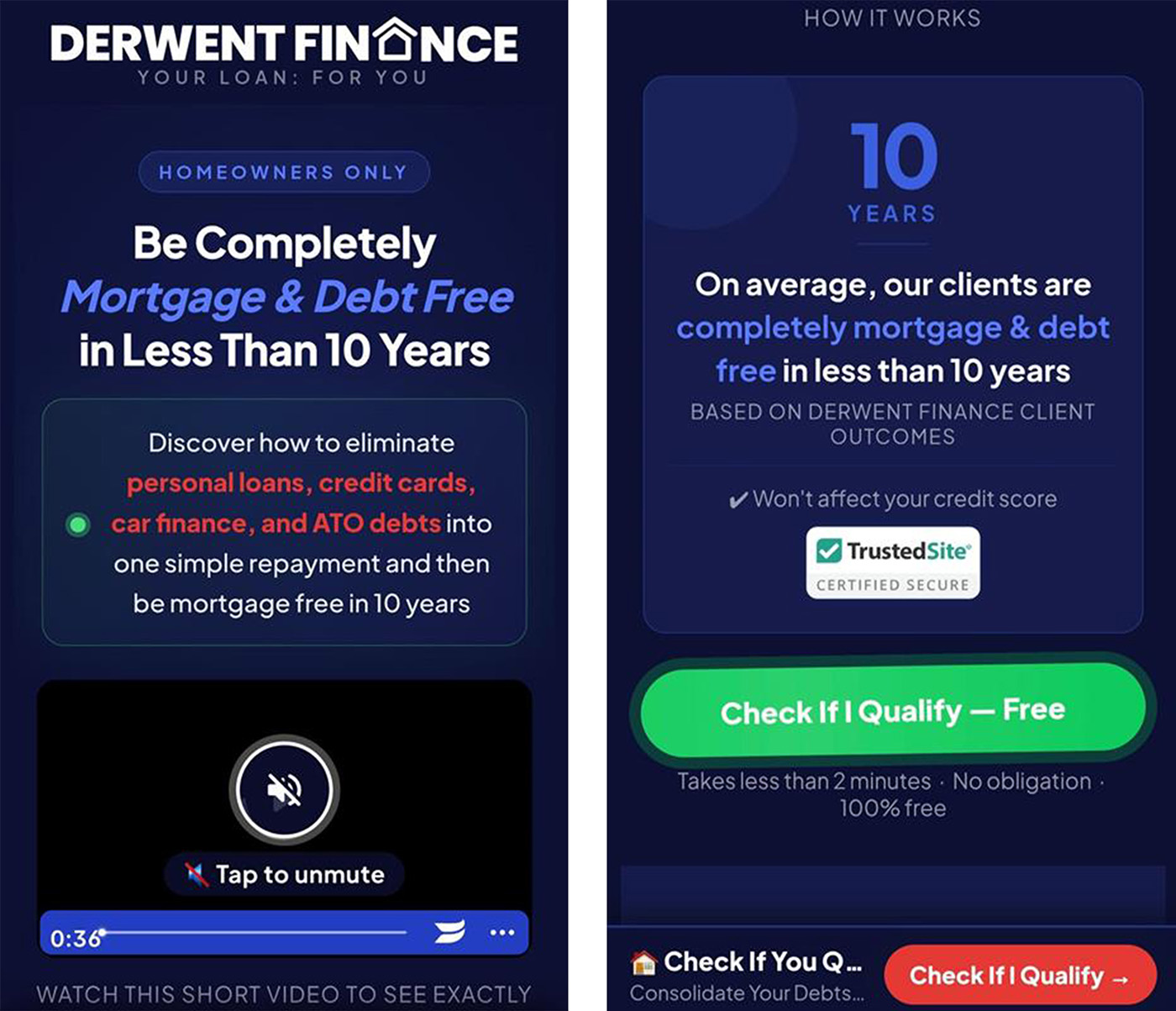
Pictured: The advertisements above were chosen in a pool of several thousand simply because they were shown in the few hours before this article was published - so they're current. None are compliant, and a few of them - such as Refinancier - is of particular concern because of the clear deception funnel that follows (they're also not responding to requests for the lender - required in the missing disclaimer - as a matter of choice, and this breach is discussed shortly).
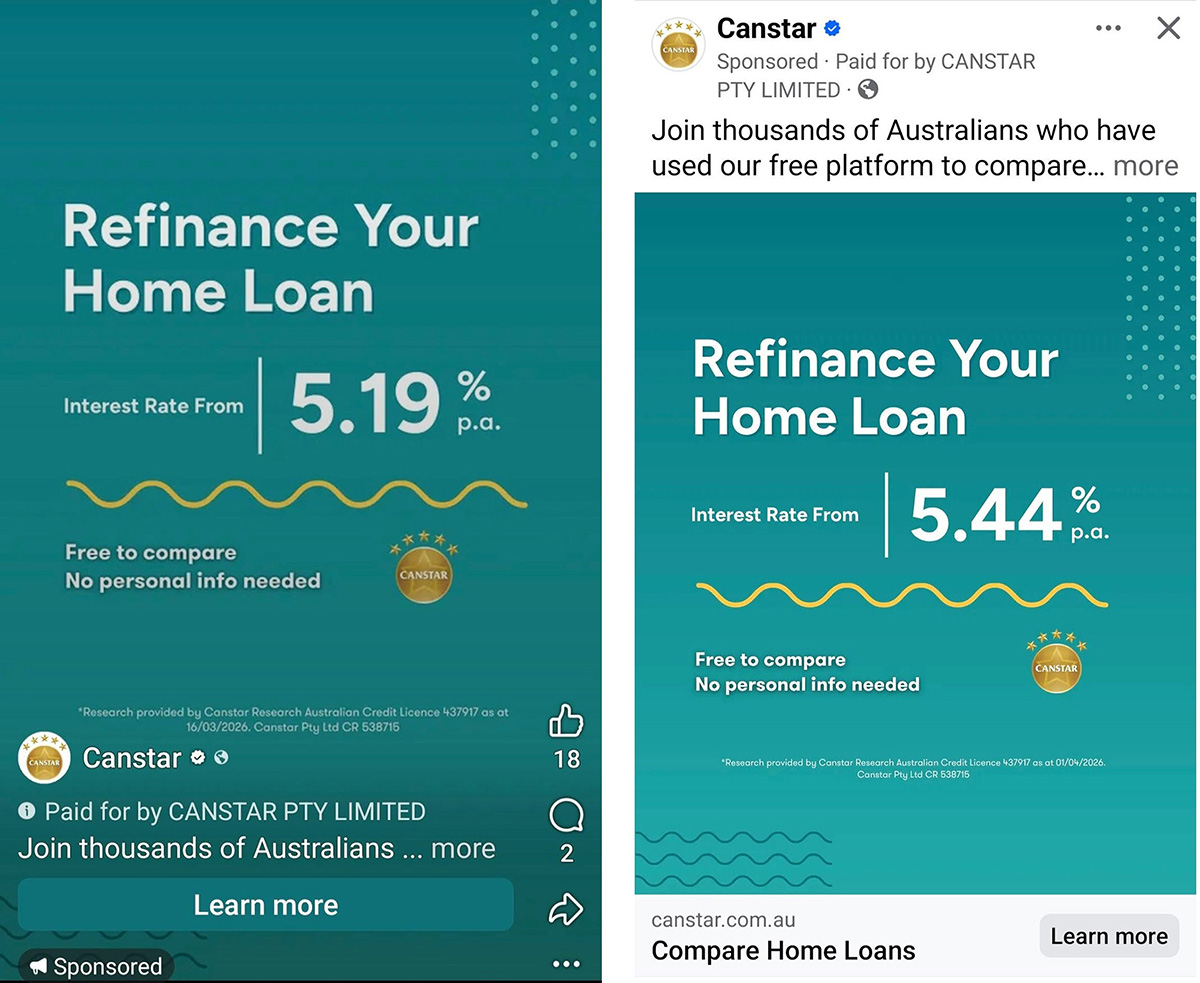
The comparison rate was never intended to function as a standalone representation of credit pricing. Rather, it was introduced as a supplementary disclosure mechanism designed to provide consumers with a more complete understanding of borrowing costs than could be achieved through the publication of an annual percentage rate alone. Section 160 operates on the assumption that consumers will ordinarily encounter both figures together, allowing them to understand not merely the nominal interest component of a loan, but also the extent to which fees and charges influence the overall (shorter-term) cost of credit. To present a comparison rate in isolation deprives consumers of the very contextual information that the comparison rate was designed to supplement.
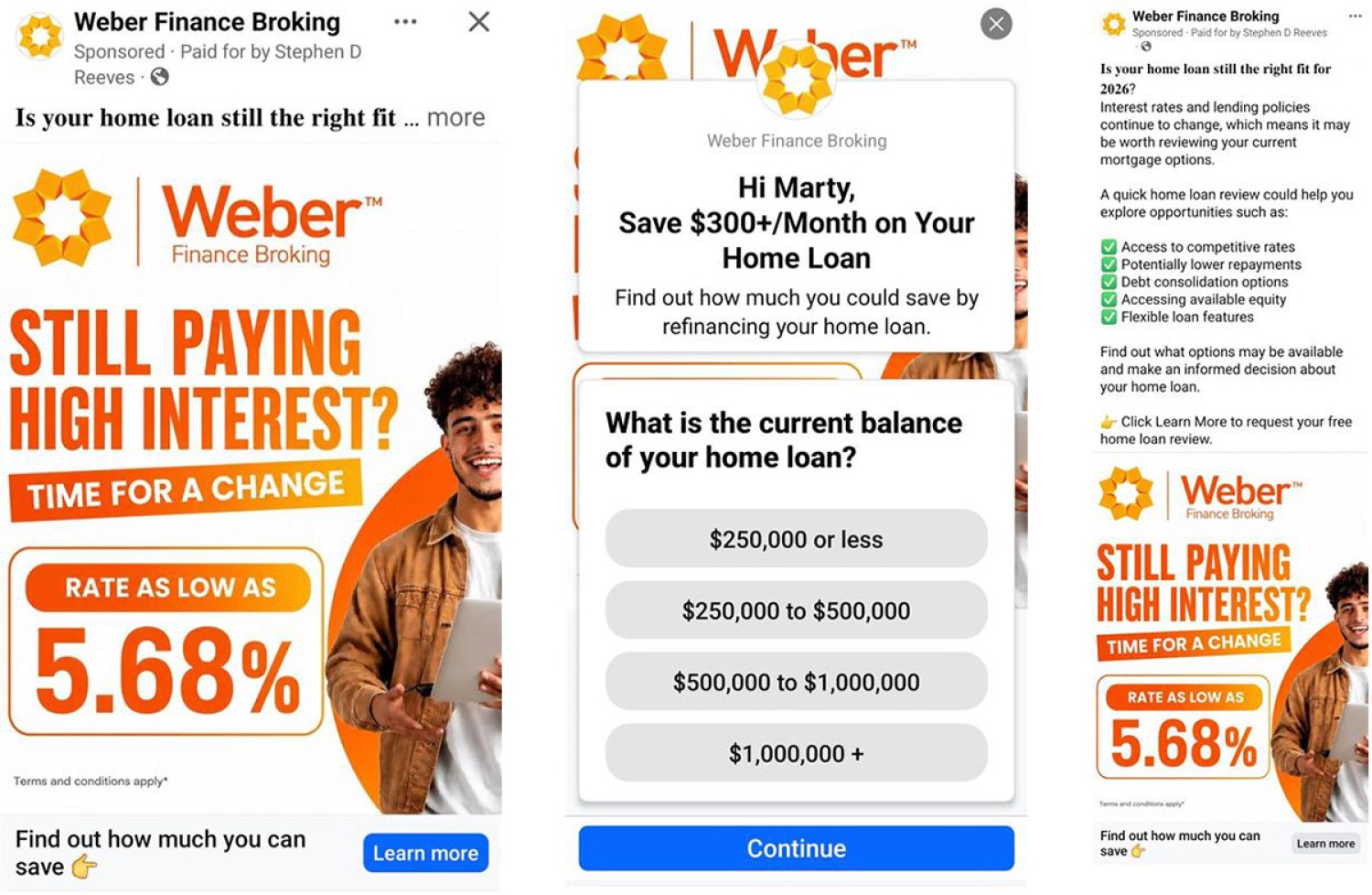
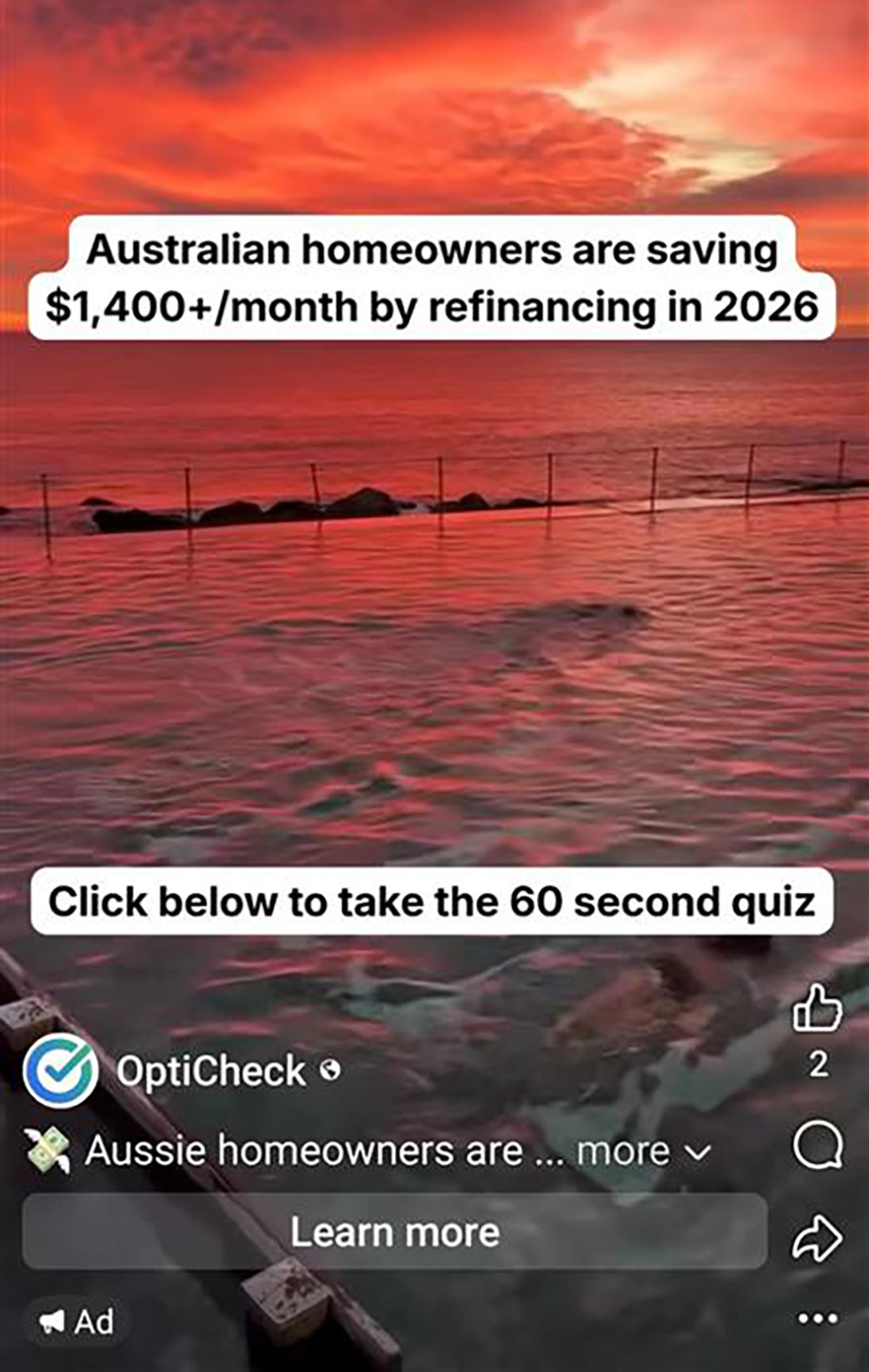
Pictured: This advertisement was indiscriminately selected from a pool of thousands. The "Rate as Low as" is an issue we discuss shortly, but the arbitrary and nonsensical figure doesn't absolve you of legislated compliance sins. The comparison is required, as is the warning, term, conditions, fees, lender, and other disclosures. The issue is compounded by the quantitative "Save $300 a month" statement which also requires full qualification and substantive and accurately resolved statements. If this advert were a horse, you'd shoot it. Sadly, most digital representation is flawed or downright illegal, and this is evident by the fact that no advert outside our own client base that discloses numeric values is presented in a compliant manner - not one.
This principle becomes particularly apparent when the broader legislative framework is considered. Section 163 of the National Credit Code requires that a comparison rate be accompanied by the prescribed warning, while Section 164 imposes strict requirements regarding the prominence and presentation of comparison rates. Most significantly, the prescribed warning itself acknowledges the inherent limitations of comparison rates, stating that different amounts and terms will result in different comparison rates and that certain costs, including redraw fees and early repayment fees, are not included in the calculation. Legislators therefore recognised that a comparison rate is not, and was never intended to be, a complete representation of the cost of credit. It is merely one component of a broader disclosure framework, so the comparison in isolation - established through case law - is used as a measure against tiers of products when early rate disclosure information was provided. What it is not is a licence to print one (often misleading) figure in isolation of broader cost-disclosure requirements as dictated by legislation.
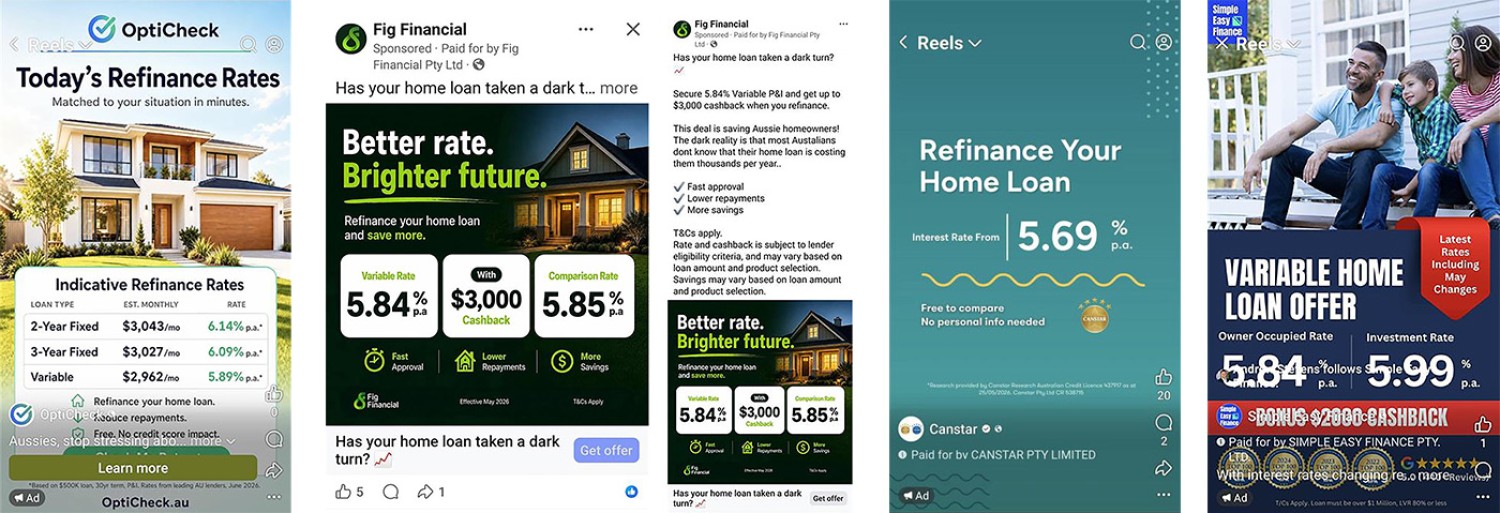
Pictured: With the exception of Fig Financial, the pictured examples have failed to provide the legally mandated comparison rate. National Consumer Credit Protection Act 2009 states very clearly in s164(a) that "[a] credit advertisement must contain the relevant comparison rate in accordance with this Part if it contains an annual percentage rate", and section 161 states that "The relevant comparison rate for the purposes of section 160 is the comparison rate calculated for whichever of the designated amounts and terms most closely represents the typical amount of credit and term initially provided by the credit provider for the consumer credit product being advertised". Among an array of other requirements, section 163(1) states that "A comparison rate in a credit advertisement must be accompanied by a warning about the accuracy of the comparison rate that is prescribed by a regulation". It's not rocket science. The two figures should be considered as Jerey Lewis and Dean Martin, Abbot and Costello, Ying and Yang, burgers and fries - inseparable and joined at the hip. You can't have one without the other. In many cases, the comparison rate is excluded as a means to intentionally deceive the borrower, and these cases are discussed in the article on the 'Deception Funnel'. Fig Finance includes the comparison rate in the primary creative but fails to include it in the copy, and the comparison warning is missing (as it is in all examples), and this is discussed in the next section.
From both a legal and behavioural perspective, the interest rate and comparison rate should therefore be regarded as inseparable disclosures. One communicates the contractual rate at which interest accrues, while the other communicates a legislatively standardised estimate of the broader cost of borrowing. Each figure derives meaning from the presence of the other. An interest rate without a comparison rate understates, misrepresents, and often hides the true cost of credit. Conversely, a comparison rate without the corresponding interest rate obscures the fundamental pricing structure of the mortgage product itself. The consumer is left with a numerical figure that appears authoritative yet lacks the contextual benchmark necessary for meaningful comparison.
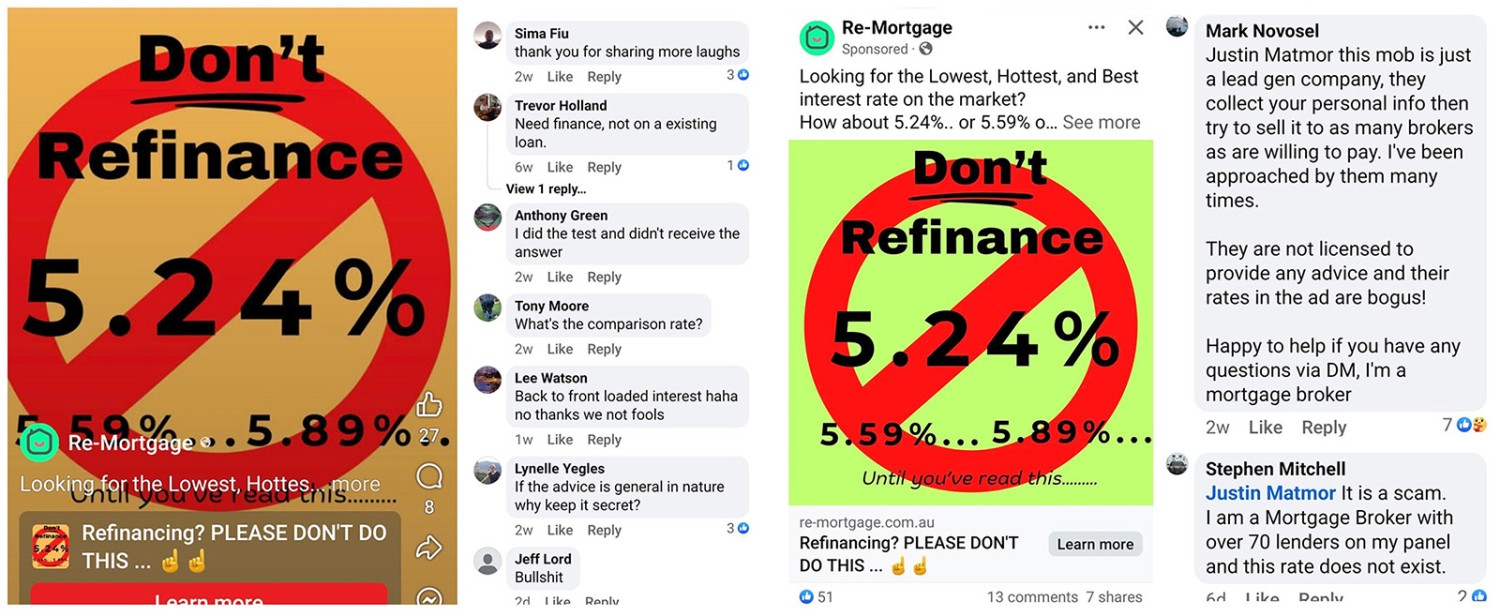
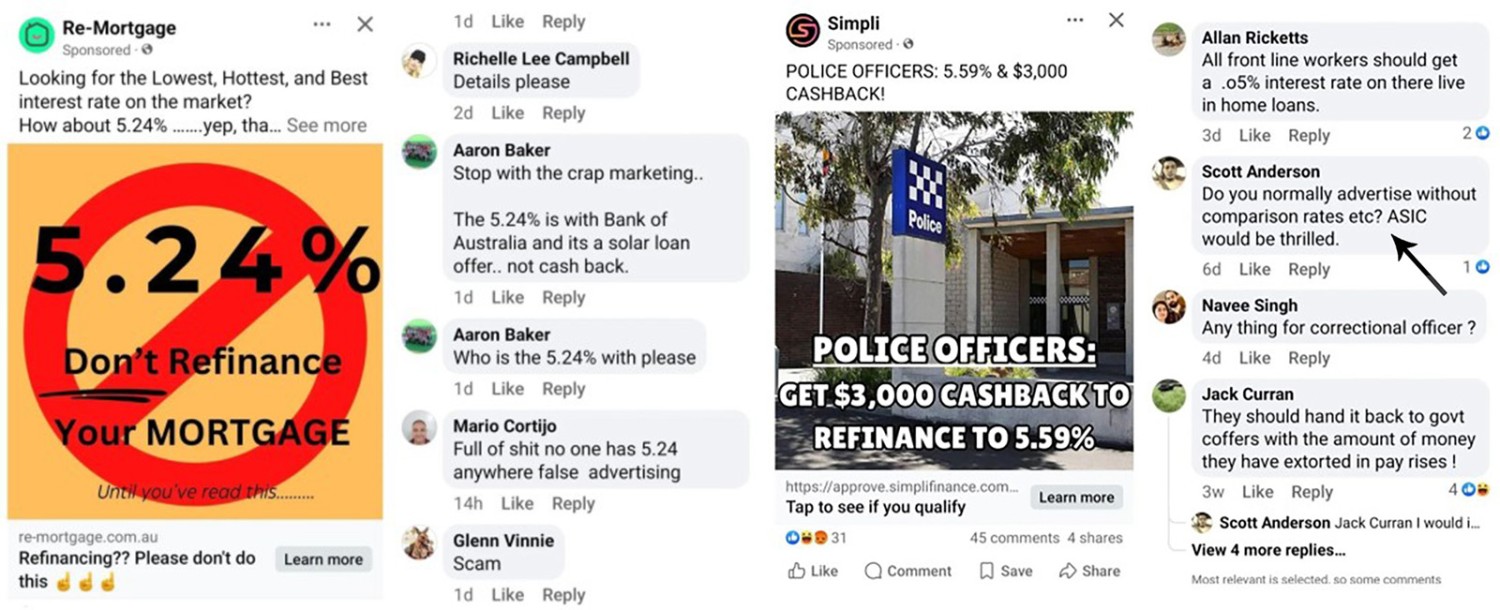
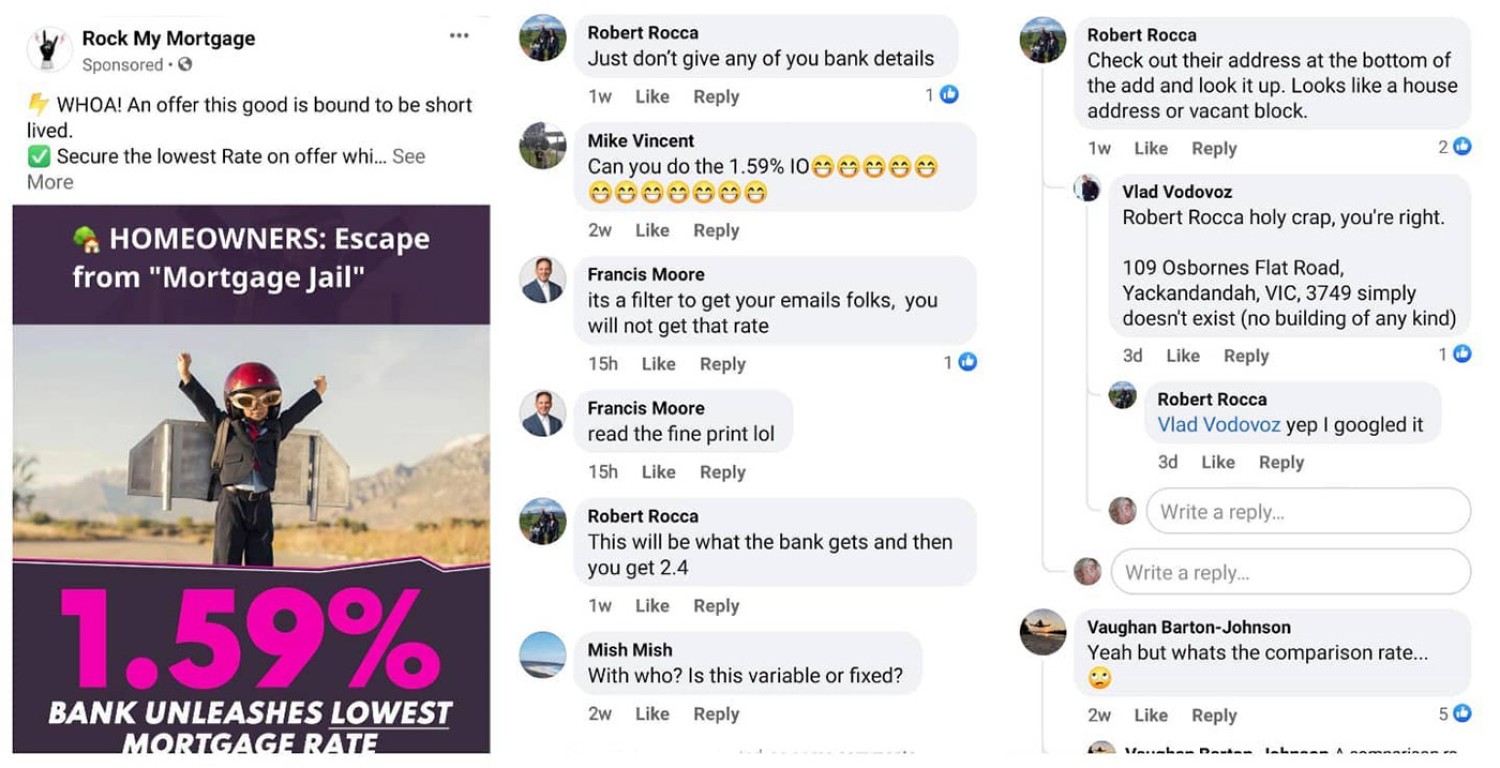
Advertising Comments: You will be called out on your bullshit. While the Simpli Finance efforts might be explained by a DIY oversight or incompetent marketing representation, the illegal Mortgage Magnet message is entirely deliberate and cannot be explained by ignorance - he knows what he's doing. John Kennedy from Tide Financial - the charlatan behind Mortgage Magnet - was a former broker (albeit, not very successful), and his representation in the advertising space has adversely impacted all those that conduct themselves ethically, responsibly, and in the best interests of the consumer, and those consumers that were presented with his advertisements were objectively exposed to broad deception. It's hard to see any broker that buys his leads as anything other than somebody supporting organised crime. Rock My Mortgage has gone a little dark lately but may have emerged as another name to escape past sins (as Broker Grow did with the legion of upset brokers at Karbn), but the brand as it existed was a minefield of compliance issues with the legal framework and honesty seemingly overlooked and ignored on the basis that "dishonesty performs better". We commented on a Mortgage Magnet advert back in 2021 and invited John to our long-stating challenge - he declined (as did John Maxwell from UpTick Marketing - he publicly accepted and privately declined). Don't buy leads!
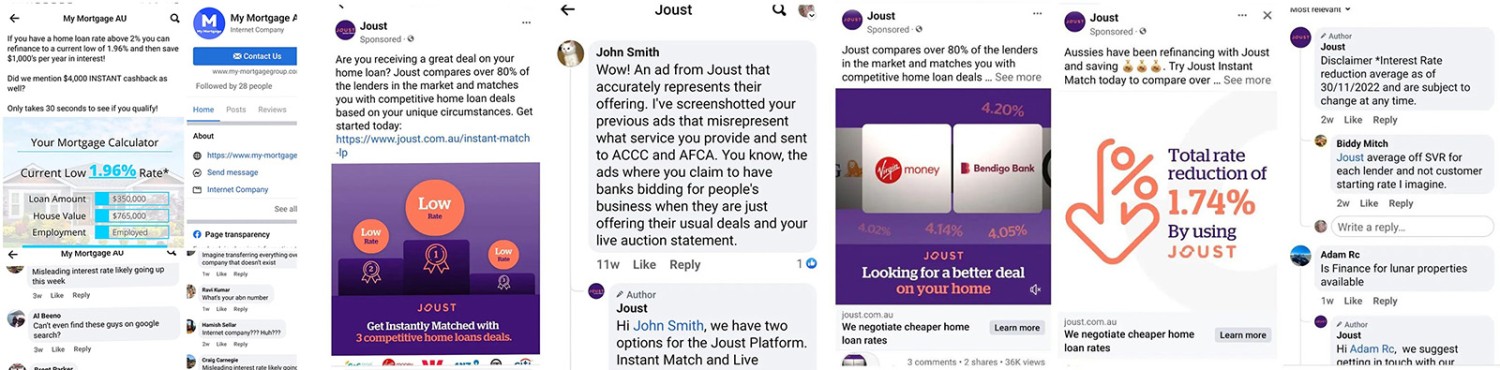
Pictured: Under previous management, the Joust platform was a fraudulent deceptive lie - both in terms of its consumer-facing advertising and the service provided to brokers. Apart from the clear issues associated with rate misrepresentation and quantification malfeasance, the notion that lenders would 'compete' for submitted deals was absurd, and customers quickly caught onto the lie. For brokers, leads were double-handled, washed against duplicate databases, and of poor quality. They insulted financial legislation but also violated basic Australian Consumer Law expectations in other ways. It's a shame: they could have leveraged decent technology and established the brand in a way that supported borrowers through education and an enhanced service. Certainly, their marketing team - supported by a gentleman by the name of John Maxwell (now selling leads under another brand) - was largely responsible for the brand's demise. The whole platform was a compliance abomination.
This interpretation is further reinforced by the overarching prohibitions against misleading or deceptive conduct contained in section 12DA of the ASIC Act and section 18 of the Australian Consumer Law. The legal test is not whether a disclosure can be defended in isolation, but whether the overall impression conveyed to an ordinary and reasonable consumer is accurate. Where a comparison rate is presented without the accompanying interest rate - an action that is well-established to be a method to mitigate true cost disclosure - there is a substantial risk that consumers may be misled as to the composition of that figure, the assumptions underlying its calculation, or the relationship between interest charges and other borrowing costs. Such an outcome would be fundamentally inconsistent with the consumer-protection objectives that underpin the comparison rate regime.

Pictured: Those lead generation companies that flog off Facebook leads aren't interested in honesty, transparent, ethical conduct, or the legal framework that underpins industry efforts. They're interested in one thing: low-cost leads. And they'll use whatever methods are necessary in order to deliberately bait potential borrowers into a subscription. Your association with these groups is a compliance breach by association - you're breaking the law. No lead generation advertisement has ever introduced the required comparison warnings, disclosures, warnings and relevant information. Not ever.
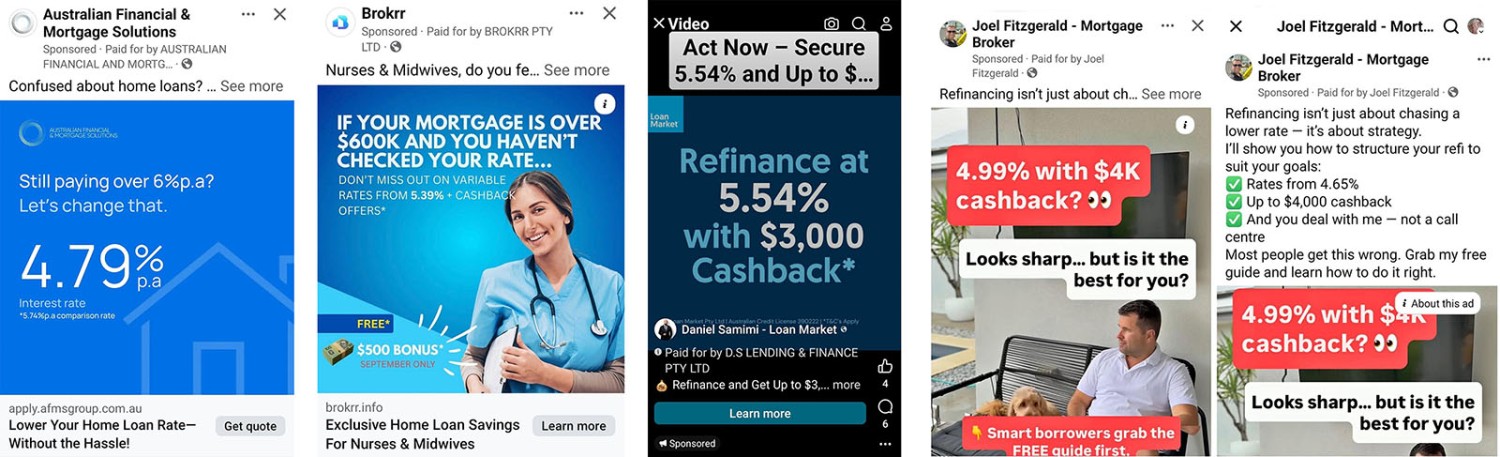
Pictured: None of the pictured advertisements meet the legal standard. Quite often, the cashback shown is not one associated with the product, and the cashback itself should be disclosed with information to support your claims. The use of disclaimers enhances the experiences and ratifies eligibility. The advertisement from Australian Mortgage Finance Solutions includes the comparison rate in a manner that is specifically regulated against, and they - along with all the other ads - exclude the required disclaimers, warnings, and information. Joel Fitzgerald's should be commended for the DIY effort, but it isn't compliant. Further, Joel returns a masup of non-compliant rates that don't match. Use of rates in video is introduced shortly (disclaimers not present)
In practical terms, compliance professionals should approach the interest rate and comparison rate as a legislatively married pair. While the National Credit Code expressly requires the comparison rate when an annual percentage rate is advertised, the broader purpose of the regime is to ensure that consumers are provided with a balanced and accurate representation of the true cost of credit. Best established legal practice therefore dictates that whenever one figure is displayed, the other should ordinarily accompany it, together with the prescribed warning and all associated disclosures. The objective is not merely technical compliance with the wording of section 160, but faithful, dutiful, transparent, honest, and ethical compliance with the legislative intent, thus enabling consumers to understand the real economic cost of borrowing before making a credit decision, or the decision to interact with an advertisement.
Note: The comparison rate cannot be arbitrarily selected. Section 161 requires the comparison rate to be calculated using the designated amount and term most closely representing the typical credit product being advertised. This requirement prevents advertisers from selectively choosing loan scenarios that artificially improve outcomes. The comparison rate must correspond to the legislatively prescribed methodology.
Mandatory Information Accompanying the Comparison Rate
Section 162 requires the advertisement to clearly states the product name, credit amount, loan term, and whether the loan is secured or unsecured where applicable. Failure to provide this contextual information will render the comparison rate misleading because consumers cannot understand the assumptions underpinning the calculation.
The legislation does not expressly state that the lender's name must appear alongside every comparison rate. However, in many advertising contexts, the lender identity forms part of the "product name" required by section 162 and is necessary to prevent the advertisement from becoming misleading.
The contextual information required by section 162 serves a purpose far broader than mere technical disclosure. Legislators recognised that a comparison rate is not a self-explanatory figure. It derives its meaning from the assumptions upon which it is calculated, including the loan amount, loan term and the particular credit product to which it relates. A comparison rate without context is little more than a number. The legislative requirement to disclose the product details therefore exists to ensure that consumers can identify precisely what is being compared and whether that comparison is relevant to their own circumstances.

Pictured: The comparison rate triggers the comparison rate and full comparison warnings, and the comparison rate triggers the full product disclosure - including the term, rate, comparison rate, product, and other information. It isn't hard.
In practice, this necessarily raises the question of product identification. A mortgage product does not exist in isolation. Every credit product is offered by a particular credit provider operating under its own credit policies, servicing standards, fee structures, eligibility criteria, offset arrangements, redraw conditions and pricing methodology. Two products carrying identical interest rates and identical comparison rates may nevertheless represent materially different consumer propositions. The identity of the lender is therefore not merely a branding exercise - it is an integral component of understanding the nature of the credit product itself.

Pictured: Warning and disclosures add validity and a measure of quality assurance to your business and operation. You'll stand out from the lead generation crowd, and your transparent communications and overt honesty legitimises your operation and forms part of your customer experience. If you need to intentionally advertise on rate in isolation as some sort of bait mechanism without legal disclosures, then you probably shouldn't be a broker.
Although section 162 refers to the "product" rather than the "lender", there are well-established legal arguments and precedent stating in clear terms that a consumer cannot meaningfully identify a product unless the credit provider or lender is also identifiable. The purpose of the provision is to ensure that consumers understand the assumptions underpinning the comparison rate. That purpose is substantially undermined where a comparison rate is advertised without allowing consumers to determine which lender's product is being represented. The practical effect is that consumers are deprived of information necessary to conduct further enquiries, compare alternative products, review credit policies or assess the suitability of the loan being advertised.
The significance of lender identification becomes even more apparent when viewed through the lens of misleading and deceptive conduct. The question under section 12DA of the ASIC Act is not whether individual statements are technically accurate, but whether the overall impression conveyed to an ordinary and reasonable consumer is misleading. An advertisement that prominently displays an attractive interest rate and comparison rate while omitting the identity of the underlying lender may create an information deficit that materially affects a consumer's ability to evaluate the offer, and this is evident by way of the examples below. In some circumstances, the omission of the lender may itself become a material omission capable of misleading consumers by preventing them from understanding the true nature of the product being promoted.
This issue of the legislated product information - and by association, lender name - is particularly relevant in digital and social media advertising. Where consumers respond to an advertisement by asking, "Which lender is this?", the question itself provides clear and indisputable evidence that the advertisement has failed to adequately communicate information that consumers consider necessary to understand the offer. That question asked will indicate that the advertisement has not successfully conveyed the contextual information required for informed consumer decision-making.
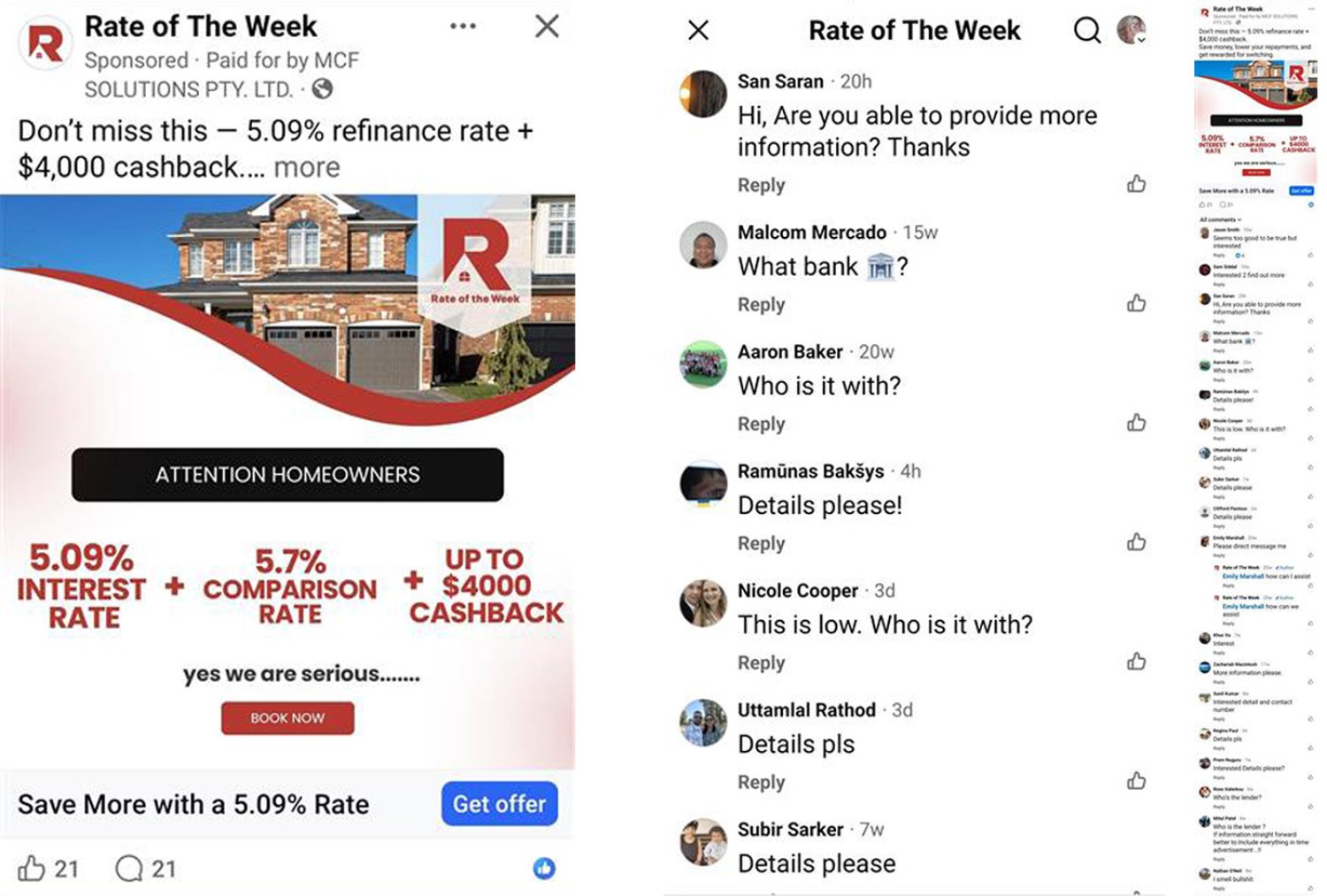
Rate of the Week: The Rate of the Week advertisement is a minefield of compliance issues. The screenshots were taken on the 8th of June 2026 at 8.16pm and likely refers to Bendigo Bank's old 'Complete Home Loan' (low LVR and discounted Owner Occupier, Principal & Interest, 2-year fixed rate), but the exact reference isn't known because it wasn't disclosed - we sourced the data from our Comparison Engine archive and this was the only match. It's possible that the rate is a siloed unpublished or green rate... and the fact we couldn't find it illustrates the problem. The rate is used in multiple locations without a comparison rate, the messaging is ambiguous, and the cashback quantification isn't defined. This is both a deception funnel and rate bait and its finest.
The Rate of the Week Rate Bait outwardly appears a little dubious and opens up a can of worms relating to rate accessibility, currency, and the promotion of rates that are inaccessible to most borrowers - such as professional, discounted, promotional, or green products - all of which we'll look at shortly.
Which Bank?: From a behavioural perspective, the questions asked under or alongside an advertisement are unsurprising. Consumers process mortgage advertisements using heuristic shortcuts. The headline rate attracts attention, while contextual disclosures receive significantly less cognitive focus. If a material proportion of consumers are unable to identify the lender after viewing the advertisement, it raises legitimate questions regarding whether the product disclosure has achieved its intended purpose. The fact that consumers are actively seeking fundamental identifying information suggests that the information may not have been presented with sufficient prominence or clarity.
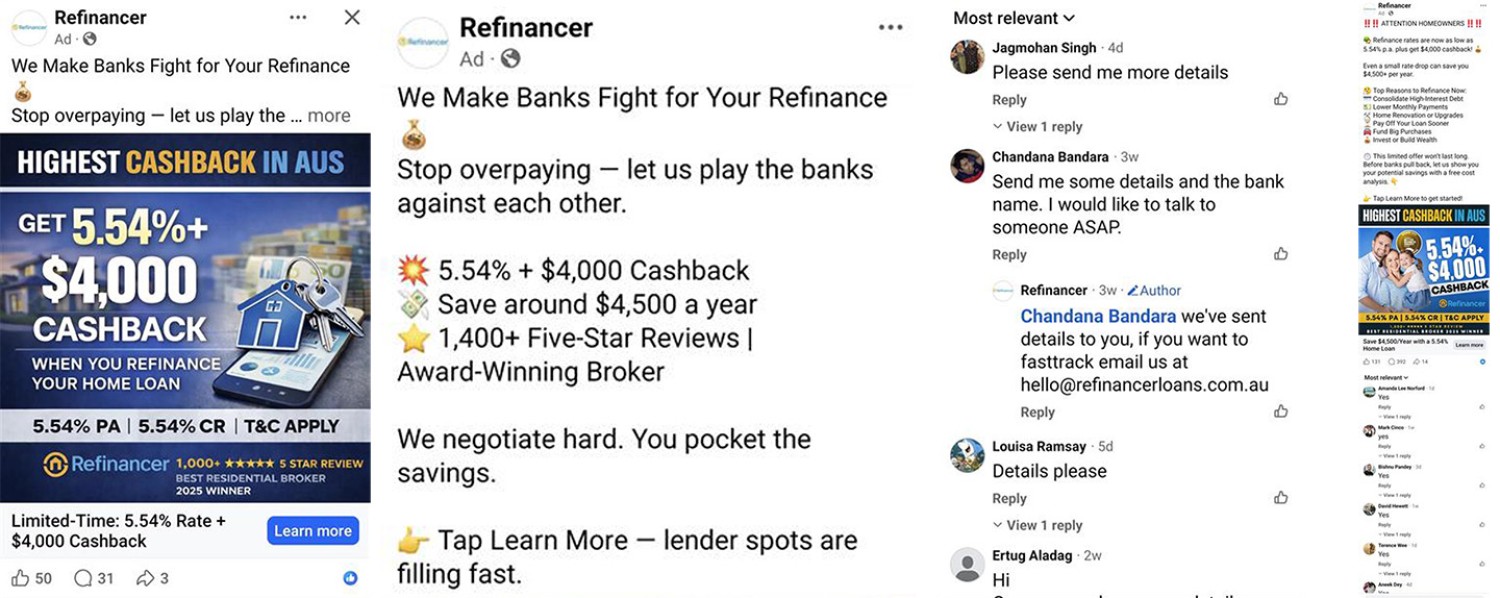
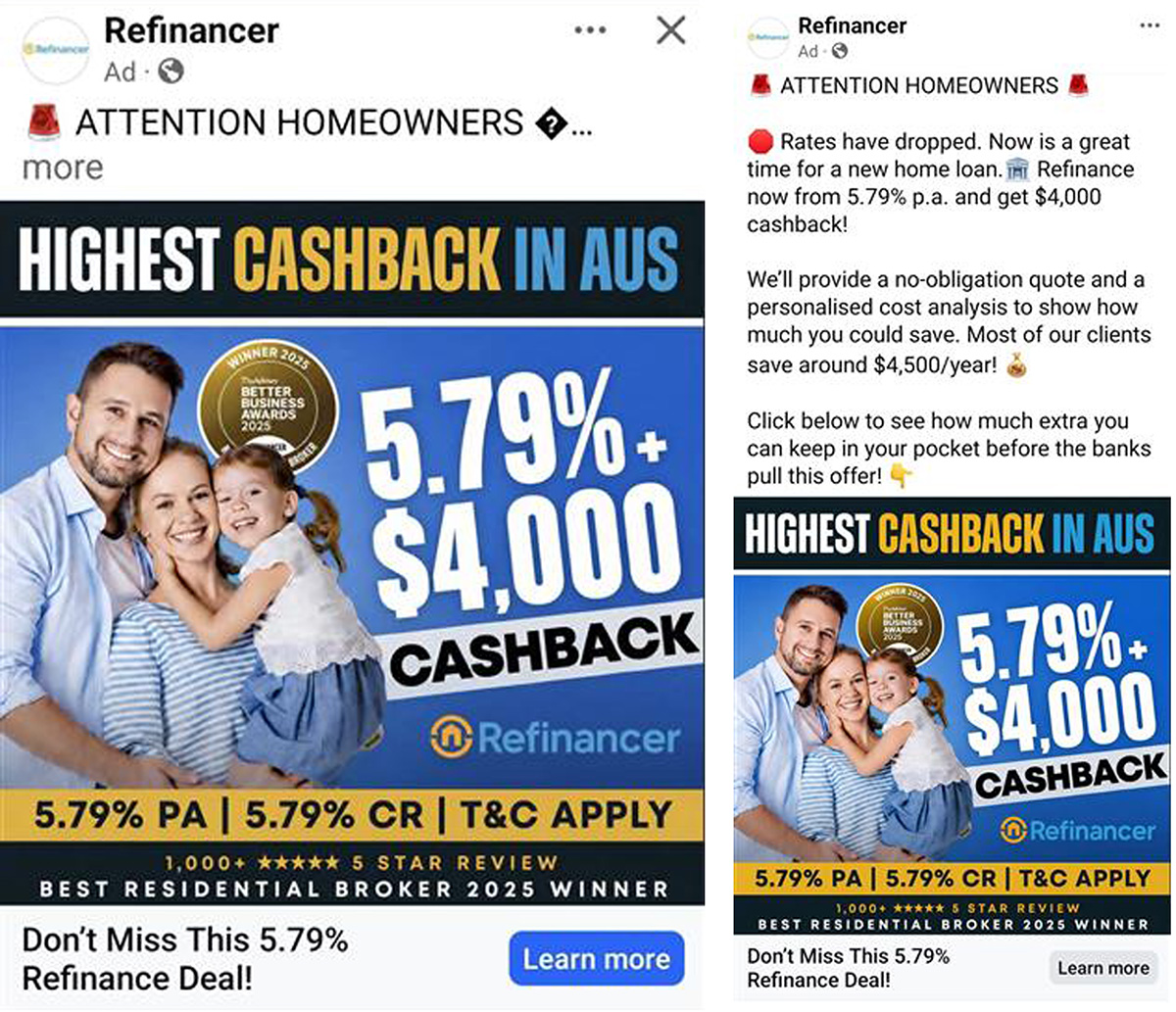
Refinancier Rate Bait & Compliance Abomination: I'm quite comfortable calling our Refinancier because I've called him out for years - there's little chance he'll call us for any help. This is an interesting advert because the comparison rate and APR are the same, but that doesn't negate the need to provide appropriate disclaimers and reinforce the cashback as part of this product. In this case, the product appears to be MB Bank (Budget Home Loan (Variable, Owner Occupier, P&I) with a cashback incentive between $3000 and $4000... but what's the harm in letting people know that? If you can't sell your service on the basis of something other than hiding rate and baiting consumers into contact, you probably shouldn't be a broker. The advert specifies savings of around "$4500 per year" without qualification, and the "lender spots are filling fast" blurb is misleading at best. The advertisement violates a number of pieces of legislation and ethical interest-duty based obligations. The company is obfuscating the lender (which was required in the first place) when specifically asked by those in the comment thread - a serious vocational and compliance-based infraction. The deliberate rate-baiting from Refinancier dates back several years. Update, 13th June 2026: As of this morning, Refinancier are pushing a new ad with an updated and valid rate of 4.79 + $4000 cashback. Changes do not include the required warnings and disclaimers required when using the comparison rate. The change comes in the aftermath of exposing their compliantly flawed experience in our Deception Funnel article. There's hope that we played a part in the change... although the experience requires far, far more work.
Importantly, post-publication clarification (such as replying to the comments in the threads above) does not cure an inadequate advertisement. Compliance obligations attach to the advertisement at the time it is published. The deliberate omission of the lender's identity, followed by a request that consumers contact the broker privately to obtain that information, transforms what should be a disclosure exercise into a lead-generation exercise. Information that is arguably material to the consumer's assessment of the product is withheld from the advertisement and released only after the consumer has engaged with the advertiser. From a behavioural economics perspective, the consumer's desire to identify the lender becomes the mechanism through which engagement is generated. The advertisement is no longer functioning solely as a vehicle for disclosure; it is functioning as a bait-funnel designed to convert curiosity into a sales interaction. The subsequent provision of lender details in response to individual comments does not alter the impression initially conveyed to consumers who viewed the advertisement but did not engage with the comment thread... and a broker that fails to acknowledge the enquiry, or one that responds privately and deliberately withholds legally mandated information, is operating in a manner that is akin to baiting. However, the adequacy of disclosure must therefore be assessed based upon the advertisement itself, not upon information that may later be provided to selected members of the audience.
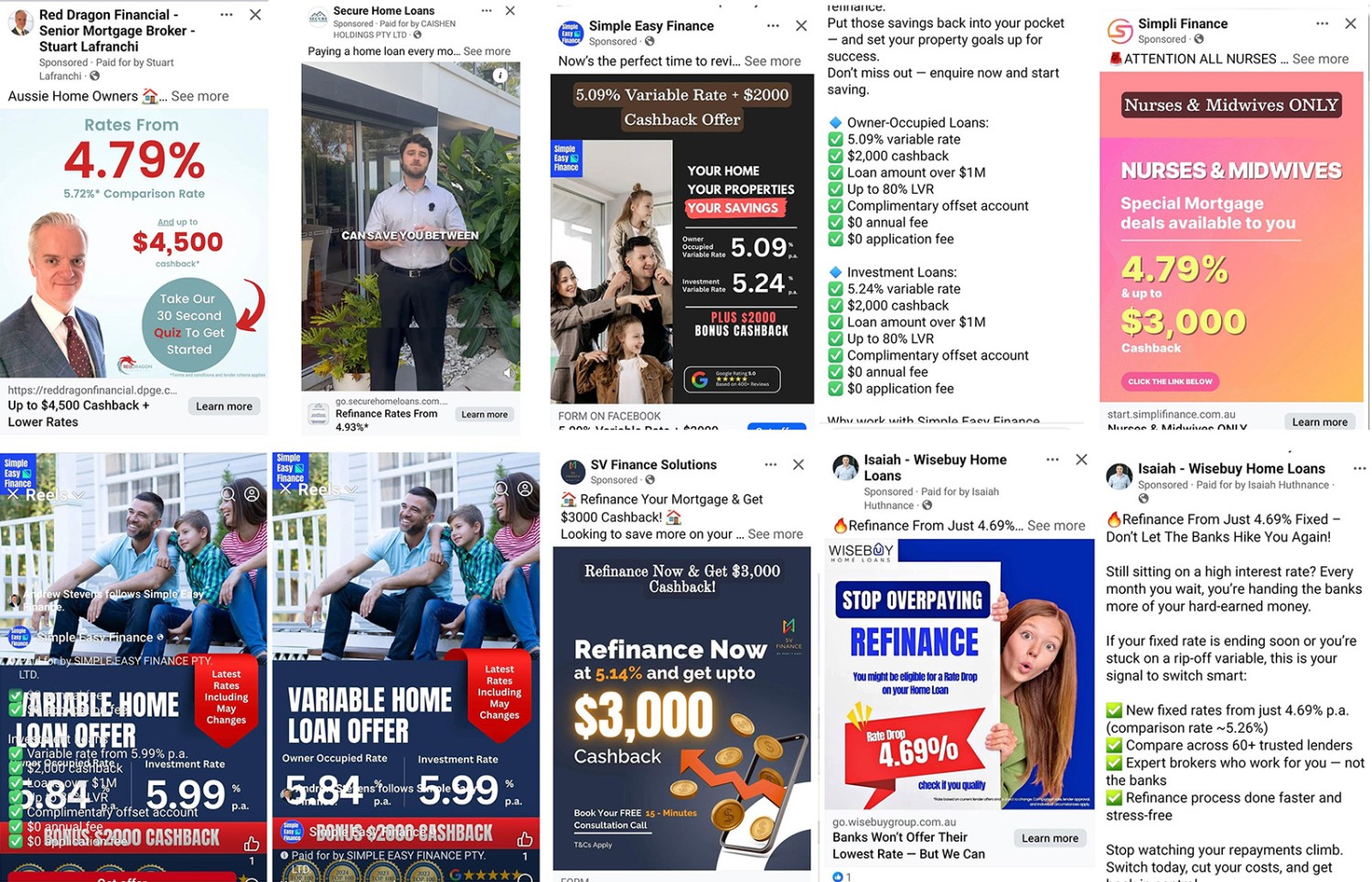
Pictured: Compliance obligations attach to the advertisement at the time it is published, so if the advertisement is seen by a single consumer, you're in breach. All advertisements should be compliant at the time they're published, but most advertising agencies simply don't understand the complexities, and most DIY courses don't introduce the compliance framework that'll protect you from legal exposure. Our Broker Growth program includes a full session on compliance, and our continued oversight ensures that you're representing yourself in a legal and ethical manner. None of the pictured ads meet basic legals standards.
For this reason, prudent compliance practice dictates that mortgage advertisements should clearly identify not only the interest rate, comparison rate and statutory assumptions, but also the lender or credit provider associated with the advertised product. While this may not be expressly prescribed by section 162 in every circumstance, it is strongly aligned with the legislative objective of ensuring that consumers receive sufficient information to understand the product being promoted and the basis upon which the comparison rate has been calculated.
Bait Advertising on Rate, and Product Accessibility
"Bait advertising" is one of those concepts that sounds intuitive in marketing discussions but is actually quite specific in legislation, and importantly, it sits primarily in the Australian Consumer Law, not the comparison rate regime itself, so while many examples described as 'bait advertisements' do not satisfy the definition in the traditional legal sense, the practice bears similarities to what may be described as digital bait-and-engage advertising. An attractive rate is publicly displayed, while material product information is withheld until the consumer initiates contact. The consumer's inability to identify the lender from the advertisement itself becomes the catalyst for engagement. In effect, the missing disclosure becomes part of the marketing strategy.

Why We're Critical of Refinancier: Of all the groups that'll never call us, Refinancier is probably at the top of the list. We have screenshots and screen recordings dating back to Covid-era rates, and the conduct is consistently not compliant. In 2024 we called them offering compliance support and were kindly told to go and procreate with ourselves. In operating dishonestly, one has to question where the interest of the business lies, and whether Best Interest Duty overlaps with their marketing efforts. Intentional deception (as evidenced by the Facebook comments above) are a metaphorical middle finder to those that they claim to support, and it's an insult to the brokers that represent themselves honestly, ethically, and to legal standards. If your first contact with a consumer is predicated on a lie, the relationship itself is built upon a fraudulent digital handshake.
Australian Consumer Law (ACL) in Schedule 2 of the Competition and Consumer Act 2010 (Cth), Section 35(1) states that "[a] person must not, in trade or commerce, advertise goods or services for supply at a specified price if there are reasonable grounds for believing that the person will not be able to supply reasonable quantities of the goods or services at that price for a reasonable period and in reasonable quantities", and its this definition that we rely upon for rate-based marketing. In essence, a low rate is used as a "headline offer" without a reasonable ability or intention to supply it to the majority of the market. Disclaimers seek to ratify this ambiguity along with advertising copy and creative in order to silo a suitable target audience.
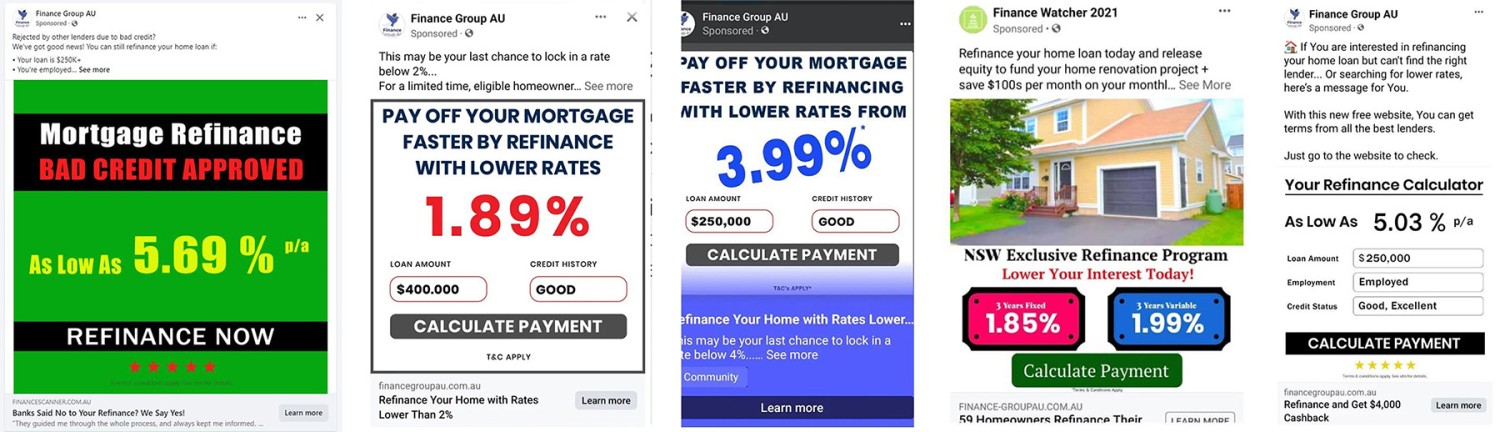
Pictured: Lead generation groups are usually the most non-compliant, and those self-hosted solutions that they introduce to businesses geneeallyt aren't any better. The pictured examples are from 'Finance Group AU' - a ficticious brand created by Biz Focused. Methods used by the likes of Bizleads are grossly non-compliant, and their Deception Funnels should bd understood by any broker that has purchased their poor leads in the past. We've inherited clients from Leadify that spent $8000 for just 50 leads and converted none of them - a serious indictment on their poor process. Most leadgen charlatans lean on rate bait almost exclusively (with fake Deception Funnel qualification) since they have nothing else to offer.
ASIC Regulatory Guide 234 (RG 234) does not redefine bait advertising in a new statutory sense. Instead, it treats it as part of broader prohibitions against misleading or deceptive conduct (ACL s18 / ASIC Act s12DA), false or misleading representations (ACL s29), and overall impression testing of advertisements. It specifically warns that: fine print does not cure a misleading dominant message, partial disclosure can itself be misleading, and prominence (and "headline prominence") matters as much as accuracy. RG 234 - remembering this is ASIC guidance designed specifically for advertising - effectively broadens bait advertising concepts into a general anti-manipulation framework, rather than limiting it to "unavailable stock at advertised price". RG 234’s core principle is that advertising must be assessed by the overall impression created on the ordinary and reasonable consumer.
Our earlier examples from Rate of the Week and Refinancier (two examples taken in the last day from hundreds we've archived) may not fit the definition of classical bait advertising because the rate is usually genuinely available to some borrowers, or at least not "unavailable in reasonable quantity" in the ACL sense, the issue is not supply of the product at the advertised price, so it's a case of information asymmetry and disclosure structure, not 'non-supply'... but the anecdotal 'common language' definition is satisfied without doubt - the rates were used in isolation and without supporting legal information to capture a larger and more reasonable percentage of the market; it's blatant lead capture disguised as product promotion. Remember, consumer perception is more important than marketing intent, and deliberate baiting or deception is usually clearly identified (particularly when supported by way of a pattern or history of a broker's deliberate malfeasance).
Comparison Rate Warnings and Disclosure Presentation
The comparison rate warning occupies a uniquely important position within our advertising framework because it serves as the mechanism through which legislators sought to counteract one of the most persistent behavioural biases exhibited by consumers when evaluating loan products: the tendency to focus almost exclusively on the headline interest rate while overlooking the broader cost structure of the credit contract (or promoted product). The comparison rate regime was introduced to provide a more meaningful basis for product comparison by incorporating both the interest rate, term, and prescribed fees and charges into a single indicative figure. However, legislators recognised that even the comparison rate itself is subject to assumptions, limitations and exclusions. Consequently, the law requires not merely the disclosure of the comparison rate, but also the disclosure of a warning explaining the circumstances in which that comparison rate may not accurately reflect the cost of a particular loan.
Section 163 of the National Credit Code provides that a comparison rate appearing in a credit advertisement must be accompanied by a warning prescribed by the regulations. The prescribed warnings are contained within Regulation 99 of the National Consumer Credit Protection Regulations 2010 and exist in both short-form and long-form variants.
Short Form Warning: "WARNING: This comparison rate is true only for the examples given and may not include all fees and charges. Different terms, fees or other loan amounts might result in a different comparison rate"
Long Form Warning: "WARNING: This comparison rate applies only to the example or examples given. Different amounts and terms will result in different comparison rates. Costs such as redraw fees or early repayment fees, and cost savings such as fee waivers, are not included in the comparison rate but may influence the cost of the loan".
At first glance, these warnings may appear to be little more than technical disclaimers. Such an interpretation would be fundamentally mistaken. The warning requirement is not a peripheral compliance obligation designed merely to satisfy a legislative formality. Rather, it represents a core component of the comparison rate disclosure regime itself. The warning exists because Parliament recognised that consumers frequently attribute a level of certainty and universality to numerical representations that exceeds what the underlying calculation can legitimately support. or convey. In practical terms, the warning functions as a legislative safeguard against the false precision that can arise when complex lending arrangements are reduced to a single numerical figure.
The placement and presentation of the comparison rate warning is therefore among the most tightly regulated disclosure requirements within the entire credit advertising framework. This area is frequently misunderstood by brokers because the legal obligations arise from the combined operation of the National Credit Code and Regulation 99, creating a layered disclosure regime in which the comparison rate and the warning are legally inseparable.
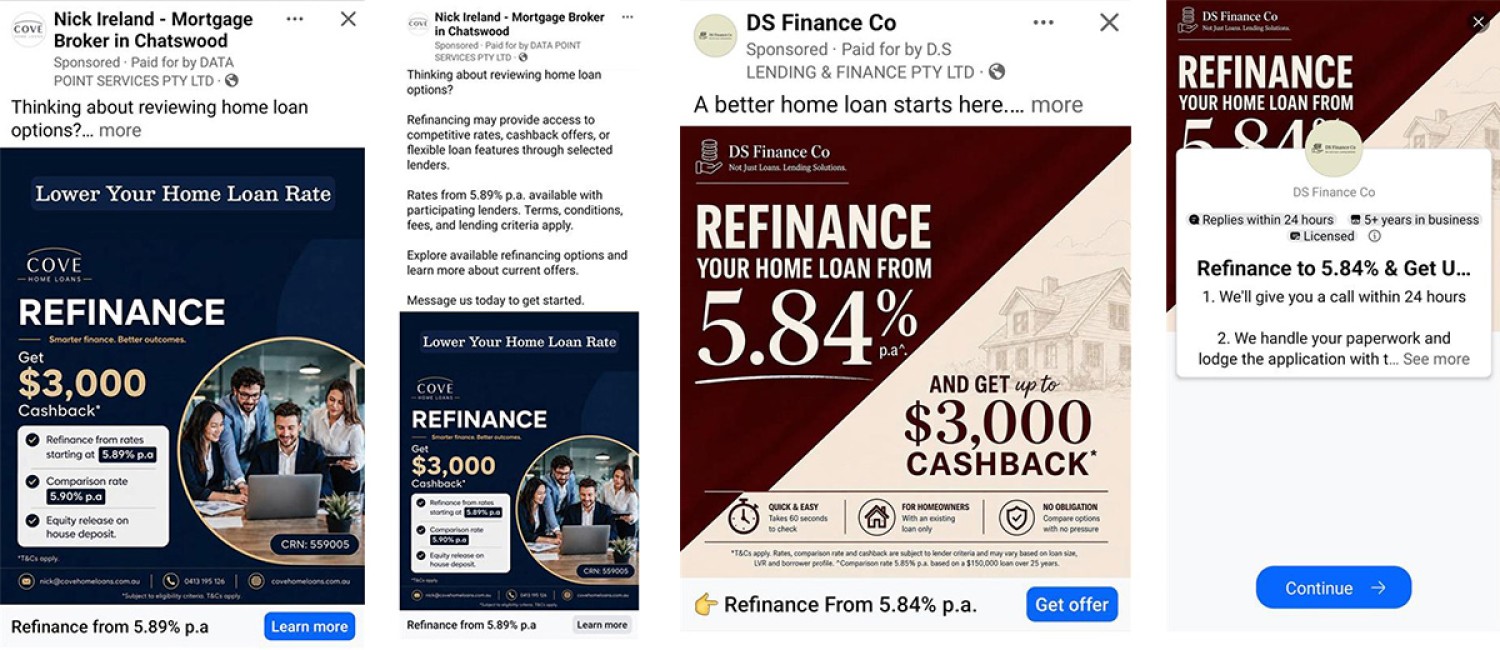
Pictured: The advertisement from Nick Ireland (first two images to the left) is a good example of somebody making an attempt to meet compliance obligations in that they've included the comparison rate... but they've 'invented' a disclaimer that doesn't come close to meeting legislated requirements. Additionally, the use of the rate in isolation at any point - particularly in the title as shown above - presents numerous problems when the abbreviated ad is shown in various other placements (as indicated by way of this advert from Yappy (they have a history of blatant rate-based non-compliance. The advertisement from DS Finance (second two images) also includes the comparison rate, but can you see it? It fails the prominence test, doesn't include any of the required disclaimers, and makes significant attempts to obfuscate the comparison rate itself. The fact the comparison rate in this screenshot is 5.85% doesn't negate the need to include it. Both ads expose the brokers to a range of compliance issues and should be removed from circulation.
The starting point is the requirement contained within section 163 itself. The legislation does not state that a warning should be provided somewhere within the advertisement, nor does it suggest that the warning may be made available upon request or accessed through a separate disclosure document or landing page. Instead, the legislation requires that the comparison rate be accompanied by the prescribed warning. The significance of this language should not be understated. The comparison rate and the warning are intended to operate as a single composite disclosure. The law does not treat them as separate advertising elements capable of independent presentation. Rather, the warning forms part of the comparison rate disclosure itself.
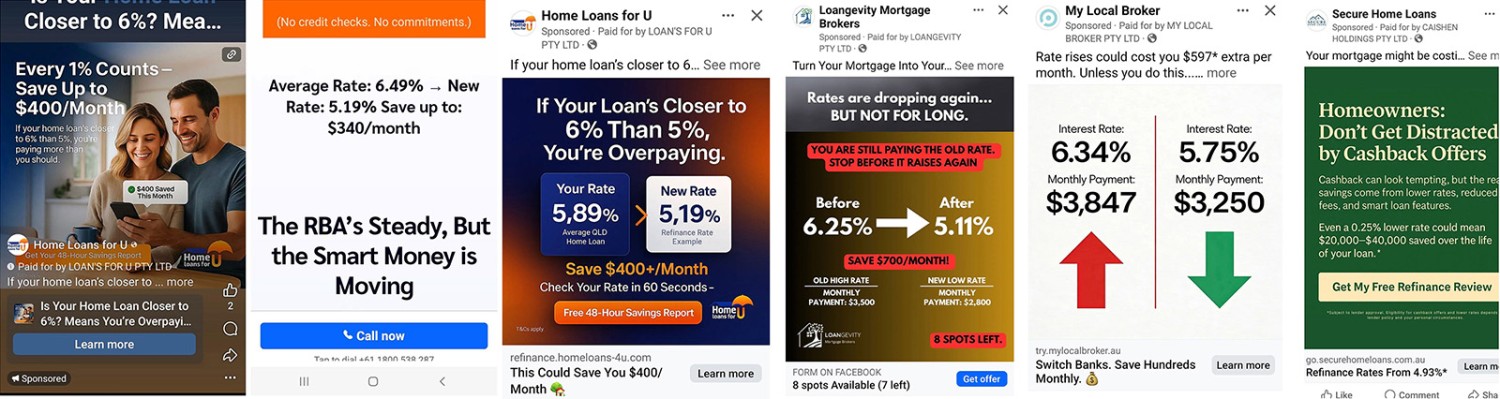
Pictured: None of the pictured advertisements meet the legal standard, and none include the required comparison rate and associated warnings. Legislation does not state that a warning should be provided somewhere within the advertisement, nor does it suggest that the warning may be made available upon request or accessed through a separate disclosure document or landing page. Instead, legislation requires that the comparison rate be accompanied by the prescribed warning. The significance of this language should not be understated. The comparison rate and the warning are intended to operate as a single composite disclosure. The law does not treat them as separate advertising elements capable of independent presentation. Rather, the warning forms part of the comparison rate disclosure itself. There's never an excuse to not publish the comparison rate, and in Meta advertising there's never an excuse to exclude comparison warnings or quantified disclosures within the create and copy.
This distinction has important practical consequences. An advertiser cannot lawfully display a comparison rate as a prominent headline feature while relegating the prescribed warning to an unrelated section of the advertisement, a separate webpage, landing page, a distant footnote or a disclosure accessible only through additional consumer interaction. Such an approach undermines the very purpose of the legislative scheme. The consumer must encounter the warning as part of the same cognitive process through which they encounter the comparison rate. The disclosure regime is designed to ensure that consumers receive both the numerical figure and the contextual limitations of that figure simultaneously.
The Comparison Rate in Facebook (Meta) and Banner Adverising: While the legislative framework establishes a clear expectation that comparison rates be accompanied by the prescribed warning, the practical application of these requirements in digital advertising environments is more nuanced than many advertisers appreciate. This is particularly evident when considering the interaction between the statutory disclosure requirements and ASIC's guidance regarding space-constrained advertising formats. ASIC addresses this issue within Regulatory Guide 234, recognising that certain advertising mediums present genuine physical limitations that may affect the amount of information capable of being displayed. The regulator acknowledges that there may be circumstances in which it is impractical to include every disclosure element within a single advertisement, particularly where the advertisement is restricted by significant space constraints. Examples may include small-format banner advertisements, certain search engine advertisements, display network placements and other highly constrained digital formats where character limits or display dimensions materially restrict the amount of information capable of being communicated. However, this recognition should not be interpreted as a broad exemption from disclosure obligations. ASIC's guidance does not suggest that disclosures become unnecessary merely because an advertisement appears online or because an advertiser wishes to prioritise marketing content over compliance information. Rather, the guidance reflects a practical recognition that disclosure requirements must sometimes be evaluated within the context of the advertising medium itself. The relevant question remains whether the advertisement, viewed as a whole, creates a misleading impression or omits information that a reasonable consumer would require in order to properly understand the representation being made. Importantly, the rationale underpinning these limited exceptions is rooted in genuine space constraints. The policy basis is not that warnings become less important in digital environments, but that certain advertising formats may physically prevent the simultaneous presentation of all required information. In such circumstances, ASIC expects advertisers to carefully consider how consumers will obtain the omitted information and whether the overall communication remains balanced, accurate and not misleading. In practice, this distinction becomes highly relevant when examining modern social media advertising, particularly advertisements distributed through platforms such as Facebook and Instagram via the Meta advertising network. Unlike traditional banner advertisements, Meta advertisements generally provide advertisers with substantial opportunities to communicate information through multiple components of the advertisement. A typical mortgage advertisement may contain a visual creative, primary text, headline text, description text, call-to-action elements and landing page links. Collectively, these elements provide significantly more disclosure capacity than is available within the narrow confines of a traditional display banner. As a result, the practical justification for omitting comparison rate warnings from Meta advertisements is often substantially weaker than advertisers assume. In most circumstances, sufficient space exists to present the advertised interest rate, the comparison rate and the prescribed warning within the overall advertisement structure. The inclusion of the warning rarely creates a meaningful operational burden given the available character limits and content areas. Indeed, across the mortgage and financial services sector it has become common practice for compliant advertisers to incorporate the prescribed comparison rate warning directly within the primary advertisement copy whenever an interest rate and comparison rate are promoted. This reflects both regulatory prudence and commercial reality. Financial services advertisers are acutely aware that ASIC evaluates advertisements according to their overall impression rather than through a purely technical assessment of whether information can be found elsewhere. Where an advertiser has ample opportunity to include the prescribed warning but elects not to do so, it becomes increasingly difficult to argue that any omission was necessitated by genuine space limitations. Instead, the omission may be perceived as a deliberate decision to prioritise promotional messaging over consumer understanding. The issue becomes even more significant when considering consumer behaviour within social media environments. Unlike consumers navigating to a lender's website after conducting independent research, users encountering mortgage advertisements within social media feeds are frequently engaging with content passively and often for only a brief period. The advertisement itself therefore assumes heightened importance as the primary source of information influencing the consumer's initial perception of the product. If a headline interest rate is displayed without the corresponding contextual information required to properly interpret that rate, there is a heightened risk that consumers will form impressions based upon incomplete information before deciding whether to engage further. From a regulatory perspective, this aligns closely with ASIC's repeated emphasis on prominence, balance and overall impression throughout RG 234. The existence of additional information on a landing page does not necessarily neutralise a misleading impression created within the advertisement itself. The regulator's focus remains on the information available to consumers at the point the representation is made. Consequently, where sufficient space exists to include a comparison rate warning, its omission may undermine arguments that the advertisement has been designed to communicate information in a clear, balanced and effective manner. For this reason, the industry norm among sophisticated lenders, aggregators and mortgage brokers has increasingly shifted toward including comparison rate disclosures and prescribed warnings within the body of Meta advertisements whenever rates are promoted. This approach not only reduces compliance risk but also reflects the broader regulatory objective underpinning the comparison rate regime: ensuring that consumers receive both the advertised benefit and the contextual information necessary to properly evaluate that benefit at the same time. While RG 234 recognises that limited exceptions may exist for genuinely space-constrained advertising formats, those exceptions should not be viewed as a general justification for omitting disclosures in environments where adequate disclosure space is readily available. In practical terms, the vast majority of contemporary Meta advertisements possess sufficient capacity in the creative and copy to accommodate comparison rate and other warnings, and industry practice has evolved accordingly. Failure to provide the warnings is measured in degrees of deception, and the 'spirit' of the RG document was aimed at space and functionally limited Google Advertisements.
From a behavioural psychology perspective, this paired comparison and warning requirement is entirely logical. Consumers exhibit a well-documented tendency toward numerical anchoring, whereby prominent numerical values become the primary reference point around which subsequent judgments are formed. A comparison rate displayed without an immediately accompanying warning creates a substantial risk that the consumer will internalise the figure before considering the assumptions and limitations upon which it is based. By requiring the warning to accompany the comparison rate, the legislation seeks to prevent consumers from treating the figure as universally applicable or representative of all borrowing scenarios.

Pictured: Consumers exhibit a well-documented tendency toward numerical anchoring, whereby prominent numerical values become the primary reference point around which subsequent judgments are formed. A comparison rate displayed without an immediately accompanying warning creates a substantial risk that the consumer will internalise the figure before considering the assumptions and limitations upon which it is based. By requiring the warning to accompany the comparison rate, the legislation seeks to prevent consumers from treating the figure as universally applicable or representative of all borrowing scenarios. None of the pictured advertisements come close to meeting a legal standard.
Although the legislation does not prescribe pixel dimensions, font sizes or exact visual layouts, this does not mean that advertisers enjoy unlimited discretion regarding presentation. The absence of prescriptive formatting requirements should not be interpreted as an absence of prominence obligations. Rather, the legislation adopts a functional approach. The relevant question is not whether a warning technically exists within the advertisement, but whether the warning is presented in a manner capable of effectively communicating its intended message to a reasonable consumer.
Prominence Requirements: Although neither the National Credit Code nor the National Consumer Credit Protection Regulations prescribe specific font sizes, colour requirements, pixel dimensions or visual layouts for comparison rate warnings, this should not be interpreted as conferring unlimited discretion upon advertisers. The legislative framework adopts a principles-based approach centred upon prominence, readability and consumer comprehension rather than prescriptive design standards. Section 164 of the National Credit Code introduces an express prominence requirement, while ASIC's Regulatory Guide 234 repeatedly emphasises that disclosures must be sufficiently clear and prominent to effectively communicate their intended message. Consequently, factors such as font size, colour contrast, visual hierarchy, placement and readability become legally relevant not because they are expressly prescribed by legislation, but because they directly influence whether the disclosure is capable of being noticed, read and understood by a reasonable consumer. In practical terms, the compliance question is not whether a warning technically appears within the advertisement, but whether the overall presentation enables the warning to fulfil the consumer protection purpose for which it was mandated. Failure to achieve this outcome may expose the advertisement to scrutiny not only under the National Credit Code but also under the broader misleading and deceptive conduct provisions contained within sections 18 and 29 of the Australian Consumer Law.
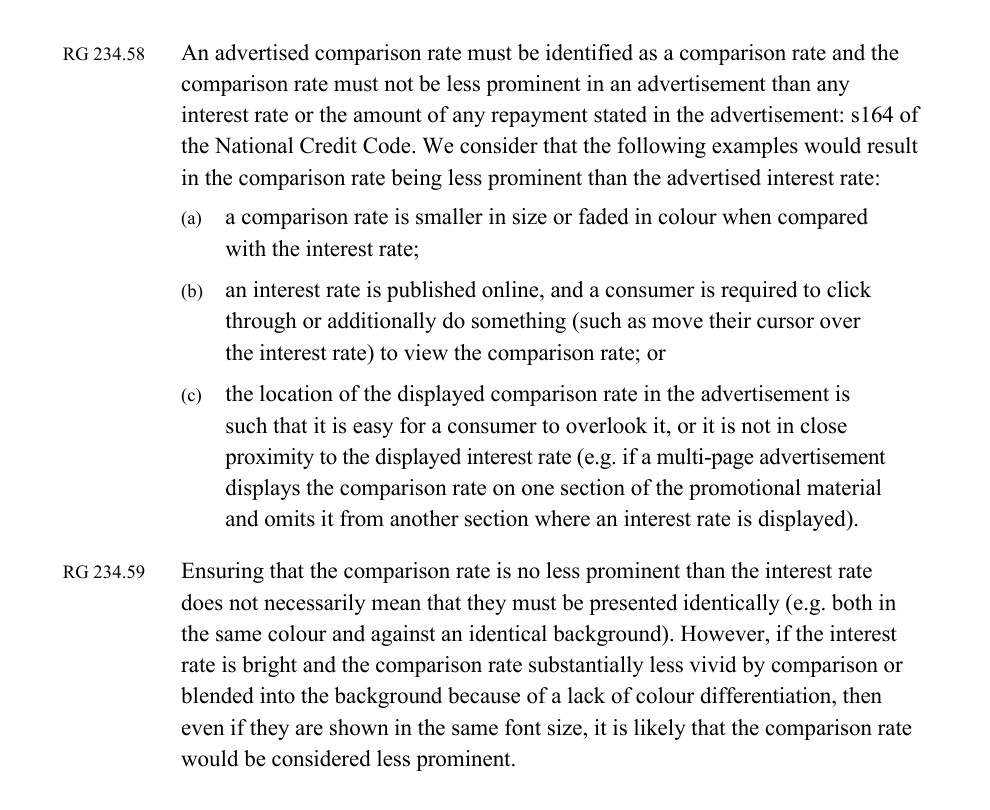
Small or Obfuscated Print Fails the Sniff Test: RG 234 repeatedly stresses that disclosures must be sufficiently prominent to be noticed by a reasonable consumer on first viewing. From a psychological perspective, consumers do not process advertisements linearly. Potential borrowers will generally process the headline (and quantifiable statements), imagery, large numerical values, and supporting information - in that order. Disclaimers are typically processed last, if at all, and often ignored if the print is too small - a common and shonky marketing method of evading 'detection'. RG 234.58 and RG 234.59 remedies and ratifies legislation by providing guidance (although given it comes from ASIC it should be considered an instruction) that applies to comparison prominence. It states that they would consider the comparison rate being less prominent than the advertised interest rate if rate is smaller in size or faded in colour when compared with the interest rate, a consumer is required to click through or additionally do something to view the comparison rate, or the location of the displayed comparison rate in the advertisement is such that it is easy for a consumer to overlook it, or it is not in close proximity to the displayed interest rate. The practical takeaway is that while they don't require the two rates to be identical, they do require that they are essentially similar despite their differences.
This principle is reinforced by section 164 of the National Credit Code, which requires that a comparison rate not be given less prominence than the annual percentage rate or repayment amount with which it is associated. More broadly, ASIC's Regulatory Guide 234 emphasises that disclosures must be clear, balanced and sufficiently prominent to ensure that consumers are not misled by the overall impression conveyed by the advertisement. The regulator has repeatedly stressed that qualifications and warnings cannot be used to cure a misleading headline if the overall presentation causes consumers to focus on the benefit while overlooking the associated limitations.
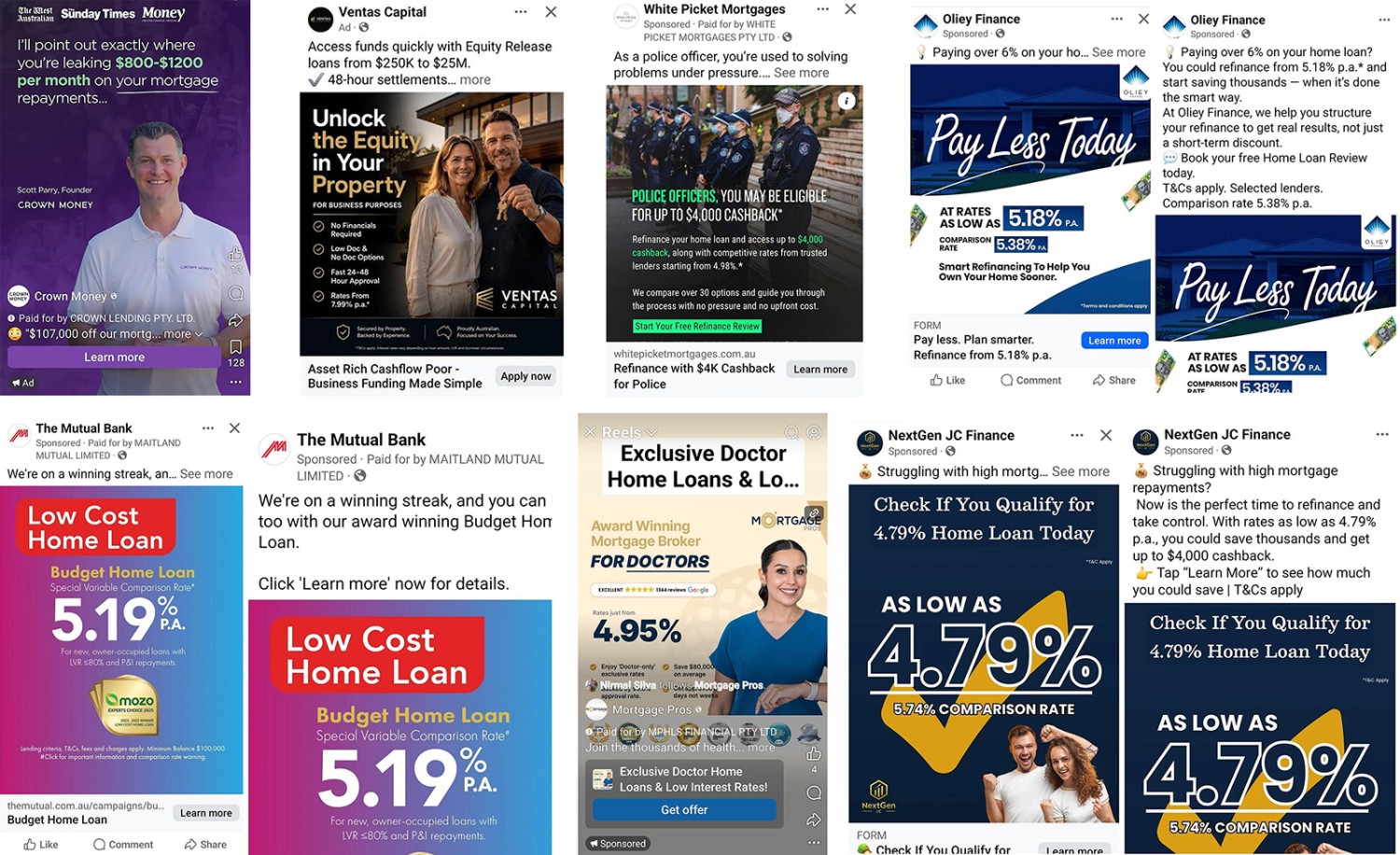
Pictured: Although neither the National Credit Code nor the National Consumer Credit Protection Regulations prescribe specific font sizes, colour requirements, pixel dimensions or visual layouts for comparison rate warnings, this should not be interpreted as conferring unlimited discretion upon advertisers. The legislative framework adopts a principles-based approach centred upon prominence, readability and consumer comprehension rather than prescriptive design standards. RG 234 repeatedly stresses that disclosures must be sufficiently prominent to be noticed by a reasonable consumer on first viewing. From a psychological perspective, consumers do not process advertisements linearly. Potential borrowers will generally process the headline (and quantifiable statements), imagery, large numerical values, and supporting information - in that order. Disclaimers are typically processed last, if at all, and often ignored if the print is too small - a common and shonky marketing method of evading 'detection'. RG 234.58 and RG 234.59 remedies and ratifies legislation by providing guidance (although given it comes from ASIC it should be considered an instruction) that applies to comparison prominence. It states that they would consider the comparison rate being less prominent than the advertised interest rate if rate is smaller in size or faded in colour when compared with the interest rate. While a couple of the pictured advertisements include the comparison rate, they don't pass the test of objective reasonableness. Crown Finance have had some interesting adverts - some extremely poor. In the pictured example, they haven't published the comparison rate, but they're also promoting a commercial product - a space where the comparison rate doesn't necessary apply. However, the inclusion of the rate is predicated on both the environment in which you operate and whether residential property plays a part in a transaction, so in this case, a full disclosure, warning and disclaimer should be shown, and it was not shown on the advert or continued experience. The advertisement from Murual Bank is an interesting one because they've shown just the comparison rate - not expressively prohibited by law, but the inclusion of the comparison rate triggers immediate and inline warnings which includes the rate, term, product, comparison rate, comparison warning, and other information. In practical terms, there's no valid reason to ever publish a comparison rate in isolation unless it supports product tiers and variations. Oliey have excluded copy-based warnings and disclaimers but they've also excluded the comparison rate from the advert title. The title is often shown in isolation, and all standard requirements apply. Never show a rate without the accompanying comparison rate. Simple.
Accordingly, compliance cannot be assessed solely by asking whether the prescribed wording appears somewhere within the advertisement. The more substantive question is whether the comparison rate warning is displayed in a manner that allows it to perform the function legislators intended it to perform. A warning hidden within dense fine print, obscured through poor contrast, separated from the comparison rate by substantial visual distance, or otherwise presented in a manner unlikely to attract consumer attention may satisfy the literal wording of the regulation while nevertheless creating significant regulatory risk. Both ASIC and the courts routinely assess advertising by reference to its overall impression rather than through a narrow technical analysis of individual disclosure elements.
The Comparison Warning Must not be less prominent than the comparison rate: The regime requires that the warning be presented: clearly, prominently, and in a way that is not inferior in visibility to the comparison rate itself Practically, this means that it cannot be hidden in a footnote if the comparison rate is in a headline, it cannot be visually de-emphasised (tiny font/low contrast/buried placement), and it must be perceivable in the same field of attention as the rate disclosure. This is reinforced by general consumer law principles under ACL s18, ASIC Act s12DA, and ASIC RG 234 (overall impression test).
Must be “accompanying” in a meaningful sense: “Accompanied” is interpreted functionally, not literally. So regulators assess spatial proximity (is it adjacent or detached?), visual hierarchy (is it subordinate or equivalent?), temporal proximity (in digital ads, is it shown at the same time?), and cognitive association (would a reasonable consumer link them?). If the warning is on a separate page, behind a link, or in expandable disclosure, then it risks being treated as not truly accompanying the comparison rate.

Pictured: The comparison requirements are introduced in the first hour of the first day of mortgage broker Cert IV education courses. There are few industries regulated to the same high standards, and there are very few services that can be accused of predatory behaviour on the basis of their advertising... and mortgage broker services are one of them. Our programs have consistently delivered better results, and we've never inherited a program where we weren't able to triple results - this supports our claim that ethical and legal advertising resonates with borrowers, while those that hide behind numbers and compliant-challenged presentations will always compromise their performance and conversions.

Pictured: Viewed holistically, the comparison rate warning is not simply a disclaimer attached to a rate advertisement. It is an integral component of the comparison rate itself. The warning exists to communicate the assumptions, limitations and exclusions inherent within the comparison rate calculation and to ensure that consumers do not attribute unwarranted certainty to a figure that is necessarily dependent upon a prescribed set of hypothetical circumstances.
Viewed holistically, the comparison rate warning is not simply a disclaimer attached to a rate advertisement. It is an integral component of the comparison rate itself. The warning exists to communicate the assumptions, limitations and exclusions inherent within the comparison rate calculation and to ensure that consumers do not attribute unwarranted certainty to a figure that is necessarily dependent upon a prescribed set of hypothetical circumstances. The legislative framework therefore treats the comparison rate and its accompanying warning as a unified disclosure mechanism, reflecting a broader regulatory objective of promoting informed consumer decision-making and preventing the distortive effects of incomplete financial information.
Technical Presentation of Warnings and Disclaimers in Meta and Other Advertisements: Comparison rate warnings should be adapted to the specific technical and behavioural constraints of each advertising format, rather than treated as a static block of text applied uniformly across placements. In Meta environments, this includes 1:1 feed placements (square), 4:5 portrait feed ads, 9:16 vertical Stories and Reels formats, 16:9 landscape placements (often used for in-stream video or link previews), and increasingly responsive placements where creative is dynamically cropped or reflowed across devices. The compliance risk is not merely whether the warning exists, but whether it is actually visible in the delivered ad unit as experienced by the end user. This requires designing disclosure placement to survive platform compression, UI overlays (such as profile icons, captions, CTA buttons, and “Sponsored” labels), and safe-zone cropping - particularly in 9:16 formats where lower-screen UI elements frequently obscure text. In practical terms, warnings should be embedded within the visual safe area of each aspect ratio, sized with sufficient contrast and padding to remain legible across mobile scaling, and duplicated where necessary across creative variants to ensure persistence across placements. Critically, advertisers should avoid relying solely on platform auto-cropping or dynamic text rendering, as these can reposition or truncate disclosures unpredictably; instead, compliance-critical warnings must be anchored within the creative itself in a fixed and visually controlled position so that the comparison rate warning is consistently presented to the consumer in the same form in which it was approved and intended to be viewed. We disusss this again in the section on Video Advertising.
Comparison and Other Disclosures in Video
The treatment of comparison rates and associated warnings in video-based credit advertising introduces a materially higher level of compliance complexity than static or single-frame advertisements. This is because video content is inherently temporal, meaning that disclosures must not only exist, but must remain continuously accessible, legible and synchronised with the corresponding promotional claims as they appear on screen. The relevant obligations are set out in section 160 (s164(3)) of the National Credit Code (as applied through the National Consumer Credit Protection framework), which prescribes specific rules governing the relationship between spoken and visual representations of annual percentage rates, comparison rates and associated warnings in electronic media, including television broadcasts, online video, and other dynamic display formats.
The Splash Screen: Some time back I was critical of some of the video making its way into market. I suggested - in part - that a splash screen be shown at the end of a video as an absolute minimal effort to maintain compliant presentation... and all of a sudden the market started pushing non-compliant experiences with that screen in isolation (we tend to dictate the nature of industry advertising). Apart from the fact most of these videos include patter that is a word-for-word copy of what we pushed to market years ago, they're not compliant and need to be removed. The videos make claims and statements that requires significant warning disclosures. The splash screen is absolutely insufficient and in breach of the Act if shown in isolation. Note to marketing morons: if you don't have the knowledge to support brokers without introducing business-debilitating representation and non-compliance to their operation, go an deal with another group.
In essence, the legislative scheme establishes a strict parity requirement between spoken and visual disclosures. Where the annual percentage rate is communicated orally rather than in text form, the comparison rate must also be communicated orally, ensuring that consumers receive equivalent informational content through the same sensory channel. Conversely, where the annual percentage rate is displayed as on-screen text, the comparison rate must also appear as on-screen text, with the option of additional spoken reinforcement. This symmetry is designed to prevent advertisers from emphasising one cost indicator through a particular modality (for example, bold on-screen typography) while relegating the comparative cost indicator to a less salient or less perceptible format.
Video Warning Technicalities: In the previous section, we talked about how comparison rate warnings should be adapted to the specific technical and behavioural constraints of each advertising format, rather than treated as a static block of text applied uniformly across placements. This is an operational imperative on Meta and other platforms where video is used. The warnings should be prominent and clearly readable.
The requirements extend further when considering the comparison rate warning and associated qualifying information. Where the comparison rate is presented in spoken form, the warning may be delivered either orally or as on-screen text; however, where the comparison rate is presented visually, the warning and related disclosures must also appear in visual form (unlike the pictured non-compliant example screenshot). This creates a functional requirement that all materially relevant disclosure elements exist in the same perceptual domain as the comparison rate itself. The legislative intent is to ensure that consumers do not receive a salient numerical representation (such as a rate or repayment figure) without simultaneously receiving the contextual information necessary to interpret that representation.

Pictured: Legislative scheme establishes a strict parity requirement between spoken and visual disclosures. Where the annual percentage rate is communicated orally rather than in text form, the comparison rate must also be communicated orally, ensuring that consumers receive equivalent informational content through the same sensory channel. Conversely, where the annual percentage rate is displayed as on-screen text, the comparison rate must also appear as on-screen text, with the option of additional spoken reinforcement. This symmetry is designed to prevent advertisers from emphasising one cost indicator through a particular modality (for example, bold on-screen typography) while relegating the comparative cost indicator to a less salient or less perceptible format. Neither of the pictured examples are compliant. If it wasn't clear, disclaimers are required for any numeric claim - not just the rate.

Pictured: The ue of spoken rate in video is often used to avoid regulatory detection... but it doesn't work. In the lower two images, 'Propertee' are showing off their use of scantily dressed woman as an attention hook.
In practical terms, this framework gives rise to what may be described as a “continuous prominence” requirement across the duration of the video advertisement. While the legislation does not explicitly use that terminology, the combined effect of the provisions is that disclosures cannot be treated as static end screens, fleeting captions or isolated compliance slides appearing independently of the relevant rate representations. Instead, where a comparison rate or interest rate is displayed on screen, the associated warning must be presented in a manner that ensures effective contemporaneous visibility to the consumer at the point the rate is being perceived.
This has significant implications for modern digital advertising formats, particularly short-form video content used in social media environments such as Meta platforms, TikTok-style vertical video placements, and in-stream advertising. These formats often involve rapid scene transitions, layered visual effects, platform interface overlays, and algorithmically optimised cropping that can materially affect the visibility of on-screen text. As a result, compliance cannot be achieved merely by inserting disclosure text somewhere within the video timeline. The disclosure must be positioned, formatted and timed in such a way that it remains legible and unobstructed at the precise moment the relevant rate or repayment information is communicated.
A further practical consideration arises from the interaction between video compression, mobile device interfaces and platform-native UI elements. Features such as captions, profile icons, call-to-action buttons, and progress bars can partially obscure lower portions of the screen, particularly in vertical 9:16 formats. Accordingly, advertisers must ensure that comparison rate disclosures and warnings are not positioned in areas likely to be covered by platform UI elements or cropped during adaptive resizing. Failure to account for these factors may result in a technically compliant disclosure being rendered functionally invisible to the consumer, thereby undermining the legislative purpose of ensuring informed decision-making.
Ultimately, the regulatory framework governing video disclosures is not concerned merely with whether the required text or spoken words exist within the advertisement. Rather, it is concerned with whether the consumer receives the rate information and its associated qualification in a temporally and visually coherent manner. The requirement for alignment between spoken and visual disclosures reflects a broader legislative objective: to prevent the fragmentation of financial information across competing sensory channels in a way that could distort consumer understanding. In this context, compliance is achieved not through the passive inclusion of disclosures, but through their active integration into the consumer’s real-time viewing experience in a manner that preserves clarity, prominence and interpretive context throughout the duration of the advertisement.
Podcasts and Influence Channels: Recording a podcast or other video still requires disclosure of certain information in real-time, and synchronised with the on-screen discussion. More on this another time.
The Regulatory Risks of Selective Rate Advertising
As mentioned earlier, the advertising of interest rates is among the most heavily scrutinised aspects of mortgage and credit promotion because rates occupy a uniquely influential position within consumer decision-making. Numerous studies in behavioural economics and consumer psychology demonstrate that borrowers overwhelmingly use the advertised rate as the primary heuristic through which competing products are evaluated. Consumers rarely commence their assessment by examining fees, eligibility criteria, product restrictions, comparison rates or long-term borrowing costs. Instead, they anchor upon the advertised rate and subsequently interpret all other information through the lens of that initial numerical reference point. It is for this reason that regulators devote significant attention to the manner in which rates are presented, qualified and contextualised.
A common misconception within the industry is that rate advertising is principally concerned with mathematical accuracy. While accuracy is undoubtedly important, the regulatory analysis extends considerably further. Under sections 18, 29 and 34 of the Australian Consumer Law, as well as ASIC's guidance in Regulatory Guide 234, the critical question is not simply whether a stated rate can be obtained by some consumer under some circumstances. Rather, the relevant inquiry is whether the overall impression conveyed by the advertisement accurately reflects the availability, accessibility and representativeness of that rate for the audience being targeted.
This distinction becomes particularly important when considering the increasingly complex pricing structures employed throughout the contemporary mortgage market. Unlike earlier lending environments in which a single product might be associated with a single rate, modern home loan pricing frequently incorporates numerous layers of conditional eligibility. A product may have different rates depending upon loan-to-value ratio, owner-occupier versus investment purpose, principal and interest versus interest-only repayments, fixed versus variable structures, package membership, loan size, professional discounts, refinance status, green lending criteria, geographic location, credit score, channel of acquisition, relationship pricing and promotional campaign periods. Consequently, a single loan product may legitimately possess multiple rates simultaneously, each applicable to a different category of borrower.
The existence of multiple legitimate pricing tiers does not eliminate the risk of misleading conduct. Rather, it increases the importance of clear and balanced disclosure. The lower the advertised rate sits within the overall pricing spectrum, the greater the likelihood that consumers will infer that the rate is broadly obtainable unless prominent qualifying information communicates otherwise. The regulator's concern is not whether the advertised rate technically exists, but whether consumers are likely to form an inaccurate understanding regarding their prospects of obtaining it.
The Misuse of "From" or "Between" Rates and Lowest-Tier Pricing
One of the most persistent issues within mortgage advertising involves the use of expressions such as "rates from 4.99% ", "rates as low as 4.89%", "best rates between 5.64% and 6.03%", "rates as low as ", or "rates starting at 4.79%". Such statements are often defended on the basis that the advertised rate is genuinely available to at least some borrowers. However, this defence addresses only the literal truth of the statement and fails to engage with the broader regulatory analysis concerning overall consumer impression.
Rates from 6.XX: A curious species of modern financial alchemy has emerged in the form of advertisements proclaiming “Rates from 6.XX% ", as though replacing the final digits with a pair of mysterious Xs somehow transforms a regulated financial representation into an abstract work of impressionist art. Unfortunately, regulatory obligations do not disappear merely because the advertiser has chosen to redact the numerals. Consumers still understand the statement as communicating a rate within a defined pricing range, and the overall impression doctrine remains very much alive and unimpressed. One cannot evade the requirements of comparison rates, disclosures and substantiation simply by placing the interest rate into witness protection. The law concerns itself with the substance of the representation, not the typography of the camouflage.
The psychological impact of a "from" rate is well understood. Consumers naturally interpret the advertised figure as the relevant reference point against which competing products should be evaluated. Even where subsequent qualifications disclose eligibility requirements, the headline figure frequently remains the dominant anchor influencing consumer perception. Research consistently demonstrates that consumers attach disproportionate significance to the first numerical value encountered, often adjusting insufficiently when later presented with additional information. This phenomenon, commonly described as anchoring bias, is particularly pronounced in financial decision-making contexts.
Accordingly, the regulatory risk associated with "from" rate advertising is not determined solely by whether the advertised rate is technically available. Rather, the risk arises where the rate is realistically obtainable only by a narrow subset of borrowers while the overall presentation creates an impression that the rate represents a broadly available pricing outcome. For example, an advertisement promoting a rate available only to borrowers with exceptionally low loan-to-value ratios, large loan balances or highly specific eligibility characteristics may create a misleading impression if those limitations are not communicated with sufficient prominence. The greater the disparity between the advertised rate and the rate likely to be obtained by the average consumer responding to the advertisement, the greater the regulatory scrutiny that may arise.
Risk-Based Pricing and Personalised Rates
The same principles apply to advertisements involving risk-based pricing models. Increasingly, lenders utilise sophisticated credit assessment methodologies to allocate borrowers across different pricing tiers. Under such models, the advertised rate may represent the best possible pricing outcome, while many consumers ultimately receive materially higher rates following credit assessment.
While risk-based pricing is not inherently problematic, difficulties arise where advertising emphasises the most favourable pricing tier without adequately communicating that the majority of applicants may not qualify. ASIC has previously expressed concerns regarding advertising practices that prominently display highly favourable rates while relegating critical eligibility information to less prominent disclosures. In such circumstances, the issue is not the existence of the lower rate itself, but whether consumers are likely to be misled regarding its practical availability.
Fixed Rates, Promotional Rates and Reversion Structures
Fixed-rate advertising presents a separate but equally important set of considerations. Consumers naturally focus upon the certainty and affordability associated with the fixed-rate period. Promotional fixed rates often feature prominently in advertising because they provide a simple and compelling comparison point for prospective borrowers. However, the attractiveness of a fixed-rate offer may be materially influenced by what occurs after the fixed period expires.
Many fixed-rate products automatically revert to a standard variable rate, revert rate or package variable rate upon completion of the fixed term. In some circumstances, the difference between the introductory fixed rate and the post-fixed rate may be substantial. Consequently, an advertisement that heavily emphasises the fixed rate while providing little or no context regarding the subsequent pricing structure may create an incomplete understanding of the product's long-term cost.
This concern reflects a broader principle contained throughout RG 234: advertisements should present information in a balanced manner and should not selectively emphasise favourable features while obscuring information that materially influences consumer decision-making. A fixed rate is not merely a standalone number; it forms part of a broader pricing lifecycle. Consumers evaluating the product require sufficient information to understand not only the introductory benefit but also the ongoing financial implications once that benefit expires.
Variable Rates and the Potential for Future Movement
Variable rate advertising presents a different category of disclosure challenge. Unlike fixed rates, variable rates are inherently capable of change throughout the life of the loan. While consumers generally understand that variable rates may increase or decrease over time, advertising can nevertheless create unrealistic expectations where current pricing is presented in a manner that implies a level of permanence or predictability that does not exist.
This issue becomes particularly relevant when historical savings projections, repayment comparisons or long-term benefit calculations are derived from current variable rates. Such calculations may be mathematically accurate at the time of publication while simultaneously creating an impression that the projected benefit will persist throughout the life of the loan. Advertisers must therefore exercise caution when presenting future savings outcomes based upon assumptions that may not reflect future market conditions.
Package Pricing, Conditional Discounts and Hidden Cost Structures
Modern mortgage products increasingly rely upon package arrangements, conditional discounts and relationship-based pricing. The advertised rate may depend upon maintaining a package membership, holding additional banking products, meeting minimum loan balances or satisfying ongoing eligibility criteria. In some cases, the rate itself may be heavily discounted while the overall cost of the package is influenced by annual package fees, account fees, offset fees or other associated charges.
The existence of these additional costs does not necessarily render the advertised rate misleading. However, difficulties arise where the prominence of the rate substantially exceeds the prominence of the conditions necessary to obtain or maintain that rate. Consumers may reasonably assume that the advertised rate represents the primary determinant of borrowing cost when, in reality, fees and package structures materially influence the economic outcome.

Pictured: The pictured advert from a Borrower First is an example of deliberate unconscionable conduct. It should be noted that industry and regulators played a part in removing this promotion from market. The 'lure' (baiting?) into the model is interest rates less than 1% - promoted illegally without a comparison rate (the rate itself was broadly promoted as 0.75%). The broker charged a $5500 upfront fee and then charged a 15% fee on 'savings' (often over 60k). The product was leveraged in that the lower rate applied to a 60% LVR investment loan, and the owner-occupied loan was loaded up in a seriously significant way - there were no savings (in fact, in most cases it cost the consumer far, far more, especially since the broker fee of 15% of savings as capitalised into the loan - we calculated the approximate comparison rate as 26%). The business in question leans on the Banking Royal Commission to support their 'broker-free' product, and they claim over and over in multiple videos and marketing material that brokers have a conflict in their dealings because of the remuneration arrangements with banks. It is our opinion that since this particular business provides only a panel of products (from a single lender) that best suits his flawed and seriously inflated commission and renumeration structure, and since his fees are tens of thousands more than any other broker performing exactly the same function, he is clearly introducing deliberate 'conflicted remuneration' into his own operation. Further, he is not providing holistic advice (and zero product comparisons), nor is he prioritising the best interest of the borrower (as required by BID legislation) in any respect, and his actions in no way represent responsible lending. He is using the Royal Commission to leverage his own model when the Commission was established to ensure this type of unconscionable conduct didn't exist. The problem with the previous statement is this: the business operator understands exactly what he's doing. The fee of $5500 was asked for before the nature of the product was revealed. The copy in this advert is ridiculously deceiving - he has the mordacity to criticise 'gimmicks' and 'hidden fees' when the entire product is laced with a very deliberate fraudulent intent. This advert is often the subject of our webinars and presentations.
The comparison rate regime was introduced in part to address this issue by incorporating many prescribed fees and charges into a standardised comparative measure. However, even comparison rates have recognised limitations. As reflected in the prescribed comparison rate warning, certain costs and benefits are excluded from the calculation. These may include redraw fees, early repayment fees, break costs, contingent fees, conditional charges and certain fee waivers. Consequently, neither the interest rate nor the comparison rate should be represented as a complete measure of borrowing cost in all circumstances.
The Importance of Representative Pricing
Ultimately, the regulatory treatment of rate advertising is grounded in a broader principle of representativeness. Rates do not exist merely as mathematical figures; they function as powerful behavioural signals that shape consumer expectations and influence borrowing decisions. The legal question is therefore not whether a particular rate can be justified in isolation, but whether the overall presentation accurately reflects the pricing experience that consumers are likely to encounter.
Advertisers who focus exclusively upon the technical availability of a favourable rate while disregarding questions of accessibility, prominence, context and consumer perception risk overlooking the central objective underpinning both the Australian Consumer Law and ASIC's advertising guidance. The purpose of credit advertising is not simply to communicate numerical information. It is to provide consumers with information that enables informed decision-making. Where rate advertising selectively emphasises the most favourable pricing outcome while obscuring the conditions, limitations or costs that materially influence that outcome, the resulting advertisement may create an impression that is legally and commercially difficult to defend. The regulator's focus will invariably return to a simple but powerful question: what would the ordinary consumer reasonably understand from the advertisement as a whole?
The Use of Quantitative Claims
The use of quantified numerical claims in advertising occupies a particularly sensitive position within our consumer protection framework because such claims possess an inherent appearance of objectivity, precision and mathematical certainty. Unlike general promotional statements, which may be interpreted by consumers as expressions of opinion, aspiration or marketing enthusiasm, a statement such as "Save $90,000" communicates the existence of a calculable and verifiable financial outcome. The consumer is invited to infer that the advertiser has undertaken a detailed comparative analysis and that the stated figure represents a realistic, evidence-based estimate capable of commonly achieved substantiation. Consequently, the regulatory burden associated with quantified savings claims is significantly higher than that associated with simple qualitative promotional language.
From a legal perspective, the difficulty arises because a quantified savings figure cannot exist in isolation. The figure necessarily derives from a series of underlying assumptions and precise calculations measured against real-world data. To state that a borrower can save $90,000 requires an identifiable comparison against an alternative and common financial position. The advertiser must therefore be able to demonstrate what product, lender, rate, fee structure, loan balance, repayment type, and loan term have been used as the benchmark against which the savings have been calculated. Without this information, the claim is not merely incomplete, it is incapable of independent verification. The consumer is presented with a numerical outcome without access to the variables necessary to assess its reliability.

Pictured: Quantitative Claims require Quantitative reasoning. It's often better to avoid these claims altogether because the simple claim - often as valid as the ratio of remaining unicorns to leprechauns - triggers full disclosure. The actual real-world values used to resolve an outcome are required which requires the annual published rate, comparison rate, comparison warning for the example used, product fees and charges, term, product and lender, and other relevant details. The fluffy nonsensical disclaimer that is often used has no connection to legislated guidelines and is not compliant, and simply not valid or legal. We have copied hundreds of advertisements that fail this simple test.
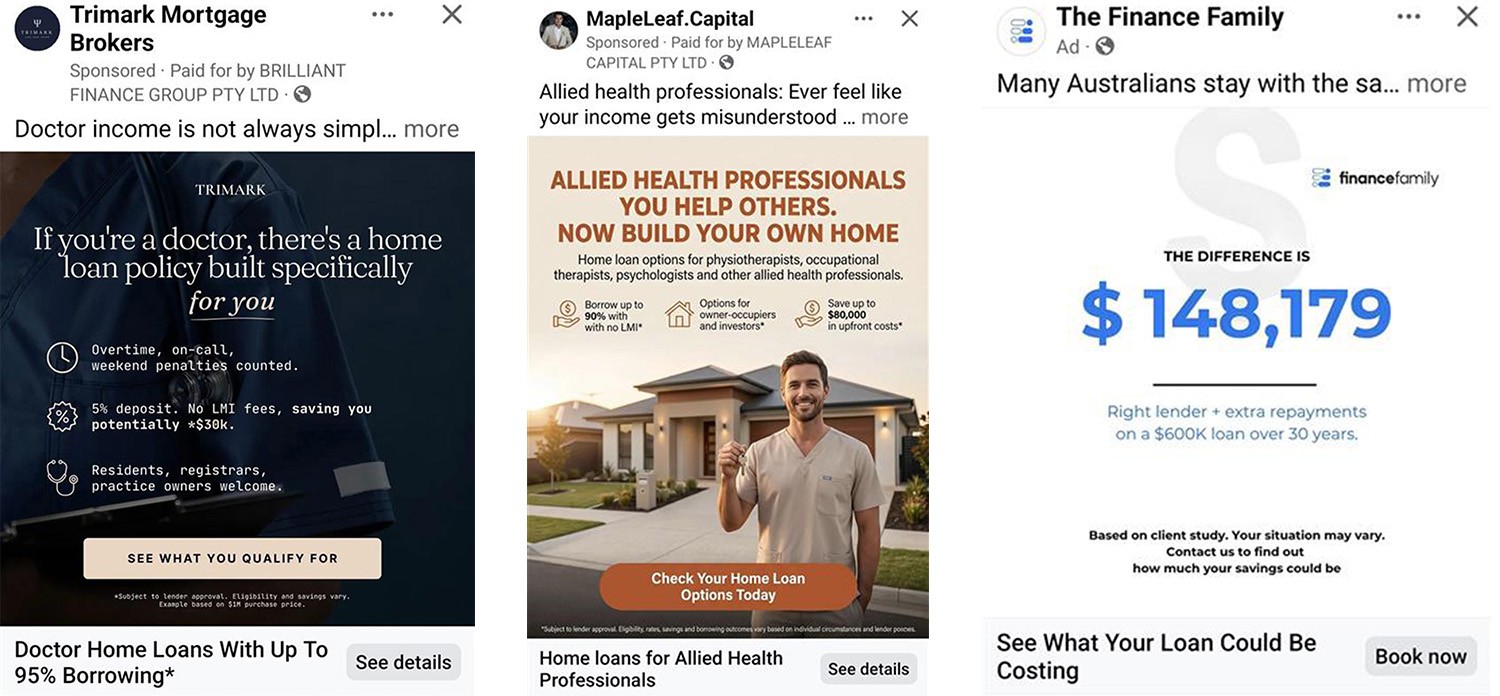
Pictured: Most common compliance violations include broad statement relating to LMI or the savings that LMI might provide. Any numeric valid requires qualification, warnings, and disclaimers. The use of virtually all numeric values will trigger an avalanche that lands on comparison warnings, terms, lender declarations, and other information. If your digital representation or support has introduced such bread-and-butter, super-simple, and black-and-white compliance issues to your advertising, sack them first, claim back your ad spend, and then sue sue for damages.
This issue is recognised throughout Australian consumer protection law. Section 18 of Schedule 2 to the Competition and Consumer Act 2010, being the Australian Consumer Law, prohibits conduct that is misleading or deceptive or likely to mislead or deceive. Sections 29 and 34 further prohibit false or misleading representations and misleading conduct concerning the nature, characteristics or benefits of services. Importantly, a representation may be misleading not only because what is stated is false, but because material information necessary to understand the representation has been omitted. A quantified savings claim that fails to disclose the assumptions underpinning the calculation risks creating a misleading impression regarding the likely benefit available to consumers.
These obligations are reinforced by the principles articulated in ASIC's Regulatory Guide 234, Advertising financial products and services (including credit): Good practice guidance. RG 234 repeatedly emphasises that advertisements must present information in a manner that is balanced, clear and not likely to create unrealistic expectations regarding potential benefits. And Numerical savings claims are particularly susceptible to creating such expectations because consumers naturally attach greater credibility to figures than to general statements. Behavioural economics has long demonstrated that numerical information carries an "authority bias" whereby consumers perceive quantified claims as more objective and reliable than equivalent qualitative statements. The mere presentation of a precise dollar figure conveys an impression of analytical rigour, regardless of whether the underlying assumptions are disclosed.
The regulatory challenge becomes more pronounced when the claimed saving is derived from interest rate comparisons, and all quantitative statements are generally derived from a live, valid, and common numeric rate figure. A statement such as "Save Up to $90,000" implicitly represents that the advertiser has compared two or more lending arrangements and calculated the difference in borrowing costs over a specified period. Yet the magnitude of any projected saving is highly sensitive to the interest rate selected for the comparison. A difference of only a few basis points can materially alter the projected outcome when applied over hundreds of thousands of dollars and multiple decades. Consequently, the validity of the savings figure depends entirely upon the validity of the interest rate assumptions used to generate it.

Pictured: We watch some groups bounce between agency to agency, with each new group presenting a new set of completely avoidable compliance challenges that need to be corrected. Lydian are a larger and more reputable brand (that I highly respect), but their advertising, and the quality of their consumer-facing advertising, is poor, not compliant, and in a few cases, presents a broken consumer experience. In the case of the pictured examples, the removal of offending elements and corrections to the landing pages would resolve most issues and mitigate the legal exposure introduced by way of the twelve missing compliance declarations.
Once the advertiser relies upon an interest rate as part of the calculation, the regulatory requirements applicable to rate advertising become engaged. Under the National Consumer Credit Protection Act 2009 and the National Consumer Credit Protection Regulations 2010, advertisements that state an interest rate for regulated consumer credit products generally trigger obligations concerning the disclosure of comparison rates. The rationale is straightforward. Consumers cannot accurately assess the true cost of credit by reference to the nominal interest rate alone. Fees, charges and other costs may materially affect the overall cost of borrowing. The comparison rate regime was introduced precisely because headline rates, when viewed in isolation, can create a misleading impression of affordability.
Accordingly, where a savings calculation is based upon a particular advertised rate, the consumer must be provided with sufficient information to understand the actual cost structure underpinning that rate. The comparison rate therefore becomes a critical component of the substantiation chain. The savings figure depends upon the interest rate; the interest rate requires contextualisation through the comparison rate; and the comparison rate itself is subject to prescribed disclosure requirements designed to ensure that consumers understand its limitations and assumptions. The advertiser cannot selectively rely upon one component of the chain while omitting the others.
This interconnected relationship produces what may be described as a cascading disclosure obligation. The quantified savings figure functions as the endpoint of a calculation. To validate the endpoint, one must accurately validate each preceding step in the analytical process. The advertiser must therefore be capable of demonstrating the methodology used to calculate the saving, the interest rates relied upon, the comparison rates associated with those products, the assumptions regarding loan size and term, the fees included in the calculation, and the basis upon which the comparative benchmark was selected. If any link within this chain is absent, the credibility and compliance of the final numerical representation is noncompliant at best.

Pictured: There are some marketing morons that occupy the financial space for the perceived 'high-ticket' rewards, and they're barely functional idiots. No marketing company or support should ever introduce compliance issues into the business of a regulated broker... yet it happens more often than not. The gentleman behind these adverts is responsible for more compliance infractions than any other in the last couple of years, and we've written an extremely detailed article to address the issue. The copy is nearly identical, the creative is often identical , and the claims made are not supported as legislated in the advert, copy, or landing page.
The requirement for substantiation is further reinforced by the evidentiary expectations imposed by section 4 of the Australian Consumer Law, which deals with representations concerning future matters. A projected savings figure is inherently forward-looking. It assumes that interest rates, borrower behaviour and loan characteristics will operate in a particular manner over time. Unless the advertiser possesses reasonable grounds for making the representation at the time it is published, the representation may be deemed misleading. Importantly, the burden of establishing reasonable grounds rests with the advertiser. It is not sufficient to argue retrospectively that the outcome could theoretically occur; the advertiser must possess contemporaneous evidence supporting the calculation when the advertisement is disseminated.

An Advertising Leadgen Abomination: Most leadgen services aren't very good... and none are compliant. Apart from the clear issues associated with very low-quality creative and copy, the same boring non-compliant rot will spilled into multiple businesses. A leadgen company should never introduce compliance issues into an operation. Mistakes happen, but what's pictured is blatant ignorance of the basic framework that dictates entry-level broker advertising compliance requirements. Each of these brokers is exposed to potential fines, regulatory penalties, loss of accreditations from lenders (on the basis of their representation and association with nonsensical non-compliance), and potential aggregation or ACL enforcement. Further, the businesses are not real, the pages themselves don't include required compliance identifications, the follow-up experience is not compliant, and only a few of the business (if they are in fact real) are created in accordance of Meta's special ad category - thus inviting deactivation. The brand connection and value derived from the exposure is almost zero. From an advertising perspective, there's no position, brand, cultural exposure, identify, or differentiation of any kind. Each of these businesses needs to call us immediately for an introduction to an experience that exceeds any finance marketing company in the industry. Of course, the required numeric claims carry no disclaimers, warnings, or information. What's pictured makes the earlier non-compliant Broker Grow ads look like works of art! Sadly, it's experiences such as those pictured that are having a broader adverse impact on the broader industry - it needs to stop!
From a consumer psychology perspective, the need for rigorous substantiation becomes even more compelling. Research consistently demonstrates that consumers anchor strongly to large numerical values. A claim such as "Save $90,000" becomes the dominant cognitive reference point in the consumer's decision-making process. Subsequent disclosures, qualifications or explanatory text often receive significantly less attention than the headline figure itself. This anchoring effect means that an inadequately substantiated savings claim can materially distort consumer perceptions even where technical disclaimers are present elsewhere in the advertisement. Regulators therefore evaluate the overall impression conveyed by the advertisement rather than merely assessing whether supporting information exists somewhere within the promotional material, advertisement, or landing page.
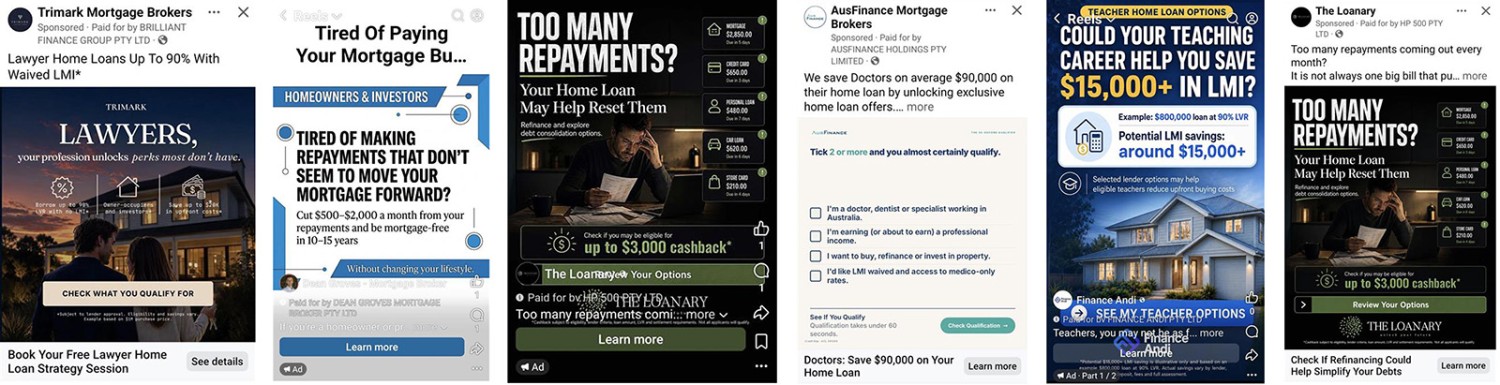
Misleading Quantitative Claims: Any numeric claim is akin to unprotected dalliance. Those disclaimers that are required in your create and copy aren't just an arse-covering exercise - they're a part of your professional conduct expectations. I hate seeing compliance infractions introduced to businesses on the back of utterly incompetent marketing representation. Your AI-created ads can introduce a readable and easily identifiable disclaimer. Any numeric claim triggers that avalanche of information that starts with the rates, follows with the comparison warning, discloses the full method for disclosed values, and then disclose the product. Our adverting should lean in the direction of caution. Whenever the question of whether something is legal or not, revert to the solution that exposes more information. Disclaimers are disclosures add real value to your advertising.
For these reasons, the compliance analysis of quantified mortgage savings claims cannot be confined to the numerical figure alone. The claim must be assessed as part of an integrated evidentiary framework. A statement such as "Save $90,000" is not simply a marketing slogan - it is the final output of a comparative financial calculation. The advertiser must therefore be able to demonstrate the entire analytical pathway leading to that outcome. This includes the comparative product selected, the interest rates relied upon, the associated comparison rates, the assumptions regarding loan size and duration, the fees incorporated into the model, and the statutory disclosures required to contextualise those figures. The absence of any component within this chain may undermine the validity of the entire representation and expose the advertiser to allegations of misleading or deceptive conduct.
Viewed through this legally correct lens, the comparison rate warning is not a peripheral compliance requirement but rather an essential component of the substantiation architecture supporting quantified savings claims. The numerical saving depends upon a rate comparison; the rate comparison depends upon comparison rate disclosures; and the comparison rate disclosure depends upon the legislatively prescribed warning explaining the assumptions and limitations of the calculation. The legal and logical relationship between these elements is inseparable. An advertiser seeking to promote a quantified saving must therefore ensure that every underlying component of the calculation is capable of independent verification and is disclosed in a manner sufficient to enable consumers to understand the basis upon which the claimed financial benefit has been derived. Only then can the representation satisfy the expectations of transparency, substantiation and consumer fairness that underpin Australia's financial services advertising regime.
Pay Off Your Home Loan in 5 - 7 Years
Among the most aggressively marketed claims within the mortgage and wealth-creation sector is the statement that consumers can "Pay Off Your Home Loan in 5–7 Years " or similar variations implying dramatically accelerated debt elimination . These representations are particularly problematic because they frequently create a highly misleading impression regarding the mechanism through which the advertised outcome is purportedly achieved. To the ordinary consumer, the phrase naturally conveys the impression that the borrower will extinguish their existing mortgage through superior budgeting strategies, repayment optimisation, cash-flow management or other forms of enhanced financial discipline using broadly conventional means. In reality, many of these strategies rely not upon accelerated repayment in the ordinary sense, but upon the acquisition of additional leveraged assets, equity recycling structures, refinancing arrangements, property appreciation assumptions or investment-based debt substitution mechanisms. The distinction is profound. The consumer is not simply "paying off" their mortgage faster; rather, they are often increasing overall leverage exposure and relying upon future asset growth, investment performance or restructuring strategies to indirectly extinguish or offset the debt over time.

Pictured: These representations are particularly problematic because they frequently create a highly misleading impression regarding the mechanism through which the advertised outcome is purportedly achieved. To the ordinary consumer, the phrase naturally conveys the impression that the borrower will extinguish their existing mortgage through superior budgeting strategies, repayment optimisation, cash-flow management or other forms of enhanced financial discipline using broadly conventional means. In reality, many of these strategies rely not upon accelerated repayment in the ordinary sense, but upon the acquisition of additional leveraged assets, equity recycling structures, refinancing arrangements, property appreciation assumptions or investment-based debt substitution mechanisms. The distinction is profound. The consumer is not simply "paying off" their mortgage faster; rather, they are often increasing overall leverage exposure and relying upon future asset growth, investment performance or restructuring strategies to indirectly extinguish or offset the debt over time.

Pictured: The claims of accelerated home ownership are common with over 1250 advertisements running right now that make the same claim. Other than the clear compliance issues associated with the risk-based quantitative claim, providing property and financial advice on wealth creation matters exposes broker to potential litigious issues. We'll address this specific promotional channel another time.

Statement of Claim: Any numeric claim must provide the numeric values and product information that played a part in the results. A claim of any type in isolation is as valid as the ratio of Smurfs to Unicorns in the Land of Fairies. Most numeric representations are interpreted by legislation as 'rate-equivalents' since the rate played a part in their resolution. A borrower will anchor onto the claim as a statement of fact, so relevant information is required in order to detail how the value was resolved - this will include all standard rate and product disclosures.
The regulatory risk arises because the headline representation materially understates both the complexity and the risk profile of the strategy being promoted. A claim that a borrower can "pay off their mortgage in 5–7 years" may be technically defensible under a narrow set of assumptions involving investment leverage, rising asset values, stable interest rates and sustained borrowing capacity. However, the overall impression conveyed to consumers may nevertheless be misleading where the advertisement fails to prominently disclose that the outcome depends upon acquiring additional debt, utilising investment properties, leveraging equity positions or participating in strategies materially different from ordinary mortgage repayment. This concern aligns closely with ASIC's guidance in RG 234, which emphasises that advertisements must not create unrealistic expectations or selectively emphasise benefits while obscuring associated risks, assumptions or complexities. Behaviourally, these claims are especially powerful because they exploit consumers' desire for financial freedom and debt elimination while suppressing the psychological salience of the additional leverage and investment risk actually required to pursue the strategy. The result is an advertising narrative that frames speculative wealth accumulation structures as simple repayment acceleration techniques, thereby creating a materially distorted understanding of the true financial arrangement being proposed.
Our Average Client Pays off Their Home in 10 Years
A claim such as "our average client pays off their home loan in 10 years " would attract significant regulatory scrutiny because it presents itself as an empirical, statistically grounded representation regarding client outcomes. Unlike aspirational marketing language, the statement implies the existence of measurable historical data demonstrating that the typical or average customer of the business achieves mortgage repayment within a decade. Under Australian Consumer Law principles, this transforms the representation into a claim requiring robust substantiation. The advertiser would likely need to possess contemporaneous evidence demonstrating not only that the statement is mathematically accurate, but also that the methodology used to derive the average is reliable, representative and not misleading in its presentation. Questions would immediately arise regarding the sample size, the timeframe assessed, whether the average refers to mean or median outcomes, whether outlier results materially distort the figure, and whether the clients involved possessed unusually high incomes, substantial existing equity, investment portfolios or access to leverage strategies not available to ordinary consumers.
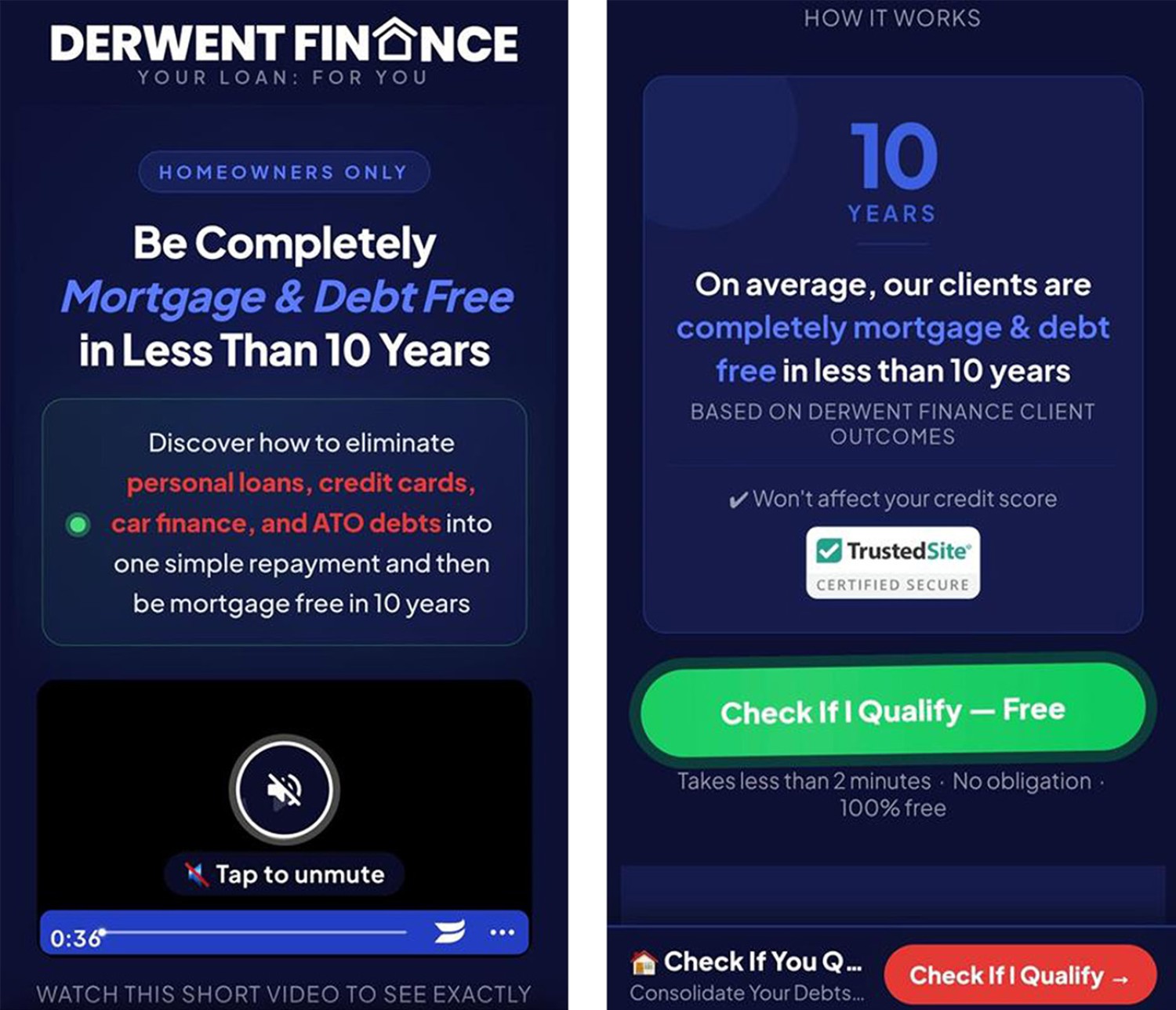
Average Client Pays Off Mortgage in 10 Years: This style of claim attracts significant regulatory scrutiny because it presents itself as an empirical, statistically grounded representation regarding client outcomes. Unlike aspirational marketing language, the statement implies the existence of measurable historical data demonstrating that the typical or average customer of the business achieves mortgage repayment within a decade. Under Australian Consumer Law principles, this transforms the representation into a claim requiring robust substantiation. The advertiser would likely need to possess contemporaneous evidence demonstrating not only that the statement is mathematically accurate, but also that the methodology used to derive the average is reliable, representative and not misleading in its presentation. It's possible that the statement is entirely factual, but it requires qualification. If it is indeed correct, they are custodians of a program that is a statistical anomaly and the single highest-performing brokerage in the country.
The regulatory concern becomes substantially greater where the statement appears on a landing page designed to generate consumer leads or encourage engagement with a debt reduction or wealth creation strategy. In that context, the claim operates not merely as a descriptive statistic, but as a behavioural persuasion mechanism intended to shape consumer expectations regarding likely outcomes. The ordinary consumer is unlikely to interpret the statement as a narrow statistical observation applying only to a highly selected cohort of sophisticated investors. Rather, many consumers would reasonably infer that engaging the advertiser's services creates a realistic prospect of achieving mortgage repayment within approximately ten years through methods broadly applicable to ordinary borrowers. If the claimed outcomes depend upon extraordinary repayment capacity, additional leverage, investment property acquisition, equity recycling, unusually favourable market conditions or highly atypical borrower behaviour, the omission of those contextual factors may render the overall impression misleading. This is particularly so where the statement is presented prominently as a headline claim without equally prominent disclosure explaining the assumptions, strategies and risks necessary to produce the outcome.
The phrase "average client" itself introduces additional legal complexity because it carries a strong representational implication of typicality and representativeness. Courts and regulators frequently distinguish between exceptional case studies and representations concerning ordinary or average consumer experiences. A business may legitimately possess some clients who repay loans in ten years while nevertheless misleading consumers if those clients are not representative of the broader customer base. The use of the word "average" therefore materially elevates the evidentiary burden attaching to the claim. It is not sufficient that some consumers achieved the result; the advertiser must be capable of substantiating that the claimed outcome genuinely reflects the average experience of the relevant client cohort under a defensible methodology.
From a behavioural psychology perspective, such claims are especially influential because they combine numerical specificity with social proof. Consumers interpret the statement not merely as a theoretical possibility, but as evidence of an established and repeatable outcome achieved by others similarly situated to themselves. The phrase therefore reduces perceived risk while simultaneously increasing perceived attainability. This creates a heightened obligation to ensure that the representation is carefully qualified and contextually accurate. Under ASIC's Regulatory Guide 234 and the broader misleading conduct provisions contained within sections 18 and 29 of the Australian Consumer Law, the central issue would ultimately be whether the overall impression conveyed to the ordinary consumer accurately reflects the true nature, rarity, assumptions and risks associated with the advertised outcome.
Borrow 95% with no LMI
“Borrow 95% with no LMI” is regarded as a quantified financial representation, and it carries many of the same substantiation and misleading conduct risks associated with other numerical credit advertising claims.
The statement contains multiple embedded quantitative representations simultaneously. First, it represents that credit is available at a 95% loan-to-value ratio, which is itself a specific numerical lending threshold carrying strong implications regarding deposit requirements, risk appetite and borrower accessibility. Second, it represents the absence of Lenders Mortgage Insurance (LMI), which consumers commonly understand as a substantial financial saving, often amounting to many thousands or even tens of thousands of dollars. The phrase therefore communicates both a borrowing capacity representation and an implied savings representation, despite not expressly quantifying the dollar benefit.

Pictured: Since we introduced our article on the Deception Funnel, we've already seen some poor lead generation groups change their creative. However, once a consumer is exposed to non-compliance, the damage is done. The introduction of LMI into advertising introduces a range of challenges that triggers a series of disclosures that lands on the disclosure of the particular product you're promoting. Anything with selective availability has to be disclosed given that it normally has an impact on choice, options, and features. Introducing an LMI figure or saving requires warnings and disclosures based on real-world arithmetic using current rates, fees, and figures (we manage this automatically). Using LMI has to be introduced using our 'PUNCH Method', and this is introduced in our webinar series. Using assumptions, sample figures, arbitrary data, unicorn-inspired borrowing amounts, fairy-dust 'reductions' in rate, and other imaginary numeracy is strictly prohibited. Surprisingly, we've seen the LMI representation make an impact on brokers via regulatory scrutiny and lenders (directly) more than anything else. A marketing company shouldn't introduce compliance issues to your business, and the boneheads responsible for the advertising above should be relegated to the scrap heap promoting wallpaper and pottery classes - they are unfit to represent brokers when their business and livelihood is predicated on legal promotion.
From a regulatory perspective, the issue is not simply whether such a product technically exists. The more important question is whether the overall impression conveyed to the ordinary consumer is accurate. In practice, "95% with no LMI" products are frequently subject to highly restrictive eligibility criteria. Access may depend upon profession-based waivers (for example medical, legal or accounting professionals - which are usually disclosed as part of a targeted advert, subscription, and landing page), family guarantees, government schemes, limited lender panels, geographic restrictions, income thresholds or other narrowly defined borrower characteristics. If the advertisement presents the feature in a broad, headline manner without adequately communicating the conditional nature of the offer, there is a substantial risk that consumers may infer that the outcome is broadly obtainable when it is in fact available only to a limited subset of applicants.
Required Disclaimer: The use of the quantitative claim requires a full breakdown in the advertisement copy itself and in the accompanying creative. The complete comparison warning is required with valid and up-to-date rates, comparison rates, warnings, terms, eligibility, and product/lender disclosures (with the lender required in the creative and copy). The single claim launches trigger after trigger in terms of compliance requirements. This disclaimer is required on the landing page with another full and complete breakdown relating to the specific example inferred by way of the claim.
How We Do It: A quantitative statement will change over time, and the arithmetic used to calculate results will vary since the rate, comparison rate, and fees used to resolve the savings will change. We use live data, our LMI API, Stamp Duty API, Postcode Risk API (if applicable), and up-to-date lender product data sourced via the lowest rate from those that support the implied policy exemption (such as Nurses, Doctors, or Police), and we build out the calculation in real time (sourcing the product, lender, fees and associated charges). The number is rounded down and will be represented appropriately in the advert and/or landing page. When you have a hundred landing pages, there's a clear technical debt associated with hard-coded information (and most representation in the market use generic and imaginary rate reductions and policy exemptions - strictly prohibited, so dynamic calculations in your footer and on landing pages are the only suitable method of staying compliant). The API used to return the above information based on any claimed 'saving' is freely available. Your calculations should never be outdated or determined based on old information. Read more about disclaimer functionality in an article with the working title of "The Landing Page Module is Updated to Adventus". Takeaway: If you don't have the capacity to ensure your compliance breakdowns source up-to-date information based on real-world conditions, don't use the Savings claim in your advertisements.
The statement also engages important behavioural dynamics. Consumers anchor strongly to both the "95%" and the "no LMI" components because together they imply accelerated market entry with reduced upfront cost barriers. For many borrowers, particularly first-home buyers, LMI represents one of the largest perceived obstacles to entering the property market. Consequently, the phrase carries disproportionate persuasive power relative to its word count. This increases the importance of ensuring that qualifying conditions are not visually subordinated or obscured through poor prominence, fine print or delayed disclosure mechanisms.
Further, depending on the structure of the advertisement, the representation may interact with additional disclosure obligations under the National Credit Code. If the advertisement also states a rate, repayment amount or savings figure associated with the "95% no LMI" product, comparison rate obligations and prescribed warnings may become engaged. Similarly, if the advertisement implies reduced borrowing costs or accelerated affordability outcomes, the advertiser may need to substantiate the assumptions underpinning those implied financial benefits.
Accordingly, while “Borrow 95% with no LMI” is not a quantified savings claim in the same way as “Save $40,000”, it nevertheless functions as a quantified financial representation involving measurable credit terms and implied economic benefit. As such, it attracts many of the same regulatory expectations concerning substantiation, prominence of qualifications, representativeness and overall consumer impression under sections 18 and 29 of the Australian Consumer Law and ASIC’s guidance in RG 234.
Comparison Rates with Stated Monthly Repayment Figures
Section 164(2)(b) of the National Credit Code extends the comparison rate disclosure obligation beyond the advertisement of interest rates alone and into the realm of repayment advertising. This is a critically important provision because consumers frequently respond more strongly to repayment figures than to annual percentage rates, and brokers will often use the former to bypass the imaginary opportunity to bypass disclosure requirements. Behavioural research consistently demonstrates that borrowers tend to evaluate affordability through the lens of periodic cash flow rather than total borrowing cost. Statements such as "$899 per week", "from $2,950 per month" or "repayments from just $68 per day" therefore possess substantial persuasive power because they frame the loan in terms of perceived day-to-day affordability rather than long-term financial cost. Legislation recognised this behavioural tendency and accordingly required that where a repayment amount is stated in an advertisement, the comparison rate must not be given less prominence than the repayment itself.
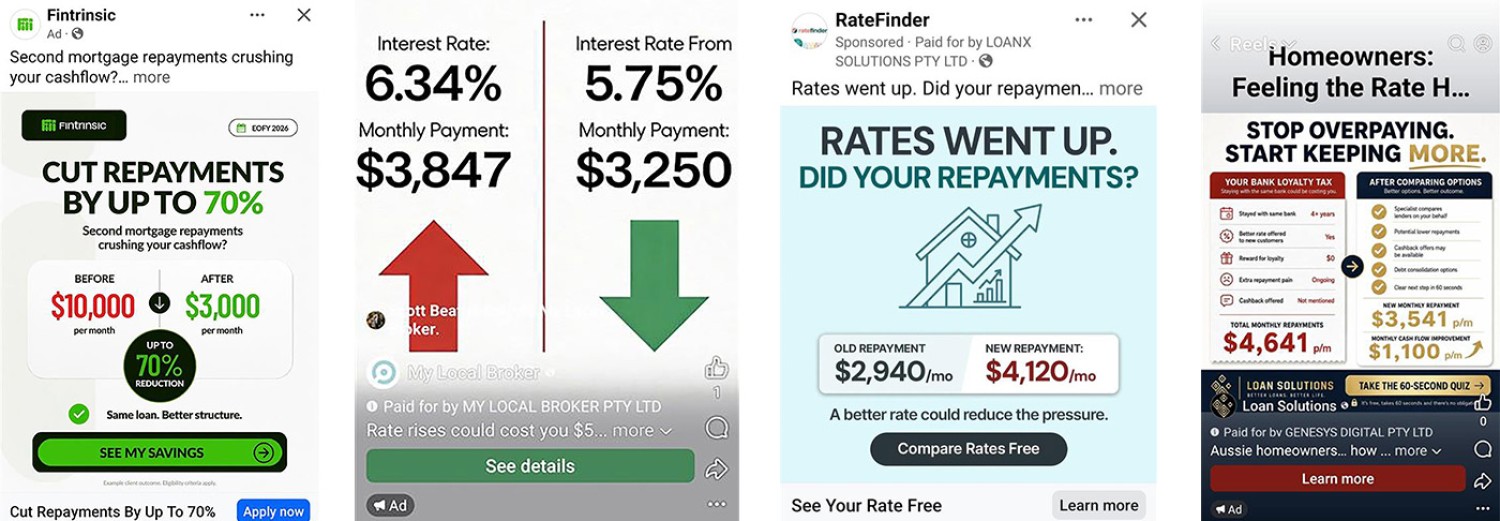
Pictured: The National Consumer Credit Protection Act 2009Section 164(2b) states that "[a] comparison rate in any credit advertisement must not be less prominent than .. the amount of any repayment stated in the advertisement". First, the advertisements above breach a larger number of regulations, so selecting just one single attribute is a flawed approach on my part, but necessary for the example. When any repayment is stated (in any form or manner), the full comparison rate is required which triggers the quantitative disclosures that further triggers the APR used for the assumptions, comparison rate, lender, product, fees, term, conditions, and other requirements - including the full comparison warning applicable to the displayed condition. Any numeric value triggers an avalanche of required disclaimers and warnings. Is the comparison rate less prominent than the stated figure? Yes - because it isn't there. Invisible disclaimers might be a defence in the Marvel universe, but it's an operational imperative for brokers living in our realm to get these basics correct.

Monthly Repayments Stated in Advertising: The samples above were chosen from a pool of thousands simply because they were shown in the couple of hours prior to publication of this article. There are clear issues associated with many of them relating to the annual percentage rates without the accompanying comparison rate and associated disclosures and warnings, but the advertisements themselves are shown on the basis of monthly repayment figures. Monthly repayments requires qualification, which includes the comparison rate, APR, term, fees, and other information. Those pictured are quite the compliance abominations (none of the ads listed the warnings on subsequent pages).
In practical terms, this prevents advertisers from using highly prominent repayment figures as a form of affordability anchoring while visually diminishing the comparison rate disclosure that contextualises the true cost of the credit product. The obligation is particularly significant in digital advertising environments, including Meta advertisements, short-form video content and responsive mobile creatives, where repayment figures are often used as the dominant visual headline due to their immediate emotional and behavioural impact. An advertisement that prominently states "Repayments from $742 per week" while relegating the comparison rate to fine print, low-contrast text or visually suppressed disclosures may create substantial regulatory risk under both section 164 and the broader misleading conduct provisions of the Australian Consumer Law. The legal issue is not merely whether the comparison rate technically appears somewhere within the advertisement, but whether consumers encountering the repayment representation are simultaneously presented with sufficiently prominent contextual information to properly evaluate the borrowing arrangement as a whole.

Pictured: Check My Rate make five savings-based claims in a single ad, from monthly repayments, LMI Savings, interest saved, through to the loan term. Each one of these claims should be quantified via valid numerical analysis disclosure in the advert itself. The advert makes an attempt to appeal to larger numbers by directly stating savings that are more likely to resonate with the consumer - quite the compliance abomination. Each claim needs to be quantified which includes the full array of rates, comparison rates, terms, fees, lender, scenarios, and projections. Sometimes, it's best to sell on the value you provide rather than the often unobtainable and unqualified rate or savings... and this is the classic example,
The same principles apply with even greater force to quantified savings and affordability representations such as "Save $40,000", "Reduce repayments by $1,200 per month" or "Pay off your mortgage years sooner"... and the quite common and highly deceptive - "Pay Off Your Home Loan in 5 - 7 Years" (discussed shortly). Such claims are not standalone marketing statements but rather the final output of comparative financial calculations dependent upon underlying assumptions regarding rates, loan terms, fees, repayment structures and borrower circumstances. Consequently, these representations require careful qualification and substantiation, including disclosure of the rates and comparison rates used in the calculation, the assumed loan amounts and terms, applicable fees and charges, and the prescribed comparison rate warning where relevant. The regulatory and behavioural considerations surrounding quantified numerical claims are examined in greater detail in a separate section dealing specifically with comparative savings representations, consumer anchoring effects and the substantiation obligations attaching to projected financial outcomes.
Validity of Rates and Disclosures
Section 167 National Consumer Credit Protection Act 2009 (Compliance grace period following changes in interest or fees) states that "[a] credit advertisement does not cease to comply with this Part merely because of a change in the annual percentage rate or in any credit fees or charges during the period of 7 days after the change takes effect". This statement makes it clear that the National Credit Code provides a limited operational tolerance in relation to advertising accuracy following changes in pricing variables, commonly referred to in practice as the "compliance grace period". Specifically, a credit advertisement does not cease to comply with the relevant advertising requirements merely because the annual percentage rate, or any credit fees or charges, change during the seven-day period after those changes take effect. This provision recognises the practical reality that credit pricing is not static and that lenders and intermediaries frequently operate in environments where rates and fees may be adjusted with short notice across multiple distribution channels simultaneously, although there's no practical excuse in the digital advertising environment to make changes outside of a couple of days.
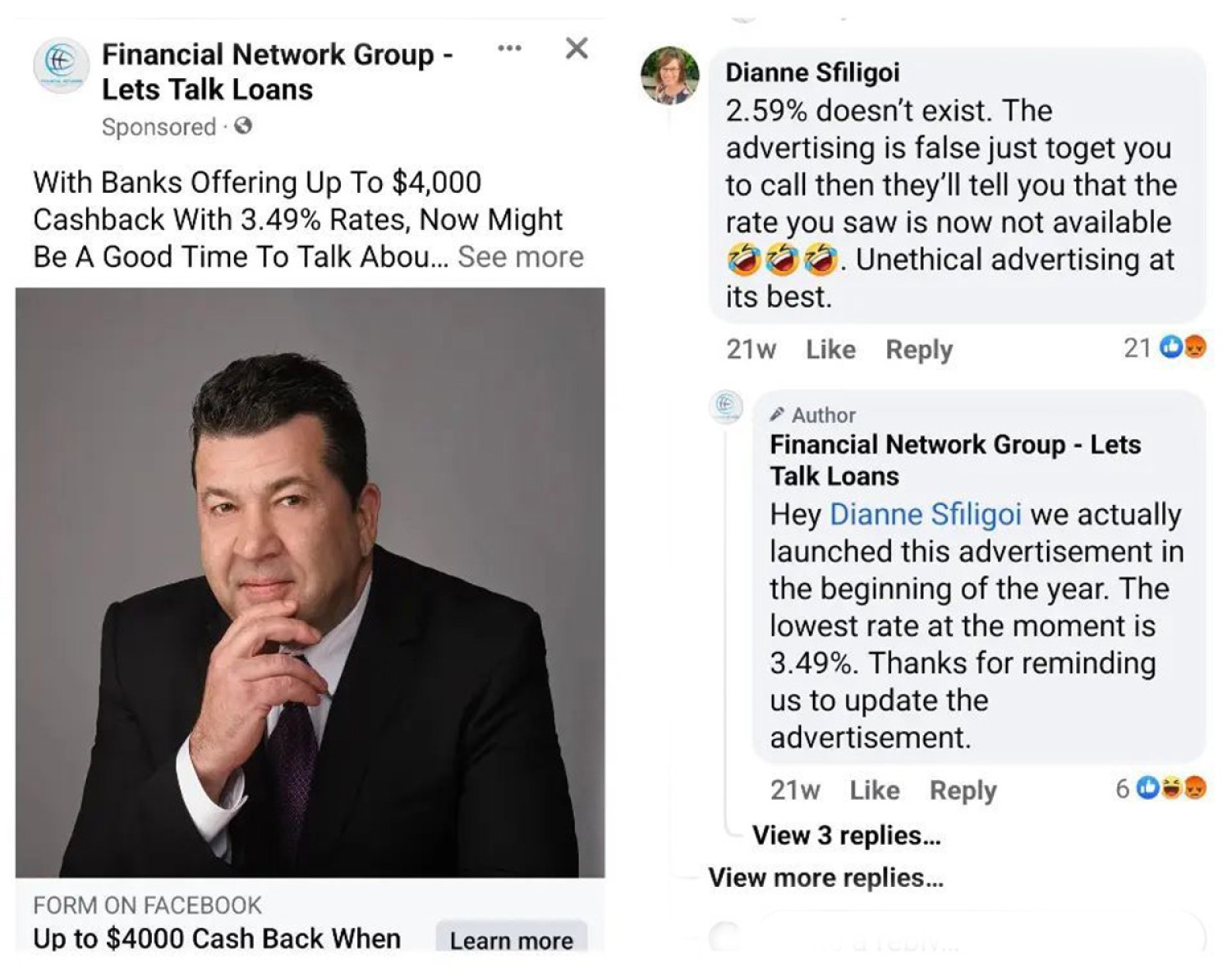
Pictured: Financial Network group have had an interesting relationship with advertising, and the evidence supports an in-house effort - something we have long advocated and supported. However, the rate two cuts were out of date for several months before the change was made to the correct rate - a clear breach. At the time of writing, the group is using some video options but their methods are reasonably poor - they should probably attend our Broker Growth Workshop!, This is one of countless of examples, with leadgen agencies in breach more often than DIY brokers. At the time of publication, we're a little dubious about Derwent's publicised rate of 5.59% - is it valid?
The existence of this seven-day tolerance should not be misconstrued as a substantive exemption from compliance obligations - particularly in an environment where representation usually requires nothing more than a single toggle to cease displaying ads. The provision does not operate as a suspension of the legislative regime, nor does it create a safe harbour in which outdated or inaccurate representations may be knowingly maintained. Rather, it functions as a narrowly confined transitional buffer designed to accommodate the operational latency inherent in updating distributed advertising ecosystems. In practice, financial services advertising exists across a complex network of landing pages, aggregator feeds, broker portals, CRM-driven content systems, and social media placements. The grace period acknowledges that synchronised real-time updating across all these environments may not always be technically immediate.
Nevertheless, the so-called "fuzziness" of the grace period should not obscure the fact that the underlying legal obligation to ensure that advertising is not misleading or deceptive continues to apply at all times. The legislation is not temporarily relaxed during this period; rather, enforcement discretion is exercised with an understanding of operational realities, provided that advertisers act promptly, systematically and in good faith to update all materially affected representations. The critical compliance risk arises where outdated rates, fees or promotional figures persist beyond what could reasonably be characterised as a transitional update window, particularly where such figures continue to appear prominently in paid media, landing pages or comparison funnels without appropriate qualification or correction.
Accordingly, organisations must treat the grace period not as a licence for delay, but as a strict administrative boundary within which robust version control, auditability and update propagation must occur. This includes ensuring that real-world figures, advertised rates, repayment illustrations and savings claims are dynamically aligned across all consumer-facing environments. Where discrepancies arise between updated pricing data and residual advertising content, the overall impression conveyed to consumers may shift from technically compliant to potentially misleading, even within the nominal seven-day window. The legal risk therefore does not disappear during the grace period; it is merely contextualised by an expectation of prompt corrective action and disciplined information governance across all advertising channels.
Interest Rates in Search Results
Where a licensee publishes a nominal interest rate in any form likely to be indexed by a search engine, the accompanying comparison rate must be embedded with equal prominence in the same HTML source. Failure to do so is an actionable contravention of the NCCP Act s160 and is likely to breach general prohibitions against misleading conduct under the ASIC Act and ACL. Where a “green” or specialist rate is used to attract general borrowers, the omission of the qualifying context (including eligibility criteria) and the mandated comparison rate exacerbates legal risk and undermines DDO compliance. There is no effective legal defence based on the argument that “Google cuts off the snippet”. The relevant test is whether the representation as made is likely to mislead the average consumer.
Misrepresentation of Interest Rates (Rate Bait) in Search Results: "Rate Bait" is introduced in an article titled "Misrepresentation of Interest Rates (Rate Bait) in Search Results". Sadly, the practice continues.
What Do We Do?: Given that we provide most of our clients a comparison engine, we'll often require the need to represent rates in search results (supported in a way that is suitable for broad Search and supplemented by the associated snipped). An article titled "How to Add an Interest and Comparison Rate to a Website Title" details how to use Rate Placeholders in a page title with other information supporting how we instruct Google to check the page daily.
Under the Design and Distribution Obligations (DDO) regime, we have a positive obligation to ensure that any financial product is appropriately targeted and not promoted in a way likely to mislead a retail consumer. Using a niche or specialist rate — such as an eco or “green” loan — as a headline grabber without context is legally fraught. A green loan - commonly used right now, and with the practice dating back a number of years - may be relevant for only a fraction of the population, and yet, presented without qualification, it can easily mislead the general audience into believing they qualify for that product when they almost certainly do not. This runs directly counter to both the spirit and letter of the DDO regime and the foundational principles of responsible lending or Best Interest Duty.
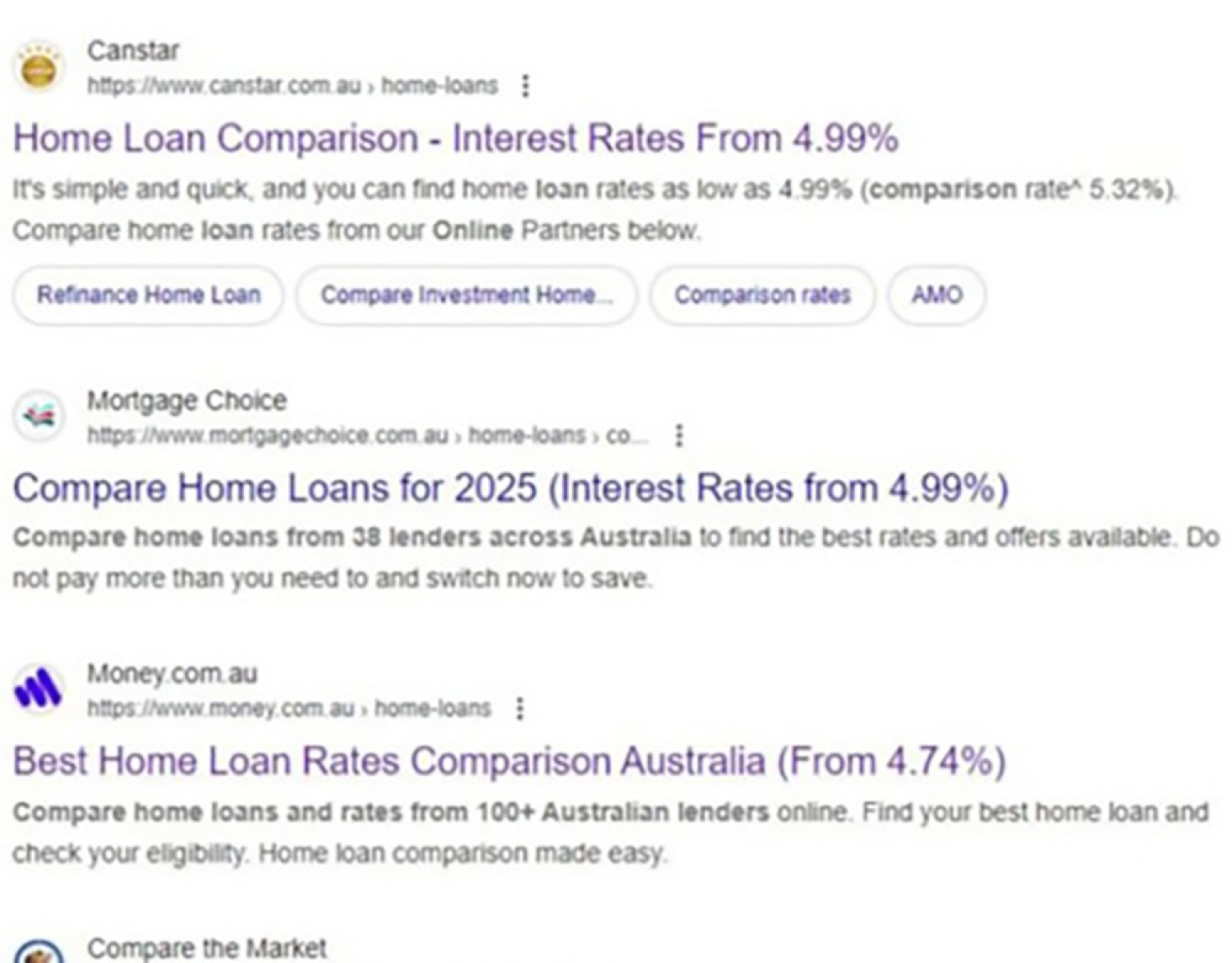
Pictured: In an era where 70 to 80% of borrower journeys begin with a digital search query, the obligation to ensure compliance extends to every word that might appear in a search engine results page (SERP) - whether paid (AdWords) or organic (SEO). Pictured is a search for various comparison websites. Those entities that returned rate in their Search title, only a few managed to satisfy the statutory obligation by disclosing a comparison rate alongside the nominal rate. The remaining websites in the same space either omitted the comparison rate altogether or buried it beyond the visible snippet - which, in functional terms, means it does not exist for compliance purposes.
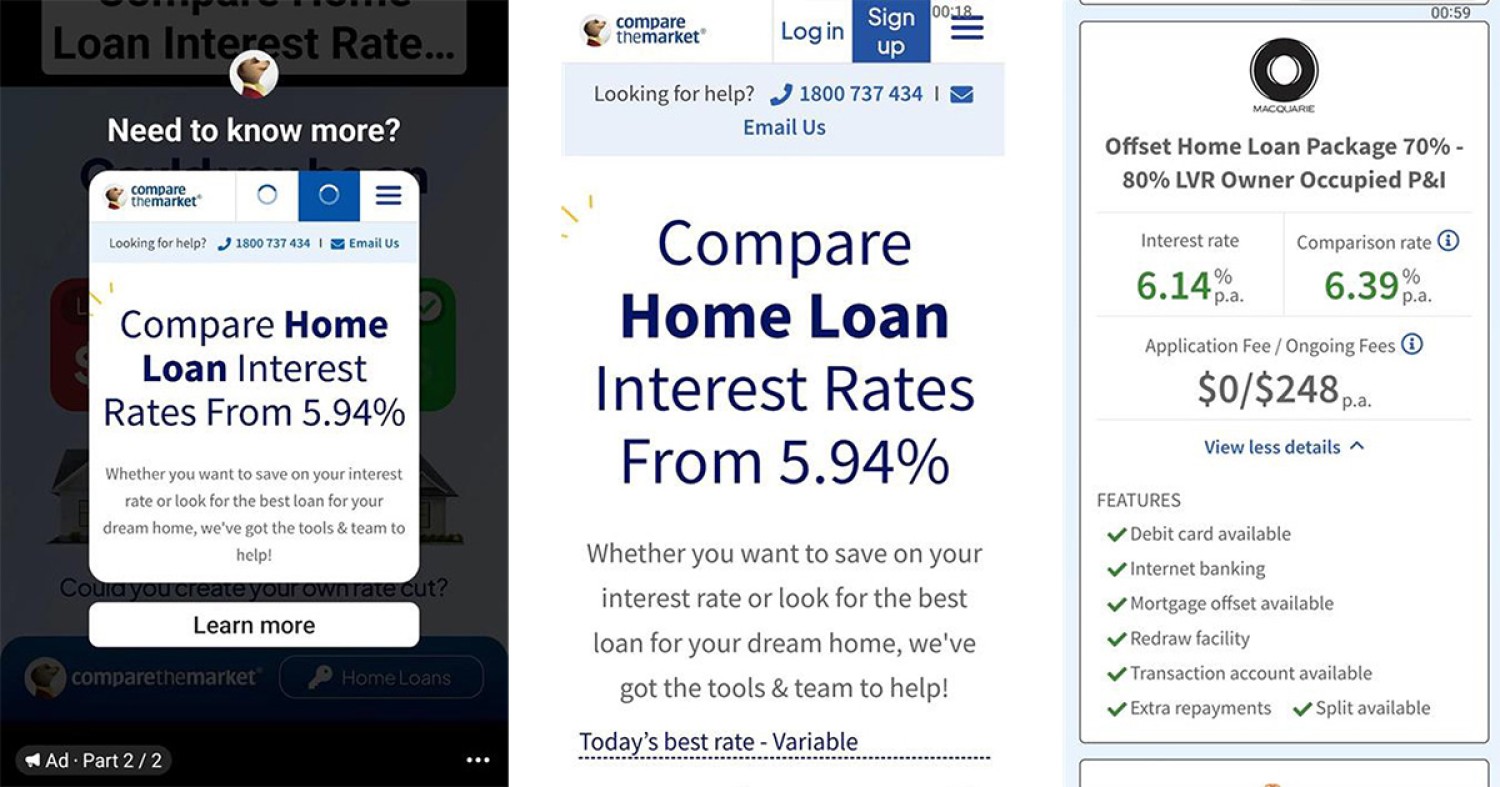
Pictured: Comparison sites represent some of the more non-compliant experiences delivered to market. An example of the Compare the Market experience is shown above - we call it 'selective compliance' given that some areas of their operation seemingly do things correctly. The widespread comparison site malfeasance will take shape in another article.
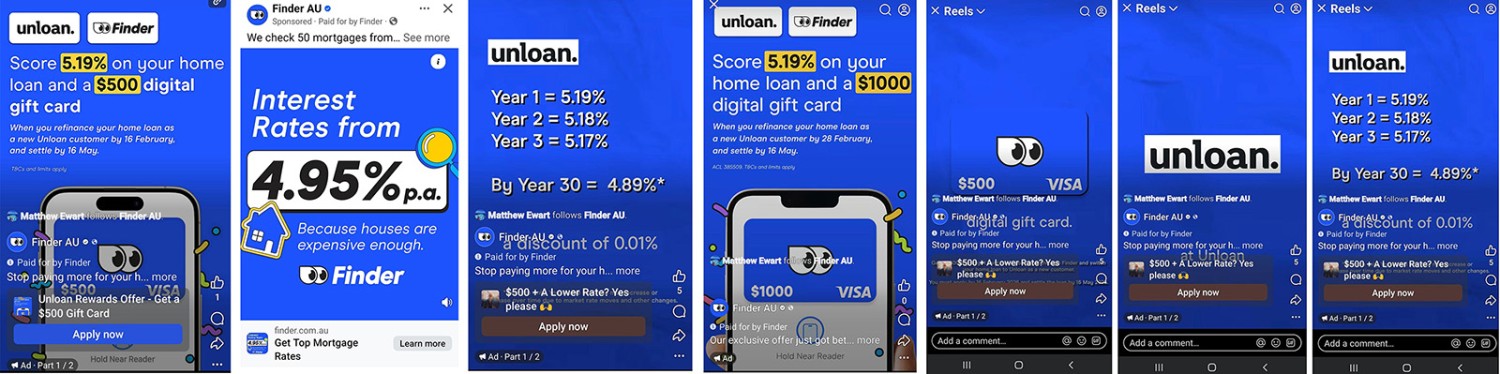
Pictured: Finder has a funny relationship with their search results, but their advertising also leaves a little to be desired with general non-compliance demonstrated by way of most of their consumer-facing touchpoints. The relationship and representation of the Unloan product is something the Commabnk may need to scrutinise. The danger of these cross-pollinating experiences is that commercially driven enterprises will often represent products in a way that supports their commercical outcomes rather than customer benefits, and it's possible that the Finder and Unloan association is evidence of this. Comparison website Canstar also have a non-compliant relationship with legislation.
To be clear: under ASIC’s regulatory framework, organic listings can be treated as advertisements. If a search snippet displays an interest rate, that snippet is effectively an extension of the ad or offer. While the probability of enforcement for an isolated organic snippet breach is low, the legal risk of "rate bait" is not zero - especially if there is evidence of systematic intent to highlight a low, unqualified special rate as a means of attracting clicks that the advertiser knows will not be suitable for the general market.
Legislative and Regulatory Framework
Listed is the most relevant legislation that should form part of your library.
1. National Consumer Credit Protection Act 2009 (Cth) ("NCCP Act")
2. National Consumer Credit Protection Regulations 2010 (Cth)
3. RG 234 – Advertising Financial Products and Services (Including Credit): Good Practice Guidance
4. Australian Securities and Investments Commission Act 2001 (Cth)
5. Competition and Consumer Act 2010 (Cth)
6. MFAA & FBAA Code of Practice
General Video Discussion
The following video was recorded as a 'general overview' for our clients as a 'study guide' before attending our high-performing webinar series.
Conclusion
The comparison rate regime is often treated as a technical disclosure requirement. This interpretation is incomplete. In reality, comparison rate legislation reflects a broader regulatory philosophy aimed at correcting predictable failures in consumer decision making. The law recognises that borrowers are susceptible to framing effects, anchoring biases, salience distortions and information asymmetry. Comparison rates therefore exist not simply to disclose information but to improve the quality of consumer judgment.
We All Make Mistakes: In an industry as heavily regulated and consequential as financial services, mistakes will inevitably occur from time to time. The issue is not the existence of human error itself, but whether those errors arise despite genuine diligence or are the product of ignorance, complacency, or a failure to properly understand the obligations attached to consumer trust. Brokers, marketers, and industry participants should therefore approach advertising and consumer engagement with a mindset that errs on the side of compliance caution rather than aggressive interpretation. Where uncertainty exists, the appropriate response should not be to ask how much can be "gotten away with", but whether the conduct genuinely reflects the transparency, honesty, and professional standards consumers are entitled to expect from those entrusted with significant financial decisions.
Mortgage brokers who approach compliance as a checkbox exercise invariably underestimate the true scope of their obligations. The legislative framework extends beyond displaying a comparison rate and a warning. It encompasses prominence, balance, context, accuracy, consumer understanding, and the avoidance of misleading overall impressions.
The definitive compliance question is therefore not whether a comparison rate appears somewhere within an advertisement. The real question is whether a reasonable consumer, viewing the advertisement as a whole, would leave with an accurate understanding of the cost, nature and limitations of the credit product being promoted. Don't let incompetent marketing agencies experiment with the continued operation or compliance reputation of your business.
Ultimately, this discussion extends far beyond comparison rates, disclosure warnings, headline pricing, or the technical mechanics of advertising legislation. At its core, it concerns the integrity of an industry entrusted with guiding Australians through some of the most significant financial decisions of their lives. Mortgage brokers occupy a position of enormous influence. Consumers approach brokers during periods of financial vulnerability, uncertainty, aspiration, and emotional significance - whether purchasing a first home, restructuring debt, supporting a growing family, or attempting to improve their long-term financial position. That level of trust carries with it a corresponding obligation to communicate honestly, transparently, and responsibly at every stage of the consumer journey, including marketing.
Our overarching Best Interests Duty should not be viewed as a narrow legal threshold satisfied only at the point of credit recommendation. It should operate as a broader ethical framework underpinning the entirety of the broker-client relationship, beginning from the very first advertisement, landing page, headline, comparison table, or savings claim encountered by the consumer. If the acquisition process itself is built upon misleading impressions, hidden assumptions, artificial urgency, fake scarcity, fabricated personalisation, or manipulative behavioural design, then the spirit of that duty has already been compromised long before any loan recommendation is made. Compliance cannot begin at the disclosure document; it must begin at first contact.
As an industry, we need to hold ourselves to the highest standards, and exceed the expectation of consumers and lenders. The public should not need to navigate misleading funnels, exaggerated savings claims, artificial “AI” systems, hidden results, or deceptive behavioural tactics in order to access quality mortgage advice. Nor should ethical brokers be forced to compete against increasingly manipulative advertising ecosystems that prioritise lead volume over consumer trust. The long-term credibility of the profession depends not merely on technical compliance with legislation, but on a collective commitment to honesty as a commercial principle rather than a regulatory inconvenience.
The reality is that mortgage broking is an extraordinarily valuable service when delivered properly. Skilled brokers provide genuine strategic guidance, lender navigation, structuring expertise, advocacy, education, and long-term financial support that many consumers could not easily obtain themselves. That value proposition is already powerful. It does not require embellishment through deception or misrepresentation. It does not require fabricated testimonials, false urgency, hidden disclosures, misleading rates, deception funnels, or artificial calculations to justify its existence. When brokers communicate transparently and deliver authentic value, consumers respond with trust — and trust remains one of the most commercially valuable assets any business can possess.
In the years ahead, regulatory scrutiny surrounding digital advertising, behavioural marketing, lead generation, AI claims, and financial promotion will almost certainly intensify. But compliance should not be driven merely by fear of enforcement. It should be driven by professional pride. The strongest businesses in this industry will ultimately be those that recognise that ethical conduct and commercial success are not competing objectives, but mutually reinforcing ones. Honest marketing builds stronger relationships, attracts higher quality clients, produces greater long-term retention, and elevates the standing of the profession as a whole. That is the standard consumers deserve, the standard lenders expect, and the standard to which we should all aspire.