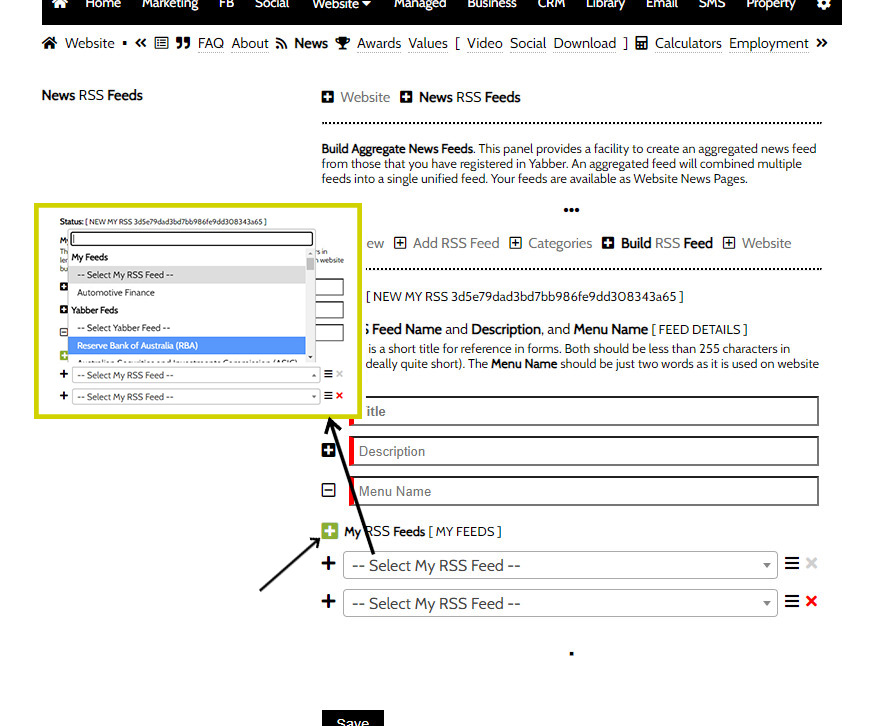
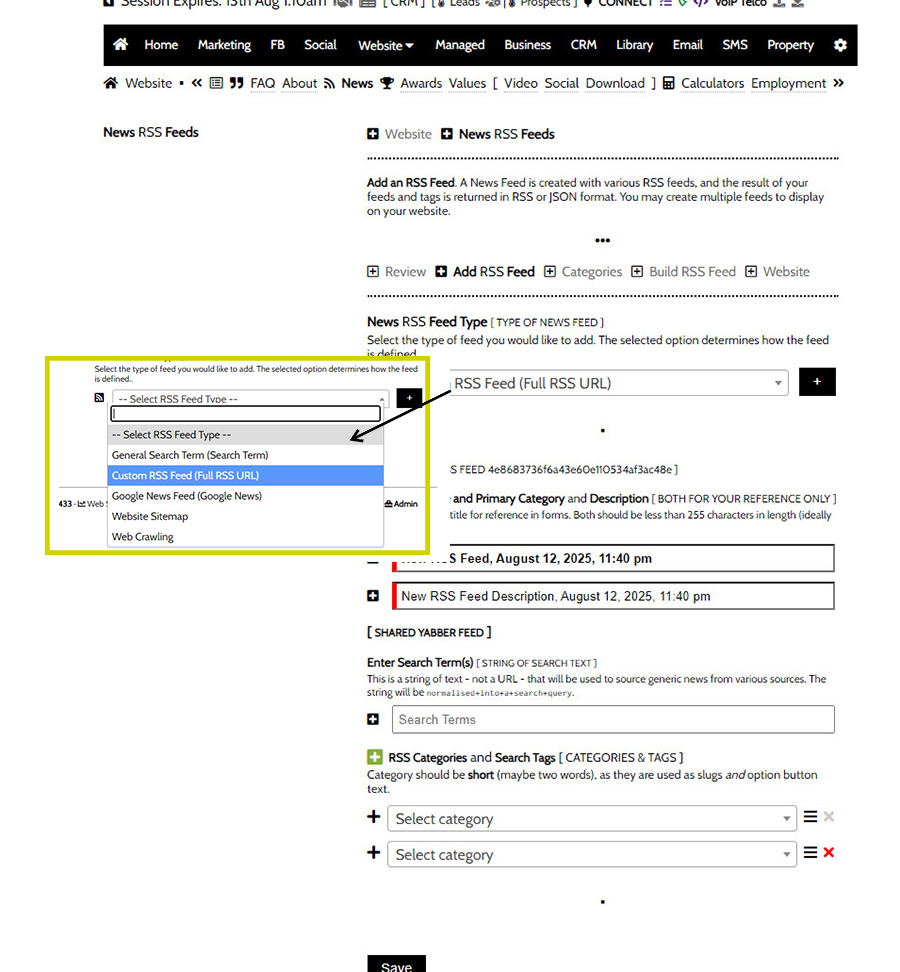
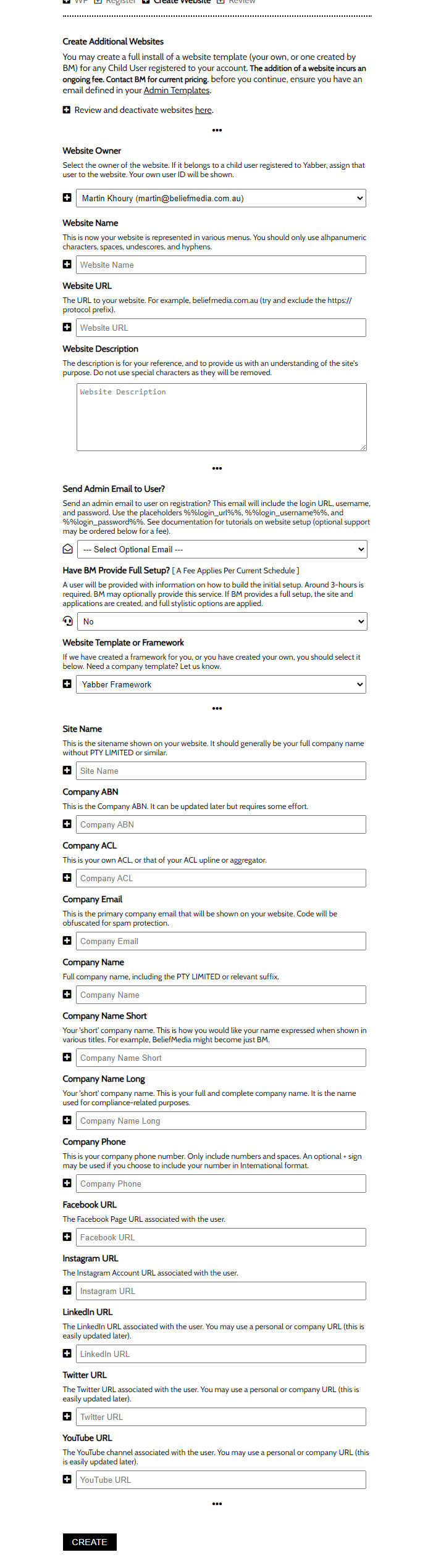
We've created a large number of sliders recently that replace various legacy website features. The slider introduced in this article show selected post type content as sliding panels. The feature may be used anywhere with a drag and drop Elementor widget or shortcode, with the expectation that it will be used on the front page of your website.
The latest slider was designed for content sent to your website social and video archives - both blog-style archives of what is traditionally external content, such as social media posts and video. However, in the light of a little early feedback, we have updated the slider to include virtually all post types.
Social and Video Archive: The mortgage broker website we provide our clients includes links to the social, video, and various other archives in the website footer. The content fed to the social archives is part of the standard (and optional) distribution made available via the Instagratify and Vista social media modules (the former is an Instagram hashtag-based filtering tool while the latter is a method to post to social directly from a dedicated Outlook calendar) - both amazing tools. The video archive was formerly an automated tool but we've since updated the system so videos ingested by Yabber enjoy a little TLC before they're sent. Both of these archives are presented in a blog-style format with a styled page showcasing your content. They're both an excelling customer-focused and SEO tool that assigns ownership of the content you create back to you. If your website is the centre of your marketing universe (and it is), then your website should be an archive of your entire digital footprint - we shouldn't allow other networks to take ownership of our content.
The Result
To return the default slider, we'll use the shortcode of [bm_posts_slider]. The slider isn't really intended to be used in an article, so we've used the shortcode attribute of truncate="16" to shorten the title, and this was done simply to ensure the title doesn't wrap around multiple lines.
Social Archive
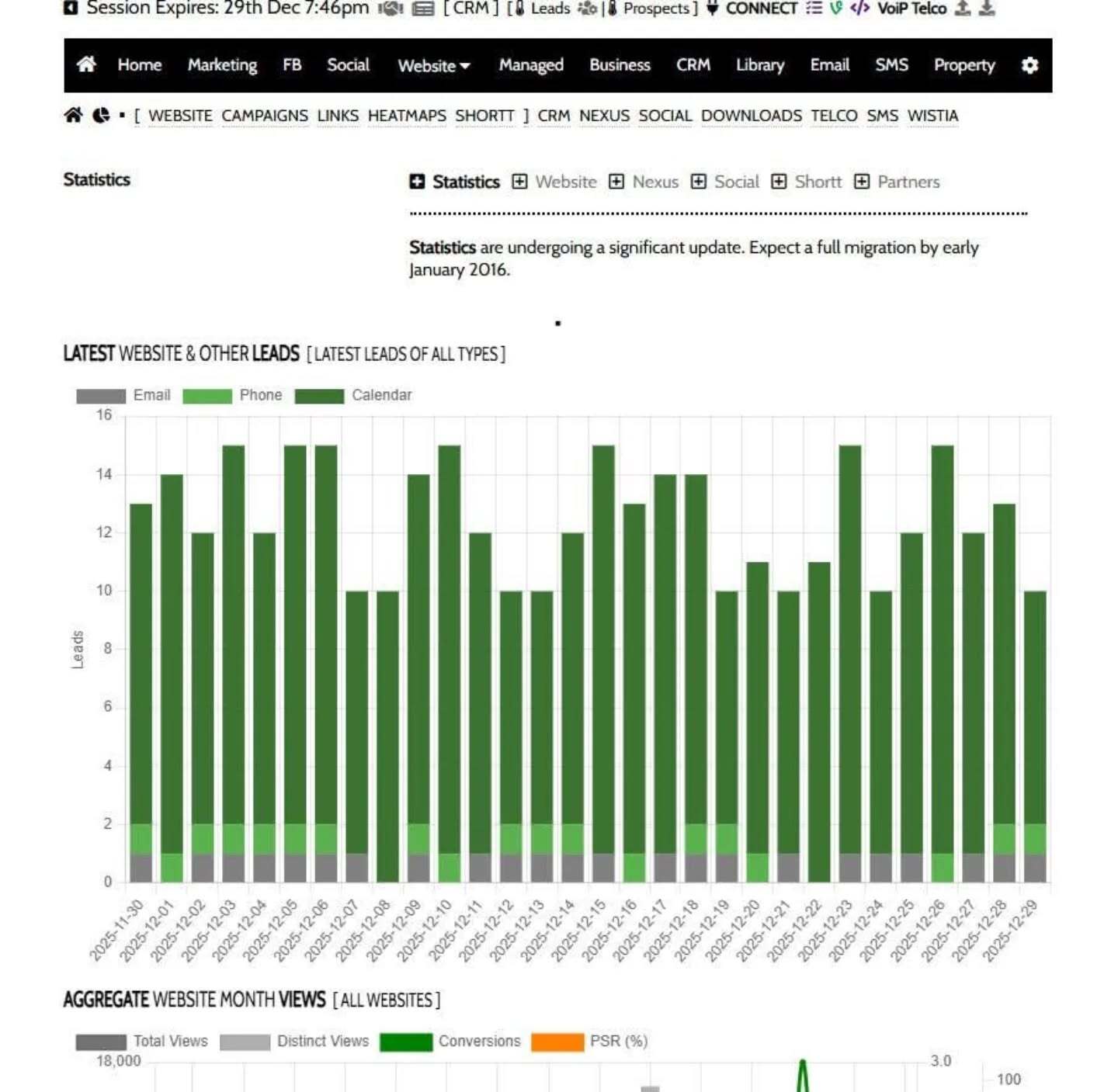
This is how a group returned 200m in monthly volume for less than 7k. 364 paid leads. Around 35% of their monthly lead expectation. Around $17 per SMS-verified lead. A little high, but verification will do that (it also reduces lead quality by about 20%). Leads typically cost less than $7, so this was an expensive gig. Around 243 converted clients based on results measured to the 14th December. Expected monthly return is over $200m. About 77% of leads visited the group website, and about the same number visited more than 5 pages. Half of that group visited the site again to review bookmarked or other pages. Digital done right gets results. You shouldn't expect to break a speed record in your Corolla, and you shouldn't expect good online results with a poor customer journey. We've still got website spots left for 80% off. Call me. 0400 777 300. View on Instagram
Social Archive
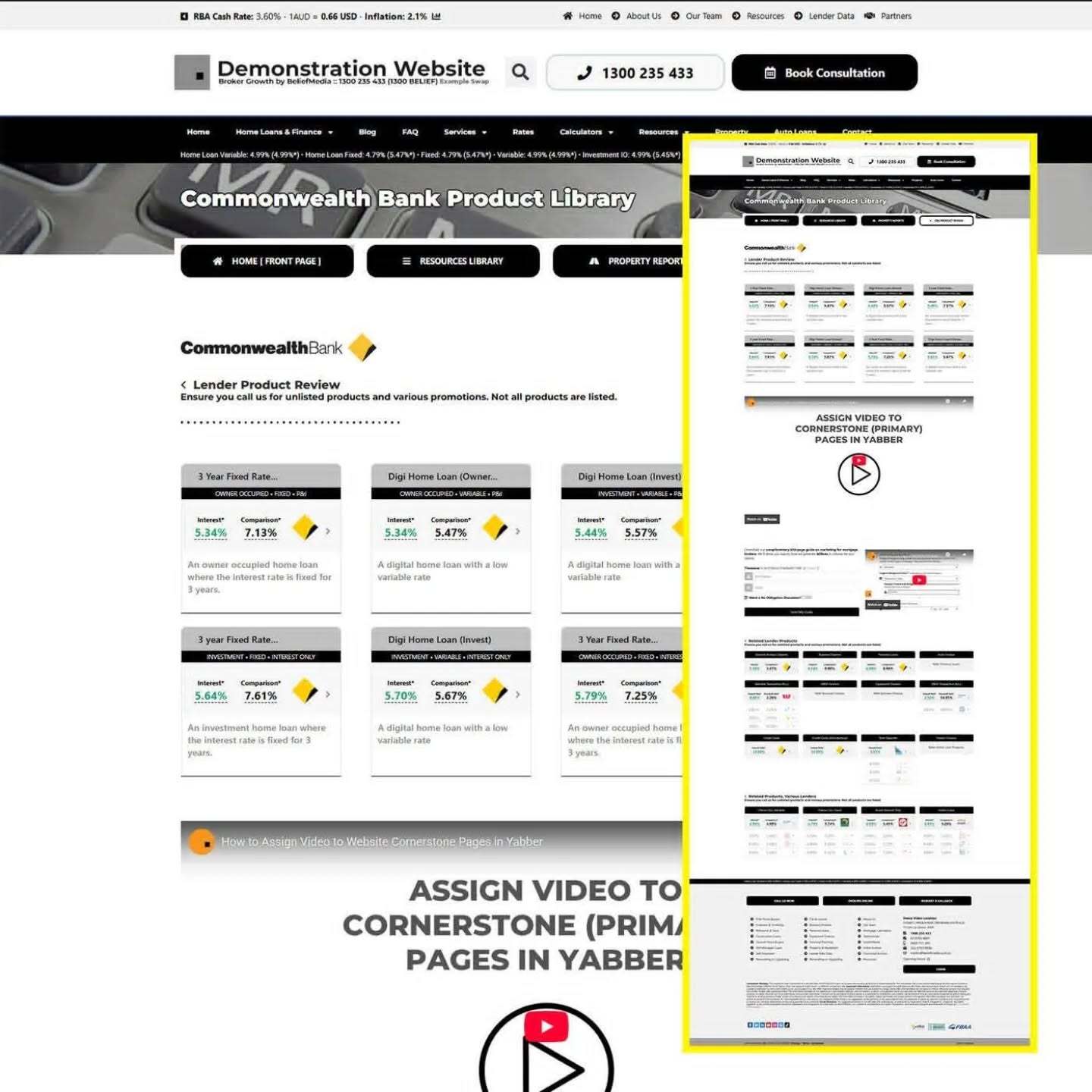
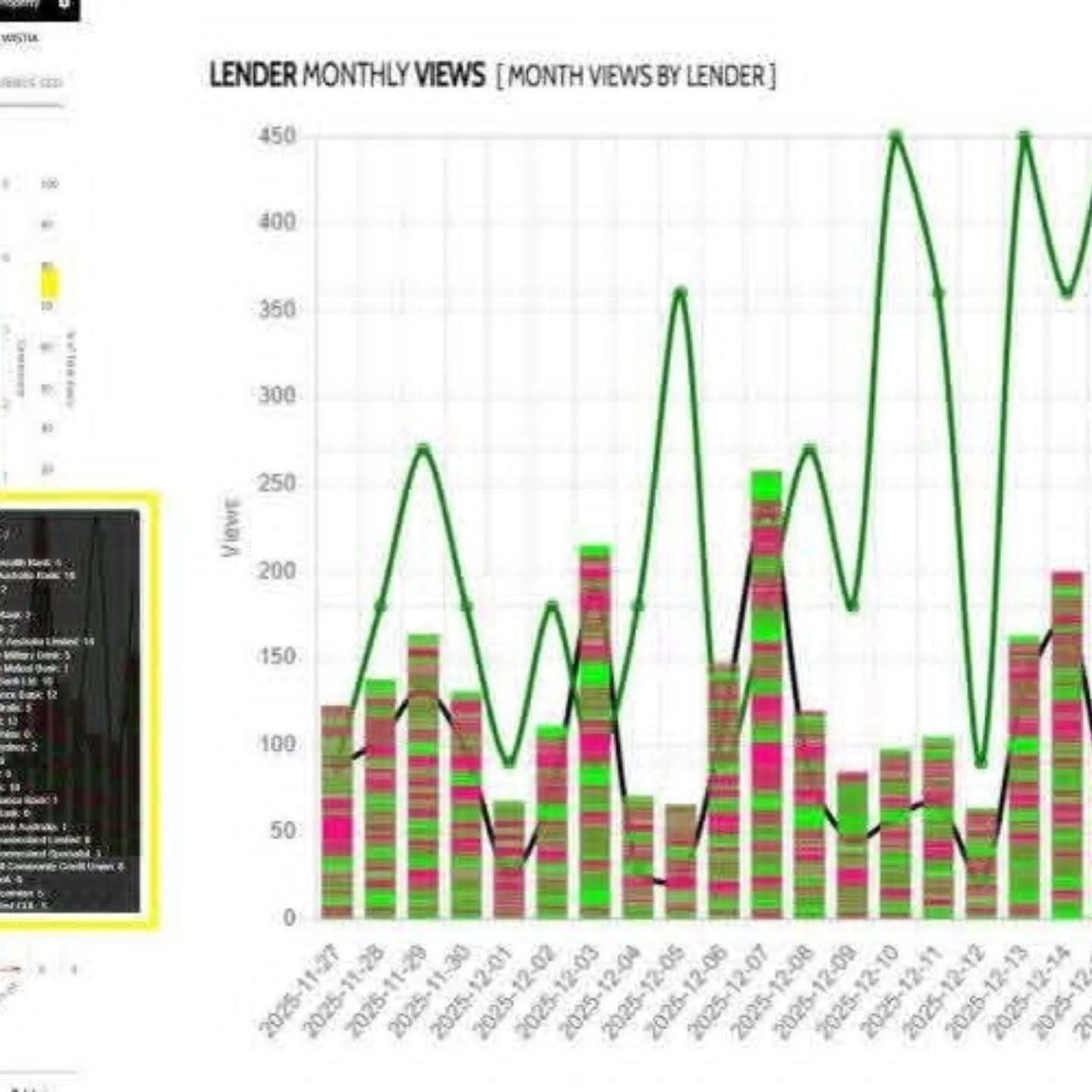
Rate data on your website is important. I've discussed it over and over, and I've talked about how those that are misinformed will erroneously associate information and education as a rate-driven broker culture. It's BS. From a performance point of view, I've attached some stats from a broker getting good results. The graph shows only lender product pages (stacked by lender). It also shows the lever views measured against all pages views, and conversion numbers (as line graphs). In this case, Mick's getting at least 200 views a day to lender product pages - and on some days over 400 - but the important part is that he's attracted at least a single calendar lead every day... and in this case he's attracted around 100 *quality* leads over the month. If you don't provide the information that is important to borrowers, others will. Not all our guys convert off these pages, and there's clear reasons for this. First, you need the right promotion on social, paid ads, promotion etc., and video (assigned in Yabber) explodes conversions. I see some with more page views and less conversions, and that's because the video or conversion facility isn't relevant. The gamified lender data…
Social Archive
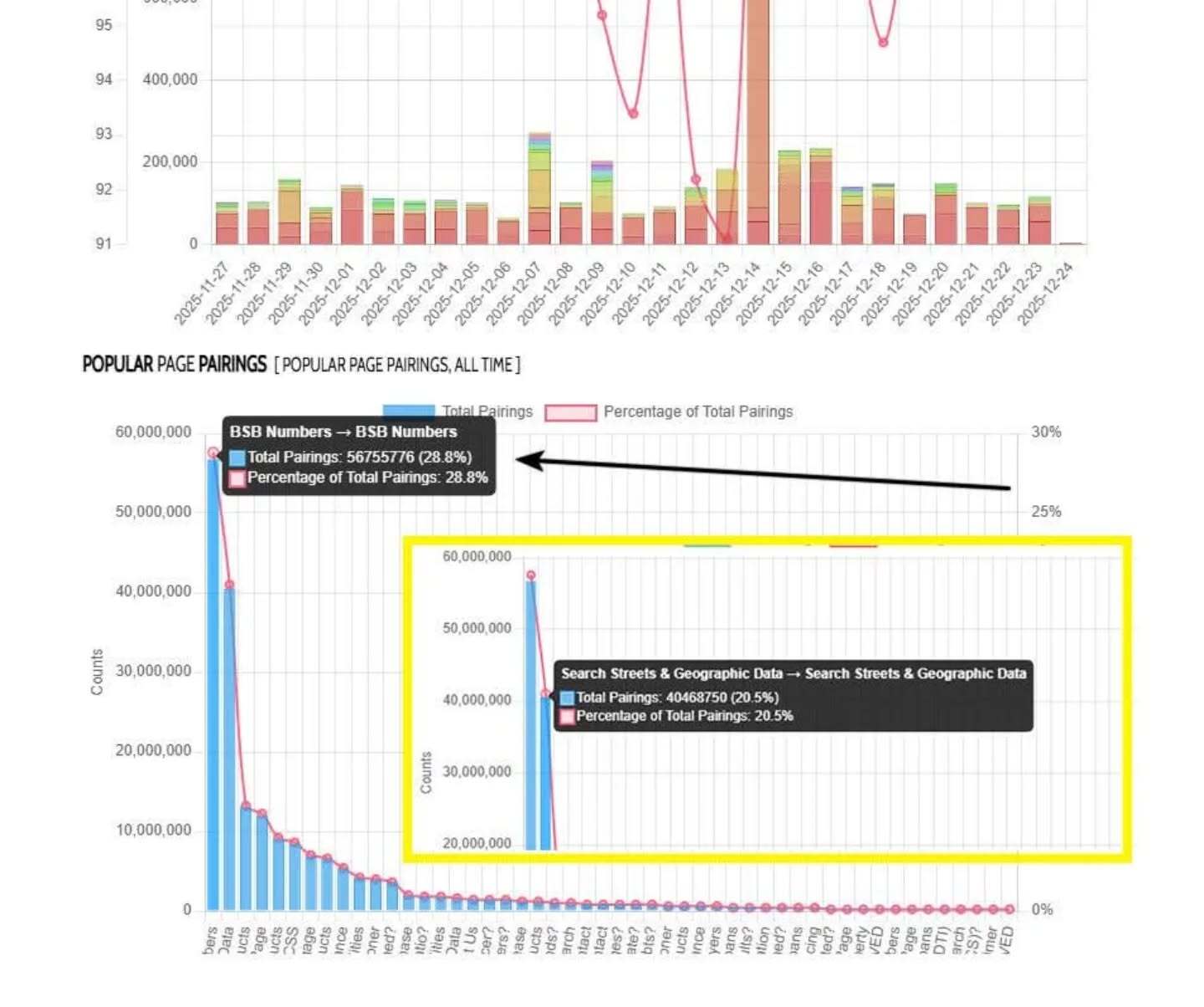
This statistic is very revealing. 100 million page pairings over a single year (from one of our own sites). It's why we built the same features into your website. Think of the conversion possibilities hiding in those numbers. Every page on your website is a type of landing page. Treat it as such and your life will change. View on Instagram
Social Archive
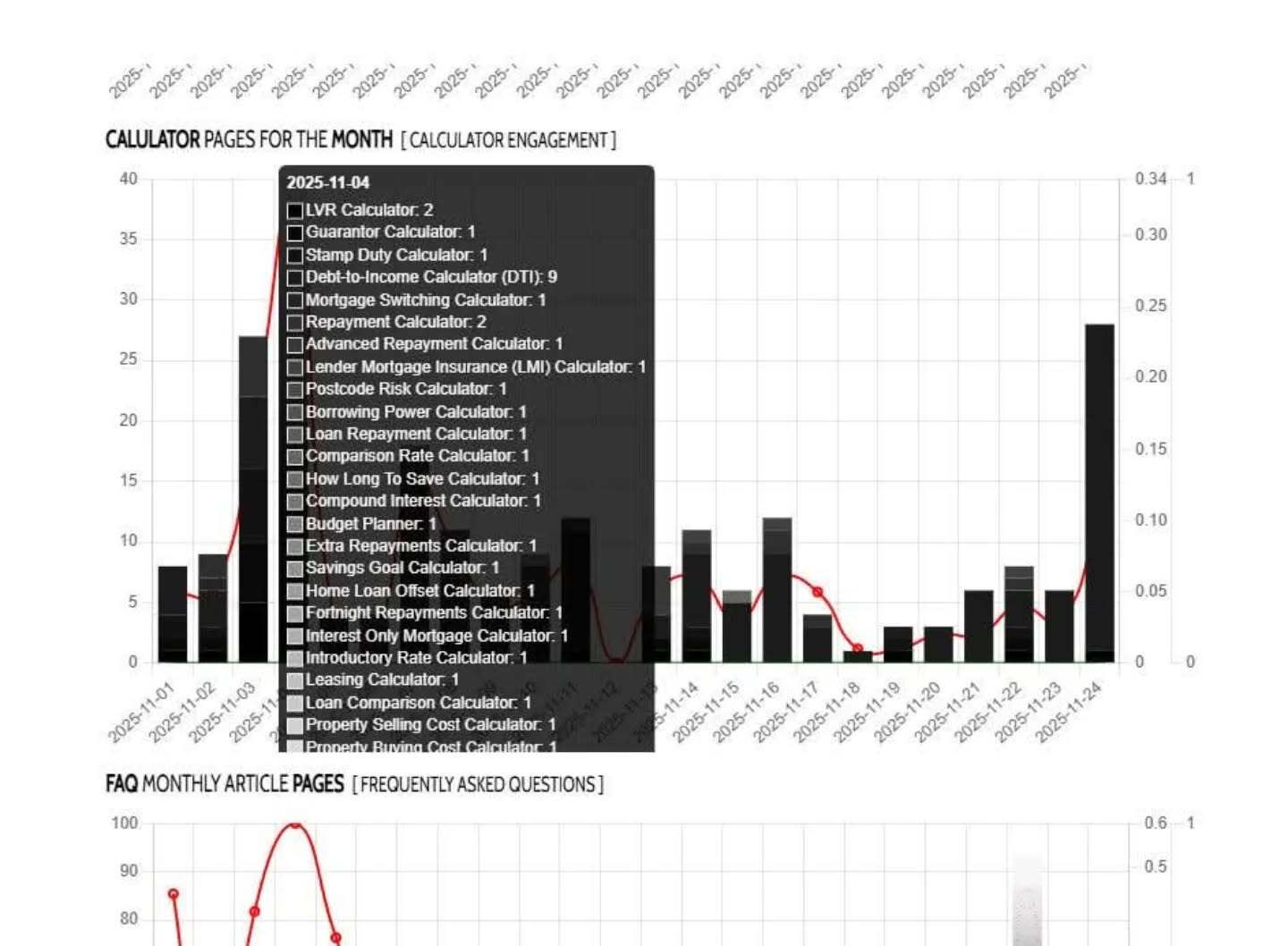
Stats from typical calculator views on a 'typical' site. You need to have calculators on your site to satisfy broad E+AT expectations, but they're only something you need to have, not something that'll actually be used. For a lot of brokers, 10-20 page views a day on just calculator pages might be a lot, but for our guys - while the pages should be design to convert (a whole other discussion), and should have purpose - they represent around 0.05% of all daily visits. It's staggering how much of an improvement can be introduced to your operation by way of out website for such a ridiculously small outlay. Call me. 0400 777 300. View on Instagram
Social Archive
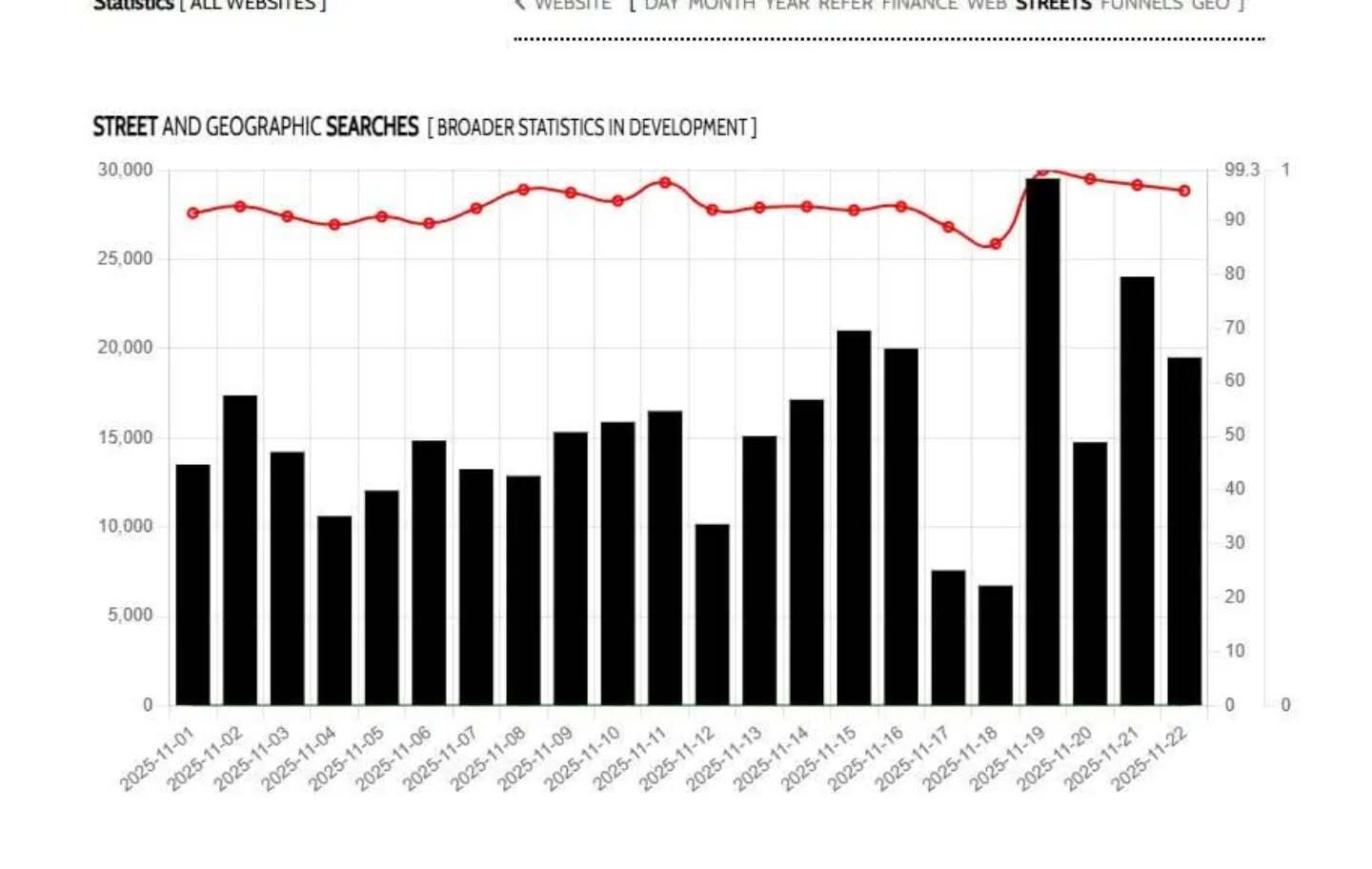
What would you pay to have an extra 25'000 visitors to your website every day? Is you were throwing money at Facebook, you would expect to pay around 300k. The broker associated with the pictured graph is attracting an average of 15k child visits to his website *every day* on the back of *just* the Geographic and Streets module. He plays this traffic well with high-intent offers via targeted forms and videos, and he attracts triple-digit leads every month. It's made him one of the highest-volume brokers in the country. SEO is made up of a number of parts. The first is the Object Graph and Markup (how your page is presented to Search/Crawlers), and the second is User Engagement Optimisation. It's the latter that is supported by this feature. It doesn't matter how you start a conversation... but it does matter how it ends. Before I continue, I should remind you that every page on your website is a type of landing page. Traffic comes from anywhere for any reason (in this case, your Geo modules), so we're compelled to provide appropriate conversion facilities on every page. If you're conversion doorway fails, you won't see any conversions... and I…
Social Archive
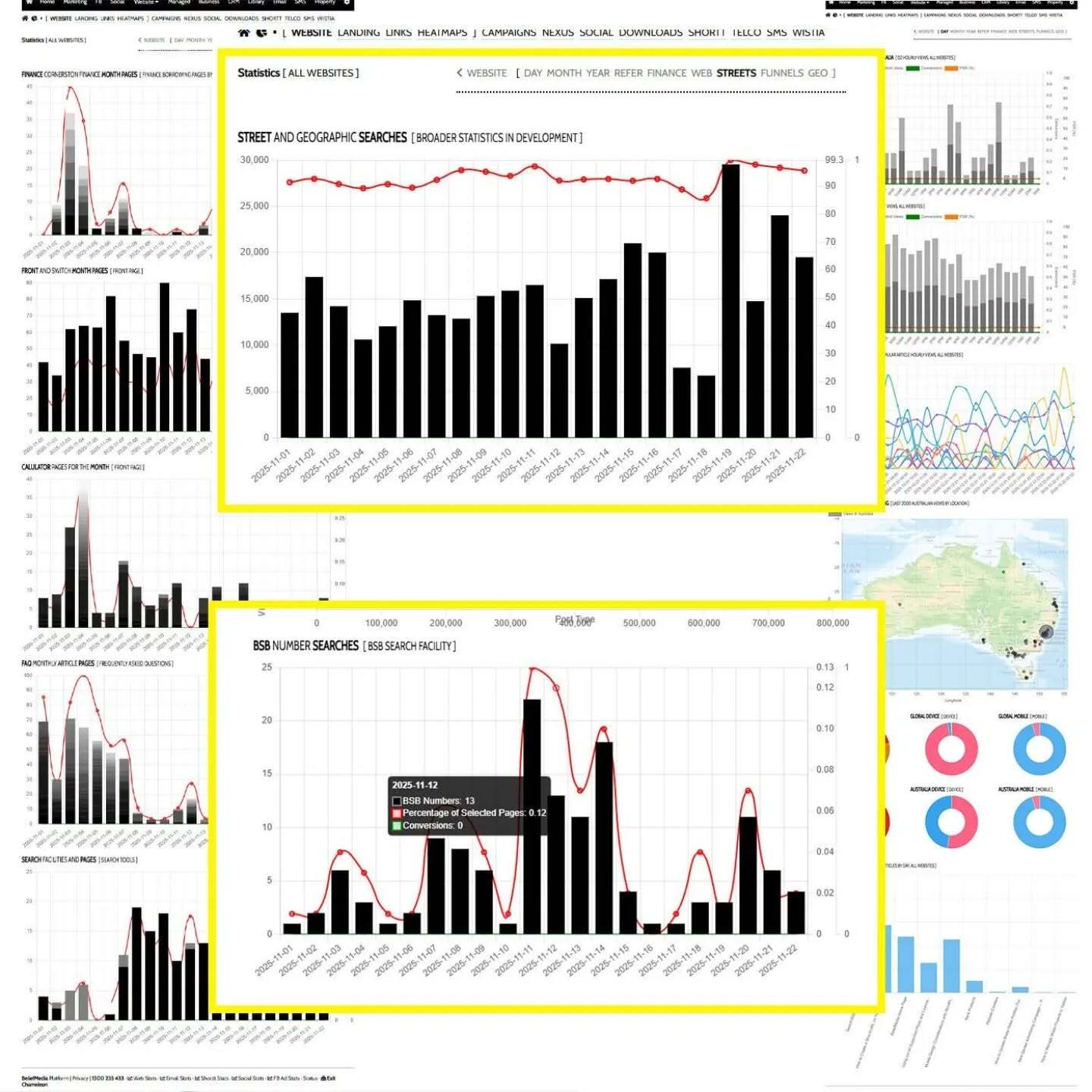
As I work through and update the vast array of advanced statistics in Yabber, I'm coming across some images I think are worth sharing. Pictured center are stats for a Sydney broker. He's averaging just 10 page views a day on his 'cornerstone' finance pages which isn't too bad given he's had his site for about a month (he previously averaged close to zero). However, he's averaging 17k views a day to his Streets module. 17k views a day! In fairness, the results aren't typical because he's promoted heavily through email campaigns and organic social, but the moderate effort has returned more leads in a month than he's seen in 3 years. You don't make friends with salad. Call me. 0400 777 300. View on Instagram
Social Archive
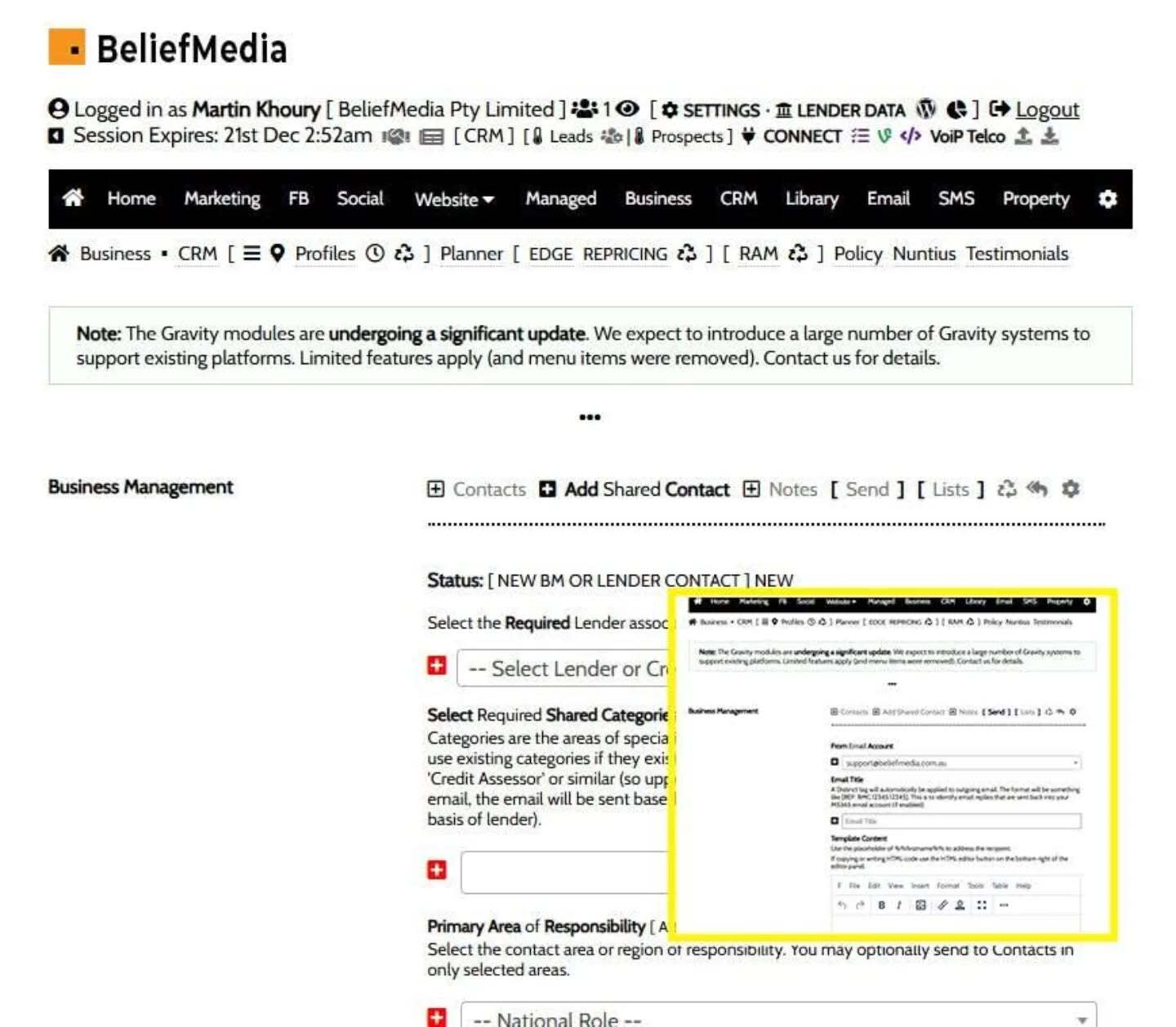
Our RAM module is worth taking about. Via `Shared Contacts' of lender BDMs, RMs, and others (that may optionally be synced to Outlook), you may send a single email to groups of support people that might be able to assist with a scenario or question. With the introduction of Nexus (email), all emails will now carry a reference ID in the title, and they'll be sent as an email campaign. This means that replies can be sent to your CRM, archived and aggregated, or used for other purposes. This module will be made available to (mostly) all in January. It is currently used by our managed groups to send several thousand emails a month. It's worth mentioning that emails are sent through your MS365 email account, optionally included in 'Sent Items', fully tracked, and completely compliant. Once you use it once you'll use it every day. It's no wonder our guys simply get better results. (Pictured image is before the update). View on Instagram
Social Archive
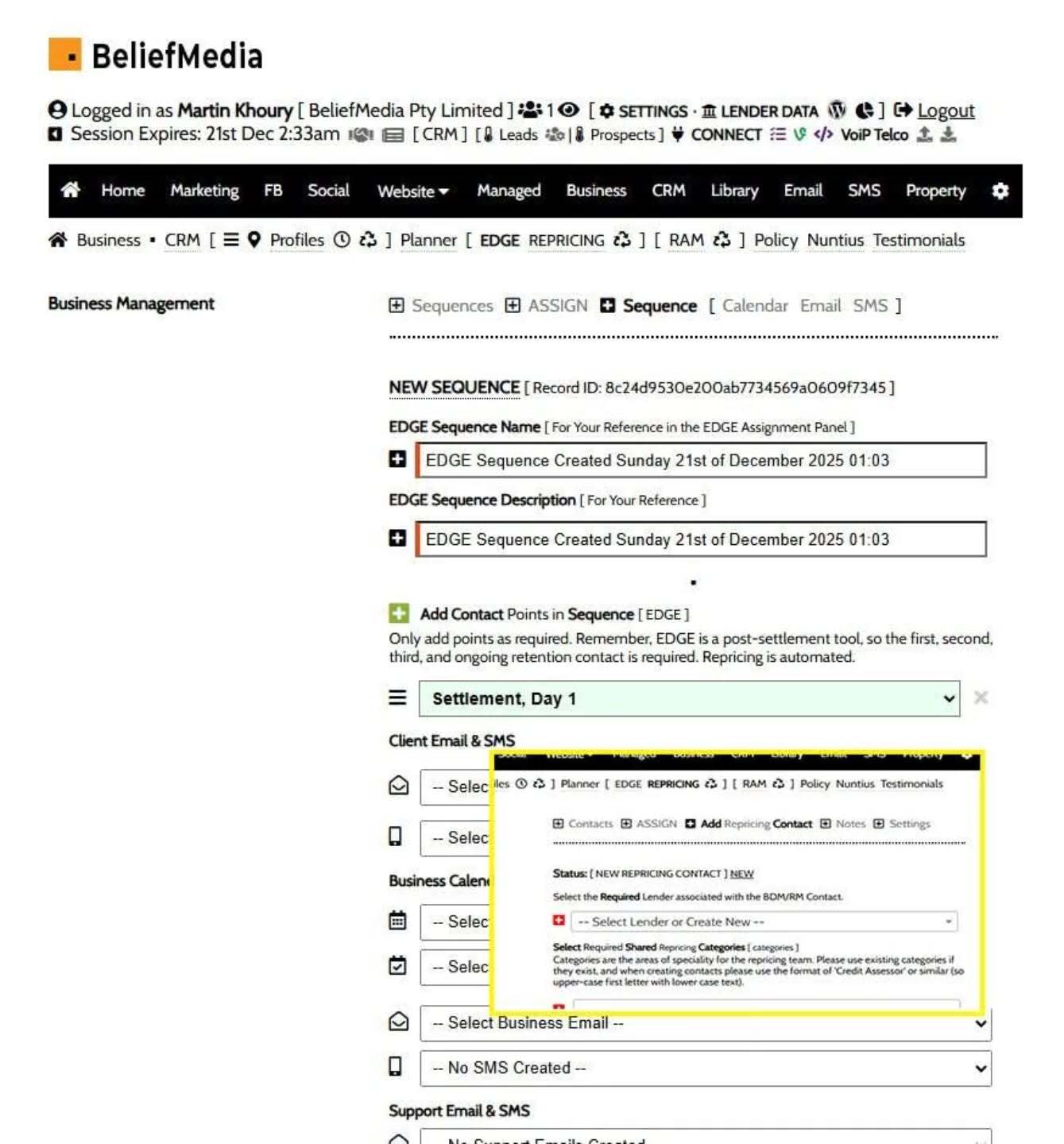
Our first version of Edge, a post-settlement and repricing system, was created around 2010. It has seen a number of changes over the years, and with the introduction of the new Nexus mail system, it'll be updated again. There's dozens of copycats now, and the industry finally caught up with the concepts, ideas, and methods that were the backbone of my own brokerage, and part of my course messaging when I was coaching. Our Edge system isn't currently available to all brokers, but it will be released to (mostly) everybody in early January after we've applied the email updates. I did a 2am Web demo this morning with a broker that was using High Level for this task. As an auditor, this terrifies me, and as a marketer, it makes me laugh. If High Level is part of your business stack, it's time to re-think you're life choices! From a functional perspective, It doesn't even create CRM notes. Just crazy. Don't use High Level for anything! By the way, I've even heard of a coach (that should know better) introducing High Level for this post settlement purpose. Apart from *massive* compliance issues, it doesn't and can't perform 10% of the…
Social Archive

I shared a BSB website example the other day and talked briefly about why it existed, and how a conversion facility was necessary. The broker in question didn't have a sound conversion funnel in place, so I built one with her. The net result of up to 280 cold views each hour? Four new bookings in a single day, which is more than acceptable for completely cold traffic. Again, the traffic was completely cold, so they were directed to her site for reasons other than home loans. I genuinely hate seeing brokers throw a budget into bad leads before they've optimised their website. Most business owners have no idea of the traffic that bounces elsewhere because their experience was underwhelming. View on Instagram
Social Archive

Salestrekker is a better CRM, but Mercury comes in at a close second. Certainly, if you're looking for API integration in order to automated your operation, Mercury is more reliable. Everything else comes in various shades of 'not as good'. I'd love to know how we could convert ST guys into (our) Nexus?!? The cost, perhaps? View on Instagram
Social Archive
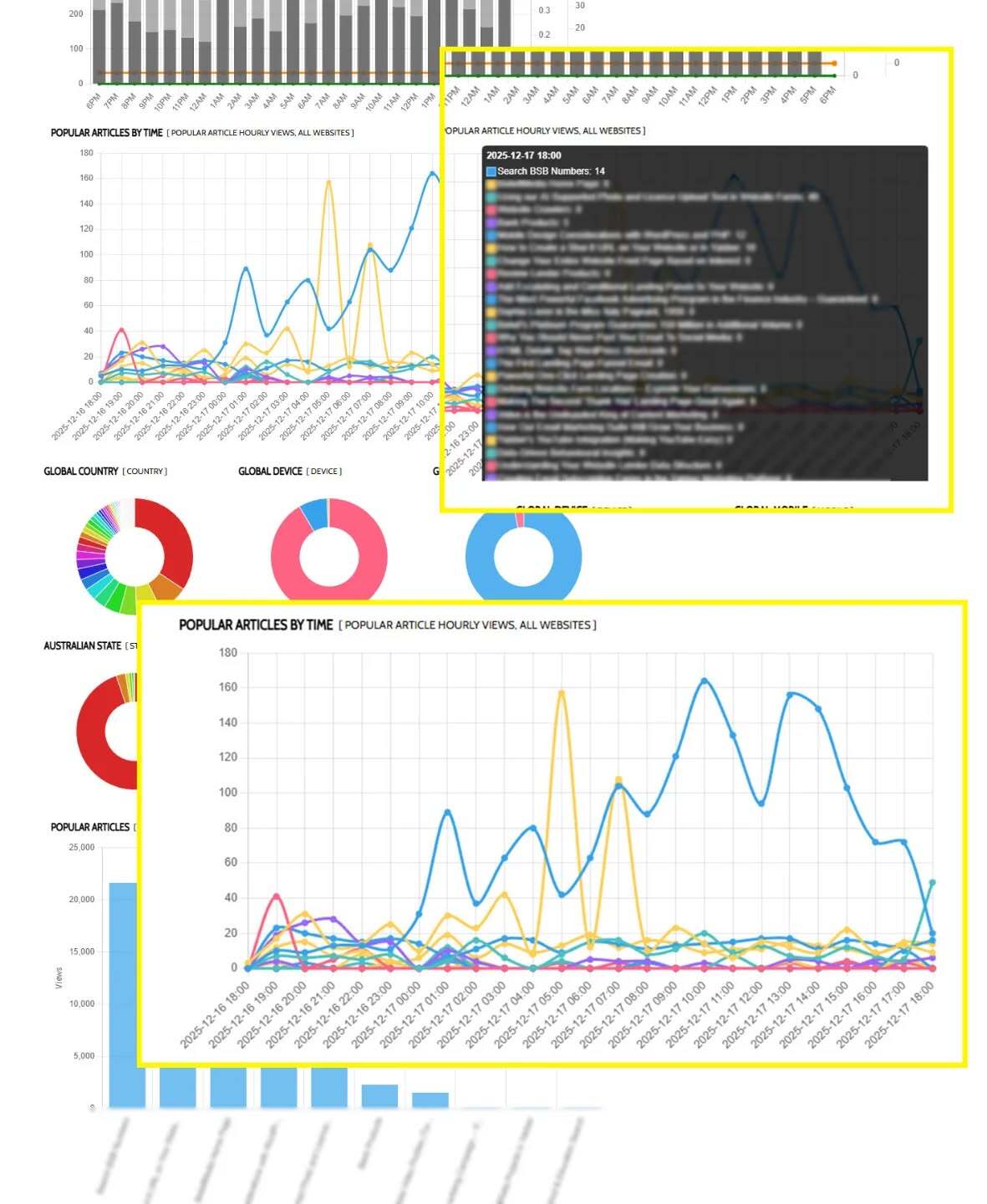
I took this screenshot a few hours ago while I was reviewing and updating various stats modules. It reinforces a point I've made 100 times... yet I'm constantly challenged. First, the screenshot comes from a broker that attracts thousands of views a day and over 100 organic leads a month. He'd be a top-10 broker if he chose to nominate himself for the recognition. The screenshot shows popularity of top posts through the day, and it's the blue line that dominates. What page is it? It's the BSB search page, with up to 190 visits an hour. (Note: Streets are excluded from most results because the page count is far higher than any other - their inclusion messes up the stats). I'm asked all the time why we have a BSB Search Engine on a broker website... and the same question is asked of a dozen modules that perform similar searches. The answer is simple: it converts. The reason most websites don't convert is because they're not any good. If you want to grow your business, get in quick and call me on 0400 777 300. View on Instagram
Social Archive
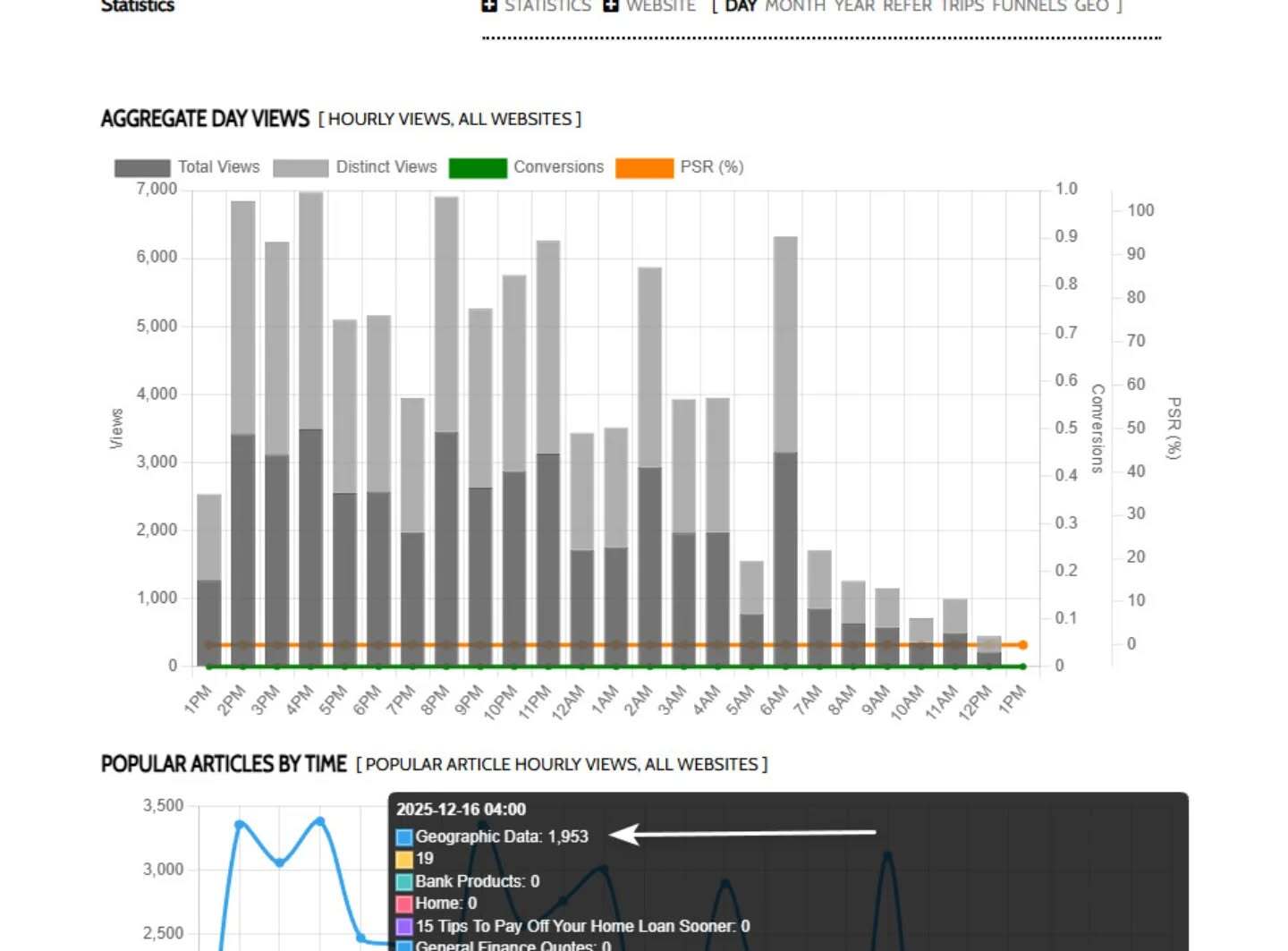
I had reason to update some statistics for a client today, which included migration into Xena (I think they're the only group that was on old stats). I bounced around certain users for a cursory look and noticed what we've always known - some modules attract a ton of traffic. The Streets module in this case attracted nearly 2k views in an hour (probably 20% of which was motivated traffic), and then I looked at their site to see what they'd activated to convert traffic. I was expecting a form, property report form, or similar, but there was nothing there. A reminder: ensure you have a form assigned to high-trafficked modules on your website, regardless of what they are. I can't wrap my head around why some brokers don't invest into the one single resource that'll organically convert more than any other. Having a website that doesn't perform core functions, or doesn't support your landing pages, is a clear act of self-sabotage. If you're not doing double-digit leads off your website every month, then we need to talk. We now have have a large number doing over 100 free organic leads every month... and this is the quality traffic that…
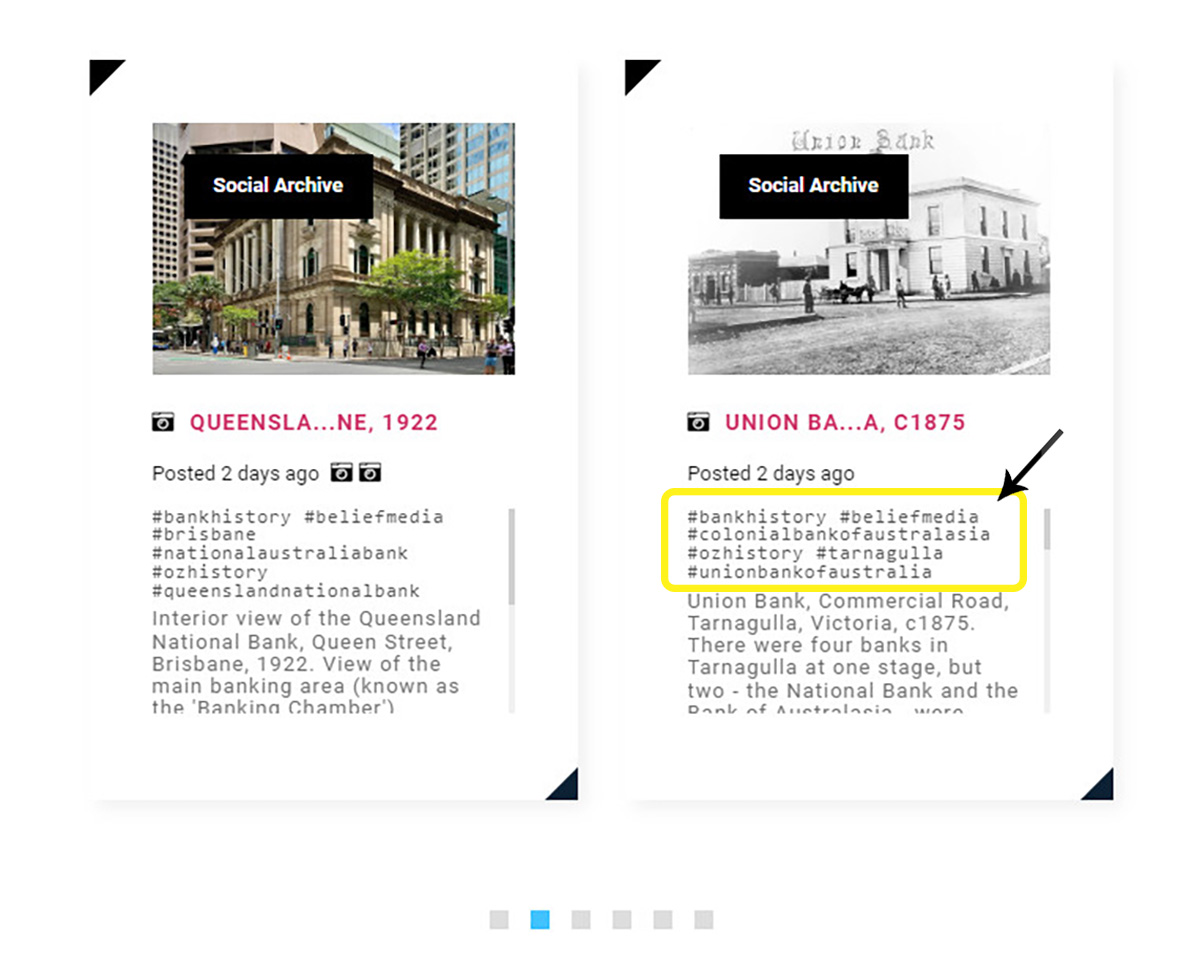
Slider Details: Showing a slider in this narrow post isn't ideal because much of the formatting is lost, and various spacing isn't preserved. It's likely we'll have an example on the front page of this website. As we'll introduce shortly, virtually every option in the slider may be customised (including the image shown as the 'featured' image). We looked at including the hashtags in various locations but ended up simply adding them to the end of the description. Note that only the most recent results will show the correct featured image and image icons until a Yabber database update is performed.
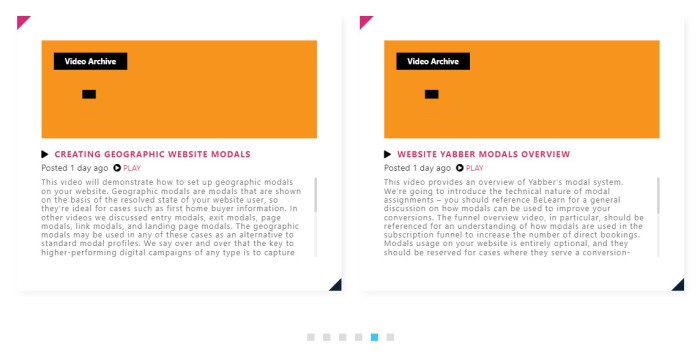
Pictured: Two slides showing post from the video archive. Note that we have 'play' icons that launch video modals. The featured image is inherited from the featured image defined as the video category in Yabber.
An option is made available in Elementor (and shortcode) that renders all post images as icons which will launch an image modal. This feature is enabled by default, and it is available for content other than the posts in the social archive.
Before we introduce the simplicity of Elementor, consider the shortcode necessary to render the next slider. Shortcode of [bm_posts_slider post_type="post" meta_margin_top="-12" include_first_image_as_featured="1" slide_speed="6" number="14" items="1" truncate="50" apply_shadow="0"] returns the following:
Blog & News

We've had a large number of people ask us about the AI-driven Licence (and general document) upload form tool lately, so this article serves as a basic introduction. The method of integrating the functionality into general forms, and the client-side upload tools in your client dashboard, will be detailed in our FAQ module, so this article serves as a brief overview. In short, the function of the primary tool is simple: upload a photograph taken from your smartphone camera, return the extracted textual results, and populate form data. We first wrote about our AI-supported API in an article titled "" in early 2023, and while we've had an OCR API since 2015, the AI integration was only introduced in 2022. It has since been used to support the equipment application forms used by about 1000 auto companies, and generally used by a smaller number of mortgage clients. It's nothing new. It should be noted that while a large number of businesses have talked to me about this feature, it's an entirely pedestrian bread-and-butter tool that is no way difficult to create, and I've long questioned why more CRM systems don't include this basic feature. The API itself is used in…
Blog & News

The Athena and associated RSS module dates back to 2007. Previously a Platinum module, we've recently migrated most of the functionality into Yabber for use by clients, and a single page on your website now supports a basic news service. Athena is a news aggregation platform that indexes news via RSS feeds, sitemaps, and general crawling, with the sourced news articles evaluated in various ways to support your marketing, social, and engagement efforts. Athena also provides RSS aggregation for the distribution of feeds for client and personal use, but as supported by Matrix, the service provides a comprehensive RESTful API that provides large custom data sets. Athena is massive, and the range of actions that may be applied to archived data is significant. In this article we'll look at the basics of displaying a news feed on your website, and how to use the most basic API endpoints for the most common data types. We'll create the full documentation with write information and the complete endpoint options when time permits. Yabber provides a facility to have RSS and other feeds indexed, and these feeds may be grouped together to return custom 'aggregate' RSS feeds - one of which may be…
Blog & News

I had a conversation recently with a gentleman from a company called LenderOptions (not their real name) where I disclosed sensitive details only because I believed the no other party would listen to the call record. I later learned that the company CTO - a chap with a less-than-stellar industry reputation - listened to the call made to me from one of their virtual mobile numbers - an act that relegates a simple personal recording into the category of illegal wiretapping - a criminal offence that carries significant penalties. It was a few days later that one of our own clients questioned the legality of the recordings I make of every call, regardless of whether the call is made or received via company VOIP or my own mobile handset. This article seeks to address the legalities of recorded calls - something that is commonplace in the financial industry for reasons of note-taking, compliance, and accountability. In short, the Telecommunications (Interception and Access) Act 1979 (Cth) at the federal level, makes it generally illegal to intercept a live telephone call without the knowledge of all parties. However, once the call is received and you’re a party to it, the interception law…
Blog & News

Last week we introduced the call. We didn't expect the overwhelming response for more information, so in the absence of finalised documentation we'll publish a few articles detailing the most common requests. The request is made when a page is required to be indexed for the first time (or subsequently with the appropriate index or crawl instruction), and this functionality wasn't previously described in the required manner because of the low public utilisation of the service. It's important to note that subsequent API requests used to retrieve crawled pages are made to the endpoint, and this article details the (truncated) response. We've redacted certain fields we're not ready to be made public, and we've removed certain data that identifies the overall rank of websites. The purpose of the API is introduced in an article titled ", but in short, the API graphs what we call The Financial Web - a full and complete index of all broker websites and advertising. Armed with definitive and virtually complete understanding of the broker website landscape, we're better positioned to support our SEO clients, and we're more informed with everyday decision-making. In terms of our own broker website framework, it arms us with the…
Blog & News

Google describes Duplicate Content as "... substantive blocks of content within or across domains that either completely match other content or are appreciably similar". They go on to detail that while the replication is not necessarily malicious in origin, some content is manufactured in blogs across various domains in an attempt to manipulate search engine rankings or garner more traffic via popular or long-tail queries. In an article we published titled "", we 'exposed' a massive problem within the business community relating to duplicate blog content and the ubiquitous failure to abide by best canonical practice. The net results of this is that multiple businesses invest in a service that they think will have a positive impact on their digital success, yet the real-world reality is that it works contrary to expected outcomes. In many cases, and when your entire blog is filled with nothing but duplicate article content, you run the risk of having your website identified as spam which may result in having your site removed from primary query searches. Google generally does a good job of filtering out duplicate article content, and it often bundles duplicates into an alternate panel with compliant copies. It's important to note…
Blog & News

The fuel that feeds Search Engines is content that fulfils Google's expectation of Expertise, Experience, Authoritativeness, and Trust (abbreviated by Google as EEAT), and this can only only be achieved by producing original and relevant material that keeps users engaged. It's not rocket science. We've borrowed Google's EEAT attributes as part of our own Magic Lantern model and expanded it to include Expertise, Experience, Education, Entertainment, and Authoritativeness (EEEEAT, or E+AT), and these are the broad components that underpin our funnel-based 'escalation of commitment' that delivers consumer 'Trust'. Failing to deliver on any Lantern attribute, or compromising any attribute, works in the same way with Google as it does your users... and duplicate blog content is near the top of the list. This article looks briefly at duplicate content, and how to search for duplicates or similar content when measured again the broader 'Financial Web' (via our Matrix API). The Matrix API is essentially a search engine for just mortgage broker websites. We also index real-estate, buyers agents, and financial planner websites, but the service was created for brokers, and its the financial sector where the data is most complete. The service indexes every bit of available page information, measures…
Blog & News

It was back in 2018 that we made the nature of our Matrix API known to the industry, although we'd used it internally for a number of years prior. With a pending SSL requirement imposed by Google back in 2018, we ran various assessments that assigned with an SEO score, and more importantly, assessed how many of these brokers had a installed on their website. A staggering 77% of brokers lacked the certificate, so we contacted industry and supported hundreds of brokers at no cost with the process. What was previously known as the 'Industry API' has evolved into the Matrix API, and the service is heavily integrated into a number of our standard marketing modules, such as News (Athena), Xena, RSS, and SEO. This article introduces the simplest and most basic feature of the Matrix API - . The purpose of the Matrix API was initially designed to crawl client (and other industry) websites in order to evaluate SEO effectiveness. It collects a large amount of page data, and follows links in a manner not unlike Google in order to establish a 'weighted' linking structure. From a broader industry perspective, we would (and still) crawl every known industry website…
Blog & News
One of the more underexplored and deeply consequential aspects of financial digital mortgage marketing is the representation of credit product pricing, specifically interest rates, within organic search snippets. This area warrants close scrutiny not only because our own broker infrastructure explicitly supports the — including embedding legally compliant rates in titles and metadata, which I’ll address in depth separately via an FAQ — but also because the deliberate or careless omission of required information in search results amounts to what we have long described and coined internally as "rate-bait". This is, in essence, a variant of click-bait aimed squarely at borrowers: a practice where an attractively low headline rate is positioned to lure borrowers’ attention, without the legally mandated accompanying disclosures. The legal position under the National Consumer Credit Protection Act 2009 (Cth) (NCCP Act) is unequivocal. Section 160 imposes a positive obligation: if a quoted interest rate appears in an advertisement in any medium it must be accompanied, with equal prominence, by a valid comparison rate. There is no exemption for metadata, no safe harbour for organic SEO content, and certainly no tolerance for disclaimers buried behind the click-through. The obligation applies to the representation as received by the…
Blog & News

Our first comparison engine dates back to around 2006 when the feature effectively occupied the front page of my iChoice website. It later become a backend feature, and since I left the business it's a tool that we've only made available to our former Platinum clients. An article titled "" details how the feature integrates with Yabber and how it functions on our mortgage broker website. Future articles will discuss our industry-leading and industry-first equipment and auto products/widgets (now used by over 1000 businesses), and another article details how our and associated integrate with the Comparison API we're about to discuss. This article details the actively supported Version 2 of the API, while our most recent release is Version 4. The latter two integrate AI Policy resolution in seriously significant ways, and the responses to Version 4 are generated entirely with AI. While many claim to have AI-powered widgets and tools, we'd argue that their use of the term is insulting to those that actually know how to use it. Version 2 of the Comparison API (so, this version) was released to the industry as an open sourced tool around 5-years ago, and the product was given away freely with…
Blog & News

As we discussed in an article titled "", aggregation and franchise groups are in a metamorphic state where they're forced to rethink their business model in order to remain relevant in a competitive and technology-driven environment. As far back as our Magnet Guide from 2010, we wrote that "... aggregation needs to broaden their technology offerings and reposition themselves as technology starts to erode the traditional aggregation model and compromise the value of existing core services". The statement is more valid now than it ever was in the past. This article seeks to present a broad overview of a product that provides a suite of digital products that exceeds the capabilities of any competing website-based aggregator product on the market. Brokers will gain access to the industry's most powerful website, social media tools, email and SMS marketing facilities, managed social and articles, and a suite of supporting marketing tools. The offer immediately positions your product ahead of those options provided by your competitors. As resolved via our , those brokers that leave one aggregator for another are doing so primarily for one reason: technology. At least that's the antidotal reasoning given the migration of brokers into SalesTrekker-based organisations. There are…
Blog & News

BeLearn was and remains a series of lessons designed to introduce clients to technology we make available on our website framework, instructions on how to create compelling campaigns, how to use various modules in Yabber, and how to implement various programs, such as our Partner, Referrer, Facebook, and other campaigns. The BeLearn resource was , but early last year we made the decision to migrate the pages onto our own website via the FAQ Module, This article will introduce the new BeLearn FAQ module. At the time of writing we've only (with about 500 in draft), but we expect around 1200 FAQs in total before we've covered the necessary core features and program details. For that reason, the Yabber-based BeLearn remains - albeit out-of-date - until the migration is complete. Making the majority of information public will also give interested parties access to the resources that will help them make better-informed decisions when implementing their marketing, or before investing in our services. A large number of privileged pages will be using the same authentication methods that clients will use to manage their own or , so a login prompt will occasionally be shown before protected information is returned. Generally speaking,…
Blog & News

In May of 2024 we introduced our , and we briefly introduced how we'd use the facility to mitigate the onslaught of illicit web traffic looking for server and plugin vulnerabilities that might potentially be exploited. While the service has made a significant impact on blocking malicious traffic, it was far from perfect, and an incident last year resulting from an out-of-date (third-party) website plugin caused problems that once again forced us to rethink our approach. While the Malware API is excellent, it lacked the scalability to detect traffic in real-time and catch intrusions made with clear malicious intent, and - while it isn't perfect - the Abuse API rectifies this with a scalable and unforgiving system. First, it needs to be stated that no server is entirely secure, and there's thousands of requests made to your website every day from malicious actors looking to exploit any possible vulnerabilities. Regular are essential to ensure you can restore your website after it becomes compromised... and your website will require restoration at some point. The rise of AI has seen a ridiculously large number of crawlers are presumably used to train various AI models. We first noticed the problem a few years…
Blog & News

We've had an increasing number of businesses come to us that require a word-for-word privacy, terms, complaints (dispute resolution), and General Disclaimer on their website, and ACL holders are sensibly requiring the sea of websites managed by their credit representatives to be kept up-to-date. Once printed, these disclaimers are usually managed via a non-controlled email that might introduce changes, but very few changes are actually actioned by downline businesses. The net result is a very mild compliance infraction. What I'll do in this article is introduce a very simple method of creating a distribution channel that ensures broker statements (and the credit guide link) are always up-to-date. We have our own module that'll enable brokers to and credit guide reference in Yabber. However, the feature is one that manages individual policies, so the requirement to update the policy - regardless of how easy it might be - is still an action that needs to be performed. If you're a larger group using our systems, Yabber does provide for an update of all websites under your 'control', so this article is entirely irrelevant. First, sharing always up-to-date compliance statements is just the start. Another article introduces how you might , such…
Blog & News

The single most significant change we've introduced to our website framework in the last few years is the inclusion of full-featured . The module will make its way out of a lengthy Beta sometime soon and find its way into our standard website and Elementor plugins. The Property module is significant and unique in that the effectiveness of rendered widgets are supported by around 30 APIs retuning data of various types. As part of this API architecture, we required the inclusion of an address form field that would automatically populate based on keystrokes. Common with forms that require address validation, the form comes in two varieties: the form that is used within a , and a single form that will redirect the user to a when a property is selected. It's the latter feature that we'll discuss (in brief) in this article. At the time of writing, the functionality we'll describe on this page is available to all clients although we're yet to actively promote the features to those that use our products. The entire module when reviewed out of context, or when evaluated without an understanding of its future purpose, can be a little confusing, but it makes far…
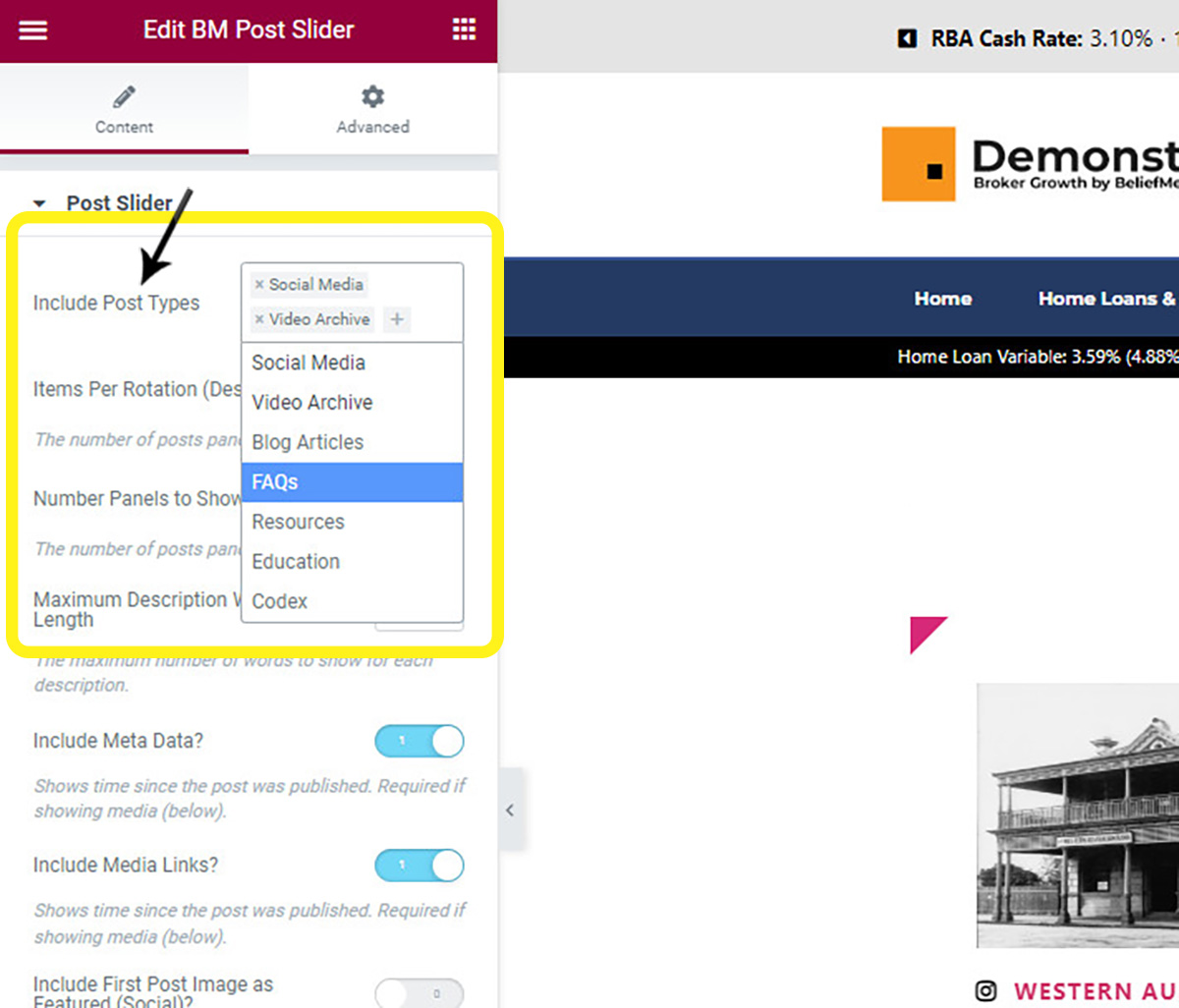
The example does illustrate how the slider may be used for alternate post types, and at the moment it supports posts from the following post types: instagram and video posts (intended usage), posts, pages, FAQs, resources, and education. Standalone sliders exist for post types such as testimonials. In the above example, we've applied the 'meta' data which shows icons for images associated with each post, but this is an option we've enabled.
Our shortcode editor will make light work of applying this style of 'complex' markup, but until then, Elementor is far easier to use.
Elementor Widget
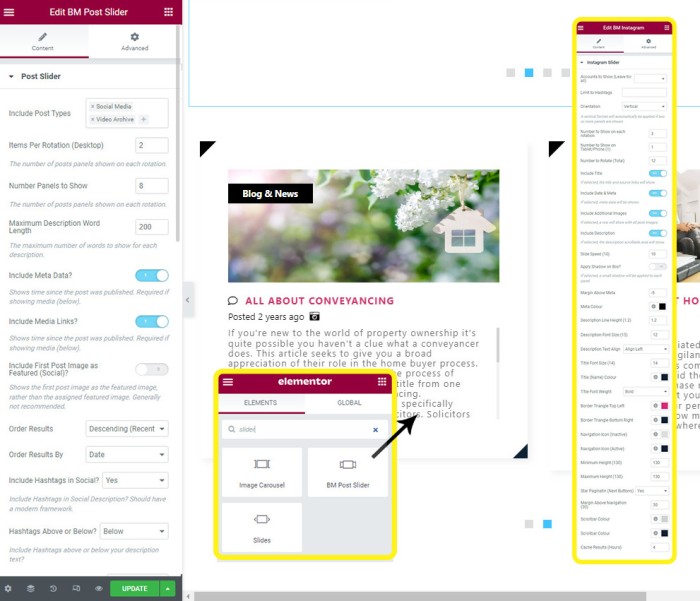
As with all our primary tools, a drag-and-drop Elementor Widget is made available that'll allow you to place the slider on any post or page. The widget includes customisation options for virtually every aspect of the slider style. Additional options will be added as they're requested.
Pictured: The Elementor Post Widget. Drag and drop the widget onto a post or page, select the post types to show, and the slider will start showing results. A large number of options apply that alter the style and formatting of the rendered slider.
Shortcode is available, but the large number of options introduce a complexity that is best avoided. That said, rendering a default slider with only minor changes takes just a few seconds.
Updates to the Social Archive
In building what was a 'simple' slider, we encountered a 'problem' (and an opportunity). In the past, Yabber would create a social article on your website based on the attributes of the post content... but it wouldn't create tags or categories. However, social posts are based on hashtags, so it only seemed appropriate that we'd assign them to each social post created. The assignment of tags (or, in this case, hashtags) means that all content connected via a hashtag may be navigated independently of other content, thus providing a more usable and engaging customer experience.
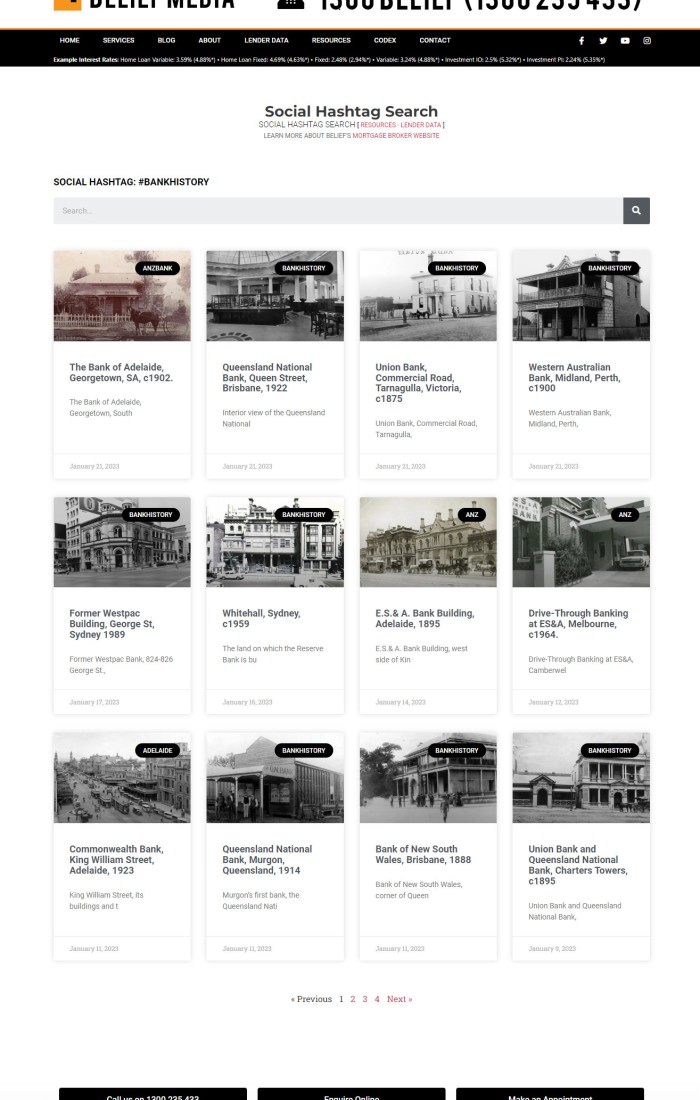
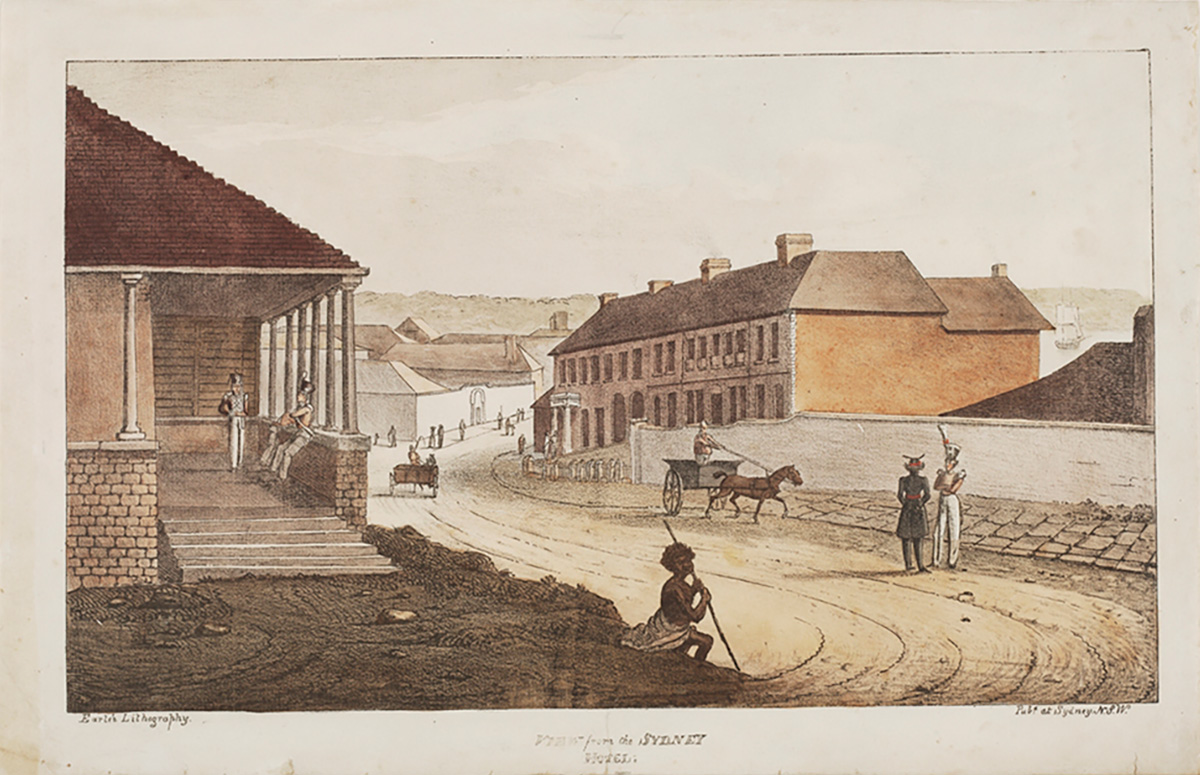
Pictured: The social archive on this website showing images associated with the #bankhistory hashtag. The archive allows a user to experience your social archive as if it were a social network by bouncing around content based on the hashtags associated with the post. This new archive presents some interesting social options we're yet to fully explore.
The framework is now shipped with a social tag archive that is linked to from the tags associated with each post (meaning you're able to browse your own social archive in the same way that you would Twitter or Instagram).
In terms of the slider itself - the primary reason the above changes were made - we now have the capacity to include hashtag links from within each panel, thus giving your website visitors direct access to social, video, and other content that interests them most.
In creating a searchable archive for the social media custom post type, we were required to create a 'hashtag' taxonomy (which is basically an association that connects the hashtag to the post), and we were required to build in a searchable hashtag archive page (or a paginated archive that shows all posts containing a single hashtag). If you're sporting a framework that was delivered anytime before January 23rd, the searchable hashtag archive will not work, and you shouldn't include hashtags in your social slider (or anywhere else) as the tags will link to an invalid page; this restriction only applies to social panels as it's the only location the tags are shown.
For those with an existing website, we'll provide video instructions on how to perform the update yourself (changes were already made on managed client websites). If you're an active social media user, and you're using our social systems, then we'd recommend an update.
Ironically, archived social media posts on your website will almost always have a higher reach than content posted to social media platforms.
Considerations
If you expect to use the slider, consider the following:
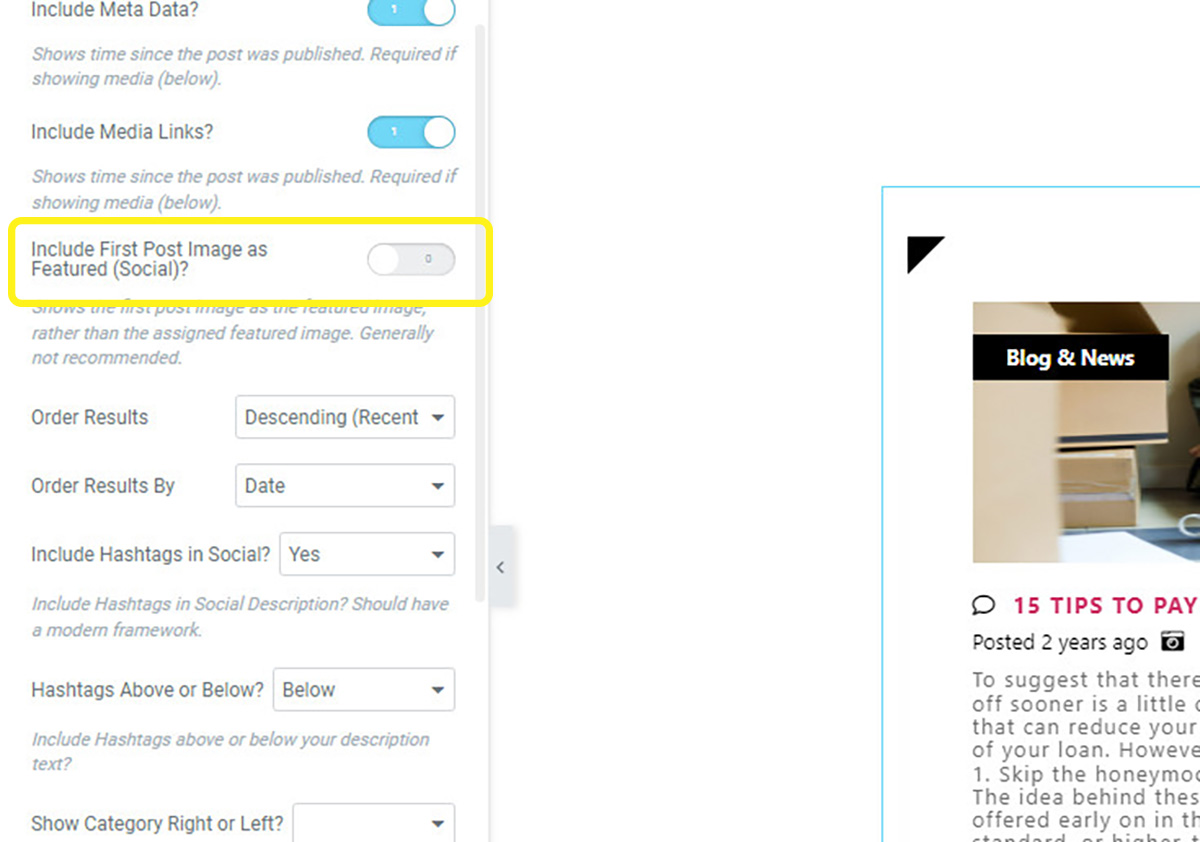
- In most cases you will use your post featured image as that which is shown in the social slider. For those cases where you set an unrelated and default featured featured image in Yabber, you may select the first post image
 shown in your article as the featured image.
- Video and Social archives are the only two post types that will display 'alternate' content (images for social posts, and a video link for video posts). Other posts types will show in a generic format. The slider can be used for posts from any archive type, including just those from your blog (supplements an existing default Elementor tool).
- There are a large number of Elementor options . In most cases you will only select the post type, and alter only those values that are related to your brand. You may select your brand 'global' colour so that any updates in the future will alter the colours to all slider instances. It's expected that we'll build a panel in Yabber to set default or specific styles.
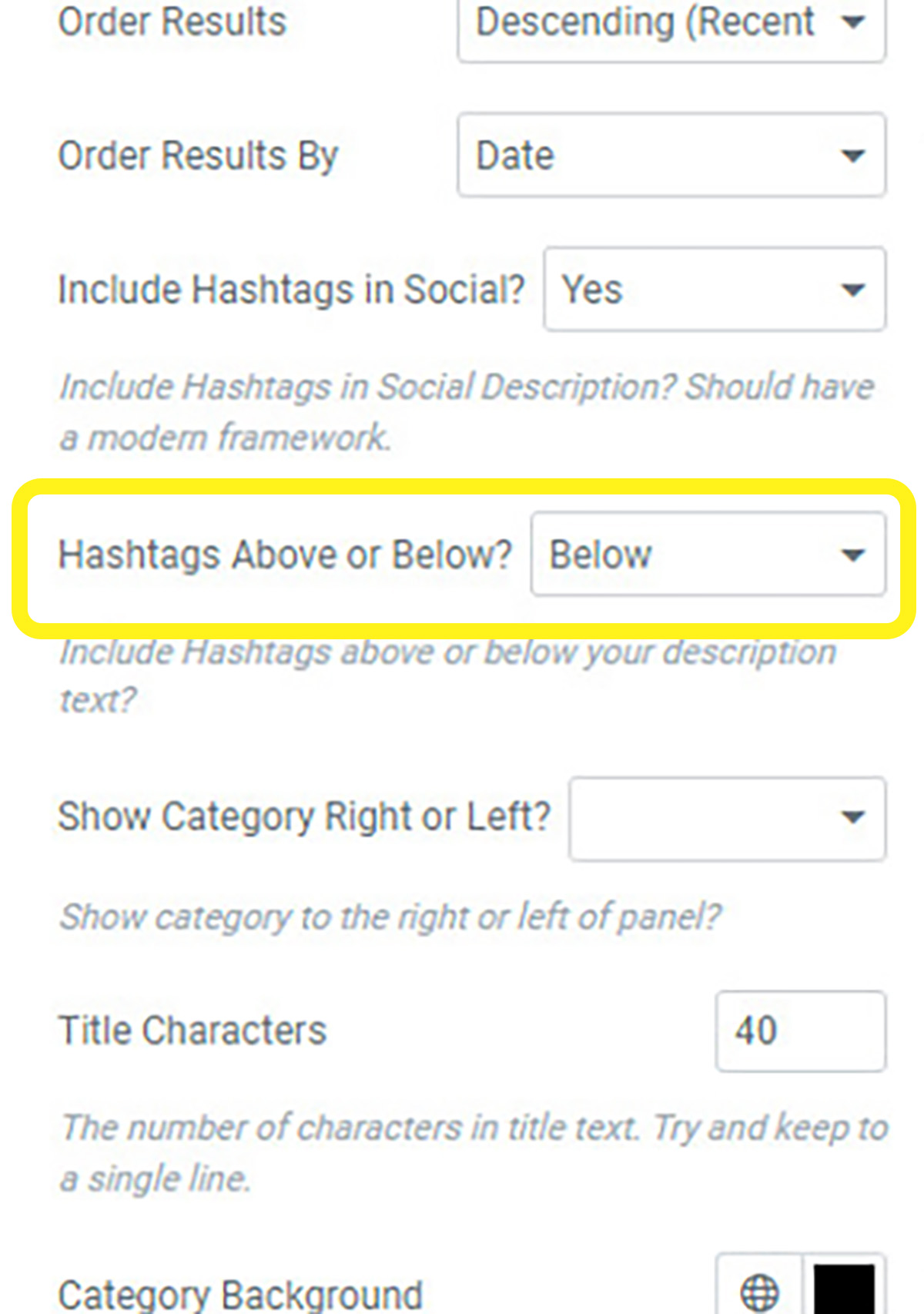
- Linked hashtags in social may be rendered above or below your post text. The option is defined in Elementor or with shortcode. We'll tidy up this option in the near future.
The feature is very new so you can expect minor bugs. Please report them as they're found. Please also forward any feature requests and we'll include them in the next plugin update.
Continued Development
One of the features we've considered implementing into the website framework is the history of lenders and banks in Australia. We've built up a significant archive ourselves, and as we post finance history to your social channels via the managed program, and as you post your own content, we can link that content to a 'history' page with more information. It's a little 'outside the box' so we'd appreciate your feedback on this type of feature.
Aggregation & Franchise
While it's yet to be used, Yabber provides for an aggregation or franchise group to include a full library of social content from all brokers on a dedicated or company website, with each post linking back to the original author - this style of social tool may also be suitable for an operation with a larger number of independent brokers. The idea is that we want our social media efforts to be archive and come alive before its buried deep down under thousands of feet of cat pics and dancing babies.
Conclusion
We're often required to explain why a company often perceived as a 'lead generation' company applies so much effort into building industry leading website tools... and the answer is a simple one: your website is required to support a full-stack marketing funnel, so the persuasiveness and value derived from your broader digital experience contributes towards your conversions. Simple.
While the slider is a fantastic tool that elevates the awareness of your social media content, it's the evolution of the social media archive that is probably more significant. Hosting your own social and video material gives you complete ownership of your own content. The searchable hashtag archive makes your website come alive with a complete searchable library of the content shared to social, and the system adds significant SEO value in the process.
Coming Soon: One of the more significant steps we've taken in this whole process was the modification of the backend framework to support a facility that will permit you to post to social media from within your social media archive. In other words, you will create content on your website, and the content and media associated with the post will send to selected social accounts. This tool will supplement the Vista and Instagratify tools, and will arguably be a more efficient mechanism for creating social content.
The last of a slider-style tool that we'll build in the short-term will return selected videos uploaded to YouTube and/or Wistia in a video slider, and the Elementor tool is expected next week.